Present Perfect Simple  and  Present Perfect Continuous   Integrated Training Centre   ‘ Best in Class’
(1) We use Present Perfect Simple: when we think about a past event with a  result now PAST RESULT NOW I’ve lost my keys.   Can’t open the door.
Give a reason in the Present Perfect for each situation:
(2) We use Present Perfect Simple to: GIVE NEWS  (we   NEVER   give precise time reference like:  yesterday; last week, etc) FINISHED  ACTION NEWS NOW I’ve bought a new car!  Want to have a ride?
Give the news  using the prompts below: Pete and Nora / to have a baby.
Give the news  using the prompts below: Nick / to divorce.
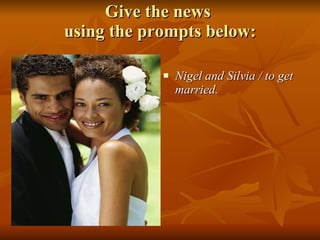
Give the news  using the prompts below: Nigel and Silvia / to get married.
Say what is the news in each picture:
But we use  Past Simple  to: give or ask for past details using question words:  Where, When, Why, How many, etc. -‘Natalie has had a baby!’ ‘ Great!   When   did   it happen?’ Yesterday.
(3) We use Present Perfect Simple to talk about: experience   up to now How much?/How often? Up to Now I’ve seen this film three times. I’ve eaten a lot of chocolate. She’s never been to Italy. Have you ever seen a monster? I’ve lived here all my life.
When we ask about experiences we often use questions with  EVER Have you ever been to London?
Ask your partner a question using the prompts below: Ever / to ride a camel? How many times / to ride a camel?
Ask your partner a question using the prompts below: Ever / to do yachting? How many times / to do yachting?
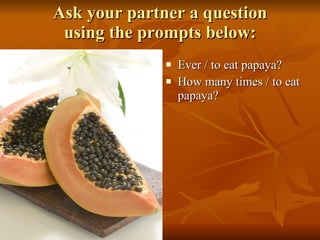
Ask your partner a question using the prompts below: Ever / to eat papaya? How many times / to eat papaya?
Ask your partner a question using the prompts below: Ever/go downhill skiing? How many times?
Have you ever…? Match the verbs in the box with the items in the list below. Then ask your partner if he/she has ever done any of these things. Make sure you ask follow up questions. Appear Be Break Fall Get Grow Have Live Meet Play Save Win Write   Your hair long A prize A sport for your town In a foreign country In love at first sight On TV So bored you fell asleep in public Someone famous Someone’s life The speed limit To a famous person To an auction Your photo in the paper
Already, Yet and Just We use  already   and  just   after  have We use  yet  in questions and negatives Would you like a coffee? – No, thanks. I’ve  just  had one . ‘ Have you spoken to Ron  yet ?’  ‘ No, not yet. He hasn’t come in  yet .’
Translate the following sentences into English. Use yet and already: Он уже пришел. Он уже пришел? Он еще не пришел. Ты уже купил подарок?  Я уже купил подарок. Мы еще не купили подарок. Мы все уже видели. Он уже все видел? Он еще не видел.
Present Perfect Simple time reference words (unfinished time) We normally use such time references as:  today / this week / recently / lately / never / ever / all my life / since / for / just / already / yet / so far / always /etc.
Say what you have managed to do so far: Today This week This month This year Since you left University/school
SINCE/FOR We use  since   +  point of time  in the past the action started. I’ve had   my car since new year We use  for  +  the period of time   I’ve had my car for 10 months
Answer the following questions. Use since and for. How long have you had your watch? How long have you lived in your present flat or house? How long have you lived in this city? How long have you had your present hairstyle? How long have you known your best friend?
Say which words refer to a finished time. A few days ago Always This month Last week Never Now Today In 2005 Lately Then When I was a child
Present Perfect Continuous Form + I/We/You/They He/She/It work   ? I/We/You/They He/She/It work  ? - I/We/You/They He/She/It work  . ing ing ing have  has  Have haven’t  Has hasn’t  been been been
(1) We use Present Perfect Continuous to talk: about a process continuing up to now,  especially when we say how long it has  lasted 08.00 The process is  not finished yet  How long have you been working? I have been working since 08.00
(2) We use Present Perfect Continuous to talk about:  long or repeated actions that have finished recently, and which have present results The process has finished Why’s your hair wet? –  I’ve been swimming. wet hair
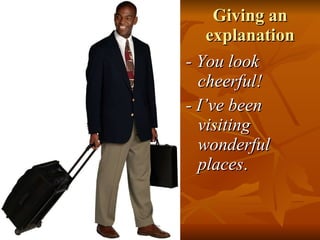
Giving an explanation - You look cheerful! - I’ve been visiting wonderful places .
Giving an explanation -  You are out of breath! - I’ve been exercising for an hour
Explain why these present results could    happen to you. Use the verbs given in brackets. You look tired. –  (to do hard work) Your books are all over the floor.  (to revise for an exam) You are very dirty.  (to clean the cellar) You look miserable.  (to talk to a nasty person)
Think of a comment  on this picture using  Present Perfect Continuous You look tired. I’ve…..
Think of a comment  on this photo using  Present Perfect Continuous My eyes are hurting. No wonder, you’ve…
Think of a comment  on this picture using  Present Perfect Continuous Just one more program, mom, please! No, you’ve been …
Present Perfect Continuous:  time reference words We often use such time references as: How long…? / since / for / all day / for ages / this week
Present Perfect Simple Present Perfect Continuous Says that something is finished I’ve read your book. Is used to say how often something has happened I’ve seen him three times this week. Is used to talk about permanent or very long-lasting situations I’ve lived here all my life. He’s known her for two days. Looks at the continuing situation itself I’ve been reading your book: I’m enjoying it. I’ve been seeing him a lot recently. I’ve been living here for the last few months. Some verbs are not used in continuous forms

My version psat simple perfect

  • 1.
    Present Perfect Simple and Present Perfect Continuous Integrated Training Centre ‘ Best in Class’
  • 2.
    (1) We usePresent Perfect Simple: when we think about a past event with a result now PAST RESULT NOW I’ve lost my keys. Can’t open the door.
  • 3.
    Give a reasonin the Present Perfect for each situation:
  • 4.
    (2) We usePresent Perfect Simple to: GIVE NEWS (we NEVER give precise time reference like: yesterday; last week, etc) FINISHED ACTION NEWS NOW I’ve bought a new car! Want to have a ride?
  • 5.
    Give the news using the prompts below: Pete and Nora / to have a baby.
  • 6.
    Give the news using the prompts below: Nick / to divorce.
  • 7.
    Give the news using the prompts below: Nigel and Silvia / to get married.
  • 8.
    Say what isthe news in each picture:
  • 9.
    But we use Past Simple to: give or ask for past details using question words: Where, When, Why, How many, etc. -‘Natalie has had a baby!’ ‘ Great! When did it happen?’ Yesterday.
  • 10.
    (3) We usePresent Perfect Simple to talk about: experience up to now How much?/How often? Up to Now I’ve seen this film three times. I’ve eaten a lot of chocolate. She’s never been to Italy. Have you ever seen a monster? I’ve lived here all my life.
  • 11.
    When we askabout experiences we often use questions with EVER Have you ever been to London?
  • 12.
    Ask your partnera question using the prompts below: Ever / to ride a camel? How many times / to ride a camel?
  • 13.
    Ask your partnera question using the prompts below: Ever / to do yachting? How many times / to do yachting?
  • 14.
    Ask your partnera question using the prompts below: Ever / to eat papaya? How many times / to eat papaya?
  • 15.
    Ask your partnera question using the prompts below: Ever/go downhill skiing? How many times?
  • 16.
    Have you ever…?Match the verbs in the box with the items in the list below. Then ask your partner if he/she has ever done any of these things. Make sure you ask follow up questions. Appear Be Break Fall Get Grow Have Live Meet Play Save Win Write Your hair long A prize A sport for your town In a foreign country In love at first sight On TV So bored you fell asleep in public Someone famous Someone’s life The speed limit To a famous person To an auction Your photo in the paper
  • 17.
    Already, Yet andJust We use already and just after have We use yet in questions and negatives Would you like a coffee? – No, thanks. I’ve just had one . ‘ Have you spoken to Ron yet ?’ ‘ No, not yet. He hasn’t come in yet .’
  • 18.
    Translate the followingsentences into English. Use yet and already: Он уже пришел. Он уже пришел? Он еще не пришел. Ты уже купил подарок? Я уже купил подарок. Мы еще не купили подарок. Мы все уже видели. Он уже все видел? Он еще не видел.
  • 19.
    Present Perfect Simpletime reference words (unfinished time) We normally use such time references as: today / this week / recently / lately / never / ever / all my life / since / for / just / already / yet / so far / always /etc.
  • 20.
    Say what youhave managed to do so far: Today This week This month This year Since you left University/school
  • 21.
    SINCE/FOR We use since + point of time in the past the action started. I’ve had my car since new year We use for + the period of time I’ve had my car for 10 months
  • 22.
    Answer the followingquestions. Use since and for. How long have you had your watch? How long have you lived in your present flat or house? How long have you lived in this city? How long have you had your present hairstyle? How long have you known your best friend?
  • 23.
    Say which wordsrefer to a finished time. A few days ago Always This month Last week Never Now Today In 2005 Lately Then When I was a child
  • 24.
    Present Perfect ContinuousForm + I/We/You/They He/She/It work ? I/We/You/They He/She/It work ? - I/We/You/They He/She/It work . ing ing ing have has Have haven’t Has hasn’t been been been
  • 25.
    (1) We usePresent Perfect Continuous to talk: about a process continuing up to now, especially when we say how long it has lasted 08.00 The process is not finished yet How long have you been working? I have been working since 08.00
  • 26.
    (2) We usePresent Perfect Continuous to talk about: long or repeated actions that have finished recently, and which have present results The process has finished Why’s your hair wet? – I’ve been swimming. wet hair
  • 27.
    Giving an explanation- You look cheerful! - I’ve been visiting wonderful places .
  • 28.
    Giving an explanation- You are out of breath! - I’ve been exercising for an hour
  • 29.
    Explain why thesepresent results could happen to you. Use the verbs given in brackets. You look tired. – (to do hard work) Your books are all over the floor. (to revise for an exam) You are very dirty. (to clean the cellar) You look miserable. (to talk to a nasty person)
  • 30.
    Think of acomment on this picture using Present Perfect Continuous You look tired. I’ve…..
  • 31.
    Think of acomment on this photo using Present Perfect Continuous My eyes are hurting. No wonder, you’ve…
  • 32.
    Think of acomment on this picture using Present Perfect Continuous Just one more program, mom, please! No, you’ve been …
  • 33.
    Present Perfect Continuous: time reference words We often use such time references as: How long…? / since / for / all day / for ages / this week
  • 34.
    Present Perfect SimplePresent Perfect Continuous Says that something is finished I’ve read your book. Is used to say how often something has happened I’ve seen him three times this week. Is used to talk about permanent or very long-lasting situations I’ve lived here all my life. He’s known her for two days. Looks at the continuing situation itself I’ve been reading your book: I’m enjoying it. I’ve been seeing him a lot recently. I’ve been living here for the last few months. Some verbs are not used in continuous forms