PRESENT
PERFECT
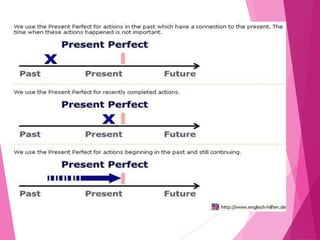
Present perfect, expresses an action
that is still going on or that stopped
recently, but has an influence on the
present. It puts emphasis on the result
AUXILIARY
HAVE ----- I, You,
We, They
HAS----- He, She, It
VERB
PAST PARTICIPLE
GONE, SWUM, SLEPT, DREAMT,
JUMPED, CUT, COOKED, ETC.
FORMULA
POSITIVE
 Example:
o I have studied Math.
o He has written a letter to María.
o We’ve been in London.
o She’s travelled around the world.
o Our son has learned how to read.
NEGATIVE
oExample:
o I haven’t seen the movie « GRAVITY».
o She hasn’t travelled around the world.
o We have not studied for our quiz.
o My brother has not won a competition.
CONTRACTIONS
Positive
I have ---------- I’ve
You have ----- You’ve
He has ---------- He’s
She has -------- She’s
It has ------------ it’s
We have ------- we’ve
They have ----- they’ve
Negative
I have not ---------------- I haven’t
You have not ----------- You haven’t
He has not --------------- He hasn’t
She has not -------------- She hasn’t
It has not ------------------ It hasn’t
We have not ------------ We haven’t
They have not ---------- They haven’t
Note:
You CANNOT use the Present Perfect with specific
time expressions such as: yesterday, one year
ago, last week, when I was a child, when I lived
in Japan, at that moment, that day, one day,
etc. We CAN use the Present Perfect with
unspecific expressions such as: ever, never,
once, many times, several times, before, so far,
already, yet, etc.
Example:
 I have seen that movie twenty times.
 I think I have met him once before.
 There have been many earthquakes in California.
 People have traveled to the Moon.
 People have not traveled to Mars.
 Have you read the book yet?
 Nobody has ever climbed that mountain.
SINCE / FOR
 For + a period of time (for six years, for a week, for a
month, for hours, for two hours.)
- I have taught English for 12 years.
 Since + a point in time (since this morning, since last
week, since yesterday,)
- I have taught English since 2001.
ALREADY/ YET
 Note: Already is going to be used: in question
and answers in positive, and yet is going to be
used in answers in negative.
 Example:
 Have you already gone to New York?
 Yes, I have already gone to New York.
 No, I haven’t gone to New York yet.
 Note: Already can also be used at the
end of the question to express surprised.
E.G. Have you finished already?
Make the present perfect sentences - it could be
positive, negative or question.
 1) I / go / to the library today .
 2) you / keep a pet for three years.
 3) you / come / here / before/ ?.
 4) it / rain all day/ ?.
 5) she / steal / all the chocolates.
 6) he / study Latin.
 7) I/ know / him for three months.
 8) we/ not / use / our tickets.
CheckShow AnswerCheckShow AnswerCheckShow AnswerCheckShow AnswerCheckShow Answer

present perfect

  • 1.
    PRESENT PERFECT Present perfect, expressesan action that is still going on or that stopped recently, but has an influence on the present. It puts emphasis on the result
  • 3.
    AUXILIARY HAVE ----- I,You, We, They HAS----- He, She, It
  • 4.
    VERB PAST PARTICIPLE GONE, SWUM,SLEPT, DREAMT, JUMPED, CUT, COOKED, ETC.
  • 5.
  • 6.
    POSITIVE  Example: o Ihave studied Math. o He has written a letter to María. o We’ve been in London. o She’s travelled around the world. o Our son has learned how to read.
  • 7.
    NEGATIVE oExample: o I haven’tseen the movie « GRAVITY». o She hasn’t travelled around the world. o We have not studied for our quiz. o My brother has not won a competition.
  • 8.
    CONTRACTIONS Positive I have ----------I’ve You have ----- You’ve He has ---------- He’s She has -------- She’s It has ------------ it’s We have ------- we’ve They have ----- they’ve
  • 9.
    Negative I have not---------------- I haven’t You have not ----------- You haven’t He has not --------------- He hasn’t She has not -------------- She hasn’t It has not ------------------ It hasn’t We have not ------------ We haven’t They have not ---------- They haven’t
  • 10.
    Note: You CANNOT usethe Present Perfect with specific time expressions such as: yesterday, one year ago, last week, when I was a child, when I lived in Japan, at that moment, that day, one day, etc. We CAN use the Present Perfect with unspecific expressions such as: ever, never, once, many times, several times, before, so far, already, yet, etc.
  • 11.
    Example:  I haveseen that movie twenty times.  I think I have met him once before.  There have been many earthquakes in California.  People have traveled to the Moon.  People have not traveled to Mars.  Have you read the book yet?  Nobody has ever climbed that mountain.
  • 12.
    SINCE / FOR For + a period of time (for six years, for a week, for a month, for hours, for two hours.) - I have taught English for 12 years.  Since + a point in time (since this morning, since last week, since yesterday,) - I have taught English since 2001.
  • 13.
    ALREADY/ YET  Note:Already is going to be used: in question and answers in positive, and yet is going to be used in answers in negative.  Example:  Have you already gone to New York?  Yes, I have already gone to New York.  No, I haven’t gone to New York yet.
  • 14.
     Note: Alreadycan also be used at the end of the question to express surprised. E.G. Have you finished already?
  • 15.
    Make the presentperfect sentences - it could be positive, negative or question.  1) I / go / to the library today .  2) you / keep a pet for three years.  3) you / come / here / before/ ?.  4) it / rain all day/ ?.  5) she / steal / all the chocolates.  6) he / study Latin.  7) I/ know / him for three months.  8) we/ not / use / our tickets. CheckShow AnswerCheckShow AnswerCheckShow AnswerCheckShow AnswerCheckShow Answer