ARTICLES
SEPTEMBER 14TH, 2021
The definite article: the
1. When the person or thing referred to is unique.
• The sun came out and soon we were dry.
• The president is giving a speech tonight.
• He won a medal at the Olympic Games.
2. When the rest of the sentence makes it clear what we are referring to
• The head of my old school was called Mr Jones.
• The woman who stopped me was wearing a badge.
3. When the surrounding context makes it clear what we are referring to.
• Your shoes are in the cupboard.
• Your dinner’s is the fridge.
4. To talk about previously mentioned things or people.
• A man and a woman walked past. The man was wearing sunglasses.
5. With superlatives
• He’s the bravest person in the team.
6. To talk about generic class of things (often on topics related
to science or technology)
• The bicycle was invented about 200 years ago.
• The panda is in danger of becoming extinct.
The definite article continued
1. With some social and national groups, when making
generalisations (followed by a plural verb).
• The unemployed need more support.
• Some of the English are descended from Danish invaders.
2. With areas such as north, centre, etc.
• Most of the population live in the north.
3. With oceans, seas, rivers and deserts.
• He’s sailed across the Atlantic.
• We went by canoe up the Orinoco.
• She said she’d driven across the Sahara.
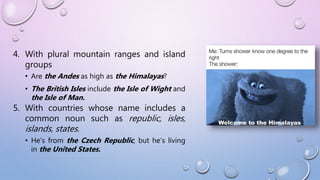
4. With plural mountain ranges and island
groups
• Are the Andes as high as the Himalayas?
• The British Isles include the Isle of Wight and
the Isle of Man.
5. With countries whose name includes a
common noun such as republic, isles,
islands, states.
• He’s from the Czech Republic, but he’s living
in the United States.
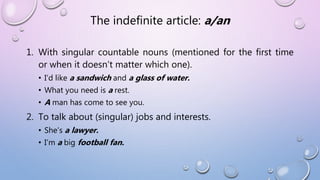
The indefinite article: a/an
1. With singular countable nouns (mentioned for the first time
or when it doesn’t matter which one).
• I’d like a sandwich and a glass of water.
• What you need is a rest.
• A man has come to see you.
2. To talk about (singular) jobs and interests.
• She’s a lawyer.
• I’m a big football fan.
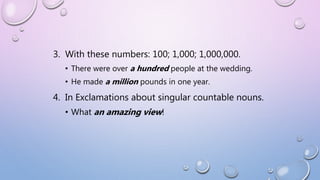
3. With these numbers: 100; 1,000; 1,000,000.
• There were over a hundred people at the wedding.
• He made a million pounds in one year.
4. In Exclamations about singular countable nouns.
• What an amazing view!
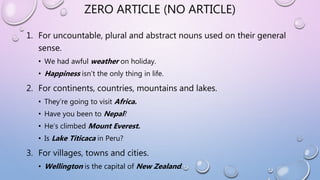
ZERO ARTICLE (NO ARTICLE)
1. For uncountable, plural and abstract nouns used on their general
sense.
• We had awful weather on holiday.
• Happiness isn’t the only thing in life.
2. For continents, countries, mountains and lakes.
• They’re going to visit Africa.
• Have you been to Nepal?
• He’s climbed Mount Everest.
• Is Lake Titicaca in Peru?
3. For villages, towns and cities.
• Wellington is the capital of New Zealand.
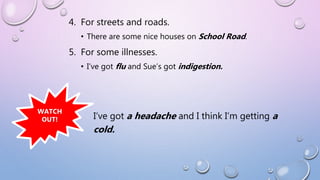
4. For streets and roads.
• There are some nice houses on School Road.
5. For some illnesses.
• I’ve got flu and Sue’s got indigestion.
WATCH
OUT! I’ve got a headache and I think I’m getting a
cold.
There are no articles in the following expressions:
• to/at/ from
school/university/college
• at home
• go home
• in/to class
• to/in/into/from church
• to/in/into/ out of prison/hospital/bed
• to/ay/from work
• for/at/to breakfast/lunch/dinner
• by
car/bus/bicycle/plane/train/tube/boat

Articles a, an, the, zero article

  • 1.
  • 2.
    The definite article:the 1. When the person or thing referred to is unique. • The sun came out and soon we were dry. • The president is giving a speech tonight. • He won a medal at the Olympic Games. 2. When the rest of the sentence makes it clear what we are referring to • The head of my old school was called Mr Jones. • The woman who stopped me was wearing a badge. 3. When the surrounding context makes it clear what we are referring to. • Your shoes are in the cupboard. • Your dinner’s is the fridge.
  • 3.
    4. To talkabout previously mentioned things or people. • A man and a woman walked past. The man was wearing sunglasses. 5. With superlatives • He’s the bravest person in the team. 6. To talk about generic class of things (often on topics related to science or technology) • The bicycle was invented about 200 years ago. • The panda is in danger of becoming extinct.
  • 4.
    The definite articlecontinued 1. With some social and national groups, when making generalisations (followed by a plural verb). • The unemployed need more support. • Some of the English are descended from Danish invaders. 2. With areas such as north, centre, etc. • Most of the population live in the north. 3. With oceans, seas, rivers and deserts. • He’s sailed across the Atlantic. • We went by canoe up the Orinoco. • She said she’d driven across the Sahara.
  • 5.
    4. With pluralmountain ranges and island groups • Are the Andes as high as the Himalayas? • The British Isles include the Isle of Wight and the Isle of Man. 5. With countries whose name includes a common noun such as republic, isles, islands, states. • He’s from the Czech Republic, but he’s living in the United States.
  • 6.
    The indefinite article:a/an 1. With singular countable nouns (mentioned for the first time or when it doesn’t matter which one). • I’d like a sandwich and a glass of water. • What you need is a rest. • A man has come to see you. 2. To talk about (singular) jobs and interests. • She’s a lawyer. • I’m a big football fan.
  • 7.
    3. With thesenumbers: 100; 1,000; 1,000,000. • There were over a hundred people at the wedding. • He made a million pounds in one year. 4. In Exclamations about singular countable nouns. • What an amazing view!
  • 8.
    ZERO ARTICLE (NOARTICLE) 1. For uncountable, plural and abstract nouns used on their general sense. • We had awful weather on holiday. • Happiness isn’t the only thing in life. 2. For continents, countries, mountains and lakes. • They’re going to visit Africa. • Have you been to Nepal? • He’s climbed Mount Everest. • Is Lake Titicaca in Peru? 3. For villages, towns and cities. • Wellington is the capital of New Zealand.
  • 9.
    4. For streetsand roads. • There are some nice houses on School Road. 5. For some illnesses. • I’ve got flu and Sue’s got indigestion. WATCH OUT! I’ve got a headache and I think I’m getting a cold.
  • 10.
    There are noarticles in the following expressions: • to/at/ from school/university/college • at home • go home • in/to class • to/in/into/from church • to/in/into/ out of prison/hospital/bed • to/ay/from work • for/at/to breakfast/lunch/dinner • by car/bus/bicycle/plane/train/tube/boat