PRESENT PERFECT
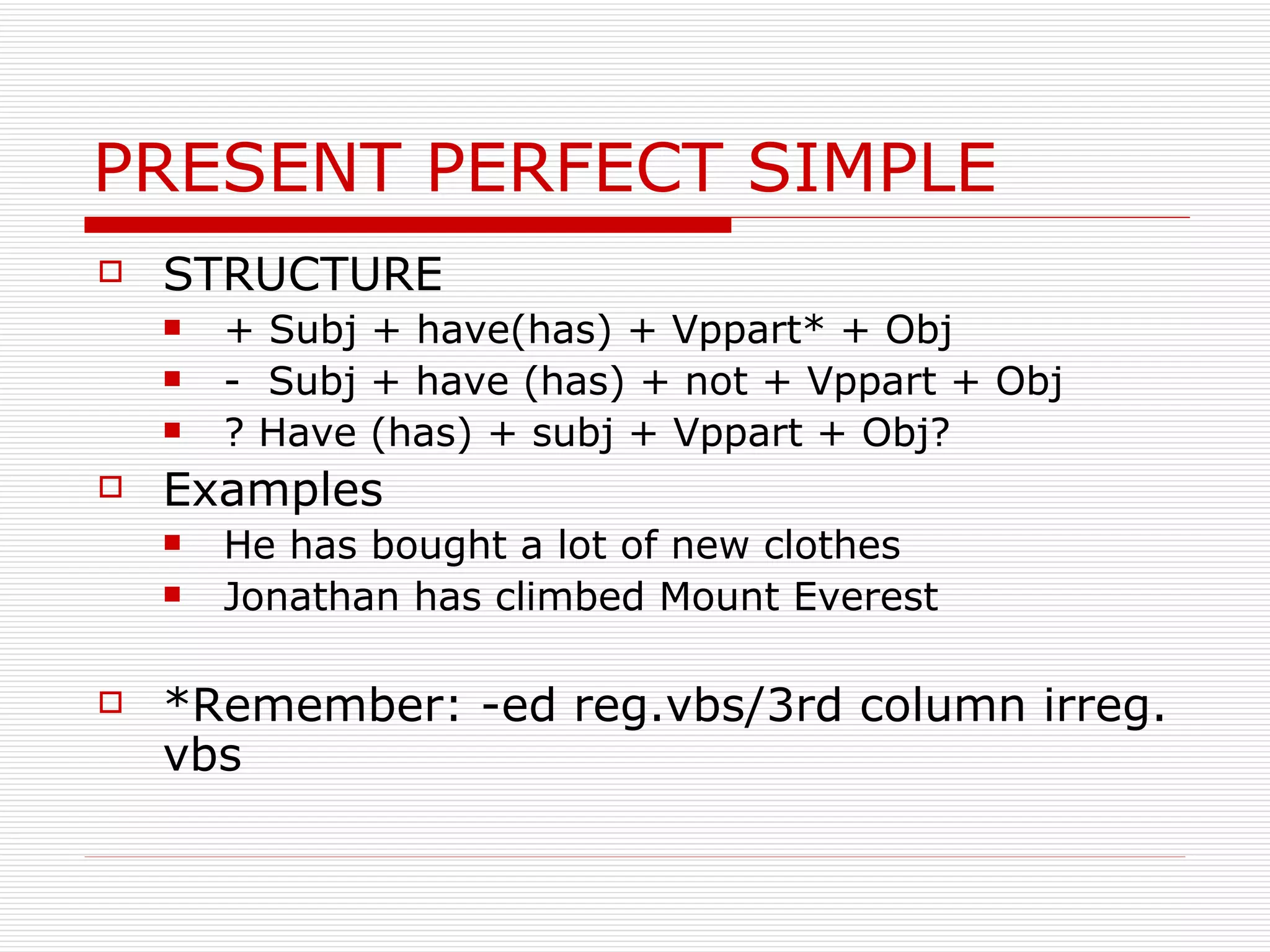
PRESENT PERFECT SIMPLE STRUCTURE + Subj + have(has) + Vppart* + Obj -  Subj + have (has) + not + Vppart + Obj ? Have (has) + subj + Vppart + Obj? Examples He has bought a lot of new clothes Jonathan has climbed Mount Everest *Remember: -ed reg.vbs/3rd column irreg. vbs
Uses To talk about a situation which started in the past and has and effect in the present I've lost my keys, so I can't leave the house. He has started again the gym, that's why he's so tired.  To talk about a present situation that started in the past.  They have owned different restaurants for several years.  She has lived in Tokyo since 1998 To talk about life experiences I've visited New York three times They have done bungee jumping on several occasions.
To talk about experiences in the past, when we are not interested or don’t know the specific point in the past I’ve visited Brazil.  REMEMBER:  When we talk about a specific point in the past we use the past simple I went to Japan in 2003
QUESTIONS AND SHORT ANSWERS Remember how we make  Questions ? Have (has) + subj + Vppart + Obj? In order to make  short answers , we use the adverb (Yes or No),  the subject in its pronoun form and the auxiliary in the correct form.  Has he won many Grand Prix? Yes, he has/ No, he hasn’t.
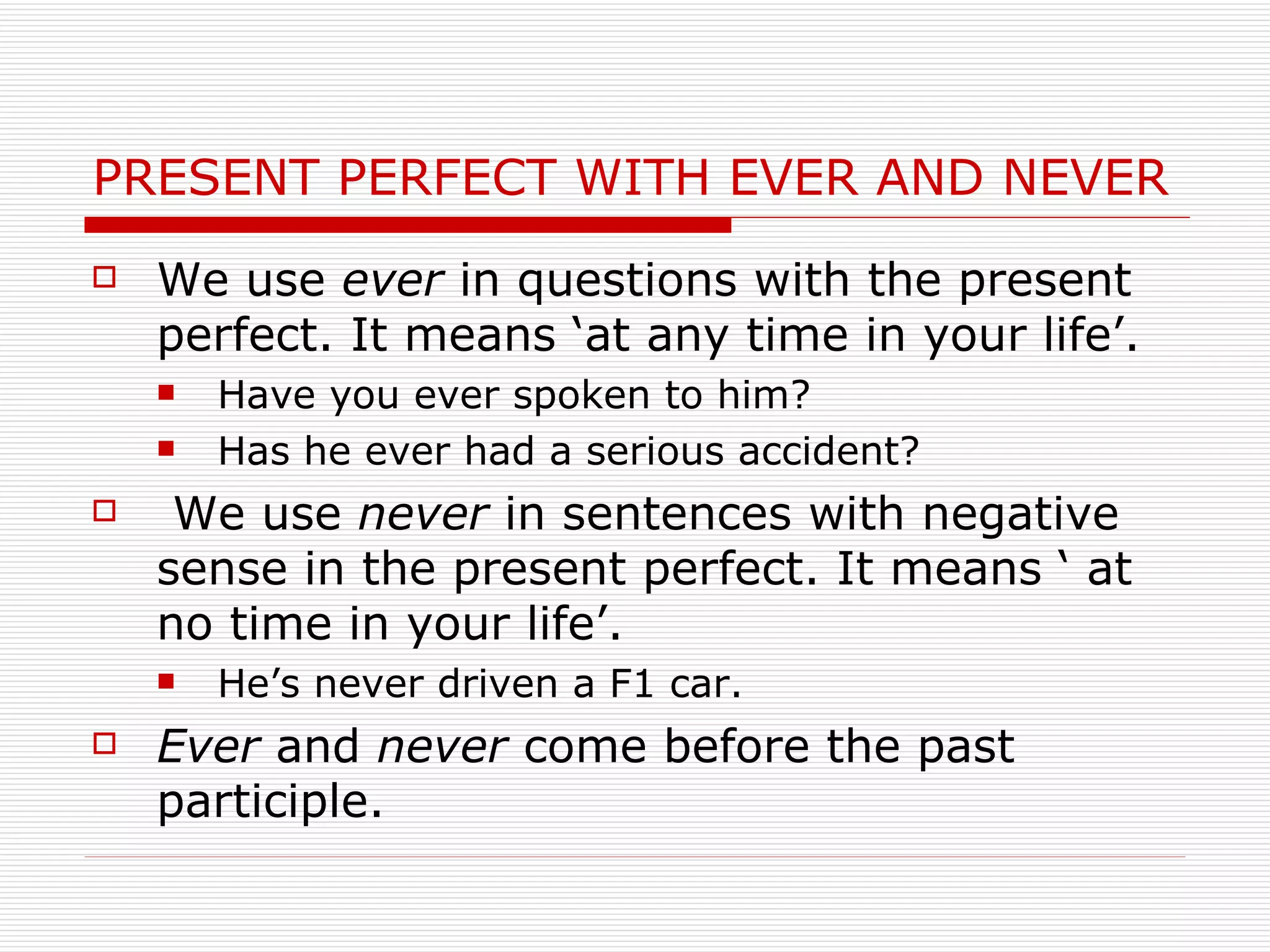
PRESENT PERFECT WITH EVER AND NEVER We use  ever  in questions with the present perfect. It means ‘at any time in your life’.  Have you ever spoken to him? Has he ever had a serious accident? We use  never  in sentences with negative sense in the present perfect. It means ‘ at no time in your life’.  He’s never driven a F1 car.  Ever  and  never  come before the past participle.
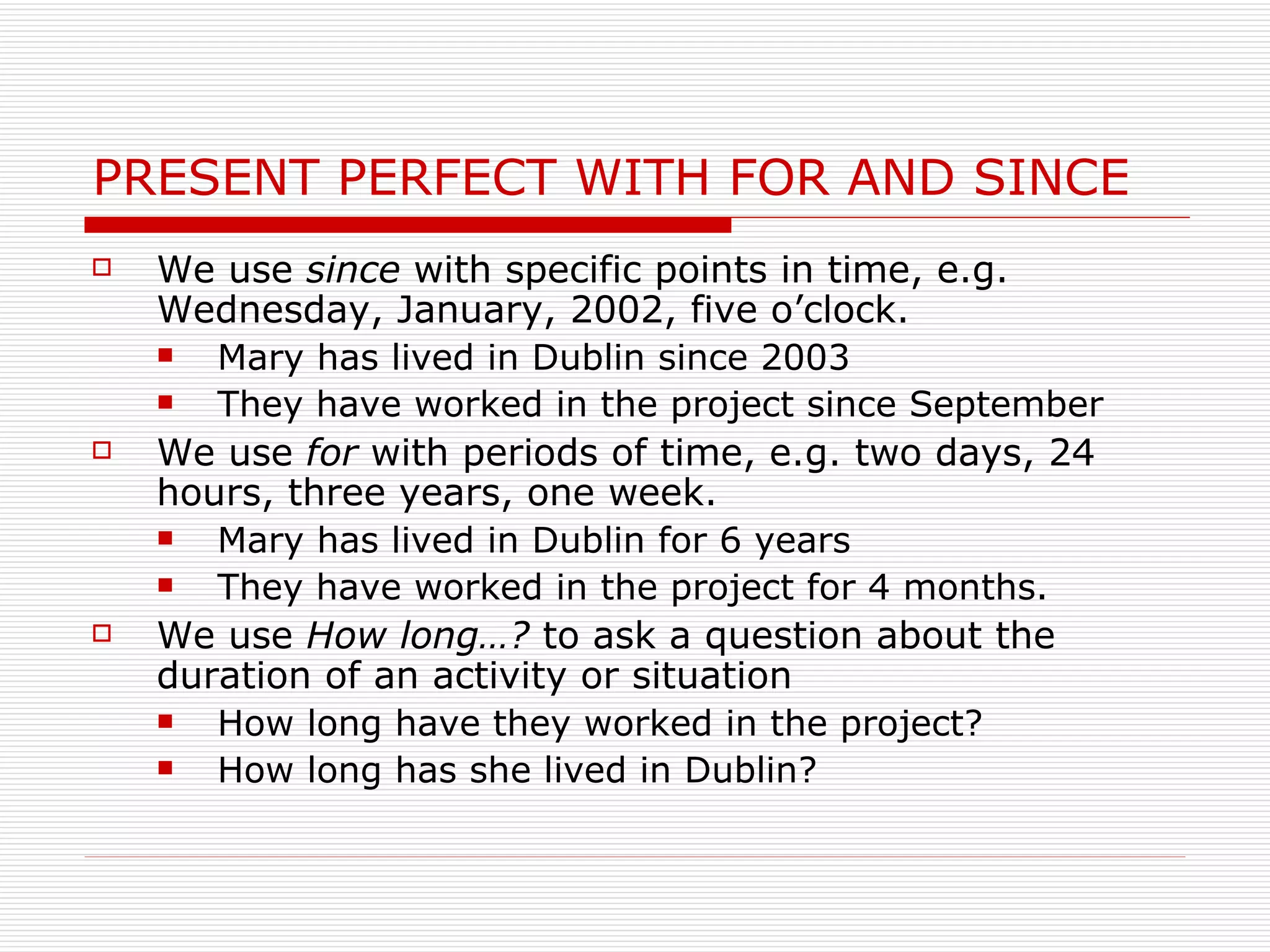
PRESENT PERFECT WITH FOR AND SINCE We use  since  with specific points in time, e.g. Wednesday, January, 2002, five o’clock.  Mary has lived in Dublin since 2003 They have worked in the project since September We use  for  with periods of time, e.g. two days, 24 hours, three years, one week.  Mary has lived in Dublin for 6 years They have worked in the project for 4 months.  We use  How long…?  to ask a question about the duration of an activity or situation How long have they worked in the project? How long has she lived in Dublin?
PRESENT PERFECT WITH JUST We use the present perfect with  just  to talk about things that happened very recently I’ve just got an e-mail They have just given me a present.

Present Perfect Simple

  • 1.
  • 2.
    PRESENT PERFECT SIMPLESTRUCTURE + Subj + have(has) + Vppart* + Obj - Subj + have (has) + not + Vppart + Obj ? Have (has) + subj + Vppart + Obj? Examples He has bought a lot of new clothes Jonathan has climbed Mount Everest *Remember: -ed reg.vbs/3rd column irreg. vbs
  • 3.
    Uses To talkabout a situation which started in the past and has and effect in the present I've lost my keys, so I can't leave the house. He has started again the gym, that's why he's so tired. To talk about a present situation that started in the past. They have owned different restaurants for several years. She has lived in Tokyo since 1998 To talk about life experiences I've visited New York three times They have done bungee jumping on several occasions.
  • 4.
    To talk aboutexperiences in the past, when we are not interested or don’t know the specific point in the past I’ve visited Brazil. REMEMBER: When we talk about a specific point in the past we use the past simple I went to Japan in 2003
  • 5.
    QUESTIONS AND SHORTANSWERS Remember how we make Questions ? Have (has) + subj + Vppart + Obj? In order to make short answers , we use the adverb (Yes or No), the subject in its pronoun form and the auxiliary in the correct form. Has he won many Grand Prix? Yes, he has/ No, he hasn’t.
  • 6.
    PRESENT PERFECT WITHEVER AND NEVER We use ever in questions with the present perfect. It means ‘at any time in your life’. Have you ever spoken to him? Has he ever had a serious accident? We use never in sentences with negative sense in the present perfect. It means ‘ at no time in your life’. He’s never driven a F1 car. Ever and never come before the past participle.
  • 7.
    PRESENT PERFECT WITHFOR AND SINCE We use since with specific points in time, e.g. Wednesday, January, 2002, five o’clock. Mary has lived in Dublin since 2003 They have worked in the project since September We use for with periods of time, e.g. two days, 24 hours, three years, one week. Mary has lived in Dublin for 6 years They have worked in the project for 4 months. We use How long…? to ask a question about the duration of an activity or situation How long have they worked in the project? How long has she lived in Dublin?
  • 8.
    PRESENT PERFECT WITHJUST We use the present perfect with just to talk about things that happened very recently I’ve just got an e-mail They have just given me a present.