A
SEMINAR PRESENTATION
ON
PRESBYOPIA
BY
DR. ANTHONY YVONNE
FEBRUARY 16, 2024
TABLE OF CONTENT
• INTRODUCTION
• PATHOPHYSIOLOGY
• ETIOLOGY
• SYMPTOMS
• TREATMENT
• SUMMARY
INTRODUCTION
Presbyopia (eye sight of old age) is not an error of
refraction but a condition of physiological
insufficiency of accommodation leading to a
progressive fall in near vision. The eye gradually
loses the ability to focus on near or up close
objects. It’s a disorder that affects everyone during
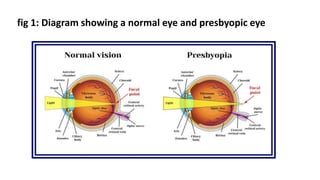
the natural aging process. When light enters your
eye, it passes through your cornea. Then it passes
through your pupil. Your iris is the coloured ring in
your eye that opens and closes your pupil to adjust
the amount of light passing through it.
After passing through your pupil , the light passes
through your lens. In the healthiest state, your lens
changes state so it can bend the light rays further
and focus them on your retina at the back of your
eye.
Your lens becomes less flexible with age. Then, it
can’t change shape as easily. As a result, it’s
unable to bend the light properly to focus it on the
retina.
fig 1: Diagram showing a normal eye and presbyopic eye
PATHOPHYSIOLOGY
To understand the pathophysiology of presbyopia a
working knowledge about accommodation is
mandatory. As we know, in an emmetropic eye far
point is infinity (∞) and near point varies with age
(being about 7 cm at the age of 10 years, 25 cm at
the age of 40 years and 33 cm at the age of 45 years).
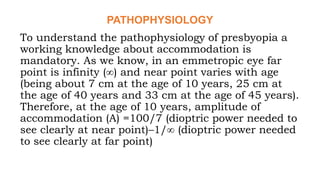
Therefore, at the age of 10 years, amplitude of
accommodation (A) =100/7 (dioptric power needed to
see clearly at near point)–1/∞ (dioptric power needed
to see clearly at far point)
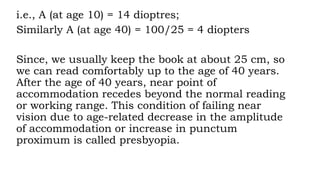
i.e., A (at age 10) = 14 dioptres;
Similarly A (at age 40) = 100/25 = 4 diopters
Since, we usually keep the book at about 25 cm, so
we can read comfortably up to the age of 40 years.
After the age of 40 years, near point of
accommodation recedes beyond the normal reading
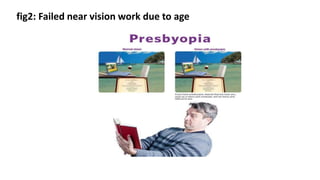
or working range. This condition of failing near
vision due to age-related decrease in the amplitude
of accommodation or increase in punctum
proximum is called presbyopia.
fig2: Failed near vision work due to age
CAUSES
Decrease in the accommodative power of crystalline
lens with increasing age, leading to presbyopia,
occurs due to:
1. Age-related changes in the lens which include:
• Decrease in the elasticity of lens capsule, and
• Progressive increase in size and hardness
(sclerosis)
of lens substance which is less easily moulded.
2. Age-related decline in ciliary muscle power
may also contribute in causation of presbyopia.
Causes of premature presbyopia are:
• Uncorrected hypermetropia.
• Premature sclerosis of the crystalline lens.
• General debility causing presenile weakness of
ciliary muscle.
• Chronic simple glaucoma.
SYMPTOMS
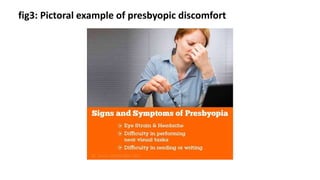
1. Difficulty in near vision. Patients usually
complaint of difficulty in reading small prints (to
start with in the evening and in dim light and later
even in good light). Another important complaint of
the patient is difficulty in threading a needle, etc.
2. Asthenopic symptoms due to fatigue of the ciliary
muscle are also complained after reading or doing
any near work.
3. Intermittent diplopia, occurring due to disturbed
relationship between accommodation and
convergence, may be experienced by few patients.
fig3: Pictoral example of presbyopic discomfort
TREATMENT
1. Optical treatment. The treatment of presbyopia
is the prescription of appropriate convex glasses
for near work.
Rough guide for providing presbyopic glasses in an
emmetrope can be made from the age of the
patient.
• 45 years : + 1 to + 1.25D
• 50 years : +1.5 to 1.75D
• 55 years : +2 to + 2.25D
• 60 years : +2.5 to + 3D
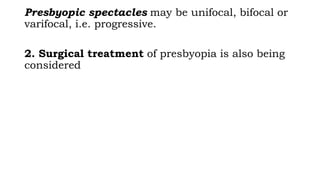
fig4: presbyopia treated with bifocal
Exact presbyopic addition required, should
however, be estimated individually in each eye in
order to determine how much is necessary to
provide a comfortable range.
Basic principles for presbyopic correction are:
•Always find out refractive error for distance and
first correct it.
•Find out the presbyopic correction needed in each
eye separately and add it to the distant correction.
Near point should be fixed by taking due
consideration for profession of the patient.
The weakest convex lens with which an individual
can see clearly at the near point should be
prescribed, since overcorrection will also result in
asthenopic symptoms.
Presbyopic spectacles may be unifocal, bifocal or
varifocal, i.e. progressive.
2. Surgical treatment of presbyopia is also being
considered
SUMMARY
Presbyopia is a very common age-related vision
disorder. It usually start at the age of 40. You may
become aware of presbyopia when you start holding
books and newspapers at arm's length to be able to
read them.
However by consulting with an eye care
professional and following their suggested
treatment option a person can significantly reduce
the life impact of the disorder.
References
Gibbons A, Ali TK, Waren DP, Donaldson KE. Causes and correction of
dissatisfaction after implantation of presbyopia-correcting intraocular
lenses. Clinical Ophthalmology. 2016 Oct 11:1965-70.
Lafosse, Edouard, J. S. Wolffsohn, Cristian Talens-Estarelles, and
Santiago García-Lázaro. "Presbyopia and the aging eye: Existing
refractive approaches and their potential impact on dry eye signs and
symptoms." Contact Lens and Anterior Eye 43, no. 2 (2020): 103-114.
Croft, Mary Ann, Adrian Glasser, and Paul L. Kaufman.
"Accommodation and presbyopia." International ophthalmology clinics
41, no. 2 (2001): 33-46.
Katz, James A., Paul M. Karpecki, Alexandra Dorca, Sima Chiva-
Razavi, Heather Floyd, Elizabeth Barnes, Mark Wuttke, and Eric
Donnenfeld. "Presbyopia–A review of current treatment options and
emerging therapies." Clinical Ophthalmology (2021): 2167-2178.

Dr. Yvonne (Presentation on Presbyopia).pptx

  • 1.
  • 2.
    TABLE OF CONTENT •INTRODUCTION • PATHOPHYSIOLOGY • ETIOLOGY • SYMPTOMS • TREATMENT • SUMMARY
  • 3.
    INTRODUCTION Presbyopia (eye sightof old age) is not an error of refraction but a condition of physiological insufficiency of accommodation leading to a progressive fall in near vision. The eye gradually loses the ability to focus on near or up close objects. It’s a disorder that affects everyone during the natural aging process. When light enters your eye, it passes through your cornea. Then it passes through your pupil. Your iris is the coloured ring in your eye that opens and closes your pupil to adjust the amount of light passing through it.
  • 4.
    After passing throughyour pupil , the light passes through your lens. In the healthiest state, your lens changes state so it can bend the light rays further and focus them on your retina at the back of your eye. Your lens becomes less flexible with age. Then, it can’t change shape as easily. As a result, it’s unable to bend the light properly to focus it on the retina.
  • 5.
    fig 1: Diagramshowing a normal eye and presbyopic eye
  • 6.
    PATHOPHYSIOLOGY To understand thepathophysiology of presbyopia a working knowledge about accommodation is mandatory. As we know, in an emmetropic eye far point is infinity (∞) and near point varies with age (being about 7 cm at the age of 10 years, 25 cm at the age of 40 years and 33 cm at the age of 45 years). Therefore, at the age of 10 years, amplitude of accommodation (A) =100/7 (dioptric power needed to see clearly at near point)–1/∞ (dioptric power needed to see clearly at far point)
  • 7.
    i.e., A (atage 10) = 14 dioptres; Similarly A (at age 40) = 100/25 = 4 diopters Since, we usually keep the book at about 25 cm, so we can read comfortably up to the age of 40 years. After the age of 40 years, near point of accommodation recedes beyond the normal reading or working range. This condition of failing near vision due to age-related decrease in the amplitude of accommodation or increase in punctum proximum is called presbyopia.
  • 8.
    fig2: Failed nearvision work due to age
  • 9.
    CAUSES Decrease in theaccommodative power of crystalline lens with increasing age, leading to presbyopia, occurs due to: 1. Age-related changes in the lens which include: • Decrease in the elasticity of lens capsule, and • Progressive increase in size and hardness (sclerosis) of lens substance which is less easily moulded. 2. Age-related decline in ciliary muscle power may also contribute in causation of presbyopia.
  • 10.
    Causes of prematurepresbyopia are: • Uncorrected hypermetropia. • Premature sclerosis of the crystalline lens. • General debility causing presenile weakness of ciliary muscle. • Chronic simple glaucoma.
  • 11.
    SYMPTOMS 1. Difficulty innear vision. Patients usually complaint of difficulty in reading small prints (to start with in the evening and in dim light and later even in good light). Another important complaint of the patient is difficulty in threading a needle, etc. 2. Asthenopic symptoms due to fatigue of the ciliary muscle are also complained after reading or doing any near work. 3. Intermittent diplopia, occurring due to disturbed relationship between accommodation and convergence, may be experienced by few patients.
  • 12.
    fig3: Pictoral exampleof presbyopic discomfort
  • 13.
    TREATMENT 1. Optical treatment.The treatment of presbyopia is the prescription of appropriate convex glasses for near work. Rough guide for providing presbyopic glasses in an emmetrope can be made from the age of the patient. • 45 years : + 1 to + 1.25D • 50 years : +1.5 to 1.75D • 55 years : +2 to + 2.25D • 60 years : +2.5 to + 3D
  • 14.
  • 15.
    Exact presbyopic additionrequired, should however, be estimated individually in each eye in order to determine how much is necessary to provide a comfortable range. Basic principles for presbyopic correction are: •Always find out refractive error for distance and first correct it. •Find out the presbyopic correction needed in each eye separately and add it to the distant correction. Near point should be fixed by taking due consideration for profession of the patient. The weakest convex lens with which an individual can see clearly at the near point should be prescribed, since overcorrection will also result in asthenopic symptoms.
  • 16.
    Presbyopic spectacles maybe unifocal, bifocal or varifocal, i.e. progressive. 2. Surgical treatment of presbyopia is also being considered
  • 17.
    SUMMARY Presbyopia is avery common age-related vision disorder. It usually start at the age of 40. You may become aware of presbyopia when you start holding books and newspapers at arm's length to be able to read them. However by consulting with an eye care professional and following their suggested treatment option a person can significantly reduce the life impact of the disorder.
  • 18.
    References Gibbons A, AliTK, Waren DP, Donaldson KE. Causes and correction of dissatisfaction after implantation of presbyopia-correcting intraocular lenses. Clinical Ophthalmology. 2016 Oct 11:1965-70. Lafosse, Edouard, J. S. Wolffsohn, Cristian Talens-Estarelles, and Santiago García-Lázaro. "Presbyopia and the aging eye: Existing refractive approaches and their potential impact on dry eye signs and symptoms." Contact Lens and Anterior Eye 43, no. 2 (2020): 103-114. Croft, Mary Ann, Adrian Glasser, and Paul L. Kaufman. "Accommodation and presbyopia." International ophthalmology clinics 41, no. 2 (2001): 33-46. Katz, James A., Paul M. Karpecki, Alexandra Dorca, Sima Chiva- Razavi, Heather Floyd, Elizabeth Barnes, Mark Wuttke, and Eric Donnenfeld. "Presbyopia–A review of current treatment options and emerging therapies." Clinical Ophthalmology (2021): 2167-2178.