SELF-REGULATED
LEARNING AT WORK
Dr Anoush Margaryan
Caledonian Academy, Glasgow Caledonian
University
http://www.gcu.ac.uk/academy/people/anoush-
margaryan/
@anoush
Central questions
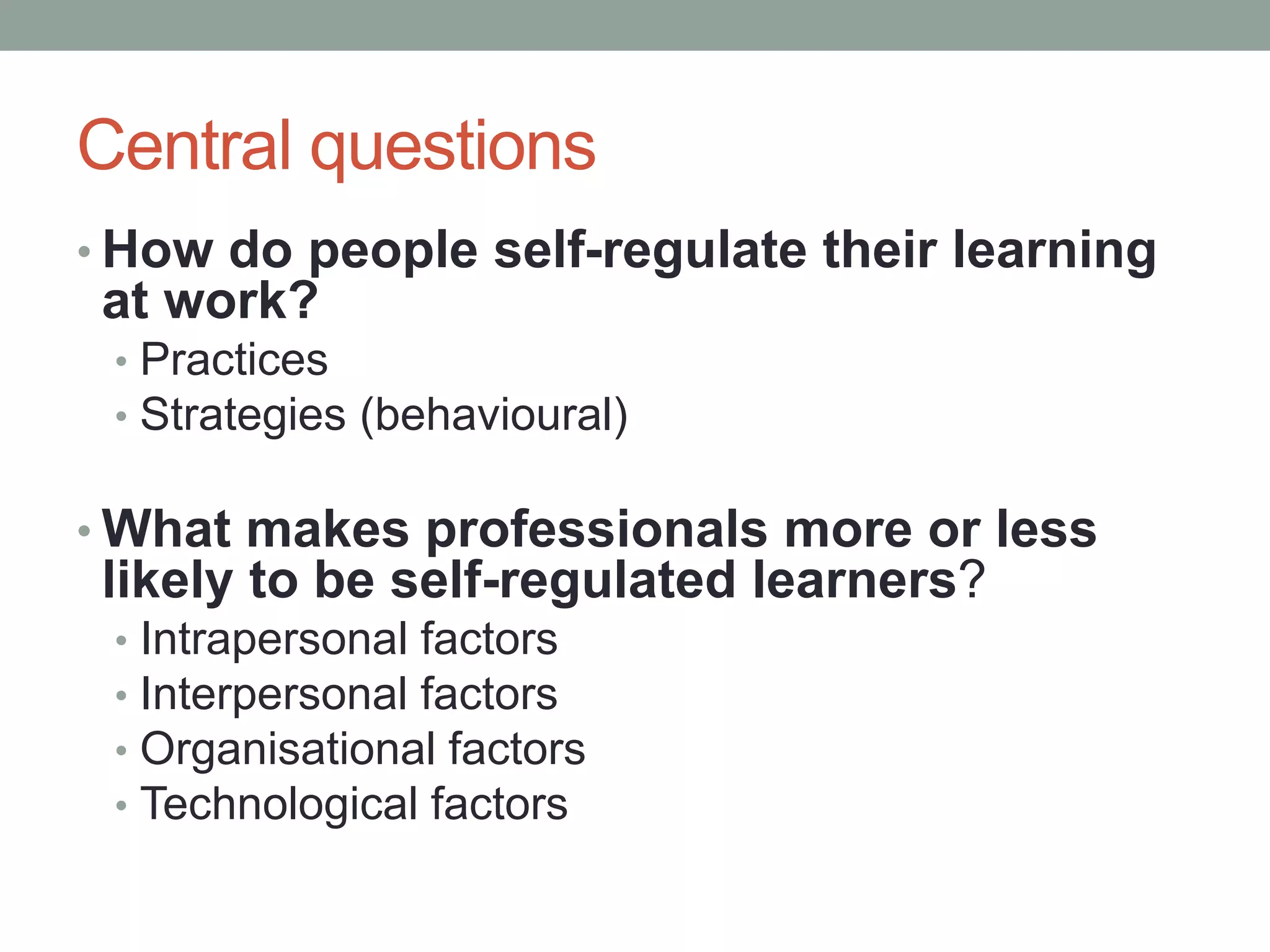
• How do people self-regulate their learning
at work?
• Practices
• Strategies (behavioural)
• What makes professionals more or less
likely to be self-regulated learners?
• Intrapersonal factors
• Interpersonal factors
• Organisational factors
• Technological factors
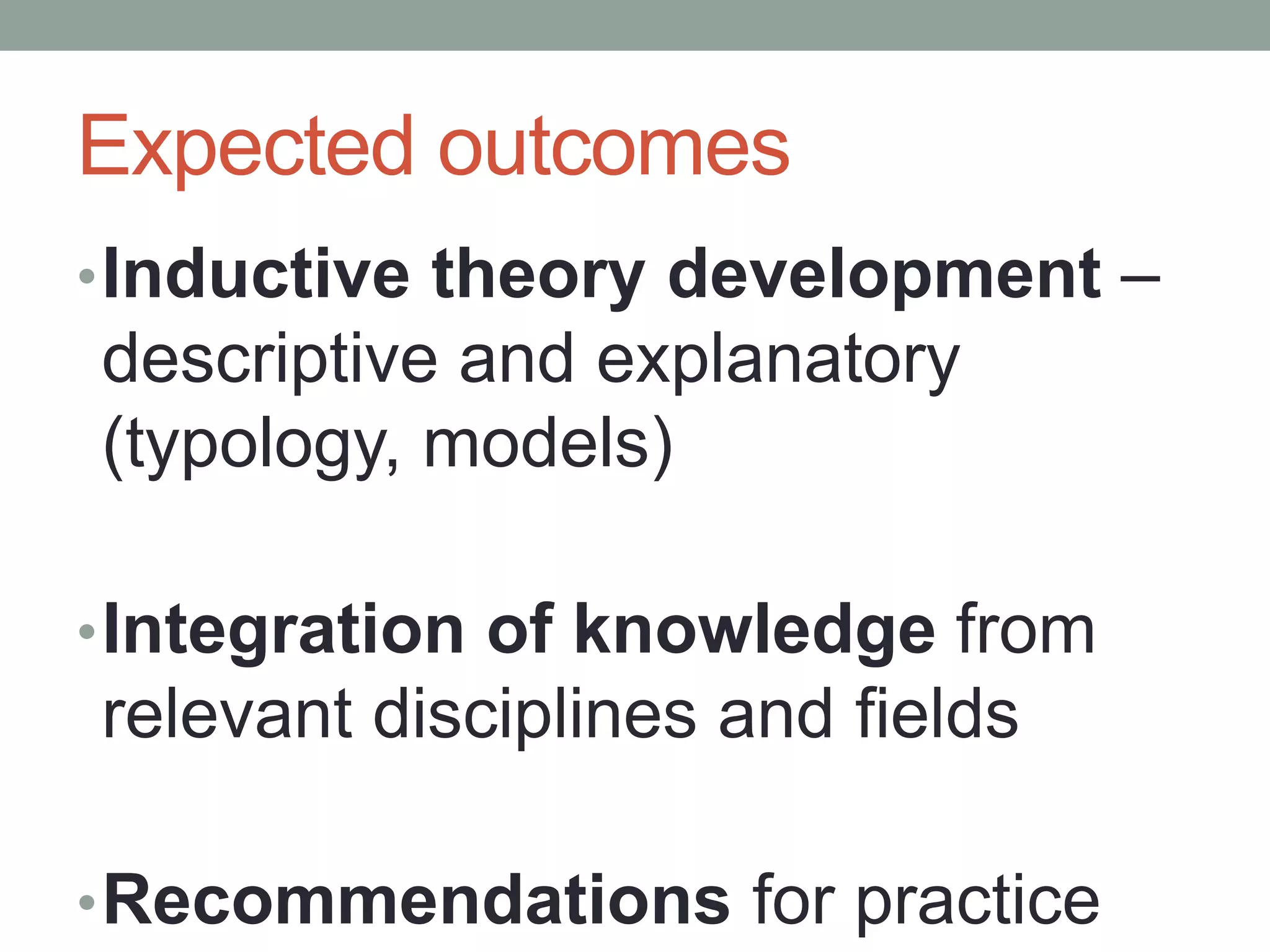
Expected outcomes
•Inductive theory development –
descriptive and explanatory
(typology, models)
•Integration of knowledge from
relevant disciplines and fields
•Recommendations for practice
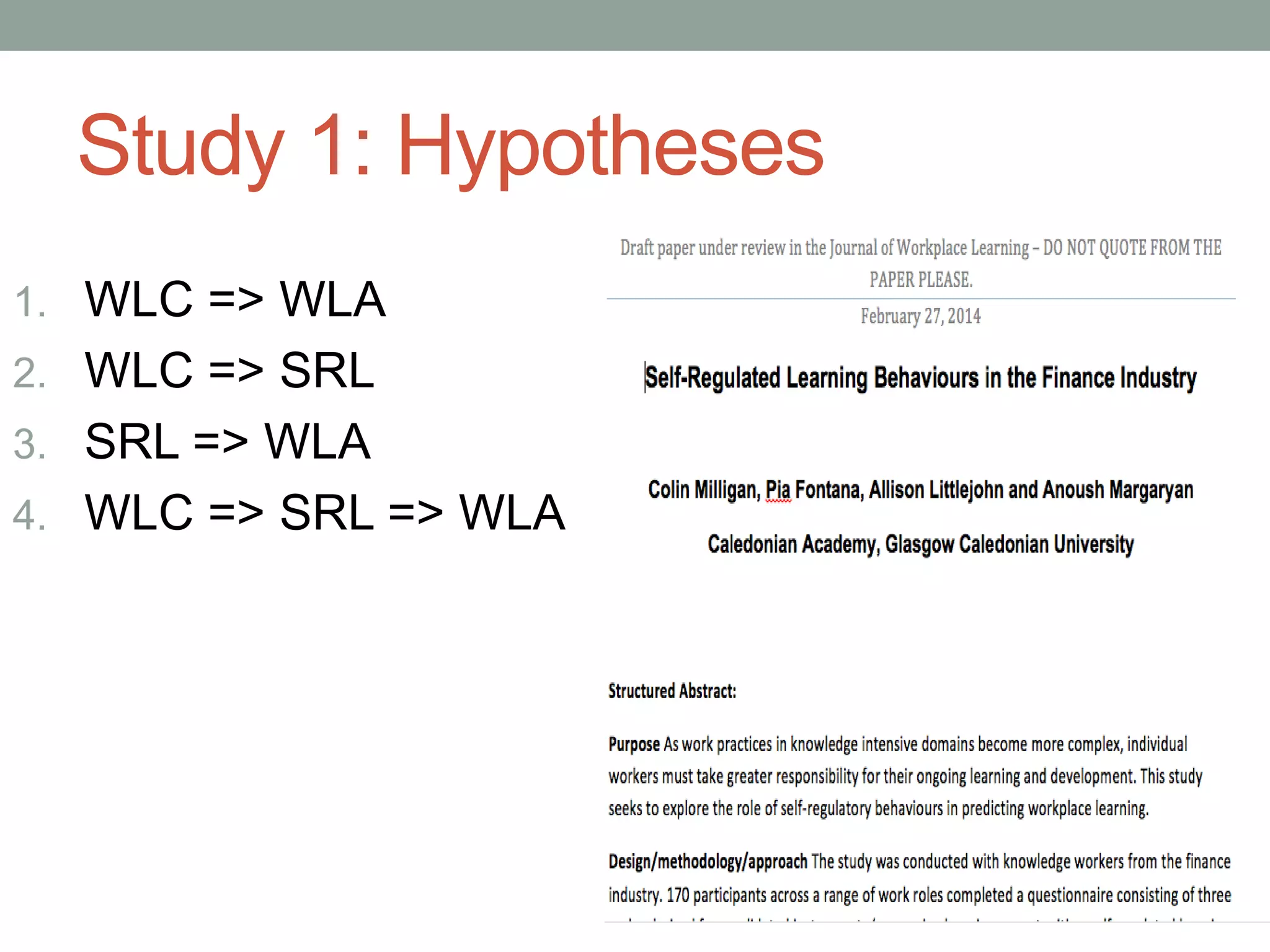
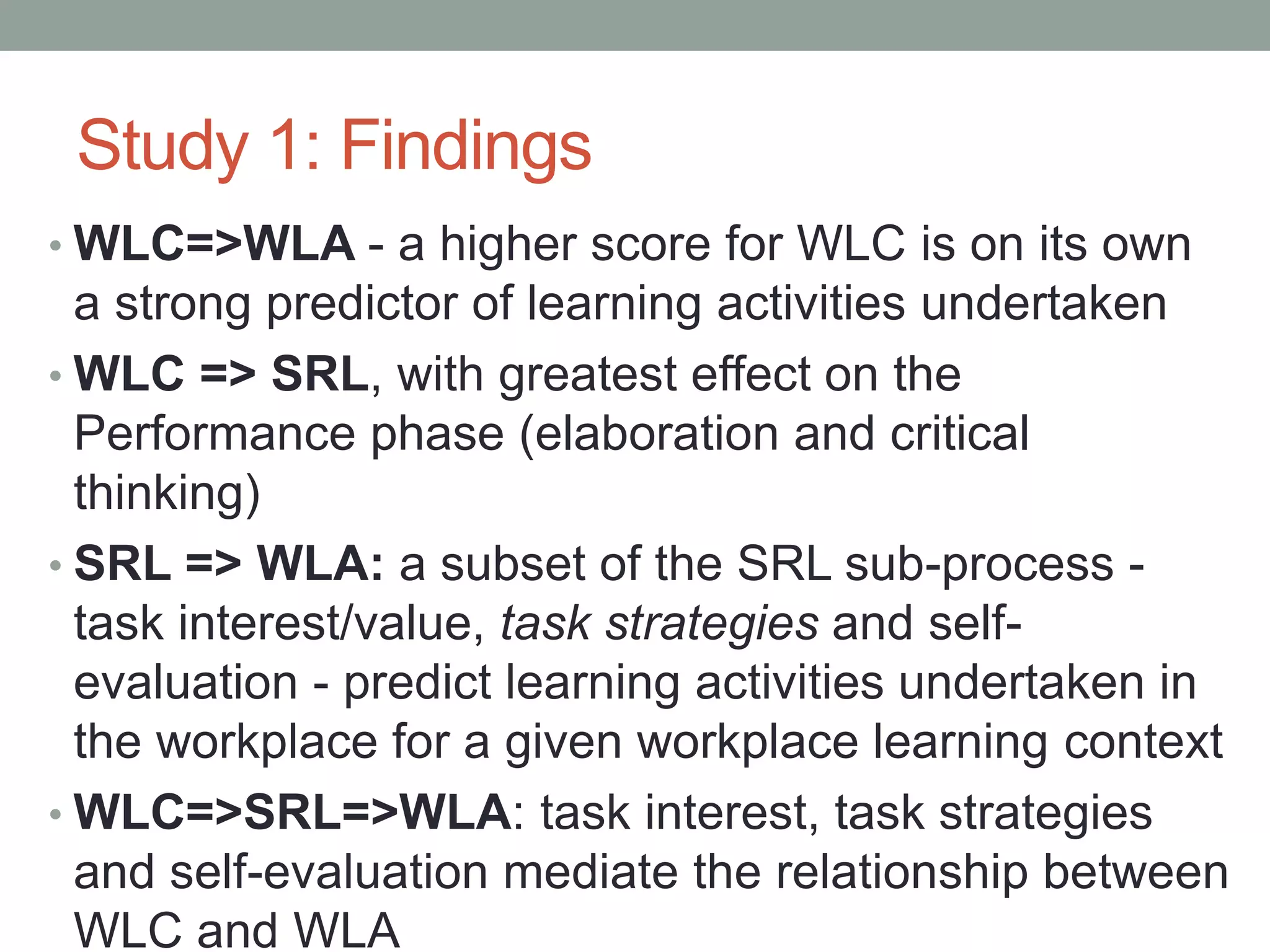
Study 1: Hypotheses
1. WLC => WLA
2. WLC => SRL
3. SRL => WLA
4. WLC => SRL => WLA
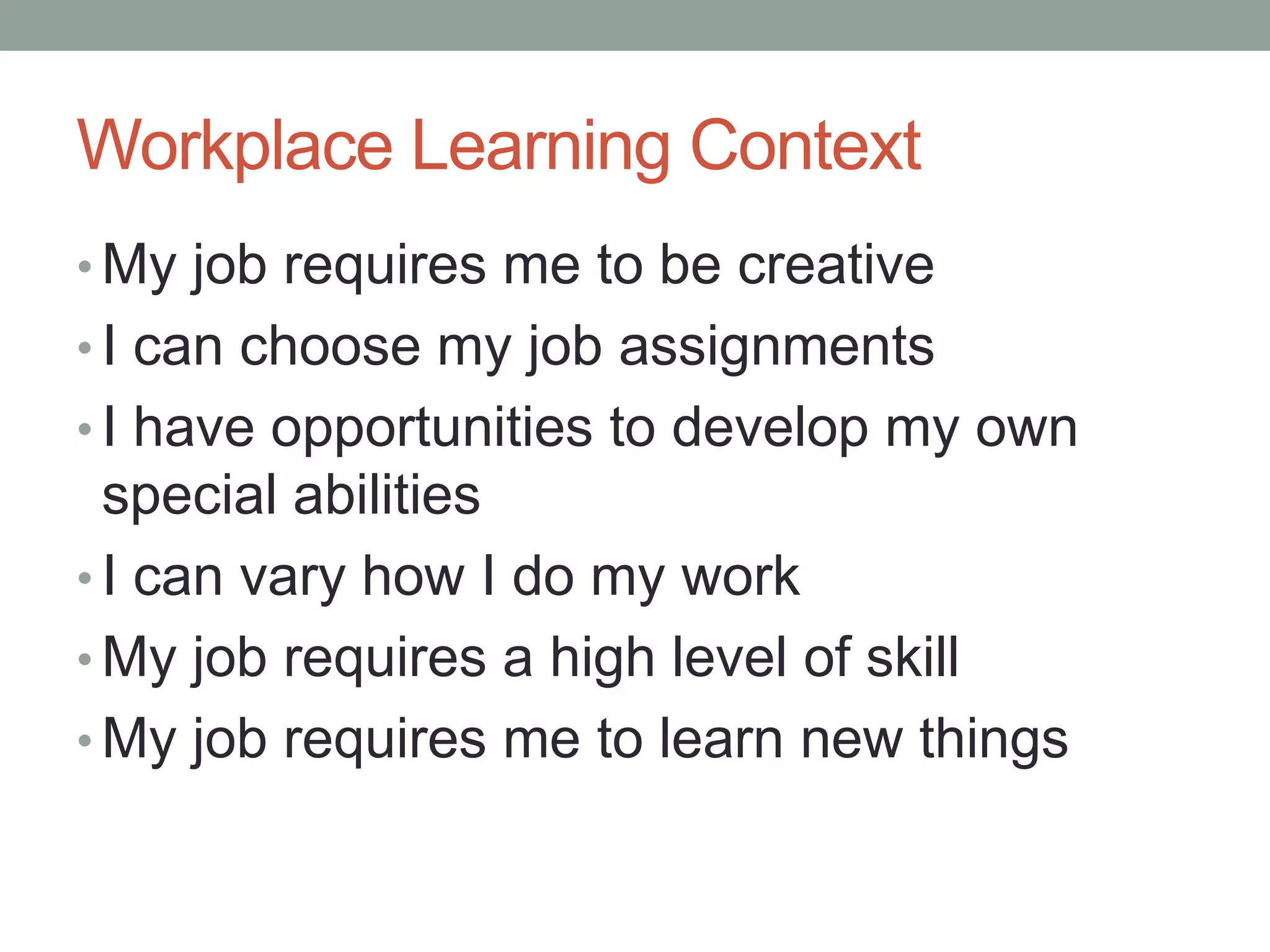
Workplace Learning Context
• My job requires me to be creative
• I can choose my job assignments
• I have opportunities to develop my own
special abilities
• I can vary how I do my work
• My job requires a high level of skill
• My job requires me to learn new things
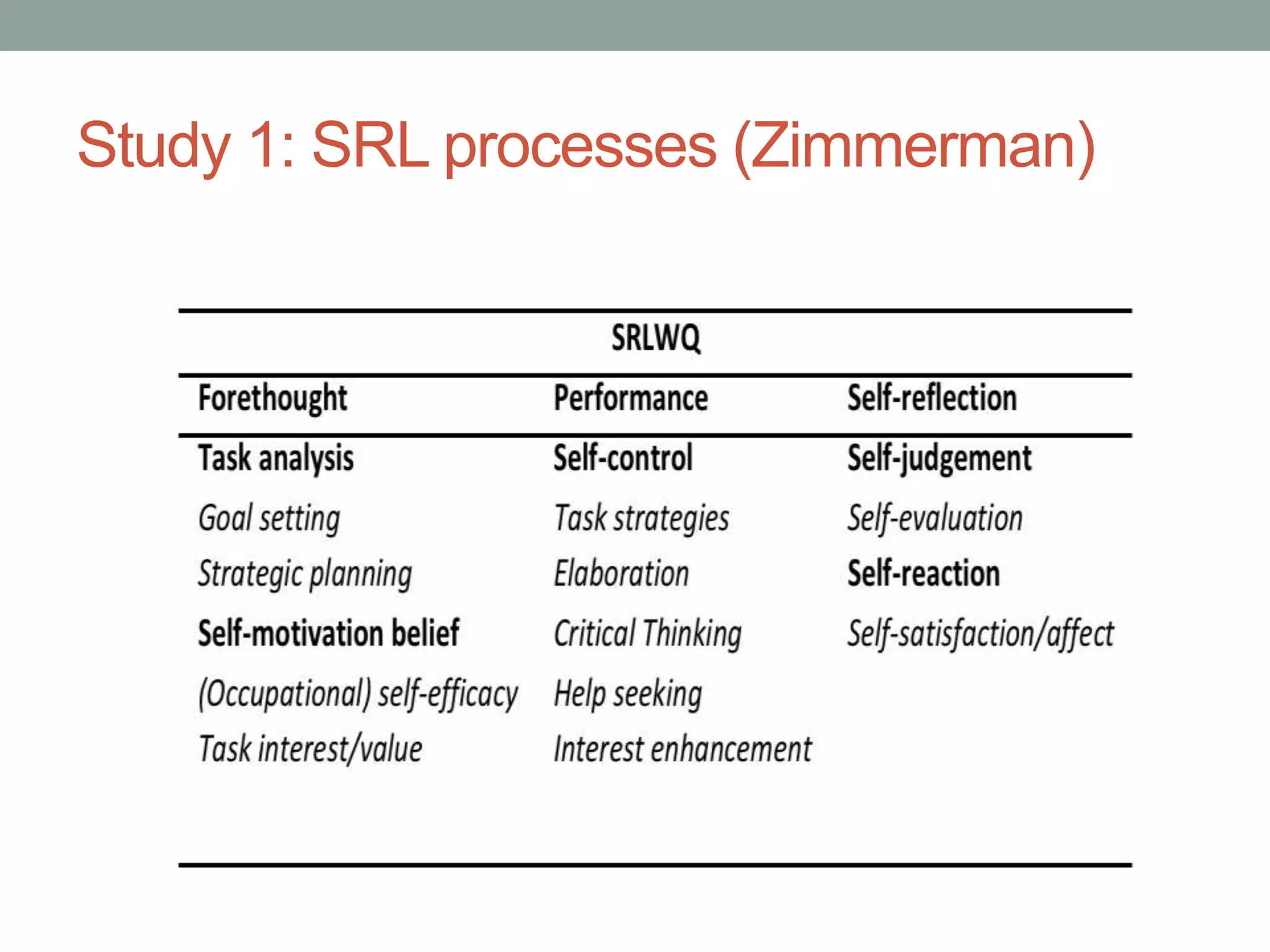
Study 1: SRL processes (Zimmerman)
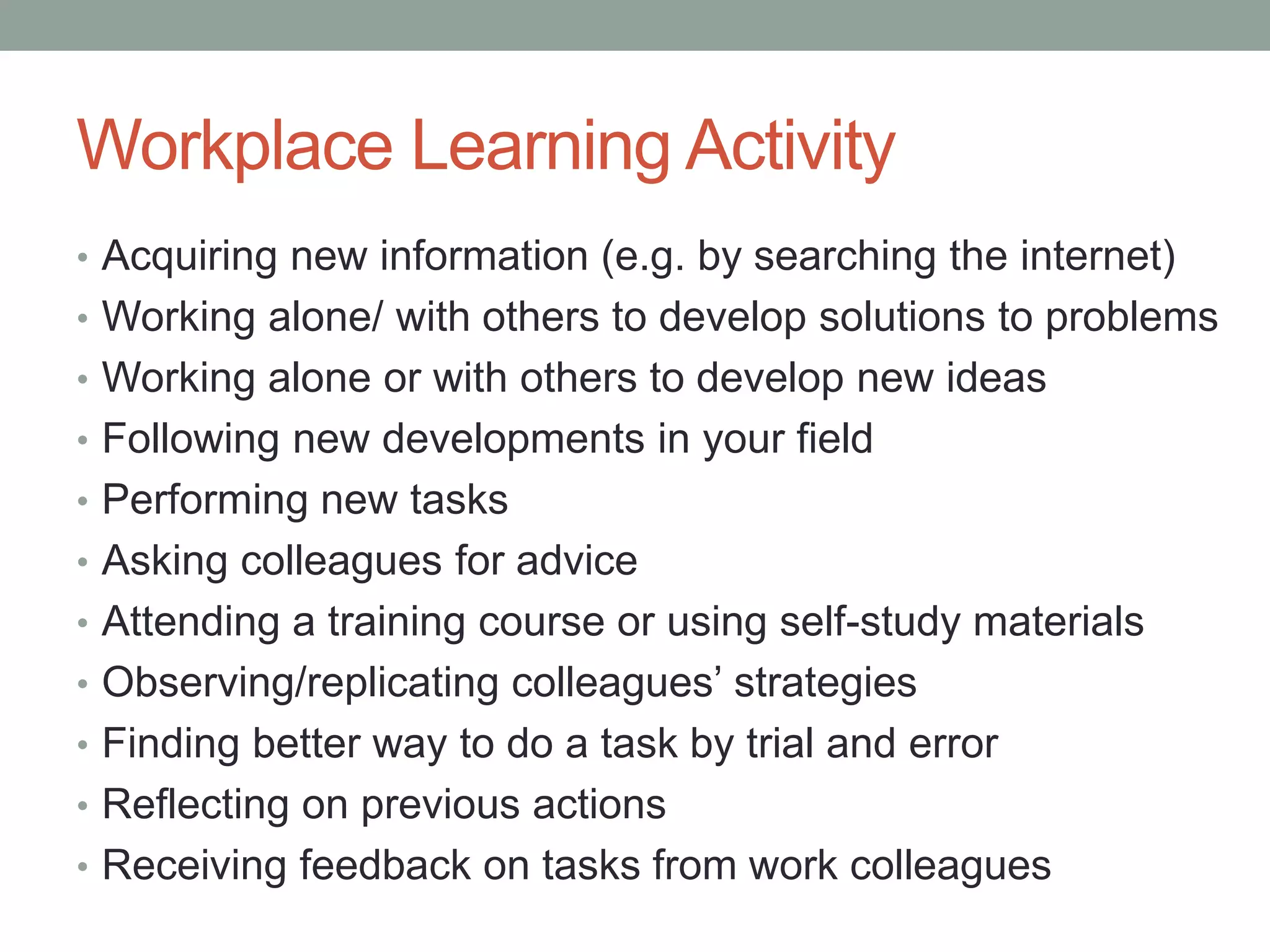
Workplace Learning Activity
• Acquiring new information (e.g. by searching the internet)
• Working alone/ with others to develop solutions to problems
• Working alone or with others to develop new ideas
• Following new developments in your field
• Performing new tasks
• Asking colleagues for advice
• Attending a training course or using self-study materials
• Observing/replicating colleagues’ strategies
• Finding better way to do a task by trial and error
• Reflecting on previous actions
• Receiving feedback on tasks from work colleagues
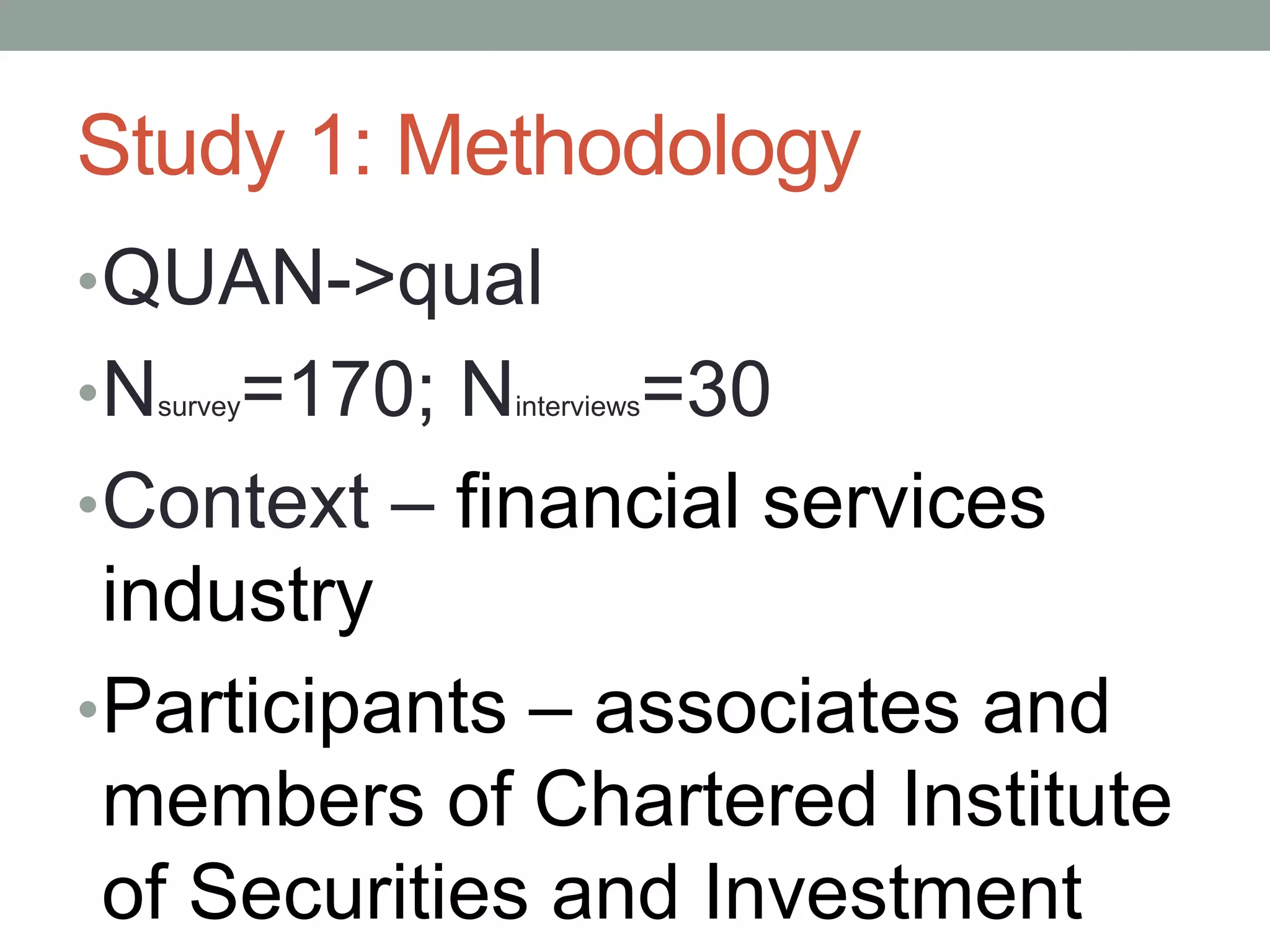
Study 1: Methodology
•QUAN->qual
•Nsurvey=170; Ninterviews=30
•Context – financial services
industry
•Participants – associates and
members of Chartered Institute
of Securities and Investment
Study 1: Findings
• WLC=>WLA - a higher score for WLC is on its own
a strong predictor of learning activities undertaken
• WLC => SRL, with greatest effect on the
Performance phase (elaboration and critical
thinking)
• SRL => WLA: a subset of the SRL sub-process -
task interest/value, task strategies and self-
evaluation - predict learning activities undertaken in
the workplace for a given workplace learning context
• WLC=>SRL=>WLA: task interest, task strategies
and self-evaluation mediate the relationship between
WLC and WLA
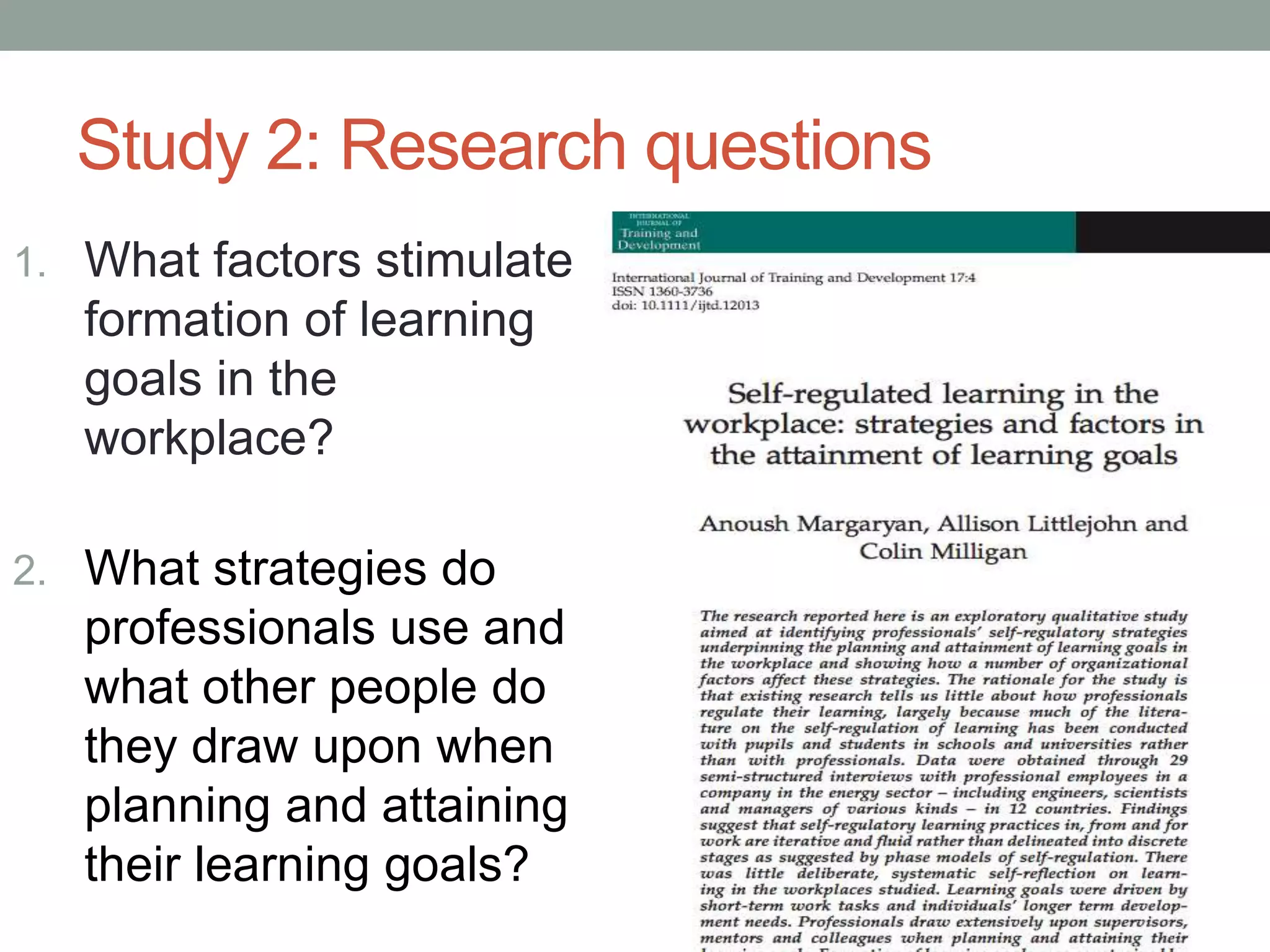
Study 2: Research questions
1. What factors stimulate
formation of learning
goals in the
workplace?
2. What strategies do
professionals use and
what other people do
they draw upon when
planning and attaining
their learning goals?
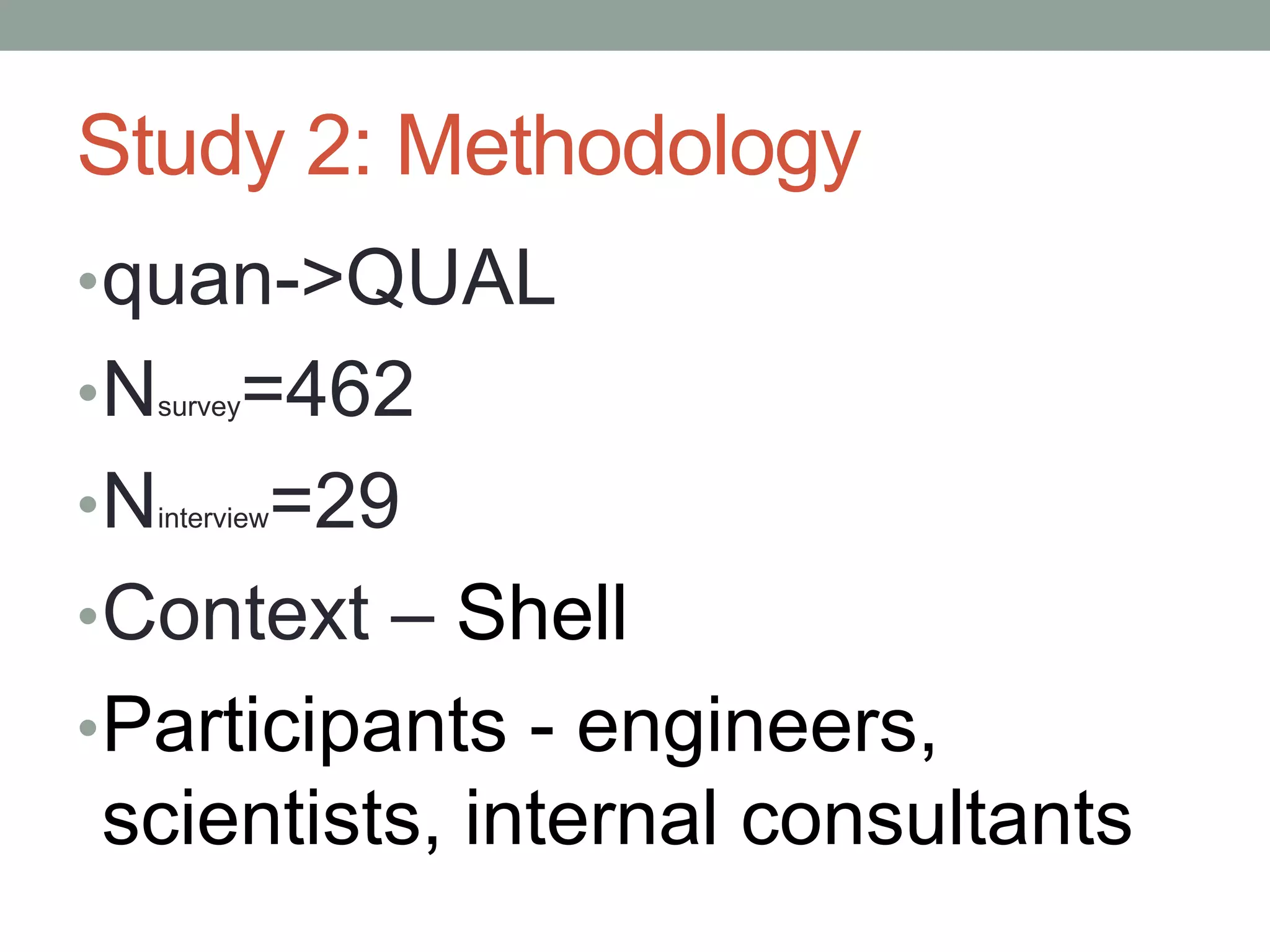
Study 2: Methodology
•quan->QUAL
•Nsurvey=462
•Ninterview=29
•Context – Shell
•Participants - engineers,
scientists, internal consultants
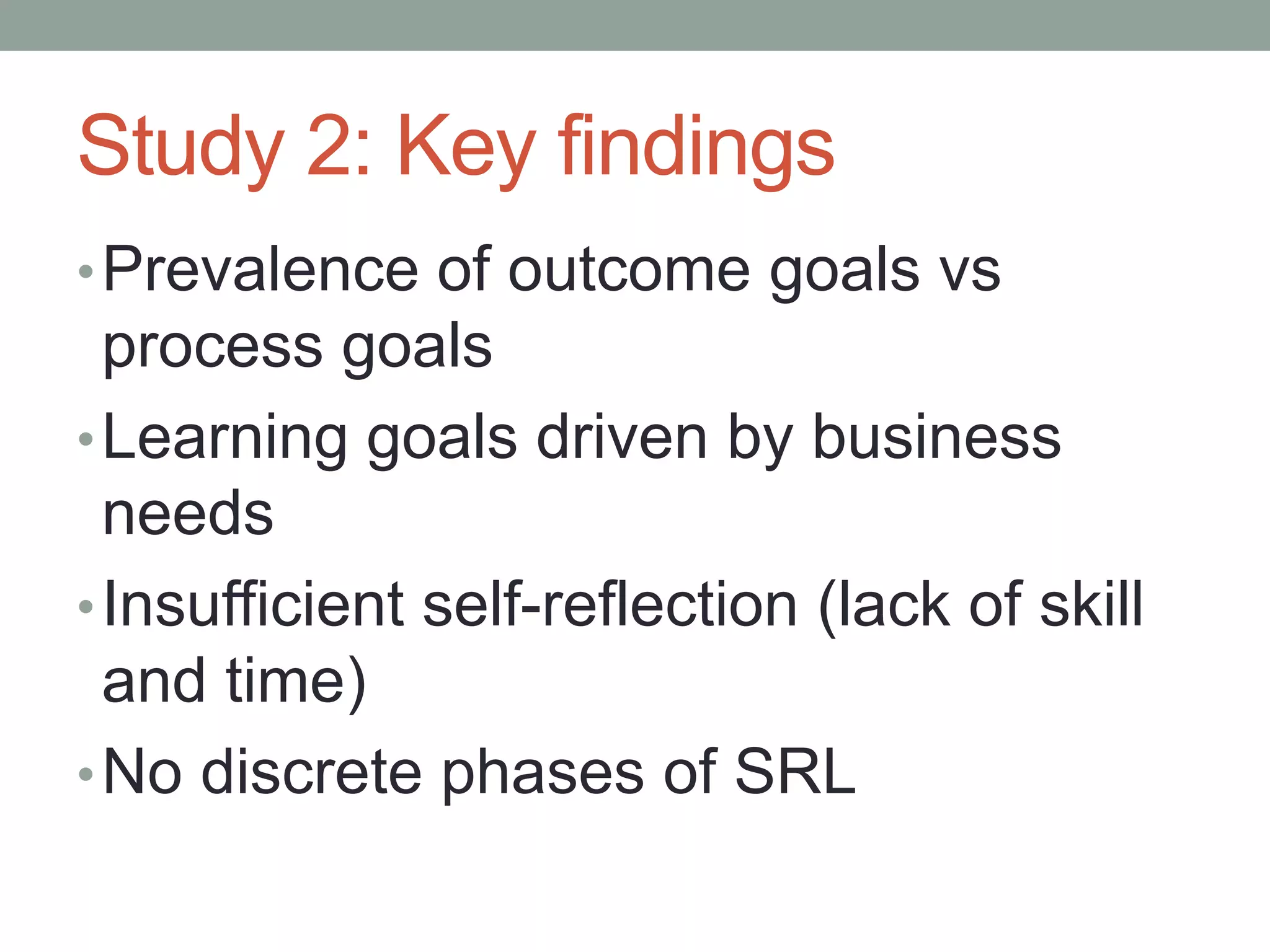
Study 2: Key findings
•Prevalence of outcome goals vs
process goals
•Learning goals driven by business
needs
•Insufficient self-reflection (lack of skill
and time)
•No discrete phases of SRL
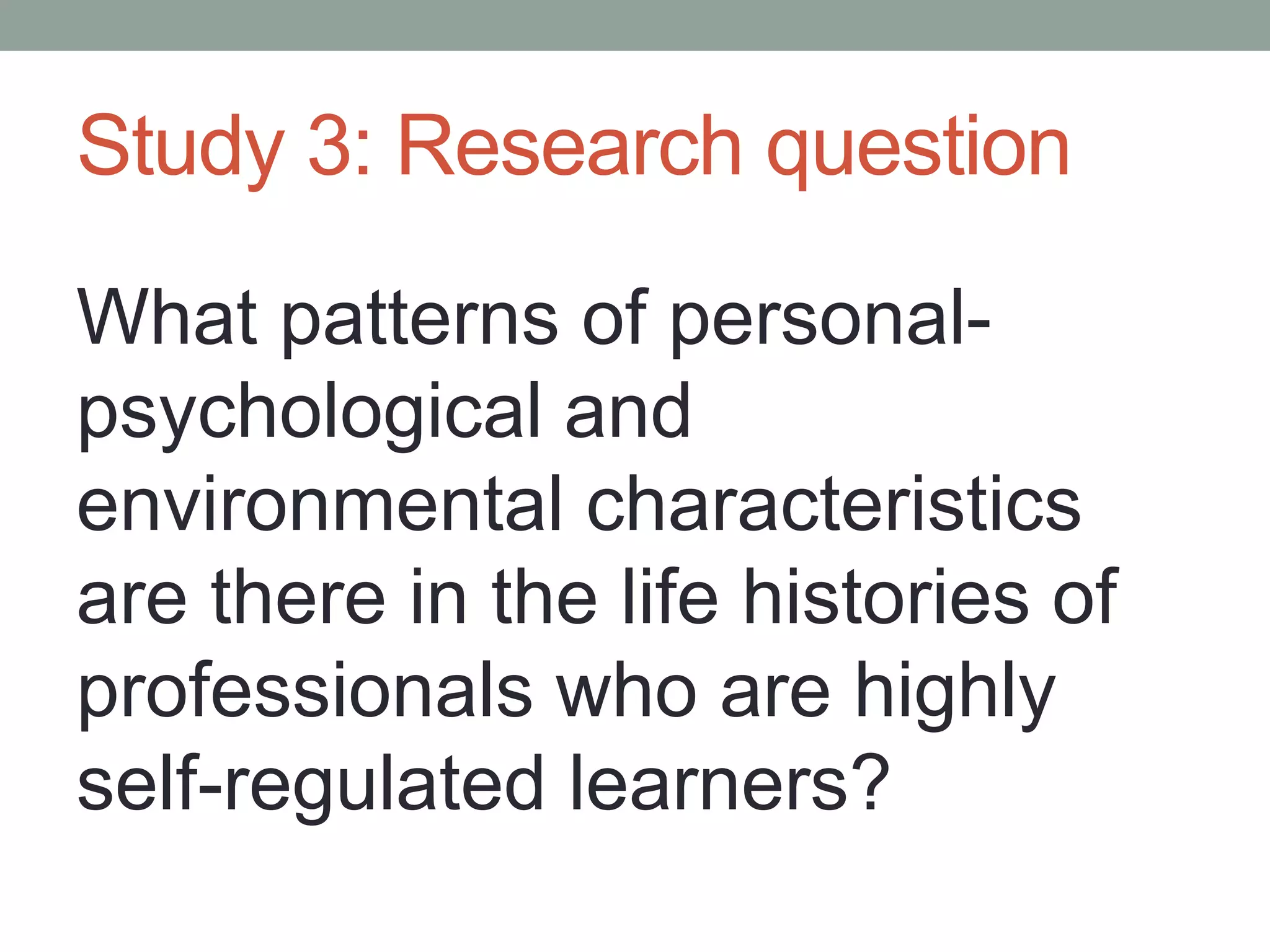
Study 3: Research question
What patterns of personal-
psychological and
environmental characteristics
are there in the life histories of
professionals who are highly
self-regulated learners?
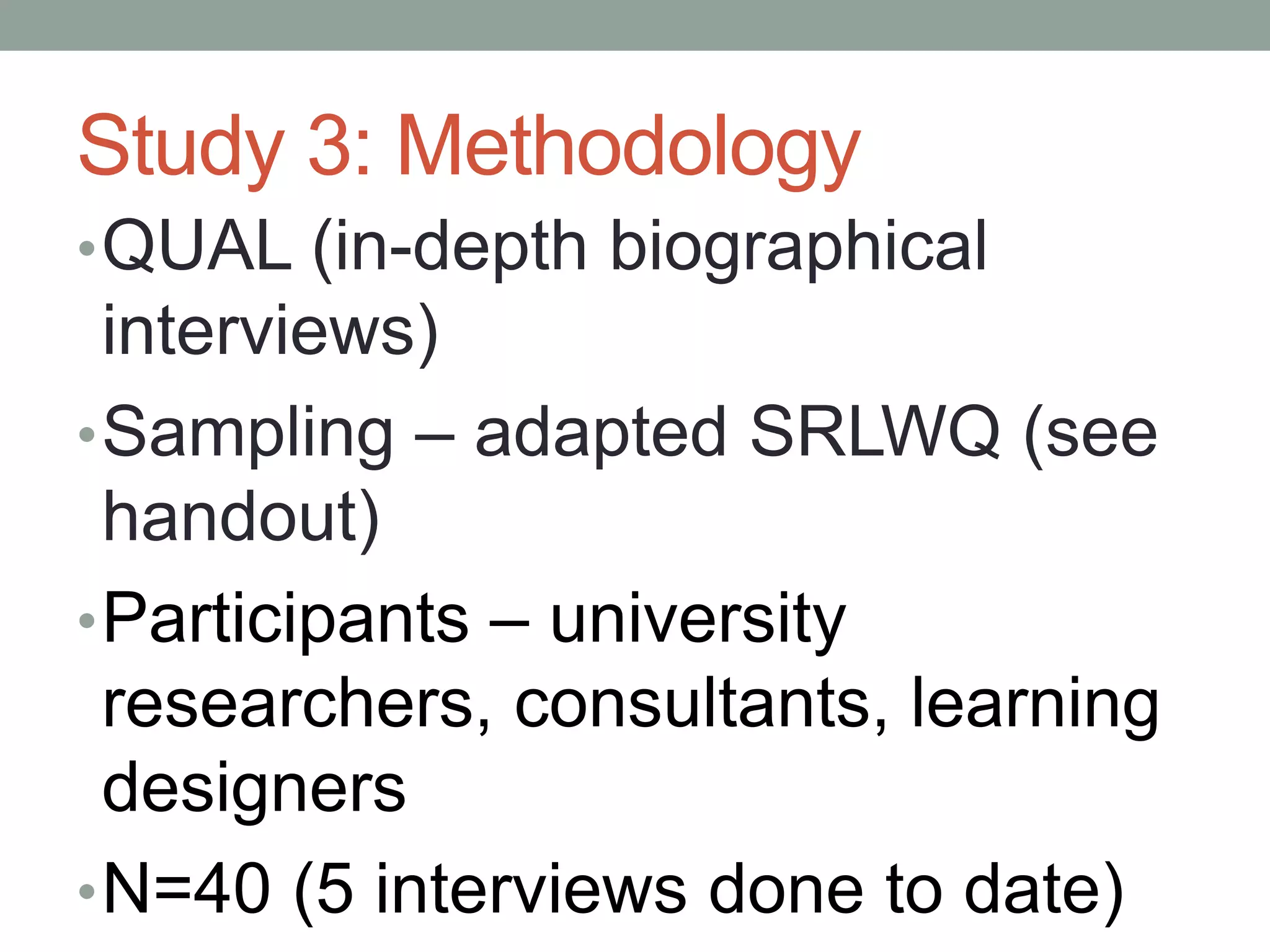
Study 3: Methodology
•QUAL (in-depth biographical
interviews)
•Sampling – adapted SRLWQ (see
handout)
•Participants – university
researchers, consultants, learning
designers
•N=40 (5 interviews done to date)
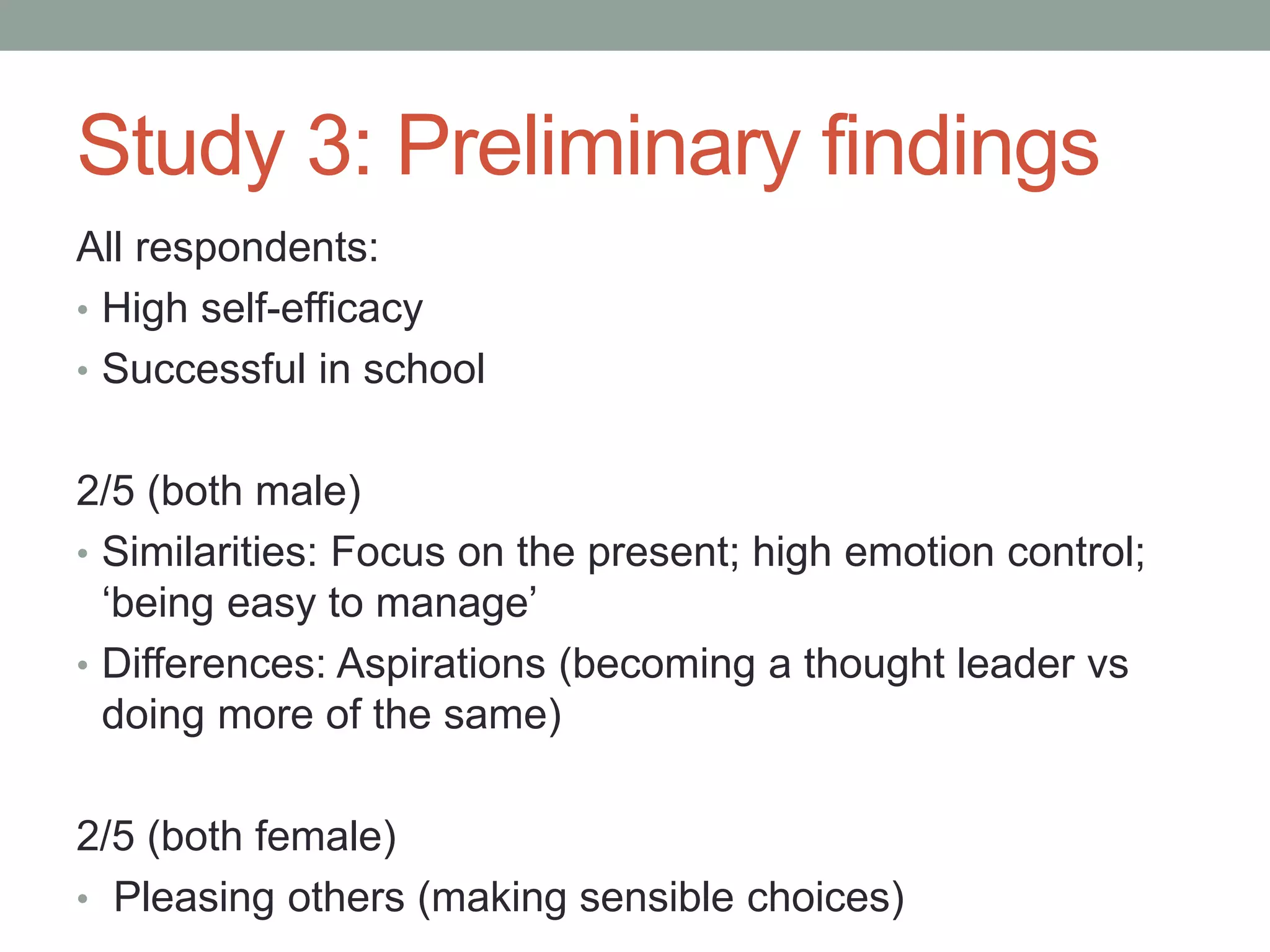
Study 3: Preliminary findings
All respondents:
• High self-efficacy
• Successful in school
2/5 (both male)
• Similarities: Focus on the present; high emotion control;
‘being easy to manage’
• Differences: Aspirations (becoming a thought leader vs
doing more of the same)
2/5 (both female)
• Pleasing others (making sensible choices)
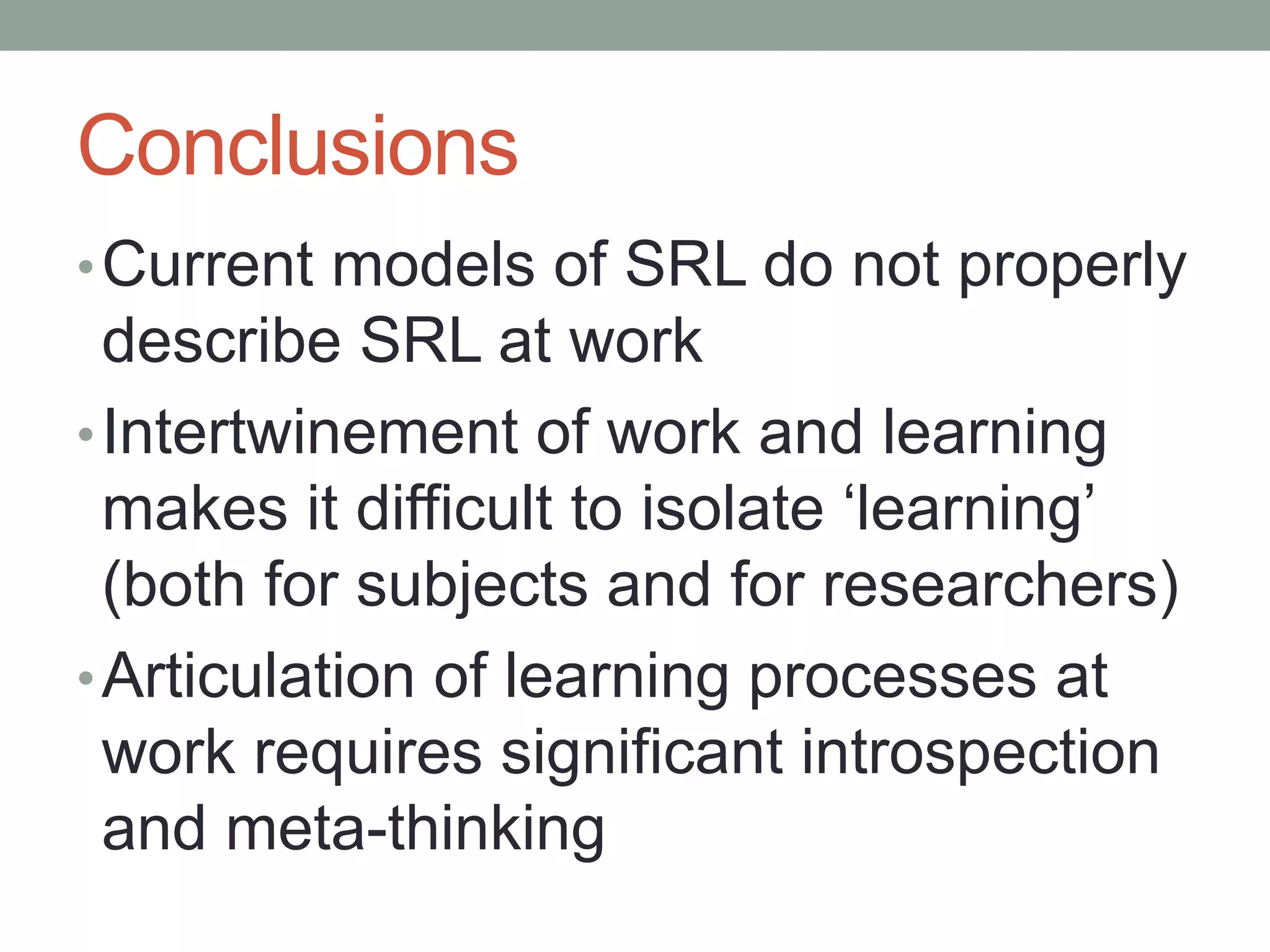
Conclusions
•Current models of SRL do not properly
describe SRL at work
•Intertwinement of work and learning
makes it difficult to isolate ‘learning’
(both for subjects and for researchers)
•Articulation of learning processes at
work requires significant introspection
and meta-thinking
Future research
•Expanding the methodological repertoire
•Development of scales to measure
aptitude to SRL at work
•Bring together relevant knowledge
across micro (Psychology), meso (WPL,
TEL, CSCW, Organisational Behaviour)
and macro (Sociology, Organisational
Learning, Economics) levels to explain
SRL at work

Self-regulated learning at work

  • 1.
    SELF-REGULATED LEARNING AT WORK DrAnoush Margaryan Caledonian Academy, Glasgow Caledonian University http://www.gcu.ac.uk/academy/people/anoush- margaryan/ @anoush
  • 2.
    Central questions • Howdo people self-regulate their learning at work? • Practices • Strategies (behavioural) • What makes professionals more or less likely to be self-regulated learners? • Intrapersonal factors • Interpersonal factors • Organisational factors • Technological factors
  • 3.
    Expected outcomes •Inductive theorydevelopment – descriptive and explanatory (typology, models) •Integration of knowledge from relevant disciplines and fields •Recommendations for practice
  • 4.
    Study 1: Hypotheses 1.WLC => WLA 2. WLC => SRL 3. SRL => WLA 4. WLC => SRL => WLA
  • 5.
    Workplace Learning Context •My job requires me to be creative • I can choose my job assignments • I have opportunities to develop my own special abilities • I can vary how I do my work • My job requires a high level of skill • My job requires me to learn new things
  • 6.
    Study 1: SRLprocesses (Zimmerman)
  • 7.
    Workplace Learning Activity •Acquiring new information (e.g. by searching the internet) • Working alone/ with others to develop solutions to problems • Working alone or with others to develop new ideas • Following new developments in your field • Performing new tasks • Asking colleagues for advice • Attending a training course or using self-study materials • Observing/replicating colleagues’ strategies • Finding better way to do a task by trial and error • Reflecting on previous actions • Receiving feedback on tasks from work colleagues
  • 8.
    Study 1: Methodology •QUAN->qual •Nsurvey=170;Ninterviews=30 •Context – financial services industry •Participants – associates and members of Chartered Institute of Securities and Investment
  • 9.
    Study 1: Findings •WLC=>WLA - a higher score for WLC is on its own a strong predictor of learning activities undertaken • WLC => SRL, with greatest effect on the Performance phase (elaboration and critical thinking) • SRL => WLA: a subset of the SRL sub-process - task interest/value, task strategies and self- evaluation - predict learning activities undertaken in the workplace for a given workplace learning context • WLC=>SRL=>WLA: task interest, task strategies and self-evaluation mediate the relationship between WLC and WLA
  • 10.
    Study 2: Researchquestions 1. What factors stimulate formation of learning goals in the workplace? 2. What strategies do professionals use and what other people do they draw upon when planning and attaining their learning goals?
  • 11.
    Study 2: Methodology •quan->QUAL •Nsurvey=462 •Ninterview=29 •Context– Shell •Participants - engineers, scientists, internal consultants
  • 12.
    Study 2: Keyfindings •Prevalence of outcome goals vs process goals •Learning goals driven by business needs •Insufficient self-reflection (lack of skill and time) •No discrete phases of SRL
  • 13.
    Study 3: Researchquestion What patterns of personal- psychological and environmental characteristics are there in the life histories of professionals who are highly self-regulated learners?
  • 14.
    Study 3: Methodology •QUAL(in-depth biographical interviews) •Sampling – adapted SRLWQ (see handout) •Participants – university researchers, consultants, learning designers •N=40 (5 interviews done to date)
  • 15.
    Study 3: Preliminaryfindings All respondents: • High self-efficacy • Successful in school 2/5 (both male) • Similarities: Focus on the present; high emotion control; ‘being easy to manage’ • Differences: Aspirations (becoming a thought leader vs doing more of the same) 2/5 (both female) • Pleasing others (making sensible choices)
  • 16.
    Conclusions •Current models ofSRL do not properly describe SRL at work •Intertwinement of work and learning makes it difficult to isolate ‘learning’ (both for subjects and for researchers) •Articulation of learning processes at work requires significant introspection and meta-thinking
  • 17.
    Future research •Expanding themethodological repertoire •Development of scales to measure aptitude to SRL at work •Bring together relevant knowledge across micro (Psychology), meso (WPL, TEL, CSCW, Organisational Behaviour) and macro (Sociology, Organisational Learning, Economics) levels to explain SRL at work