Ilanga Protea Training
Consultants
In collaboration with
The South African Board for People
Practice
HUMAN RESOURCE DEVELOPMENT
BOOTCAMP FOR HR PROFESSIONALS 2015/16
HIGHLIGHTS
• INTRODUCTION TO HUMAN RESOURCE DEVELOPMENT
• ASSESSING HRD NEEDS
• IMPLEMENTING HRD PROGRAMS
• Special Mention: HR STANDARDS AND METRICS (NATIONAL HR COMPETENCY MODEL)
• HRD AND DIVERSITY: DIVERSITY TRAINING AND BEYOND
• MANAGEMENT DEVELOPMENT
Part 1
6 CPD Points
Dates: 25th – 27th February 2015
Venue: Protea Wanderers Hotel
Johannesburg South Africa
Date: 25th – 27th March 2015
Venue: Protea Wanderers Hotel
Johannesburg South Africa
Date: 20th – 22nd May 2015
Venue: Protea Wanderers Hotel
Johannesburg South Africa
Part 2
6 CPD Points
Dates: 17th – 19th June 2015
Venue: African Pride Melrose Arch Hotel
Johannesburg South Africa
Date: 22nd – 24th July 2015
Venue: African Pride Melrose Arch Hotel
Johannesburg South Africa
Date: 26th – 28th August 2015
Venue: African Pride Melrose Arch Hotel
Johannesburg South Africa
WHO SHOULD ATTEND
• Human Resource or Personnel staff at
middle to senior management level wishing
to progress
• Senior Managers who wish to consolidate,
refresh and reinforce their knowledge and
skills
• Managers wishing to develop their HR
thinking and understanding to work more
effectively with HR specialists
• It will be ideal for candidates who are
intending to move into the highest levels of
management or onto a Board and therefore
need to refine their management skills
quickly and efficiently
ILanga Protea Training Consultants structured
Human Resource Development to serve
primarily as a comprehensive text in business,
management, public administration,
educational administration, and other fields
that prepare individuals to train and develop
other people. As such, the training:
• Covers the field of HRD (as defined by
SABPP), from orientation and skills
training, to career development and
organizational development
• Provides a clear understanding of the
concepts, processes, and practices that form
the basis of successful HRD
• Shows how concepts and theories can and
have been put into practice in a variety of
organizations
• Focuses on the shared role of line
management and human resource
specialists in HRD
• Reflects the current state of the field,
blending real-world practices and up-to-
date research
• Discussion on the HR STANDARDS
AND METRICS (NATIONAL HR
COMPETENCY MODEL)
INTRODUCTION
Employee skills and motivation are critical for
organizational success. This has always been
true, but the pace and volume of modern
change is drawing increased attention to the
ways that human resource development
(HRD) activities can be used to ensure that
organization members have what it takes to
successfully meet their challenges. While there
is solid evidence that HRD works, it is not a
magic bullet. The challenges many
organizations face are complex, and new
dimensions, such as globalization and an
increasingly diverse workforce, make it more
difficult to ensure HRD efforts will succeed.
Unless those responsible for training and
development make informed choices about the
content of a developmental experience and the
methods of delivering it, the results of many
HRD efforts will fail to meet expectations.
Fortunately, there is a growing base of theory,
research, and practical experience to support
HRD efforts. We structured this bootcamp to
help HR Personnel, HRD professionals, and
managers at all levels take advantage of this
knowledge and experience.
We firmly believe that if they do so, they will
increase their effectiveness, along with that of
individuals with whom they work and the
organizations of which they are a part.
TRAINING METHODOLOGY
The methodology is based on interactive
learning. i.e. learning through exercises.
Furthermore, learners will use examples from
their own organization, thus ensuring that
learning is anchored at their workplace.
As with all our programmes, we strive to effect
actual change back at the workplace through
effective and practical outcomes based training
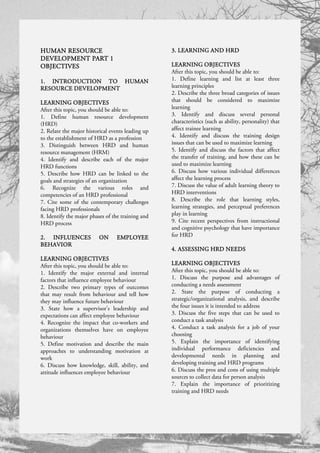
HUMAN RESOURCE
DEVELOPMENT PART 1
OBJECTIVES
1. INTRODUCTION TO HUMAN
RESOURCE DEVELOPMENT
LEARNING OBJECTIVES
After this topic, you should be able to:
1. Define human resource development
(HRD)
2. Relate the major historical events leading up
to the establishment of HRD as a profession
3. Distinguish between HRD and human
resource management (HRM)
4. Identify and describe each of the major
HRD functions
5. Describe how HRD can be linked to the
goals and strategies of an organization
6. Recognize the various roles and
competencies of an HRD professional
7. Cite some of the contemporary challenges
facing HRD professionals
8. Identify the major phases of the training and
HRD process
2. INFLUENCES ON EMPLOYEE
BEHAVIOR
LEARNING OBJECTIVES
After this topic, you should be able to:
1. Identify the major external and internal
factors that influence employee behaviour
2. Describe two primary types of outcomes
that may result from behaviour and tell how
they may influence future behaviour
3. State how a supervisor’s leadership and
expectations can affect employee behaviour
4. Recognize the impact that co-workers and
organizations themselves have on employee
behaviour
5. Define motivation and describe the main
approaches to understanding motivation at
work
6. Discuss how knowledge, skill, ability, and
attitude influences employee behaviour
3. LEARNING AND HRD
LEARNING OBJECTIVES
After this topic, you should be able to:
1. Define learning and list at least three
learning principles
2. Describe the three broad categories of issues
that should be considered to maximize
learning
3. Identify and discuss several personal
characteristics (such as ability, personality) that
affect trainee learning
4. Identify and discuss the training design
issues that can be used to maximize learning
5. Identify and discuss the factors that affect
the transfer of training, and how these can be
used to maximize learning
6. Discuss how various individual differences
affect the learning process
7. Discuss the value of adult learning theory to
HRD interventions
8. Describe the role that learning styles,
learning strategies, and perceptual preferences
play in learning
9. Cite recent perspectives from instructional
and cognitive psychology that have importance
for HRD
4. ASSESSING HRD NEEDS
LEARNING OBJECTIVES
After this topic, you should be able to:
1. Discuss the purpose and advantages of
conducting a needs assessment
2. State the purpose of conducting a
strategic/organizational analysis, and describe
the four issues it is intended to address
3. Discuss the five steps that can be used to
conduct a task analysis
4. Conduct a task analysis for a job of your
choosing
5. Explain the importance of identifying
individual performance deficiencies and
developmental needs in planning and
developing training and HRD programs
6. Discuss the pros and cons of using multiple
sources to collect data for person analysis
7. Explain the importance of prioritizing
training and HRD needs
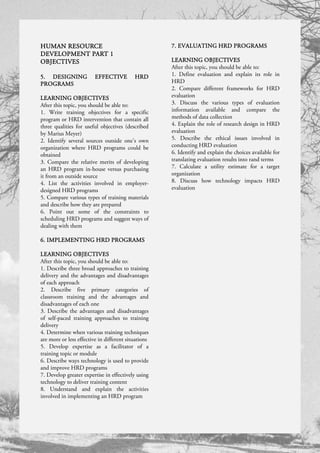
HUMAN RESOURCE
DEVELOPMENT PART 1
OBJECTIVES
5. DESIGNING EFFECTIVE HRD
PROGRAMS
LEARNING OBJECTIVES
After this topic, you should be able to:
1. Write training objectives for a specific
program or HRD intervention that contain all
three qualities for useful objectives (described
by Marius Meyer)
2. Identify several sources outside one’s own
organization where HRD programs could be
obtained
3. Compare the relative merits of developing
an HRD program in-house versus purchasing
it from an outside source
4. List the activities involved in employer-
designed HRD programs
5. Compare various types of training materials
and describe how they are prepared
6. Point out some of the constraints to
scheduling HRD programs and suggest ways of
dealing with them
6. IMPLEMENTING HRD PROGRAMS
LEARNING OBJECTIVES
After this topic, you should be able to:
1. Describe three broad approaches to training
delivery and the advantages and disadvantages
of each approach
2. Describe five primary categories of
classroom training and the advantages and
disadvantages of each one
3. Describe the advantages and disadvantages
of self-paced training approaches to training
delivery
4. Determine when various training techniques
are more or less effective in different situations
5. Develop expertise as a facilitator of a
training topic or module
6. Describe ways technology is used to provide
and improve HRD programs
7. Develop greater expertise in effectively using
technology to deliver training content
8. Understand and explain the activities
involved in implementing an HRD program
7. EVALUATING HRD PROGRAMS
LEARNING OBJECTIVES
After this topic, you should be able to:
1. Define evaluation and explain its role in
HRD
2. Compare different frameworks for HRD
evaluation
3. Discuss the various types of evaluation
information available and compare the
methods of data collection
4. Explain the role of research design in HRD
evaluation
5. Describe the ethical issues involved in
conducting HRD evaluation
6. Identify and explain the choices available for
translating evaluation results into rand terms
7. Calculate a utility estimate for a target
organization
8. Discuss how technology impacts HRD
evaluation
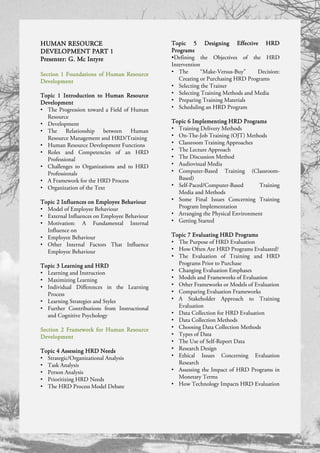
HUMAN RESOURCE
DEVELOPMENT PART 1
Presenter: G. Mc Intyre
Section 1 Foundations of Human Resource
Development
Topic 1 Introduction to Human Resource
Development
• The Progression toward a Field of Human
Resource
• Development
• The Relationship between Human
Resource Management and HRD/Training
• Human Resource Development Functions
• Roles and Competencies of an HRD
Professional
• Challenges to Organizations and to HRD
Professionals
• A Framework for the HRD Process
• Organization of the Text
Topic 2 Influences on Employee Behaviour
• Model of Employee Behaviour
• External Influences on Employee Behaviour
• Motivation: A Fundamental Internal
Influence on
• Employee Behaviour
• Other Internal Factors That Influence
Employee Behaviour
Topic 3 Learning and HRD
• Learning and Instruction
• Maximizing Learning
• Individual Differences in the Learning
Process
• Learning Strategies and Styles
• Further Contributions from Instructional
and Cognitive Psychology
Section 2 Framework for Human Resource
Development
Topic 4 Assessing HRD Needs
• Strategic/Organizational Analysis
• Task Analysis
• Person Analysis
• Prioritizing HRD Needs
• The HRD Process Model Debate
Topic 5 Designing Effective HRD
Programs
•Defining the Objectives of the HRD
Intervention
• The “Make-Versus-Buy” Decision:
Creating or Purchasing HRD Programs
• Selecting the Trainer
• Selecting Training Methods and Media
• Preparing Training Materials
• Scheduling an HRD Program
Topic 6 Implementing HRD Programs
• Training Delivery Methods
• On-The-Job Training (OJT) Methods
• Classroom Training Approaches
• The Lecture Approach
• The Discussion Method
• Audiovisual Media
• Computer-Based Training (Classroom-
Based)
• Self-Paced/Computer-Based Training
Media and Methods
• Some Final Issues Concerning Training
Program Implementation
• Arranging the Physical Environment
• Getting Started
Topic 7 Evaluating HRD Programs
• The Purpose of HRD Evaluation
• How Often Are HRD Programs Evaluated?
• The Evaluation of Training and HRD
Programs Prior to Purchase
• Changing Evaluation Emphases
• Models and Frameworks of Evaluation
• Other Frameworks or Models of Evaluation
• Comparing Evaluation Frameworks
• A Stakeholder Approach to Training
Evaluation
• Data Collection for HRD Evaluation
• Data Collection Methods
• Choosing Data Collection Methods
• Types of Data
• The Use of Self-Report Data
• Research Design
• Ethical Issues Concerning Evaluation
Research
• Assessing the Impact of HRD Programs in
Monetary Terms
• How Technology Impacts HRD Evaluation
HUMAN RESOURCE
DEVELOPMENT PART 2
OBJECTIVES
8. ON-BOARDING: EMPLOYEE
SOCIALIZATION AND ORIENTATION
LEARNING OBJECTIVES
After this topic, you should be able to:
1. Discuss the content, outcomes, and process
of organizational socialization
2. State the challenges faced by new employees
entering an organization and the things they
need in order to be successful
3. Describe the realistic job preview approach
to recruiting, and explain how it can benefit
organizations and new employees
4. Define and explain the goals of employee
orientation/on-boarding
5. Identify the characteristics of an effective
orientation/on-boarding program
6. Learn the key elements necessary to design,
implement, and evaluate an effective
orientation/on-boarding program
9. SKILLS AND TECHNICAL
TRAINING
LEARNING OBJECTIVES
After this topic, you should be able to:
1. Identify and describe basic workplace
competencies
2. Explain the need for remedial basic skills
training programs
3. Explain the role of apprenticeship programs
in today’s work environment
4. Describe a typical technical skills training
program
5. Describe a typical interpersonal skills
training program
6. Understand the professional development
and education practices common in many
organizations
10. COACHING AND PERFORMANCE
MANAGEMENT
LEARNING OBJECTIVES
After this topic, you should be able to:
1. Define coaching and performance
management, and explain the need for such
activities in organizations
2. Explain how to analyse employee
performance to set the stage for a coaching
discussion
3. Describe the steps involved in coaching to
improve poor performance
4. Explain how coaching can be used to
maintain effective performance and encourage
superior performance
5. Identify the skills necessary for effective
coaching
6. Identify the critical elements in a
performance management system
7. Discuss the evidence supporting the
effectiveness of coaching and performance
management
11. EMPLOYEE COUNSELLING AND
WELLNESS SERVICES
LEARNING OBJECTIVES
After this topic, you should be able to:
1. Explain the need for employee counselling
and wellness efforts in organizations, and why
counselling is an HRD activity
2. Describe the typical activities included in
employee counselling programs
3. Describe the focus and effectiveness of three
types of employee counselling programs:
employee assistance programs, stress
management interventions, and employee
wellness/health promotion programs
4. Describe the role of supervisors in the
various types of employee counselling
programs
5. Explain the legal and ethical issues raised by
employee counselling, assistance, and health
and wellness programs
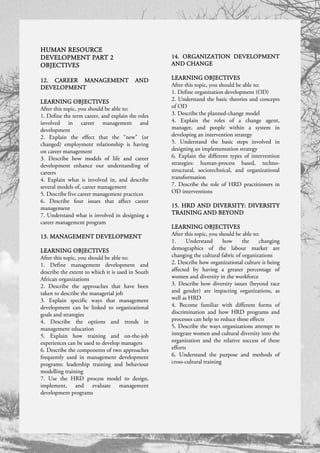
HUMAN RESOURCE
DEVELOPMENT PART 2
OBJECTIVES
12. CAREER MANAGEMENT AND
DEVELOPMENT
LEARNING OBJECTIVES
After this topic, you should be able to:
1. Define the term career, and explain the roles
involved in career management and
development
2. Explain the effect that the “new” (or
changed) employment relationship is having
on career management
3. Describe how models of life and career
development enhance our understanding of
careers
4. Explain what is involved in, and describe
several models of, career management
5. Describe five career management practices
6. Describe four issues that affect career
management
7. Understand what is involved in designing a
career management program
13. MANAGEMENT DEVELOPMENT
LEARNING OBJECTIVES
After this topic, you should be able to:
1. Define management development and
describe the extent to which it is used in South
African organizations
2. Describe the approaches that have been
taken to describe the managerial job
3. Explain specific ways that management
development can be linked to organizational
goals and strategies
4. Describe the options and trends in
management education
5. Explain how training and on-the-job
experiences can be used to develop managers
6. Describe the components of two approaches
frequently used in management development
programs: leadership training and behaviour
modelling training
7. Use the HRD process model to design,
implement, and evaluate management
development programs
14. ORGANIZATION DEVELOPMENT
AND CHANGE
LEARNING OBJECTIVES
After this topic, you should be able to:
1. Define organization development (OD)
2. Understand the basic theories and concepts
of OD
3. Describe the planned-change model
4. Explain the roles of a change agent,
manager, and people within a system in
developing an intervention strategy
5. Understand the basic steps involved in
designing an implementation strategy
6. Explain the different types of intervention
strategies: human-process based, techno-
structural, sociotechnical, and organizational
transformation
7. Describe the role of HRD practitioners in
OD interventions
15. HRD AND DIVERSITY: DIVERSITY
TRAINING AND BEYOND
LEARNING OBJECTIVES
After this topic, you should be able to:
1. Understand how the changing
demographics of the labour market are
changing the cultural fabric of organizations
2. Describe how organizational culture is being
affected by having a greater percentage of
women and diversity in the workforce
3. Describe how diversity issues (beyond race
and gender) are impacting organizations, as
well as HRD
4. Become familiar with different forms of
discrimination and how HRD programs and
processes can help to reduce these effects
5. Describe the ways organizations attempt to
integrate women and cultural diversity into the
organization and the relative success of these
efforts
6. Understand the purpose and methods of
cross-cultural training
HUMAN RESOURCE
DEVELOPMENT PART 2
Presenter: G. Mc Intyre
Section 3 Human Resource Development
Applications
Topic 8 Onboarding: Employee
Socialization and Orientation
• Socialization: The Process of Becoming an
Insider
• Various Perspectives on the Socialization
Process
• The Realistic Job Preview
Topic 9 Skills and Technical Training
• Basic Workplace Competencies
• Basic Skills/Literacy Programs
• Technical Training
• Interpersonal Skills Training
• Role of Labor Unions in Skills and
Technical Training Programs
• Professional Development and Education
Topic 10 Coaching and Performance
Management
• The Need for Coaching
• Coaching: A Positive Approach to
Managing Performance
• Coaching and Performance Management
• Definition of Coaching
• Role of the Supervisor and Manager in
Coaching
• The HRD Professional’s Role in Coaching
• Coaching to Improve Poor Performance
• Defining Poor Performance
• Responding to Poor Performance
• Conducting the Coaching Analysis
• Maintaining Effective Performance and
Encouraging Superior Performance
• Skills Necessary for Effective Coaching
• The Effectiveness of Coaching
• Employee Participation In Discussion
• Being Supportive
• Using Constructive Criticism
• Setting Performance Goals during
Discussion
• Training and the Supervisor’s Credibility
• Organizational Support
• Closing Comments on Coaching and
Performance Management
Topic 11 Employee Counselling and Wellness
Services
• Overview of employee counselling Services
• Employee Assistance Programs
• Stress management Interventions
• Employee Wellness and Health Promotion
Programs
• Exercise and Fitness Interventions
• Smoking Cessation
• Issues in Employee Counselling
Topic 12 Career Management and
Development
• Defining Career Concepts
• Stages of Life and Career Development
• Models of Career Development
• The Process of Career Management
• Roles in Career Management
• Career Development Practices and Activities
• Issues in Career Development
• Delivering Effective Career Development
Systems
Topic 13 Management Development
• Describing the Manager’s Job: Management
Roles and
• Competencies
• •Making Management Development Strategic
• Management Education
• Bachelor’s or Master’s Degree Programs in
Business Administration
• Executive Education Programs
• Management Training and Experiences
• Examples of Approaches Used to Develop
Managers
• Designing Effective Management
Development Programs
Topic 14 Organization Development and
Change
• Organization Development Theories and
Concepts
• Model of Planned Change
• Designing an Intervention Strategy
• Types of Interventions: Human Process-Based
• Types of Interventions: Techno-Structural
• Types of Interventions: Sociotechnical
Systems
• Types of Interventions: Organizational
Transformation
• Whither Organization Development?
HUMAN RESOURCE
DEVELOPMENT PART 2
Presenter: G. Mc Intyre
Topic 15 HRD and Diversity: Diversity
Training and Beyond
• Organizational Culture
• Labour-Market Changes and
Discrimination
• Adapting to Demographic Changes
• Cross-Cultural Education and Training
Programs
• Human Resource Development Programs
for Culturally Diverse Employees
• Other Human Resource Management
Programs and Processes
GENERAL INFORMATION
REGISTRATION
Booking in the first instance can be made by:
PHONE: +27- 11- 042- 7010
FAX: +27- 86- 544- 1247 |
EMAIL: bookings@ilangaprotea.co.za
and then by completing and returning the attached
registration form to the address shown.
Places on the course are limited, EARLY
BOOKING IS ADVISED.
JOINING INSTRUCTIONS
Detailed joining instructions, including a map, will
be sent to all participants 10 - 14 days prior to the
commencement of the course. While every attempt
will be made to ensure the material arrives in time,
it is the participants’ responsibility to contact
Ilanga Protea Training Consultants Centre for
Professional Development if no information has
been received.
FEES
The fee covers facilitation, course notes, lunches,
light refreshments, but does not cover
accommodation. Please note that all fees are plus
Tablet and must be paid before the event.
In the event of a high participation, income from
the registration fees will be used to contribute
towards developing country participation and
capacity building.
DISCOUNT
A 10% discount on the course fee (applicable at
time of booking) is available if you book 5 or more.
VENUE
The course will take place at 2 locations for PART
1 & 2,
PART 1: Protea Wanderers Hotel, Sandton
Johannesburg South Africa
PART 2: African Pride Melrose Arch Hotel
Johannesburg South Africa
TIMES FOR EACH DAY
08:30: Registration & Refreshments
08:45: Opening of Training
10:45 Mid-morning Refreshments
12:30: Lunch
15:00 : Afternoon Refreshments
16:00 : End of Day
CANCELLATION AND REFUNDS
A 20% administration fee will be levied for
cancellations made up to two weeks prior to the
start of the module.
Cancellations thereafter will be liable to the loss
of the full fee. Notice of cancellation must be
given in writing by letter or fax and action will be
taken to recover, from the delegates or their
employers, that proportion of the fee owing at
the time of cancellation.
Ilanga Protea Training Consultants reserves the
right to cancel an advertised course at short
notice. It will endeavour to provide participants
with as much notice as possible, but will not
accept liability for costs incurred by participants
or their organisations for the cancellation of
travel arrangements and/or accommodation
reservations as a result of the course being
cancelled or postponed. Ilanga Protea Training
Consultants also reserves the right to postpone or
make such alterations to the content and
presenters of a course as may be necessary.
QUERIES
Queries regarding registration and other
administrative matters should be directed to:
Joshua Solani
Centre for Professional Development
Ilanga Protea Training Consultants
Tel. +27- 11- 042- 7010
Fax: +27- 86- 544- 1247
Email: joshua@ilangaprotea.co.za
Information on other professional development
short courses can be found at:
www.ilangaprotea.co.za
©2015 Ilanga Protea training Consultants
REGISTRATION FORM
HUMAN RESOURCE DEVELOPMENT
BOOTCAMP FOR HR PROFESSIONALS 2015/16
DELEGATE NOMINATIONS
1. Mr./Mrs./Miss: ………………………………………………………………………….
Email: ………………………………………………………..…………………
Tel: ................................................ Cell: ...................................................
2. Mr./Mrs./Miss: ………………………………………………………………………….
Email: ………………………………………………..………………………….
Tel: ................................................ Cell: ...................................................
3. Mr./Mrs./Miss: ………………………………………………………………………….
Email: ………………………………………………..………………………….
Tel: ................................................ Cell: ...................................................
4. Mr./Mrs./Miss: ………………………………………………………………………….
Email: ………………………………………………..………………………….
Tel: ................................................ Cell: ...................................................
5. Mr./Mrs./Miss: ………………………………………………………………………….
Email: ………………………………………………..………………………….
Tel: ................................................ Cell: ...................................................
DELEGATE APPROVAL (PLEASE REGISTER ME/US)
Signatory must be authorized to sign on behalf of contracting organization
Name: ………………………………………………………………………………………………….
Position: ……………………………………………………………………………………………….
Organisation: …………………………………………………………………………………………..
Tel:…………………………………………Email:
………………………………………………………
Physical Address: …………………………………………………………………………………..
Signature:…………… …………… ………… Order No: …………………………………………..
This booking form is invalid without a signature
METHOD OF PAYMENT (PLEASE TICK)
BANKING DETAILS
Bank: Standard Bank
Branch: Randburg
Account No: 220076405
Swift Code: SBZAZAJJ
HR Bootcamp Part 1
Price: R8 999.00
6 CPD Points
Dates: 25th – 27th February 2015
Venue: Protea Wanderers Hotel
Johannesburg South Africa
Date: 25th – 27th March 2015
Venue: Protea wanderers Hotel
Johannesburg South Africa
Date: 20th – 22nd May 2015
Venue: Protea Wanderers Hotel
Johannesburg South Africa
HR Bootcamp Part 2
Price: R8 999.00
6 CPD Points
Dates: 17th – 19th June 2015
Venue: African Pride Melrose Arch
Hotel
Johannesburg South Africa
Date: 22nd – 24th July 2015
Venue: African Pride Melrose Arch
Hotel
Johannesburg South Africa
Date: 26th – 28th August 2015
Venue: African Pride Melrose Arch
Hotel
Johannesburg South Africa
Discount: BOOK NOW for HRD PART 1 &
PART 2 and only pay R 14 999.00
Tick appropriate date/s
Contact Freddie For more Info

Human Resource Development Training (SABPP Certificate)

  • 1.
    Ilanga Protea Training Consultants Incollaboration with The South African Board for People Practice HUMAN RESOURCE DEVELOPMENT BOOTCAMP FOR HR PROFESSIONALS 2015/16 HIGHLIGHTS • INTRODUCTION TO HUMAN RESOURCE DEVELOPMENT • ASSESSING HRD NEEDS • IMPLEMENTING HRD PROGRAMS • Special Mention: HR STANDARDS AND METRICS (NATIONAL HR COMPETENCY MODEL) • HRD AND DIVERSITY: DIVERSITY TRAINING AND BEYOND • MANAGEMENT DEVELOPMENT Part 1 6 CPD Points Dates: 25th – 27th February 2015 Venue: Protea Wanderers Hotel Johannesburg South Africa Date: 25th – 27th March 2015 Venue: Protea Wanderers Hotel Johannesburg South Africa Date: 20th – 22nd May 2015 Venue: Protea Wanderers Hotel Johannesburg South Africa Part 2 6 CPD Points Dates: 17th – 19th June 2015 Venue: African Pride Melrose Arch Hotel Johannesburg South Africa Date: 22nd – 24th July 2015 Venue: African Pride Melrose Arch Hotel Johannesburg South Africa Date: 26th – 28th August 2015 Venue: African Pride Melrose Arch Hotel Johannesburg South Africa
  • 2.
    WHO SHOULD ATTEND •Human Resource or Personnel staff at middle to senior management level wishing to progress • Senior Managers who wish to consolidate, refresh and reinforce their knowledge and skills • Managers wishing to develop their HR thinking and understanding to work more effectively with HR specialists • It will be ideal for candidates who are intending to move into the highest levels of management or onto a Board and therefore need to refine their management skills quickly and efficiently ILanga Protea Training Consultants structured Human Resource Development to serve primarily as a comprehensive text in business, management, public administration, educational administration, and other fields that prepare individuals to train and develop other people. As such, the training: • Covers the field of HRD (as defined by SABPP), from orientation and skills training, to career development and organizational development • Provides a clear understanding of the concepts, processes, and practices that form the basis of successful HRD • Shows how concepts and theories can and have been put into practice in a variety of organizations • Focuses on the shared role of line management and human resource specialists in HRD • Reflects the current state of the field, blending real-world practices and up-to- date research • Discussion on the HR STANDARDS AND METRICS (NATIONAL HR COMPETENCY MODEL) INTRODUCTION Employee skills and motivation are critical for organizational success. This has always been true, but the pace and volume of modern change is drawing increased attention to the ways that human resource development (HRD) activities can be used to ensure that organization members have what it takes to successfully meet their challenges. While there is solid evidence that HRD works, it is not a magic bullet. The challenges many organizations face are complex, and new dimensions, such as globalization and an increasingly diverse workforce, make it more difficult to ensure HRD efforts will succeed. Unless those responsible for training and development make informed choices about the content of a developmental experience and the methods of delivering it, the results of many HRD efforts will fail to meet expectations. Fortunately, there is a growing base of theory, research, and practical experience to support HRD efforts. We structured this bootcamp to help HR Personnel, HRD professionals, and managers at all levels take advantage of this knowledge and experience. We firmly believe that if they do so, they will increase their effectiveness, along with that of individuals with whom they work and the organizations of which they are a part. TRAINING METHODOLOGY The methodology is based on interactive learning. i.e. learning through exercises. Furthermore, learners will use examples from their own organization, thus ensuring that learning is anchored at their workplace. As with all our programmes, we strive to effect actual change back at the workplace through effective and practical outcomes based training
  • 3.
    HUMAN RESOURCE DEVELOPMENT PART1 OBJECTIVES 1. INTRODUCTION TO HUMAN RESOURCE DEVELOPMENT LEARNING OBJECTIVES After this topic, you should be able to: 1. Define human resource development (HRD) 2. Relate the major historical events leading up to the establishment of HRD as a profession 3. Distinguish between HRD and human resource management (HRM) 4. Identify and describe each of the major HRD functions 5. Describe how HRD can be linked to the goals and strategies of an organization 6. Recognize the various roles and competencies of an HRD professional 7. Cite some of the contemporary challenges facing HRD professionals 8. Identify the major phases of the training and HRD process 2. INFLUENCES ON EMPLOYEE BEHAVIOR LEARNING OBJECTIVES After this topic, you should be able to: 1. Identify the major external and internal factors that influence employee behaviour 2. Describe two primary types of outcomes that may result from behaviour and tell how they may influence future behaviour 3. State how a supervisor’s leadership and expectations can affect employee behaviour 4. Recognize the impact that co-workers and organizations themselves have on employee behaviour 5. Define motivation and describe the main approaches to understanding motivation at work 6. Discuss how knowledge, skill, ability, and attitude influences employee behaviour 3. LEARNING AND HRD LEARNING OBJECTIVES After this topic, you should be able to: 1. Define learning and list at least three learning principles 2. Describe the three broad categories of issues that should be considered to maximize learning 3. Identify and discuss several personal characteristics (such as ability, personality) that affect trainee learning 4. Identify and discuss the training design issues that can be used to maximize learning 5. Identify and discuss the factors that affect the transfer of training, and how these can be used to maximize learning 6. Discuss how various individual differences affect the learning process 7. Discuss the value of adult learning theory to HRD interventions 8. Describe the role that learning styles, learning strategies, and perceptual preferences play in learning 9. Cite recent perspectives from instructional and cognitive psychology that have importance for HRD 4. ASSESSING HRD NEEDS LEARNING OBJECTIVES After this topic, you should be able to: 1. Discuss the purpose and advantages of conducting a needs assessment 2. State the purpose of conducting a strategic/organizational analysis, and describe the four issues it is intended to address 3. Discuss the five steps that can be used to conduct a task analysis 4. Conduct a task analysis for a job of your choosing 5. Explain the importance of identifying individual performance deficiencies and developmental needs in planning and developing training and HRD programs 6. Discuss the pros and cons of using multiple sources to collect data for person analysis 7. Explain the importance of prioritizing training and HRD needs
  • 4.
    HUMAN RESOURCE DEVELOPMENT PART1 OBJECTIVES 5. DESIGNING EFFECTIVE HRD PROGRAMS LEARNING OBJECTIVES After this topic, you should be able to: 1. Write training objectives for a specific program or HRD intervention that contain all three qualities for useful objectives (described by Marius Meyer) 2. Identify several sources outside one’s own organization where HRD programs could be obtained 3. Compare the relative merits of developing an HRD program in-house versus purchasing it from an outside source 4. List the activities involved in employer- designed HRD programs 5. Compare various types of training materials and describe how they are prepared 6. Point out some of the constraints to scheduling HRD programs and suggest ways of dealing with them 6. IMPLEMENTING HRD PROGRAMS LEARNING OBJECTIVES After this topic, you should be able to: 1. Describe three broad approaches to training delivery and the advantages and disadvantages of each approach 2. Describe five primary categories of classroom training and the advantages and disadvantages of each one 3. Describe the advantages and disadvantages of self-paced training approaches to training delivery 4. Determine when various training techniques are more or less effective in different situations 5. Develop expertise as a facilitator of a training topic or module 6. Describe ways technology is used to provide and improve HRD programs 7. Develop greater expertise in effectively using technology to deliver training content 8. Understand and explain the activities involved in implementing an HRD program 7. EVALUATING HRD PROGRAMS LEARNING OBJECTIVES After this topic, you should be able to: 1. Define evaluation and explain its role in HRD 2. Compare different frameworks for HRD evaluation 3. Discuss the various types of evaluation information available and compare the methods of data collection 4. Explain the role of research design in HRD evaluation 5. Describe the ethical issues involved in conducting HRD evaluation 6. Identify and explain the choices available for translating evaluation results into rand terms 7. Calculate a utility estimate for a target organization 8. Discuss how technology impacts HRD evaluation
  • 5.
    HUMAN RESOURCE DEVELOPMENT PART1 Presenter: G. Mc Intyre Section 1 Foundations of Human Resource Development Topic 1 Introduction to Human Resource Development • The Progression toward a Field of Human Resource • Development • The Relationship between Human Resource Management and HRD/Training • Human Resource Development Functions • Roles and Competencies of an HRD Professional • Challenges to Organizations and to HRD Professionals • A Framework for the HRD Process • Organization of the Text Topic 2 Influences on Employee Behaviour • Model of Employee Behaviour • External Influences on Employee Behaviour • Motivation: A Fundamental Internal Influence on • Employee Behaviour • Other Internal Factors That Influence Employee Behaviour Topic 3 Learning and HRD • Learning and Instruction • Maximizing Learning • Individual Differences in the Learning Process • Learning Strategies and Styles • Further Contributions from Instructional and Cognitive Psychology Section 2 Framework for Human Resource Development Topic 4 Assessing HRD Needs • Strategic/Organizational Analysis • Task Analysis • Person Analysis • Prioritizing HRD Needs • The HRD Process Model Debate Topic 5 Designing Effective HRD Programs •Defining the Objectives of the HRD Intervention • The “Make-Versus-Buy” Decision: Creating or Purchasing HRD Programs • Selecting the Trainer • Selecting Training Methods and Media • Preparing Training Materials • Scheduling an HRD Program Topic 6 Implementing HRD Programs • Training Delivery Methods • On-The-Job Training (OJT) Methods • Classroom Training Approaches • The Lecture Approach • The Discussion Method • Audiovisual Media • Computer-Based Training (Classroom- Based) • Self-Paced/Computer-Based Training Media and Methods • Some Final Issues Concerning Training Program Implementation • Arranging the Physical Environment • Getting Started Topic 7 Evaluating HRD Programs • The Purpose of HRD Evaluation • How Often Are HRD Programs Evaluated? • The Evaluation of Training and HRD Programs Prior to Purchase • Changing Evaluation Emphases • Models and Frameworks of Evaluation • Other Frameworks or Models of Evaluation • Comparing Evaluation Frameworks • A Stakeholder Approach to Training Evaluation • Data Collection for HRD Evaluation • Data Collection Methods • Choosing Data Collection Methods • Types of Data • The Use of Self-Report Data • Research Design • Ethical Issues Concerning Evaluation Research • Assessing the Impact of HRD Programs in Monetary Terms • How Technology Impacts HRD Evaluation
  • 6.
    HUMAN RESOURCE DEVELOPMENT PART2 OBJECTIVES 8. ON-BOARDING: EMPLOYEE SOCIALIZATION AND ORIENTATION LEARNING OBJECTIVES After this topic, you should be able to: 1. Discuss the content, outcomes, and process of organizational socialization 2. State the challenges faced by new employees entering an organization and the things they need in order to be successful 3. Describe the realistic job preview approach to recruiting, and explain how it can benefit organizations and new employees 4. Define and explain the goals of employee orientation/on-boarding 5. Identify the characteristics of an effective orientation/on-boarding program 6. Learn the key elements necessary to design, implement, and evaluate an effective orientation/on-boarding program 9. SKILLS AND TECHNICAL TRAINING LEARNING OBJECTIVES After this topic, you should be able to: 1. Identify and describe basic workplace competencies 2. Explain the need for remedial basic skills training programs 3. Explain the role of apprenticeship programs in today’s work environment 4. Describe a typical technical skills training program 5. Describe a typical interpersonal skills training program 6. Understand the professional development and education practices common in many organizations 10. COACHING AND PERFORMANCE MANAGEMENT LEARNING OBJECTIVES After this topic, you should be able to: 1. Define coaching and performance management, and explain the need for such activities in organizations 2. Explain how to analyse employee performance to set the stage for a coaching discussion 3. Describe the steps involved in coaching to improve poor performance 4. Explain how coaching can be used to maintain effective performance and encourage superior performance 5. Identify the skills necessary for effective coaching 6. Identify the critical elements in a performance management system 7. Discuss the evidence supporting the effectiveness of coaching and performance management 11. EMPLOYEE COUNSELLING AND WELLNESS SERVICES LEARNING OBJECTIVES After this topic, you should be able to: 1. Explain the need for employee counselling and wellness efforts in organizations, and why counselling is an HRD activity 2. Describe the typical activities included in employee counselling programs 3. Describe the focus and effectiveness of three types of employee counselling programs: employee assistance programs, stress management interventions, and employee wellness/health promotion programs 4. Describe the role of supervisors in the various types of employee counselling programs 5. Explain the legal and ethical issues raised by employee counselling, assistance, and health and wellness programs
  • 7.
    HUMAN RESOURCE DEVELOPMENT PART2 OBJECTIVES 12. CAREER MANAGEMENT AND DEVELOPMENT LEARNING OBJECTIVES After this topic, you should be able to: 1. Define the term career, and explain the roles involved in career management and development 2. Explain the effect that the “new” (or changed) employment relationship is having on career management 3. Describe how models of life and career development enhance our understanding of careers 4. Explain what is involved in, and describe several models of, career management 5. Describe five career management practices 6. Describe four issues that affect career management 7. Understand what is involved in designing a career management program 13. MANAGEMENT DEVELOPMENT LEARNING OBJECTIVES After this topic, you should be able to: 1. Define management development and describe the extent to which it is used in South African organizations 2. Describe the approaches that have been taken to describe the managerial job 3. Explain specific ways that management development can be linked to organizational goals and strategies 4. Describe the options and trends in management education 5. Explain how training and on-the-job experiences can be used to develop managers 6. Describe the components of two approaches frequently used in management development programs: leadership training and behaviour modelling training 7. Use the HRD process model to design, implement, and evaluate management development programs 14. ORGANIZATION DEVELOPMENT AND CHANGE LEARNING OBJECTIVES After this topic, you should be able to: 1. Define organization development (OD) 2. Understand the basic theories and concepts of OD 3. Describe the planned-change model 4. Explain the roles of a change agent, manager, and people within a system in developing an intervention strategy 5. Understand the basic steps involved in designing an implementation strategy 6. Explain the different types of intervention strategies: human-process based, techno- structural, sociotechnical, and organizational transformation 7. Describe the role of HRD practitioners in OD interventions 15. HRD AND DIVERSITY: DIVERSITY TRAINING AND BEYOND LEARNING OBJECTIVES After this topic, you should be able to: 1. Understand how the changing demographics of the labour market are changing the cultural fabric of organizations 2. Describe how organizational culture is being affected by having a greater percentage of women and diversity in the workforce 3. Describe how diversity issues (beyond race and gender) are impacting organizations, as well as HRD 4. Become familiar with different forms of discrimination and how HRD programs and processes can help to reduce these effects 5. Describe the ways organizations attempt to integrate women and cultural diversity into the organization and the relative success of these efforts 6. Understand the purpose and methods of cross-cultural training
  • 8.
    HUMAN RESOURCE DEVELOPMENT PART2 Presenter: G. Mc Intyre Section 3 Human Resource Development Applications Topic 8 Onboarding: Employee Socialization and Orientation • Socialization: The Process of Becoming an Insider • Various Perspectives on the Socialization Process • The Realistic Job Preview Topic 9 Skills and Technical Training • Basic Workplace Competencies • Basic Skills/Literacy Programs • Technical Training • Interpersonal Skills Training • Role of Labor Unions in Skills and Technical Training Programs • Professional Development and Education Topic 10 Coaching and Performance Management • The Need for Coaching • Coaching: A Positive Approach to Managing Performance • Coaching and Performance Management • Definition of Coaching • Role of the Supervisor and Manager in Coaching • The HRD Professional’s Role in Coaching • Coaching to Improve Poor Performance • Defining Poor Performance • Responding to Poor Performance • Conducting the Coaching Analysis • Maintaining Effective Performance and Encouraging Superior Performance • Skills Necessary for Effective Coaching • The Effectiveness of Coaching • Employee Participation In Discussion • Being Supportive • Using Constructive Criticism • Setting Performance Goals during Discussion • Training and the Supervisor’s Credibility • Organizational Support • Closing Comments on Coaching and Performance Management Topic 11 Employee Counselling and Wellness Services • Overview of employee counselling Services • Employee Assistance Programs • Stress management Interventions • Employee Wellness and Health Promotion Programs • Exercise and Fitness Interventions • Smoking Cessation • Issues in Employee Counselling Topic 12 Career Management and Development • Defining Career Concepts • Stages of Life and Career Development • Models of Career Development • The Process of Career Management • Roles in Career Management • Career Development Practices and Activities • Issues in Career Development • Delivering Effective Career Development Systems Topic 13 Management Development • Describing the Manager’s Job: Management Roles and • Competencies • •Making Management Development Strategic • Management Education • Bachelor’s or Master’s Degree Programs in Business Administration • Executive Education Programs • Management Training and Experiences • Examples of Approaches Used to Develop Managers • Designing Effective Management Development Programs Topic 14 Organization Development and Change • Organization Development Theories and Concepts • Model of Planned Change • Designing an Intervention Strategy • Types of Interventions: Human Process-Based • Types of Interventions: Techno-Structural • Types of Interventions: Sociotechnical Systems • Types of Interventions: Organizational Transformation • Whither Organization Development?
  • 9.
    HUMAN RESOURCE DEVELOPMENT PART2 Presenter: G. Mc Intyre Topic 15 HRD and Diversity: Diversity Training and Beyond • Organizational Culture • Labour-Market Changes and Discrimination • Adapting to Demographic Changes • Cross-Cultural Education and Training Programs • Human Resource Development Programs for Culturally Diverse Employees • Other Human Resource Management Programs and Processes
  • 10.
    GENERAL INFORMATION REGISTRATION Booking inthe first instance can be made by: PHONE: +27- 11- 042- 7010 FAX: +27- 86- 544- 1247 | EMAIL: bookings@ilangaprotea.co.za and then by completing and returning the attached registration form to the address shown. Places on the course are limited, EARLY BOOKING IS ADVISED. JOINING INSTRUCTIONS Detailed joining instructions, including a map, will be sent to all participants 10 - 14 days prior to the commencement of the course. While every attempt will be made to ensure the material arrives in time, it is the participants’ responsibility to contact Ilanga Protea Training Consultants Centre for Professional Development if no information has been received. FEES The fee covers facilitation, course notes, lunches, light refreshments, but does not cover accommodation. Please note that all fees are plus Tablet and must be paid before the event. In the event of a high participation, income from the registration fees will be used to contribute towards developing country participation and capacity building. DISCOUNT A 10% discount on the course fee (applicable at time of booking) is available if you book 5 or more. VENUE The course will take place at 2 locations for PART 1 & 2, PART 1: Protea Wanderers Hotel, Sandton Johannesburg South Africa PART 2: African Pride Melrose Arch Hotel Johannesburg South Africa TIMES FOR EACH DAY 08:30: Registration & Refreshments 08:45: Opening of Training 10:45 Mid-morning Refreshments 12:30: Lunch 15:00 : Afternoon Refreshments 16:00 : End of Day CANCELLATION AND REFUNDS A 20% administration fee will be levied for cancellations made up to two weeks prior to the start of the module. Cancellations thereafter will be liable to the loss of the full fee. Notice of cancellation must be given in writing by letter or fax and action will be taken to recover, from the delegates or their employers, that proportion of the fee owing at the time of cancellation. Ilanga Protea Training Consultants reserves the right to cancel an advertised course at short notice. It will endeavour to provide participants with as much notice as possible, but will not accept liability for costs incurred by participants or their organisations for the cancellation of travel arrangements and/or accommodation reservations as a result of the course being cancelled or postponed. Ilanga Protea Training Consultants also reserves the right to postpone or make such alterations to the content and presenters of a course as may be necessary. QUERIES Queries regarding registration and other administrative matters should be directed to: Joshua Solani Centre for Professional Development Ilanga Protea Training Consultants Tel. +27- 11- 042- 7010 Fax: +27- 86- 544- 1247 Email: joshua@ilangaprotea.co.za Information on other professional development short courses can be found at: www.ilangaprotea.co.za ©2015 Ilanga Protea training Consultants
  • 11.
    REGISTRATION FORM HUMAN RESOURCEDEVELOPMENT BOOTCAMP FOR HR PROFESSIONALS 2015/16 DELEGATE NOMINATIONS 1. Mr./Mrs./Miss: …………………………………………………………………………. Email: ………………………………………………………..………………… Tel: ................................................ Cell: ................................................... 2. Mr./Mrs./Miss: …………………………………………………………………………. Email: ………………………………………………..…………………………. Tel: ................................................ Cell: ................................................... 3. Mr./Mrs./Miss: …………………………………………………………………………. Email: ………………………………………………..…………………………. Tel: ................................................ Cell: ................................................... 4. Mr./Mrs./Miss: …………………………………………………………………………. Email: ………………………………………………..…………………………. Tel: ................................................ Cell: ................................................... 5. Mr./Mrs./Miss: …………………………………………………………………………. Email: ………………………………………………..…………………………. Tel: ................................................ Cell: ................................................... DELEGATE APPROVAL (PLEASE REGISTER ME/US) Signatory must be authorized to sign on behalf of contracting organization Name: …………………………………………………………………………………………………. Position: ………………………………………………………………………………………………. Organisation: ………………………………………………………………………………………….. Tel:…………………………………………Email: ……………………………………………………… Physical Address: ………………………………………………………………………………….. Signature:…………… …………… ………… Order No: ………………………………………….. This booking form is invalid without a signature METHOD OF PAYMENT (PLEASE TICK) BANKING DETAILS Bank: Standard Bank Branch: Randburg Account No: 220076405 Swift Code: SBZAZAJJ HR Bootcamp Part 1 Price: R8 999.00 6 CPD Points Dates: 25th – 27th February 2015 Venue: Protea Wanderers Hotel Johannesburg South Africa Date: 25th – 27th March 2015 Venue: Protea wanderers Hotel Johannesburg South Africa Date: 20th – 22nd May 2015 Venue: Protea Wanderers Hotel Johannesburg South Africa HR Bootcamp Part 2 Price: R8 999.00 6 CPD Points Dates: 17th – 19th June 2015 Venue: African Pride Melrose Arch Hotel Johannesburg South Africa Date: 22nd – 24th July 2015 Venue: African Pride Melrose Arch Hotel Johannesburg South Africa Date: 26th – 28th August 2015 Venue: African Pride Melrose Arch Hotel Johannesburg South Africa Discount: BOOK NOW for HRD PART 1 & PART 2 and only pay R 14 999.00 Tick appropriate date/s Contact Freddie For more Info