Fire Hazards:
Concepts and
Causes
Objectives:
Discuss the elements of fire triangle
 Identify the different causes of fire
 Apply how fire can be prevented and
 Orient oneself about precautionary measures and
procedures in a fire incident
1. How can a match create a fire?
Ans: The match head is made of potassium
chlorate. When it gets hot, it releases a lot of extra
oxygen and heat. These makes the match head
burn quickly and strongly.
2. Why do you think the fire was extinguished after a
while when a glass covered the lighted candle?
Ans: This happens because oxygen in the air inside
the glass is utilized in burning the candle. All oxygen
gets converted into carbon dioxide. Carbon dioxide
does not support burning and hence candles stops
burning.
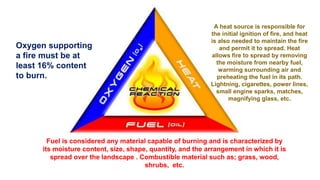
Oxygen supporting
a fire must be at
least 16% content
to burn.
Fuel is considered any material capable of burning and is characterized by
its moisture content, size, shape, quantity, and the arrangement in which it is
spread over the landscape . Combustible material such as; grass, wood,
shrubs, etc.
A heat source is responsible for
the initial ignition of fire, and heat
is also needed to maintain the fire
and permit it to spread. Heat
allows fire to spread by removing
the moisture from nearby fuel,
warming surrounding air and
preheating the fuel in its path.
Lightning, cigarettes, power lines,
small engine sparks, matches,
magnifying glass, etc.
Electrical
Faulty wiring is a misnomer. If there is actually faulty
wiring, there would have been no electrical power from
the very start when you switch on the circuit breaker or
the main service protective equipment. What actually
happens is that the wires or circuit becomes overloaded
due to increase in the load the circuit carries without
changing the size of the wires. The subsequent effect
will be weakening of the insulation of the wires due to
overheating in the circuit caused by the additional load.
Incendiarism (Arson)
It pertains to the malicious burning of
property, using certain chemicals, bombs,
etc, and causing fire start.
Open flames
Unattended burning candles or kerosene
lamps that are placed near flammable/
combustible material is a fire waiting to
happen. Unattended cooking causes most
fires in the homes that occur in the kitchen.
Oil or fat starting to smoke is near the
combustion point and can ignite violently.
Liquefied Petroleum Gas (LPG)
LPG is liquid inside the container, but immediately
transforms to the gaseous state when released. It is
liquefied so it can be stored economically and
transported easily. A gallon of liquid LPG in a bottle
will expand about 270 times as much when
suspended in a vapor form. LPG is colorless,
tasteless & odorless, but odorizing agent called
“ethyl mercaptan” is introduced so that leaks can be
easily detected.
Fireworks
These are beautiful pyrotechnic displays resulting from
the occurrence of certain oxidation, reduction, and
reactions. The substances that produce fireworks are
hazardous materials. These must be stored, transported,
handled as oxidizers, and displayed by experienced, and
knowledgeable professionals. Implementation of
prohibitions in the manufacture, handling and use should
be strictly complied with everyone as fire safety
precaution.
Spontaneous Ignition
This occurs as a result of a chemical reaction
within the material. It is a reaction independent of
any outside source of heat. It begins with
spontaneous heating which some of the common
materials that may spontaneously heat and ignite
are animal oils, mixed fish oils, coal, sawdust, hay,
grain, and cotton.
Static electricity
It involves the movement of electrons between two
objects in contact with each other. Electrical charges
are produced on the objects when they are
separated. If the charge builds up, it will develop
enough energy to jump as a spark to a nearby
grounded or less highly charged object. This spark
can ignite flammable vapors, flammable gases or
finely dispersed combustible solid materials.
Smoking
Careless smoking especially in bed is a
leading cause of fire in the homes. In the
Philippines it is the fourth leading cause of
fire.
The fire killed 162 people in Quezon City 21
years ago and is considered the worst club
fire in the Philippines and seventh in the
world (https://www.rappler.com/move-
ph/issues/disasters/knowledge-
base/87521-1996-ozone-disco-club-fire)
Group 1: Make I list on how you can PREVENT fire
at home.
Group 2: Make a list on what to do in the event of
fire.
s
Group 3: Make a list on what to do if a person is
on fire.
1. In the Fire Triangle, which of the following raise the
material for its ignition temperature?
a. Fuel
b. Oxygen
c. Chemical
d. Heat
2. If you catch a fire, you need to do the “Dock, cover
and Hold right away
True
False
3. When answering a phone call, you
must turn off the stove, or you leave
the room
True
False
4. Pertains to the malicious burning of
property:
a. Fraud
b. Plunder
c. Arson
d. Slander
5. It is worthless that everyone knows
what to do and act decisively when a
fire will happen
True
False
6. Wood, kerosene, heat of the sun: What
will should be added to create a fire?
a. Oxygen
b. Wind
c. Water
d. Soil
7. What does BFP stand for?
a. Bureau of Fire Protection
b. Bureau of Fire Program
c. Bureau of Fire Practice
d. Bureau of Fire Piracy
8. They are uncontrolled fires in rural
areas or countryside
a. Grassfire
b. Wildfire
c. Urban Fire
d. Fire
9. On March 1996, the Philippines
witnessed its worst urban fire disaster
located at:
a. Helium Disco Club
b. Carbon Disco Club
c. Fire Disco Club
d. Ozone Disco Club
10. The following are causes of fire except:
a. Candles
b. Arson
c. Fireworks
d. Calculus
Fire Triangle PPT.pptx

Fire Triangle PPT.pptx

  • 1.
  • 2.
    Objectives: Discuss the elementsof fire triangle  Identify the different causes of fire  Apply how fire can be prevented and  Orient oneself about precautionary measures and procedures in a fire incident
  • 4.
    1. How cana match create a fire? Ans: The match head is made of potassium chlorate. When it gets hot, it releases a lot of extra oxygen and heat. These makes the match head burn quickly and strongly. 2. Why do you think the fire was extinguished after a while when a glass covered the lighted candle? Ans: This happens because oxygen in the air inside the glass is utilized in burning the candle. All oxygen gets converted into carbon dioxide. Carbon dioxide does not support burning and hence candles stops burning.
  • 6.
    Oxygen supporting a firemust be at least 16% content to burn. Fuel is considered any material capable of burning and is characterized by its moisture content, size, shape, quantity, and the arrangement in which it is spread over the landscape . Combustible material such as; grass, wood, shrubs, etc. A heat source is responsible for the initial ignition of fire, and heat is also needed to maintain the fire and permit it to spread. Heat allows fire to spread by removing the moisture from nearby fuel, warming surrounding air and preheating the fuel in its path. Lightning, cigarettes, power lines, small engine sparks, matches, magnifying glass, etc.
  • 8.
    Electrical Faulty wiring isa misnomer. If there is actually faulty wiring, there would have been no electrical power from the very start when you switch on the circuit breaker or the main service protective equipment. What actually happens is that the wires or circuit becomes overloaded due to increase in the load the circuit carries without changing the size of the wires. The subsequent effect will be weakening of the insulation of the wires due to overheating in the circuit caused by the additional load.
  • 9.
    Incendiarism (Arson) It pertainsto the malicious burning of property, using certain chemicals, bombs, etc, and causing fire start.
  • 10.
    Open flames Unattended burningcandles or kerosene lamps that are placed near flammable/ combustible material is a fire waiting to happen. Unattended cooking causes most fires in the homes that occur in the kitchen. Oil or fat starting to smoke is near the combustion point and can ignite violently.
  • 11.
    Liquefied Petroleum Gas(LPG) LPG is liquid inside the container, but immediately transforms to the gaseous state when released. It is liquefied so it can be stored economically and transported easily. A gallon of liquid LPG in a bottle will expand about 270 times as much when suspended in a vapor form. LPG is colorless, tasteless & odorless, but odorizing agent called “ethyl mercaptan” is introduced so that leaks can be easily detected.
  • 12.
    Fireworks These are beautifulpyrotechnic displays resulting from the occurrence of certain oxidation, reduction, and reactions. The substances that produce fireworks are hazardous materials. These must be stored, transported, handled as oxidizers, and displayed by experienced, and knowledgeable professionals. Implementation of prohibitions in the manufacture, handling and use should be strictly complied with everyone as fire safety precaution.
  • 13.
    Spontaneous Ignition This occursas a result of a chemical reaction within the material. It is a reaction independent of any outside source of heat. It begins with spontaneous heating which some of the common materials that may spontaneously heat and ignite are animal oils, mixed fish oils, coal, sawdust, hay, grain, and cotton.
  • 14.
    Static electricity It involvesthe movement of electrons between two objects in contact with each other. Electrical charges are produced on the objects when they are separated. If the charge builds up, it will develop enough energy to jump as a spark to a nearby grounded or less highly charged object. This spark can ignite flammable vapors, flammable gases or finely dispersed combustible solid materials.
  • 15.
    Smoking Careless smoking especiallyin bed is a leading cause of fire in the homes. In the Philippines it is the fourth leading cause of fire.
  • 17.
    The fire killed162 people in Quezon City 21 years ago and is considered the worst club fire in the Philippines and seventh in the world (https://www.rappler.com/move- ph/issues/disasters/knowledge- base/87521-1996-ozone-disco-club-fire)
  • 18.
    Group 1: MakeI list on how you can PREVENT fire at home. Group 2: Make a list on what to do in the event of fire. s Group 3: Make a list on what to do if a person is on fire.
  • 20.
    1. In theFire Triangle, which of the following raise the material for its ignition temperature? a. Fuel b. Oxygen c. Chemical d. Heat
  • 21.
    2. If youcatch a fire, you need to do the “Dock, cover and Hold right away True False
  • 22.
    3. When answeringa phone call, you must turn off the stove, or you leave the room True False
  • 23.
    4. Pertains tothe malicious burning of property: a. Fraud b. Plunder c. Arson d. Slander
  • 24.
    5. It isworthless that everyone knows what to do and act decisively when a fire will happen True False
  • 25.
    6. Wood, kerosene,heat of the sun: What will should be added to create a fire? a. Oxygen b. Wind c. Water d. Soil
  • 26.
    7. What doesBFP stand for? a. Bureau of Fire Protection b. Bureau of Fire Program c. Bureau of Fire Practice d. Bureau of Fire Piracy
  • 27.
    8. They areuncontrolled fires in rural areas or countryside a. Grassfire b. Wildfire c. Urban Fire d. Fire
  • 28.
    9. On March1996, the Philippines witnessed its worst urban fire disaster located at: a. Helium Disco Club b. Carbon Disco Club c. Fire Disco Club d. Ozone Disco Club
  • 29.
    10. The followingare causes of fire except: a. Candles b. Arson c. Fireworks d. Calculus