1
FIRE EMERGENCY
PROCEDURE
(Code Red) (Ext: 000)
What is Fire ?
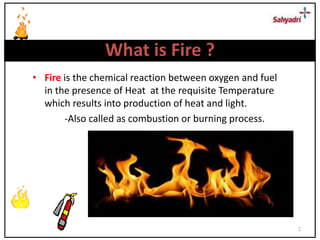
• Fire is the chemical reaction between oxygen and fuel
in the presence of Heat at the requisite Temperature
which results into production of heat and light.
-Also called as combustion or burning process.
2
3
How Does A Fire Work?
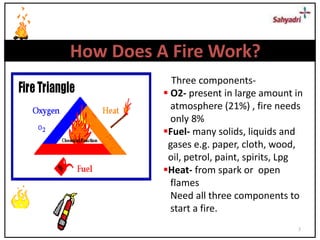
Three components-
 O2- present in large amount in
atmosphere (21%) , fire needs
only 8%
Fuel- many solids, liquids and
gases e.g. paper, cloth, wood,
oil, petrol, paint, spirits, Lpg
Heat- from spark or open
flames
Need all three components to
start a fire.
4
How to extinguish fire? /Methods
Methods Of Extinguishing Fire
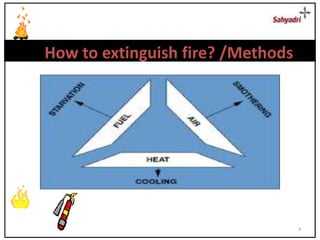
• Smothering-
Removing/Lowering Oxygen Level below 8% by -
- using fire blankets, dry chemical powder or soil,
foam
- dilution of O2 with inert gases like CO2 or halons
• Starvation-
Removal of fuel by- physical manipulation or separation
• Cooling-
Absorption of heat by using water, water mist, fog
5
Classification Of Fire
6
Class A- Ordinary solids like wood, paper, cloth, trash,
plastics, solids that are not metals.
Class B- Flammable liquids like Petrol, oil, grease,
paint, acids, ethers, spirits, organic solvents
Class C- Flammable gases like Lpg, acetylene, Cng
Class D- Metals Fire & Live Electronics Equipment
Magnesium, Titanium, Lithium, Sodium
Causes Of Fire In Hospital
7
• Smoking materials
• Electronic, office and entertainment equipments
• Medical equipments - oxygen and radiological equipments
• Cloth washers and dryers
• Heating equipments – boilers, incinerators, electrical stoves
• Electrical distribution and lighting equipments
• Contained trash and debris
• Cooking equipments
• Intentional cause
Extinguishing Media
8
Different types of fire extinguishing media are used to fight
different classes of fire.
1. Water- for Class A fire only
2. Mechanical Foam- for Class A & Class B fire
3. CO2- for all Classes of fire A, B, C, D
4. Dry Chemical Powder- for Class A, Class B and Class C type
fires
Fire Protection Systems
• Fire Fighting System-
A) Hand appliances- e.g. sand buckets, fire extinguishers
B) Fixed fire fighting system- e.g. fire pumps, fire hydrant
valves, rubber hose reels, hose boxes, sprinkler system
• Fire Alarm System-
e.g. control panel, smoke detectors, heat detectors,
manual call points
• Public Addressing System- e.g. Mike and Speakers
-
9
Fire Protection System
10
Smoke Detector
Fire Hydrant Valves
Sprinkler System
Hose Boxes
Manual call point
Rubber hose reel
Fire Extinguishers
11
A AB ABC ABCD
What Is Fire Extinguisher?
• Extinguisher is handy, portable fire fighting appliance
with limited capacities of fire extinguishing media
and used as a First Aid on certain types of fire in
initial stages.
• Used in the intermediate between discovery of fire
and arrival of professional fire fighters.
12
13
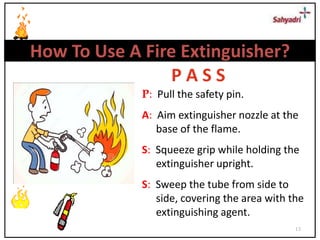
How To Use A Fire Extinguisher?
P A S S
P: Pull the safety pin.
A: Aim extinguisher nozzle at the
base of the flame.
S: Squeeze grip while holding the
extinguisher upright.
S: Sweep the tube from side to
side, covering the area with the
extinguishing agent.
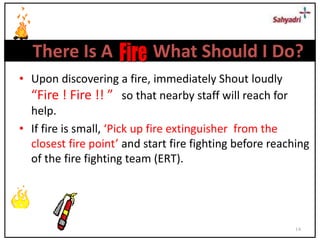
There Is A What Should I Do?
• Upon discovering a fire, immediately Shout loudly
“Fire ! Fire !! ” so that nearby staff will reach for
help.
• If fire is small, ‘Pick up fire extinguisher from the
closest fire point’ and start fire fighting before reaching
of the fire fighting team (ERT).
14
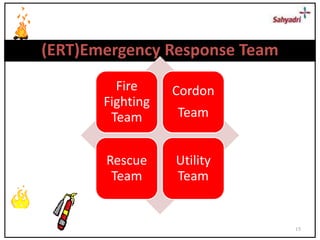
(ERT)Emergency Response Team
Fire
Fighting
Team
Cordon
Team
Rescue
Team
Utility
Team
15
16
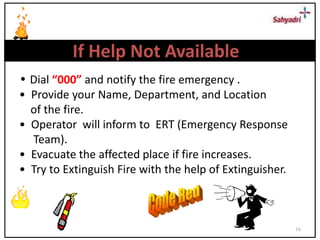
If Help Not Available
• Dial “000” and notify the fire emergency .
• Provide your Name, Department, and Location
of the fire.
• Operator will inform to ERT (Emergency Response
Team).
• Evacuate the affected place if fire increases.
• Try to Extinguish Fire with the help of Extinguisher.
17
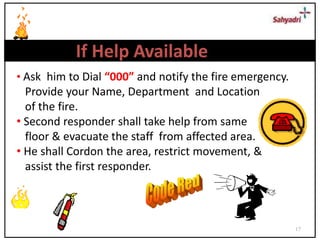
• Ask him to Dial “000” and notify the fire emergency.
Provide your Name, Department and Location
of the fire.
• Second responder shall take help from same
floor & evacuate the staff from affected area.
• He shall Cordon the area, restrict movement, &
assist the first responder.
If Help Available
18
• After Receiving the call, fire fighting team will
immediately reach at the location of fire & start
extinguishing the fire.
• Telephone operator will announce Code Red with
location through PA System three times ( *only incase
of major fire & with permission or Authorization of
Fire & Safety Officer/Chief Operations Officer.)
• Staff will be evacuated from affected area to safe
location of same floor (or as per the requirement).
Action
Action
• Requirement of oxygen supply cut off In affected area will
be assessed and decision will be taken accordingly.
• Clinical staff will do alternate arrangement before cut off
the oxygen supply for patients.
• Stretchers, beds, wheel chairs & space for putting beds
will be arranged incase there is need for patient
evacuation.
19
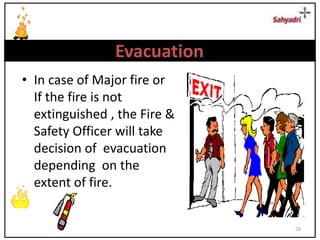
• In case of Major fire or
If the fire is not
extinguished , the Fire &
Safety Officer will take
decision of evacuation
depending on the
extent of fire.
20
Evacuation
Types of Evacuation
• Horizontal Evacuation (on same floor)
• Vertical Evacuation (2 floor up 1 floor down)
• Full Evacuation
21
Evacuation Guidelines
• Safely stop your work and gather your personal belongings if it is safe.
• If safe, close your room doors and windows, but do not lock them and
proceed to assembly point.
• Stay calm; do not run; walk fast and do not panic.
• Use the nearest safe stairs and proceed to the nearest exit. Do not use
the elevator/lift.
• Wait for instructions from emergency responders at assembly point.
• Do not re-enter the building or work area until you have been
instructed to do so by the emergency responders.
• Do not leave assembly area until all clear is given by the operation
manager.
22
Assembly Point
• Upper Parking Area of the extension
building is the common gathering point
(Assembly Area).
• The Fire & Safety Manager will issue the
“All Clear” when the building is deemed
safe.
23
Questions
24
THANK YOU
&
ALL THE BEST
25

Fire emergency procedure

  • 1.
  • 2.
    What is Fire? • Fire is the chemical reaction between oxygen and fuel in the presence of Heat at the requisite Temperature which results into production of heat and light. -Also called as combustion or burning process. 2
  • 3.
    3 How Does AFire Work? Three components-  O2- present in large amount in atmosphere (21%) , fire needs only 8% Fuel- many solids, liquids and gases e.g. paper, cloth, wood, oil, petrol, paint, spirits, Lpg Heat- from spark or open flames Need all three components to start a fire.
  • 4.
    4 How to extinguishfire? /Methods
  • 5.
    Methods Of ExtinguishingFire • Smothering- Removing/Lowering Oxygen Level below 8% by - - using fire blankets, dry chemical powder or soil, foam - dilution of O2 with inert gases like CO2 or halons • Starvation- Removal of fuel by- physical manipulation or separation • Cooling- Absorption of heat by using water, water mist, fog 5
  • 6.
    Classification Of Fire 6 ClassA- Ordinary solids like wood, paper, cloth, trash, plastics, solids that are not metals. Class B- Flammable liquids like Petrol, oil, grease, paint, acids, ethers, spirits, organic solvents Class C- Flammable gases like Lpg, acetylene, Cng Class D- Metals Fire & Live Electronics Equipment Magnesium, Titanium, Lithium, Sodium
  • 7.
    Causes Of FireIn Hospital 7 • Smoking materials • Electronic, office and entertainment equipments • Medical equipments - oxygen and radiological equipments • Cloth washers and dryers • Heating equipments – boilers, incinerators, electrical stoves • Electrical distribution and lighting equipments • Contained trash and debris • Cooking equipments • Intentional cause
  • 8.
    Extinguishing Media 8 Different typesof fire extinguishing media are used to fight different classes of fire. 1. Water- for Class A fire only 2. Mechanical Foam- for Class A & Class B fire 3. CO2- for all Classes of fire A, B, C, D 4. Dry Chemical Powder- for Class A, Class B and Class C type fires
  • 9.
    Fire Protection Systems •Fire Fighting System- A) Hand appliances- e.g. sand buckets, fire extinguishers B) Fixed fire fighting system- e.g. fire pumps, fire hydrant valves, rubber hose reels, hose boxes, sprinkler system • Fire Alarm System- e.g. control panel, smoke detectors, heat detectors, manual call points • Public Addressing System- e.g. Mike and Speakers - 9
  • 10.
    Fire Protection System 10 SmokeDetector Fire Hydrant Valves Sprinkler System Hose Boxes Manual call point Rubber hose reel
  • 11.
  • 12.
    What Is FireExtinguisher? • Extinguisher is handy, portable fire fighting appliance with limited capacities of fire extinguishing media and used as a First Aid on certain types of fire in initial stages. • Used in the intermediate between discovery of fire and arrival of professional fire fighters. 12
  • 13.
    13 How To UseA Fire Extinguisher? P A S S P: Pull the safety pin. A: Aim extinguisher nozzle at the base of the flame. S: Squeeze grip while holding the extinguisher upright. S: Sweep the tube from side to side, covering the area with the extinguishing agent.
  • 14.
    There Is AWhat Should I Do? • Upon discovering a fire, immediately Shout loudly “Fire ! Fire !! ” so that nearby staff will reach for help. • If fire is small, ‘Pick up fire extinguisher from the closest fire point’ and start fire fighting before reaching of the fire fighting team (ERT). 14
  • 15.
  • 16.
    16 If Help NotAvailable • Dial “000” and notify the fire emergency . • Provide your Name, Department, and Location of the fire. • Operator will inform to ERT (Emergency Response Team). • Evacuate the affected place if fire increases. • Try to Extinguish Fire with the help of Extinguisher.
  • 17.
    17 • Ask himto Dial “000” and notify the fire emergency. Provide your Name, Department and Location of the fire. • Second responder shall take help from same floor & evacuate the staff from affected area. • He shall Cordon the area, restrict movement, & assist the first responder. If Help Available
  • 18.
    18 • After Receivingthe call, fire fighting team will immediately reach at the location of fire & start extinguishing the fire. • Telephone operator will announce Code Red with location through PA System three times ( *only incase of major fire & with permission or Authorization of Fire & Safety Officer/Chief Operations Officer.) • Staff will be evacuated from affected area to safe location of same floor (or as per the requirement). Action
  • 19.
    Action • Requirement ofoxygen supply cut off In affected area will be assessed and decision will be taken accordingly. • Clinical staff will do alternate arrangement before cut off the oxygen supply for patients. • Stretchers, beds, wheel chairs & space for putting beds will be arranged incase there is need for patient evacuation. 19
  • 20.
    • In caseof Major fire or If the fire is not extinguished , the Fire & Safety Officer will take decision of evacuation depending on the extent of fire. 20 Evacuation
  • 21.
    Types of Evacuation •Horizontal Evacuation (on same floor) • Vertical Evacuation (2 floor up 1 floor down) • Full Evacuation 21
  • 22.
    Evacuation Guidelines • Safelystop your work and gather your personal belongings if it is safe. • If safe, close your room doors and windows, but do not lock them and proceed to assembly point. • Stay calm; do not run; walk fast and do not panic. • Use the nearest safe stairs and proceed to the nearest exit. Do not use the elevator/lift. • Wait for instructions from emergency responders at assembly point. • Do not re-enter the building or work area until you have been instructed to do so by the emergency responders. • Do not leave assembly area until all clear is given by the operation manager. 22
  • 23.
    Assembly Point • UpperParking Area of the extension building is the common gathering point (Assembly Area). • The Fire & Safety Manager will issue the “All Clear” when the building is deemed safe. 23
  • 24.
  • 25.