PREOPERATIVE
PREPARATION
Dr Nisar Ahmed Arain
Assistant Professor
Anesthesia/Critical Care/ER
-Learning Objectives
-To be able to organize preoperative care and
the operating list
-To understand surgical, medical, and anesthetic
aspects of assesment
-How to optimize the patients condition
-How to take consent
-How to organize an operation list
-DEFINATION
-The pre-operative period runs from the time
the patient is admitted to the hospital or in
the surgicenter to the time that the surgery
begins
-Pre operative plan
-Gathering and recording concisely all relevant
information
-Planning to minimize risk and maximize benefit
for the patient
-Prepared for adverse events and how to deal
with them
-Communicate with patient and all members of
the team
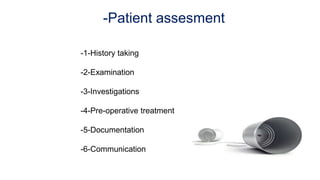
-Patient assesment
-1-History taking
-2-Examination
-3-Investigations
-4-Pre-operative treatment
-5-Documentation
-6-Communication
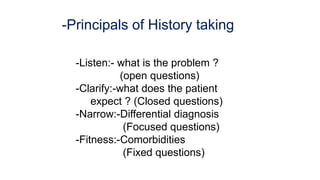
-Principals of History taking
-Listen:- what is the problem ?
(open questions)
-Clarify:-what does the patient
expect ? (Closed questions)
-Narrow:-Differential diagnosis
(Focused questions)
-Fitness:-Comorbidities
(Fixed questions)
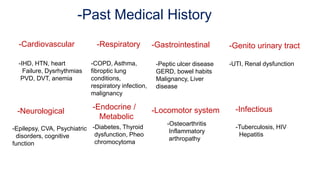
-Past Medical History
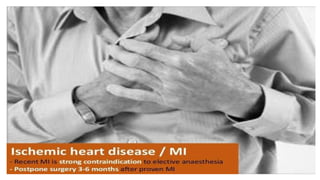
-Cardiovascular
-IHD, HTN, heart
Failure, Dysrhythmias
PVD, DVT, anemia
-Respiratory
-COPD, Asthma,
fibroptic lung
conditions,
respiratory infection,
malignancy
-Gastrointestinal
-Peptic ulcer disease
GERD, bowel habits
Malignancy, Liver
disease
-Genito urinary tract
-UTI, Renal dysfunction
-Neurological
-Epilepsy, CVA, Psychiatric
disorders, cognitive
function
-Endocrine /
Metabolic
-Diabetes, Thyroid
dysfunction, Pheo
chromocytoma
-Locomotor system
-Osteoarthritis
Inflammatory
arthropathy
-Infectious
-Tuberculosis, HIV
Hepatitis
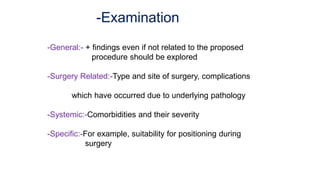
-Examination
-General:- + findings even if not related to the proposed
procedure should be explored
-Surgery Related:-Type and site of surgery, complications
which have occurred due to underlying pathology
-Systemic:-Comorbidities and their severity
-Specific:-For example, suitability for positioning during
surgery
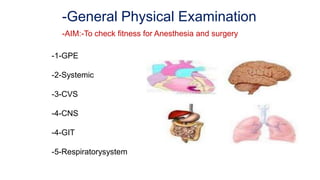
-General Physical Examination
-AIM:-To check fitness for Anesthesia and surgery
-1-GPE
-2-Systemic
-3-CVS
-4-CNS
-4-GIT
-5-Respiratorysystem
-Specific Surgical Examination
-AIM:-To confirm previous findings and diagnosis, to determine
severity and to gauge extent
-E.g. In inguinal hernia please confirm its inguinal not femoral
, It is reduceable or not reduceable and whether there
are any signs of bowel obstruction.
-Specific Medical Examination
-Aim:- is to evaluate the presence and severity
of other problems
-Diabetic patients undergoing surgery needs careful
examination for Sepsis, Neuropathy, or microvascular disease
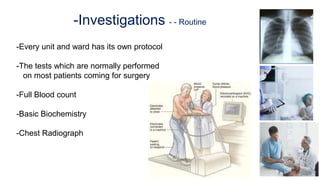
-Investigations - - Routine
-Every unit and ward has its own protocol
-The tests which are normally performed
on most patients coming for surgery
-Full Blood count
-Basic Biochemistry
-Chest Radiograph
-Investigations ---Targeted tests
-Hematology:-To exclude Anemia, for platelets
count
and to asses the amount of blood may be needed
during or after operation
-Urea, Creatinine, and Electrolytes:-State
of
dehydration and renal insufficiency
-Liver Function Tests:-Albumin and Protein
guide to nutritional status and shows any clotting
problems.
-Investigations – Others(Non specific)
-ECG:-Its recommended in all patients >65 years, patients
with blood loss and cardiovascular / Pulmonary problems
-Urinalysis:-Used for determination of renal function,
inflammation, infection, and metabolic disorders
-Pregnancy Test:- (B- HCG )
-HBsAg and HIV testing
-RBS and HbA1c :- Diabetes
-Blood Gas analysis :-Occ required
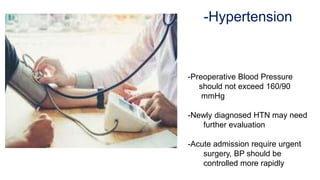
-Hypertension
-Preoperative Blood Pressure
should not exceed 160/90
mmHg
-Newly diagnosed HTN may need
further evaluation
-Acute admission require urgent
surgery, BP should be
controlled more rapidly
-Dysrhythmias
-Fast Atrial Fibrillation must be
controlled before surgery
-Warfarin should be stopped 3 to 4 days
before surgery
-Regular measurement of serum
potassium is essential
-Some conduction disorders may require
pacing
preoperatively, 2nd and 3rd degree heart
block
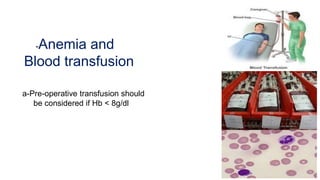
-Anemia and
Blood transfusion
a-Pre-operative transfusion should
be considered if Hb < 8g/dl
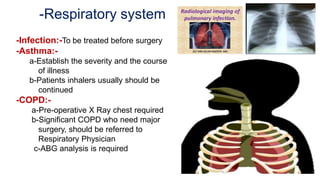
-Respiratory system
-Infection:-To be treated before surgery
-Asthma:-
a-Establish the severity and the course
of illness
b-Patients inhalers usually should be
continued
-COPD:-
a-Pre-operative X Ray chest required
b-Significant COPD who need major
surgery, should be referred to
Respiratory Physician
c-ABG analysis is required
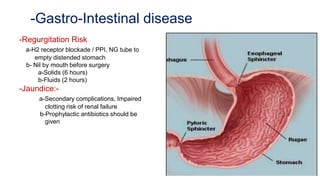
-Gastro-Intestinal disease
-Regurgitation Risk
a-H2 receptor blockade / PPI, NG tube to
empty distended stomach
b- Nil by mouth before surgery
a-Solids (6 hours)
b-Fluids (2 hours)
-Jaundice:-
a-Secondary complications, Impaired
clotting risk of renal failure
b-Prophylactic antibiotics should be
given
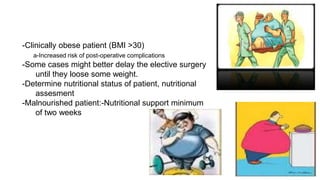
-Clinically obese patient (BMI >30)
a-Increased risk of post-operative complications
-Some cases might better delay the elective surgery
until they loose some weight.
-Determine nutritional status of patient, nutritional
assesment
-Malnourished patient:-Nutritional support minimum
of two weeks
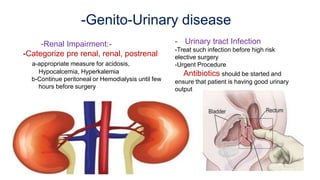
-Genito-Urinary disease
-Renal Impairment:-
-Categorize pre renal, renal, postrenal
a-appropriate measure for acidosis,
Hypocalcemia, Hyperkalemia
b-Continue peritoneal or Hemodialysis until few
hours before surgery
- Urinary tract Infection
-Treat such infection before high risk
elective surgery
-Urgent Procedure
Antibiotics should be started and
ensure that patient is having good urinary
output
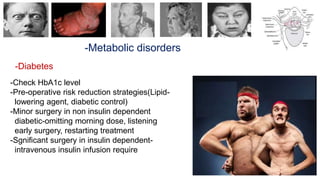
-Metabolic disorders
-Diabetes
-Check HbA1c level
-Pre-operative risk reduction strategies(Lipid-
lowering agent, diabetic control)
-Minor surgery in non insulin dependent
diabetic-omitting morning dose, listening
early surgery, restarting treatment
-Sgnificant surgery in insulin dependent-
intravenous insulin infusion require
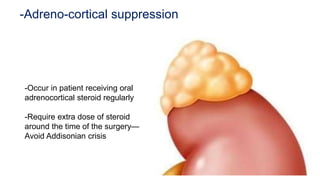
-Adreno-cortical suppression
-Occur in patient receiving oral
adrenocortical steroid regularly
-Require extra dose of steroid
around the time of the surgery—
Avoid Addisonian crisis
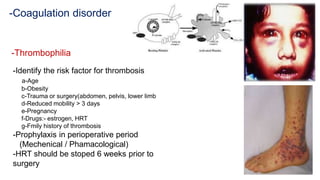
-Coagulation disorder
-Thrombophilia
-Identify the risk factor for thrombosis
a-Age
b-Obesity
c-Trauma or surgery(abdomen, pelvis, lower limb
d-Reduced mobility > 3 days
e-Pregnancy
f-Drugs:- estrogen, HRT
g-Fmily history of thrombosis
-Prophylaxis in perioperative period
(Mechenical / Phamacological)
-HRT should be stoped 6 weeks prior to
surgery
-Other disorders
-Neurological:-
-H/O stroke, with neurological Deficit
-Withdraw antiplatelet agents
a-Aspirin (7 days before)
b-Clopidogrel (10 days before)
-Neuropathies / Myopathies
need prolonged ventilation
-Psychiatric:-
-Need GA
-Certain medication
Mono-amine-oxidase
-inhibitor. Unwanted
interaction and anesthetic
medication
-Locomotor:-
-Inflammatory arthropathies
to be identified
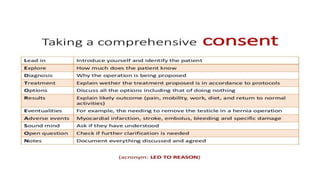
-Management Plan---KEY POINTS
-Provide all information necessary for the
patient to make an informed decision
-Discuss the options, rather then telling the
patient what will be done
-Give the patient time to think, things over
-Encourage to discuss the things– as a
trusted person
-Risk assesment and consent
-All life:- or limb—threatening complications rather all the
complications with an incidence of 1% or more should
be thoroughly discussed with the patient
-Risks:-Related to comorbidities, anesthesia and surgery
-Explain:-Advantages, side effects, prognosis
-Language:-Simple, use daily life comparisons to
explain risks
-Consents:-Valid consent is necessary except in
life—saving circumstances
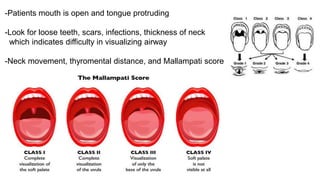
-Patients mouth is open and tongue protruding
-Look for loose teeth, scars, infections, thickness of neck
which indicates difficulty in visualizing airway
-Neck movement, thyromental distance, and Mallampati score
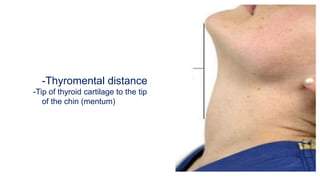
-Thyromental distance
-Tip of thyroid cartilage to the tip
of the chin (mentum)
-Arranging the theatre list
-Date, Time and Place of operation should be matched
with availability of the personnel.
-Appropriate equipment and instruments should be made
available
-Operation list should be distributed as early as possible
to all staff who are involved.
-Prioritize all the patients
a-First:-Children and diabetic patients
b-Life and Limb threatening surgery
c-Cancer patients
#Preoperative preparation

#Preoperative preparation

  • 1.
    PREOPERATIVE PREPARATION Dr Nisar AhmedArain Assistant Professor Anesthesia/Critical Care/ER
  • 4.
    -Learning Objectives -To beable to organize preoperative care and the operating list -To understand surgical, medical, and anesthetic aspects of assesment -How to optimize the patients condition -How to take consent -How to organize an operation list
  • 5.
    -DEFINATION -The pre-operative periodruns from the time the patient is admitted to the hospital or in the surgicenter to the time that the surgery begins
  • 6.
    -Pre operative plan -Gatheringand recording concisely all relevant information -Planning to minimize risk and maximize benefit for the patient -Prepared for adverse events and how to deal with them -Communicate with patient and all members of the team
  • 7.
  • 8.
    -Principals of Historytaking -Listen:- what is the problem ? (open questions) -Clarify:-what does the patient expect ? (Closed questions) -Narrow:-Differential diagnosis (Focused questions) -Fitness:-Comorbidities (Fixed questions)
  • 9.
    -Past Medical History -Cardiovascular -IHD,HTN, heart Failure, Dysrhythmias PVD, DVT, anemia -Respiratory -COPD, Asthma, fibroptic lung conditions, respiratory infection, malignancy -Gastrointestinal -Peptic ulcer disease GERD, bowel habits Malignancy, Liver disease -Genito urinary tract -UTI, Renal dysfunction -Neurological -Epilepsy, CVA, Psychiatric disorders, cognitive function -Endocrine / Metabolic -Diabetes, Thyroid dysfunction, Pheo chromocytoma -Locomotor system -Osteoarthritis Inflammatory arthropathy -Infectious -Tuberculosis, HIV Hepatitis
  • 10.
    -Examination -General:- + findingseven if not related to the proposed procedure should be explored -Surgery Related:-Type and site of surgery, complications which have occurred due to underlying pathology -Systemic:-Comorbidities and their severity -Specific:-For example, suitability for positioning during surgery
  • 11.
    -General Physical Examination -AIM:-Tocheck fitness for Anesthesia and surgery -1-GPE -2-Systemic -3-CVS -4-CNS -4-GIT -5-Respiratorysystem
  • 12.
    -Specific Surgical Examination -AIM:-Toconfirm previous findings and diagnosis, to determine severity and to gauge extent -E.g. In inguinal hernia please confirm its inguinal not femoral , It is reduceable or not reduceable and whether there are any signs of bowel obstruction.
  • 13.
    -Specific Medical Examination -Aim:-is to evaluate the presence and severity of other problems -Diabetic patients undergoing surgery needs careful examination for Sepsis, Neuropathy, or microvascular disease
  • 14.
    -Investigations - -Routine -Every unit and ward has its own protocol -The tests which are normally performed on most patients coming for surgery -Full Blood count -Basic Biochemistry -Chest Radiograph
  • 15.
    -Investigations ---Targeted tests -Hematology:-Toexclude Anemia, for platelets count and to asses the amount of blood may be needed during or after operation -Urea, Creatinine, and Electrolytes:-State of dehydration and renal insufficiency -Liver Function Tests:-Albumin and Protein guide to nutritional status and shows any clotting problems.
  • 16.
    -Investigations – Others(Nonspecific) -ECG:-Its recommended in all patients >65 years, patients with blood loss and cardiovascular / Pulmonary problems -Urinalysis:-Used for determination of renal function, inflammation, infection, and metabolic disorders -Pregnancy Test:- (B- HCG ) -HBsAg and HIV testing -RBS and HbA1c :- Diabetes -Blood Gas analysis :-Occ required
  • 18.
    -Hypertension -Preoperative Blood Pressure shouldnot exceed 160/90 mmHg -Newly diagnosed HTN may need further evaluation -Acute admission require urgent surgery, BP should be controlled more rapidly
  • 20.
    -Dysrhythmias -Fast Atrial Fibrillationmust be controlled before surgery -Warfarin should be stopped 3 to 4 days before surgery -Regular measurement of serum potassium is essential -Some conduction disorders may require pacing preoperatively, 2nd and 3rd degree heart block
  • 21.
    -Anemia and Blood transfusion a-Pre-operativetransfusion should be considered if Hb < 8g/dl
  • 22.
    -Respiratory system -Infection:-To betreated before surgery -Asthma:- a-Establish the severity and the course of illness b-Patients inhalers usually should be continued -COPD:- a-Pre-operative X Ray chest required b-Significant COPD who need major surgery, should be referred to Respiratory Physician c-ABG analysis is required
  • 23.
    -Gastro-Intestinal disease -Regurgitation Risk a-H2receptor blockade / PPI, NG tube to empty distended stomach b- Nil by mouth before surgery a-Solids (6 hours) b-Fluids (2 hours) -Jaundice:- a-Secondary complications, Impaired clotting risk of renal failure b-Prophylactic antibiotics should be given
  • 24.
    -Clinically obese patient(BMI >30) a-Increased risk of post-operative complications -Some cases might better delay the elective surgery until they loose some weight. -Determine nutritional status of patient, nutritional assesment -Malnourished patient:-Nutritional support minimum of two weeks
  • 25.
    -Genito-Urinary disease -Renal Impairment:- -Categorizepre renal, renal, postrenal a-appropriate measure for acidosis, Hypocalcemia, Hyperkalemia b-Continue peritoneal or Hemodialysis until few hours before surgery - Urinary tract Infection -Treat such infection before high risk elective surgery -Urgent Procedure Antibiotics should be started and ensure that patient is having good urinary output
  • 26.
    -Metabolic disorders -Diabetes -Check HbA1clevel -Pre-operative risk reduction strategies(Lipid- lowering agent, diabetic control) -Minor surgery in non insulin dependent diabetic-omitting morning dose, listening early surgery, restarting treatment -Sgnificant surgery in insulin dependent- intravenous insulin infusion require
  • 27.
    -Adreno-cortical suppression -Occur inpatient receiving oral adrenocortical steroid regularly -Require extra dose of steroid around the time of the surgery— Avoid Addisonian crisis
  • 28.
    -Coagulation disorder -Thrombophilia -Identify therisk factor for thrombosis a-Age b-Obesity c-Trauma or surgery(abdomen, pelvis, lower limb d-Reduced mobility > 3 days e-Pregnancy f-Drugs:- estrogen, HRT g-Fmily history of thrombosis -Prophylaxis in perioperative period (Mechenical / Phamacological) -HRT should be stoped 6 weeks prior to surgery
  • 29.
    -Other disorders -Neurological:- -H/O stroke,with neurological Deficit -Withdraw antiplatelet agents a-Aspirin (7 days before) b-Clopidogrel (10 days before) -Neuropathies / Myopathies need prolonged ventilation -Psychiatric:- -Need GA -Certain medication Mono-amine-oxidase -inhibitor. Unwanted interaction and anesthetic medication -Locomotor:- -Inflammatory arthropathies to be identified
  • 30.
    -Management Plan---KEY POINTS -Provideall information necessary for the patient to make an informed decision -Discuss the options, rather then telling the patient what will be done -Give the patient time to think, things over -Encourage to discuss the things– as a trusted person
  • 31.
    -Risk assesment andconsent -All life:- or limb—threatening complications rather all the complications with an incidence of 1% or more should be thoroughly discussed with the patient -Risks:-Related to comorbidities, anesthesia and surgery -Explain:-Advantages, side effects, prognosis -Language:-Simple, use daily life comparisons to explain risks -Consents:-Valid consent is necessary except in life—saving circumstances
  • 32.
    -Patients mouth isopen and tongue protruding -Look for loose teeth, scars, infections, thickness of neck which indicates difficulty in visualizing airway -Neck movement, thyromental distance, and Mallampati score
  • 33.
    -Thyromental distance -Tip ofthyroid cartilage to the tip of the chin (mentum)
  • 35.
    -Arranging the theatrelist -Date, Time and Place of operation should be matched with availability of the personnel. -Appropriate equipment and instruments should be made available -Operation list should be distributed as early as possible to all staff who are involved. -Prioritize all the patients a-First:-Children and diabetic patients b-Life and Limb threatening surgery c-Cancer patients