LT COL SM SHAHADAT HOSSAIN
MCPS,FCPS( Surgery),FCPS(Thoracic
surgery)
Surgical Spl & Thoracic Surgeon
CMH, Bogra
PREOPERATIVE PREPARATION
INTRODUCTION
 To obtain satisfactory results in surgery requires a
careful approach to preoperative preparation is
necessary
 High risk patients should be identified early and
appropriate measures taken to reduce complications
 The approach is multidisciplinary. It involves
participation of anaesthetic and surgical teams,
radiologists, pathologists, specialist nursing staff and
Operating Room staffs.

PREOPERATIVE PLAN
Preoperative plan for the best patient
outcomes
 Gather and record all relevant information
 Optimise patient condition
 Choose surgery that offers minimal risk and
maximum benefit
 Anticipate and plan for adverse events •
Inform everyone concerned
PREOPERATIVE SITUATION
 Emergency : Life-threatening condition requiring
immediate action ( e.g. Extradural haematoma,
penetrating trauma, peritonitis, ruptured aneurysm,
crush injury)
 Urgent :Surgery required within few hours (
e.g.Perforation, intestinal obstruction, appendicitis,
ectopic pregnancy)
 Elective : ( e.g.Cholelithiasis, hernia, pyloric stenosis,
varicose vein, colorectal malignancies, breast
malignancy )
ROUTINE PREPARATION FOR SURGERY
 History
 Physical examination
 Special investigation
 Informed consent
 Marking the site/side of operation
 Thromboembolic prophylaxis
 Antibiotic prophylaxis
PATIENT ASSESSMENT
HISTORY TAKING:
Principles of history taking
• Listen: What is the problem? (Open questions)
• Clarify: What does the patient expect?(Closed questions)
• Narrow: Differential diagnosis (Focused questions)
• Fitness: Co morbidities (Fixed questions)
History
Past History:
 Ischaemic heart disease ,arrhythmias
 Hypertension, Heart failure
 Diabetes, Thyroid dysfunction
 Chronic obstructive pulmonary disease, Asthma,
Tuberculosis
 Renal dysfunction, Hepatitis, Malignancy, Allergy
Drug History: HTN,OHA,Thyroid,
Personal history:
Examination
General:
 Anaemia
 Jaundice
 Cyanosis
 Nutritional status/Dehydration
 Lymh nodes
 Sources of infection (teeth, feet, leg ulcers)
Cardiovascular:
 Pulse
 Blood pressure
 Heart sounds
 Bruits
 Peripheral oedema
Examination
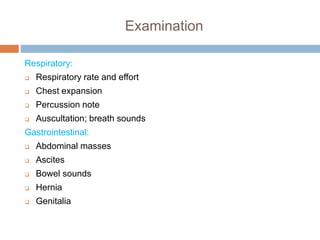
Respiratory:
 Respiratory rate and effort
 Chest expansion
 Percussion note
 Auscultation; breath sounds
Gastrointestinal:
 Abdominal masses
 Ascites
 Bowel sounds
 Hernia
 Genitalia
Examination
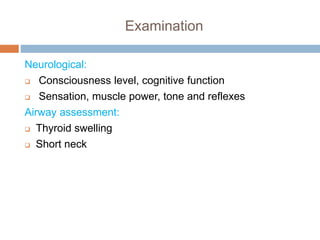
Neurological:
 Consciousness level, cognitive function
 Sensation, muscle power, tone and reflexes
Airway assessment:
 Thyroid swelling
 Short neck
Investigations
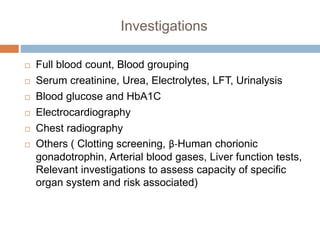
 Full blood count, Blood grouping
 Serum creatinine, Urea, Electrolytes, LFT, Urinalysis
 Blood glucose and HbA1C
 Electrocardiography
 Chest radiography
 Others ( Clotting screening, β-Human chorionic
gonadotrophin, Arterial blood gases, Liver function tests,
Relevant investigations to assess capacity of specific
organ system and risk associated)
SPECIFIC PREOPERATIVE
PROBLEMS AND MANAGEMENT
Cardiovascular disease
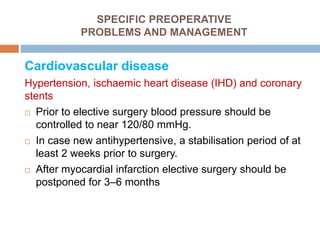
Hypertension, ischaemic heart disease (IHD) and coronary
stents
 Prior to elective surgery blood pressure should be
controlled to near 120/80 mmHg.
 In case new antihypertensive, a stabilisation period of at
least 2 weeks prior to surgery.
 After myocardial infarction elective surgery should be
postponed for 3–6 months
Specific preoperative problems
Dysrhythmias
 β-blockers, digoxin or calcium channel blockers should
be started preoperatively
 Warfarin should be stopped 5 days preoperatively to
achieve an international normalised ratio (INR) of 1.5 or
less
 Antiplatelet agents should be withdrawn (7 days for
aspirin, 10 days for clopidogrel)
Specific preoperative problems
Anaemia and blood transfusion
In case of elective surgery:
 Correctable cause of anemia- delay surgery e.g. Iron/Vit
Deficiency
 Uncorrectable cause e.g. Haemorrhoid, GI bleeding –
blood transfusion
 Blood transfusion are also required during emergency
surgeries
Specific preoperative problems
Respiratory disease
Postoperative pneumonia increase the morbidity and
mortality
Assessment should be done in:
 All lung resection cases
 Major abdominal and thoracic cases in patients older
than 60 years
Specific preoperative problems
Tests should be done:
 CT scan of chest
 Forced vital capacity in 1 sec(FEV-1)
 Forced vital capacity
 Diffusing capacity of carbon monoxide
Specific preoperative problems
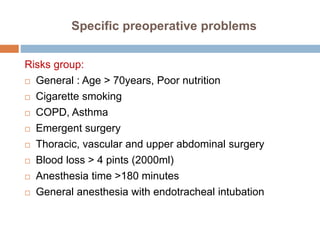
Risks group:
 General : Age > 70years, Poor nutrition
 Cigarette smoking
 COPD, Asthma
 Emergent surgery
 Thoracic, vascular and upper abdominal surgery
 Blood loss > 4 pints (2000ml)
 Anesthesia time >180 minutes
 General anesthesia with endotracheal intubation
Specific preoperative problems
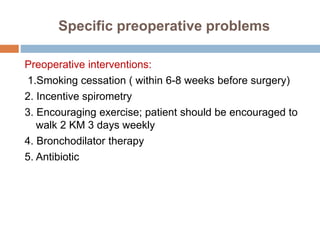
Preoperative interventions:
1.Smoking cessation ( within 6-8 weeks before surgery)
2. Incentive spirometry
3. Encouraging exercise; patient should be encouraged to
walk 2 KM 3 days weekly
4. Bronchodilator therapy
5. Antibiotic
Specific preoperative problems
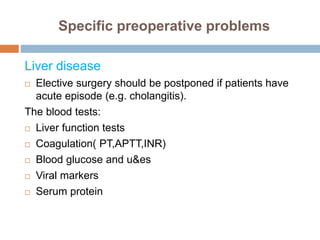
Liver disease
 Elective surgery should be postponed if patients have
acute episode (e.g. cholangitis).
The blood tests:
 Liver function tests
 Coagulation( PT,APTT,INR)
 Blood glucose and u&es
 Viral markers
 Serum protein
Specific preoperative problems
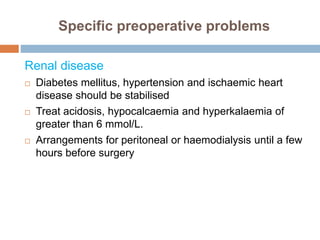
Renal disease
 Diabetes mellitus, hypertension and ischaemic heart
disease should be stabilised
 Treat acidosis, hypocalcaemia and hyperkalaemia of
greater than 6 mmol/L.
 Arrangements for peritoneal or haemodialysis until a few
hours before surgery
Specific preoperative problems
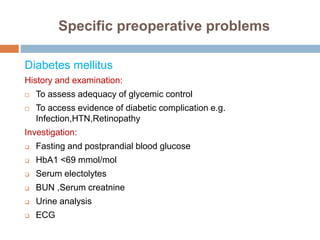
Diabetes mellitus
History and examination:
 To assess adequacy of glycemic control
 To access evidence of diabetic complication e.g.
Infection,HTN,Retinopathy
Investigation:
 Fasting and postprandial blood glucose
 HbA1 <69 mmol/mol
 Serum electolytes
 BUN ,Serum creatnine
 Urine analysis
 ECG
Specific preoperative problems
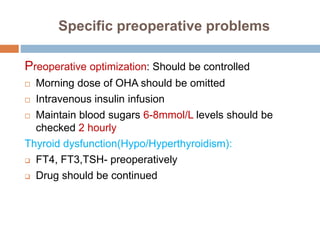
Preoperative optimization: Should be controlled
 Morning dose of OHA should be omitted
 Intravenous insulin infusion
 Maintain blood sugars 6-8mmol/L levels should be
checked 2 hourly
Thyroid dysfunction(Hypo/Hyperthyroidism):
 FT4, FT3,TSH- preoperatively
 Drug should be continued
Specific preoperative problems
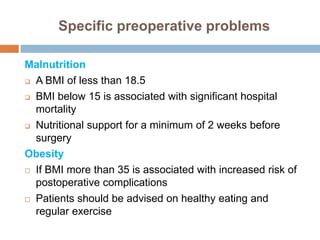
Malnutrition
 A BMI of less than 18.5
 BMI below 15 is associated with significant hospital
mortality
 Nutritional support for a minimum of 2 weeks before
surgery
Obesity
 If BMI more than 35 is associated with increased risk of
postoperative complications
 Patients should be advised on healthy eating and
regular exercise
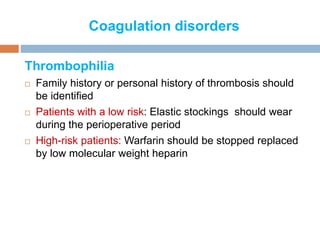
Coagulation disorders
Thrombophilia
 Family history or personal history of thrombosis should
be identified
 Patients with a low risk: Elastic stockings should wear
during the perioperative period
 High-risk patients: Warfarin should be stopped replaced
by low molecular weight heparin
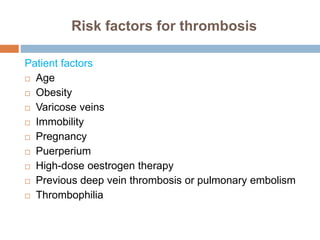
Risk factors for thrombosis
Patient factors
 Age
 Obesity
 Varicose veins
 Immobility
 Pregnancy
 Puerperium
 High-dose oestrogen therapy
 Previous deep vein thrombosis or pulmonary embolism
 Thrombophilia
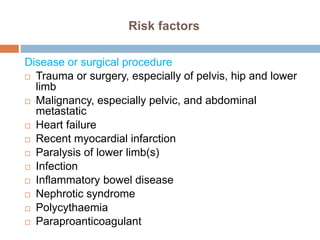
Risk factors
Disease or surgical procedure
 Trauma or surgery, especially of pelvis, hip and lower
limb
 Malignancy, especially pelvic, and abdominal
metastatic
 Heart failure
 Recent myocardial infarction
 Paralysis of lower limb(s)
 Infection
 Inflammatory bowel disease
 Nephrotic syndrome
 Polycythaemia
 Paraproanticoagulant
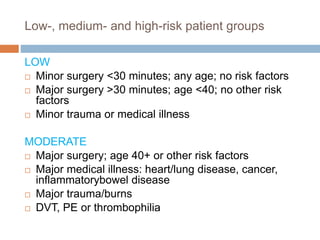
Low-, medium- and high-risk patient groups
LOW
 Minor surgery <30 minutes; any age; no risk factors
 Major surgery >30 minutes; age <40; no other risk
factors
 Minor trauma or medical illness
MODERATE
 Major surgery; age 40+ or other risk factors
 Major medical illness: heart/lung disease, cancer,
inflammatorybowel disease
 Major trauma/burns
 DVT, PE or thrombophilia
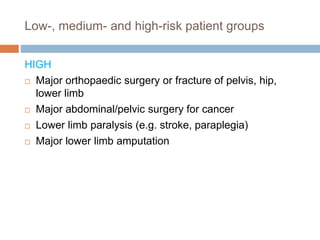
Low-, medium- and high-risk patient groups
HIGH
 Major orthopaedic surgery or fracture of pelvis, hip,
lower limb
 Major abdominal/pelvic surgery for cancer
 Lower limb paralysis (e.g. stroke, paraplegia)
 Major lower limb amputation
Prophylaxis of thrombosis
 Graduated elastic compression stockings
 External pneumatic compression
 Low molecular weight heparin (LMWH)
MEDICATIONS
 Continue medication for hypertension, ischaemic heart
disease.
 Convert oral steroid to intravenous hydrocortisone.
 Stop oral anticoagulation 3-4 days.
 Stop antiplatelet 5 days before surgery.
RISK ASSESSMENT AND CONSENT
Risks: Related to the co-morbidities, anaesthesia and
surgery
Explain: Advantages, side effects, prognosis
Language: Simple
Consents: Valid consent is necessary except in life-saving
circumstances
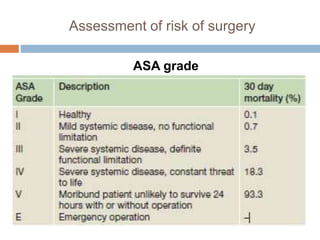
Assessment of risk of surgery
ASA grade
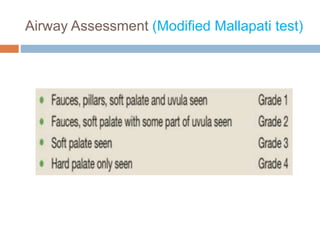
Airway Assessment (Modified Mallapati test)
ARRANGING THE THEATRE LIST
 Date, place and time of operation
 Appropriate equipment and instruments should be
available
 The operating list should be distributed as early as
possible
PRIORITISE PATIENTS
 Children and diabetic patients should be placed at the
beginning of the list
 Life- and limb-threatening surgery should take priority
 Cancer patients need to be treated early
SPECIAL CONSIDERATIONS
 Nil by mouth
 Patients are advised not to take solids within 6 hours
and clear fluids (isotonic drinks and water) within 2
hours before anaesthesia
 Infants are allowed a clear drink up to 2 hours, mother's
milk up to 3 hours and cow or formula milk up to 6 hours
before anaesthesia
Preoperative preparation

Preoperative preparation

  • 1.
    LT COL SMSHAHADAT HOSSAIN MCPS,FCPS( Surgery),FCPS(Thoracic surgery) Surgical Spl & Thoracic Surgeon CMH, Bogra PREOPERATIVE PREPARATION
  • 2.
    INTRODUCTION  To obtainsatisfactory results in surgery requires a careful approach to preoperative preparation is necessary  High risk patients should be identified early and appropriate measures taken to reduce complications  The approach is multidisciplinary. It involves participation of anaesthetic and surgical teams, radiologists, pathologists, specialist nursing staff and Operating Room staffs.
  • 3.
    PREOPERATIVE PLAN Preoperative planfor the best patient outcomes  Gather and record all relevant information  Optimise patient condition  Choose surgery that offers minimal risk and maximum benefit  Anticipate and plan for adverse events • Inform everyone concerned
  • 4.
    PREOPERATIVE SITUATION  Emergency: Life-threatening condition requiring immediate action ( e.g. Extradural haematoma, penetrating trauma, peritonitis, ruptured aneurysm, crush injury)  Urgent :Surgery required within few hours ( e.g.Perforation, intestinal obstruction, appendicitis, ectopic pregnancy)  Elective : ( e.g.Cholelithiasis, hernia, pyloric stenosis, varicose vein, colorectal malignancies, breast malignancy )
  • 5.
    ROUTINE PREPARATION FORSURGERY  History  Physical examination  Special investigation  Informed consent  Marking the site/side of operation  Thromboembolic prophylaxis  Antibiotic prophylaxis
  • 6.
    PATIENT ASSESSMENT HISTORY TAKING: Principlesof history taking • Listen: What is the problem? (Open questions) • Clarify: What does the patient expect?(Closed questions) • Narrow: Differential diagnosis (Focused questions) • Fitness: Co morbidities (Fixed questions)
  • 7.
    History Past History:  Ischaemicheart disease ,arrhythmias  Hypertension, Heart failure  Diabetes, Thyroid dysfunction  Chronic obstructive pulmonary disease, Asthma, Tuberculosis  Renal dysfunction, Hepatitis, Malignancy, Allergy Drug History: HTN,OHA,Thyroid, Personal history:
  • 8.
    Examination General:  Anaemia  Jaundice Cyanosis  Nutritional status/Dehydration  Lymh nodes  Sources of infection (teeth, feet, leg ulcers) Cardiovascular:  Pulse  Blood pressure  Heart sounds  Bruits  Peripheral oedema
  • 9.
    Examination Respiratory:  Respiratory rateand effort  Chest expansion  Percussion note  Auscultation; breath sounds Gastrointestinal:  Abdominal masses  Ascites  Bowel sounds  Hernia  Genitalia
  • 10.
    Examination Neurological:  Consciousness level,cognitive function  Sensation, muscle power, tone and reflexes Airway assessment:  Thyroid swelling  Short neck
  • 11.
    Investigations  Full bloodcount, Blood grouping  Serum creatinine, Urea, Electrolytes, LFT, Urinalysis  Blood glucose and HbA1C  Electrocardiography  Chest radiography  Others ( Clotting screening, β-Human chorionic gonadotrophin, Arterial blood gases, Liver function tests, Relevant investigations to assess capacity of specific organ system and risk associated)
  • 12.
    SPECIFIC PREOPERATIVE PROBLEMS ANDMANAGEMENT Cardiovascular disease Hypertension, ischaemic heart disease (IHD) and coronary stents  Prior to elective surgery blood pressure should be controlled to near 120/80 mmHg.  In case new antihypertensive, a stabilisation period of at least 2 weeks prior to surgery.  After myocardial infarction elective surgery should be postponed for 3–6 months
  • 13.
    Specific preoperative problems Dysrhythmias β-blockers, digoxin or calcium channel blockers should be started preoperatively  Warfarin should be stopped 5 days preoperatively to achieve an international normalised ratio (INR) of 1.5 or less  Antiplatelet agents should be withdrawn (7 days for aspirin, 10 days for clopidogrel)
  • 14.
    Specific preoperative problems Anaemiaand blood transfusion In case of elective surgery:  Correctable cause of anemia- delay surgery e.g. Iron/Vit Deficiency  Uncorrectable cause e.g. Haemorrhoid, GI bleeding – blood transfusion  Blood transfusion are also required during emergency surgeries
  • 15.
    Specific preoperative problems Respiratorydisease Postoperative pneumonia increase the morbidity and mortality Assessment should be done in:  All lung resection cases  Major abdominal and thoracic cases in patients older than 60 years
  • 16.
    Specific preoperative problems Testsshould be done:  CT scan of chest  Forced vital capacity in 1 sec(FEV-1)  Forced vital capacity  Diffusing capacity of carbon monoxide
  • 17.
    Specific preoperative problems Risksgroup:  General : Age > 70years, Poor nutrition  Cigarette smoking  COPD, Asthma  Emergent surgery  Thoracic, vascular and upper abdominal surgery  Blood loss > 4 pints (2000ml)  Anesthesia time >180 minutes  General anesthesia with endotracheal intubation
  • 18.
    Specific preoperative problems Preoperativeinterventions: 1.Smoking cessation ( within 6-8 weeks before surgery) 2. Incentive spirometry 3. Encouraging exercise; patient should be encouraged to walk 2 KM 3 days weekly 4. Bronchodilator therapy 5. Antibiotic
  • 19.
    Specific preoperative problems Liverdisease  Elective surgery should be postponed if patients have acute episode (e.g. cholangitis). The blood tests:  Liver function tests  Coagulation( PT,APTT,INR)  Blood glucose and u&es  Viral markers  Serum protein
  • 20.
    Specific preoperative problems Renaldisease  Diabetes mellitus, hypertension and ischaemic heart disease should be stabilised  Treat acidosis, hypocalcaemia and hyperkalaemia of greater than 6 mmol/L.  Arrangements for peritoneal or haemodialysis until a few hours before surgery
  • 21.
    Specific preoperative problems Diabetesmellitus History and examination:  To assess adequacy of glycemic control  To access evidence of diabetic complication e.g. Infection,HTN,Retinopathy Investigation:  Fasting and postprandial blood glucose  HbA1 <69 mmol/mol  Serum electolytes  BUN ,Serum creatnine  Urine analysis  ECG
  • 22.
    Specific preoperative problems Preoperativeoptimization: Should be controlled  Morning dose of OHA should be omitted  Intravenous insulin infusion  Maintain blood sugars 6-8mmol/L levels should be checked 2 hourly Thyroid dysfunction(Hypo/Hyperthyroidism):  FT4, FT3,TSH- preoperatively  Drug should be continued
  • 23.
    Specific preoperative problems Malnutrition A BMI of less than 18.5  BMI below 15 is associated with significant hospital mortality  Nutritional support for a minimum of 2 weeks before surgery Obesity  If BMI more than 35 is associated with increased risk of postoperative complications  Patients should be advised on healthy eating and regular exercise
  • 24.
    Coagulation disorders Thrombophilia  Familyhistory or personal history of thrombosis should be identified  Patients with a low risk: Elastic stockings should wear during the perioperative period  High-risk patients: Warfarin should be stopped replaced by low molecular weight heparin
  • 25.
    Risk factors forthrombosis Patient factors  Age  Obesity  Varicose veins  Immobility  Pregnancy  Puerperium  High-dose oestrogen therapy  Previous deep vein thrombosis or pulmonary embolism  Thrombophilia
  • 26.
    Risk factors Disease orsurgical procedure  Trauma or surgery, especially of pelvis, hip and lower limb  Malignancy, especially pelvic, and abdominal metastatic  Heart failure  Recent myocardial infarction  Paralysis of lower limb(s)  Infection  Inflammatory bowel disease  Nephrotic syndrome  Polycythaemia  Paraproanticoagulant
  • 27.
    Low-, medium- andhigh-risk patient groups LOW  Minor surgery <30 minutes; any age; no risk factors  Major surgery >30 minutes; age <40; no other risk factors  Minor trauma or medical illness MODERATE  Major surgery; age 40+ or other risk factors  Major medical illness: heart/lung disease, cancer, inflammatorybowel disease  Major trauma/burns  DVT, PE or thrombophilia
  • 28.
    Low-, medium- andhigh-risk patient groups HIGH  Major orthopaedic surgery or fracture of pelvis, hip, lower limb  Major abdominal/pelvic surgery for cancer  Lower limb paralysis (e.g. stroke, paraplegia)  Major lower limb amputation
  • 29.
    Prophylaxis of thrombosis Graduated elastic compression stockings  External pneumatic compression  Low molecular weight heparin (LMWH)
  • 30.
    MEDICATIONS  Continue medicationfor hypertension, ischaemic heart disease.  Convert oral steroid to intravenous hydrocortisone.  Stop oral anticoagulation 3-4 days.  Stop antiplatelet 5 days before surgery.
  • 32.
    RISK ASSESSMENT ANDCONSENT Risks: Related to the co-morbidities, anaesthesia and surgery Explain: Advantages, side effects, prognosis Language: Simple Consents: Valid consent is necessary except in life-saving circumstances
  • 33.
    Assessment of riskof surgery ASA grade
  • 34.
  • 35.
    ARRANGING THE THEATRELIST  Date, place and time of operation  Appropriate equipment and instruments should be available  The operating list should be distributed as early as possible
  • 36.
    PRIORITISE PATIENTS  Childrenand diabetic patients should be placed at the beginning of the list  Life- and limb-threatening surgery should take priority  Cancer patients need to be treated early
  • 37.
    SPECIAL CONSIDERATIONS  Nilby mouth  Patients are advised not to take solids within 6 hours and clear fluids (isotonic drinks and water) within 2 hours before anaesthesia  Infants are allowed a clear drink up to 2 hours, mother's milk up to 3 hours and cow or formula milk up to 6 hours before anaesthesia