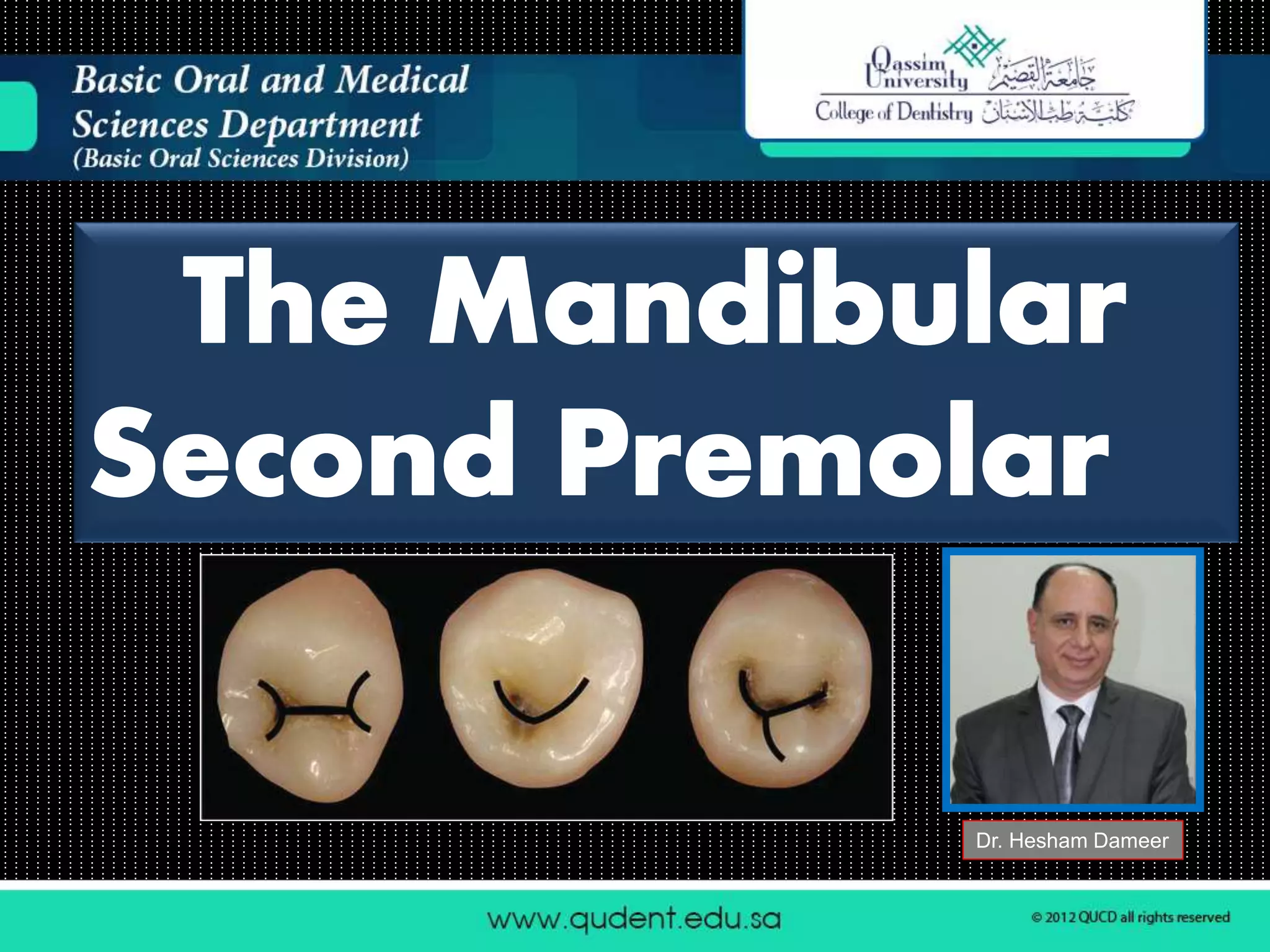
Dr. Hesham Dameer
Describe the mandibular second premolars:
a. Chronology.
b. Geometric outline of the crown in different aspects .
c. Outlines & Surface anatomy of the crown in different
aspects.
d. Comparison between the 2 types of the second
mandibular premolars in different surfaces.
e. Comparison between the first & second mandibular
premolars .
Chronology
• First evidence of calcification 21/4 -21/2Y
• Crown ( enamel ) completion 6-7 Y
• Eruption 11-12 Y
• Root completed 13-14 Y
There are 2 types differ mainly
from the occlusal & lingual aspects
while the other surfaces are nearly
similar .
Three Cusp Type Two Cusp Type
• The crown may show three cusps (about 47%)
or two cusps (about 43%) .
Buccal Lingual Mesial occlusal
It has 5 aspects:
Distal
Mandibular second premolar:
Two Cusp
Type
Buccal Lingual Mesial occlusalDistal
Occurs most often
Mandibular Second Premolar:
Three Cusp
Type
Geometric outline of the crown
Facial and lingual aspects have trapezoid outline.
The smallest
uneven side
cervically.
• Its general form somewhat similar to
that of the mandibular first premolars
but shows a number of distinctions.
Mandibular
Second
Premolar
• The crown is larger than the mandibular first
premolar but shorter and has an extremely
variable occlusal morphology .
• The root is broader mesiodistally and longer
than first premolar .
5
4
5
4
Buccal Outlines and Surface anatomy
2nd Premolar
D M
First premolar
MD
The mesial outline, the distal outline are
nearly the same like lower 4 except that :
The buccal cusp in 3cusp form is broader
and less pointed (Mesiobuccal cusp ridge
and distobuccal cusp ridge show less
degree angulation ) .
Mesial & Distal C. A. both broad ,appear
higher because of short buccal cusp .
Surface Anatomy: like that of lower 4
with less developed B ridge
The root has a blunt root apex
Lingual Aspect There are 2 types
Three cusp type Two cusp type
Have Two
Ling. Cusps :
M Ling
D Ling
No ling.
convergence
ML DL
ML cusp is longer and larger than DL cusp.
They both shorter than B cusp and less pointed. There is Ling.
developmental groove between the 2 cusps
One Ling
cusp
L cusp is smaller &
shorter by about 1
mm than B cusp but
larger than of Lower 4
No lingual developmental g.
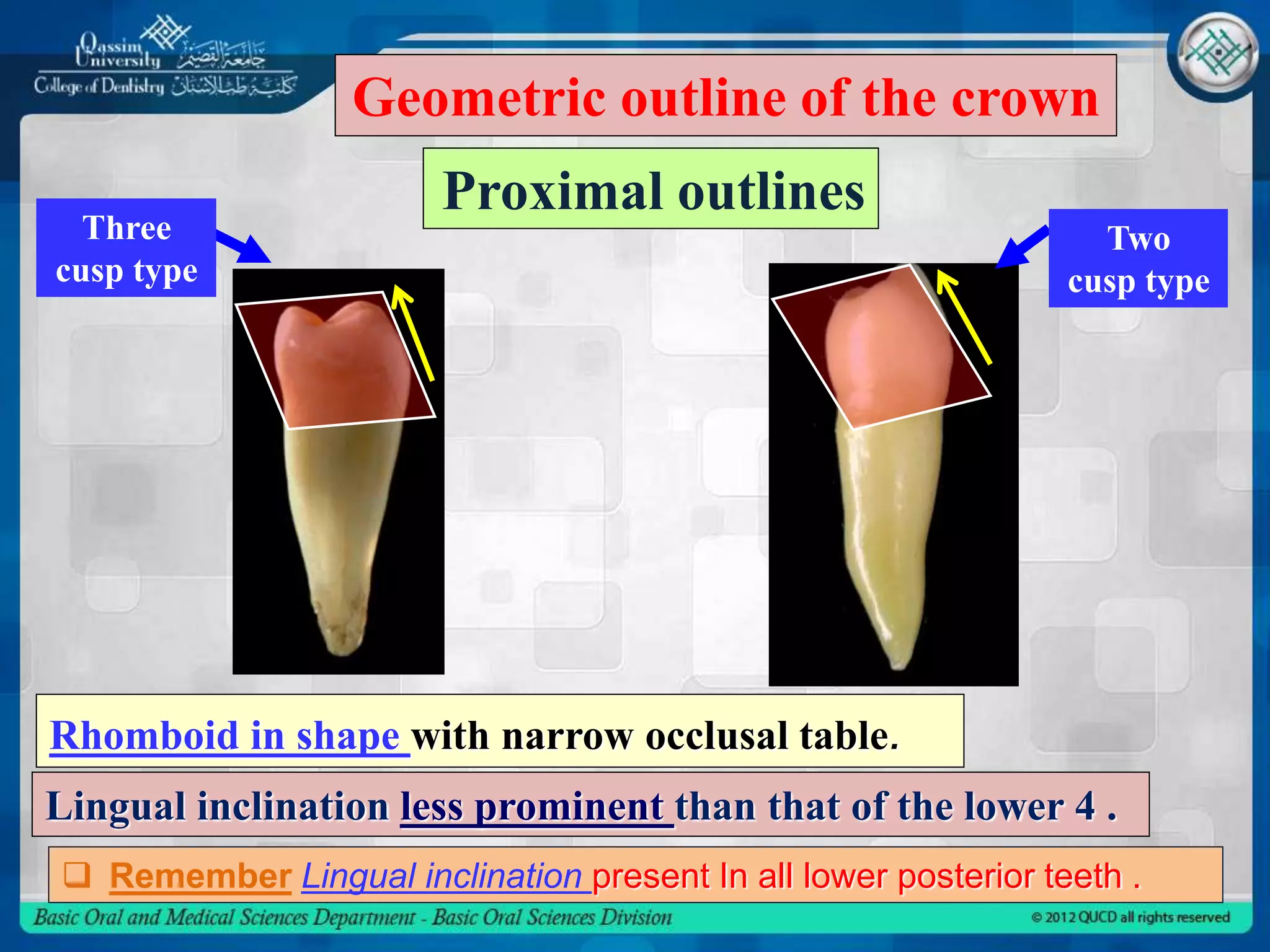
Proximal outlines
 Remember Lingual inclination present In all lower posterior teeth .
Rhomboid in shape with narrow occlusal table.
Lingual inclination less prominent than that of the lower 4 .
Geometric outline of the crown
Two
cusp type
Three
cusp type
Buccal outlines and surface anatomy
M
view
D
view
M
view
D
view
Maximum convexity at Cervical 1/3 bucally & Middle 1/3 Lingually .
Lingual cusp or cusps are shorter and smaller than B cusp
The buccal cusp is shorter than in lower 4 and more buccal to the center of the
root. While Ling cusp larger than of lower4
The mesial and distal marginal ridges are straight and at right angles to the long
axis of the tooth .
Geometric outline of the occlusal aspect
No Lingual convergence
Two cusp type:
Outline is oval
Slight lingual convergence
Three cusp type:
Outline is square
When the two lingual cusps are large, the lingual
side of the occlusal surfaces will be broader than
the buccal side .
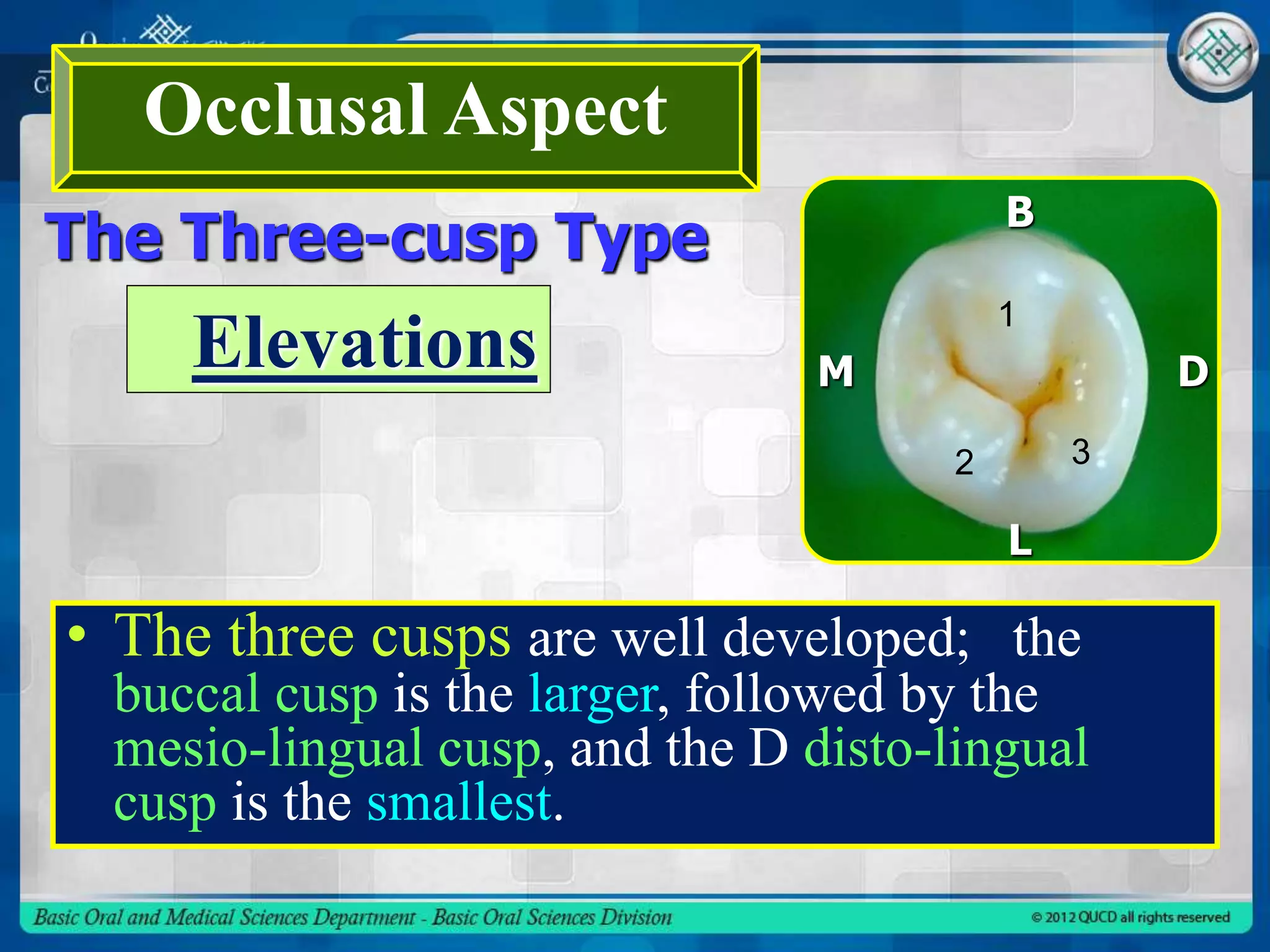
• The three cusps are well developed; the
buccal cusp is the larger, followed by the
mesio-lingual cusp, and the D disto-lingual
cusp is the smallest.
Occlusal Aspect
The Three-cusp Type
B
L
M DElevations
1
2 3
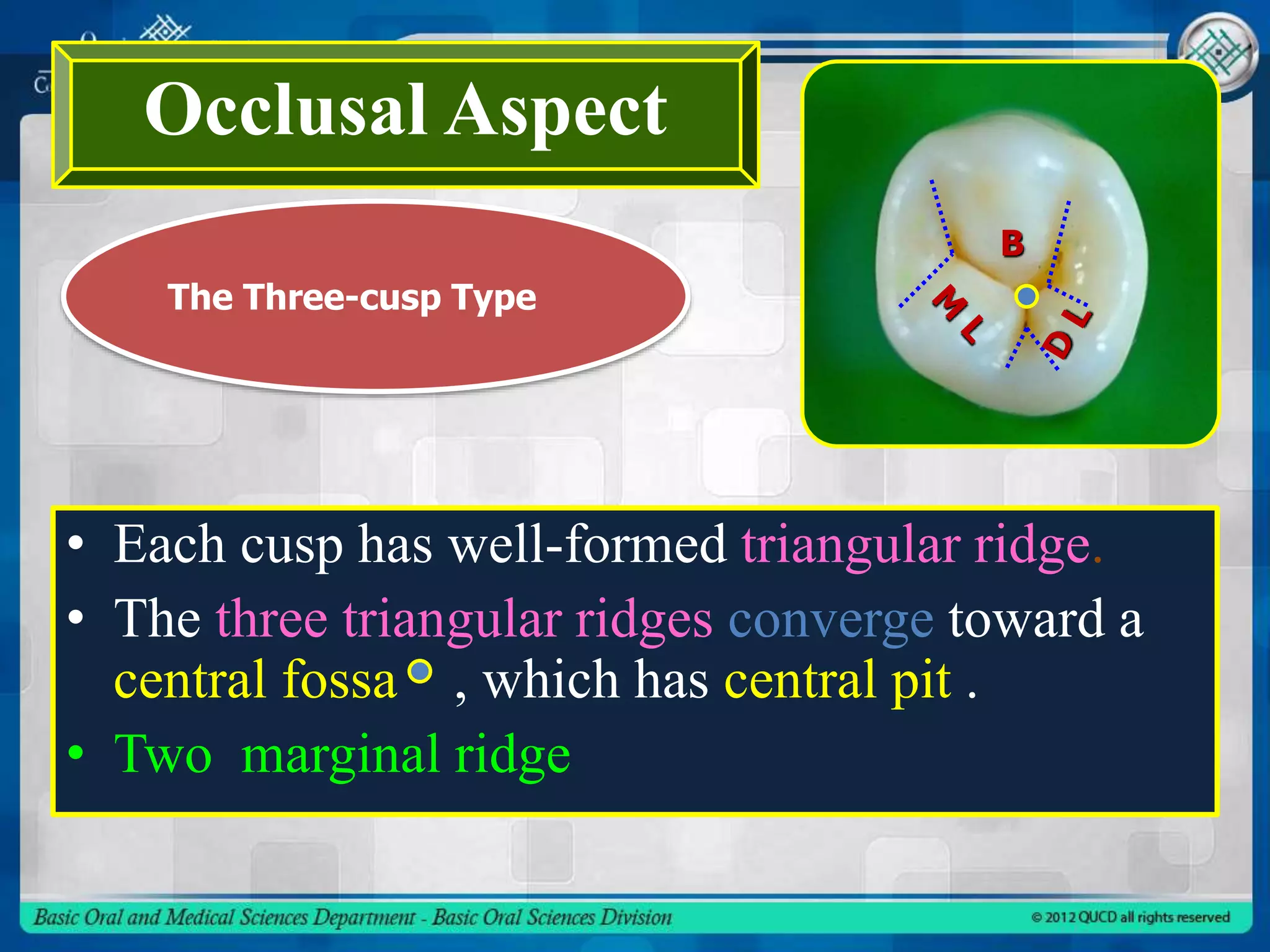
• Each cusp has well-formed triangular ridge.
• The three triangular ridges converge toward a
central fossa , which has central pit .
• Two marginal ridge
Occlusal Aspect
B
The Three-cusp Type
• A central pit is located in the middle of
the occlusal surface bucco-lingually and
slightly distal to the center mesio-distally.
Occlusal Aspect
The Three-cusp Type
Depressions
Depressions
The Three-cusp
Type
• There are three developmental grooves on the
occlusal surface radiate from the central pit and
form a Y shape ( the mesial, distal and lingual
developmental grooves ) separate the triangular
ridges .
M D
YY-shaped groove
• The long mesial groove extends in a
mesio-buccal direction and ends in the
mesial triangular fossa just distal to the
mesial marginal ridge .
B
L
DMM
B
D
L
• The short distal groove extends in a disto-
buccal direction and ends in the distal
triangular fossa mesial to the distal marginal
ridge .
Prof. A. El- Sahn
L
B
DM
DM
L
B
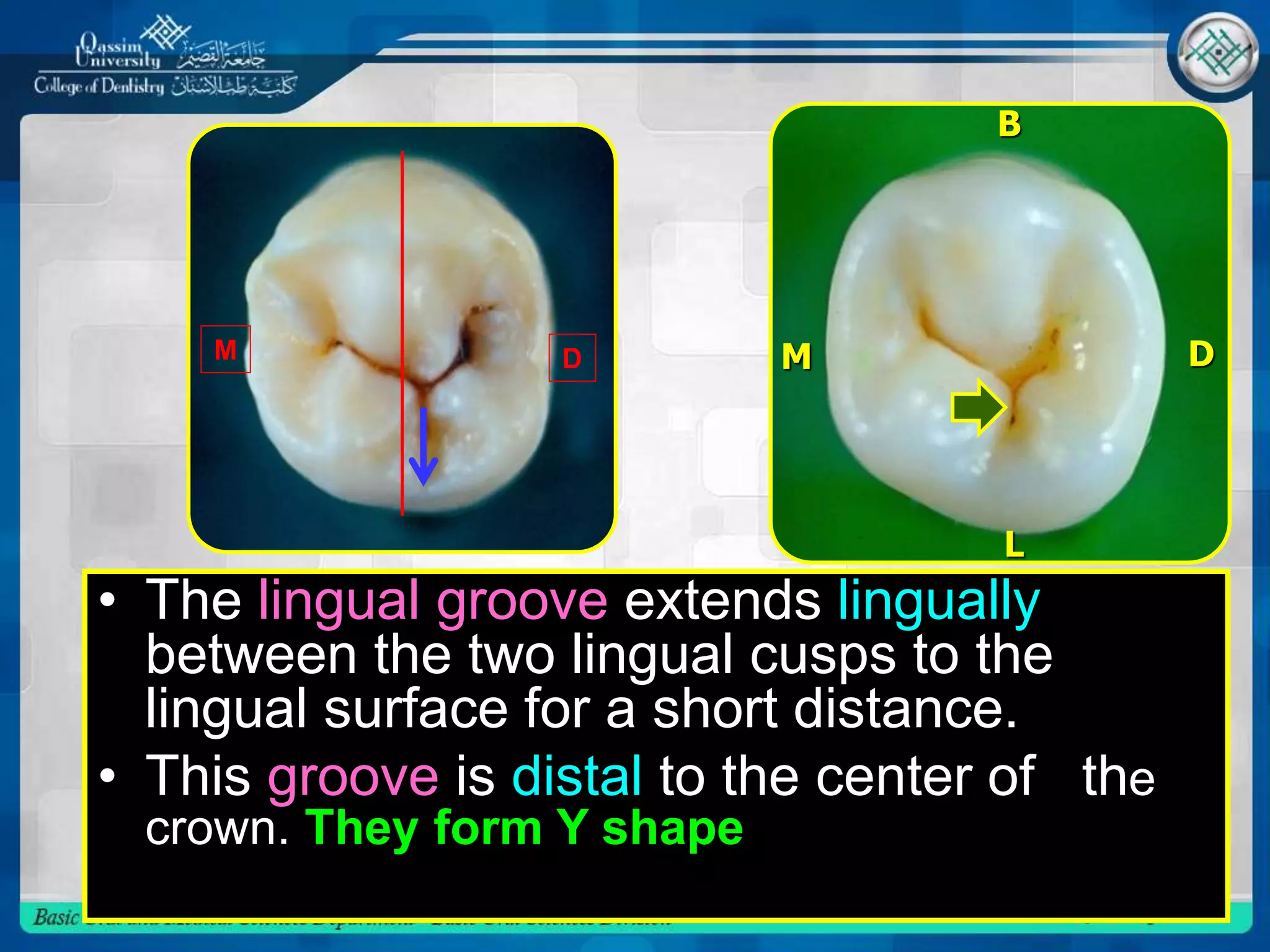
• The lingual groove extends lingually
between the two lingual cusps to the
lingual surface for a short distance.
• This groove is distal to the center of the
crown. They form Y shape
L
B
DMM D
• The distal
triangular fossa is
smaller than the
mesial one .
M D
B
L
Supplemental grooves are often seen
Note that ,the Three-cusp Type
of mandibular second premolars
do not have either a central
developmental groove or a
transverse ridge .
Three pits were located in the lower second premolar 3
cusp types that is Central pit , Mesial & Distal pits .
M D
B
L
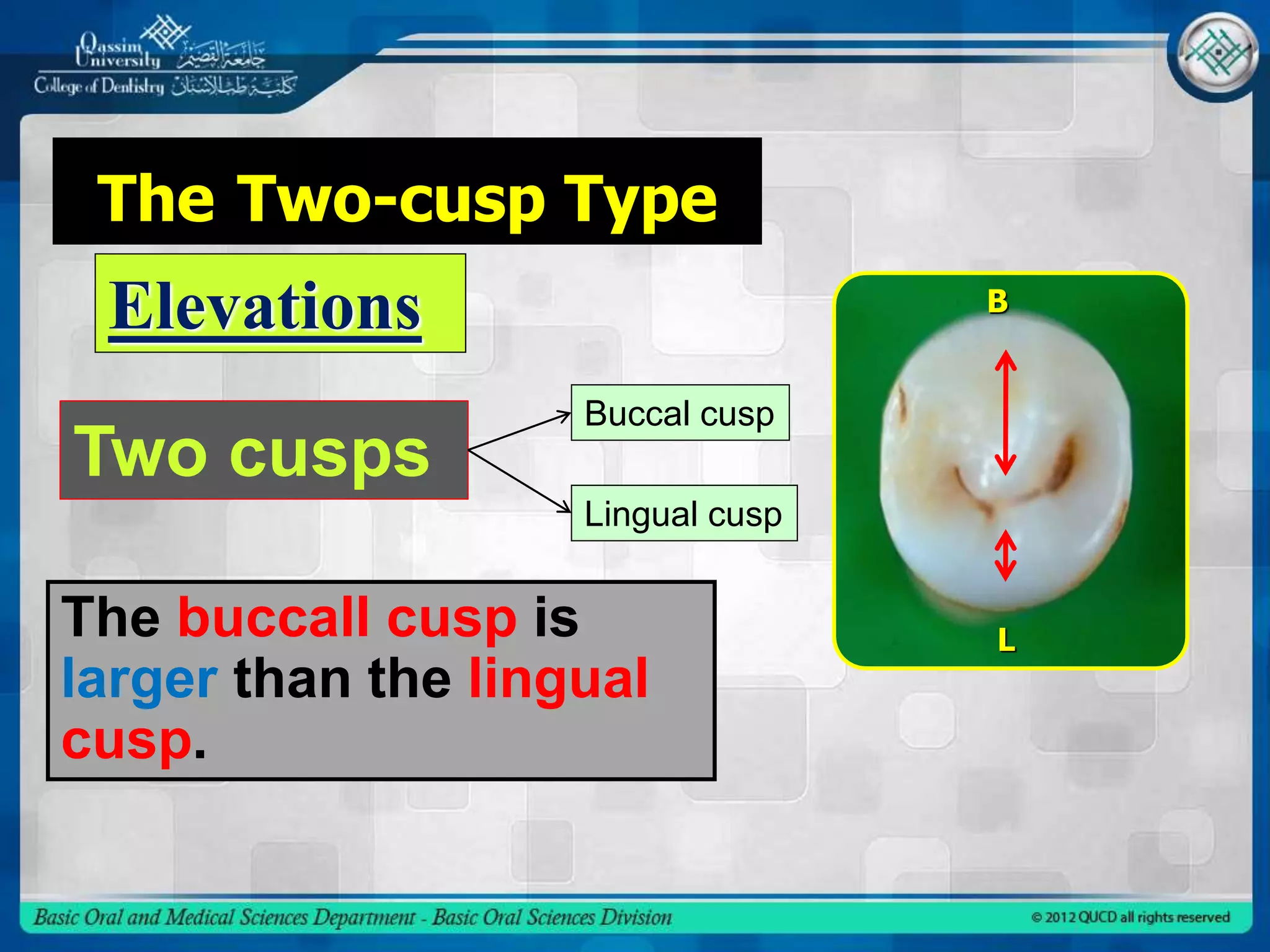
The Two-cusp Type
Elevations
The buccall cusp is
larger than the lingual
cusp.
B
L
Two cusps
Buccal cusp
Lingual cusp
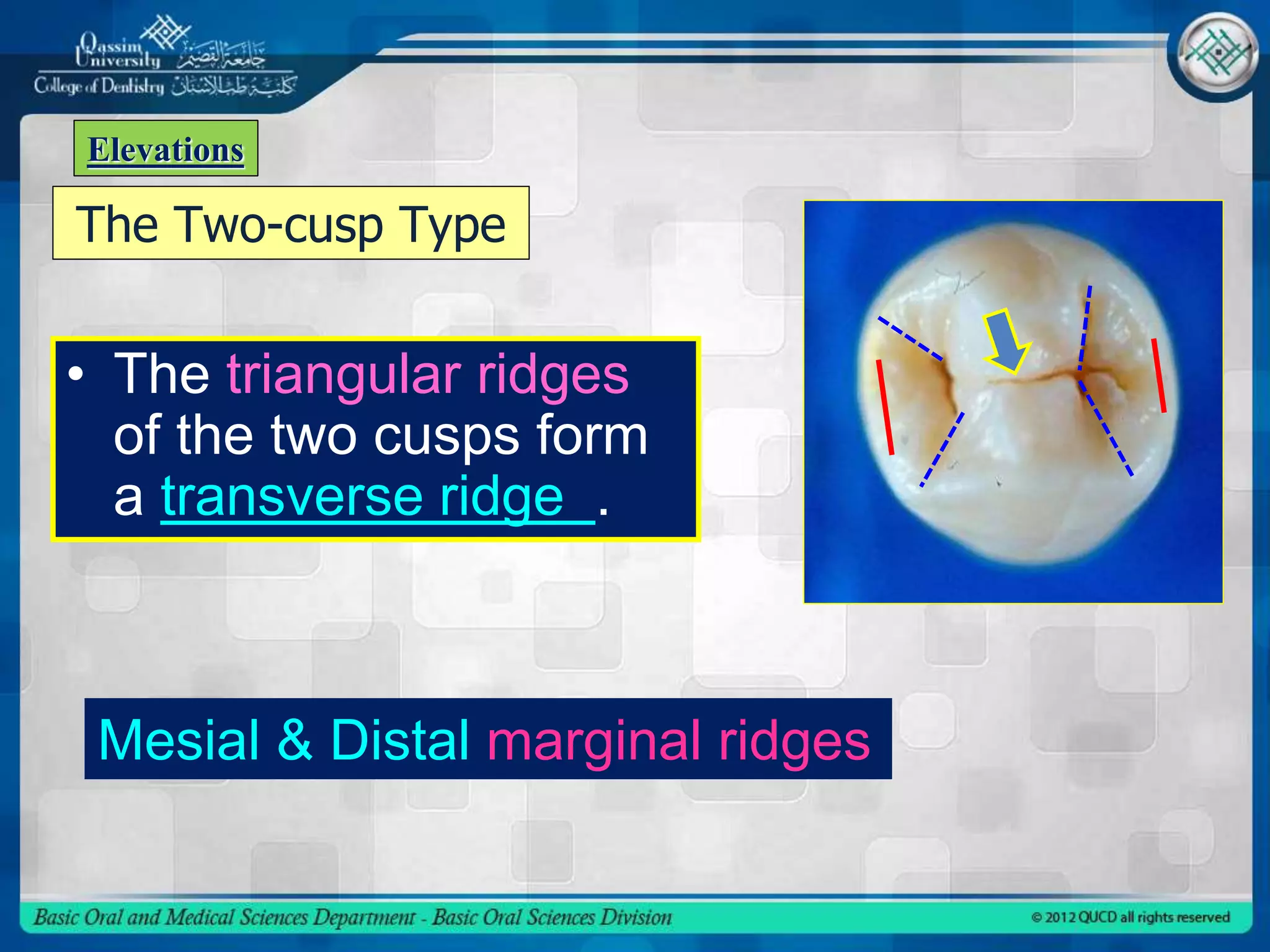
• The triangular ridges
of the two cusps form
a transverse ridge .
The Two-cusp Type
Mesial & Distal marginal ridges
Elevations
The Two-cusp Type
Depressions
Occlusal Aspect
► There is a central
developmental groove
extends mesio-distally across
the occlusal surface.
U-shaped groove
The central groove is most often crescent
shaped, forming a U-shaped groove pattern
on the occlusal surface.
U
►Less often, the central groove may be
straight, forming an H-shaped groove
pattern on the occlusal surface.
H-shaped groove
• The central groove ends in the mesial and distal
fossae.
• The mesial and distal fossae are
roughly circular depressions
sometimes having supplemental
grooves radiating from the
central groove and it ends at the
marginal ridges.
Comparison between
Mandibular First Premolar
and
Mandibular Second
Premolar
Two cusp type
Diamond-
shaped.
Lingual
convergence is
sharp.
The geometric outline
Slight lingual convergence
Three cusp type
square
Mandibular First Premolar Mandibular Second Premolar
U- shaped H - shaped
M D
M D
Elevations &
depressions + ML dg
Geometric
outline
Surface Anatomy
Elevations & depressions
is oval
Absent lingual
convergence
Self-Evaluation Review
1. Compare between the 1st & 2nd lower
premolars ( 2 cusp type)
2. Compare between the two types from
the occlusal aspect
• Wheeler’s Dental Anatomy, Physiology and
Occlusion, 8th Ed .ASH and NELSON,W.B.
Saunders Company, 2008.
• Dental Anatomy: Its Relevance to Dentistry,
Julian BW, Rickne CS.5thEd,Williams&
Wilkins, Baltimore, 1997.

Mandibular 2nd premolars 2020

  • 1.
  • 2.
    Describe the mandibularsecond premolars: a. Chronology. b. Geometric outline of the crown in different aspects . c. Outlines & Surface anatomy of the crown in different aspects. d. Comparison between the 2 types of the second mandibular premolars in different surfaces. e. Comparison between the first & second mandibular premolars .
  • 3.
    Chronology • First evidenceof calcification 21/4 -21/2Y • Crown ( enamel ) completion 6-7 Y • Eruption 11-12 Y • Root completed 13-14 Y
  • 4.
    There are 2types differ mainly from the occlusal & lingual aspects while the other surfaces are nearly similar . Three Cusp Type Two Cusp Type • The crown may show three cusps (about 47%) or two cusps (about 43%) .
  • 5.
    Buccal Lingual Mesialocclusal It has 5 aspects: Distal Mandibular second premolar: Two Cusp Type
  • 6.
    Buccal Lingual MesialocclusalDistal Occurs most often Mandibular Second Premolar: Three Cusp Type
  • 7.
    Geometric outline ofthe crown Facial and lingual aspects have trapezoid outline. The smallest uneven side cervically.
  • 8.
    • Its generalform somewhat similar to that of the mandibular first premolars but shows a number of distinctions. Mandibular Second Premolar
  • 9.
    • The crownis larger than the mandibular first premolar but shorter and has an extremely variable occlusal morphology . • The root is broader mesiodistally and longer than first premolar . 5 4 5 4
  • 10.
    Buccal Outlines andSurface anatomy 2nd Premolar D M First premolar MD The mesial outline, the distal outline are nearly the same like lower 4 except that : The buccal cusp in 3cusp form is broader and less pointed (Mesiobuccal cusp ridge and distobuccal cusp ridge show less degree angulation ) . Mesial & Distal C. A. both broad ,appear higher because of short buccal cusp . Surface Anatomy: like that of lower 4 with less developed B ridge The root has a blunt root apex
  • 11.
    Lingual Aspect Thereare 2 types Three cusp type Two cusp type Have Two Ling. Cusps : M Ling D Ling No ling. convergence ML DL ML cusp is longer and larger than DL cusp. They both shorter than B cusp and less pointed. There is Ling. developmental groove between the 2 cusps One Ling cusp L cusp is smaller & shorter by about 1 mm than B cusp but larger than of Lower 4 No lingual developmental g.
  • 12.
    Proximal outlines  RememberLingual inclination present In all lower posterior teeth . Rhomboid in shape with narrow occlusal table. Lingual inclination less prominent than that of the lower 4 . Geometric outline of the crown Two cusp type Three cusp type
  • 13.
    Buccal outlines andsurface anatomy M view D view M view D view Maximum convexity at Cervical 1/3 bucally & Middle 1/3 Lingually . Lingual cusp or cusps are shorter and smaller than B cusp The buccal cusp is shorter than in lower 4 and more buccal to the center of the root. While Ling cusp larger than of lower4 The mesial and distal marginal ridges are straight and at right angles to the long axis of the tooth .
  • 14.
    Geometric outline ofthe occlusal aspect No Lingual convergence Two cusp type: Outline is oval Slight lingual convergence Three cusp type: Outline is square When the two lingual cusps are large, the lingual side of the occlusal surfaces will be broader than the buccal side .
  • 15.
    • The threecusps are well developed; the buccal cusp is the larger, followed by the mesio-lingual cusp, and the D disto-lingual cusp is the smallest. Occlusal Aspect The Three-cusp Type B L M DElevations 1 2 3
  • 16.
    • Each cusphas well-formed triangular ridge. • The three triangular ridges converge toward a central fossa , which has central pit . • Two marginal ridge Occlusal Aspect B The Three-cusp Type
  • 17.
    • A centralpit is located in the middle of the occlusal surface bucco-lingually and slightly distal to the center mesio-distally. Occlusal Aspect The Three-cusp Type Depressions
  • 18.
    Depressions The Three-cusp Type • Thereare three developmental grooves on the occlusal surface radiate from the central pit and form a Y shape ( the mesial, distal and lingual developmental grooves ) separate the triangular ridges . M D YY-shaped groove
  • 19.
    • The longmesial groove extends in a mesio-buccal direction and ends in the mesial triangular fossa just distal to the mesial marginal ridge . B L DMM B D L
  • 20.
    • The shortdistal groove extends in a disto- buccal direction and ends in the distal triangular fossa mesial to the distal marginal ridge . Prof. A. El- Sahn L B DM DM L B
  • 21.
    • The lingualgroove extends lingually between the two lingual cusps to the lingual surface for a short distance. • This groove is distal to the center of the crown. They form Y shape L B DMM D
  • 22.
    • The distal triangularfossa is smaller than the mesial one . M D B L Supplemental grooves are often seen
  • 23.
    Note that ,theThree-cusp Type of mandibular second premolars do not have either a central developmental groove or a transverse ridge . Three pits were located in the lower second premolar 3 cusp types that is Central pit , Mesial & Distal pits . M D B L
  • 24.
    The Two-cusp Type Elevations Thebuccall cusp is larger than the lingual cusp. B L Two cusps Buccal cusp Lingual cusp
  • 25.
    • The triangularridges of the two cusps form a transverse ridge . The Two-cusp Type Mesial & Distal marginal ridges Elevations
  • 26.
    The Two-cusp Type Depressions OcclusalAspect ► There is a central developmental groove extends mesio-distally across the occlusal surface. U-shaped groove The central groove is most often crescent shaped, forming a U-shaped groove pattern on the occlusal surface. U
  • 27.
    ►Less often, thecentral groove may be straight, forming an H-shaped groove pattern on the occlusal surface. H-shaped groove
  • 28.
    • The centralgroove ends in the mesial and distal fossae. • The mesial and distal fossae are roughly circular depressions sometimes having supplemental grooves radiating from the central groove and it ends at the marginal ridges.
  • 29.
    Comparison between Mandibular FirstPremolar and Mandibular Second Premolar
  • 30.
    Two cusp type Diamond- shaped. Lingual convergenceis sharp. The geometric outline Slight lingual convergence Three cusp type square Mandibular First Premolar Mandibular Second Premolar U- shaped H - shaped M D M D Elevations & depressions + ML dg Geometric outline Surface Anatomy Elevations & depressions is oval Absent lingual convergence
  • 31.
    Self-Evaluation Review 1. Comparebetween the 1st & 2nd lower premolars ( 2 cusp type) 2. Compare between the two types from the occlusal aspect
  • 32.
    • Wheeler’s DentalAnatomy, Physiology and Occlusion, 8th Ed .ASH and NELSON,W.B. Saunders Company, 2008. • Dental Anatomy: Its Relevance to Dentistry, Julian BW, Rickne CS.5thEd,Williams& Wilkins, Baltimore, 1997.