OCR Media Studies – AS Level
Unit G321: Foundation Portfolio in Media
Planning & Research
Name: TJ Salango
Candidate Number: 1220
Center Name: St. Andrew’s Catholic School
Center Number: 64135
Set Brief - Print
Music Magazine – Production
Preliminary Task Progression and
Planning & Research
Section 1) –
Preliminary Task
Preliminary Task Progression–
Evidence
Front Cover
Step-by-step
Step 1
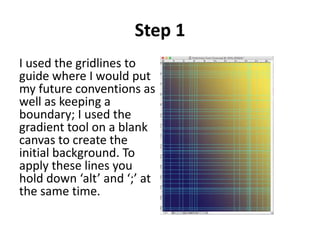
I used the gridlines to
guide where I would put
my future conventions as
well as keeping a
boundary; I used the
gradient tool on a blank
canvas to create the
initial background. To
apply these lines you
hold down ‘alt’ and ‘;’ at
the same time.
Step 2
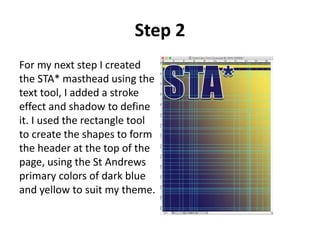
For my next step I created
the STA* masthead using the
text tool, I added a stroke
effect and shadow to define
it. I used the rectangle tool
to create the shapes to form
the header at the top of the
page, using the St Andrews
primary colors of dark blue
and yellow to suit my theme.
Step 3
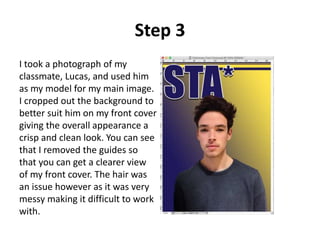
I took a photograph of my
classmate, Lucas, and used him
as my model for my main image.
I cropped out the background to
better suit him on my front cover
giving the overall appearance a
crisp and clean look. You can see
that I removed the guides so
that you can get a clearer view
of my front cover. The hair was
an issue however as it was very
messy making it difficult to work
with.
Step 4
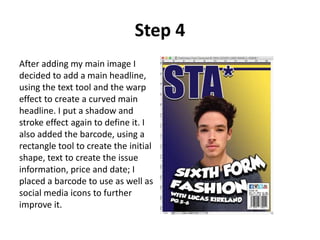
After adding my main image I
decided to add a main headline,
using the text tool and the warp
effect to create a curved main
headline. I put a shadow and
stroke effect again to define it. I
also added the barcode, using a
rectangle tool to create the initial
shape, text to create the issue
information, price and date; I
placed a barcode to use as well as
social media icons to further
improve it.
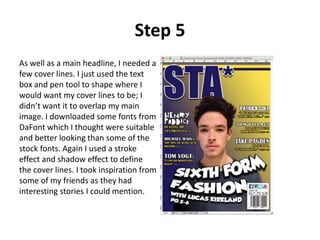
Step 5
As well as a main headline, I needed a
few cover lines. I just used the text
box and pen tool to shape where I
would want my cover lines to be; I
didn’t want it to overlap my main
image. I downloaded some fonts from
DaFont which I thought were suitable
and better looking than some of the
stock fonts. Again I used a stroke
effect and shadow effect to define
the cover lines. I took inspiration from
some of my friends as they had
interesting stories I could mention.
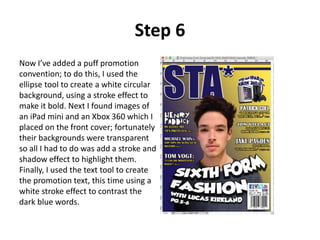
Step 6
Now I’ve added a puff promotion
convention; to do this, I used the
ellipse tool to create a white circular
background, using a stroke effect to
make it bold. Next I found images of
an iPad mini and an Xbox 360 which I
placed on the front cover; fortunately
their backgrounds were transparent
so all I had to do was add a stroke and
shadow effect to highlight them.
Finally, I used the text tool to create
the promotion text, this time using a
white stroke effect to contrast the
dark blue words.
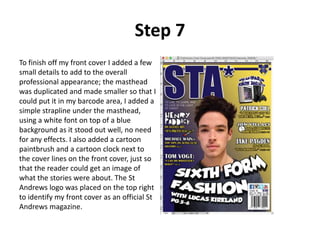
Step 7
To finish off my front cover I added a few
small details to add to the overall
professional appearance; the masthead
was duplicated and made smaller so that I
could put it in my barcode area, I added a
simple strapline under the masthead,
using a white font on top of a blue
background as it stood out well, no need
for any effects. I also added a cartoon
paintbrush and a cartoon clock next to
the cover lines on the front cover, just so
that the reader could get an image of
what the stories were about. The St
Andrews logo was placed on the top right
to identify my front cover as an official St
Andrews magazine.
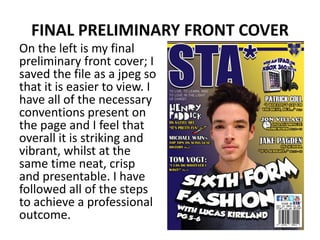
FINAL PRELIMINARY FRONT COVER
On the left is my final
preliminary front cover; I
saved the file as a jpeg so
that it is easier to view. I
have all of the necessary
conventions present on
the page and I feel that
overall it is striking and
vibrant, whilst at the
same time neat, crisp
and presentable. I have
followed all of the steps
to achieve a professional
outcome.
Preliminary Task Progression–
Evidence
Contents Page
Step-by-step
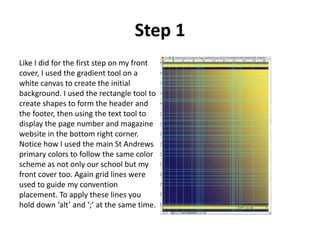
Step 1
Like I did for the first step on my front
cover, I used the gradient tool on a
white canvas to create the initial
background. I used the rectangle tool to
create shapes to form the header and
the footer, then using the text tool to
display the page number and magazine
website in the bottom right corner.
Notice how I used the main St Andrews
primary colors to follow the same color
scheme as not only our school but my
front cover too. Again grid lines were
used to guide my convention
placement. To apply these lines you
hold down ‘alt’ and ‘;’ at the same time.
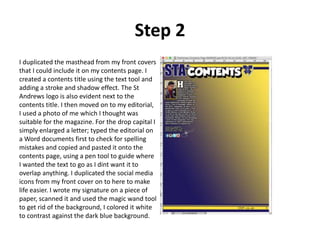
Step 2
I duplicated the masthead from my front covers
that I could include it on my contents page. I
created a contents title using the text tool and
adding a stroke and shadow effect. The St
Andrews logo is also evident next to the
contents title. I then moved on to my editorial,
I used a photo of me which I thought was
suitable for the magazine. For the drop capital I
simply enlarged a letter; typed the editorial on
a Word documents first to check for spelling
mistakes and copied and pasted it onto the
contents page, using a pen tool to guide where
I wanted the text to go as I dint want it to
overlap anything. I duplicated the social media
icons from my front cover on to here to make
life easier. I wrote my signature on a piece of
paper, scanned it and used the magic wand tool
to get rid of the background, I colored it white
to contrast against the dark blue background.
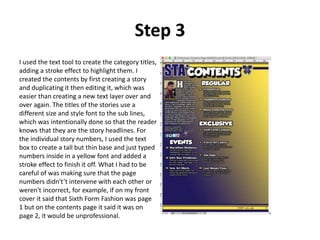
Step 3
I used the text tool to create the category titles,
adding a stroke effect to highlight them. I
created the contents by first creating a story
and duplicating it then editing it, which was
easier than creating a new text layer over and
over again. The titles of the stories use a
different size and style font to the sub lines,
which was intentionally done so that the reader
knows that they are the story headlines. For
the individual story numbers, I used the text
box to create a tall but thin base and just typed
numbers inside in a yellow font and added a
stroke effect to finish it off. What I had to be
careful of was making sure that the page
numbers didn't’t intervene with each other or
weren't incorrect, for example, if on my front
cover it said that Sixth Form Fashion was page
1 but on the contents page it said it was on
page 2, it would be unprofessional.
Step 4
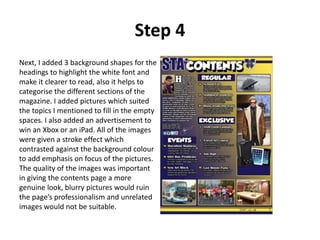
Next, I added 3 background shapes for the
headings to highlight the white font and
make it clearer to read, also it helps to
categorise the different sections of the
magazine. I added pictures which suited
the topics I mentioned to fill in the empty
spaces. I also added an advertisement to
win an Xbox or an iPad. All of the images
were given a stroke effect which
contrasted against the background colour
to add emphasis on focus of the pictures.
The quality of the images was important
in giving the contents page a more
genuine look, blurry pictures would ruin
the page’s professionalism and unrelated
images would not be suitable.
Step 5
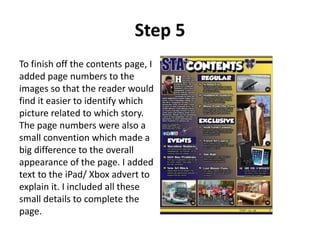
To finish off the contents page, I
added page numbers to the
images so that the reader would
find it easier to identify which
picture related to which story.
The page numbers were also a
small convention which made a
big difference to the overall
appearance of the page. I added
text to the iPad/ Xbox advert to
explain it. I included all these
small details to complete the
page.
FINAL PRELIMINARY CONTENTS PAGE
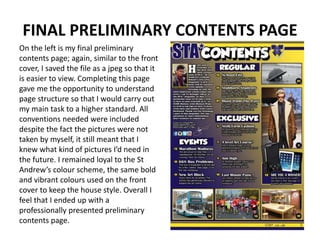
On the left is my final preliminary
contents page; again, similar to the front
cover, I saved the file as a jpeg so that it
is easier to view. Completing this page
gave me the opportunity to understand
page structure so that I would carry out
my main task to a higher standard. All
conventions needed were included
despite the fact the pictures were not
taken by myself, it still meant that I
knew what kind of pictures I’d need in
the future. I remained loyal to the St
Andrew’s colour scheme, the same bold
and vibrant colours used on the front
cover to keep the house style. Overall I
feel that I ended up with a
professionally presented preliminary
contents page.
Section 2) – Log Book
Music Magazine – Genre research
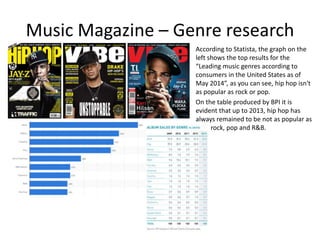
According to Statista, the graph on the
left shows the top results for the
“Leading music genres according to
consumers in the United States as of
May 2014”, as you can see, hip hop isn't
as popular as rock or pop.
On the table produced by BPI it is
evident that up to 2013, hip hop has
always remained to be not as popular as
ggg rock, pop and R&B.
Established Magazine for my Research
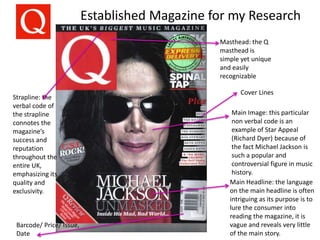
Masthead: the Q
masthead is
simple yet unique
and easily
recognizable
Cover Lines
Main Headline: the language
on the main headline is often
intriguing as its purpose is to
lure the consumer into
reading the magazine, it is
vague and reveals very little
of the main story.
Barcode/ Price/ Issue,
Date
Strapline: the
verbal code of
the strapline
connotes the
magazine’s
success and
reputation
throughout the
entire UK,
emphasizing its
quality and
exclusivity.
Main Image: this particular
non verbal code is an
example of Star Appeal
(Richard Dyer) because of
the fact Michael Jackson is
such a popular and
controversial figure in music
history.
Target Audience – Katz, Maslow, Hartley and/or socio-economic needs
Michael Jackson fans, people who listen to music and like to keep themselves updated on
mainstream media, also frequent readers of the Q magazines; more exclusively in the UK as
the strapline suggests that this is a UK based music magazine. Q magazine is a very well
established brand which charges high prices for each issue; more affordable for the upper
class. Q magazine includes people from a range of ethnicities on their covers, this appeals
to a very large audience range. According to Bauer media the readership of Q fits into the
A,B,C1 section of the socio-economic needs table with a majority of 71.8%; this information
was found on www.bauermedia.co.uk/uploads/Q.pdf .
What is the USP of this magazine? From the research completed into this media
product, I think the USP is the magazine’s use of ‘Star Appeal’ (Richard Dyer) as
one of the world’s most famous and easily recognizable celebrities, Michael
Jackson, occupies the majority of the front cover. Thanks to Micghael Jackson’s
fame he is a very iconic character in the whole of music history, being referred to
as the king of pop, meaning that plenty of potential consumers will purchase the
magazine. This attracts viewers and draws their attention to the smaller details on
the page such as other significant cover stories featuring lesser known artists or
possible promotions.
Publisher research
• Q magazine’s slogan, “Discover great music”, connotes that
their magazine is not just a regular music magazine but one
that offers a different perspective on music, emphasising the
magazine’s superior taste in music due to the adjective ‘great’.
It is short and simple, easy to memorise and recognise,
making it an ideal slogan.
• Q magazine’s target audience is aimed towards 30-40 year old
males who are interested in alternative music and purchasing
CD’s and albums. According to the Bauer Media Magazines
website, 83.8% of readers are between the age of 15 and 44.
66.2% are male and the other, female. By featuring popular
artists such as Adele and classic artists such as John Lennon
and Madonna, Q reaches out to a very wide audience.
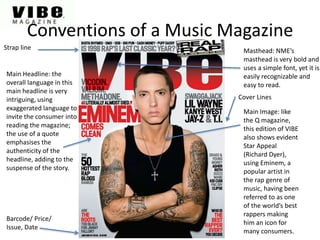
Conventions of a Music Magazine
Masthead: NME’s
masthead is very bold and
uses a simple font, yet it is
easily recognizable and
easy to read.
Cover Lines
Main Headline: the
overall language in this
main headline is very
intriguing, using
exaggerated language to
invite the consumer into
reading the magazine;
the use of a quote
emphasises the
authenticity of the
headline, adding to the
suspense of the story.
Main Image: like
the Q magazine,
this edition of VIBE
also shows evident
Star Appeal
(Richard Dyer),
using Eminem, a
popular artist in
the rap genre of
music, having been
referred to as one
of the world’s best
rappers making
him an icon for
many consumers.
Barcode/ Price/
Issue, Date
Strap line
Target Audience – Katz, Maslow, Hartley and/or socio-economic needs
Judging from the famous celebrities used in the main image of the front cover, I can safely
assume that the target audience for VIBE magazine can be denoted as survivors, keeping
themselves updated on the most recent news on those featured on the magazines. Studies
have shown that education does not really matter as only 50.7% of Vibes audience never
went to college. Which means only 19% study at college or higher education. Therefore,
their magazine content is not aimed at educated people, hence why slang is very evident
throughout. Furthermore, studies also show that that 71.3% of the audience is African
Americans; this means that the magazine should be relatable to them by including their
interests and culture.
What is the USP of this magazine?
From the research completed into this media product, I think the USP of VIBE is
based around the main image, specifically the Star Appeal (Richard Dyer) as
plenty of their magazines advertise well known stars who cover up a slight
fraction of the masthead to prioritize the image. In this particular issue Eminem
represents the main story. VIBE also has names of famous rappers/ singers written
in a bright bold font on their cover to attract those people who are interested in
not only the person used in the main image but in the cover stories too. Words
such as ‘exclusive’, ‘hottest’ and ‘best’ emphasize that the magazine really is
something special, persuading the public to buy it and read it.
The logo of the magazine SHOULD be placed on this slide neatly somewhere
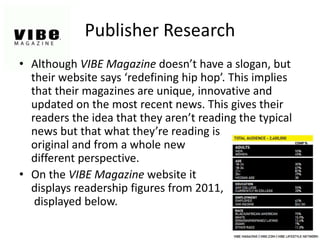
Publisher Research
• Although VIBE Magazine doesn’t have a slogan, but
their website says ‘redefining hip hop’. This implies
that their magazines are unique, innovative and
updated on the most recent news. This gives their
readers the idea that they aren’t reading the typical
news but that what they’re reading is
original and from a whole new
different perspective.
• On the VIBE Magazine website it
displays readership figures from 2011,
displayed below.

Preliminary Planning and Research Task

  • 1.
    OCR Media Studies– AS Level Unit G321: Foundation Portfolio in Media Planning & Research Name: TJ Salango Candidate Number: 1220 Center Name: St. Andrew’s Catholic School Center Number: 64135 Set Brief - Print Music Magazine – Production Preliminary Task Progression and Planning & Research
  • 2.
  • 3.
  • 4.
    Step 1 I usedthe gridlines to guide where I would put my future conventions as well as keeping a boundary; I used the gradient tool on a blank canvas to create the initial background. To apply these lines you hold down ‘alt’ and ‘;’ at the same time.
  • 5.
    Step 2 For mynext step I created the STA* masthead using the text tool, I added a stroke effect and shadow to define it. I used the rectangle tool to create the shapes to form the header at the top of the page, using the St Andrews primary colors of dark blue and yellow to suit my theme.
  • 6.
    Step 3 I tooka photograph of my classmate, Lucas, and used him as my model for my main image. I cropped out the background to better suit him on my front cover giving the overall appearance a crisp and clean look. You can see that I removed the guides so that you can get a clearer view of my front cover. The hair was an issue however as it was very messy making it difficult to work with.
  • 7.
    Step 4 After addingmy main image I decided to add a main headline, using the text tool and the warp effect to create a curved main headline. I put a shadow and stroke effect again to define it. I also added the barcode, using a rectangle tool to create the initial shape, text to create the issue information, price and date; I placed a barcode to use as well as social media icons to further improve it.
  • 8.
    Step 5 As wellas a main headline, I needed a few cover lines. I just used the text box and pen tool to shape where I would want my cover lines to be; I didn’t want it to overlap my main image. I downloaded some fonts from DaFont which I thought were suitable and better looking than some of the stock fonts. Again I used a stroke effect and shadow effect to define the cover lines. I took inspiration from some of my friends as they had interesting stories I could mention.
  • 9.
    Step 6 Now I’veadded a puff promotion convention; to do this, I used the ellipse tool to create a white circular background, using a stroke effect to make it bold. Next I found images of an iPad mini and an Xbox 360 which I placed on the front cover; fortunately their backgrounds were transparent so all I had to do was add a stroke and shadow effect to highlight them. Finally, I used the text tool to create the promotion text, this time using a white stroke effect to contrast the dark blue words.
  • 10.
    Step 7 To finishoff my front cover I added a few small details to add to the overall professional appearance; the masthead was duplicated and made smaller so that I could put it in my barcode area, I added a simple strapline under the masthead, using a white font on top of a blue background as it stood out well, no need for any effects. I also added a cartoon paintbrush and a cartoon clock next to the cover lines on the front cover, just so that the reader could get an image of what the stories were about. The St Andrews logo was placed on the top right to identify my front cover as an official St Andrews magazine.
  • 11.
    FINAL PRELIMINARY FRONTCOVER On the left is my final preliminary front cover; I saved the file as a jpeg so that it is easier to view. I have all of the necessary conventions present on the page and I feel that overall it is striking and vibrant, whilst at the same time neat, crisp and presentable. I have followed all of the steps to achieve a professional outcome.
  • 12.
  • 13.
    Step 1 Like Idid for the first step on my front cover, I used the gradient tool on a white canvas to create the initial background. I used the rectangle tool to create shapes to form the header and the footer, then using the text tool to display the page number and magazine website in the bottom right corner. Notice how I used the main St Andrews primary colors to follow the same color scheme as not only our school but my front cover too. Again grid lines were used to guide my convention placement. To apply these lines you hold down ‘alt’ and ‘;’ at the same time.
  • 14.
    Step 2 I duplicatedthe masthead from my front covers that I could include it on my contents page. I created a contents title using the text tool and adding a stroke and shadow effect. The St Andrews logo is also evident next to the contents title. I then moved on to my editorial, I used a photo of me which I thought was suitable for the magazine. For the drop capital I simply enlarged a letter; typed the editorial on a Word documents first to check for spelling mistakes and copied and pasted it onto the contents page, using a pen tool to guide where I wanted the text to go as I dint want it to overlap anything. I duplicated the social media icons from my front cover on to here to make life easier. I wrote my signature on a piece of paper, scanned it and used the magic wand tool to get rid of the background, I colored it white to contrast against the dark blue background.
  • 15.
    Step 3 I usedthe text tool to create the category titles, adding a stroke effect to highlight them. I created the contents by first creating a story and duplicating it then editing it, which was easier than creating a new text layer over and over again. The titles of the stories use a different size and style font to the sub lines, which was intentionally done so that the reader knows that they are the story headlines. For the individual story numbers, I used the text box to create a tall but thin base and just typed numbers inside in a yellow font and added a stroke effect to finish it off. What I had to be careful of was making sure that the page numbers didn't’t intervene with each other or weren't incorrect, for example, if on my front cover it said that Sixth Form Fashion was page 1 but on the contents page it said it was on page 2, it would be unprofessional.
  • 16.
    Step 4 Next, Iadded 3 background shapes for the headings to highlight the white font and make it clearer to read, also it helps to categorise the different sections of the magazine. I added pictures which suited the topics I mentioned to fill in the empty spaces. I also added an advertisement to win an Xbox or an iPad. All of the images were given a stroke effect which contrasted against the background colour to add emphasis on focus of the pictures. The quality of the images was important in giving the contents page a more genuine look, blurry pictures would ruin the page’s professionalism and unrelated images would not be suitable.
  • 17.
    Step 5 To finishoff the contents page, I added page numbers to the images so that the reader would find it easier to identify which picture related to which story. The page numbers were also a small convention which made a big difference to the overall appearance of the page. I added text to the iPad/ Xbox advert to explain it. I included all these small details to complete the page.
  • 18.
    FINAL PRELIMINARY CONTENTSPAGE On the left is my final preliminary contents page; again, similar to the front cover, I saved the file as a jpeg so that it is easier to view. Completing this page gave me the opportunity to understand page structure so that I would carry out my main task to a higher standard. All conventions needed were included despite the fact the pictures were not taken by myself, it still meant that I knew what kind of pictures I’d need in the future. I remained loyal to the St Andrew’s colour scheme, the same bold and vibrant colours used on the front cover to keep the house style. Overall I feel that I ended up with a professionally presented preliminary contents page.
  • 19.
  • 20.
    Music Magazine –Genre research According to Statista, the graph on the left shows the top results for the “Leading music genres according to consumers in the United States as of May 2014”, as you can see, hip hop isn't as popular as rock or pop. On the table produced by BPI it is evident that up to 2013, hip hop has always remained to be not as popular as ggg rock, pop and R&B.
  • 21.
    Established Magazine formy Research Masthead: the Q masthead is simple yet unique and easily recognizable Cover Lines Main Headline: the language on the main headline is often intriguing as its purpose is to lure the consumer into reading the magazine, it is vague and reveals very little of the main story. Barcode/ Price/ Issue, Date Strapline: the verbal code of the strapline connotes the magazine’s success and reputation throughout the entire UK, emphasizing its quality and exclusivity. Main Image: this particular non verbal code is an example of Star Appeal (Richard Dyer) because of the fact Michael Jackson is such a popular and controversial figure in music history.
  • 22.
    Target Audience –Katz, Maslow, Hartley and/or socio-economic needs Michael Jackson fans, people who listen to music and like to keep themselves updated on mainstream media, also frequent readers of the Q magazines; more exclusively in the UK as the strapline suggests that this is a UK based music magazine. Q magazine is a very well established brand which charges high prices for each issue; more affordable for the upper class. Q magazine includes people from a range of ethnicities on their covers, this appeals to a very large audience range. According to Bauer media the readership of Q fits into the A,B,C1 section of the socio-economic needs table with a majority of 71.8%; this information was found on www.bauermedia.co.uk/uploads/Q.pdf . What is the USP of this magazine? From the research completed into this media product, I think the USP is the magazine’s use of ‘Star Appeal’ (Richard Dyer) as one of the world’s most famous and easily recognizable celebrities, Michael Jackson, occupies the majority of the front cover. Thanks to Micghael Jackson’s fame he is a very iconic character in the whole of music history, being referred to as the king of pop, meaning that plenty of potential consumers will purchase the magazine. This attracts viewers and draws their attention to the smaller details on the page such as other significant cover stories featuring lesser known artists or possible promotions.
  • 23.
    Publisher research • Qmagazine’s slogan, “Discover great music”, connotes that their magazine is not just a regular music magazine but one that offers a different perspective on music, emphasising the magazine’s superior taste in music due to the adjective ‘great’. It is short and simple, easy to memorise and recognise, making it an ideal slogan. • Q magazine’s target audience is aimed towards 30-40 year old males who are interested in alternative music and purchasing CD’s and albums. According to the Bauer Media Magazines website, 83.8% of readers are between the age of 15 and 44. 66.2% are male and the other, female. By featuring popular artists such as Adele and classic artists such as John Lennon and Madonna, Q reaches out to a very wide audience.
  • 24.
    Conventions of aMusic Magazine Masthead: NME’s masthead is very bold and uses a simple font, yet it is easily recognizable and easy to read. Cover Lines Main Headline: the overall language in this main headline is very intriguing, using exaggerated language to invite the consumer into reading the magazine; the use of a quote emphasises the authenticity of the headline, adding to the suspense of the story. Main Image: like the Q magazine, this edition of VIBE also shows evident Star Appeal (Richard Dyer), using Eminem, a popular artist in the rap genre of music, having been referred to as one of the world’s best rappers making him an icon for many consumers. Barcode/ Price/ Issue, Date Strap line
  • 25.
    Target Audience –Katz, Maslow, Hartley and/or socio-economic needs Judging from the famous celebrities used in the main image of the front cover, I can safely assume that the target audience for VIBE magazine can be denoted as survivors, keeping themselves updated on the most recent news on those featured on the magazines. Studies have shown that education does not really matter as only 50.7% of Vibes audience never went to college. Which means only 19% study at college or higher education. Therefore, their magazine content is not aimed at educated people, hence why slang is very evident throughout. Furthermore, studies also show that that 71.3% of the audience is African Americans; this means that the magazine should be relatable to them by including their interests and culture. What is the USP of this magazine? From the research completed into this media product, I think the USP of VIBE is based around the main image, specifically the Star Appeal (Richard Dyer) as plenty of their magazines advertise well known stars who cover up a slight fraction of the masthead to prioritize the image. In this particular issue Eminem represents the main story. VIBE also has names of famous rappers/ singers written in a bright bold font on their cover to attract those people who are interested in not only the person used in the main image but in the cover stories too. Words such as ‘exclusive’, ‘hottest’ and ‘best’ emphasize that the magazine really is something special, persuading the public to buy it and read it. The logo of the magazine SHOULD be placed on this slide neatly somewhere
  • 26.
    Publisher Research • AlthoughVIBE Magazine doesn’t have a slogan, but their website says ‘redefining hip hop’. This implies that their magazines are unique, innovative and updated on the most recent news. This gives their readers the idea that they aren’t reading the typical news but that what they’re reading is original and from a whole new different perspective. • On the VIBE Magazine website it displays readership figures from 2011, displayed below.