Evaluation - Conventions
Madeleine Deneri
Conventions of cover
Has cover lines/stories in a
conventional format (mainly on the
left) this is because the audience pay
more attention to the left. Also, they
conventionally surround the artist to
portray dominance/significance and
link to the artist.
Masthead is big and easy to see
Teasing contents
The word 'featuring' is an example
of the type of language used in a
music magazine.
Name of artist is large
Barcode in left bottom corner
so it fits with cover lines,
conventional location.
Colloquial language
used to grab the
audiences attention
The costume and makeup effectively looks
like what a pop artist would stereotypically
wear. It is an up-to-date appearance.
The main image is appealing to the target
audience.
Has unisex -masculine/feminine- colours.
Use of sans serif to make it clear and stand
out, also not too feminine.
Mid-shot or close up is
conventional for main image as
the image attracts the eye.
Conventionally there are a 3 o 4 colours
used.Pug to catch the
readers eye.
Eye contact with the readers to make it
seem more personal and engaging.
Conventions of cover
Has cover
lines/stories mainly
surrounding the
artist again like
mine to convey
significance.
Teasing contents and
use of different colours
for key words to make
them stand out.
Font is mainly sans serif making it
easier to read and eye catching.
Name of artist is large along with the masthead,
also using the left of third principle.
Barcode in left bottom corner
so it fits with cover lines,
conventional location.
Colloquial language used in
both similarly to mine to
grab the audiences
attention.
On the right (Billboard) the costume
and makeup is fair and bright making
the artist look pure and innocent,
along with her hair colour and choice
of costume.
The main image is again appealing to the
target audience.
Has colours to suit the target audience, for example
pink and baby blue are feminine and found on this
cover of Billboard and dark and rich red to suit the
male target audience of Q.
My magazine contains
elements of Billboard and Q
magazine.
Red is conventional for Q
magazine.
Used to break up the
text and make it more
clear.
Stories to attract target
audience.
Camera is usually positioned
straight onwards the artist(s).
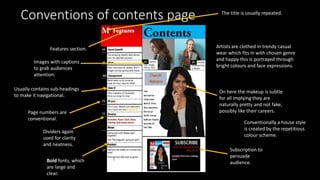
Conventions of contents page The title is usually repeated.
Page numbers are
conventional.
Usually contains sub-headings
to make it navigational.
Conventionally a house style
is created by the repetitious
colour scheme.
Images with captions
to grab audiences
attention.
Bold fonts, which
are large and
clear.
Features section. Artists are clothed in trendy casual
wear which fits in with chosen genre
and happy this is portrayed through
bright colours and face expressions.
On here the makeup is subtle
for all implying they are
naturally pretty and not fake,
possibly like their careers.
Dividers again
used for clarity
and neatness.
Subscription to
persuade
audience.
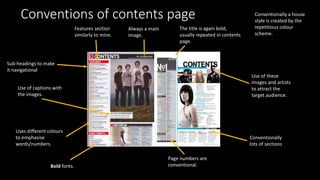
Conventions of contents page
The title is again bold,
usually repeated in contents
page.
Page numbers are
conventional.
Sub-headings to make
it navigational
Conventionally a house
style is created by the
repetitious colour
scheme.
Use of captions with
the images.
Bold fonts.
Use of these
images and artists
to attract the
target audience.
Always a main
image.
Features section
similarly to mine.
Conventionally
lots of sections
Uses different colours
to emphasise
words/numbers.
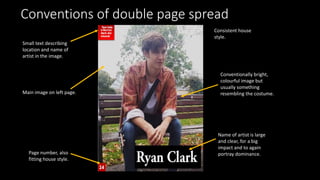
Conventions of double page spread
Main image on left page.
Name of artist is large
and clear, for a big
impact and to again
portray dominance.
Consistent house
style.
Page number, also
fitting house style.
Small text describing
location and name of
artist in the image.
Conventionally bright,
colourful image but
usually something
resembling the costume.
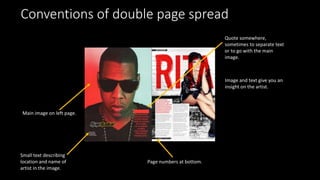
Conventions of double page spread
Main image on left page.
Page numbers at bottom.
Small text describing
location and name of
artist in the image.
Quote somewhere,
sometimes to separate text
or to go with the main
image.
Image and text give you an
insight on the artist.
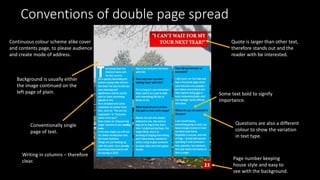
Conventions of double page spread
Some text bold to signify
importance.
Writing in columns – therefore
clear.
Continuous colour scheme alike cover
and contents page, to please audience
and create mode of address.
Conventionally single
page of text.
Page number keeping
house style and easy to
see with the background.
Questions are also a different
colour to show the variation
in text type.
Quote is larger than other text,
therefore stands out and the
reader with be interested.
Background is usually either
the image continued on the
left page of plain.
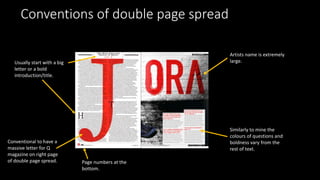
Conventions of double page spread
Conventional to have a
massive letter for Q
magazine on right page
of double page spread.
Artists name is extremely
large.
Similarly to mine the
colours of questions and
boldness vary from the
rest of text.
Page numbers at the
bottom.
Usually start with a big
letter or a bold
introduction/title.

Evaluation conventions 1

  • 1.
  • 2.
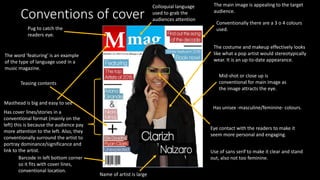
    Conventions of cover Hascover lines/stories in a conventional format (mainly on the left) this is because the audience pay more attention to the left. Also, they conventionally surround the artist to portray dominance/significance and link to the artist. Masthead is big and easy to see Teasing contents The word 'featuring' is an example of the type of language used in a music magazine. Name of artist is large Barcode in left bottom corner so it fits with cover lines, conventional location. Colloquial language used to grab the audiences attention The costume and makeup effectively looks like what a pop artist would stereotypically wear. It is an up-to-date appearance. The main image is appealing to the target audience. Has unisex -masculine/feminine- colours. Use of sans serif to make it clear and stand out, also not too feminine. Mid-shot or close up is conventional for main image as the image attracts the eye. Conventionally there are a 3 o 4 colours used.Pug to catch the readers eye. Eye contact with the readers to make it seem more personal and engaging.
  • 3.
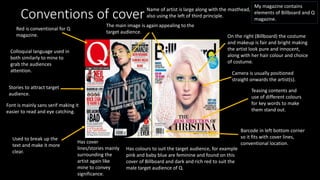
    Conventions of cover Hascover lines/stories mainly surrounding the artist again like mine to convey significance. Teasing contents and use of different colours for key words to make them stand out. Font is mainly sans serif making it easier to read and eye catching. Name of artist is large along with the masthead, also using the left of third principle. Barcode in left bottom corner so it fits with cover lines, conventional location. Colloquial language used in both similarly to mine to grab the audiences attention. On the right (Billboard) the costume and makeup is fair and bright making the artist look pure and innocent, along with her hair colour and choice of costume. The main image is again appealing to the target audience. Has colours to suit the target audience, for example pink and baby blue are feminine and found on this cover of Billboard and dark and rich red to suit the male target audience of Q. My magazine contains elements of Billboard and Q magazine. Red is conventional for Q magazine. Used to break up the text and make it more clear. Stories to attract target audience. Camera is usually positioned straight onwards the artist(s).
  • 4.
    Conventions of contentspage The title is usually repeated. Page numbers are conventional. Usually contains sub-headings to make it navigational. Conventionally a house style is created by the repetitious colour scheme. Images with captions to grab audiences attention. Bold fonts, which are large and clear. Features section. Artists are clothed in trendy casual wear which fits in with chosen genre and happy this is portrayed through bright colours and face expressions. On here the makeup is subtle for all implying they are naturally pretty and not fake, possibly like their careers. Dividers again used for clarity and neatness. Subscription to persuade audience.
  • 5.
    Conventions of contentspage The title is again bold, usually repeated in contents page. Page numbers are conventional. Sub-headings to make it navigational Conventionally a house style is created by the repetitious colour scheme. Use of captions with the images. Bold fonts. Use of these images and artists to attract the target audience. Always a main image. Features section similarly to mine. Conventionally lots of sections Uses different colours to emphasise words/numbers.
  • 6.
    Conventions of doublepage spread Main image on left page. Name of artist is large and clear, for a big impact and to again portray dominance. Consistent house style. Page number, also fitting house style. Small text describing location and name of artist in the image. Conventionally bright, colourful image but usually something resembling the costume.
  • 7.
    Conventions of doublepage spread Main image on left page. Page numbers at bottom. Small text describing location and name of artist in the image. Quote somewhere, sometimes to separate text or to go with the main image. Image and text give you an insight on the artist.
  • 8.
    Conventions of doublepage spread Some text bold to signify importance. Writing in columns – therefore clear. Continuous colour scheme alike cover and contents page, to please audience and create mode of address. Conventionally single page of text. Page number keeping house style and easy to see with the background. Questions are also a different colour to show the variation in text type. Quote is larger than other text, therefore stands out and the reader with be interested. Background is usually either the image continued on the left page of plain.
  • 9.
    Conventions of doublepage spread Conventional to have a massive letter for Q magazine on right page of double page spread. Artists name is extremely large. Similarly to mine the colours of questions and boldness vary from the rest of text. Page numbers at the bottom. Usually start with a big letter or a bold introduction/title.