PREFORMULATION STUDIES
It is a phase of research and development process the
research scientist characterizes physical and chemical
properties of new drug substance in order to develop
stable, safe and effective dosage forms.
PREFORMULATION STUDY
• Before formulating a new drug in to dosage form, it is
necessary to study its physical ,chemical and other
parameters which are suitable to enhance the efficacy,
stability and handling of drugs.
• All these parameters studied prior(before) to formulation ,
hence called preformulation study.
PREFORMULATION
Definition:
• Study of physiochemical properties of drug alone or in
mixture with excipients, to generate key information.
• This information is used to develop elegant,
economical and stable dosage form
Objective :
• To generate useful information to the formulator to
design an optimum drug delivery system or dosage form
GOALS OF PREFORMULATION STUDY
• To establish physiochemical properties of new drug
• To develop data on drug-excipient compatibility.
• To establish drug kinetic rate profile.
PARAMETERS CONSIDERED IN PREFORMULATION STUDIES
Physical parameters Chemical parameters Formulation parameters
Characteristics of drugs Salt formation Anti-oxidants
Microscopy Hydrolytic degradation binding agents
Particle size Oxidation Adsorbents
Partition coefficient pKa determination Diluents
Polymorphism Common ion effect Colorants
Crystallinity Dissolution Flavoring agents
Solubility Stability analysis Sweetening agents
Permeability Solution stability Vehicles
Bulk density Solid state stability Preservatives
Flow characteristics
Temperature effect
Physical properties
1. Organoleptic characteristics:
• Color: may be white, off white, creamy yellow ,shiny
etc
• Odor: odorless, pungent, aromatic etc
• Taste: tasteless, sweet, bitter, sour etc.
Physical properties
2. Particle size and shape:
• Particle size affects dissolution rate, absorption rate, content
uniformity, bioavailability, stability , color etc.
• Flow property, sedimentation is controlled by particle size.
• So it is necessary to study particle size and its utility in
formulation of product.
• Micronisation ( particle size reduction) is method used to
enhance solubility of poorly soluble drug and hence
bioavailability.
• Particles with spherical shape have better flow property than
irregular particles.
• Particle size is determined by Microscopy, Sieving,
Sedimentation, Coulter counter technique.
Particle size and shape……….
• Particle shape is determined by optical microscopy, scanning
electron microscopy, and by polarizing microscope
• Particle size is characterized using these terms :
i)Very coarse (#8)
ii) Coarse (#20)
iii)Moderately coarse (#40)
iv) Fine (#60)
v) Very fine (#80)
Particle shapes
Flow property:
• Powders used in formulation are classified as
free flowing powder
non free flowing or cohesive or sticky.
• Flow property of powders is affected by ,shape, porosity, density,
moisture, electrostatic charge.
• Flow properties of powder are important in tablet formulation, capsule
filling, granulation, powder filling in containers.
• Flow property can be enhanced by use of glidants.
Ex- Starch, Talc.
• Flow property can be determined by determining angle or
repose and should be less than 30°. & can be determined by
following equation.
Tan θ = h/r.
where, θ = angle of repose.
h=height of pile.
r= radius. Angle Of Repose
( In degree)
Type Of Flow
<25 Excellent
25-30 Good
30-40 Passable
>40 Very poor
Bulk density
• It is ratio of mass of powder to its bulk volume.
• Determined using cylinder method.
• Flow property can also be determined by Carrs index
Carr’s Index(%) =(Tapped Density – Poured Density) X 100
Tapped Density
Carr’s Index Type of flow
5-15 Excellent
12-16 Good
18-21 Fair To Passable
23-35 Poor
33-38 Very Poor
>40 Extremely Poor
Polymorphism:
• In this arrangement of molecule is different in solid state and exist in
two different forms.
• These forms have different physiochemical properties, different
melting , boiling points, stability, solubility.
• Chloromphenicol exist in A,B & C forms, of these B form is more
stable & most
preferable.
• Methods used to determine polymorphs are hot stage microscopy,
thermal analysis, infra red spectroscopy, X-ray diffraction.
Hygroscopicity
• Some Drugs When Exposed to Atmosphere Get Converted To
Liquid Form.
• Moisture content makes powder cohesive, lumpy, sticky and
promotes microbial growth.
• It Affects Chemical Stability, rheological Properties And
Compatibility.
• Moisture Content or uptake can be determined by method
like karl Fischer Titration, Gas Chromatography and
Thermogravimetry.
 Solubility:
• Solubility is amount of solute that goes in to solution till equilibrium is established.
• Drug must dissolve prior to its absorption, hence rate of dissolution is important
criteria for its bioavailability.
• Drug must have aqueous solubility greater than 1% W/V for better absorption.
• When drug solubility is less than 10mg/ml, suitable steps must be taken to improve
solubility.
Dissolution:
• Very important factor in preformulation study since dissolution
rate of drug relates to bioavailability of the drug.
• It is measure of mass transfer of solid in to solution (mg/ml).
• Dissolution with respect to time is called dissolution rate.
• Dissolution testing is done in dissolution test apparatus, where
drug dosage form is agitated at constant temperature( 37± 2 0
c) using suitable dissolution medium (water, acidic or basic
buffer). After specific interval the drug is removed analyzed
for drug content.
Dissolution:
• Dissolution rate of a compound can be determined using Noyes Whitney equation
dc/dt =DA/hV (Cs- C)
where
D - Diffusion Coefficient
A- Surface area of drug particle
V- volume of dissolution medium
Cs- concentration of saturated solution in dissolution medium
c- concentration of drug
h- thickness of diffusion layer
t- time required
Partition coefficient
• Lipid soluble drugs easily cross biological membrane, but
must have balance hydrophilic lipophilic properties for
distribution in the body.
• It determines the capacity of drug to partition from one
phase to another.
• Orally administered drug dissolve in aqueous gastric
content and must posses lipid solubility to cross biological
membrane.
• Definition: when drug is added in mixture of immiscible
liquids, it get distributed between two phases in fixed ratio
at equilibrium, so called Partition coefficient.
• Example; water/octanol system is used to study Partition
coefficient.
Dissociation constant:
• The biological membrane is composed of hydrophilic proteins
embedded in lipids.
• The drug must be in unionized form for rapid absorption.
• Hence during absorption the drug must be in dissolved state and in
unionized form.
• Henderson Hasselbalch equation provides estimate of dissociation of
drug at particular pH.
For acidic drugs:
pH = pKa + log (ionised drug/ unionised drug)
For basic drugs
pH = pKa + log (unionised drug/ ionised drug)
• Weak acidic drugs (pKa< 4.5) and weak basic drugs (pKa> 8.5) have
better absorption than strong acidic and basic drugs
Wetting:
• Wetting is displacement of air from surface by a liquid.
• Wetting is first step of dissolution,
• The solvent should cover the solute surface , but presence of air
entraped in porous solid surface oppose wetting.
• Disintegration and dissolution of tablet may slow down due to poor
wetting of tablet by gastric fluids.
• The wetting of drug can be increased by addition of surfactants which
lowers the surface tension at surface between solid and liquid and
increases solubility.
• Example : Sodium Lauryl Sulhpate
Stability studies:
• Stability means ability to retain the original physiochemical form of drug
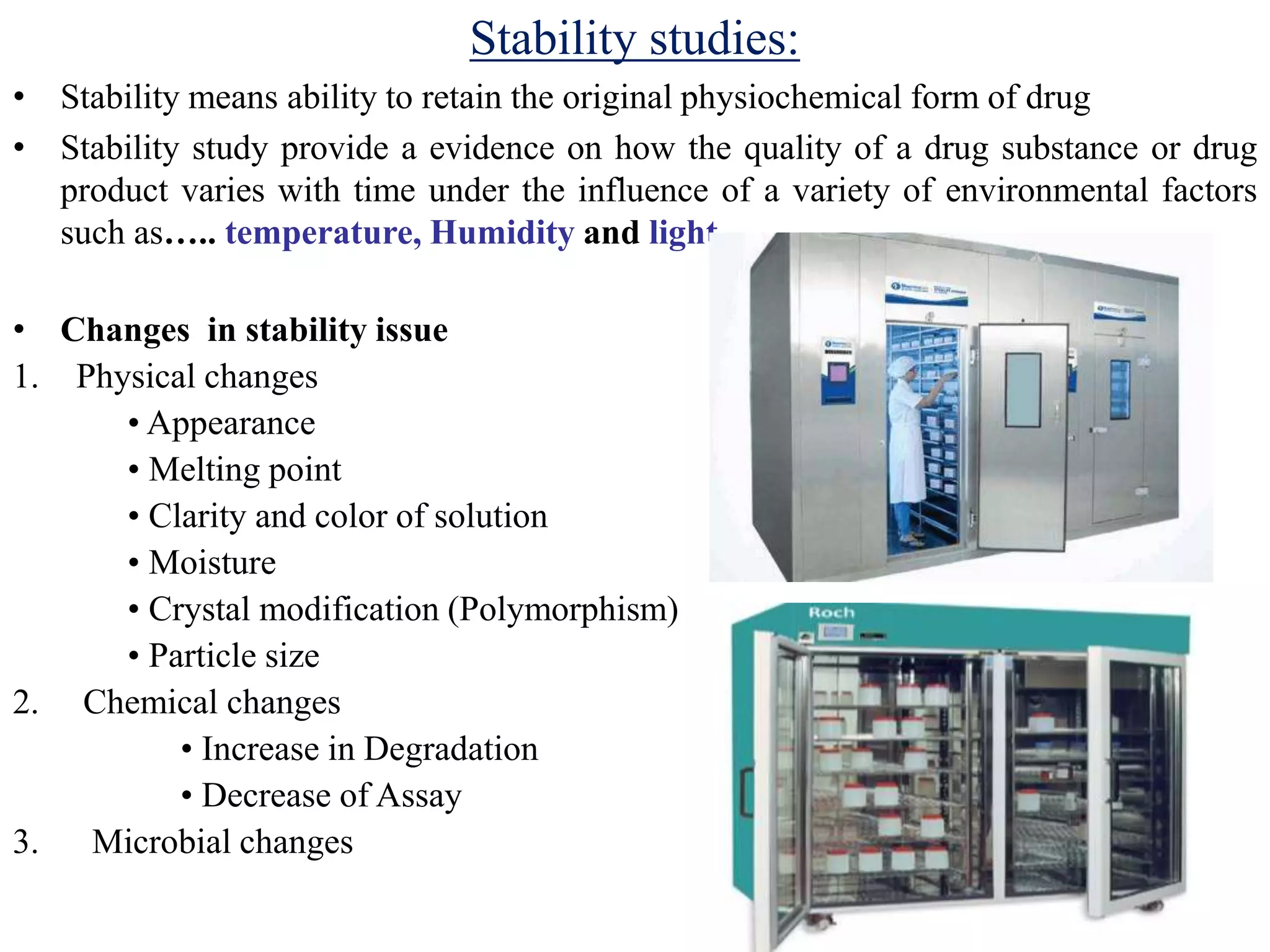
• Stability study provide a evidence on how the quality of a drug substance or drug
product varies with time under the influence of a variety of environmental factors
such as….. temperature, Humidity and light.
• Changes in stability issue
1. Physical changes
• Appearance
• Melting point
• Clarity and color of solution
• Moisture
• Crystal modification (Polymorphism)
• Particle size
2. Chemical changes
• Increase in Degradation
• Decrease of Assay
3. Microbial changes
• Degradation o f drug occurs by hydrolysis, oxidation, photolysis and metal
impurities.
• Accelerated stability studies are performed to speed up stability testing, these test
are as follows
Acidic & Basic conditions.
Dry heat exposure
UV radiation exposure
Influence of pH
Influence of temperature
Influence of ionic strength
• Expiry date of drug or dosage form is calculated on basis of percentage of drug
degraded and expressed as shelf life.
• In shelf life period the drug retains its 90 % potency.
 Drug –Excipient interaction(incompatability)
Once drug stability is checked , then interaction of drug with excipient is analyzed.
The drug excipient incompatibility may be
Physical Incompatibility
Chemical Incompatibility
Therapeutic Incompatibility.
• Techniques used to study drug –excipient interaction are
 Chromatography
 Differential thermal methods
 Spectroscopic methods
 Fluorescence methods
 Vapor pressure Osmomtery
 Accelerated storage testing
Preformlation

Preformlation

  • 1.
  • 2.
    PREFORMULATION STUDIES It isa phase of research and development process the research scientist characterizes physical and chemical properties of new drug substance in order to develop stable, safe and effective dosage forms.
  • 3.
    PREFORMULATION STUDY • Beforeformulating a new drug in to dosage form, it is necessary to study its physical ,chemical and other parameters which are suitable to enhance the efficacy, stability and handling of drugs. • All these parameters studied prior(before) to formulation , hence called preformulation study.
  • 4.
    PREFORMULATION Definition: • Study ofphysiochemical properties of drug alone or in mixture with excipients, to generate key information. • This information is used to develop elegant, economical and stable dosage form Objective : • To generate useful information to the formulator to design an optimum drug delivery system or dosage form
  • 5.
    GOALS OF PREFORMULATIONSTUDY • To establish physiochemical properties of new drug • To develop data on drug-excipient compatibility. • To establish drug kinetic rate profile.
  • 6.
    PARAMETERS CONSIDERED INPREFORMULATION STUDIES Physical parameters Chemical parameters Formulation parameters Characteristics of drugs Salt formation Anti-oxidants Microscopy Hydrolytic degradation binding agents Particle size Oxidation Adsorbents Partition coefficient pKa determination Diluents Polymorphism Common ion effect Colorants Crystallinity Dissolution Flavoring agents Solubility Stability analysis Sweetening agents Permeability Solution stability Vehicles Bulk density Solid state stability Preservatives Flow characteristics Temperature effect
  • 7.
    Physical properties 1. Organolepticcharacteristics: • Color: may be white, off white, creamy yellow ,shiny etc • Odor: odorless, pungent, aromatic etc • Taste: tasteless, sweet, bitter, sour etc.
  • 8.
    Physical properties 2. Particlesize and shape: • Particle size affects dissolution rate, absorption rate, content uniformity, bioavailability, stability , color etc. • Flow property, sedimentation is controlled by particle size. • So it is necessary to study particle size and its utility in formulation of product. • Micronisation ( particle size reduction) is method used to enhance solubility of poorly soluble drug and hence bioavailability. • Particles with spherical shape have better flow property than irregular particles. • Particle size is determined by Microscopy, Sieving, Sedimentation, Coulter counter technique.
  • 9.
    Particle size andshape………. • Particle shape is determined by optical microscopy, scanning electron microscopy, and by polarizing microscope • Particle size is characterized using these terms : i)Very coarse (#8) ii) Coarse (#20) iii)Moderately coarse (#40) iv) Fine (#60) v) Very fine (#80)
  • 10.
  • 11.
    Flow property: • Powdersused in formulation are classified as free flowing powder non free flowing or cohesive or sticky. • Flow property of powders is affected by ,shape, porosity, density, moisture, electrostatic charge. • Flow properties of powder are important in tablet formulation, capsule filling, granulation, powder filling in containers. • Flow property can be enhanced by use of glidants. Ex- Starch, Talc.
  • 12.
    • Flow propertycan be determined by determining angle or repose and should be less than 30°. & can be determined by following equation. Tan θ = h/r. where, θ = angle of repose. h=height of pile. r= radius. Angle Of Repose ( In degree) Type Of Flow <25 Excellent 25-30 Good 30-40 Passable >40 Very poor
  • 13.
    Bulk density • Itis ratio of mass of powder to its bulk volume. • Determined using cylinder method. • Flow property can also be determined by Carrs index Carr’s Index(%) =(Tapped Density – Poured Density) X 100 Tapped Density Carr’s Index Type of flow 5-15 Excellent 12-16 Good 18-21 Fair To Passable 23-35 Poor 33-38 Very Poor >40 Extremely Poor
  • 14.
    Polymorphism: • In thisarrangement of molecule is different in solid state and exist in two different forms. • These forms have different physiochemical properties, different melting , boiling points, stability, solubility. • Chloromphenicol exist in A,B & C forms, of these B form is more stable & most preferable. • Methods used to determine polymorphs are hot stage microscopy, thermal analysis, infra red spectroscopy, X-ray diffraction.
  • 15.
    Hygroscopicity • Some DrugsWhen Exposed to Atmosphere Get Converted To Liquid Form. • Moisture content makes powder cohesive, lumpy, sticky and promotes microbial growth. • It Affects Chemical Stability, rheological Properties And Compatibility. • Moisture Content or uptake can be determined by method like karl Fischer Titration, Gas Chromatography and Thermogravimetry.
  • 16.
     Solubility: • Solubilityis amount of solute that goes in to solution till equilibrium is established. • Drug must dissolve prior to its absorption, hence rate of dissolution is important criteria for its bioavailability. • Drug must have aqueous solubility greater than 1% W/V for better absorption. • When drug solubility is less than 10mg/ml, suitable steps must be taken to improve solubility.
  • 17.
    Dissolution: • Very importantfactor in preformulation study since dissolution rate of drug relates to bioavailability of the drug. • It is measure of mass transfer of solid in to solution (mg/ml). • Dissolution with respect to time is called dissolution rate. • Dissolution testing is done in dissolution test apparatus, where drug dosage form is agitated at constant temperature( 37± 2 0 c) using suitable dissolution medium (water, acidic or basic buffer). After specific interval the drug is removed analyzed for drug content.
  • 18.
    Dissolution: • Dissolution rateof a compound can be determined using Noyes Whitney equation dc/dt =DA/hV (Cs- C) where D - Diffusion Coefficient A- Surface area of drug particle V- volume of dissolution medium Cs- concentration of saturated solution in dissolution medium c- concentration of drug h- thickness of diffusion layer t- time required
  • 19.
    Partition coefficient • Lipidsoluble drugs easily cross biological membrane, but must have balance hydrophilic lipophilic properties for distribution in the body. • It determines the capacity of drug to partition from one phase to another. • Orally administered drug dissolve in aqueous gastric content and must posses lipid solubility to cross biological membrane. • Definition: when drug is added in mixture of immiscible liquids, it get distributed between two phases in fixed ratio at equilibrium, so called Partition coefficient. • Example; water/octanol system is used to study Partition coefficient.
  • 20.
    Dissociation constant: • Thebiological membrane is composed of hydrophilic proteins embedded in lipids. • The drug must be in unionized form for rapid absorption. • Hence during absorption the drug must be in dissolved state and in unionized form. • Henderson Hasselbalch equation provides estimate of dissociation of drug at particular pH. For acidic drugs: pH = pKa + log (ionised drug/ unionised drug) For basic drugs pH = pKa + log (unionised drug/ ionised drug) • Weak acidic drugs (pKa< 4.5) and weak basic drugs (pKa> 8.5) have better absorption than strong acidic and basic drugs
  • 21.
    Wetting: • Wetting isdisplacement of air from surface by a liquid. • Wetting is first step of dissolution, • The solvent should cover the solute surface , but presence of air entraped in porous solid surface oppose wetting. • Disintegration and dissolution of tablet may slow down due to poor wetting of tablet by gastric fluids. • The wetting of drug can be increased by addition of surfactants which lowers the surface tension at surface between solid and liquid and increases solubility. • Example : Sodium Lauryl Sulhpate
  • 22.
    Stability studies: • Stabilitymeans ability to retain the original physiochemical form of drug • Stability study provide a evidence on how the quality of a drug substance or drug product varies with time under the influence of a variety of environmental factors such as….. temperature, Humidity and light. • Changes in stability issue 1. Physical changes • Appearance • Melting point • Clarity and color of solution • Moisture • Crystal modification (Polymorphism) • Particle size 2. Chemical changes • Increase in Degradation • Decrease of Assay 3. Microbial changes
  • 23.
    • Degradation of drug occurs by hydrolysis, oxidation, photolysis and metal impurities. • Accelerated stability studies are performed to speed up stability testing, these test are as follows Acidic & Basic conditions. Dry heat exposure UV radiation exposure Influence of pH Influence of temperature Influence of ionic strength • Expiry date of drug or dosage form is calculated on basis of percentage of drug degraded and expressed as shelf life. • In shelf life period the drug retains its 90 % potency.
  • 24.
     Drug –Excipientinteraction(incompatability) Once drug stability is checked , then interaction of drug with excipient is analyzed. The drug excipient incompatibility may be Physical Incompatibility Chemical Incompatibility Therapeutic Incompatibility. • Techniques used to study drug –excipient interaction are  Chromatography  Differential thermal methods  Spectroscopic methods  Fluorescence methods  Vapor pressure Osmomtery  Accelerated storage testing