SEMINAR ON PHYSIOCHEMICAL FACTORS INFLUENCING FORMULATION PRESENTED BY:- VBM ROLL :- 12 YEAR-2010-2011
PREFORMULATION What it is? It is defined as phase of research and development in which preformulation scientist characterize physical & chemical properties of new drug molecule in order to develop safe, effective, and stable dosage form.
DIRECT BENEFITS Gives direction for development of formulation in choice of dosage form, excipients, composition, physical structure Helps in adjustment of Pharmacokinetics and biopharmaceutical properties. Support for process development of drug substance (yield, filtration...). Produce necessary and useful data for development of analytical methods.
CONTENTS:- PHYSICAL CHARACTERISTICS BULK CHARACTERISTIC 1) Crystallinity and Polymorphism 2) Hygroscopicity 3) Particle Size & Surface Area 4) Flow properties & Bulk density 5) Compressibility 6) Drug- Excipient Compatibility  
B. SOLUBILITY ANALYSIS 1) Ionization constant 2) Solubilization. 3) Partition Coefficient 4) Thermal effect 5) Common ion effect. 6) Dissolution. C. STABILITY ANALYSIS 1) Solid State Stability. 2) Solution State Stability
II. CHEMICAL CHARACTERISTIC 1) Oxidation. 2) Hydrolysis. 3) Photolysis. 4) Racemization. 5) Polymerization. 6) Isomerization. 7) Decarboxylation. 8) Enzyme Decomposition.
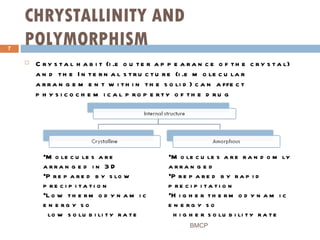
CHRYSTALLINITY AND POLYMORPHISM Crystal habit (i.e outer appearance of the crystal) and the Internal structure (i.e molecular arrangement within the solid) can affect physicochemical property of the drug BMCP Molecules are arranged in 3D Prepared by slow precipitation Low thermodynamic energy so low solubility rate Molecules are randomly arranged Prepared by rapid precipitation Higher thermodynamic  energy so higher solubility rate
POLYMORPHISM:- It is defined as the ability of a compound to crystallize in more than one crystalline form Chemical stability and solubility changes due to polymorphism For e.g chloramphenicol palmitate exists in three (A,B,C) polymorphic form, from which B is more soluble and melting point, density and hardness will also change  
HYGROSCOPICITY Some drugs have the tendency to adsorb atmospheric moisture Now the amount of adsorb moisture depends upon the atmospheric humidity, temperature, surface area and the mechanism for the moisture uptake The change in moisture level greatly influences chemical stability, flowability, and compactability.
PARTICAL SIZE AND SURFACE AREA lt affects the bulk flow, formulation homogenicity of the drug particles Each drug particle is tested for the smallest particle size as it facilitates preparation of homogenous mixture  Instruments used for checking the size and shape are  Light microscope - Hemacytometer slide  Coulter counter - Samples are dispersed in the conducting medium such as isotonic saline and a few drops of surfactant, than 0.5 to 2 mi of this suspension is drawn into tube through small aperture across which voltage is applied and the particle passing through the hole is counted
FLOW PROPERTY AND BULK DENSITY Bulk density is of greatest important in the size of high dose capsule product and in a low dose formulation in which there is a large difference in drug and excepients density.
IONIZATION CONSTANT(pKa):- 75% of all drugs are weak base 20% are weak acids and only 5% are non ionic amphoteric or alcohol Henderson-Hasselblach equation:- pH = pKa + log[ionised form]/ [unionised form] ---for acids pH = pKa + log [unionised form] / [ionised form]---for base Uses of this equation To determine pKa. To predict solubility of any pH provided that intrensic solubility(Co) & pKa are known To facilitate the selection of suitable salt forming compounds To predict the solubility and pH properties of the salt
METHODS TO DETERMINE pKa Potentiometric method Conductivity method  Dissolution rate method Liquid liquid partition method Spectrophotometric method
SOLUBILIZATION  Many different approaches have been developed to improve drug solubility Micronization:- Eg. Griseofulvin shows increased solubility by reducing particle size Change in pH:- Eg. Solubility of Nimesulide increases as pH is increased Eg. Arginine increases solubility of coumarins Eg. Etoposide formulation is difficult because of its poor solubility & liable chemical stability so etoposide loaded emulsion (ELE) is formulates most stable at pH 4-5
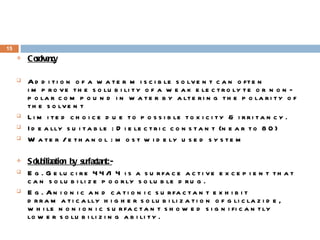
Cosolvency Addition of a water miscible solvent can often improve the solubility of a weak electrolyte or non-polar compound in water by altering the polarity of the solvent Limited choice due to possible toxicity & irritancy. Ideally suitable : Dielectric constant (near to 80) Water / ethanol : most widely used system Solubilization by surfactant:- Eg. Gelucire 44/14 is a surface active excepient that can solubilize poorly soluble drug. Eg. Anionic and cationic surfactant exhibit drramatically higher solubilization of gliclazide, while nonionic surfactant showed significantly lower solubilizing ability.
Complexation:- Eg. The complexation of iodine with 10-15% pvp can improve aq. Solubility of active agent  Use of metastable polymorphs:- Eg. B form of chloramphenicol palmitate is more water soluble than A & C forms.
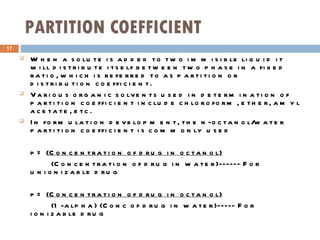
PARTITION COEFFICIENT When a solute is added to two immisible liquid it  will distribute itself between two phase in a fixed ratio, which is referred to as partition or distribution coefficient. Various organic solvents used in determination of partition coefficient include chloroform, ether, amyl acetate, etc. In formulation development, the n-octanol/water partition coefficient is commonly used p=  (Concentration of drug in octanol) (Concentration of drug in water)------ For unionizable drug p=  (Concentration of drug in octanol) (1-alpha) (Conc of drug in water)----- For ionizable drug
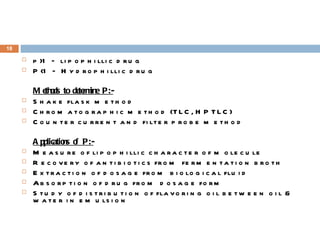
p>1 – lipophillic drug P<1 – Hydrophillic drug Methods to determine P:- Shake flask method Chromatographic method (TLC, HPTLC) Counter current and filter probe method Applications of P:- Measure of lipophillic character of molecule Recovery of antibiotics from fermentation broth Extraction of dosage from biological fluid Absorption of drug from dosage form Study of distribution of flavoring oil between oil & water in emulsion
THERMAL EFFECT Effect of temperature on the solubility of drug can be determind by measuring heat of solution (▲Hs) ln S = - ▲Hs/R*T + c| Where S= Molar solubility at temp T (0K) R= Gas constant If Hs is positive than increase In temperature increases the drug solubility and vice-versa Heat of solution represents the heat released or absorbed when a mole  of solute is dissolved in a large quantity of solvent. Typical temp. range should include 5 0 C, 25 0 C, 37 0 C, & 50 0 C. Important: Determination of temp effect on solubility helps in predicting storage condition & dosage form designing
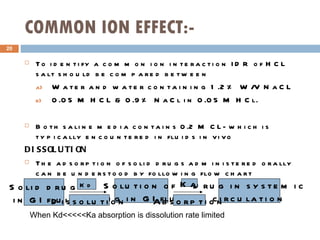
COMMO N  ION EFFECT:- To identify a common ion interaction IDR of HCL salt should be compared between  Water and water containing 1.2% W/V NaCL 0.05 M HCL & 0.9% NaCl in 0.05 M HCl.  Both saline media contains 0.2 M CL- which is typically encountered in fluids in vivo DISSOLUTION The adsorption of solid drugs administered orally can be understood by following flow chart  Solid drug in GI fluid Solution of  drug in GI fluid Drug in systemic circulation Dissolution Absorption Kd Ka When Kd<<<<<Ka absorption is dissolution rate limited
Dissolution rate can affect:- Onset of action Intensity of action  Duration of response  Control the overall bioavaibality of drug form
STABILITY ANALYSIS Development of a drug substance into a suitable dosage form repairs the preformulation stability studies as: [1] Solid state stability [2] Solution state stability Solid state stability :- Solid state reactions are much slower and more difficult to interpret than solution state reactions because of reduced no. of molecular contacts between drugs and excepient molecules and occurrence of multiple reactions
Technique for solid state stability studies: Solid state NMR Spectroscopy (SSNMR) Powder x-ray diffraction (PXRD) Fourier transform IR (FTIR) Raman Spectroscopy Differential scanning calorimetry (DSC) Thermo gravimetric analysis (TGA) Dynamic vapour sorption (DSV) SOLUTION STATE STABILITY The primary objective is identification of conditions necessary to form a stable solution  These studies include the effects of -pH  -Oxygen -Light -Temperature -Ionic strength -Coosolvent
If the result of this solution stability studies dictate the compound as sufficiently stable, liquid formulations can be developed.
Chemical Characteristic OXIDATION It is very common pathway for drug degradation in both liquid and solid formulation  Oxidation occurs in two ways Auto oxidation Free radical oxidation Functional group having high susceptibility towards oxidation:-   Alkenes  Substituted aromatic group (Toluene, Phenols, Anisole). Ethers Thioethers Amines
FACTORS AFFECTING OXIDATION PROCESS Oxygen concentration Light Heavy metals particularly those having two or more valence state Hydrogen & Hydroxyl Ion Temperature
PREVENTION OF OXIDATION Reducing oxygen content Storage in a dark and cool condition Addition of chelating agent (Eg. EDTA, Citric acid, Tartaric acid) Adjustment of pH Changing solvent (Eg. Aldehydes, ethers, Ketones, may influence free radical reaction) Addition of an antioxidant. Reducing agent Chain inhibitors of radical induced decomposition
HYDROLYSIS It involves nucleophilic attack of liable group Eg. Lactum > Ester > Amide > Imide When this attack is by a solvent other than water than it is known as solvolysis It generally follows 2nd order kinetics as there are two reacting species, water and API. In aqueous solution, water is in excess, the reaction is 1st orde. Conditions that catalysis the breakdown Presence of hydroxil ion Presence of hydride ion Presence of divalent ion Heat Light Ionic hydrolysis Solution polarity and ionic strength High drug concentration
PREVENTION OF HYDROLYSIS pH adjustment Formulate the drug solution close to its pH of optimum sability. Addition of water miscible solvent in formulation Optimum buffer concentration Addition of surfactant Nonionic, cationic, and anionic surfactant stabilizes the drug against base catalysis Salts and Esters  Eg.Phosphate esters of clindamycine   The solubility of p’ceuticals undergoing ester hydrolysis can be reduced by forming less soluble salts. By use of complexing agent
PHOTOLYSIS Mechanism of decomposition Electronic configuration of drug overlaps with spectrum of sunlight or any artificial light & thereby energy is absorbrd by electron and it goes to the excited state. They are unstable and releases the acquired energy and come to the ground state and decompose the drug
PHOTODECOMPOSITION PATHWAY N-Dealkylation Eg. Diphenylhydramine , Chloroquine, Methotrexate Dehalogination Eg. Chlorpropamide, Furosemide Dehydrogenation of Ca++channel blocker Eg. Solution of Nifedipine
Oxidation Eg. Chlorpromazine & other Phenothiazines give N- & S- oxides in the presence of sunlight
PREVENTION OF PHOTODECOMPOSITION:- Suitable packing. Eg. Yellow-green glass gives the best protection in U.V. region while Amber confers considerable protection against U.V. radiation but little from I.R. Protection of drug from light Eg. Nifedipine is manufactured under Na light. Avoiding sunbath.
RACEMIZATION The interconversion from one isomer to another can lead to different P'cokinetic properties (ADME) as well as different P'cological & toxicological effect. Eg. L-epinephrine is 15 to 20 times more active than d-form, while activity of racemic mixture is just one half of the L-form. It depends on temperature, solvent, catalyst & presence or absence of light.
POLYMERIZATION It is a continuous reaction between molecules. More than one monomer reacts to form a polymer. Eg. Darkening of glucose solution is attributed to polymerization of breakdown product [5- (hydroxyl methyl) furfural. Eg. Shellac on aging undergoes polymerization & hence prolongs disintegration time &dissolution time.
ISOMERIZATION It is the process involving change of one structure to another having same empirical formula but different properties in one or more respects. Its occurrence is rare. Examples:- Tetracycline & its dvts. can undergo reversible Isomerization at pH range 2-6. Trans-cis Isomerization of Amphotericin B.
DECARBOXYLATION Evolution of C02 gas from -COOH group containing drugs. Eg. Solid PAS undergoes decarboxlation to m- aminophenol & Carbondioxide. Enzyme Decomposition Chemical degradation due to enzymes induced by drug results into decomposition. Remedy: Use of buccal tab. Use of pro-drug. (L-dopa). Improvement in physicochemical properties has been achieved by structural optimization or prodrug approach - Enhancement of occular penetration when given orally.(ORAL DRUG DELIVERY SYSTEM)
REFERENCES: Pharmaceutics- The science of Dosage Form Design by M. E. Aulton.(2nd edition): pg.113 The Science & Practice of Pharmacy by Remington. (19th edition): 1447 The Theory & Practice of Industrial Pharmacy by Leon Lachman, HerbetA. Lieberman, Joseph L. Kaing. (3rd edition): pg. 171 Pharmaceutical Dosage Forms by Leon Lachman, Herbet A. Lieberman; (Volume I):  pg. 1
THANK YOU

Physiochemical factors influencing formulaon

  • 1.
    SEMINAR ON PHYSIOCHEMICALFACTORS INFLUENCING FORMULATION PRESENTED BY:- VBM ROLL :- 12 YEAR-2010-2011
  • 2.
    PREFORMULATION What itis? It is defined as phase of research and development in which preformulation scientist characterize physical & chemical properties of new drug molecule in order to develop safe, effective, and stable dosage form.
  • 3.
    DIRECT BENEFITS Givesdirection for development of formulation in choice of dosage form, excipients, composition, physical structure Helps in adjustment of Pharmacokinetics and biopharmaceutical properties. Support for process development of drug substance (yield, filtration...). Produce necessary and useful data for development of analytical methods.
  • 4.
    CONTENTS:- PHYSICAL CHARACTERISTICSBULK CHARACTERISTIC 1) Crystallinity and Polymorphism 2) Hygroscopicity 3) Particle Size & Surface Area 4) Flow properties & Bulk density 5) Compressibility 6) Drug- Excipient Compatibility  
  • 5.
    B. SOLUBILITY ANALYSIS1) Ionization constant 2) Solubilization. 3) Partition Coefficient 4) Thermal effect 5) Common ion effect. 6) Dissolution. C. STABILITY ANALYSIS 1) Solid State Stability. 2) Solution State Stability
  • 6.
    II. CHEMICAL CHARACTERISTIC1) Oxidation. 2) Hydrolysis. 3) Photolysis. 4) Racemization. 5) Polymerization. 6) Isomerization. 7) Decarboxylation. 8) Enzyme Decomposition.
  • 7.
    CHRYSTALLINITY AND POLYMORPHISMCrystal habit (i.e outer appearance of the crystal) and the Internal structure (i.e molecular arrangement within the solid) can affect physicochemical property of the drug BMCP Molecules are arranged in 3D Prepared by slow precipitation Low thermodynamic energy so low solubility rate Molecules are randomly arranged Prepared by rapid precipitation Higher thermodynamic energy so higher solubility rate
  • 8.
    POLYMORPHISM:- It isdefined as the ability of a compound to crystallize in more than one crystalline form Chemical stability and solubility changes due to polymorphism For e.g chloramphenicol palmitate exists in three (A,B,C) polymorphic form, from which B is more soluble and melting point, density and hardness will also change  
  • 9.
    HYGROSCOPICITY Some drugshave the tendency to adsorb atmospheric moisture Now the amount of adsorb moisture depends upon the atmospheric humidity, temperature, surface area and the mechanism for the moisture uptake The change in moisture level greatly influences chemical stability, flowability, and compactability.
  • 10.
    PARTICAL SIZE ANDSURFACE AREA lt affects the bulk flow, formulation homogenicity of the drug particles Each drug particle is tested for the smallest particle size as it facilitates preparation of homogenous mixture Instruments used for checking the size and shape are Light microscope - Hemacytometer slide Coulter counter - Samples are dispersed in the conducting medium such as isotonic saline and a few drops of surfactant, than 0.5 to 2 mi of this suspension is drawn into tube through small aperture across which voltage is applied and the particle passing through the hole is counted
  • 11.
    FLOW PROPERTY ANDBULK DENSITY Bulk density is of greatest important in the size of high dose capsule product and in a low dose formulation in which there is a large difference in drug and excepients density.
  • 12.
    IONIZATION CONSTANT(pKa):- 75%of all drugs are weak base 20% are weak acids and only 5% are non ionic amphoteric or alcohol Henderson-Hasselblach equation:- pH = pKa + log[ionised form]/ [unionised form] ---for acids pH = pKa + log [unionised form] / [ionised form]---for base Uses of this equation To determine pKa. To predict solubility of any pH provided that intrensic solubility(Co) & pKa are known To facilitate the selection of suitable salt forming compounds To predict the solubility and pH properties of the salt
  • 13.
    METHODS TO DETERMINEpKa Potentiometric method Conductivity method Dissolution rate method Liquid liquid partition method Spectrophotometric method
  • 14.
    SOLUBILIZATION Manydifferent approaches have been developed to improve drug solubility Micronization:- Eg. Griseofulvin shows increased solubility by reducing particle size Change in pH:- Eg. Solubility of Nimesulide increases as pH is increased Eg. Arginine increases solubility of coumarins Eg. Etoposide formulation is difficult because of its poor solubility & liable chemical stability so etoposide loaded emulsion (ELE) is formulates most stable at pH 4-5
  • 15.
    Cosolvency Addition ofa water miscible solvent can often improve the solubility of a weak electrolyte or non-polar compound in water by altering the polarity of the solvent Limited choice due to possible toxicity & irritancy. Ideally suitable : Dielectric constant (near to 80) Water / ethanol : most widely used system Solubilization by surfactant:- Eg. Gelucire 44/14 is a surface active excepient that can solubilize poorly soluble drug. Eg. Anionic and cationic surfactant exhibit drramatically higher solubilization of gliclazide, while nonionic surfactant showed significantly lower solubilizing ability.
  • 16.
    Complexation:- Eg. Thecomplexation of iodine with 10-15% pvp can improve aq. Solubility of active agent Use of metastable polymorphs:- Eg. B form of chloramphenicol palmitate is more water soluble than A & C forms.
  • 17.
    PARTITION COEFFICIENT Whena solute is added to two immisible liquid it will distribute itself between two phase in a fixed ratio, which is referred to as partition or distribution coefficient. Various organic solvents used in determination of partition coefficient include chloroform, ether, amyl acetate, etc. In formulation development, the n-octanol/water partition coefficient is commonly used p= (Concentration of drug in octanol) (Concentration of drug in water)------ For unionizable drug p= (Concentration of drug in octanol) (1-alpha) (Conc of drug in water)----- For ionizable drug
  • 18.
    p>1 – lipophillicdrug P<1 – Hydrophillic drug Methods to determine P:- Shake flask method Chromatographic method (TLC, HPTLC) Counter current and filter probe method Applications of P:- Measure of lipophillic character of molecule Recovery of antibiotics from fermentation broth Extraction of dosage from biological fluid Absorption of drug from dosage form Study of distribution of flavoring oil between oil & water in emulsion
  • 19.
    THERMAL EFFECT Effectof temperature on the solubility of drug can be determind by measuring heat of solution (▲Hs) ln S = - ▲Hs/R*T + c| Where S= Molar solubility at temp T (0K) R= Gas constant If Hs is positive than increase In temperature increases the drug solubility and vice-versa Heat of solution represents the heat released or absorbed when a mole of solute is dissolved in a large quantity of solvent. Typical temp. range should include 5 0 C, 25 0 C, 37 0 C, & 50 0 C. Important: Determination of temp effect on solubility helps in predicting storage condition & dosage form designing
  • 20.
    COMMO N ION EFFECT:- To identify a common ion interaction IDR of HCL salt should be compared between Water and water containing 1.2% W/V NaCL 0.05 M HCL & 0.9% NaCl in 0.05 M HCl. Both saline media contains 0.2 M CL- which is typically encountered in fluids in vivo DISSOLUTION The adsorption of solid drugs administered orally can be understood by following flow chart Solid drug in GI fluid Solution of drug in GI fluid Drug in systemic circulation Dissolution Absorption Kd Ka When Kd<<<<<Ka absorption is dissolution rate limited
  • 21.
    Dissolution rate canaffect:- Onset of action Intensity of action Duration of response Control the overall bioavaibality of drug form
  • 22.
    STABILITY ANALYSIS Developmentof a drug substance into a suitable dosage form repairs the preformulation stability studies as: [1] Solid state stability [2] Solution state stability Solid state stability :- Solid state reactions are much slower and more difficult to interpret than solution state reactions because of reduced no. of molecular contacts between drugs and excepient molecules and occurrence of multiple reactions
  • 23.
    Technique for solidstate stability studies: Solid state NMR Spectroscopy (SSNMR) Powder x-ray diffraction (PXRD) Fourier transform IR (FTIR) Raman Spectroscopy Differential scanning calorimetry (DSC) Thermo gravimetric analysis (TGA) Dynamic vapour sorption (DSV) SOLUTION STATE STABILITY The primary objective is identification of conditions necessary to form a stable solution These studies include the effects of -pH -Oxygen -Light -Temperature -Ionic strength -Coosolvent
  • 24.
    If the resultof this solution stability studies dictate the compound as sufficiently stable, liquid formulations can be developed.
  • 25.
    Chemical Characteristic OXIDATIONIt is very common pathway for drug degradation in both liquid and solid formulation Oxidation occurs in two ways Auto oxidation Free radical oxidation Functional group having high susceptibility towards oxidation:- Alkenes Substituted aromatic group (Toluene, Phenols, Anisole). Ethers Thioethers Amines
  • 26.
    FACTORS AFFECTING OXIDATIONPROCESS Oxygen concentration Light Heavy metals particularly those having two or more valence state Hydrogen & Hydroxyl Ion Temperature
  • 27.
    PREVENTION OF OXIDATIONReducing oxygen content Storage in a dark and cool condition Addition of chelating agent (Eg. EDTA, Citric acid, Tartaric acid) Adjustment of pH Changing solvent (Eg. Aldehydes, ethers, Ketones, may influence free radical reaction) Addition of an antioxidant. Reducing agent Chain inhibitors of radical induced decomposition
  • 28.
    HYDROLYSIS It involvesnucleophilic attack of liable group Eg. Lactum > Ester > Amide > Imide When this attack is by a solvent other than water than it is known as solvolysis It generally follows 2nd order kinetics as there are two reacting species, water and API. In aqueous solution, water is in excess, the reaction is 1st orde. Conditions that catalysis the breakdown Presence of hydroxil ion Presence of hydride ion Presence of divalent ion Heat Light Ionic hydrolysis Solution polarity and ionic strength High drug concentration
  • 29.
    PREVENTION OF HYDROLYSISpH adjustment Formulate the drug solution close to its pH of optimum sability. Addition of water miscible solvent in formulation Optimum buffer concentration Addition of surfactant Nonionic, cationic, and anionic surfactant stabilizes the drug against base catalysis Salts and Esters Eg.Phosphate esters of clindamycine The solubility of p’ceuticals undergoing ester hydrolysis can be reduced by forming less soluble salts. By use of complexing agent
  • 30.
    PHOTOLYSIS Mechanism ofdecomposition Electronic configuration of drug overlaps with spectrum of sunlight or any artificial light & thereby energy is absorbrd by electron and it goes to the excited state. They are unstable and releases the acquired energy and come to the ground state and decompose the drug
  • 31.
    PHOTODECOMPOSITION PATHWAY N-DealkylationEg. Diphenylhydramine , Chloroquine, Methotrexate Dehalogination Eg. Chlorpropamide, Furosemide Dehydrogenation of Ca++channel blocker Eg. Solution of Nifedipine
  • 32.
    Oxidation Eg. Chlorpromazine& other Phenothiazines give N- & S- oxides in the presence of sunlight
  • 33.
    PREVENTION OF PHOTODECOMPOSITION:-Suitable packing. Eg. Yellow-green glass gives the best protection in U.V. region while Amber confers considerable protection against U.V. radiation but little from I.R. Protection of drug from light Eg. Nifedipine is manufactured under Na light. Avoiding sunbath.
  • 34.
    RACEMIZATION The interconversionfrom one isomer to another can lead to different P'cokinetic properties (ADME) as well as different P'cological & toxicological effect. Eg. L-epinephrine is 15 to 20 times more active than d-form, while activity of racemic mixture is just one half of the L-form. It depends on temperature, solvent, catalyst & presence or absence of light.
  • 35.
    POLYMERIZATION It isa continuous reaction between molecules. More than one monomer reacts to form a polymer. Eg. Darkening of glucose solution is attributed to polymerization of breakdown product [5- (hydroxyl methyl) furfural. Eg. Shellac on aging undergoes polymerization & hence prolongs disintegration time &dissolution time.
  • 36.
    ISOMERIZATION It isthe process involving change of one structure to another having same empirical formula but different properties in one or more respects. Its occurrence is rare. Examples:- Tetracycline & its dvts. can undergo reversible Isomerization at pH range 2-6. Trans-cis Isomerization of Amphotericin B.
  • 37.
    DECARBOXYLATION Evolution ofC02 gas from -COOH group containing drugs. Eg. Solid PAS undergoes decarboxlation to m- aminophenol & Carbondioxide. Enzyme Decomposition Chemical degradation due to enzymes induced by drug results into decomposition. Remedy: Use of buccal tab. Use of pro-drug. (L-dopa). Improvement in physicochemical properties has been achieved by structural optimization or prodrug approach - Enhancement of occular penetration when given orally.(ORAL DRUG DELIVERY SYSTEM)
  • 38.
    REFERENCES: Pharmaceutics- Thescience of Dosage Form Design by M. E. Aulton.(2nd edition): pg.113 The Science & Practice of Pharmacy by Remington. (19th edition): 1447 The Theory & Practice of Industrial Pharmacy by Leon Lachman, HerbetA. Lieberman, Joseph L. Kaing. (3rd edition): pg. 171 Pharmaceutical Dosage Forms by Leon Lachman, Herbet A. Lieberman; (Volume I): pg. 1
  • 39.

Editor's Notes