PRESENTED BY-
MR. DEBASHIS PUROHIT
M.PHARM,1st SEMESTER
(INDUSTRIALPHARMACY)
REGD. NO-1761617004
DATE-09/11/2017
SCHOOL OF PHARMACEUTICALSCIENCES,
SIKSHA ’O’ ANUSANDHAN UNIVERSITY,BHUBANESWAR
TOPIC-PH AND SOLUBILITY PROFILE
Introduction
 Solubility[1] - It is the property of solid,liquid or
gaseous substance called solute to dissolve in
solid,liquid or gaseous substance.
 pH[1] It is defined as negative logarithm of hydrogen
ion concentration in a substance.(Acidic- 0 to 7)
(Alkaline/ Basic-7 to 14).
 Formula for calculation of PH[2] -
Significance of pH[2] -
 It helps to identify a substance either it is acidic or
alkaline in nature.
 The pH scale ranges from 0 to 14, which is the most
acidic, a pH of 7 is neutral, and 14 is the most
alkaline.
Determination of pH of a drug/substance is
very necessary during a pharmaceutical
preparation.
Significance of Solubility[2] -
Solubility is one of the important parameters
to achieve desired concentration of drug in
systemic circulation for achieving required
pharmacological response .
It plays a major role in parentral formulations.
It differs with different environmental factors
like temperature,pressure etc.
Applications[3]
Solubility is commonly used to describe the
substance, to indicate a substance's polarity, to
help to distinguish it from other substances,
and as a guide to applications of the substance.
Solubility is useful while separating of
mixture.
 For example- A mixture of salt and silica can be
separated by dissolving salt in water and filterring off
the undissolved silica.
PH Scale-
Difference between ionized and unionized drug[4] -
.
 An ionized drug will not be absorbed whereas an
unionized drug will be absorbed.
 Acidic drugs are in their unionized form in an acidic
environment and basic drugs are unionized in a basic
environment.
 Physiologically. an ionized drug will be more available
to tissues than an unionized drug.
pka and it’s relation with pH[4] -
pKa explains what the pH needs to be in order for a
chemical species to donate or accept a proton.
The lower the pH, the higher the concentration of
hydrogen ions, [H+]. The lower the pKa, the stronger
the acid and the greater its ability to donate protons.
pH depends on the concentration of the solution.
because a weak acid could actually have a lower pH
than a diluted strong acid. For example, concentrated
vinegar (acetic acid, which is a weak acid) could have
a lower pH than a dilute solution of hydrochloric acid
(a strong acid). On the other hand, the pKa value is a
constant for each type of molecule. It is unaffected
by concentration.
RELATION OF Pka WITH SOLUBILITY[4]
 PKa values influence behaviour of absorption, binding
and salt selection, as well as influencing other
physicochemical properties such as lipophilicity,
solubility and dissolution.
 Lower the Pka value greater will be dissociation
const.Hence, solubility is more.
 More the dissociation value then more is the solubility.
Papers Published on pH &
solubilization
1-Mosharraf etal; [5] explained that the solubility
vs. pH profiles of Propylparaben has been
determined through two different methods, the
shake-flask (S-F) and the cheqsol methods using
in both instances the appropriate Henderson–
Hasselbalch (H–H) equation.
H-H equation-
Conclusion-
• The solubility values obtained by the S-F method
(whenever the buffer agent used) and the cheqsol
methods are consistent for the studied drug.
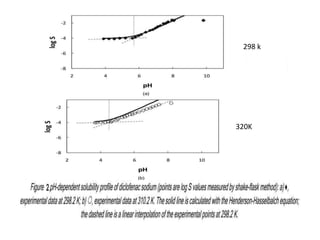
2- R. J. Prankerd[6] explained the solubilities of sparingly
soluble drug-compounds in water was measured at
constant temperatures (298.2 and 310.2 K) by shake-flask
method. Drug presented in this work is diclofenac sodium
. In the current experimental condition the Henderson-
Hasselbalch (HH) relationship was used to predict the
pH-dependent solubility profiles of choosen drug at two
temperatures. For this purpose pH dependent profile of
drug were determined at temperature of 298.2 K and
310.2 K.
298 k
320K
CONCLUSION-
 pH dependent solubilty profile of diclofenac
sodium was determined by using shake-flask
method and Hendeson-Hessel Balch equation
at different temperatures i.e. 320K and 298K.
3-Khan MA etal;[7] studied to illustrate the effect of
pH on dissolution profile of diclofenac sodium
sustained release tablets .Here the drug content in
each tablets was 100mg. The eqiupments used
were UV/visible Spectrophotometer,tablet
dissolution test apparatus,paddle and Friability test
apparatus and characterized for physical
examinations.% of drug release was studied.
[7]
CONCLUSION-
The release profile of diclofenac sodium from the
tablets increased continuously with time, and the
amount of drug release increased as the pH
increased and as the pH increases, the solubility of
diclofenac sodium increases which increases the
drug release.
REFERENCE
1-Feldman, Isaac . "Use and Abuse of pH measurements’’ .Analytical
Chemistry. 28th edition,vol-2,pg no- 1859–1866,1956.
2- Elham Shoghi, Elisabet Fuguet,’Solubility–pH profiles of some
acidic, basic and amphoteric drugs’’ Europian Journal of
Pharmaceutical Science,vol-3,pg no-291-300,2013.
3- K.J. Box, G.Volgyi, E.Stuart, M.Comer,’’Equilibrium versus kinetic
measurements of aqueous solubility and the ability of compounds
supersaturate in solution – a validation study’’, Journal of european
academic research,vol-08,Pg no-1298–1307,2006.
4-D. Sharma, M. Soni, S. Kumar,G. D. Gupta, “Solubility
enhancement-eminent role in poorly soluble drugs,” Research Journal
of Pharmacy and Technology, vol. 2,pg no-220–224,2009.
5-Mosharraf, M., Nyström, C.,”Solubility characterization of practically
insoluble drugs using the Coulter counter principle”. International
Journal of Pharmaceutical science,vol-122, Pg no-57–67,1995.
6-R.J.Prankerd. “Critical Compilation of pKa Values for Pharmaceutical
Substances and Profiles of Drug Substances, Excipients, and Related
Methodology’’.Journal of Drug Delivery & Therapeutics,New
York,Vol. 33,pgno-65-66,2013.
7-Khan MA, and Maheshwari RK, ‘’Studies of relationship between
swelling and drug release in the sustained release hydrophilic matrices
containing different grades of droxypropylmethyl cellulose’’ ,Research
Journal of Pharmaceutical , Biological and Chemical Sciences , Vol-
2,pg no-970,2011.
Ph  and solubility profile

Ph and solubility profile

  • 1.
    PRESENTED BY- MR. DEBASHISPUROHIT M.PHARM,1st SEMESTER (INDUSTRIALPHARMACY) REGD. NO-1761617004 DATE-09/11/2017 SCHOOL OF PHARMACEUTICALSCIENCES, SIKSHA ’O’ ANUSANDHAN UNIVERSITY,BHUBANESWAR TOPIC-PH AND SOLUBILITY PROFILE
  • 2.
    Introduction  Solubility[1] -It is the property of solid,liquid or gaseous substance called solute to dissolve in solid,liquid or gaseous substance.  pH[1] It is defined as negative logarithm of hydrogen ion concentration in a substance.(Acidic- 0 to 7) (Alkaline/ Basic-7 to 14).  Formula for calculation of PH[2] -
  • 3.
    Significance of pH[2]-  It helps to identify a substance either it is acidic or alkaline in nature.  The pH scale ranges from 0 to 14, which is the most acidic, a pH of 7 is neutral, and 14 is the most alkaline. Determination of pH of a drug/substance is very necessary during a pharmaceutical preparation.
  • 4.
    Significance of Solubility[2]- Solubility is one of the important parameters to achieve desired concentration of drug in systemic circulation for achieving required pharmacological response . It plays a major role in parentral formulations. It differs with different environmental factors like temperature,pressure etc.
  • 5.
    Applications[3] Solubility is commonlyused to describe the substance, to indicate a substance's polarity, to help to distinguish it from other substances, and as a guide to applications of the substance. Solubility is useful while separating of mixture.
  • 6.
     For example-A mixture of salt and silica can be separated by dissolving salt in water and filterring off the undissolved silica. PH Scale-
  • 7.
    Difference between ionizedand unionized drug[4] - .  An ionized drug will not be absorbed whereas an unionized drug will be absorbed.  Acidic drugs are in their unionized form in an acidic environment and basic drugs are unionized in a basic environment.  Physiologically. an ionized drug will be more available to tissues than an unionized drug.
  • 8.
    pka and it’srelation with pH[4] - pKa explains what the pH needs to be in order for a chemical species to donate or accept a proton. The lower the pH, the higher the concentration of hydrogen ions, [H+]. The lower the pKa, the stronger the acid and the greater its ability to donate protons. pH depends on the concentration of the solution. because a weak acid could actually have a lower pH than a diluted strong acid. For example, concentrated vinegar (acetic acid, which is a weak acid) could have a lower pH than a dilute solution of hydrochloric acid (a strong acid). On the other hand, the pKa value is a constant for each type of molecule. It is unaffected by concentration.
  • 9.
    RELATION OF PkaWITH SOLUBILITY[4]  PKa values influence behaviour of absorption, binding and salt selection, as well as influencing other physicochemical properties such as lipophilicity, solubility and dissolution.  Lower the Pka value greater will be dissociation const.Hence, solubility is more.  More the dissociation value then more is the solubility.
  • 10.
    Papers Published onpH & solubilization 1-Mosharraf etal; [5] explained that the solubility vs. pH profiles of Propylparaben has been determined through two different methods, the shake-flask (S-F) and the cheqsol methods using in both instances the appropriate Henderson– Hasselbalch (H–H) equation.
  • 11.
  • 12.
    Conclusion- • The solubilityvalues obtained by the S-F method (whenever the buffer agent used) and the cheqsol methods are consistent for the studied drug.
  • 13.
    2- R. J.Prankerd[6] explained the solubilities of sparingly soluble drug-compounds in water was measured at constant temperatures (298.2 and 310.2 K) by shake-flask method. Drug presented in this work is diclofenac sodium . In the current experimental condition the Henderson- Hasselbalch (HH) relationship was used to predict the pH-dependent solubility profiles of choosen drug at two temperatures. For this purpose pH dependent profile of drug were determined at temperature of 298.2 K and 310.2 K.
  • 14.
  • 15.
    CONCLUSION-  pH dependentsolubilty profile of diclofenac sodium was determined by using shake-flask method and Hendeson-Hessel Balch equation at different temperatures i.e. 320K and 298K.
  • 16.
    3-Khan MA etal;[7]studied to illustrate the effect of pH on dissolution profile of diclofenac sodium sustained release tablets .Here the drug content in each tablets was 100mg. The eqiupments used were UV/visible Spectrophotometer,tablet dissolution test apparatus,paddle and Friability test apparatus and characterized for physical examinations.% of drug release was studied.
  • 17.
  • 18.
    CONCLUSION- The release profileof diclofenac sodium from the tablets increased continuously with time, and the amount of drug release increased as the pH increased and as the pH increases, the solubility of diclofenac sodium increases which increases the drug release.
  • 19.
    REFERENCE 1-Feldman, Isaac ."Use and Abuse of pH measurements’’ .Analytical Chemistry. 28th edition,vol-2,pg no- 1859–1866,1956. 2- Elham Shoghi, Elisabet Fuguet,’Solubility–pH profiles of some acidic, basic and amphoteric drugs’’ Europian Journal of Pharmaceutical Science,vol-3,pg no-291-300,2013. 3- K.J. Box, G.Volgyi, E.Stuart, M.Comer,’’Equilibrium versus kinetic measurements of aqueous solubility and the ability of compounds supersaturate in solution – a validation study’’, Journal of european academic research,vol-08,Pg no-1298–1307,2006. 4-D. Sharma, M. Soni, S. Kumar,G. D. Gupta, “Solubility enhancement-eminent role in poorly soluble drugs,” Research Journal of Pharmacy and Technology, vol. 2,pg no-220–224,2009.
  • 20.
    5-Mosharraf, M., Nyström,C.,”Solubility characterization of practically insoluble drugs using the Coulter counter principle”. International Journal of Pharmaceutical science,vol-122, Pg no-57–67,1995. 6-R.J.Prankerd. “Critical Compilation of pKa Values for Pharmaceutical Substances and Profiles of Drug Substances, Excipients, and Related Methodology’’.Journal of Drug Delivery & Therapeutics,New York,Vol. 33,pgno-65-66,2013. 7-Khan MA, and Maheshwari RK, ‘’Studies of relationship between swelling and drug release in the sustained release hydrophilic matrices containing different grades of droxypropylmethyl cellulose’’ ,Research Journal of Pharmaceutical , Biological and Chemical Sciences , Vol- 2,pg no-970,2011.