
Prediction as a service with
Ensemble Model trained in
SparkML and Python ScikitLearn
on 1Bn observed flight prices daily
Josef Habdank
Lead Data Scientist & Data Platform Architect at INFARE
• jha@infare.com www.infare.com
• www.linkedin.com/in/jahabdank
• @jahabdank
Leading provider of
Airfare Intelligence Solutions
to the Aviation Industry
150 Airlines & Airports 7 offices worldwide
Collect and processes
1.2 billion distinct
airfares daily
https://www.youtube.com/watch?v=h9cQTooY92E
What is this talk about?
• Ensemble approach for large scale
DataScience
– Online learning for huge datasets
– thousands simple models are better
than one very complex
• N-billion rows/day machine learning
system architecture
– Implementation of parallel online
training of tens of thousands of
models in Spark Streaming and
Python ScikitLearn
Ensemble approach on
billions of rows
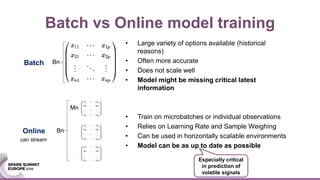
Batch vs Online model training
• Large variety of options available (historical
reasons)
• Often more accurate
• Does not scale well
• Model might be missing critical latest
information
• Train on microbatches or individual observations
• Relies on Learning Rate and Sample Weighing
• Can be used in horizontally scalable environments
• Model can be as up to date as possible
Bn
can stream
Batch
Online Bn
Mn
Especially critical
in prediction of
volatile signals
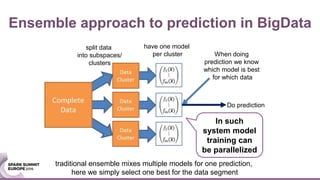
split data
into subspaces/
clusters
have one model
per cluster When doing
prediction we know
which model is best
for which data
Do prediction
Ensemble approach to prediction in BigData
traditional ensemble mixes multiple models for one prediction,
here we simply select one best for the data segment
In such
system model
training can
be parallelized
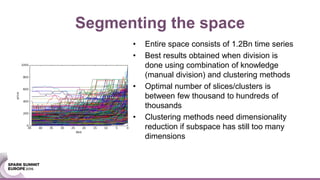
• Entire space consists of 1.2Bn time series
• Best results obtained when division is
done using combination of knowledge
(manual division) and clustering methods
• Optimal number of slices/clusters is
between few thousand to hundreds of
thousands
• Clustering methods need dimensionality
reduction if subspace has still too many
dimensions
Segmenting the space
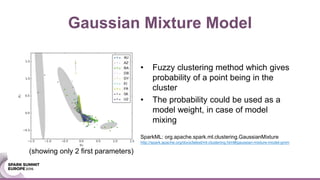
• Fuzzy clustering method which gives
probability of a point being in the
cluster
• The probability could be used as a
model weight, in case of model
mixing
SparkML: org.apache.spark.ml.clustering.GaussianMixture
http://spark.apache.org/docs/latest/ml-clustering.html#gaussian-mixture-model-gmm
(showing only 2 first parameters)
Gaussian Mixture Model
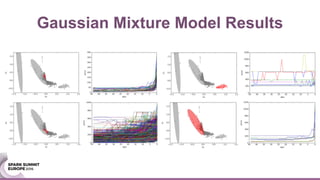
Gaussian Mixture Model Results
• Classification vs regression
– if your problem can be converted into
classification, try this as a first attempt
• Linear online models in Python:
– sklearn.linear_model.SGDClassifier
http://scikit-learn.org/stable/modules/generated/sklearn.linear_model.SGDClassifier.html
– sklearn.linear_model.SGDRegressor
http://scikit-learn.org/stable/modules/generated/sklearn.linear_model.SGDRegressor.html
• Other interesting models:
– whole sklearn.svm package
– Kalman and ARIMA models
– Particle Predictor (wrote own library)
Feature and model selection
• OneHotEncoder:
– can capture any nonlinear behavior
– explodes exponentially dims
– can reduce your problem to a
hypercube
• Try assigning values to labels
which carry information
– ℎ𝑜𝑢𝑟 ∈ 0, 1, … , 23 → ℎ𝑜𝑢𝑟′
∈
0.22, 0.45, … , 0.03
• Try to capture nonlinear behavior
using linear model, by adding
meta-features
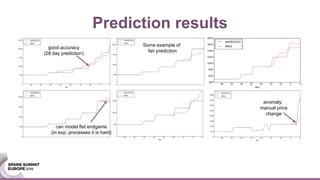
Prediction results
good accuracy
(28 day prediction)
can model flat endgame
(in exp. processes it is hard)
Some example of
fair prediction
anomaly,
manual price
change
N-billion rows/day
machine learning architecture
using DataBricks
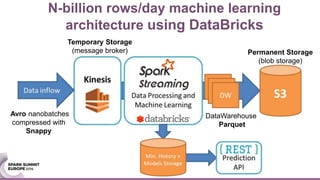
N-billion rows/day machine learning
architecture using DataBricks
Avro nanobatches
compressed with
Snappy
DataWarehouse
Parquet
Permanent Storage
(blob storage)
Temporary Storage
(message broker)
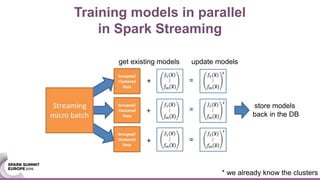
Training models in parallel
in Spark Streaming
get existing models update models
store models
back in the DB
* we already know the clusters
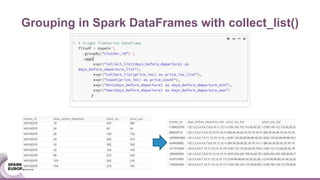
Grouping in Spark DataFrames with collect_list()
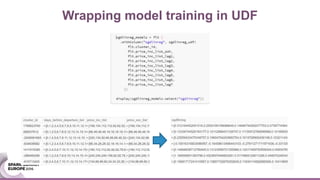
Wrapping model training in UDF
Prepare the Matrix with inputs
for model training
Normalize the data using normalization
defined for this particular cluster
Generate sample weights which enable
controlling the learning rate
Get the current model from DB
(use in memory DB for fast response)
Preform partial fit using the sample weights
Important trick:
Converts numpy.ndarray[numpy.float64]
into native python list[float] which then
can be autoconverted to Spark List[Double]
Register UDF which returns Spark List[Double]
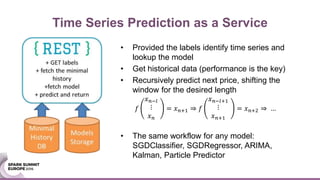
Time Series Prediction as a Service
• Provided the labels identify time series and
lookup the model
• Get historical data (performance is the key)
• Recursively predict next price, shifting the
window for the desired length
• The same workflow for any model:
SGDClassifier, SGDRegressor, ARIMA,
Kalman, Particle Predictor
𝑓
𝑥 𝑛−𝑙
⋮
𝑥 𝑛
= 𝑥 𝑛+1 ⇒ 𝑓
𝑥 𝑛−𝑙+1
⋮
𝑥 𝑛+1
= 𝑥 𝑛+2 ⇒ …
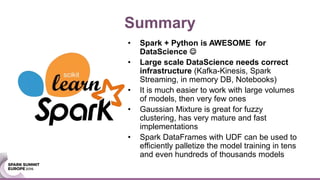
Summary
• Spark + Python is AWESOME for
DataScience 
• Large scale DataScience needs correct
infrastructure (Kafka-Kinesis, Spark
Streaming, in memory DB, Notebooks)
• It is much easier to work with large volumes
of models, then very few ones
• Gaussian Mixture is great for fuzzy
clustering, has very mature and fast
implementations
• Spark DataFrames with UDF can be used to
efficiently palletize the model training in tens
and even hundreds of thousands models
Senior Data Scientist, working with
Apache Spark + Python doing Airfare/price forecasting
Senior Big Data Engineer/Senior Backend Developer,
working with Apache Spark/S3/MemSql/Scala + MicroAPIs
job@infare.com
http://www.infare.com/jobs/
Want to work with cutting edge
100% Apache Spark + Python projects? We are hiring!!!
THANK YOU!
Q/ARemember, we are hiring!
Josef Habdank
Lead Data Scientist & Data Platform Architect at INFARE
• jha@infare.com www.infare.com
• www.linkedin.com/in/jahabdank
• @jahabdank
Prediction as a service with ensemble model in SparkML and Python ScikitLearn

Prediction as a service with ensemble model in SparkML and Python ScikitLearn

  • 1.
    Prediction as aservice with Ensemble Model trained in SparkML and Python ScikitLearn on 1Bn observed flight prices daily Josef Habdank Lead Data Scientist & Data Platform Architect at INFARE • jha@infare.com www.infare.com • www.linkedin.com/in/jahabdank • @jahabdank
  • 2.
    Leading provider of AirfareIntelligence Solutions to the Aviation Industry 150 Airlines & Airports 7 offices worldwide Collect and processes 1.2 billion distinct airfares daily https://www.youtube.com/watch?v=h9cQTooY92E
  • 3.
    What is thistalk about? • Ensemble approach for large scale DataScience – Online learning for huge datasets – thousands simple models are better than one very complex • N-billion rows/day machine learning system architecture – Implementation of parallel online training of tens of thousands of models in Spark Streaming and Python ScikitLearn
  • 4.
  • 5.
    Batch vs Onlinemodel training • Large variety of options available (historical reasons) • Often more accurate • Does not scale well • Model might be missing critical latest information • Train on microbatches or individual observations • Relies on Learning Rate and Sample Weighing • Can be used in horizontally scalable environments • Model can be as up to date as possible Bn can stream Batch Online Bn Mn Especially critical in prediction of volatile signals
  • 6.
    split data into subspaces/ clusters haveone model per cluster When doing prediction we know which model is best for which data Do prediction Ensemble approach to prediction in BigData traditional ensemble mixes multiple models for one prediction, here we simply select one best for the data segment In such system model training can be parallelized
  • 7.
    • Entire spaceconsists of 1.2Bn time series • Best results obtained when division is done using combination of knowledge (manual division) and clustering methods • Optimal number of slices/clusters is between few thousand to hundreds of thousands • Clustering methods need dimensionality reduction if subspace has still too many dimensions Segmenting the space
  • 8.
    • Fuzzy clusteringmethod which gives probability of a point being in the cluster • The probability could be used as a model weight, in case of model mixing SparkML: org.apache.spark.ml.clustering.GaussianMixture http://spark.apache.org/docs/latest/ml-clustering.html#gaussian-mixture-model-gmm (showing only 2 first parameters) Gaussian Mixture Model
  • 9.
  • 10.
    • Classification vsregression – if your problem can be converted into classification, try this as a first attempt • Linear online models in Python: – sklearn.linear_model.SGDClassifier http://scikit-learn.org/stable/modules/generated/sklearn.linear_model.SGDClassifier.html – sklearn.linear_model.SGDRegressor http://scikit-learn.org/stable/modules/generated/sklearn.linear_model.SGDRegressor.html • Other interesting models: – whole sklearn.svm package – Kalman and ARIMA models – Particle Predictor (wrote own library) Feature and model selection • OneHotEncoder: – can capture any nonlinear behavior – explodes exponentially dims – can reduce your problem to a hypercube • Try assigning values to labels which carry information – ℎ𝑜𝑢𝑟 ∈ 0, 1, … , 23 → ℎ𝑜𝑢𝑟′ ∈ 0.22, 0.45, … , 0.03 • Try to capture nonlinear behavior using linear model, by adding meta-features
  • 11.
    Prediction results good accuracy (28day prediction) can model flat endgame (in exp. processes it is hard) Some example of fair prediction anomaly, manual price change
  • 12.
    N-billion rows/day machine learningarchitecture using DataBricks
  • 13.
    N-billion rows/day machinelearning architecture using DataBricks Avro nanobatches compressed with Snappy DataWarehouse Parquet Permanent Storage (blob storage) Temporary Storage (message broker)
  • 14.
    Training models inparallel in Spark Streaming get existing models update models store models back in the DB * we already know the clusters
  • 15.
    Grouping in SparkDataFrames with collect_list()
  • 16.
  • 17.
    Wrapping model trainingin UDF Prepare the Matrix with inputs for model training Normalize the data using normalization defined for this particular cluster Generate sample weights which enable controlling the learning rate Get the current model from DB (use in memory DB for fast response) Preform partial fit using the sample weights Important trick: Converts numpy.ndarray[numpy.float64] into native python list[float] which then can be autoconverted to Spark List[Double] Register UDF which returns Spark List[Double]
  • 18.
    Time Series Predictionas a Service • Provided the labels identify time series and lookup the model • Get historical data (performance is the key) • Recursively predict next price, shifting the window for the desired length • The same workflow for any model: SGDClassifier, SGDRegressor, ARIMA, Kalman, Particle Predictor 𝑓 𝑥 𝑛−𝑙 ⋮ 𝑥 𝑛 = 𝑥 𝑛+1 ⇒ 𝑓 𝑥 𝑛−𝑙+1 ⋮ 𝑥 𝑛+1 = 𝑥 𝑛+2 ⇒ …
  • 19.
    Summary • Spark +Python is AWESOME for DataScience  • Large scale DataScience needs correct infrastructure (Kafka-Kinesis, Spark Streaming, in memory DB, Notebooks) • It is much easier to work with large volumes of models, then very few ones • Gaussian Mixture is great for fuzzy clustering, has very mature and fast implementations • Spark DataFrames with UDF can be used to efficiently palletize the model training in tens and even hundreds of thousands models
  • 20.
    Senior Data Scientist,working with Apache Spark + Python doing Airfare/price forecasting Senior Big Data Engineer/Senior Backend Developer, working with Apache Spark/S3/MemSql/Scala + MicroAPIs job@infare.com http://www.infare.com/jobs/ Want to work with cutting edge 100% Apache Spark + Python projects? We are hiring!!!
  • 21.
    THANK YOU! Q/ARemember, weare hiring! Josef Habdank Lead Data Scientist & Data Platform Architect at INFARE • jha@infare.com www.infare.com • www.linkedin.com/in/jahabdank • @jahabdank