Course-5 Introduction to Marine Technology 
Ships Main Particulars 
Lecturer : Adi Wirawan Husodo, ST, MT 
© Adi Wirawan Husodo 
2014 
Odd Semester 2014/2015 
1
References 
• Dokkum, K.V., 2003, Ship Knowledge: A Modern Encyclopedia, 
Dokmar, Netherland. 
© Adi Wirawan Husodo 
2014 
Odd Semester 2014/2015 
2
Definitions 
• Length overall : Length of the ship over its extremities. 
• Length between perpendiculars : Length from aft 
perpendicular (center of rudderstock) to forward 
perpendicular. 
• Load line length : Length as used in freeboard calculation. 
• Beam : Width of the hull, usually inside shell plating. 
• Depth : Height from baseline to uppermost continuous deck 
at side, inside of plating. 
• Draught : The maximal depth underwater, incl. shell plating. 
© Adi Wirawan Husodo 
2014 
Odd Semester 2014/2015 
3
Definitions (2) 
• Perpendiculars : Imaginary lines, perpendicular to the base 
line or plane (and the water line). 
• Forward perpendicular (Fpp or Fp): this line crosses the 
intersection of the water line and the front of the stem. 
• Aft perpendicular (App or Ap): This line usually aligns with the 
center line of the rudder stock (the imaginary line around which 
the rudder rotates). 
• The perpendiculars are used when the lines plan is made. 
They are the ends of “block” where the underwater part of 
the hull fits in. 
© Adi Wirawan Husodo 
2014 
Odd Semester 2014/2015 
4
Definitions (3) 
• Load line : The water line of a ship lying in the water. 
• Deck line : Extended line from the upper side of freeboard 
deck (or deck covering) at the ship’s side. 
• Moulded dimensions : Distance between two points, 
measured at inside of shell plating (or outside framing). 
• Base line : Top of the flat keel plate. 
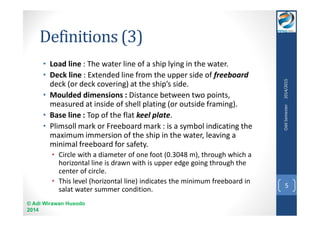
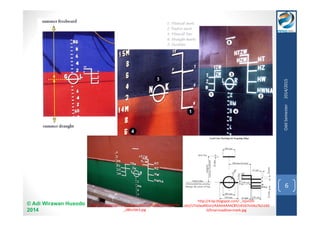
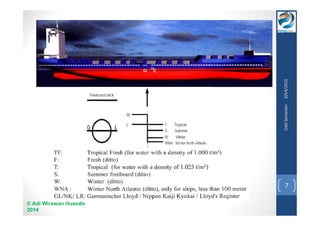
• Plimsoll mark or Freeboard mark : is a symbol indicating the 
maximum immersion of the ship in the water, leaving a 
minimal freeboard for safety. 
• Circle with a diameter of one foot (0.3048 m), through which a 
horizontal line is drawn with is upper edge going through the 
center of circle. 
• This level (horizontal line) indicates the minimum freeboard in 
salat water summer condition. 
© Adi Wirawan Husodo 
2014 
Odd Semester 2014/2015 
5
© Adi Wirawan Husodo 
2014 
Odd Semester 2014/2015 
6 
http://4.bp.blogspot.com/-_mjvnVV-L6U/ 
UTo0waNGvrI/AAAAAAAAC8Y/zKVb7mtXuTk/s160 
0/final+loadline+mark.jpg 
http://s0.geograph.org.uk/geophotos/02/98/90/2989045 
_d8fa1bb3.jpg
© Adi Wirawan Husodo 
2014 
Odd Semester 2014/2015 
7
Dimensions 
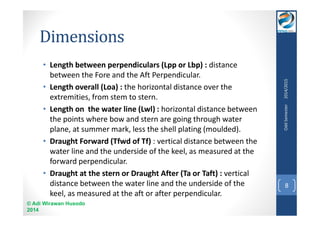
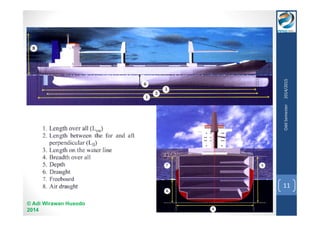
• Length between perpendiculars (Lpp or Lbp) : distance 
between the Fore and the Aft Perpendicular. 
• Length overall (Loa) : the horizontal distance over the 
extremities, from stem to stern. 
• Length on the water line (Lwl) : horizontal distance between 
the points where bow and stern are going through water 
plane, at summer mark, less the shell plating (moulded). 
• Draught Forward (Tfwd of Tf) : vertical distance between the 
water line and the underside of the keel, as measured at the 
forward perpendicular. 
• Draught at the stern or Draught After (Ta or Taft) : vertical 
distance between the water line and the underside of the 
keel, as measured at the aft or after perpendicular. 
© Adi Wirawan Husodo 
2014 
Odd Semester 2014/2015 
8
Dimensions (2) 
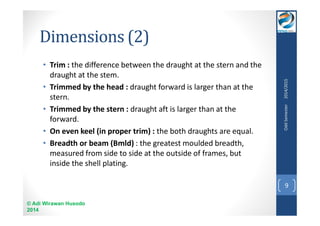
• Trim : the difference between the draught at the stern and the 
draught at the stem. 
• Trimmed by the head : draught forward is larger than at the 
stern. 
• Trimmed by the stern : draught aft is larger than at the 
forward. 
• On even keel (in proper trim) : the both draughts are equal. 
• Breadth or beam (Bmld) : the greatest moulded breadth, 
measured from side to side at the outside of frames, but 
inside the shell plating. 
© Adi Wirawan Husodo 
2014 
Odd Semester 2014/2015 
9
Dimensions (3) 
• Freeboard : distance between the water line and the top of 
deck at the side (deck line). 
• Summer Freeboard : the distance from the top of the Summer 
Load Line or the Plimsoll Mark and the upper edge of the deck 
line. 
• Air draught : the vertical distance between the water line and 
the highest point of the ship. 
© Adi Wirawan Husodo 
2014 
Odd Semester 2014/2015 
10 
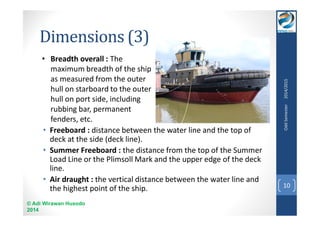
• Breadth overall : The 
maximum breadth of the ship 
as measured from the outer 
hull on starboard to the outer 
hull on port side, including 
rubbing bar, permanent 
fenders, etc.
© Adi Wirawan Husodo 
2014 
Odd Semester 2014/2015 
11
Volumes and Weights 
• Register Ton 
• Register ton is actually a measure of the volume of enclosed spaces 
on a ship (not vessel’s mass or weight). 
• It used to determine the size of a ship. 
• It is based on volume; 1 register ton = 100 cft or 2.83 m3. 
• It is an internationally recognized basis for raising taxes from the 
shipping industry and setting levels of fees for port dues, towage, 
pilotage and canal passages. 
• It is also used as a size determiner in both national and international 
shipping regulation. For example: ships of 1,600 GRT or more must 
have more comprehensive radio equipment than smaller vessel. 
• GRT (Gross Register Tonnage), NRT (Net Register Tonnage). 
• IMO in 1969 issued the new measurement system (Universal 
Tonnage Measurement System – UMS); GT (Gross Tonnage) and NT 
(Net Tonnage). 
© Adi Wirawan Husodo 
2014 
Odd Semester 2014/2015 
12
Volumes and Weights 
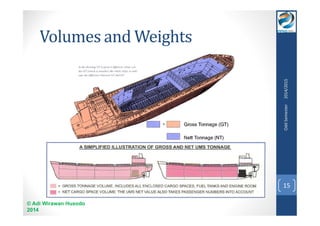
• Gross Register Tonnage 
• Gross Tonnage 
• Includes all enclosed spaces (volume below main deck and 
enclosed spaces above main deck). 
• Net Register Tonnage 
• Net Tonnage 
• Just enclosed cargo spaces 
• NT is derived from the GT by subtracting the volume of space 
occupied by : crew, navigation equipment, the propulsion 
equipment (partly), workshops, ballast. 
• NT may not less than 30% of the GT. 
© Adi Wirawan Husodo 
2014 
Odd Semester 2014/2015 
13
Volumes and Weights 
• Gross Register Tonnage 
• Gross Tonnage 
• Includes all enclosed spaces (volume below main deck and 
enclosed spaces above main deck). 
• Net Register Tonnage 
• Net Tonnage 
• Just enclosed cargo spaces 
• NT is derived from the GT by subtracting the volume of space 
occupied by : crew, navigation equipment, the propulsion 
equipment (partly), workshops, ballast. 
• NT may not less than 30% of the GT. 
• All measurements in moulded dimensions 
© Adi Wirawan Husodo 
2014 
Odd Semester 2014/2015 
14
Volumes and Weights 
© Adi Wirawan Husodo 
2014 
Odd Semester 2014/2015 
15
Volumes and Weights 
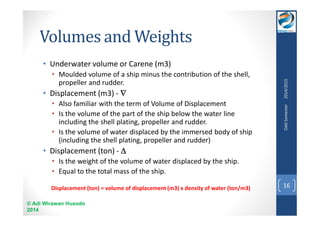
• Underwater volume or Carene (m3) 
• Moulded volume of a ship minus the contribution of the shell, 
propeller and rudder. 
• Displacement (m3) -  
• Also familiar with the term of Volume of Displacement 
• Is the volume of the part of the ship below the water line 
including the shell plating, propeller and rudder. 
• Is the volume of water displaced by the immersed body of ship 
(including the shell plating, propeller and rudder) 
• Displacement (ton) -  
• Is the weight of the volume of water displaced by the ship. 
• Equal to the total mass of the ship. 
Displacement (ton) = volume of displacement (m3) x density of water (ton/m3) 
© Adi Wirawan Husodo 
2014 
Odd Semester 2014/2015 
16
Volumes and Weights 
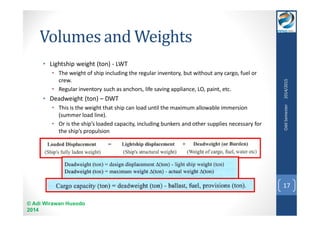
• Lightship weight (ton) - LWT 
• The weight of ship including the regular inventory, but without any cargo, fuel or 
crew. 
• Regular inventory such as anchors, life saving appliance, LO, paint, etc. 
• Deadweight (ton) – DWT 
• This is the weight that ship can load until the maximum allowable immersion 
(summer load line). 
• Or is the ship’s loaded capacity, including bunkers and other supplies necessary for 
the ship’s propulsion 
• Is a fixed value; 
© Adi Wirawan Husodo 
2014 
Odd Semester 2014/2015 
17
Form Coefficients 
• Define the characteristics of the vessel’s shape below the 
design waterline. 
• Non-dimensional figures. 
• Volume based and area based. 
• Area based: 
• Water plane coefficient (Cw or ) 
• Midship coefficient (Cm or ) 
• Volume based: 
• Block coefficient or coefficient of fineness (Cb or ) 
• Prismatic coefficient (Cp or ) 
• Vertival prismatic coefficient (Cpv) 
© Adi Wirawan Husodo 
2014 
Odd Semester 2014/2015 
18
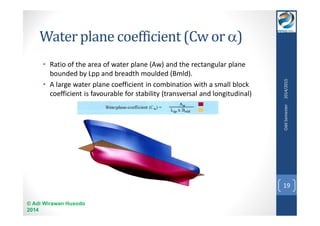
Water plane coefficient (Cw or ) 
• Ratio of the area of water plane (Aw) and the rectangular plane 
bounded by Lpp and breadth moulded (Bmld). 
• A large water plane coefficient in combination with a small block 
coefficient is favourable for stability (transversal and longitudinal) 
© Adi Wirawan Husodo 
2014 
Odd Semester 2014/2015 
19
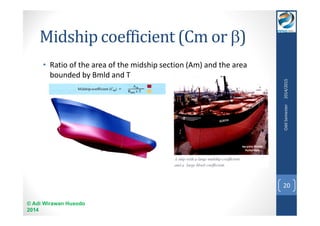
Midship coefficient (Cm or ) 
• Ratio of the area of the midship section (Am) and the area 
bounded by Bmld and T 
© Adi Wirawan Husodo 
2014 
Odd Semester 2014/2015 
20
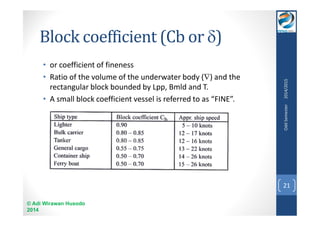
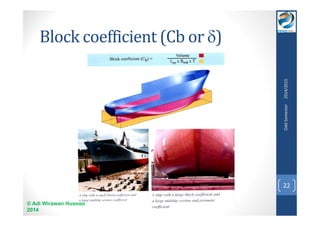
Block coefficient (Cb or ) 
• or coefficient of fineness 
• Ratio of the volume of the underwater body () and the 
rectangular block bounded by Lpp, Bmld and T. 
• A small block coefficient vessel is referred to as “FINE”. 
© Adi Wirawan Husodo 
2014 
Odd Semester 2014/2015 
21
Block coefficient (Cb or ) 
© Adi Wirawan Husodo 
2014 
Odd Semester 2014/2015 
22
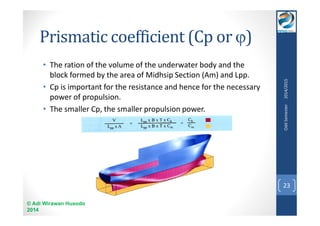
Prismatic coefficient (Cp or ) 
• The ration of the volume of the underwater body and the 
block formed by the area of Midhsip Section (Am) and Lpp. 
• Cp is important for the resistance and hence for the necessary 
power of propulsion. 
• The smaller Cp, the smaller propulsion power. 
© Adi Wirawan Husodo 
2014 
Odd Semester 2014/2015 
23
© Adi Wirawan Husodo 
2014 
Thank You 
Odd Semester 2014/2015 
24

[5] ptk 2014 2015 ship main particulars

  • 1.
    Course-5 Introduction toMarine Technology Ships Main Particulars Lecturer : Adi Wirawan Husodo, ST, MT © Adi Wirawan Husodo 2014 Odd Semester 2014/2015 1
  • 2.
    References • Dokkum,K.V., 2003, Ship Knowledge: A Modern Encyclopedia, Dokmar, Netherland. © Adi Wirawan Husodo 2014 Odd Semester 2014/2015 2
  • 3.
    Definitions • Lengthoverall : Length of the ship over its extremities. • Length between perpendiculars : Length from aft perpendicular (center of rudderstock) to forward perpendicular. • Load line length : Length as used in freeboard calculation. • Beam : Width of the hull, usually inside shell plating. • Depth : Height from baseline to uppermost continuous deck at side, inside of plating. • Draught : The maximal depth underwater, incl. shell plating. © Adi Wirawan Husodo 2014 Odd Semester 2014/2015 3
  • 4.
    Definitions (2) •Perpendiculars : Imaginary lines, perpendicular to the base line or plane (and the water line). • Forward perpendicular (Fpp or Fp): this line crosses the intersection of the water line and the front of the stem. • Aft perpendicular (App or Ap): This line usually aligns with the center line of the rudder stock (the imaginary line around which the rudder rotates). • The perpendiculars are used when the lines plan is made. They are the ends of “block” where the underwater part of the hull fits in. © Adi Wirawan Husodo 2014 Odd Semester 2014/2015 4
  • 5.
    Definitions (3) •Load line : The water line of a ship lying in the water. • Deck line : Extended line from the upper side of freeboard deck (or deck covering) at the ship’s side. • Moulded dimensions : Distance between two points, measured at inside of shell plating (or outside framing). • Base line : Top of the flat keel plate. • Plimsoll mark or Freeboard mark : is a symbol indicating the maximum immersion of the ship in the water, leaving a minimal freeboard for safety. • Circle with a diameter of one foot (0.3048 m), through which a horizontal line is drawn with is upper edge going through the center of circle. • This level (horizontal line) indicates the minimum freeboard in salat water summer condition. © Adi Wirawan Husodo 2014 Odd Semester 2014/2015 5
  • 6.
    © Adi WirawanHusodo 2014 Odd Semester 2014/2015 6 http://4.bp.blogspot.com/-_mjvnVV-L6U/ UTo0waNGvrI/AAAAAAAAC8Y/zKVb7mtXuTk/s160 0/final+loadline+mark.jpg http://s0.geograph.org.uk/geophotos/02/98/90/2989045 _d8fa1bb3.jpg
  • 7.
    © Adi WirawanHusodo 2014 Odd Semester 2014/2015 7
  • 8.
    Dimensions • Lengthbetween perpendiculars (Lpp or Lbp) : distance between the Fore and the Aft Perpendicular. • Length overall (Loa) : the horizontal distance over the extremities, from stem to stern. • Length on the water line (Lwl) : horizontal distance between the points where bow and stern are going through water plane, at summer mark, less the shell plating (moulded). • Draught Forward (Tfwd of Tf) : vertical distance between the water line and the underside of the keel, as measured at the forward perpendicular. • Draught at the stern or Draught After (Ta or Taft) : vertical distance between the water line and the underside of the keel, as measured at the aft or after perpendicular. © Adi Wirawan Husodo 2014 Odd Semester 2014/2015 8
  • 9.
    Dimensions (2) •Trim : the difference between the draught at the stern and the draught at the stem. • Trimmed by the head : draught forward is larger than at the stern. • Trimmed by the stern : draught aft is larger than at the forward. • On even keel (in proper trim) : the both draughts are equal. • Breadth or beam (Bmld) : the greatest moulded breadth, measured from side to side at the outside of frames, but inside the shell plating. © Adi Wirawan Husodo 2014 Odd Semester 2014/2015 9
  • 10.
    Dimensions (3) •Freeboard : distance between the water line and the top of deck at the side (deck line). • Summer Freeboard : the distance from the top of the Summer Load Line or the Plimsoll Mark and the upper edge of the deck line. • Air draught : the vertical distance between the water line and the highest point of the ship. © Adi Wirawan Husodo 2014 Odd Semester 2014/2015 10 • Breadth overall : The maximum breadth of the ship as measured from the outer hull on starboard to the outer hull on port side, including rubbing bar, permanent fenders, etc.
  • 11.
    © Adi WirawanHusodo 2014 Odd Semester 2014/2015 11
  • 12.
    Volumes and Weights • Register Ton • Register ton is actually a measure of the volume of enclosed spaces on a ship (not vessel’s mass or weight). • It used to determine the size of a ship. • It is based on volume; 1 register ton = 100 cft or 2.83 m3. • It is an internationally recognized basis for raising taxes from the shipping industry and setting levels of fees for port dues, towage, pilotage and canal passages. • It is also used as a size determiner in both national and international shipping regulation. For example: ships of 1,600 GRT or more must have more comprehensive radio equipment than smaller vessel. • GRT (Gross Register Tonnage), NRT (Net Register Tonnage). • IMO in 1969 issued the new measurement system (Universal Tonnage Measurement System – UMS); GT (Gross Tonnage) and NT (Net Tonnage). © Adi Wirawan Husodo 2014 Odd Semester 2014/2015 12
  • 13.
    Volumes and Weights • Gross Register Tonnage • Gross Tonnage • Includes all enclosed spaces (volume below main deck and enclosed spaces above main deck). • Net Register Tonnage • Net Tonnage • Just enclosed cargo spaces • NT is derived from the GT by subtracting the volume of space occupied by : crew, navigation equipment, the propulsion equipment (partly), workshops, ballast. • NT may not less than 30% of the GT. © Adi Wirawan Husodo 2014 Odd Semester 2014/2015 13
  • 14.
    Volumes and Weights • Gross Register Tonnage • Gross Tonnage • Includes all enclosed spaces (volume below main deck and enclosed spaces above main deck). • Net Register Tonnage • Net Tonnage • Just enclosed cargo spaces • NT is derived from the GT by subtracting the volume of space occupied by : crew, navigation equipment, the propulsion equipment (partly), workshops, ballast. • NT may not less than 30% of the GT. • All measurements in moulded dimensions © Adi Wirawan Husodo 2014 Odd Semester 2014/2015 14
  • 15.
    Volumes and Weights © Adi Wirawan Husodo 2014 Odd Semester 2014/2015 15
  • 16.
    Volumes and Weights • Underwater volume or Carene (m3) • Moulded volume of a ship minus the contribution of the shell, propeller and rudder. • Displacement (m3) -  • Also familiar with the term of Volume of Displacement • Is the volume of the part of the ship below the water line including the shell plating, propeller and rudder. • Is the volume of water displaced by the immersed body of ship (including the shell plating, propeller and rudder) • Displacement (ton) -  • Is the weight of the volume of water displaced by the ship. • Equal to the total mass of the ship. Displacement (ton) = volume of displacement (m3) x density of water (ton/m3) © Adi Wirawan Husodo 2014 Odd Semester 2014/2015 16
  • 17.
    Volumes and Weights • Lightship weight (ton) - LWT • The weight of ship including the regular inventory, but without any cargo, fuel or crew. • Regular inventory such as anchors, life saving appliance, LO, paint, etc. • Deadweight (ton) – DWT • This is the weight that ship can load until the maximum allowable immersion (summer load line). • Or is the ship’s loaded capacity, including bunkers and other supplies necessary for the ship’s propulsion • Is a fixed value; © Adi Wirawan Husodo 2014 Odd Semester 2014/2015 17
  • 18.
    Form Coefficients •Define the characteristics of the vessel’s shape below the design waterline. • Non-dimensional figures. • Volume based and area based. • Area based: • Water plane coefficient (Cw or ) • Midship coefficient (Cm or ) • Volume based: • Block coefficient or coefficient of fineness (Cb or ) • Prismatic coefficient (Cp or ) • Vertival prismatic coefficient (Cpv) © Adi Wirawan Husodo 2014 Odd Semester 2014/2015 18
  • 19.
    Water plane coefficient(Cw or ) • Ratio of the area of water plane (Aw) and the rectangular plane bounded by Lpp and breadth moulded (Bmld). • A large water plane coefficient in combination with a small block coefficient is favourable for stability (transversal and longitudinal) © Adi Wirawan Husodo 2014 Odd Semester 2014/2015 19
  • 20.
    Midship coefficient (Cmor ) • Ratio of the area of the midship section (Am) and the area bounded by Bmld and T © Adi Wirawan Husodo 2014 Odd Semester 2014/2015 20
  • 21.
    Block coefficient (Cbor ) • or coefficient of fineness • Ratio of the volume of the underwater body () and the rectangular block bounded by Lpp, Bmld and T. • A small block coefficient vessel is referred to as “FINE”. © Adi Wirawan Husodo 2014 Odd Semester 2014/2015 21
  • 22.
    Block coefficient (Cbor ) © Adi Wirawan Husodo 2014 Odd Semester 2014/2015 22
  • 23.
    Prismatic coefficient (Cpor ) • The ration of the volume of the underwater body and the block formed by the area of Midhsip Section (Am) and Lpp. • Cp is important for the resistance and hence for the necessary power of propulsion. • The smaller Cp, the smaller propulsion power. © Adi Wirawan Husodo 2014 Odd Semester 2014/2015 23
  • 24.
    © Adi WirawanHusodo 2014 Thank You Odd Semester 2014/2015 24