Yasser B. A. Farag
MSc. of Maritime Energy Management - - Sweden
Lecturer at Institute of Maritime Upgrading Studies
Maritime Chief Engineer
Maritime Upgrading Studies Institute - 2 0 2 0 -
Marine Engineering Knowledge
UE231
M a r i n e E n g i n e e r i n g K n o w l e d g e U E 2 3 1 | Y A S S E R B . A . F A R A G16 November 2020
Hydrofoil shape
152
Relative fluid
M a r i n e E n g i n e e r i n g K n o w l e d g e U E 2 3 1 | Y A S S E R B . A . F A R A G16 November 2020
Theory
153
When a rudder is turned to some angle (α), a force (F) is produced due to the high and low pressure regions
generated by the water flow. On one side of the rudder the flow reduces in speed whilst on the other it
increases. By Bernoulli, lower velocities are associated with higher pressure, whilst higher velocities give lower
pressure so that a rudder force is produced as shown in the sketch.
α
Water Flow
CL
+
-
M a r i n e E n g i n e e r i n g K n o w l e d g e U E 2 3 1 | Y A S S E R B . A . F A R A G16 November 2020
Theory
154
α
F
Water Flow
CL
+
-
Lift
Drag
b
Center of Effort
The total force generated can be assumed to act as a single force at the centre of pressure of the rudder, more often
referred to as the `centre of effort’. The force F has two components:
• a `lift component' which is the transverse component of the rudder force, causing the ship to turn;
• a `drag component' which is the longitudinal component of the rudder force.
M a r i n e E n g i n e e r i n g K n o w l e d g e U E 2 3 1 | Y A S S E R B . A . F A R A G16 November 2020
Theory
155
α
F
Water Flow
CL
+
-
Lift
Drag
b
Center of Effort
The torque imposed by the water flow (which needs to be overcome by the steering gear) is the force on the rudder
multiplied by the distance from the centre of effort to the axis of rotation. If the rudder were assumed to rotate
about its leading edge and the distance to the centre of effort was `b' as in the sketch, the torque would
T= f x b
M a r i n e E n g i n e e r i n g K n o w l e d g e U E 2 3 1 | Y A S S E R B . A . F A R A G16 November 2020
Stall angle
156
M a r i n e E n g i n e e r i n g K n o w l e d g e U E 2 3 1 | Y A S S E R B . A . F A R A G16 November 2020
Less torque acting
on the rudder &
more ship’s heeling
Rudder angle limit
157
Angle of Attack
α
LiftCoefficient
DragCoefficient
Turbulence
Stall
35~37
M a r i n e E n g i n e e r i n g K n o w l e d g e U E 2 3 1 | Y A S S E R B . A . F A R A G16 November 2020
Ship’s turning
158
M a r i n e E n g i n e e r i n g K n o w l e d g e U E 2 3 1 | Y A S S E R B . A . F A R A G16 November 2020
SOLAS requirements
159
M a r i n e E n g i n e e r i n g K n o w l e d g e U E 2 3 1 | Y A S S E R B . A . F A R A G16 November 2020
SOLAS, CH II-1, Reg. 29
160
M a r i n e E n g i n e e r i n g K n o w l e d g e U E 2 3 1 | Y A S S E R B . A . F A R A G16 November 2020 161
SOLAS, CH II-1, Reg. 29
M a r i n e E n g i n e e r i n g K n o w l e d g e U E 2 3 1 | Y A S S E R B . A . F A R A G16 November 2020 162
SOLAS, CH II-1, Reg. 29
M a r i n e E n g i n e e r i n g K n o w l e d g e U E 2 3 1 | Y A S S E R B . A . F A R A G16 November 2020 163
SOLAS, CH II-1, Reg. 29
M a r i n e E n g i n e e r i n g K n o w l e d g e U E 2 3 1 | Y A S S E R B . A . F A R A G16 November 2020 164
SOLAS, CH II-1, Reg. 29
M a r i n e E n g i n e e r i n g K n o w l e d g e U E 2 3 1 | Y A S S E R B . A . F A R A G16 November 2020
SOLAS, CH II-1, Reg. 29
165
M a r i n e E n g i n e e r i n g K n o w l e d g e U E 2 3 1 | Y A S S E R B . A . F A R A G16 November 2020
SOLAS, CH II-1, Reg. 29
166
M a r i n e E n g i n e e r i n g K n o w l e d g e U E 2 3 1 | Y A S S E R B . A . F A R A G16 November 2020
SOLAS, CH II-1, Reg. 29
167
M a r i n e E n g i n e e r i n g K n o w l e d g e U E 2 3 1 | Y A S S E R B . A . F A R A G16 November 2020
SOLAS, CH II-1, Reg. 29
168
M a r i n e E n g i n e e r i n g K n o w l e d g e U E 2 3 1 | Y A S S E R B . A . F A R A G16 November 2020
SOLAS, CH II-1, Reg. 29
169
M a r i n e E n g i n e e r i n g K n o w l e d g e U E 2 3 1 | Y A S S E R B . A . F A R A G16 November 2020
SOLAS, CH II-1, Reg. 29
170
M a r i n e E n g i n e e r i n g K n o w l e d g e U E 2 3 1 | Y A S S E R B . A . F A R A G16 November 2020
SOLAS, CH II-1, Reg. 29
171
M a r i n e E n g i n e e r i n g K n o w l e d g e U E 2 3 1 | Y A S S E R B . A . F A R A G16 November 2020
SOLAS, CH II-1, Reg. 29
172
M a r i n e E n g i n e e r i n g K n o w l e d g e U E 2 3 1 | Y A S S E R B . A . F A R A G16 November 2020
SOLAS, CH II-1, Reg. 30
173
SOLAS, CH II-1, Reg. 30
M a r i n e E n g i n e e r i n g K n o w l e d g e U E 2 3 1 | Y A S S E R B . A . F A R A G16 November 2020 174
SOLAS, CH V-1, Reg. 19
M a r i n e E n g i n e e r i n g K n o w l e d g e U E 2 3 1 | Y A S S E R B . A . F A R A G16 November 2020 175
SOLAS, CH V-1, Reg. 19
M a r i n e E n g i n e e r i n g K n o w l e d g e U E 2 3 1 | Y A S S E R B . A . F A R A G16 November 2020 176
SOLAS, CH V-1, Reg. 19
M a r i n e E n g i n e e r i n g K n o w l e d g e U E 2 3 1 | Y A S S E R B . A . F A R A G16 November 2020
Steering Gear system
• Steering gears can be arranged with hydraulic control equipment known as a ‘ Telemotor ', or
with electrical control equipment.
• The power unit may in turn be hydraulic or electrically operated. Each of these units will be
considered in turn, with the hydraulic unit pump being considered first.
• A pump is required in the hydraulic system which can immediately pump fluid in order to
provide a hydraulic force that will move the rudder.
• Instant response does not allow time for the pump to be switched on and therefore a constantly
running pump is required which pumps fluid only when required.
• A variable delivery pump provides this facility.
177
M a r i n e E n g i n e e r i n g K n o w l e d g e U E 2 3 1 | Y A S S E R B . A . F A R A G16 November 2020
Steering Gear system
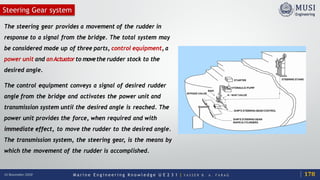
The steering gear provides a movement of the rudder in
response to a signal from the bridge. The total system may
be considered made up of three parts, control equipment, a
power unit and anActuatorto movethe rudder stock to the
desired angle.
The control equipment conveys a signal of desired rudder
angle from the bridge and activates the power unit and
transmission system until the desired angle is reached. The
power unit provides the force, when required and with
immediate effect, to move the rudder to the desired angle.
The transmission system, the steering gear, is the means by
which the movement of the rudder is accomplished.
178
M a r i n e E n g i n e e r i n g K n o w l e d g e U E 2 3 1 | Y A S S E R B . A . F A R A G16 November 2020
Auto-Pilot
SG system
Block diagram
179
Controller Transmitter Receiver Actuator Rudder Ship Compass
Manual
Amplifier
Variable/
Positive
displacement
pumpTelemotor system
External forces
Set
Course
Actual
Course
Feedback
Feedback
Input power
• Hydraulic
• Electric
• Hele-Shaw
• Swash plate
• Screw pump + directional valves
• Ram
• Rotary vane
M a r i n e E n g i n e e r i n g K n o w l e d g e U E 2 3 1 | Y A S S E R B . A . F A R A G16 November 2020
Steering Gear Types
(i) Hydraulic steering gear,
(ii) Electric steering gear and
(iii) Electro-hydraulic steering gear.
180
M a r i n e E n g i n e e r i n g K n o w l e d g e U E 2 3 1 | Y A S S E R B . A . F A R A G16 November 2020
Telemotor system
M a r i n e E n g i n e e r i n g K n o w l e d g e U E 2 3 1 | Y A S S E R B . A . F A R A G16 November 2020
Telemotor system
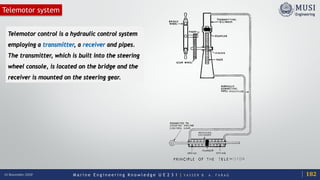
Telemotor control is a hydraulic control system
employing a transmitter, a receiver and pipes.
The transmitter, which is built into the steering
wheel console, is located on the bridge and the
receiver is mounted on the steering gear.
182
M a r i n e E n g i n e e r i n g K n o w l e d g e U E 2 3 1 | Y A S S E R B . A . F A R A G16 November 2020
Telemotor-Transmitter
183
M a r i n e E n g i n e e r i n g K n o w l e d g e U E 2 3 1 | Y A S S E R B . A . F A R A G16 November 2020
Telemotor-Receiver
184
M a r i n e E n g i n e e r i n g K n o w l e d g e U E 2 3 1 | Y A S S E R B . A . F A R A G16 November 2020
Electrical telemotor
185
M a r i n e E n g i n e e r i n g K n o w l e d g e U E 2 3 1 | Y A S S E R B . A . F A R A G16 November 2020
Telemotor- oil charging
186
M a r i n e E n g i n e e r i n g K n o w l e d g e U E 2 3 1 | Y A S S E R B . A . F A R A G16 November 2020
By pass valve operation and leakage test
187
M a r i n e E n g i n e e r i n g K n o w l e d g e U E 2 3 1 | Y A S S E R B . A . F A R A G16 November 2020
Telemotor fluid properties
Good quality mineral lubricating oil is used. Its properties are-
• Low pour point (-50°C)
• Low viscosity ( to reduced fractional drag, but not too thin to mate gland
sealing, 12 cSt at 50°C)
• High flash point (150° C closed)
• Non sludge forming
• Non corrosive
• Good lubricating properties
• Specific gravity 0.88 at 15.5° C
188
M a r i n e E n g i n e e r i n g K n o w l e d g e U E 2 3 1 | Y A S S E R B . A . F A R A G16 November 2020
Power unit
M a r i n e E n g i n e e r i n g K n o w l e d g e U E 2 3 1 | Y A S S E R B . A . F A R A G16 November 2020
+
Shortest
stroke
Hele Shaw Pump
190
T
B
+o BAF GCCE D
Rotation
Shaft
Oil
Slippers
Plungers
Mid-position
(Idle running)
Floating ring
Longest stroke
Slipper
path
Gudgeons
Suction
Discharge
M a r i n e E n g i n e e r i n g K n o w l e d g e U E 2 3 1 | Y A S S E R B . A . F A R A G16 November 2020
Hele Shaw Pump
191
M a r i n e E n g i n e e r i n g K n o w l e d g e U E 2 3 1 | Y A S S E R B . A . F A R A G16 November 2020
Hele Shaw Pump
192
M a r i n e E n g i n e e r i n g K n o w l e d g e U E 2 3 1 | Y A S S E R B . A . F A R A G16 November 2020 193
Hele Shaw Pump
M a r i n e E n g i n e e r i n g K n o w l e d g e U E 2 3 1 | Y A S S E R B . A . F A R A G16 November 2020
Hele Shaw Pump
194
M a r i n e E n g i n e e r i n g K n o w l e d g e U E 2 3 1 | Y A S S E R B . A . F A R A G16 November 2020
Hele Shaw Pump
195
M a r i n e E n g i n e e r i n g K n o w l e d g e U E 2 3 1 | Y A S S E R B . A . F A R A G16 November 2020
Hele Shaw Pump
196
M a r i n e E n g i n e e r i n g K n o w l e d g e U E 2 3 1 | Y A S S E R B . A . F A R A G16 November 2020
Hele Shaw Pump
197
M a r i n e E n g i n e e r i n g K n o w l e d g e U E 2 3 1 | Y A S S E R B . A . F A R A G16 November 2020
Hele Shaw Pump
198
M a r i n e E n g i n e e r i n g K n o w l e d g e U E 2 3 1 | Y A S S E R B . A . F A R A G16 November 2020
Animation
199
M a r i n e E n g i n e e r i n g K n o w l e d g e U E 2 3 1 | Y A S S E R B . A . F A R A G16 November 2020
Swash plate pump
200
M a r i n e E n g i n e e r i n g K n o w l e d g e U E 2 3 1 | Y A S S E R B . A . F A R A G16 November 2020
Swash plate pump
201
M a r i n e E n g i n e e r i n g K n o w l e d g e U E 2 3 1 | Y A S S E R B . A . F A R A G16 November 2020
Swash plate pump
202
M a r i n e E n g i n e e r i n g K n o w l e d g e U E 2 3 1 | Y A S S E R B . A . F A R A G16 November 2020
Swash plate pump
203
M a r i n e E n g i n e e r i n g K n o w l e d g e U E 2 3 1 | Y A S S E R B . A . F A R A G16 November 2020
Swash plate pump
204
M a r i n e E n g i n e e r i n g K n o w l e d g e U E 2 3 1 | Y A S S E R B . A . F A R A G16 November 2020
Swash plate pump
Hydraulic lock is an abnormal condition of any device which is designed to compress a gas by mechanically restraining it; most commonly
the reciprocating internal combustion engine. It occurs when a volume of liquid greater than the volume of the cylinder at its minimum
(end of the piston's stroke) enters the cylinder. Since liquids are nearly incompressible the piston cannot complete its travel; either the
engine must stop rotating or a mechanical failure must occur.
Swash plate pump
205
M a r i n e E n g i n e e r i n g K n o w l e d g e U E 2 3 1 | Y A S S E R B . A . F A R A G16 November 2020
Swash plate pump
206
M a r i n e E n g i n e e r i n g K n o w l e d g e U E 2 3 1 | Y A S S E R B . A . F A R A G16 November 2020
Swash plate pump
207
M a r i n e E n g i n e e r i n g K n o w l e d g e U E 2 3 1 | Y A S S E R B . A . F A R A G16 November 2020
Animation
208
M a r i n e E n g i n e e r i n g K n o w l e d g e U E 2 3 1 | Y A S S E R B . A . F A R A G16 November 2020
Tilting pump
209
M a r i n e E n g i n e e r i n g K n o w l e d g e U E 2 3 1 | Y A S S E R B . A . F A R A G16 November 2020
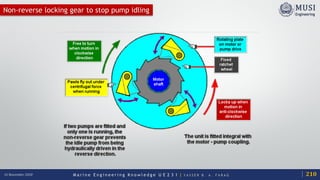
Non-reverse locking gear to stop pump idling
210
M a r i n e E n g i n e e r i n g K n o w l e d g e U E 2 3 1 | Y A S S E R B . A . F A R A G16 November 2020
Control unit
M a r i n e E n g i n e e r i n g K n o w l e d g e U E 2 3 1 | Y A S S E R B . A . F A R A G16 November 2020
(Hunting gear – Floating lever)
1. The telemotor moves the end of floating lever A to 𝐴𝐴1 for
a certain rudder angle ( certain direction and angle)
2. Subsequently, The pump control is moved, therefore
from B to 𝐵𝐵1. Pumping of the hydraulic oil causes
movement of the rams and the end of rod C moves to 𝐶𝐶1 ,
thus causing the pump control to be pulled back to the
neutral position B.
3. If the rudder is displaced by a heavy sea through lifting of
the relief valves, the hunting gear is moved by the rudder
stock. This will put the pump on stroke and rudder will be
restored to its previous position.
1
2
1
2
A
B
C
𝐴𝐴1
𝐵𝐵1
𝐶𝐶1
Variable
displacement
pump
From
Telemotor
Control
Connection to
Rudder stock
or Tiller
Fulcrum
1
1
2
2
𝐵𝐵2
212
M a r i n e E n g i n e e r i n g K n o w l e d g e U E 2 3 1 | Y A S S E R B . A . F A R A G16 November 2020
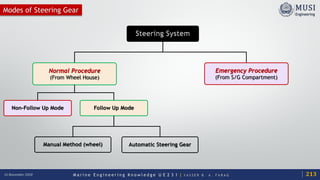
Modes of Steering Gear
Normal Procedure
(From Wheel House)
Non-Follow Up Mode Follow Up Mode
Manual Method (wheel) Automatic Steering Gear
Emergency Procedure
(From S/G Compartment)
213
M a r i n e E n g i n e e r i n g K n o w l e d g e U E 2 3 1 | Y A S S E R B . A . F A R A G16 November 2020
Follow Up Mode
• This is the Principal mode of steering.
• In this mode, the rudder Follows the wheel. If the rudder is
put 10° to Starboard, the rudder will follow to 10° to Stbd and
remain there as long as wheel is kept to 10° to Stbd.
• To bring the rudder to ‘Midship’, the wheel will have to be
brought to ‘Midship’.
• This mode is followed in the following methods of steering
 The hand steering mode in which the steering wheel sets
the rudder angle,
 Auto-steering mode in which the wheel order is
automatically generated depending upon the difference
between the ordered course and the actual course
214
M a r i n e E n g i n e e r i n g K n o w l e d g e U E 2 3 1 | Y A S S E R B . A . F A R A G16 November 2020
Non-Follow Up Mode
• This mode of steering is not done with a steering
wheel but with a NFU Lever.
• The NFU lever does not have any markings. As long as
it is kept pressed, the rudder will continue turning
and stop the moment the lever is released.
• This mode is used when ships telemotor system fails.
In that case, the NFU lever sends rudder setting
directly to the Control Unit.
• To return the rudder to the midship, the NFU lever
will have to be pressed to the opposite side of the
initial movement and kept pressed till the rudder is
midship.
215
M a r i n e E n g i n e e r i n g K n o w l e d g e U E 2 3 1 | Y A S S E R B . A . F A R A G16 November 2020
Actuators
M a r i n e E n g i n e e r i n g K n o w l e d g e U E 2 3 1 | Y A S S E R B . A . F A R A G16 November 2020
Steering Gear Actuators
There are two main types of steering actuators:
1. Electro-Hydraulic: Ram, Rotary Vane.
2. All Electric: Ward Leonard, Single Motor
217
M a r i n e E n g i n e e r i n g K n o w l e d g e U E 2 3 1 | Y A S S E R B . A . F A R A G16 November 2020
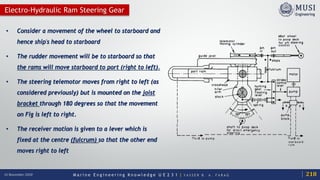
Electro-Hydraulic Ram Steering Gear
• Consider a movement of the wheel to starboard and
hence ship's head to starboard
• The rudder movement will be to starboard so that
the rams will move starboard to port (right to left).
• The steering telemotor moves from right to left (as
considered previously) but is mounted on the joist
bracket through 180 degrees so that the movement
on Fig is left to right.
• The receiver motion is given to a lever which is
fixed at the centre (fulcrum) so that the other end
moves right to left
218
M a r i n e E n g i n e e r i n g K n o w l e d g e U E 2 3 1 | Y A S S E R B . A . F A R A G16 November 2020
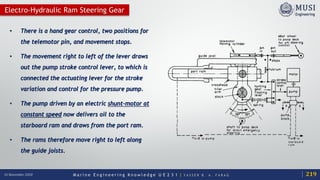
Electro-Hydraulic Ram Steering Gear
219
• There is a hand gear control, two positions for
the telemotor pin, and movement stops.
• The movement right to left of the lever draws
out the pump stroke control lever, to which is
connected the actuating lever for the stroke
variation and control for the pressure pump.
• The pump driven by an electric shunt-motor at
constant speed now delivers oil to the
starboard ram and draws from the port ram.
• The rams therefore move right to left along
the guide joists.
M a r i n e E n g i n e e r i n g K n o w l e d g e U E 2 3 1 | Y A S S E R B . A . F A R A G16 November 2020
Electro-Hydraulic Ram Steering Gear
220
• The bottom of the lever is being pushed to the
right and so the stroke control of the pump is
almost immediately brought back to pump mid
position. This means the pump stops pumping
and the unit is virtually fluid locked at the
required rudder position.
• At the pump block are non return valves and
connections leading to the sump or
replenishing tank to act as suction and
replenishing leads (XX)
M a r i n e E n g i n e e r i n g K n o w l e d g e U E 2 3 1 | Y A S S E R B . A . F A R A G16 November 2020
4-Ram Hydraulic Actuator
221
All Cylinders in operation:
Valves B,C ,D,E are open and A,F are
Closed.
Cylinders 1 & 2 Operational:
Valves B,C and F are open and A,D and
E Closed.
Cylinders 3 & 4 Operational:
Valves E,D and A are open and B,C and
F are Closed
M a r i n e E n g i n e e r i n g K n o w l e d g e U E 2 3 1 | Y A S S E R B . A . F A R A G16 November 2020
4-Ram Hydraulic Actuator
• Two other valves, of the spring loaded type act
as double shock relief valves.
• Each valve connects both sides of the system
when the pressure in either ram cylinder
reaches 80 to 190 bar (depending on the
design) the valve lifts, so letting the rudder
give way when subject to severe sea action.
• When giving way the pump actuating spindle is
moved and the pump acts to return the rudder
to the previous position when the loading
reduces.
222
M a r i n e E n g i n e e r i n g K n o w l e d g e U E 2 3 1 | Y A S S E R B . A . F A R A G16 November 2020
4-Ram Hydraulic Actuator
• The gear is filled by coupling up to the hand
steering and rotating port and starboard with
the motor running.
• Ram cylinders, replenishing valves and bypass
valves open.
• The bypass valves are then shut and the gear
fully rotated port and starboard whilst the air
is purged from the ram cylinders at the air
cocks
• The bypass valves are two fold units in the
block, consisting of bypass and isolating valves.
223
M a r i n e E n g i n e e r i n g K n o w l e d g e U E 2 3 1 | Y A S S E R B . A . F A R A G16 November 2020
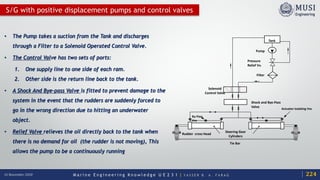
S/G with positive displacement pumps and control valves
Pressure
Relief Vv.
Filter F
Solenoid
Control Valve
Shock and Bye-Pass
Valve
Steering Gear
Cylinders
Rudder cross Head
Tie Bar
Pump
Tank
By-Pass
Vvs
Actuator isolating Vvs
• The Pump takes a suction from the Tank and discharges
through a Filter to a Solenoid Operated Control Valve.
• The Control Valve has two sets of ports:
1. One supply line to one side of each ram.
2. Other side is the return line back to the tank.
• A Shock And Bye-pass Valve is fitted to prevent damage to the
system in the event that the rudders are suddenly forced to
go in the wrong direction due to hitting an underwater
object.
• Relief Valve relieves the oil directly back to the tank when
there is no demand for oil (the rudder is not moving), This
allows the pump to be a continuously running
224
M a r i n e E n g i n e e r i n g K n o w l e d g e U E 2 3 1 | Y A S S E R B . A . F A R A G16 November 2020
Rotary Vane
• The usual arrangement of three fixed and three moving
vanes allows a rudder angle of 70° with a vane-type
steering gear .
• A larger turning angle is obtained with two fixed and
two moving vanes if required .
• Vanes in the gear shown are of spheroidal graphite cast
iron, the fixed ones being held to the stator by high-
tensile steel dowel pins and cap screws . Moving vanes
are keyed to the cast steel rotor which in turn is fitted
to a taper on the rudder stock and keyed..
225
M a r i n e E n g i n e e r i n g K n o w l e d g e U E 2 3 1 | Y A S S E R B . A . F A R A G16 November 2020
Rotary Vane
• Vanes are sealed by steel strips backed by
synthetic rubber laid in slots . Weight of
the gear is supported by a rudder carrier
bearing beneath it in this design .
• Rotation of the gear is prevented by two
anchor bolts held in fixed anchor brackets
with rubber shock-absorbing sleeves . The
bolts have outer cast-iron bushes to take
wear from the steering gear flanges . Top
and bottom stator flanges are welded on
after oil manifold grooves have been
machined
226
M a r i n e E n g i n e e r i n g K n o w l e d g e U E 2 3 1 | Y A S S E R B . A . F A R A G16 November 2020
Rotary Vane
227
M a r i n e E n g i n e e r i n g K n o w l e d g e U E 2 3 1 | Y A S S E R B . A . F A R A G16 November 2020
Rotary Vane
228
M a r i n e E n g i n e e r i n g K n o w l e d g e U E 2 3 1 | Y A S S E R B . A . F A R A G16 November 2020
Comparison
229
M a r i n e E n g i n e e r i n g K n o w l e d g e U E 2 3 1 | Y A S S E R B . A . F A R A G16 November 2020
Electrical steering gear
M a r i n e E n g i n e e r i n g K n o w l e d g e U E 2 3 1 | Y A S S E R B . A . F A R A G16 November 2020
Electrical S.G – Ward Leonard
231
M a r i n e E n g i n e e r i n g K n o w l e d g e U E 2 3 1 | Y A S S E R B . A . F A R A G16 November 2020
Electrical S.G – Ward Leonard
232
M a r i n e E n g i n e e r i n g K n o w l e d g e U E 2 3 1 | Y A S S E R B . A . F A R A G16 November 2020
Crosshead arrangement
M a r i n e E n g i n e e r i n g K n o w l e d g e U E 2 3 1 | Y A S S E R B . A . F A R A G16 November 2020
Cross Head arrangement
• As the rams slide across they push on the ram
crossheads moving the tiller arm to port, the arm
sliding through the swivel bearing.
• A wear down rudder allowance of 19 mm is provided so
as not to induce bending stresses on the ram.
• With the tiller arm going to port the rudder moves to
starboard.
• The rotating stock movement is led back by a spring
link to the pump control floating lever. This
constitutes the hunting gear (feed back) in that when
the telemotor movement stops, the floating lever
stops going to the left.
234
M a r i n e E n g i n e e r i n g K n o w l e d g e U E 2 3 1 | Y A S S E R B . A . F A R A G16 November 2020
Rudder Carrier Bearing
• The rudder carrier bearing takes the weight of the rudder on a grease
lubricated bronze thrust face . The rudder stock is located by the
journal, also grease lubricated .
• Support for the bearing is provided by a doubler plate and steel chock.
The base of the carrier bearing is located by wedge type side chocks,
welded to the deck stiffening.
• Carrier bearing components are split as necessary for removal or
replacement. Screw down lubricators are fitted, and the grease used for
lubrication is a water resistant type (calcium soap base with graphite).
• Bearing wear down occurs over a period of time, and allowance is made
in the construction of the steering gear for a small vertical drop of the
rudder stock.
• Lifting of the rudder and stock by heavy weather is prevented by jumping
stops between the upper surface of the rudder and the stern frame.
235
M a r i n e E n g i n e e r i n g K n o w l e d g e U E 2 3 1 | Y A S S E R B . A . F A R A G16 November 2020
Rudder Carrier Bearing
External rudder stops are fitted to limit
its movement to, say, 39° each way from
the mid position . In the steering gear
there are also stops set to limit the angle
to which the rudder can be moved by the
gear . These are set to, e.g ., 37° each
way from the mid position . The latter
are necessary to prevent the rudder from
being forced against the outside stops.
Limits on the telemotor are set at say
35° each way from the mid position .
236
M a r i n e E n g i n e e r i n g K n o w l e d g e U E 2 3 1 | Y A S S E R B . A . F A R A G16 November 2020
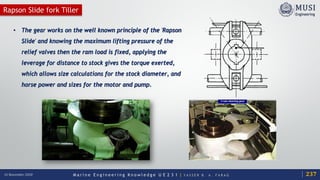
Rapson Slide fork Tiller
• The gear works on the well known principle of the 'Rapson
Slide' and knowing the maximum lifting pressure of the
relief valves then the ram load is fixed, applying the
leverage for distance to stock gives the torque exerted,
which allows size calculations for the stock diameter, and
horse power and sizes for the motor and pump.
237
M a r i n e E n g i n e e r i n g K n o w l e d g e U E 2 3 1 | Y A S S E R B . A . F A R A G16 November 2020
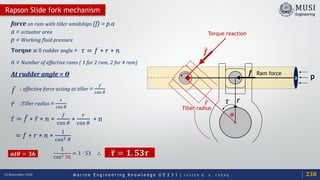
Rapson Slide fork mechanism
force on ram with tiller amidships (f) = p.a
a = actuator area
p = Working fluid pressure
Torque at 0 rudder angle =
n = Number of effective rams ( 1 for 2 ram, 2 for 4 ram)
At rudder angle = Ѳ
: effective force acting at tiller =
𝑓𝑓
cos 𝜃𝜃
:Tiller radius =
𝑟𝑟
cos 𝜃𝜃
̅𝑓𝑓
̅𝑟𝑟
̅𝜏𝜏 = ̅𝑓𝑓 ∗ ̅𝑟𝑟 ∗ 𝑛𝑛 =
𝑓𝑓
cos 𝜃𝜃
∗
𝑟𝑟
cos 𝜃𝜃
∗ n
𝜏𝜏 = 𝑓𝑓 ∗ 𝑟𝑟 ∗ 𝑛𝑛
= 𝑓𝑓 ∗ 𝑟𝑟 ∗ 𝑛𝑛 ∗
1
cos2 𝜃𝜃
�𝝉𝝉 = 𝟏𝟏. 𝟓𝟓𝟓𝟓𝝉𝝉
1
cos2 36
= 1 ⋅ 53𝒂𝒂𝒂𝒂𝒂𝒂 = 𝟑𝟑𝟑𝟑
238
+
p
̅𝑟𝑟 r
�𝒇𝒇
𝒇𝒇
Ѳ
a
Torque reaction
Tiller radius
Ram force
𝜏𝜏
∴
M a r i n e E n g i n e e r i n g K n o w l e d g e U E 2 3 1 | Y A S S E R B . A . F A R A G16 November 2020
Video
239
M a r i n e E n g i n e e r i n g K n o w l e d g e U E 2 3 1 | Y A S S E R B . A . F A R A G16 November 2020
Q & A
M a r i n e E n g i n e e r i n g K n o w l e d g e U E 2 3 1 | Y A S S E R B . A . F A R A G16 November 2020
 What are the types of telemotor system in steering gear on ships ?
1. Hydraulic system
2. Electric system
 What are the types of steering system ?
Electro hydraulic system
I. Ram type system (2 ram or 4 ram)
II. Vane type system
All electric system
I. Ward Leonard system
II. Single motor system.
 What is meant be non-follow up system in steering gear ?
When steering gear set to required position, rudder is moved & when rudder reach the
required position, steering gear must be set to off position. This system uses the three
solenoid valve.
Frequently asked Questions
241
M a r i n e E n g i n e e r i n g K n o w l e d g e U E 2 3 1 | Y A S S E R B . A . F A R A G16 November 2020
 What is meant be follow up system in steering gear ?
When steering gear set to required position, rudder is moved & when rudder reaches the
set position, steering gear still remains at that position. This system uses the hunting
gear arrangement.
 What is hunting gear ?
It is a feed back mechanism of steering gear which repositions the floating lever of
hydraulic pump as the tiller moves to the desire position.
 What are the safety devices for steering system ?
Hunting gear - Buffer spring - Angle adjusting stop (Hand over position limit switch) -
Double shock valve - Relief valve - Tank level alarm (oil) - Over load alarm
Frequently asked Questions
242
M a r i n e E n g i n e e r i n g K n o w l e d g e U E 2 3 1 | Y A S S E R B . A . F A R A G16 November 2020
 What is the indication of air in the steering system ?
Jumping pressure gauges
Jerky operation
Defective steering
 What is the effect of air in the steering system ?
Air being compressible gives incorrect balance between units, time lags and irregular
operation. (which can be dangerous).
 Emergency steering gear operation
• In the case of Telemotor failure, by switching the change over pin, emergency
steering can be carried out by isolating the receiver cylinder and directly controlling
the connecting rod of the main steering power unit’s pump lever.
• The emergency rudder angel indicator and communication system to bridge being
provided at the emergency station.
Frequently asked Questions
243
M a r i n e E n g i n e e r i n g K n o w l e d g e U E 2 3 1 | Y A S S E R B . A . F A R A G16 November 2020
 Action in case of electrical telemotor failure ?
• Put bridge control to manual
• Emergency steering gear system is operated by (solenoid button) whether port or
starboard.
• Rudder angle indicator and communication system between steering room and
bridge must be provided.
 How to operate emergency steering gear?
1. Disconnect auto pilot system.
2. Take out change over pin from attachment with telemotor receiver & fit to the
hand gear.
3. Use communication system with telephone from steering gear room to bridge
Frequently asked Questions
244
M a r i n e E n g i n e e r i n g K n o w l e d g e U E 2 3 1 | Y A S S E R B . A . F A R A G16 November 2020
 What are steering gear tests & maintenance?
• 12 hour before departure
Operation of main & auxiliary steering gear.
Operation of remote control system.
Operation of emergency power supply.
Alarm test.
Actual rudder angle & indicator.
Communication system.(Bridge, Engine room & Steering gear room)
• Every 3 months interval
Emergency steering gear drill at steering gear room to bridge with sound
communication system.
Frequently asked Questions
245
M a r i n e E n g i n e e r i n g K n o w l e d g e U E 2 3 1 | Y A S S E R B . A . F A R A G16 November 2020
 Steering tests required before departure ?
• Steering gear should be checked at least one hour prior to departure.
• Telemotor transmitter oil level to be checked.
• Oil level of actuating system tank should be checked and replenished if
necessary.
• Rudder carrier bearing and bottom sea gland checked and greased.
• Start pump and check response of the gear.
• Check abnormal noise and heat .
• Check load carrying and running of the gear ( swing from port 35° to stbd 30°
within 28 sec )
Frequently asked Questions
246
M a r i n e E n g i n e e r i n g K n o w l e d g e U E 2 3 1 | Y A S S E R B . A . F A R A G16 November 2020
 What are daily check in steering gear room ?
• Pressure gauge of steering pump.
• Motor ampere on the steering switch board & motor hand touch feeling
• Noise and vibration.
• Oil level in tank
• Oil leakage in system
• Grease in rudder carrier bearing
• Check the bottom seal gland whether good or not.
Frequently asked Questions
247
M a r i n e E n g i n e e r i n g K n o w l e d g e U E 2 3 1 | Y A S S E R B . A . F A R A G16 November 2020
 What are steering system regulations ?
• Every ship shall be provided with a main steering gear and an auxiliary steering gear.
• The failure of one of them will not render the other one inoperative.
• Relief valves shall be fitted to any part of the hydraulic system.
• The main steering gear and rudder stock shall be:
(a) of adequate strength and capable of steering the ship at maximum ahead service speed. (b) capable
of putting the rudder over from 35′ on one side to 35′ on the other side with the ship at its deepest sea
going draught and running ahead at maximum ahead service speed and, under the same conditions,
from 35′ on either side to 30′ on the other side in not more than 28 seconds. (c) So that they will not be
damaged at maximum astern speed.
• The auxiliary steering gear shall be: (a) of adequate strength and capable of steering the ship at
navigable speed and of being brought speedily into action in an emergency. (b) capable of putting the
redder over from 15′ on one side to 15′ on the other side in not more than 60 seconds with the ship at
its deepest seagoing draught and running ahead at one half of the maximum ahead service speed or 7
knots, whichever is the greater.
• In every tanker, chemical tanker or gas carrier of 10,000 gross ton and upwards and in every ships of
70,000 gross ton and upwards, the main steering gear shall comprise two or more identical power units.
Frequently asked Questions
248
M a r i n e E n g i n e e r i n g K n o w l e d g e U E 2 3 1 | Y A S S E R B . A . F A R A G16 November 2020
 What are the advantages of rotary vane type over ram type ?
• Smaller space required
• Low installation cost
• Less weight
• Smaller power required, for the same load, because it can transmit pure torque
to the rudder stock.
 What are the disadvantages of rotary vane type over ram type?
• Synthetic rubber backed steel sealing strips at vane tops are not strong enough
for large ship gear.
• Can be used for rudder stock ratings of about 1700 KNm, and less torque
generated by two ram is 120 to 160 KNm, and for four ram 250 to 10,000KNm
Frequently asked Questions
249
M a r i n e E n g i n e e r i n g K n o w l e d g e U E 2 3 1 | Y A S S E R B . A . F A R A G16 November 2020
 What are the properties of telemotor hydraulic fluid ??
Good quality mineral lubricating oil is used. Its properties are-
• Low pour point (-50°C)
• Low viscosity ( to reduced fractional drag, but not too thin to mate gland
sealing, 12 cSt at 50°C)
• High viscosity index (110)
• High flash point (150° C closed)
• Non sludge forming
• Non corrosive
• Good lubricating properties
• Specific gravity 0.88 at 15.5° C
Frequently asked Questions
250
M a r i n e E n g i n e e r i n g K n o w l e d g e U E 2 3 1 | Y A S S E R B . A . F A R A G16 November 2020
 What is the purpose of buffer spring ?
To prevent the damages of the control system.
• Absorb the difference between the steering order speeds and follow up
speed.
• Absorb the movement of steering wheel if it is mishandled when the
hydraulic pump stop in.
• Absorb the movement of the control lever when rudder drift
• Absorb the vibration and shocks from the rudder.
Frequently asked Questions
251

Steering gear system

  • 1.
    Yasser B. A.Farag MSc. of Maritime Energy Management - - Sweden Lecturer at Institute of Maritime Upgrading Studies Maritime Chief Engineer Maritime Upgrading Studies Institute - 2 0 2 0 - Marine Engineering Knowledge UE231
  • 2.
    M a ri n e E n g i n e e r i n g K n o w l e d g e U E 2 3 1 | Y A S S E R B . A . F A R A G16 November 2020
  • 3.
    M a ri n e E n g i n e e r i n g K n o w l e d g e U E 2 3 1 | Y A S S E R B . A . F A R A G16 November 2020 Hydrofoil shape 152 Relative fluid
  • 4.
    M a ri n e E n g i n e e r i n g K n o w l e d g e U E 2 3 1 | Y A S S E R B . A . F A R A G16 November 2020 Theory 153 When a rudder is turned to some angle (α), a force (F) is produced due to the high and low pressure regions generated by the water flow. On one side of the rudder the flow reduces in speed whilst on the other it increases. By Bernoulli, lower velocities are associated with higher pressure, whilst higher velocities give lower pressure so that a rudder force is produced as shown in the sketch. α Water Flow CL + -
  • 5.
    M a ri n e E n g i n e e r i n g K n o w l e d g e U E 2 3 1 | Y A S S E R B . A . F A R A G16 November 2020 Theory 154 α F Water Flow CL + - Lift Drag b Center of Effort The total force generated can be assumed to act as a single force at the centre of pressure of the rudder, more often referred to as the `centre of effort’. The force F has two components: • a `lift component' which is the transverse component of the rudder force, causing the ship to turn; • a `drag component' which is the longitudinal component of the rudder force.
  • 6.
    M a ri n e E n g i n e e r i n g K n o w l e d g e U E 2 3 1 | Y A S S E R B . A . F A R A G16 November 2020 Theory 155 α F Water Flow CL + - Lift Drag b Center of Effort The torque imposed by the water flow (which needs to be overcome by the steering gear) is the force on the rudder multiplied by the distance from the centre of effort to the axis of rotation. If the rudder were assumed to rotate about its leading edge and the distance to the centre of effort was `b' as in the sketch, the torque would T= f x b
  • 7.
    M a ri n e E n g i n e e r i n g K n o w l e d g e U E 2 3 1 | Y A S S E R B . A . F A R A G16 November 2020 Stall angle 156
  • 8.
    M a ri n e E n g i n e e r i n g K n o w l e d g e U E 2 3 1 | Y A S S E R B . A . F A R A G16 November 2020 Less torque acting on the rudder & more ship’s heeling Rudder angle limit 157 Angle of Attack α LiftCoefficient DragCoefficient Turbulence Stall 35~37
  • 9.
    M a ri n e E n g i n e e r i n g K n o w l e d g e U E 2 3 1 | Y A S S E R B . A . F A R A G16 November 2020 Ship’s turning 158
  • 10.
    M a ri n e E n g i n e e r i n g K n o w l e d g e U E 2 3 1 | Y A S S E R B . A . F A R A G16 November 2020 SOLAS requirements 159
  • 11.
    M a ri n e E n g i n e e r i n g K n o w l e d g e U E 2 3 1 | Y A S S E R B . A . F A R A G16 November 2020 SOLAS, CH II-1, Reg. 29 160
  • 12.
    M a ri n e E n g i n e e r i n g K n o w l e d g e U E 2 3 1 | Y A S S E R B . A . F A R A G16 November 2020 161 SOLAS, CH II-1, Reg. 29
  • 13.
    M a ri n e E n g i n e e r i n g K n o w l e d g e U E 2 3 1 | Y A S S E R B . A . F A R A G16 November 2020 162 SOLAS, CH II-1, Reg. 29
  • 14.
    M a ri n e E n g i n e e r i n g K n o w l e d g e U E 2 3 1 | Y A S S E R B . A . F A R A G16 November 2020 163 SOLAS, CH II-1, Reg. 29
  • 15.
    M a ri n e E n g i n e e r i n g K n o w l e d g e U E 2 3 1 | Y A S S E R B . A . F A R A G16 November 2020 164 SOLAS, CH II-1, Reg. 29
  • 16.
    M a ri n e E n g i n e e r i n g K n o w l e d g e U E 2 3 1 | Y A S S E R B . A . F A R A G16 November 2020 SOLAS, CH II-1, Reg. 29 165
  • 17.
    M a ri n e E n g i n e e r i n g K n o w l e d g e U E 2 3 1 | Y A S S E R B . A . F A R A G16 November 2020 SOLAS, CH II-1, Reg. 29 166
  • 18.
    M a ri n e E n g i n e e r i n g K n o w l e d g e U E 2 3 1 | Y A S S E R B . A . F A R A G16 November 2020 SOLAS, CH II-1, Reg. 29 167
  • 19.
    M a ri n e E n g i n e e r i n g K n o w l e d g e U E 2 3 1 | Y A S S E R B . A . F A R A G16 November 2020 SOLAS, CH II-1, Reg. 29 168
  • 20.
    M a ri n e E n g i n e e r i n g K n o w l e d g e U E 2 3 1 | Y A S S E R B . A . F A R A G16 November 2020 SOLAS, CH II-1, Reg. 29 169
  • 21.
    M a ri n e E n g i n e e r i n g K n o w l e d g e U E 2 3 1 | Y A S S E R B . A . F A R A G16 November 2020 SOLAS, CH II-1, Reg. 29 170
  • 22.
    M a ri n e E n g i n e e r i n g K n o w l e d g e U E 2 3 1 | Y A S S E R B . A . F A R A G16 November 2020 SOLAS, CH II-1, Reg. 29 171
  • 23.
    M a ri n e E n g i n e e r i n g K n o w l e d g e U E 2 3 1 | Y A S S E R B . A . F A R A G16 November 2020 SOLAS, CH II-1, Reg. 29 172
  • 24.
    M a ri n e E n g i n e e r i n g K n o w l e d g e U E 2 3 1 | Y A S S E R B . A . F A R A G16 November 2020 SOLAS, CH II-1, Reg. 30 173 SOLAS, CH II-1, Reg. 30
  • 25.
    M a ri n e E n g i n e e r i n g K n o w l e d g e U E 2 3 1 | Y A S S E R B . A . F A R A G16 November 2020 174 SOLAS, CH V-1, Reg. 19
  • 26.
    M a ri n e E n g i n e e r i n g K n o w l e d g e U E 2 3 1 | Y A S S E R B . A . F A R A G16 November 2020 175 SOLAS, CH V-1, Reg. 19
  • 27.
    M a ri n e E n g i n e e r i n g K n o w l e d g e U E 2 3 1 | Y A S S E R B . A . F A R A G16 November 2020 176 SOLAS, CH V-1, Reg. 19
  • 28.
    M a ri n e E n g i n e e r i n g K n o w l e d g e U E 2 3 1 | Y A S S E R B . A . F A R A G16 November 2020 Steering Gear system • Steering gears can be arranged with hydraulic control equipment known as a ‘ Telemotor ', or with electrical control equipment. • The power unit may in turn be hydraulic or electrically operated. Each of these units will be considered in turn, with the hydraulic unit pump being considered first. • A pump is required in the hydraulic system which can immediately pump fluid in order to provide a hydraulic force that will move the rudder. • Instant response does not allow time for the pump to be switched on and therefore a constantly running pump is required which pumps fluid only when required. • A variable delivery pump provides this facility. 177
  • 29.
    M a ri n e E n g i n e e r i n g K n o w l e d g e U E 2 3 1 | Y A S S E R B . A . F A R A G16 November 2020 Steering Gear system The steering gear provides a movement of the rudder in response to a signal from the bridge. The total system may be considered made up of three parts, control equipment, a power unit and anActuatorto movethe rudder stock to the desired angle. The control equipment conveys a signal of desired rudder angle from the bridge and activates the power unit and transmission system until the desired angle is reached. The power unit provides the force, when required and with immediate effect, to move the rudder to the desired angle. The transmission system, the steering gear, is the means by which the movement of the rudder is accomplished. 178
  • 30.
    M a ri n e E n g i n e e r i n g K n o w l e d g e U E 2 3 1 | Y A S S E R B . A . F A R A G16 November 2020 Auto-Pilot SG system Block diagram 179 Controller Transmitter Receiver Actuator Rudder Ship Compass Manual Amplifier Variable/ Positive displacement pumpTelemotor system External forces Set Course Actual Course Feedback Feedback Input power • Hydraulic • Electric • Hele-Shaw • Swash plate • Screw pump + directional valves • Ram • Rotary vane
  • 31.
    M a ri n e E n g i n e e r i n g K n o w l e d g e U E 2 3 1 | Y A S S E R B . A . F A R A G16 November 2020 Steering Gear Types (i) Hydraulic steering gear, (ii) Electric steering gear and (iii) Electro-hydraulic steering gear. 180
  • 32.
    M a ri n e E n g i n e e r i n g K n o w l e d g e U E 2 3 1 | Y A S S E R B . A . F A R A G16 November 2020 Telemotor system
  • 33.
    M a ri n e E n g i n e e r i n g K n o w l e d g e U E 2 3 1 | Y A S S E R B . A . F A R A G16 November 2020 Telemotor system Telemotor control is a hydraulic control system employing a transmitter, a receiver and pipes. The transmitter, which is built into the steering wheel console, is located on the bridge and the receiver is mounted on the steering gear. 182
  • 34.
    M a ri n e E n g i n e e r i n g K n o w l e d g e U E 2 3 1 | Y A S S E R B . A . F A R A G16 November 2020 Telemotor-Transmitter 183
  • 35.
    M a ri n e E n g i n e e r i n g K n o w l e d g e U E 2 3 1 | Y A S S E R B . A . F A R A G16 November 2020 Telemotor-Receiver 184
  • 36.
    M a ri n e E n g i n e e r i n g K n o w l e d g e U E 2 3 1 | Y A S S E R B . A . F A R A G16 November 2020 Electrical telemotor 185
  • 37.
    M a ri n e E n g i n e e r i n g K n o w l e d g e U E 2 3 1 | Y A S S E R B . A . F A R A G16 November 2020 Telemotor- oil charging 186
  • 38.
    M a ri n e E n g i n e e r i n g K n o w l e d g e U E 2 3 1 | Y A S S E R B . A . F A R A G16 November 2020 By pass valve operation and leakage test 187
  • 39.
    M a ri n e E n g i n e e r i n g K n o w l e d g e U E 2 3 1 | Y A S S E R B . A . F A R A G16 November 2020 Telemotor fluid properties Good quality mineral lubricating oil is used. Its properties are- • Low pour point (-50°C) • Low viscosity ( to reduced fractional drag, but not too thin to mate gland sealing, 12 cSt at 50°C) • High flash point (150° C closed) • Non sludge forming • Non corrosive • Good lubricating properties • Specific gravity 0.88 at 15.5° C 188
  • 40.
    M a ri n e E n g i n e e r i n g K n o w l e d g e U E 2 3 1 | Y A S S E R B . A . F A R A G16 November 2020 Power unit
  • 41.
    M a ri n e E n g i n e e r i n g K n o w l e d g e U E 2 3 1 | Y A S S E R B . A . F A R A G16 November 2020 + Shortest stroke Hele Shaw Pump 190 T B +o BAF GCCE D Rotation Shaft Oil Slippers Plungers Mid-position (Idle running) Floating ring Longest stroke Slipper path Gudgeons Suction Discharge
  • 42.
    M a ri n e E n g i n e e r i n g K n o w l e d g e U E 2 3 1 | Y A S S E R B . A . F A R A G16 November 2020 Hele Shaw Pump 191
  • 43.
    M a ri n e E n g i n e e r i n g K n o w l e d g e U E 2 3 1 | Y A S S E R B . A . F A R A G16 November 2020 Hele Shaw Pump 192
  • 44.
    M a ri n e E n g i n e e r i n g K n o w l e d g e U E 2 3 1 | Y A S S E R B . A . F A R A G16 November 2020 193 Hele Shaw Pump
  • 45.
    M a ri n e E n g i n e e r i n g K n o w l e d g e U E 2 3 1 | Y A S S E R B . A . F A R A G16 November 2020 Hele Shaw Pump 194
  • 46.
    M a ri n e E n g i n e e r i n g K n o w l e d g e U E 2 3 1 | Y A S S E R B . A . F A R A G16 November 2020 Hele Shaw Pump 195
  • 47.
    M a ri n e E n g i n e e r i n g K n o w l e d g e U E 2 3 1 | Y A S S E R B . A . F A R A G16 November 2020 Hele Shaw Pump 196
  • 48.
    M a ri n e E n g i n e e r i n g K n o w l e d g e U E 2 3 1 | Y A S S E R B . A . F A R A G16 November 2020 Hele Shaw Pump 197
  • 49.
    M a ri n e E n g i n e e r i n g K n o w l e d g e U E 2 3 1 | Y A S S E R B . A . F A R A G16 November 2020 Hele Shaw Pump 198
  • 50.
    M a ri n e E n g i n e e r i n g K n o w l e d g e U E 2 3 1 | Y A S S E R B . A . F A R A G16 November 2020 Animation 199
  • 51.
    M a ri n e E n g i n e e r i n g K n o w l e d g e U E 2 3 1 | Y A S S E R B . A . F A R A G16 November 2020 Swash plate pump 200
  • 52.
    M a ri n e E n g i n e e r i n g K n o w l e d g e U E 2 3 1 | Y A S S E R B . A . F A R A G16 November 2020 Swash plate pump 201
  • 53.
    M a ri n e E n g i n e e r i n g K n o w l e d g e U E 2 3 1 | Y A S S E R B . A . F A R A G16 November 2020 Swash plate pump 202
  • 54.
    M a ri n e E n g i n e e r i n g K n o w l e d g e U E 2 3 1 | Y A S S E R B . A . F A R A G16 November 2020 Swash plate pump 203
  • 55.
    M a ri n e E n g i n e e r i n g K n o w l e d g e U E 2 3 1 | Y A S S E R B . A . F A R A G16 November 2020 Swash plate pump 204
  • 56.
    M a ri n e E n g i n e e r i n g K n o w l e d g e U E 2 3 1 | Y A S S E R B . A . F A R A G16 November 2020 Swash plate pump Hydraulic lock is an abnormal condition of any device which is designed to compress a gas by mechanically restraining it; most commonly the reciprocating internal combustion engine. It occurs when a volume of liquid greater than the volume of the cylinder at its minimum (end of the piston's stroke) enters the cylinder. Since liquids are nearly incompressible the piston cannot complete its travel; either the engine must stop rotating or a mechanical failure must occur. Swash plate pump 205
  • 57.
    M a ri n e E n g i n e e r i n g K n o w l e d g e U E 2 3 1 | Y A S S E R B . A . F A R A G16 November 2020 Swash plate pump 206
  • 58.
    M a ri n e E n g i n e e r i n g K n o w l e d g e U E 2 3 1 | Y A S S E R B . A . F A R A G16 November 2020 Swash plate pump 207
  • 59.
    M a ri n e E n g i n e e r i n g K n o w l e d g e U E 2 3 1 | Y A S S E R B . A . F A R A G16 November 2020 Animation 208
  • 60.
    M a ri n e E n g i n e e r i n g K n o w l e d g e U E 2 3 1 | Y A S S E R B . A . F A R A G16 November 2020 Tilting pump 209
  • 61.
    M a ri n e E n g i n e e r i n g K n o w l e d g e U E 2 3 1 | Y A S S E R B . A . F A R A G16 November 2020 Non-reverse locking gear to stop pump idling 210
  • 62.
    M a ri n e E n g i n e e r i n g K n o w l e d g e U E 2 3 1 | Y A S S E R B . A . F A R A G16 November 2020 Control unit
  • 63.
    M a ri n e E n g i n e e r i n g K n o w l e d g e U E 2 3 1 | Y A S S E R B . A . F A R A G16 November 2020 (Hunting gear – Floating lever) 1. The telemotor moves the end of floating lever A to 𝐴𝐴1 for a certain rudder angle ( certain direction and angle) 2. Subsequently, The pump control is moved, therefore from B to 𝐵𝐵1. Pumping of the hydraulic oil causes movement of the rams and the end of rod C moves to 𝐶𝐶1 , thus causing the pump control to be pulled back to the neutral position B. 3. If the rudder is displaced by a heavy sea through lifting of the relief valves, the hunting gear is moved by the rudder stock. This will put the pump on stroke and rudder will be restored to its previous position. 1 2 1 2 A B C 𝐴𝐴1 𝐵𝐵1 𝐶𝐶1 Variable displacement pump From Telemotor Control Connection to Rudder stock or Tiller Fulcrum 1 1 2 2 𝐵𝐵2 212
  • 64.
    M a ri n e E n g i n e e r i n g K n o w l e d g e U E 2 3 1 | Y A S S E R B . A . F A R A G16 November 2020 Modes of Steering Gear Normal Procedure (From Wheel House) Non-Follow Up Mode Follow Up Mode Manual Method (wheel) Automatic Steering Gear Emergency Procedure (From S/G Compartment) 213
  • 65.
    M a ri n e E n g i n e e r i n g K n o w l e d g e U E 2 3 1 | Y A S S E R B . A . F A R A G16 November 2020 Follow Up Mode • This is the Principal mode of steering. • In this mode, the rudder Follows the wheel. If the rudder is put 10° to Starboard, the rudder will follow to 10° to Stbd and remain there as long as wheel is kept to 10° to Stbd. • To bring the rudder to ‘Midship’, the wheel will have to be brought to ‘Midship’. • This mode is followed in the following methods of steering  The hand steering mode in which the steering wheel sets the rudder angle,  Auto-steering mode in which the wheel order is automatically generated depending upon the difference between the ordered course and the actual course 214
  • 66.
    M a ri n e E n g i n e e r i n g K n o w l e d g e U E 2 3 1 | Y A S S E R B . A . F A R A G16 November 2020 Non-Follow Up Mode • This mode of steering is not done with a steering wheel but with a NFU Lever. • The NFU lever does not have any markings. As long as it is kept pressed, the rudder will continue turning and stop the moment the lever is released. • This mode is used when ships telemotor system fails. In that case, the NFU lever sends rudder setting directly to the Control Unit. • To return the rudder to the midship, the NFU lever will have to be pressed to the opposite side of the initial movement and kept pressed till the rudder is midship. 215
  • 67.
    M a ri n e E n g i n e e r i n g K n o w l e d g e U E 2 3 1 | Y A S S E R B . A . F A R A G16 November 2020 Actuators
  • 68.
    M a ri n e E n g i n e e r i n g K n o w l e d g e U E 2 3 1 | Y A S S E R B . A . F A R A G16 November 2020 Steering Gear Actuators There are two main types of steering actuators: 1. Electro-Hydraulic: Ram, Rotary Vane. 2. All Electric: Ward Leonard, Single Motor 217
  • 69.
    M a ri n e E n g i n e e r i n g K n o w l e d g e U E 2 3 1 | Y A S S E R B . A . F A R A G16 November 2020 Electro-Hydraulic Ram Steering Gear • Consider a movement of the wheel to starboard and hence ship's head to starboard • The rudder movement will be to starboard so that the rams will move starboard to port (right to left). • The steering telemotor moves from right to left (as considered previously) but is mounted on the joist bracket through 180 degrees so that the movement on Fig is left to right. • The receiver motion is given to a lever which is fixed at the centre (fulcrum) so that the other end moves right to left 218
  • 70.
    M a ri n e E n g i n e e r i n g K n o w l e d g e U E 2 3 1 | Y A S S E R B . A . F A R A G16 November 2020 Electro-Hydraulic Ram Steering Gear 219 • There is a hand gear control, two positions for the telemotor pin, and movement stops. • The movement right to left of the lever draws out the pump stroke control lever, to which is connected the actuating lever for the stroke variation and control for the pressure pump. • The pump driven by an electric shunt-motor at constant speed now delivers oil to the starboard ram and draws from the port ram. • The rams therefore move right to left along the guide joists.
  • 71.
    M a ri n e E n g i n e e r i n g K n o w l e d g e U E 2 3 1 | Y A S S E R B . A . F A R A G16 November 2020 Electro-Hydraulic Ram Steering Gear 220 • The bottom of the lever is being pushed to the right and so the stroke control of the pump is almost immediately brought back to pump mid position. This means the pump stops pumping and the unit is virtually fluid locked at the required rudder position. • At the pump block are non return valves and connections leading to the sump or replenishing tank to act as suction and replenishing leads (XX)
  • 72.
    M a ri n e E n g i n e e r i n g K n o w l e d g e U E 2 3 1 | Y A S S E R B . A . F A R A G16 November 2020 4-Ram Hydraulic Actuator 221 All Cylinders in operation: Valves B,C ,D,E are open and A,F are Closed. Cylinders 1 & 2 Operational: Valves B,C and F are open and A,D and E Closed. Cylinders 3 & 4 Operational: Valves E,D and A are open and B,C and F are Closed
  • 73.
    M a ri n e E n g i n e e r i n g K n o w l e d g e U E 2 3 1 | Y A S S E R B . A . F A R A G16 November 2020 4-Ram Hydraulic Actuator • Two other valves, of the spring loaded type act as double shock relief valves. • Each valve connects both sides of the system when the pressure in either ram cylinder reaches 80 to 190 bar (depending on the design) the valve lifts, so letting the rudder give way when subject to severe sea action. • When giving way the pump actuating spindle is moved and the pump acts to return the rudder to the previous position when the loading reduces. 222
  • 74.
    M a ri n e E n g i n e e r i n g K n o w l e d g e U E 2 3 1 | Y A S S E R B . A . F A R A G16 November 2020 4-Ram Hydraulic Actuator • The gear is filled by coupling up to the hand steering and rotating port and starboard with the motor running. • Ram cylinders, replenishing valves and bypass valves open. • The bypass valves are then shut and the gear fully rotated port and starboard whilst the air is purged from the ram cylinders at the air cocks • The bypass valves are two fold units in the block, consisting of bypass and isolating valves. 223
  • 75.
    M a ri n e E n g i n e e r i n g K n o w l e d g e U E 2 3 1 | Y A S S E R B . A . F A R A G16 November 2020 S/G with positive displacement pumps and control valves Pressure Relief Vv. Filter F Solenoid Control Valve Shock and Bye-Pass Valve Steering Gear Cylinders Rudder cross Head Tie Bar Pump Tank By-Pass Vvs Actuator isolating Vvs • The Pump takes a suction from the Tank and discharges through a Filter to a Solenoid Operated Control Valve. • The Control Valve has two sets of ports: 1. One supply line to one side of each ram. 2. Other side is the return line back to the tank. • A Shock And Bye-pass Valve is fitted to prevent damage to the system in the event that the rudders are suddenly forced to go in the wrong direction due to hitting an underwater object. • Relief Valve relieves the oil directly back to the tank when there is no demand for oil (the rudder is not moving), This allows the pump to be a continuously running 224
  • 76.
    M a ri n e E n g i n e e r i n g K n o w l e d g e U E 2 3 1 | Y A S S E R B . A . F A R A G16 November 2020 Rotary Vane • The usual arrangement of three fixed and three moving vanes allows a rudder angle of 70° with a vane-type steering gear . • A larger turning angle is obtained with two fixed and two moving vanes if required . • Vanes in the gear shown are of spheroidal graphite cast iron, the fixed ones being held to the stator by high- tensile steel dowel pins and cap screws . Moving vanes are keyed to the cast steel rotor which in turn is fitted to a taper on the rudder stock and keyed.. 225
  • 77.
    M a ri n e E n g i n e e r i n g K n o w l e d g e U E 2 3 1 | Y A S S E R B . A . F A R A G16 November 2020 Rotary Vane • Vanes are sealed by steel strips backed by synthetic rubber laid in slots . Weight of the gear is supported by a rudder carrier bearing beneath it in this design . • Rotation of the gear is prevented by two anchor bolts held in fixed anchor brackets with rubber shock-absorbing sleeves . The bolts have outer cast-iron bushes to take wear from the steering gear flanges . Top and bottom stator flanges are welded on after oil manifold grooves have been machined 226
  • 78.
    M a ri n e E n g i n e e r i n g K n o w l e d g e U E 2 3 1 | Y A S S E R B . A . F A R A G16 November 2020 Rotary Vane 227
  • 79.
    M a ri n e E n g i n e e r i n g K n o w l e d g e U E 2 3 1 | Y A S S E R B . A . F A R A G16 November 2020 Rotary Vane 228
  • 80.
    M a ri n e E n g i n e e r i n g K n o w l e d g e U E 2 3 1 | Y A S S E R B . A . F A R A G16 November 2020 Comparison 229
  • 81.
    M a ri n e E n g i n e e r i n g K n o w l e d g e U E 2 3 1 | Y A S S E R B . A . F A R A G16 November 2020 Electrical steering gear
  • 82.
    M a ri n e E n g i n e e r i n g K n o w l e d g e U E 2 3 1 | Y A S S E R B . A . F A R A G16 November 2020 Electrical S.G – Ward Leonard 231
  • 83.
    M a ri n e E n g i n e e r i n g K n o w l e d g e U E 2 3 1 | Y A S S E R B . A . F A R A G16 November 2020 Electrical S.G – Ward Leonard 232
  • 84.
    M a ri n e E n g i n e e r i n g K n o w l e d g e U E 2 3 1 | Y A S S E R B . A . F A R A G16 November 2020 Crosshead arrangement
  • 85.
    M a ri n e E n g i n e e r i n g K n o w l e d g e U E 2 3 1 | Y A S S E R B . A . F A R A G16 November 2020 Cross Head arrangement • As the rams slide across they push on the ram crossheads moving the tiller arm to port, the arm sliding through the swivel bearing. • A wear down rudder allowance of 19 mm is provided so as not to induce bending stresses on the ram. • With the tiller arm going to port the rudder moves to starboard. • The rotating stock movement is led back by a spring link to the pump control floating lever. This constitutes the hunting gear (feed back) in that when the telemotor movement stops, the floating lever stops going to the left. 234
  • 86.
    M a ri n e E n g i n e e r i n g K n o w l e d g e U E 2 3 1 | Y A S S E R B . A . F A R A G16 November 2020 Rudder Carrier Bearing • The rudder carrier bearing takes the weight of the rudder on a grease lubricated bronze thrust face . The rudder stock is located by the journal, also grease lubricated . • Support for the bearing is provided by a doubler plate and steel chock. The base of the carrier bearing is located by wedge type side chocks, welded to the deck stiffening. • Carrier bearing components are split as necessary for removal or replacement. Screw down lubricators are fitted, and the grease used for lubrication is a water resistant type (calcium soap base with graphite). • Bearing wear down occurs over a period of time, and allowance is made in the construction of the steering gear for a small vertical drop of the rudder stock. • Lifting of the rudder and stock by heavy weather is prevented by jumping stops between the upper surface of the rudder and the stern frame. 235
  • 87.
    M a ri n e E n g i n e e r i n g K n o w l e d g e U E 2 3 1 | Y A S S E R B . A . F A R A G16 November 2020 Rudder Carrier Bearing External rudder stops are fitted to limit its movement to, say, 39° each way from the mid position . In the steering gear there are also stops set to limit the angle to which the rudder can be moved by the gear . These are set to, e.g ., 37° each way from the mid position . The latter are necessary to prevent the rudder from being forced against the outside stops. Limits on the telemotor are set at say 35° each way from the mid position . 236
  • 88.
    M a ri n e E n g i n e e r i n g K n o w l e d g e U E 2 3 1 | Y A S S E R B . A . F A R A G16 November 2020 Rapson Slide fork Tiller • The gear works on the well known principle of the 'Rapson Slide' and knowing the maximum lifting pressure of the relief valves then the ram load is fixed, applying the leverage for distance to stock gives the torque exerted, which allows size calculations for the stock diameter, and horse power and sizes for the motor and pump. 237
  • 89.
    M a ri n e E n g i n e e r i n g K n o w l e d g e U E 2 3 1 | Y A S S E R B . A . F A R A G16 November 2020 Rapson Slide fork mechanism force on ram with tiller amidships (f) = p.a a = actuator area p = Working fluid pressure Torque at 0 rudder angle = n = Number of effective rams ( 1 for 2 ram, 2 for 4 ram) At rudder angle = Ѳ : effective force acting at tiller = 𝑓𝑓 cos 𝜃𝜃 :Tiller radius = 𝑟𝑟 cos 𝜃𝜃 ̅𝑓𝑓 ̅𝑟𝑟 ̅𝜏𝜏 = ̅𝑓𝑓 ∗ ̅𝑟𝑟 ∗ 𝑛𝑛 = 𝑓𝑓 cos 𝜃𝜃 ∗ 𝑟𝑟 cos 𝜃𝜃 ∗ n 𝜏𝜏 = 𝑓𝑓 ∗ 𝑟𝑟 ∗ 𝑛𝑛 = 𝑓𝑓 ∗ 𝑟𝑟 ∗ 𝑛𝑛 ∗ 1 cos2 𝜃𝜃 �𝝉𝝉 = 𝟏𝟏. 𝟓𝟓𝟓𝟓𝝉𝝉 1 cos2 36 = 1 ⋅ 53𝒂𝒂𝒂𝒂𝒂𝒂 = 𝟑𝟑𝟑𝟑 238 + p ̅𝑟𝑟 r �𝒇𝒇 𝒇𝒇 Ѳ a Torque reaction Tiller radius Ram force 𝜏𝜏 ∴
  • 90.
    M a ri n e E n g i n e e r i n g K n o w l e d g e U E 2 3 1 | Y A S S E R B . A . F A R A G16 November 2020 Video 239
  • 91.
    M a ri n e E n g i n e e r i n g K n o w l e d g e U E 2 3 1 | Y A S S E R B . A . F A R A G16 November 2020 Q & A
  • 92.
    M a ri n e E n g i n e e r i n g K n o w l e d g e U E 2 3 1 | Y A S S E R B . A . F A R A G16 November 2020  What are the types of telemotor system in steering gear on ships ? 1. Hydraulic system 2. Electric system  What are the types of steering system ? Electro hydraulic system I. Ram type system (2 ram or 4 ram) II. Vane type system All electric system I. Ward Leonard system II. Single motor system.  What is meant be non-follow up system in steering gear ? When steering gear set to required position, rudder is moved & when rudder reach the required position, steering gear must be set to off position. This system uses the three solenoid valve. Frequently asked Questions 241
  • 93.
    M a ri n e E n g i n e e r i n g K n o w l e d g e U E 2 3 1 | Y A S S E R B . A . F A R A G16 November 2020  What is meant be follow up system in steering gear ? When steering gear set to required position, rudder is moved & when rudder reaches the set position, steering gear still remains at that position. This system uses the hunting gear arrangement.  What is hunting gear ? It is a feed back mechanism of steering gear which repositions the floating lever of hydraulic pump as the tiller moves to the desire position.  What are the safety devices for steering system ? Hunting gear - Buffer spring - Angle adjusting stop (Hand over position limit switch) - Double shock valve - Relief valve - Tank level alarm (oil) - Over load alarm Frequently asked Questions 242
  • 94.
    M a ri n e E n g i n e e r i n g K n o w l e d g e U E 2 3 1 | Y A S S E R B . A . F A R A G16 November 2020  What is the indication of air in the steering system ? Jumping pressure gauges Jerky operation Defective steering  What is the effect of air in the steering system ? Air being compressible gives incorrect balance between units, time lags and irregular operation. (which can be dangerous).  Emergency steering gear operation • In the case of Telemotor failure, by switching the change over pin, emergency steering can be carried out by isolating the receiver cylinder and directly controlling the connecting rod of the main steering power unit’s pump lever. • The emergency rudder angel indicator and communication system to bridge being provided at the emergency station. Frequently asked Questions 243
  • 95.
    M a ri n e E n g i n e e r i n g K n o w l e d g e U E 2 3 1 | Y A S S E R B . A . F A R A G16 November 2020  Action in case of electrical telemotor failure ? • Put bridge control to manual • Emergency steering gear system is operated by (solenoid button) whether port or starboard. • Rudder angle indicator and communication system between steering room and bridge must be provided.  How to operate emergency steering gear? 1. Disconnect auto pilot system. 2. Take out change over pin from attachment with telemotor receiver & fit to the hand gear. 3. Use communication system with telephone from steering gear room to bridge Frequently asked Questions 244
  • 96.
    M a ri n e E n g i n e e r i n g K n o w l e d g e U E 2 3 1 | Y A S S E R B . A . F A R A G16 November 2020  What are steering gear tests & maintenance? • 12 hour before departure Operation of main & auxiliary steering gear. Operation of remote control system. Operation of emergency power supply. Alarm test. Actual rudder angle & indicator. Communication system.(Bridge, Engine room & Steering gear room) • Every 3 months interval Emergency steering gear drill at steering gear room to bridge with sound communication system. Frequently asked Questions 245
  • 97.
    M a ri n e E n g i n e e r i n g K n o w l e d g e U E 2 3 1 | Y A S S E R B . A . F A R A G16 November 2020  Steering tests required before departure ? • Steering gear should be checked at least one hour prior to departure. • Telemotor transmitter oil level to be checked. • Oil level of actuating system tank should be checked and replenished if necessary. • Rudder carrier bearing and bottom sea gland checked and greased. • Start pump and check response of the gear. • Check abnormal noise and heat . • Check load carrying and running of the gear ( swing from port 35° to stbd 30° within 28 sec ) Frequently asked Questions 246
  • 98.
    M a ri n e E n g i n e e r i n g K n o w l e d g e U E 2 3 1 | Y A S S E R B . A . F A R A G16 November 2020  What are daily check in steering gear room ? • Pressure gauge of steering pump. • Motor ampere on the steering switch board & motor hand touch feeling • Noise and vibration. • Oil level in tank • Oil leakage in system • Grease in rudder carrier bearing • Check the bottom seal gland whether good or not. Frequently asked Questions 247
  • 99.
    M a ri n e E n g i n e e r i n g K n o w l e d g e U E 2 3 1 | Y A S S E R B . A . F A R A G16 November 2020  What are steering system regulations ? • Every ship shall be provided with a main steering gear and an auxiliary steering gear. • The failure of one of them will not render the other one inoperative. • Relief valves shall be fitted to any part of the hydraulic system. • The main steering gear and rudder stock shall be: (a) of adequate strength and capable of steering the ship at maximum ahead service speed. (b) capable of putting the rudder over from 35′ on one side to 35′ on the other side with the ship at its deepest sea going draught and running ahead at maximum ahead service speed and, under the same conditions, from 35′ on either side to 30′ on the other side in not more than 28 seconds. (c) So that they will not be damaged at maximum astern speed. • The auxiliary steering gear shall be: (a) of adequate strength and capable of steering the ship at navigable speed and of being brought speedily into action in an emergency. (b) capable of putting the redder over from 15′ on one side to 15′ on the other side in not more than 60 seconds with the ship at its deepest seagoing draught and running ahead at one half of the maximum ahead service speed or 7 knots, whichever is the greater. • In every tanker, chemical tanker or gas carrier of 10,000 gross ton and upwards and in every ships of 70,000 gross ton and upwards, the main steering gear shall comprise two or more identical power units. Frequently asked Questions 248
  • 100.
    M a ri n e E n g i n e e r i n g K n o w l e d g e U E 2 3 1 | Y A S S E R B . A . F A R A G16 November 2020  What are the advantages of rotary vane type over ram type ? • Smaller space required • Low installation cost • Less weight • Smaller power required, for the same load, because it can transmit pure torque to the rudder stock.  What are the disadvantages of rotary vane type over ram type? • Synthetic rubber backed steel sealing strips at vane tops are not strong enough for large ship gear. • Can be used for rudder stock ratings of about 1700 KNm, and less torque generated by two ram is 120 to 160 KNm, and for four ram 250 to 10,000KNm Frequently asked Questions 249
  • 101.
    M a ri n e E n g i n e e r i n g K n o w l e d g e U E 2 3 1 | Y A S S E R B . A . F A R A G16 November 2020  What are the properties of telemotor hydraulic fluid ?? Good quality mineral lubricating oil is used. Its properties are- • Low pour point (-50°C) • Low viscosity ( to reduced fractional drag, but not too thin to mate gland sealing, 12 cSt at 50°C) • High viscosity index (110) • High flash point (150° C closed) • Non sludge forming • Non corrosive • Good lubricating properties • Specific gravity 0.88 at 15.5° C Frequently asked Questions 250
  • 102.
    M a ri n e E n g i n e e r i n g K n o w l e d g e U E 2 3 1 | Y A S S E R B . A . F A R A G16 November 2020  What is the purpose of buffer spring ? To prevent the damages of the control system. • Absorb the difference between the steering order speeds and follow up speed. • Absorb the movement of steering wheel if it is mishandled when the hydraulic pump stop in. • Absorb the movement of the control lever when rudder drift • Absorb the vibration and shocks from the rudder. Frequently asked Questions 251