Technology Training that WorksTechnology Training that Workswww.idc-online.com/slideshare
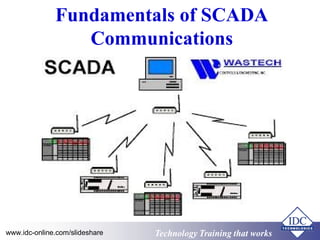
Fundamentals of SCADA
Communications
Technology Training that WorksTechnology Training that Workswww.idc-online.com/slideshare
Topics
• SCADA Systems
• Remote Terminal Units
• Communication Architectures
• Communication Philosophies
• RS-232 and RS 485
• MODBUS Protocol
Technology Training that WorksTechnology Training that Workswww.idc-online.com/slideshare
SCADA System
• Supervisory Control and Data Acquisition System
• Comprises a number of Remote Terminal Units
(RTU’s) collecting field data connected back to a
master station via a communications system
Technology Training that WorksTechnology Training that Workswww.idc-online.com/slideshare
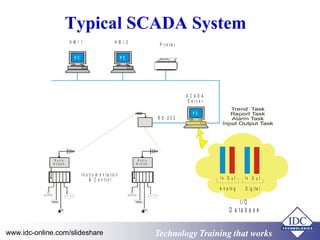
Typical SCADA System
S C A D A
S e r v e r
R S - 2 3 2
I n I nO u t
A n a lo g D ig ita l
O u t
I n s t r u m e n t a t io n
& C o n t r o l
H M I 1 H M I 2 P r in t e r
R a d i o
M o d e m
R a d io
M o d e m
P C P C
P C
I / O
D a t a b a s e
Technology Training that WorksTechnology Training that Workswww.idc-online.com/slideshare
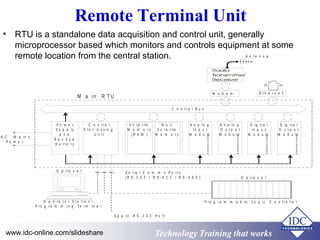
Remote Terminal Unit
• RTU is a standalone data acquisition and control unit, generally
microprocessor based which monitors and controls equipment at some
remote location from the central station.
O p t io n a l
S p a r e R S - 2 3 2 P o r t
O p e r a t o r S t a t io n /
P r o g r a m m in g Te r m in a l
O p t io n a l
N o n
V o la t ile
M e m o r y
P o w e r
S u p p ly
a n d
B a c k u p
B a t t e r y
M o d e m
A n t e n n a
A n a lo g
In p u t
M o d u le
A n a lo g
O u t p u t
M o d u le
D ig it a l
In p u t
M o d u le
A C M a in s
P o w e r
V o la t ile
M e m o r y
( R A M )
C e n t r a l
P r o c e s s in g
U n it
D ig it a l
O u t p u t
M o d u le
C e n t r a l B u s
M a in R TU
S e r ia l C o m m s P o r t s
( R S - 2 3 2 / R S - 4 2 2 / R S - 4 8 5 )
P r o g r a m m a b le L o g ic C o n t r o lle r
E t h e r n e t
Technology Training that WorksTechnology Training that Workswww.idc-online.com/slideshare
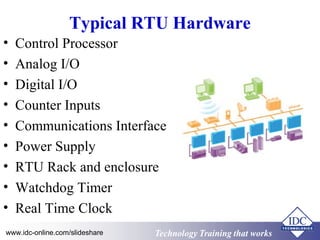
Typical RTU Hardware
• Control Processor
• Analog I/O
• Digital I/O
• Counter Inputs
• Communications Interface
• Power Supply
• RTU Rack and enclosure
• Watchdog Timer
• Real Time Clock
Technology Training that WorksTechnology Training that Workswww.idc-online.com/slideshare
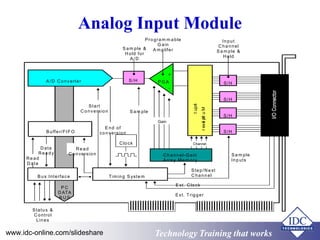
Analog Input Module
Gain
A/D Co nverter
B uffer/FIFO
S/H
Clock
S/H
S/H
S/H
S/H
B us Interface Tim in g S yste m
Ch annel-G ain
Arra y Me m ory
Pro gra m m a ble
G ain
A m pliferS a m ple &
H old for
A/ D
S a m ple
E nd of
co nversion
Start
Co nversion
Step/N ext
C hann el
E xt. Clock
Ext. Trigger
Sa m ple
Inp uts
Re ad
C onversion
P C
D ATA
B U S
D ata
Rea dy
Re ad
D ata
P G A
+
-
Input
C ha nnel
S a m ple &
Hold
Status &
Control
Lin es
Channel
Input
Multiplexer
Technology Training that WorksTechnology Training that Workswww.idc-online.com/slideshare
A/D Converters
• Integrating A/D
– low sample rate
– high accuracy
• Successive Approximation A/D
– high sample rate
– lower accuracy
Technology Training that WorksTechnology Training that Workswww.idc-online.com/slideshare
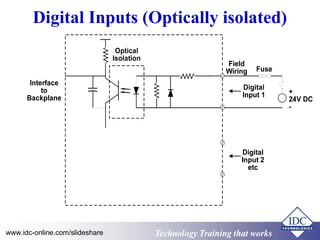
Digital Inputs (Optically isolated)
Technology Training that WorksTechnology Training that Workswww.idc-online.com/slideshare
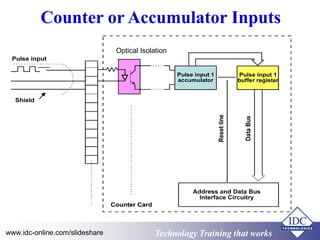
Counter or Accumulator Inputs
Optical Isolation
Technology Training that WorksTechnology Training that Workswww.idc-online.com/slideshare
Polled (or Master-Slave)
• Advantages:
– simple, predictable, no collisions
– quickly detect link failure
• Disadvantages:
– performance
– all slaves must be polled (cannot spontaneously
report alarms)
Technology Training that WorksTechnology Training that Workswww.idc-online.com/slideshare
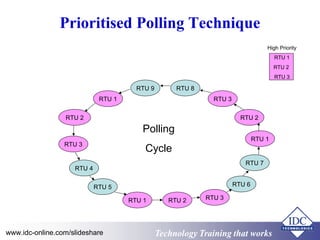
Prioritised Polling Technique
RTU 9
RTU 1
RTU 2
RTU 3
RTU 4
RTU 8
RTU 3
RTU 2
RTU 1
RTU 1
RTU 5
RTU 7
RTU 6
RTU 2
High Priority
RTU 1
RTU 2
RTU 3
Polling
Cycle
RTU 3
Technology Training that WorksTechnology Training that Workswww.idc-online.com/slideshare
Peer to Peer (CSMA/CD)
• Advantages:
– Slaves can report alarms spontaneously
– Can have many stations
• Disadvantages:
– Need to control collisions (priorities)
– Can lead to network collapse
– Link failure detection slower
• Use Exception Reporting to cut down
unnecessary traffic
Technology Training that WorksTechnology Training that Workswww.idc-online.com/slideshare
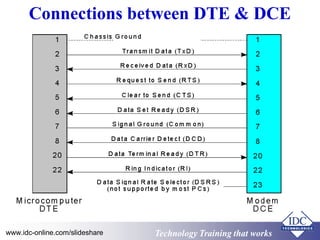
Connections between DTE & DCE
Technology Training that WorksTechnology Training that Workswww.idc-online.com/slideshare
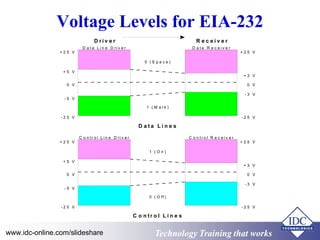
Voltage Levels for EIA-232
D a t a L i n e D r i v e r
C o n t r o l L i n e D ri v e r
0 ( S p a c e )
1 ( O n )
1 ( M a r k )
0 ( O ff )
D a t a L i n e s
D r i v e r R e c e i v e r
C o n t r o l L i n e s
D a t a R e c e i v e r
C o n t r o l R e c e i v e r
+ 2 5 V
+ 2 5 V
+ 2 5 V
+ 2 5 V
- 2 5 V
- 2 5 V
- 2 5 V
- 2 5 V
+ 5 V
+ 5 V
+ 3 V
+ 3 V
- 5 V
- 5 V
- 3 V
- 3 V
0 V
0 V
0 V
0 V
Technology Training that WorksTechnology Training that Workswww.idc-online.com/slideshare
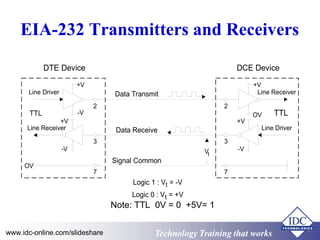
EIA-232 Transmitters and Receivers
DCE DeviceDTE Device
TTL TTL
Data Transmit
Data Receive
Signal Common
Logic 1 : V = -V
Logic 0 : V = +V
t
t
Line DriverLine Receiver
+V+V
+V+V
22
33
77
OV
OV
-V-V
-V
Line ReceiverLine Driver
Vt
Note: TTL 0V = 0 +5V= 1
Technology Training that WorksTechnology Training that Workswww.idc-online.com/slideshare
RS 485
• RS-485 is the most common voltage standard in
use today for multi-drop communication systems.
• Because:
• It is very resistant to noise
• It can send data at high speeds
• And can go long distances
Technology Training that WorksTechnology Training that Workswww.idc-online.com/slideshare
EIA-485 Interface Standard
• Distance: up to 1200m (4000 ft)
• Speed: up to 10 Mbps
• Up to 32 line drivers - balanced, tri-state
• Up to 32 balanced receivers
NOTE can only address 32 devices
Technology Training that WorksTechnology Training that Workswww.idc-online.com/slideshare
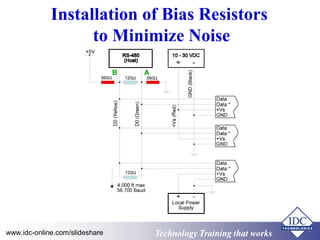
Installation of Bias Resistors
to Minimize Noise
B A
560Ω 560Ω120Ω
120Ω
Technology Training that WorksTechnology Training that Workswww.idc-online.com/slideshare
Modbus Protocol
• Developed by Modicon for use with Process
Control Systems.
• Estimated by Control Engineering Magazine
that over 40 % of industrial interfacing was
done using this Protocol.
• Even the new Fieldbus state of the art
standards appearing today have a Modbus
Gateway.
Technology Training that WorksTechnology Training that Workswww.idc-online.com/slideshare
Open Protocol
• While Modbus is not an actual system it is a
protocol used on many industrial systems
• Although it is an old standard (written in Fortran in
the 1970s) it has become a highly successful Open
protocol (defacto standard)
Technology Training that WorksTechnology Training that Workswww.idc-online.com/slideshare
MODBUS Protocol
• Originally intended to link Modicon PLC’s with
intelligent terminals
• Half-duplex, Master/slave operation
• Connects 1 Master with up to 247 slaves
• Typically used with a multidrop bus
Technology Training that WorksTechnology Training that Workswww.idc-online.com/slideshare
A De-facto Standard
• Relatively Slow compared to other buses.
• Widespread acceptance.
• PLC jargon used in describing the standard....but
used in instruments/gas chromatographs....etc
• Two versions:
– Modbus RTU (Modbus-B sometimes)
– Modbus ASCII
– Very similar structure
Technology Training that WorksTechnology Training that Workswww.idc-online.com/slideshare
Physical Layer
• No physical layer specified so Modbus can be used
with a variety of interface standards:
– RS-232/RS-422 (point-to-point)
– RS-485 (multidrop bus)
– Bell 202 modem (switched and leased lines)
– “Modbus modem” (baseband line driver on twisted pair
up to 5000m)
– Asynchronous, byte-oriented frames
Technology Training that WorksTechnology Training that Workswww.idc-online.com/slideshare
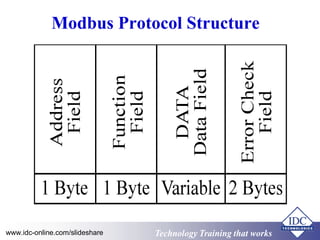
Modbus Protocol Structure
Technology Training that WorksTechnology Training that Workswww.idc-online.com/slideshare
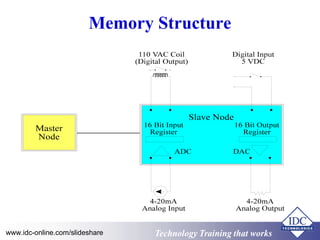
Memory Structure
Technology Training that WorksTechnology Training that Workswww.idc-online.com/slideshare
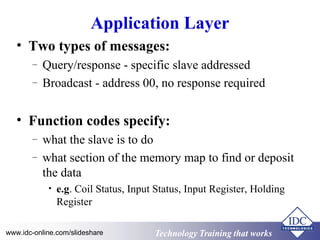
Application Layer
• Two types of messages:
– Query/response - specific slave addressed
– Broadcast - address 00, no response required
• Function codes specify:
– what the slave is to do
– what section of the memory map to find or deposit
the data
• e.g. Coil Status, Input Status, Input Register, Holding
Register
Technology Training that WorksTechnology Training that Workswww.idc-online.com/slideshare
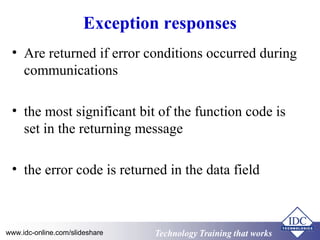
Exception responses
• Are returned if error conditions occurred during
communications
• the most significant bit of the function code is
set in the returning message
• the error code is returned in the data field
Technology Training that WorksTechnology Training that Workswww.idc-online.com/slideshare
Validating Changes
• Can you trust the response that comes back
when you are changing a critical parameter on
the device?
• Methods to check:
– Do a subsequent read request of that parameter.
– Check some other associated parameter..e.g. start a
pump, check flow rate...
Technology Training that WorksTechnology Training that Workswww.idc-online.com/slideshare
DO YOU WANT TO KNOW MORE?
If you are interested in further training or information,
please visit:
http://idc-online.com/slideshare

Practical DNP3, 60870.5 & Modern SCADA Communication System

  • 1.
    Technology Training thatWorksTechnology Training that Workswww.idc-online.com/slideshare Fundamentals of SCADA Communications
  • 2.
    Technology Training thatWorksTechnology Training that Workswww.idc-online.com/slideshare Topics • SCADA Systems • Remote Terminal Units • Communication Architectures • Communication Philosophies • RS-232 and RS 485 • MODBUS Protocol
  • 3.
    Technology Training thatWorksTechnology Training that Workswww.idc-online.com/slideshare SCADA System • Supervisory Control and Data Acquisition System • Comprises a number of Remote Terminal Units (RTU’s) collecting field data connected back to a master station via a communications system
  • 4.
    Technology Training thatWorksTechnology Training that Workswww.idc-online.com/slideshare Typical SCADA System S C A D A S e r v e r R S - 2 3 2 I n I nO u t A n a lo g D ig ita l O u t I n s t r u m e n t a t io n & C o n t r o l H M I 1 H M I 2 P r in t e r R a d i o M o d e m R a d io M o d e m P C P C P C I / O D a t a b a s e
  • 5.
    Technology Training thatWorksTechnology Training that Workswww.idc-online.com/slideshare Remote Terminal Unit • RTU is a standalone data acquisition and control unit, generally microprocessor based which monitors and controls equipment at some remote location from the central station. O p t io n a l S p a r e R S - 2 3 2 P o r t O p e r a t o r S t a t io n / P r o g r a m m in g Te r m in a l O p t io n a l N o n V o la t ile M e m o r y P o w e r S u p p ly a n d B a c k u p B a t t e r y M o d e m A n t e n n a A n a lo g In p u t M o d u le A n a lo g O u t p u t M o d u le D ig it a l In p u t M o d u le A C M a in s P o w e r V o la t ile M e m o r y ( R A M ) C e n t r a l P r o c e s s in g U n it D ig it a l O u t p u t M o d u le C e n t r a l B u s M a in R TU S e r ia l C o m m s P o r t s ( R S - 2 3 2 / R S - 4 2 2 / R S - 4 8 5 ) P r o g r a m m a b le L o g ic C o n t r o lle r E t h e r n e t
  • 6.
    Technology Training thatWorksTechnology Training that Workswww.idc-online.com/slideshare Typical RTU Hardware • Control Processor • Analog I/O • Digital I/O • Counter Inputs • Communications Interface • Power Supply • RTU Rack and enclosure • Watchdog Timer • Real Time Clock
  • 7.
    Technology Training thatWorksTechnology Training that Workswww.idc-online.com/slideshare Analog Input Module Gain A/D Co nverter B uffer/FIFO S/H Clock S/H S/H S/H S/H B us Interface Tim in g S yste m Ch annel-G ain Arra y Me m ory Pro gra m m a ble G ain A m pliferS a m ple & H old for A/ D S a m ple E nd of co nversion Start Co nversion Step/N ext C hann el E xt. Clock Ext. Trigger Sa m ple Inp uts Re ad C onversion P C D ATA B U S D ata Rea dy Re ad D ata P G A + - Input C ha nnel S a m ple & Hold Status & Control Lin es Channel Input Multiplexer
  • 8.
    Technology Training thatWorksTechnology Training that Workswww.idc-online.com/slideshare A/D Converters • Integrating A/D – low sample rate – high accuracy • Successive Approximation A/D – high sample rate – lower accuracy
  • 9.
    Technology Training thatWorksTechnology Training that Workswww.idc-online.com/slideshare Digital Inputs (Optically isolated)
  • 10.
    Technology Training thatWorksTechnology Training that Workswww.idc-online.com/slideshare Counter or Accumulator Inputs Optical Isolation
  • 11.
    Technology Training thatWorksTechnology Training that Workswww.idc-online.com/slideshare Polled (or Master-Slave) • Advantages: – simple, predictable, no collisions – quickly detect link failure • Disadvantages: – performance – all slaves must be polled (cannot spontaneously report alarms)
  • 12.
    Technology Training thatWorksTechnology Training that Workswww.idc-online.com/slideshare Prioritised Polling Technique RTU 9 RTU 1 RTU 2 RTU 3 RTU 4 RTU 8 RTU 3 RTU 2 RTU 1 RTU 1 RTU 5 RTU 7 RTU 6 RTU 2 High Priority RTU 1 RTU 2 RTU 3 Polling Cycle RTU 3
  • 13.
    Technology Training thatWorksTechnology Training that Workswww.idc-online.com/slideshare Peer to Peer (CSMA/CD) • Advantages: – Slaves can report alarms spontaneously – Can have many stations • Disadvantages: – Need to control collisions (priorities) – Can lead to network collapse – Link failure detection slower • Use Exception Reporting to cut down unnecessary traffic
  • 14.
    Technology Training thatWorksTechnology Training that Workswww.idc-online.com/slideshare Connections between DTE & DCE
  • 15.
    Technology Training thatWorksTechnology Training that Workswww.idc-online.com/slideshare Voltage Levels for EIA-232 D a t a L i n e D r i v e r C o n t r o l L i n e D ri v e r 0 ( S p a c e ) 1 ( O n ) 1 ( M a r k ) 0 ( O ff ) D a t a L i n e s D r i v e r R e c e i v e r C o n t r o l L i n e s D a t a R e c e i v e r C o n t r o l R e c e i v e r + 2 5 V + 2 5 V + 2 5 V + 2 5 V - 2 5 V - 2 5 V - 2 5 V - 2 5 V + 5 V + 5 V + 3 V + 3 V - 5 V - 5 V - 3 V - 3 V 0 V 0 V 0 V 0 V
  • 16.
    Technology Training thatWorksTechnology Training that Workswww.idc-online.com/slideshare EIA-232 Transmitters and Receivers DCE DeviceDTE Device TTL TTL Data Transmit Data Receive Signal Common Logic 1 : V = -V Logic 0 : V = +V t t Line DriverLine Receiver +V+V +V+V 22 33 77 OV OV -V-V -V Line ReceiverLine Driver Vt Note: TTL 0V = 0 +5V= 1
  • 17.
    Technology Training thatWorksTechnology Training that Workswww.idc-online.com/slideshare RS 485 • RS-485 is the most common voltage standard in use today for multi-drop communication systems. • Because: • It is very resistant to noise • It can send data at high speeds • And can go long distances
  • 18.
    Technology Training thatWorksTechnology Training that Workswww.idc-online.com/slideshare EIA-485 Interface Standard • Distance: up to 1200m (4000 ft) • Speed: up to 10 Mbps • Up to 32 line drivers - balanced, tri-state • Up to 32 balanced receivers NOTE can only address 32 devices
  • 19.
    Technology Training thatWorksTechnology Training that Workswww.idc-online.com/slideshare Installation of Bias Resistors to Minimize Noise B A 560Ω 560Ω120Ω 120Ω
  • 20.
    Technology Training thatWorksTechnology Training that Workswww.idc-online.com/slideshare Modbus Protocol • Developed by Modicon for use with Process Control Systems. • Estimated by Control Engineering Magazine that over 40 % of industrial interfacing was done using this Protocol. • Even the new Fieldbus state of the art standards appearing today have a Modbus Gateway.
  • 21.
    Technology Training thatWorksTechnology Training that Workswww.idc-online.com/slideshare Open Protocol • While Modbus is not an actual system it is a protocol used on many industrial systems • Although it is an old standard (written in Fortran in the 1970s) it has become a highly successful Open protocol (defacto standard)
  • 22.
    Technology Training thatWorksTechnology Training that Workswww.idc-online.com/slideshare MODBUS Protocol • Originally intended to link Modicon PLC’s with intelligent terminals • Half-duplex, Master/slave operation • Connects 1 Master with up to 247 slaves • Typically used with a multidrop bus
  • 23.
    Technology Training thatWorksTechnology Training that Workswww.idc-online.com/slideshare A De-facto Standard • Relatively Slow compared to other buses. • Widespread acceptance. • PLC jargon used in describing the standard....but used in instruments/gas chromatographs....etc • Two versions: – Modbus RTU (Modbus-B sometimes) – Modbus ASCII – Very similar structure
  • 24.
    Technology Training thatWorksTechnology Training that Workswww.idc-online.com/slideshare Physical Layer • No physical layer specified so Modbus can be used with a variety of interface standards: – RS-232/RS-422 (point-to-point) – RS-485 (multidrop bus) – Bell 202 modem (switched and leased lines) – “Modbus modem” (baseband line driver on twisted pair up to 5000m) – Asynchronous, byte-oriented frames
  • 25.
    Technology Training thatWorksTechnology Training that Workswww.idc-online.com/slideshare Modbus Protocol Structure
  • 26.
    Technology Training thatWorksTechnology Training that Workswww.idc-online.com/slideshare Memory Structure
  • 27.
    Technology Training thatWorksTechnology Training that Workswww.idc-online.com/slideshare Application Layer • Two types of messages: – Query/response - specific slave addressed – Broadcast - address 00, no response required • Function codes specify: – what the slave is to do – what section of the memory map to find or deposit the data • e.g. Coil Status, Input Status, Input Register, Holding Register
  • 28.
    Technology Training thatWorksTechnology Training that Workswww.idc-online.com/slideshare Exception responses • Are returned if error conditions occurred during communications • the most significant bit of the function code is set in the returning message • the error code is returned in the data field
  • 29.
    Technology Training thatWorksTechnology Training that Workswww.idc-online.com/slideshare Validating Changes • Can you trust the response that comes back when you are changing a critical parameter on the device? • Methods to check: – Do a subsequent read request of that parameter. – Check some other associated parameter..e.g. start a pump, check flow rate...
  • 30.
    Technology Training thatWorksTechnology Training that Workswww.idc-online.com/slideshare DO YOU WANT TO KNOW MORE? If you are interested in further training or information, please visit: http://idc-online.com/slideshare