PR for Startups!

Guidelines, ideas, and case studies.

Alok Rodinhood Kejriwal – Sept 12
Introduction
• These are my personal views and ideas.
• I am a digital, startup entrepreneur who has
  been involved with several companies since
  the past 12 years.
• To find my PR score, google “Alok Kejriwal”
• This PPT is intended to help fresh startup
  entrepreneurs understand and succeed in the
  confusing world of PR.
Sections in this PPT
1.   Offline PR
2.   Online PR
3.   Social PR
4.   Event related PR
1. Offline PR
Why does Offline PR matter?
1. There is a market of decision makers (CEOs of
   Companies, Heads of Departments, Senior Govt.
   Officials, etc) who only read print.
2. The online websites of large publications have
   large audiences and once you are written up in
   print, you automatically get featured online too.
3. Think of it as ‘proof of concept’ test. The day
   you can make it in the Fortune or Time or The
   Economist, you have done something
   worthwhile.
Tips for Offline PR
1. Don’t hire a PR firm immediately. Hire them 2
   years later.
2. Start by learning the basics yourself.
3. Read all the papers and magazines that you
   would like to be covered in
4. READ the way people are quoted in your
   industry – what do they say, how do they
   contribute to stories, what do they stand for?
5. Pretend that you were approached for the same
   story – what really would you say?? What would
   be YOUR quote?
Indulge in Interviews!
• The one reward that Offline PR offers is the
  excitement of a ‘real interview’.
• After 10 years of active PR, I have realized that
  a real interview with an experienced journalist
  helps in massive introspection and a release of
  bottled energy! It’s an amazing catharsis!
  (Case study at the end of ppt)
• Interviews also allow you to share your
  ‘personal’ side – something that readers vibe
  with instantly.
Contact Journalists directly- it’s easy!
Communicate with Journalists.
Don’t SPAM them!
1. Journalists get thousands of mails, press releases,
   phone calls and e-mails all day long.
2. Write to them with your idea and concept and keep
   it short, sweet and interesting.
3. DON’T spam them and bombard them with
   messages and reminders. They will detest you for it.
4. Become someone they get interesting ideas from
   regularly. They will contact you.
5. Journalists love their work. Once a friend, always a
   friend. They will stay in touch with you, even as
   they change jobs.
Hygiene
1. Invest in a nice professional portfolio. Please have
   photos that look better than the ones you shot
   when were hung over in the loo!
2. DON’T try and bribe or gift journalists. That SUCKS.
3. If you do get a mail or call, revert with lightning
   speed. Journos love dependable people who
   respond in time.
4. Understand that journos follow ‘beats’ or themes –
   hence a tech journo will write about tech – not
   about gardening! Don’t send the wrong message to
   the wrong journalist.
2. Online PR
Why does Online PR matter?
1. Simple! It’s what appears when people search
   for you or your company on the web.
2. Most influencers, opinion makers and decision
   makers (with less grey hair) read stuff online.
3. Online links from very popular sites massively
   help in SEO (google rankings) of your Company’s
   site/blog.
4. The online platform is interactive and allows you
   and the reader to have a conversation. That’s a
   BIG DEAL.
Tips for Online PR
1. MOST definitely DO IT YOURSELF.
2. Identify friends (positive people and sites),
   neutrals and the negatives (people and sites
   who only try and deride). Avoid the negatives.
3. Directly become friends with the editor (owners)
   of the smaller sites, and begin communicating
   with relevant journos of the bigger sites.
4. BE HONEST in whatever you write and retort.
   Online PR is about honesty and saying what you
   mean. Yeah, things get ‘checked out’ very
   quickly online!
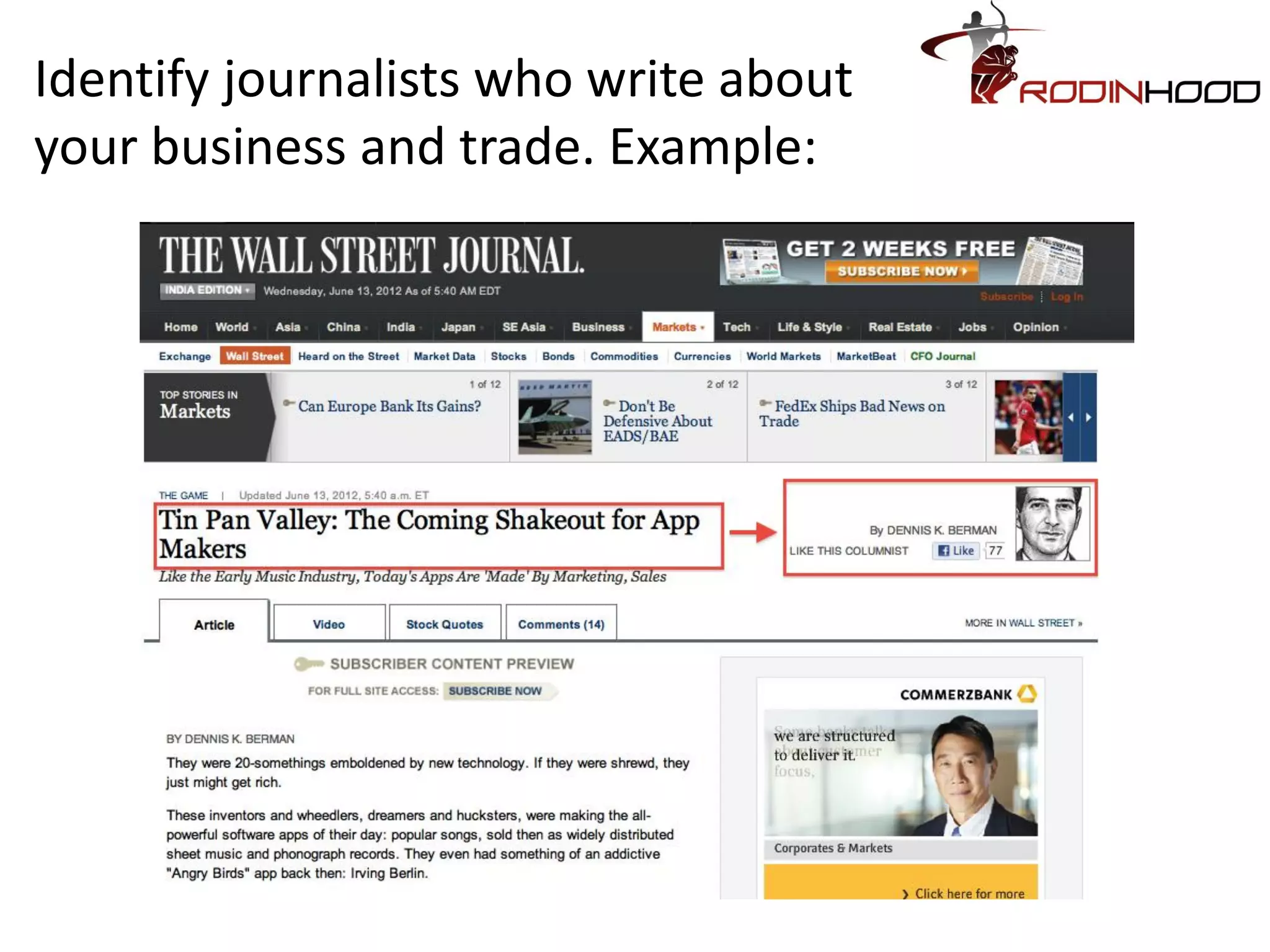
Identify journalists who write about
your business and trade. Example:
Interact with the journalist directly!
3. Social PR
Why does Social PR matter?
1. For startups, the line between the business and the
   founder/s are blurred. Sometimes it’s the same.
2. Individually, you can easily ‘connect’ with people.
3. As a business, few will ‘like’ your startup’s facebook
   page, but they will become friends with you on FB.
4. Being socially active allows you to ask for help,
   market your business, hire great talent and just get
   noticed!
5. Having your own friends and ‘social circle’ allows
   you to counter opinions and views that others may
   throw at you.
Tips for Social PR
1. Get AS MANY friends as you can on facebook,
   twitter, linkedin, google+ and other social networks.
2. Own a blog. Write as often as you can (see example)
3. Post something interesting (NOT marketing crap) on
   your networks. It should be stuff that make your
   friends laugh, cry, intrigued, educated – but never
   BORING (“why am I great” stuff).
4. Actively comment on large websites that matter –
   you will get noticed.
5. Play cool, defensive or aggressive roles as your
   personality allows. Decide on your approach and
   stick to it!
Do’s and Don’ts
1. DON’T create random facebook groups. They
   are obnoxious.
2. DON’T invite people to ‘like’ your facebook
   page. They don’t care.
3. Share what you know and share NAKEDLY.
   Don’t hold back.
4. Be very open to criticism and negative
   feedback. If you are aggressive socially, then
   be willing to face venomous online wrath!
Case study:
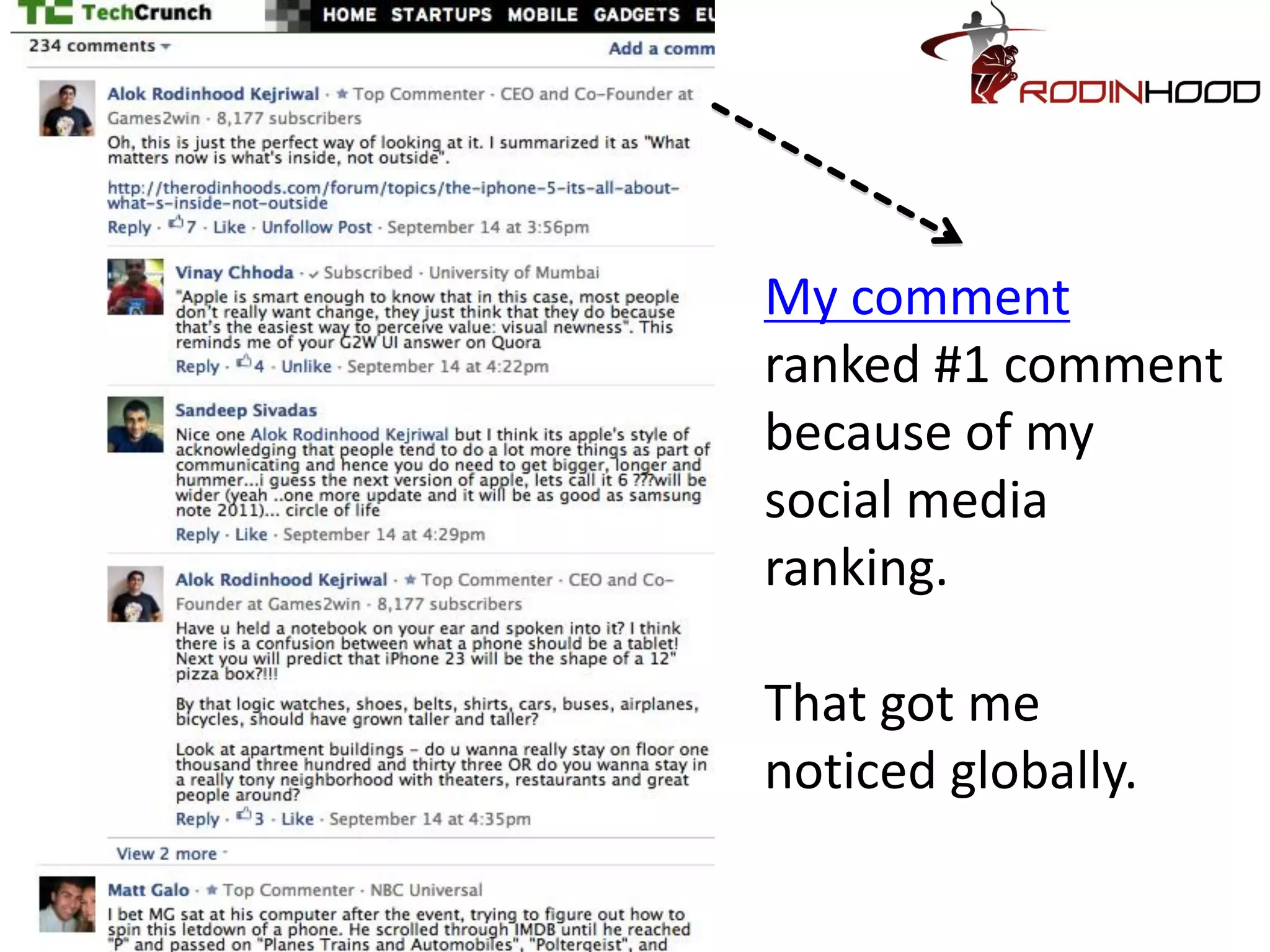
A recent article on Techcrunch on
the iPhone 5 launch attracted 234 comments
My comment ranked #1
comment on that day
because of my social
media strength (= nos of
likes & follow-on
comments)

That got me noticed
globally.
Case study:
A recent question on Quora was
mildly critical of games2win – the business I manage
I replied to the post as objectively as
I could and won supporters and
suggestions for improving my business
4. Events as PR
Why do PR Events matter?
1. You meet people! That’s the most important
   reason why events matter.
2. People notice you and what you stand for.
3. Television reaches the maximum number of
   people possible (not necessarily the right target
   group); if nothing else, your stuck up aunt in a
   small town will notice you on TV and call you!
4. Events (panels, key notes) project you and your
   business as market leaders and opinion creators.
Tips for Events
1. Find out who is presenting with you at the
   event. You should at least be amidst peers, if not
   leaders.
2. Seize any sensible opportunity you get. Once
   you get on the TV circuit with channels, they will
   keep calling you back.
3. Even if you are just attending an event, sit in the
   last row. When the Q&A starts, grab the mike
   and ask a clever question AFTER announcing
   your name + your Company’s name. You will get
   noticed and remembered.
Do’s and Don’ts
1. Make snappy, short bullet-like statements. No one
   likes to listen to sermons.
2. Kick up a fight! Panel disagreements are well
   received and wake up the audience.
3. Say something outrageous (I called “Kolaveri Di” a
   ‘one trick monkey’). You will be remembered!
4. Network before and after the event like mad.
   Collect all the cards you can.
5. Eat lunch with the audience. Mingle. Get feedback
   on what they thought about your speech.
Sign of success
• On TV, I believe that the greatest sign of
  success is if one of your panel members (or
  the anchor) begins to repeatedly mention
  your name!
• Television is all about being in the spotlight. If
  you crack a joke, make people laugh or make
  an impactful point, the camera will follow you.
Some final points
1. The best advice I got was from Gita Piramal
   who told me, “Alok, first do something
   remarkable. Then the media will run after
   you.”
2. Amitabh Saxena of Actimedia told me, “Alok,
   on TV people remember how you looked. In
   print they remember what you said.”
3. PR takes 10 years to yield results. Yes TEN
   years. If you don’t have that stamina, don’t
   run the PR marathon.
Some more final points
4. NEVER LIE to the media. It will kill you.
5. Be the single spokesperson. You can share PR
   responsibility with someone later after your firm
   grows. If you have more than one person speaking
   (INITIALLY), the message gets confused.
6. REHEARSE if you are not used to public speaking.
   For TV appearances, actually do a mock TV
   interview in the office and observe how you look
   and the expressions you make on camera. (For a
   ‘Shakers and Movers’ episode in 2001, my mock
   shoot revealed that I was gulping too much!)
Some final, final points
7. Contribute sound bites, quotes, views and
   anything that the media asks you for. DON’T
   RATION time for PR. The more you give, the
   more you will get.
8. Be honest and genuine with journalists. If you
   don’t want to say something, DON’T SAY IT –
   never say “It’s off the record” (it never is).
9. Contribute as a columnist, as a blogger, as a
   writer to media. There won’t always be stories
   to be quoted in – so INVENT the stories!
Most importantly
• Have FUN when you are indulging in PR!
• Please sport a sense of humor. Do not go on
  camera or for an interview just around the
  time you realize you have lost your iPhone.
• Don’t ARGUE with people for the sake of it.
• Don’t stall a discussion. Let people have their
  say and make way for more discussion.
• THANK ALL the people who gave you a PR
  moment after release.
References & Homework
Homework:

An interview in CNBC – Can you figure the mistake I am making?
  (appears early on)

References:

The Techcrunch article (of slide 20)

The Quora article (of slide 22)

An interview in ‘Entrepreneur’ magazine that was cathartic for
  me and is one my best interviews to date.
I hope this was helpful!
Connect with me & give me feedback!

                       e-mail - alok@rodinhood.com

                       Facebook -
                       facebook.com/rodinhood

                       Twitter - @rodinhood

                       My social network for anyone
                       enterprising!
                       therodinhoods.com

                       Blogs and articles written by me

                       Presentations –
                       http:slideshare.net/rodinhood

PR for Startups! A reference guide

  • 1.
    PR for Startups! Guidelines,ideas, and case studies. Alok Rodinhood Kejriwal – Sept 12
  • 2.
    Introduction • These aremy personal views and ideas. • I am a digital, startup entrepreneur who has been involved with several companies since the past 12 years. • To find my PR score, google “Alok Kejriwal” • This PPT is intended to help fresh startup entrepreneurs understand and succeed in the confusing world of PR.
  • 3.
    Sections in thisPPT 1. Offline PR 2. Online PR 3. Social PR 4. Event related PR
  • 4.
  • 5.
    Why does OfflinePR matter? 1. There is a market of decision makers (CEOs of Companies, Heads of Departments, Senior Govt. Officials, etc) who only read print. 2. The online websites of large publications have large audiences and once you are written up in print, you automatically get featured online too. 3. Think of it as ‘proof of concept’ test. The day you can make it in the Fortune or Time or The Economist, you have done something worthwhile.
  • 6.
    Tips for OfflinePR 1. Don’t hire a PR firm immediately. Hire them 2 years later. 2. Start by learning the basics yourself. 3. Read all the papers and magazines that you would like to be covered in 4. READ the way people are quoted in your industry – what do they say, how do they contribute to stories, what do they stand for? 5. Pretend that you were approached for the same story – what really would you say?? What would be YOUR quote?
  • 7.
    Indulge in Interviews! •The one reward that Offline PR offers is the excitement of a ‘real interview’. • After 10 years of active PR, I have realized that a real interview with an experienced journalist helps in massive introspection and a release of bottled energy! It’s an amazing catharsis! (Case study at the end of ppt) • Interviews also allow you to share your ‘personal’ side – something that readers vibe with instantly.
  • 8.
  • 9.
    Communicate with Journalists. Don’tSPAM them! 1. Journalists get thousands of mails, press releases, phone calls and e-mails all day long. 2. Write to them with your idea and concept and keep it short, sweet and interesting. 3. DON’T spam them and bombard them with messages and reminders. They will detest you for it. 4. Become someone they get interesting ideas from regularly. They will contact you. 5. Journalists love their work. Once a friend, always a friend. They will stay in touch with you, even as they change jobs.
  • 10.
    Hygiene 1. Invest ina nice professional portfolio. Please have photos that look better than the ones you shot when were hung over in the loo! 2. DON’T try and bribe or gift journalists. That SUCKS. 3. If you do get a mail or call, revert with lightning speed. Journos love dependable people who respond in time. 4. Understand that journos follow ‘beats’ or themes – hence a tech journo will write about tech – not about gardening! Don’t send the wrong message to the wrong journalist.
  • 11.
  • 12.
    Why does OnlinePR matter? 1. Simple! It’s what appears when people search for you or your company on the web. 2. Most influencers, opinion makers and decision makers (with less grey hair) read stuff online. 3. Online links from very popular sites massively help in SEO (google rankings) of your Company’s site/blog. 4. The online platform is interactive and allows you and the reader to have a conversation. That’s a BIG DEAL.
  • 13.
    Tips for OnlinePR 1. MOST definitely DO IT YOURSELF. 2. Identify friends (positive people and sites), neutrals and the negatives (people and sites who only try and deride). Avoid the negatives. 3. Directly become friends with the editor (owners) of the smaller sites, and begin communicating with relevant journos of the bigger sites. 4. BE HONEST in whatever you write and retort. Online PR is about honesty and saying what you mean. Yeah, things get ‘checked out’ very quickly online!
  • 14.
    Identify journalists whowrite about your business and trade. Example:
  • 15.
    Interact with thejournalist directly!
  • 16.
  • 17.
    Why does SocialPR matter? 1. For startups, the line between the business and the founder/s are blurred. Sometimes it’s the same. 2. Individually, you can easily ‘connect’ with people. 3. As a business, few will ‘like’ your startup’s facebook page, but they will become friends with you on FB. 4. Being socially active allows you to ask for help, market your business, hire great talent and just get noticed! 5. Having your own friends and ‘social circle’ allows you to counter opinions and views that others may throw at you.
  • 18.
    Tips for SocialPR 1. Get AS MANY friends as you can on facebook, twitter, linkedin, google+ and other social networks. 2. Own a blog. Write as often as you can (see example) 3. Post something interesting (NOT marketing crap) on your networks. It should be stuff that make your friends laugh, cry, intrigued, educated – but never BORING (“why am I great” stuff). 4. Actively comment on large websites that matter – you will get noticed. 5. Play cool, defensive or aggressive roles as your personality allows. Decide on your approach and stick to it!
  • 19.
    Do’s and Don’ts 1.DON’T create random facebook groups. They are obnoxious. 2. DON’T invite people to ‘like’ your facebook page. They don’t care. 3. Share what you know and share NAKEDLY. Don’t hold back. 4. Be very open to criticism and negative feedback. If you are aggressive socially, then be willing to face venomous online wrath!
  • 20.
    Case study: A recentarticle on Techcrunch on the iPhone 5 launch attracted 234 comments
  • 21.
    My comment ranked#1 comment on that day because of my social media strength (= nos of likes & follow-on comments) That got me noticed globally.
  • 22.
    Case study: A recentquestion on Quora was mildly critical of games2win – the business I manage
  • 23.
    I replied tothe post as objectively as I could and won supporters and suggestions for improving my business
  • 24.
  • 25.
    Why do PREvents matter? 1. You meet people! That’s the most important reason why events matter. 2. People notice you and what you stand for. 3. Television reaches the maximum number of people possible (not necessarily the right target group); if nothing else, your stuck up aunt in a small town will notice you on TV and call you! 4. Events (panels, key notes) project you and your business as market leaders and opinion creators.
  • 26.
    Tips for Events 1.Find out who is presenting with you at the event. You should at least be amidst peers, if not leaders. 2. Seize any sensible opportunity you get. Once you get on the TV circuit with channels, they will keep calling you back. 3. Even if you are just attending an event, sit in the last row. When the Q&A starts, grab the mike and ask a clever question AFTER announcing your name + your Company’s name. You will get noticed and remembered.
  • 27.
    Do’s and Don’ts 1.Make snappy, short bullet-like statements. No one likes to listen to sermons. 2. Kick up a fight! Panel disagreements are well received and wake up the audience. 3. Say something outrageous (I called “Kolaveri Di” a ‘one trick monkey’). You will be remembered! 4. Network before and after the event like mad. Collect all the cards you can. 5. Eat lunch with the audience. Mingle. Get feedback on what they thought about your speech.
  • 28.
    Sign of success •On TV, I believe that the greatest sign of success is if one of your panel members (or the anchor) begins to repeatedly mention your name! • Television is all about being in the spotlight. If you crack a joke, make people laugh or make an impactful point, the camera will follow you.
  • 29.
    Some final points 1.The best advice I got was from Gita Piramal who told me, “Alok, first do something remarkable. Then the media will run after you.” 2. Amitabh Saxena of Actimedia told me, “Alok, on TV people remember how you looked. In print they remember what you said.” 3. PR takes 10 years to yield results. Yes TEN years. If you don’t have that stamina, don’t run the PR marathon.
  • 30.
    Some more finalpoints 4. NEVER LIE to the media. It will kill you. 5. Be the single spokesperson. You can share PR responsibility with someone later after your firm grows. If you have more than one person speaking (INITIALLY), the message gets confused. 6. REHEARSE if you are not used to public speaking. For TV appearances, actually do a mock TV interview in the office and observe how you look and the expressions you make on camera. (For a ‘Shakers and Movers’ episode in 2001, my mock shoot revealed that I was gulping too much!)
  • 31.
    Some final, finalpoints 7. Contribute sound bites, quotes, views and anything that the media asks you for. DON’T RATION time for PR. The more you give, the more you will get. 8. Be honest and genuine with journalists. If you don’t want to say something, DON’T SAY IT – never say “It’s off the record” (it never is). 9. Contribute as a columnist, as a blogger, as a writer to media. There won’t always be stories to be quoted in – so INVENT the stories!
  • 32.
    Most importantly • HaveFUN when you are indulging in PR! • Please sport a sense of humor. Do not go on camera or for an interview just around the time you realize you have lost your iPhone. • Don’t ARGUE with people for the sake of it. • Don’t stall a discussion. Let people have their say and make way for more discussion. • THANK ALL the people who gave you a PR moment after release.
  • 33.
    References & Homework Homework: Aninterview in CNBC – Can you figure the mistake I am making? (appears early on) References: The Techcrunch article (of slide 20) The Quora article (of slide 22) An interview in ‘Entrepreneur’ magazine that was cathartic for me and is one my best interviews to date.
  • 34.
    I hope thiswas helpful!
  • 35.
    Connect with me& give me feedback! e-mail - alok@rodinhood.com Facebook - facebook.com/rodinhood Twitter - @rodinhood My social network for anyone enterprising! therodinhoods.com Blogs and articles written by me Presentations – http:slideshare.net/rodinhood