
Marketing-in-a-Box
Public Relations for Startups
Contents
• PR – Definition & goals
• Messaging – what it is how to use it
• How to measure PR effectiveness
• PR by stages – when to use what and when
• Amplifying PR via social media
• Agencies, dealing with press and releases
• Appendix:
– PR agencies
– PR tools & sites
– The Art of Newjacking – getting free PR
What is PR?
“PR is the practice of managing the spread of
information between` an organization or person and
the public. PR can include a person or company
getting exposure to their target audience using
topics of public interest and news that do not
require direct payment.”
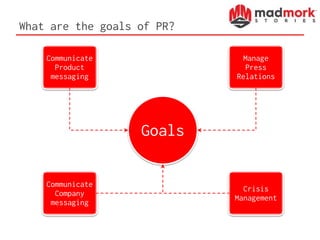
What are the goals of PR?
Goals
Communicate
Company
messaging
Communicate
Product
messaging
Crisis
Management
Manage
Press
Relations
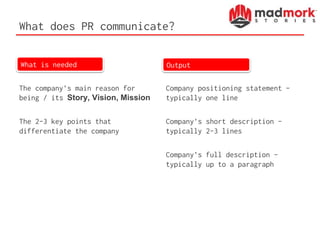
What does PR communicate?
The company’s main reason for
being / its Story, Vision, Mission
The 2-3 key points that
differentiate the company
Company positioning statement –
typically one line
Company’s short description –
typically 2-3 lines
Company’s full description –
typically up to a paragraph
What is needed Output
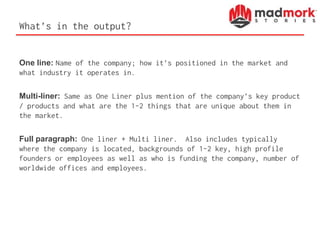
What’s in the output?
One line: Name of the company; how it’s positioned in the market and
what industry it operates in.
Multi-liner: Same as One Liner plus mention of the company’s key product
/ products and what are the 1-2 things that are unique about them in
the market.
Full paragraph: One liner + Multi liner. Also includes typically
where the company is located, backgrounds of 1-2 key, high profile
founders or employees as well as who is funding the company, number of
worldwide offices and employees.
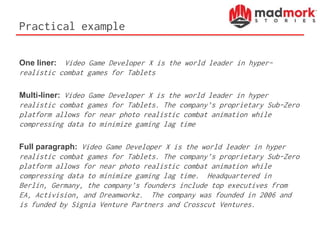
Practical example
One liner: Video Game Developer X is the world leader in hyper-
realistic combat games for Tablets
Multi-liner: Video Game Developer X is the world leader in hyper
realistic combat games for Tablets. The company’s proprietary Sub-Zero
platform allows for near photo realistic combat animation while
compressing data to minimize gaming lag time
Full paragraph: Video Game Developer X is the world leader in hyper
realistic combat games for Tablets. The company’s proprietary Sub-Zero
platform allows for near photo realistic combat animation while
compressing data to minimize gaming lag time. Headquartered in
Berlin, Germany, the company’s founders include top executives from
EA, Activision, and Dreamworkz. The company was founded in 2006 and
is funded by Signia Venture Partners and Crosscut Ventures.
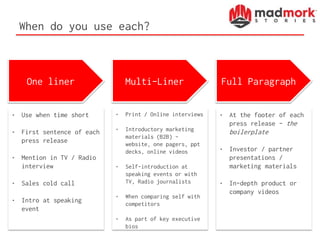
When do you use each?
One liner Multi-Liner Full Paragraph
• Use when time short
• First sentence of each
press release
• Mention in TV / Radio
interview
• Sales cold call
• Intro at speaking
event
• Print / Online interviews
• Introductory marketing
materials (B2B) –
website, one pagers, ppt
decks, online videos
• Self-introduction at
speaking events or with
TV, Radio journalists
• When comparing self with
competitors
• As part of key executive
bios
• At the footer of each
press release – the
boilerplate
• Investor / partner
presentations /
marketing materials
• In-depth product or
company videos
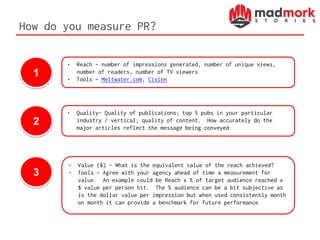
How do you measure PR?
1
2
3
• Reach – number of impressions generated, number of unique views,
number of readers, number of TV viewers
• Tools – Meltwater.com, Cision
• Quality– Quality of publications; top 5 pubs in your particular
industry / vertical; quality of content. How accurately do the
major articles reflect the message being conveyed
• Value ($) – What is the equivalent value of the reach achieved?
• Tools – Agree with your agency ahead of time a measurement for
value. An example could be Reach x % of target audience reached x
$ value per person hit. The % audience can be a bit subjective as
is the dollar value per impression but when used consistently month
on month it can provide a benchmark for future performance
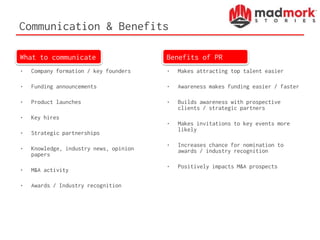
Communication & Benefits
• Company formation / key founders
• Funding announcements
• Product launches
• Key hires
• Strategic partnerships
• Knowledge, industry news, opinion
papers
• M&A activity
• Awards / Industry recognition
• Makes attracting top talent easier
• Awareness makes funding easier / faster
• Builds awareness with prospective
clients / strategic partners
• Makes invitations to key events more
likely
• Increases chance for nomination to
awards / industry recognition
• Positively impacts M&A prospects
What to communicate Benefits of PR
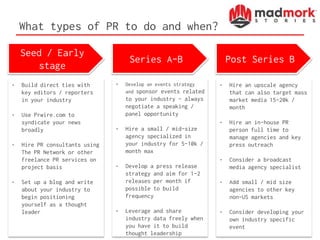
What types of PR to do and when?
Seed / Early
stage
Series A-B Post Series B
• Build direct ties with
key editors / reporters
in your industry
• Use Prwire.com to
syndicate your news
broadly
• Hire PR consultants using
The PR Network or other
freelance PR services on
project basis
• Set up a blog and write
about your industry to
begin positioning
yourself as a thought
leader
• Develop an events strategy
and sponsor events related
to your industry – always
negotiate a speaking /
panel opportunity
• Hire a small / mid-size
agency specialized in
your industry for 5-10k /
month max
• Develop a press release
strategy and aim for 1-2
releases per month if
possible to build
frequency
• Leverage and share
industry data freely when
you have it to build
thought leadership
• Hire an upscale agency
that can also target mass
market media 15-20k /
month
• Hire an in-house PR
person full time to
manage agencies and key
press outreach
• Consider a broadcast
media agency specialist
• Add small / mid size
agencies to other key
non-US markets
• Consider developing your
own industry specific
event
Amplifying PR via social media
• Twitter
– Type: Broadcast, 1:many medium
– Tools: Hashtag for company, product and/or partner, pre-
generated max 150 characters for your news (including
link), Twitter page
– *Can use Bt.ly to shorten link to news to save characters
– Created Twitter ad with download URL for app if
appropriate
– Email tweets to VC’s and partners to amplify
• Facebook
– Type: Broadcast and Engagement; 1: many
– Tools: Facebook page, imagery where possible, video when
possible, promote page via ads with download links (if
appropriate), Mention partners and investors, and others
in posts where possible to share
Other ways to amplify PR
• Blog – all PR releases, news, knowledge and research should
also be sourced from your blog
– Type: 1: Many good for targeted broadcast and for user feedback
– Tools: Varies from blog to blog. Services available include –
Blogger, WordPress, Wix, Weebly among others, Always add links to
blog posts; mention key persons, funds, partners using links in any
articles to provide ease of sharing / syndication, add graphics /
video where appropriate, create compelling / short headers with key
search terms in title (Google, Android, iOS, Apple, etc.)
• Other tools
– Alternative / less noisy social platforms: Quibb, Hacker News (for
YC), Product Hunt, Reddit
– Email / CRM: create a distribution list (with clear opt out) and
regularly share your press releases and posts
– Clear company / team sections in company website together with team
bios, linkedin page links and blog section. More best practices
check here
Sourcing a PR agency
1. Create a clear brief (1-2 pages) that details – who you are, your key challenges,
your product(s), your goals and what your measurable metrics are. Ask the agency for
a plan on how to meet these goals within a specified time and budget X
1. Create a shortlist of at least 5-10 agencies that have demonstrated track record in
your industry and send them the brief asking them to pitch
1. Get references from existing and past clients. Clearly ask which clients are
current. Ask who specifically will be on your account team, their bios and how many
other clients they will manage (the fewer the better)
1. Use whatever agency you select on a project / trial basis first (a single project or
1-3 month trial). Agree on key performance metrics before starting any project
(views, impressions, number of unique users, value of PR)
1. Jointly establish a weekly PR meeting and monthly performance report to track
progress. Any good agency will agree to measurable metrics as well as on a frequency
to review these
1. Ask the agency what feedback they would like from you and agree to a half yearly or
at least yearly client feedback where you score them on a pre-agreed list of criteria
(responsiveness, number of interviews, number of speaking agreements negotiated for
free, value of PR generated, quality of publications reached and number of times
hit). Allow the agency a 360 feedback where they provide feedback on you as a client
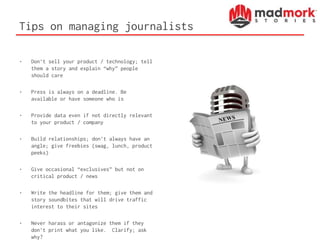
Tips on managing journalists
• Don’t sell your product / technology; tell
them a story and explain “why” people
should care
• Press is always on a deadline. Be
available or have someone who is
• Provide data even if not directly relevant
to your product / company
• Build relationships; don’t always have an
angle; give freebies (swag, lunch, product
peeks)
• Give occasional “exclusives” but not on
critical product / news
• Write the headline for them; give them and
story soundbites that will drive traffic
interest to their sites
• Never harass or antagonize them if they
don’t print what you like. Clarify; ask
why?
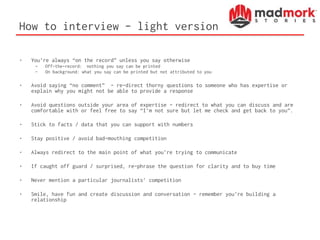
How to interview - light version
• You’re always “on the record” unless you say otherwise
– Off-the-record: nothing you say can be printed
– On background: what you say can be printed but not attributed to you
• Avoid saying “no comment” - re-direct thorny questions to someone who has expertise or
explain why you might not be able to provide a response
• Avoid questions outside your area of expertise – redirect to what you can discuss and are
comfortable with or feel free to say “I’m not sure but let me check and get back to you”.
• Stick to facts / data that you can support with numbers
• Stay positive / avoid bad-mouthing competition
• Always redirect to the main point of what you’re trying to communicate
• If caught off guard / surprised, re-phrase the question for clarity and to buy time
• Never mention a particular journalists’ competition
• Smile, have fun and create discussion and conversation – remember you’re building a
relationship
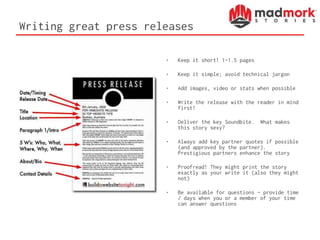
Writing great press releases
• Keep it short! 1-1.5 pages
• Keep it simple; avoid technical jargon
• Add images, video or stats when possible
• Write the release with the reader in mind
first!
• Deliver the key Soundbite. What makes
this story sexy?
• Always add key partner quotes if possible
(and approved by the partner).
Prestigious partners enhance the story
• Proofread! They might print the story
exactly as your write it (also they might
not)
• Be available for questions – provide time
/ days when you or a member of your time
can answer questions
APPENDIX
Introduction to Public Relations
PR agencies & useful links
• SparkPR
• Mighty PR
• Atomico
• Outcast
• Brew
• Komodo (UK only)
• Tips for Finding the
Perfect agency
• How to use PR in a
startup
• Why most startups don’t
get PR
• Best PR firms in San
Francisco
• Top ranked Tech PR
agencies -2016
Tools & Sites
• The PR Network – Site for freelance PR professionals that can be
hired on full-time or half time basis. Mostly UK based but also
have US freelancers. Broader sites for freelancers include Odesk
and Guru.com
• Meltwater – PR service that helps capture online news coverage
globally. Provides link source, number of views, audience size as
well as translation of articles in foreign languages into English
• PR Wire – News distribution & syndication service. Allows
companies to upload and distribute their news for a fee. Includes
reporting by day of where news was featured including news source,
links and audience size. Alternatives include Brand.com and Prweb
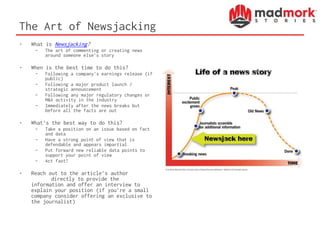
The Art of Newsjacking
• What is Newsjacking?
– The art of commenting or creating news
around someone else’s story
• When is the best time to do this?
– Following a company’s earnings release (if
public)
– Following a major product launch /
strategic announcement
– Following any major regulatory changes or
M&A activity in the industry
– Immediately after the news breaks but
before all the facts are out
• What’s the best way to do this?
– Take a position on an issue based on fact
and data
– Have a strong point of view that is
defendable and appears impartial
– Put forward new reliable data points to
support your point of view
– Act fast!
• Reach out to the article’s author
directly to provide the
information and offer an interview to
explain your position (if you’re a small
company consider offering an exclusive to
the journalist)

PR Crash Course for Startups

  • 1.
  • 2.
    Contents • PR –Definition & goals • Messaging – what it is how to use it • How to measure PR effectiveness • PR by stages – when to use what and when • Amplifying PR via social media • Agencies, dealing with press and releases • Appendix: – PR agencies – PR tools & sites – The Art of Newjacking – getting free PR
  • 3.
    What is PR? “PRis the practice of managing the spread of information between` an organization or person and the public. PR can include a person or company getting exposure to their target audience using topics of public interest and news that do not require direct payment.”
  • 4.
    What are thegoals of PR? Goals Communicate Company messaging Communicate Product messaging Crisis Management Manage Press Relations
  • 5.
    What does PRcommunicate? The company’s main reason for being / its Story, Vision, Mission The 2-3 key points that differentiate the company Company positioning statement – typically one line Company’s short description – typically 2-3 lines Company’s full description – typically up to a paragraph What is needed Output
  • 6.
    What’s in theoutput? One line: Name of the company; how it’s positioned in the market and what industry it operates in. Multi-liner: Same as One Liner plus mention of the company’s key product / products and what are the 1-2 things that are unique about them in the market. Full paragraph: One liner + Multi liner. Also includes typically where the company is located, backgrounds of 1-2 key, high profile founders or employees as well as who is funding the company, number of worldwide offices and employees.
  • 7.
    Practical example One liner:Video Game Developer X is the world leader in hyper- realistic combat games for Tablets Multi-liner: Video Game Developer X is the world leader in hyper realistic combat games for Tablets. The company’s proprietary Sub-Zero platform allows for near photo realistic combat animation while compressing data to minimize gaming lag time Full paragraph: Video Game Developer X is the world leader in hyper realistic combat games for Tablets. The company’s proprietary Sub-Zero platform allows for near photo realistic combat animation while compressing data to minimize gaming lag time. Headquartered in Berlin, Germany, the company’s founders include top executives from EA, Activision, and Dreamworkz. The company was founded in 2006 and is funded by Signia Venture Partners and Crosscut Ventures.
  • 8.
    When do youuse each? One liner Multi-Liner Full Paragraph • Use when time short • First sentence of each press release • Mention in TV / Radio interview • Sales cold call • Intro at speaking event • Print / Online interviews • Introductory marketing materials (B2B) – website, one pagers, ppt decks, online videos • Self-introduction at speaking events or with TV, Radio journalists • When comparing self with competitors • As part of key executive bios • At the footer of each press release – the boilerplate • Investor / partner presentations / marketing materials • In-depth product or company videos
  • 9.
    How do youmeasure PR? 1 2 3 • Reach – number of impressions generated, number of unique views, number of readers, number of TV viewers • Tools – Meltwater.com, Cision • Quality– Quality of publications; top 5 pubs in your particular industry / vertical; quality of content. How accurately do the major articles reflect the message being conveyed • Value ($) – What is the equivalent value of the reach achieved? • Tools – Agree with your agency ahead of time a measurement for value. An example could be Reach x % of target audience reached x $ value per person hit. The % audience can be a bit subjective as is the dollar value per impression but when used consistently month on month it can provide a benchmark for future performance
  • 10.
    Communication & Benefits •Company formation / key founders • Funding announcements • Product launches • Key hires • Strategic partnerships • Knowledge, industry news, opinion papers • M&A activity • Awards / Industry recognition • Makes attracting top talent easier • Awareness makes funding easier / faster • Builds awareness with prospective clients / strategic partners • Makes invitations to key events more likely • Increases chance for nomination to awards / industry recognition • Positively impacts M&A prospects What to communicate Benefits of PR
  • 11.
    What types ofPR to do and when? Seed / Early stage Series A-B Post Series B • Build direct ties with key editors / reporters in your industry • Use Prwire.com to syndicate your news broadly • Hire PR consultants using The PR Network or other freelance PR services on project basis • Set up a blog and write about your industry to begin positioning yourself as a thought leader • Develop an events strategy and sponsor events related to your industry – always negotiate a speaking / panel opportunity • Hire a small / mid-size agency specialized in your industry for 5-10k / month max • Develop a press release strategy and aim for 1-2 releases per month if possible to build frequency • Leverage and share industry data freely when you have it to build thought leadership • Hire an upscale agency that can also target mass market media 15-20k / month • Hire an in-house PR person full time to manage agencies and key press outreach • Consider a broadcast media agency specialist • Add small / mid size agencies to other key non-US markets • Consider developing your own industry specific event
  • 12.
    Amplifying PR viasocial media • Twitter – Type: Broadcast, 1:many medium – Tools: Hashtag for company, product and/or partner, pre- generated max 150 characters for your news (including link), Twitter page – *Can use Bt.ly to shorten link to news to save characters – Created Twitter ad with download URL for app if appropriate – Email tweets to VC’s and partners to amplify • Facebook – Type: Broadcast and Engagement; 1: many – Tools: Facebook page, imagery where possible, video when possible, promote page via ads with download links (if appropriate), Mention partners and investors, and others in posts where possible to share
  • 13.
    Other ways toamplify PR • Blog – all PR releases, news, knowledge and research should also be sourced from your blog – Type: 1: Many good for targeted broadcast and for user feedback – Tools: Varies from blog to blog. Services available include – Blogger, WordPress, Wix, Weebly among others, Always add links to blog posts; mention key persons, funds, partners using links in any articles to provide ease of sharing / syndication, add graphics / video where appropriate, create compelling / short headers with key search terms in title (Google, Android, iOS, Apple, etc.) • Other tools – Alternative / less noisy social platforms: Quibb, Hacker News (for YC), Product Hunt, Reddit – Email / CRM: create a distribution list (with clear opt out) and regularly share your press releases and posts – Clear company / team sections in company website together with team bios, linkedin page links and blog section. More best practices check here
  • 14.
    Sourcing a PRagency 1. Create a clear brief (1-2 pages) that details – who you are, your key challenges, your product(s), your goals and what your measurable metrics are. Ask the agency for a plan on how to meet these goals within a specified time and budget X 1. Create a shortlist of at least 5-10 agencies that have demonstrated track record in your industry and send them the brief asking them to pitch 1. Get references from existing and past clients. Clearly ask which clients are current. Ask who specifically will be on your account team, their bios and how many other clients they will manage (the fewer the better) 1. Use whatever agency you select on a project / trial basis first (a single project or 1-3 month trial). Agree on key performance metrics before starting any project (views, impressions, number of unique users, value of PR) 1. Jointly establish a weekly PR meeting and monthly performance report to track progress. Any good agency will agree to measurable metrics as well as on a frequency to review these 1. Ask the agency what feedback they would like from you and agree to a half yearly or at least yearly client feedback where you score them on a pre-agreed list of criteria (responsiveness, number of interviews, number of speaking agreements negotiated for free, value of PR generated, quality of publications reached and number of times hit). Allow the agency a 360 feedback where they provide feedback on you as a client
  • 15.
    Tips on managingjournalists • Don’t sell your product / technology; tell them a story and explain “why” people should care • Press is always on a deadline. Be available or have someone who is • Provide data even if not directly relevant to your product / company • Build relationships; don’t always have an angle; give freebies (swag, lunch, product peeks) • Give occasional “exclusives” but not on critical product / news • Write the headline for them; give them and story soundbites that will drive traffic interest to their sites • Never harass or antagonize them if they don’t print what you like. Clarify; ask why?
  • 16.
    How to interview- light version • You’re always “on the record” unless you say otherwise – Off-the-record: nothing you say can be printed – On background: what you say can be printed but not attributed to you • Avoid saying “no comment” - re-direct thorny questions to someone who has expertise or explain why you might not be able to provide a response • Avoid questions outside your area of expertise – redirect to what you can discuss and are comfortable with or feel free to say “I’m not sure but let me check and get back to you”. • Stick to facts / data that you can support with numbers • Stay positive / avoid bad-mouthing competition • Always redirect to the main point of what you’re trying to communicate • If caught off guard / surprised, re-phrase the question for clarity and to buy time • Never mention a particular journalists’ competition • Smile, have fun and create discussion and conversation – remember you’re building a relationship
  • 17.
    Writing great pressreleases • Keep it short! 1-1.5 pages • Keep it simple; avoid technical jargon • Add images, video or stats when possible • Write the release with the reader in mind first! • Deliver the key Soundbite. What makes this story sexy? • Always add key partner quotes if possible (and approved by the partner). Prestigious partners enhance the story • Proofread! They might print the story exactly as your write it (also they might not) • Be available for questions – provide time / days when you or a member of your time can answer questions
  • 18.
  • 19.
    PR agencies &useful links • SparkPR • Mighty PR • Atomico • Outcast • Brew • Komodo (UK only) • Tips for Finding the Perfect agency • How to use PR in a startup • Why most startups don’t get PR • Best PR firms in San Francisco • Top ranked Tech PR agencies -2016
  • 20.
    Tools & Sites •The PR Network – Site for freelance PR professionals that can be hired on full-time or half time basis. Mostly UK based but also have US freelancers. Broader sites for freelancers include Odesk and Guru.com • Meltwater – PR service that helps capture online news coverage globally. Provides link source, number of views, audience size as well as translation of articles in foreign languages into English • PR Wire – News distribution & syndication service. Allows companies to upload and distribute their news for a fee. Includes reporting by day of where news was featured including news source, links and audience size. Alternatives include Brand.com and Prweb
  • 21.
    The Art ofNewsjacking • What is Newsjacking? – The art of commenting or creating news around someone else’s story • When is the best time to do this? – Following a company’s earnings release (if public) – Following a major product launch / strategic announcement – Following any major regulatory changes or M&A activity in the industry – Immediately after the news breaks but before all the facts are out • What’s the best way to do this? – Take a position on an issue based on fact and data – Have a strong point of view that is defendable and appears impartial – Put forward new reliable data points to support your point of view – Act fast! • Reach out to the article’s author directly to provide the information and offer an interview to explain your position (if you’re a small company consider offering an exclusive to the journalist)