







STANDING OUT IN
YOUR JOB
SEARCH IN 2021
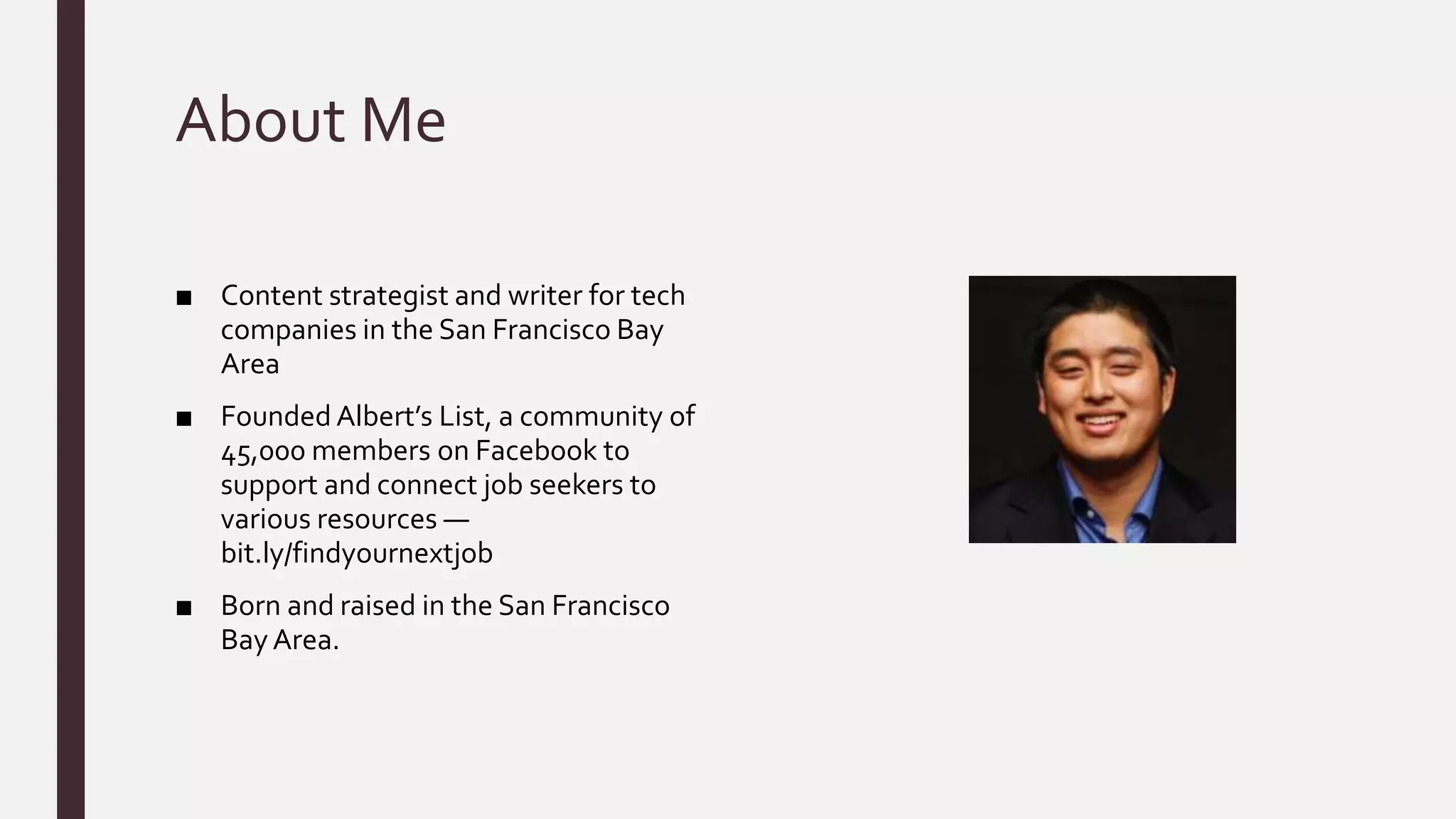
Albert Qian
Albert’s List
January 14, 2020
About Me
■ Content strategist and writer for tech
companies in the San Francisco Bay
Area
■ Founded Albert’s List, a community of
45,000 members on Facebook to
support and connect job seekers to
various resources —
bit.ly/findyournextjob
■ Born and raised in the San Francisco
BayArea.
The Problem
Too many of us are sitting at our desks
suffering in a state of silence and hoping
someone will finally notice us.
Is this you? 🙌
🙌
The Solution
Find a way to get noticed.
Stand up for what makes you amazing.
Show up like never before.
Is this what you want? 🙌
Agenda
■ The State of the Job Search
■ Best Practice #1: Learn toTell a Story
■ Best Practice #2: Don’t SellYourself Short
■ Best Practice #3: Play the Game inYour Favor
■ Best Practice #4: KnowWhat’s at Stake
■ Great—Now How Do I Get Hired?
THE STATE OFTHE JOB SEARCH
What’s Changed: Interviews are Remote
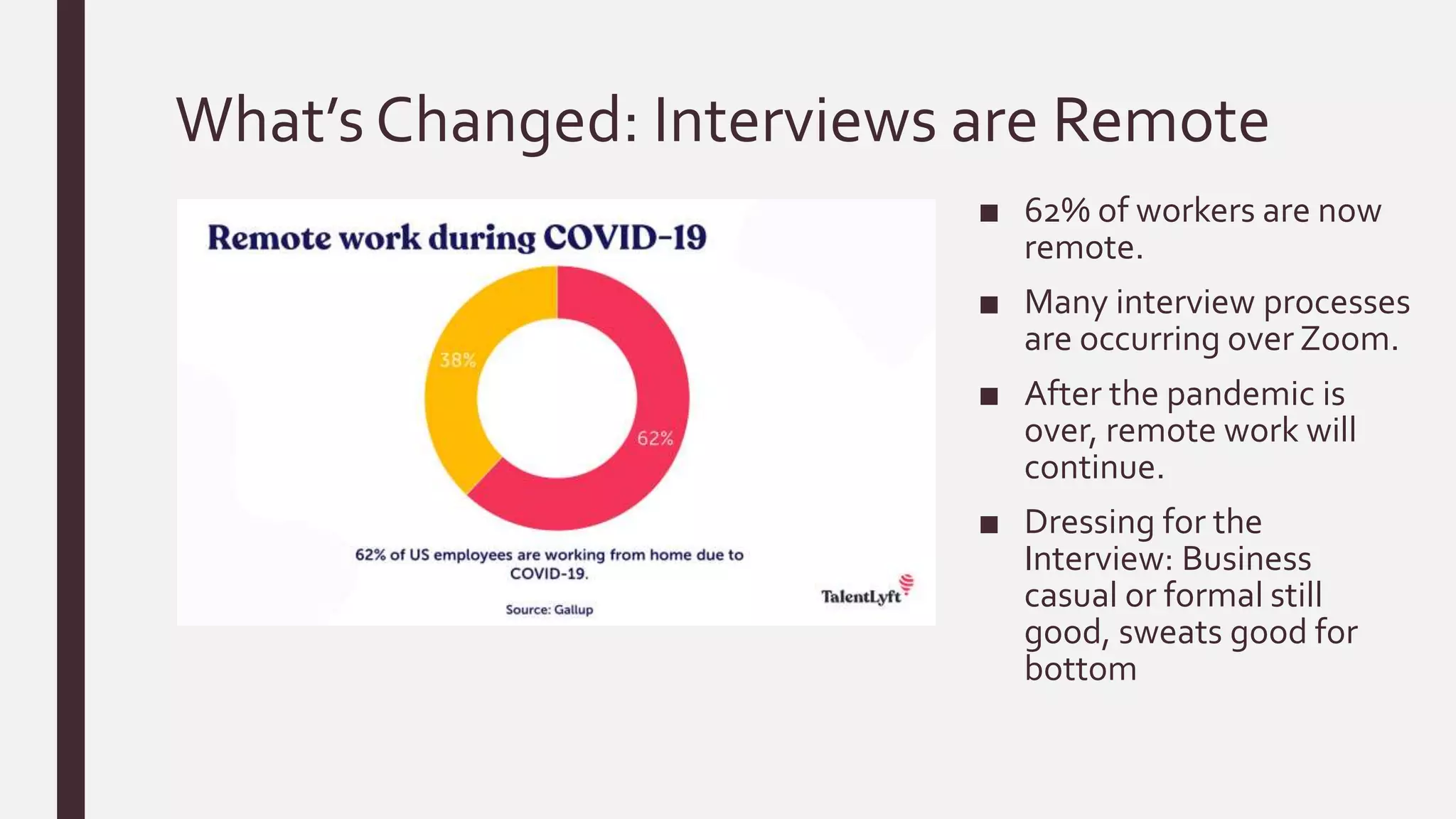
■ 62% of workers are now
remote.
■ Many interview processes
are occurring over Zoom.
■ After the pandemic is
over, remote work will
continue.
■ Dressing for the
Interview: Business
casual or formal still
good, sweats good for
bottom
What’s Changed: COVID-19 is an Excuse
■ 2020 is a mulligan—every
employer understands
that COVID-19 happened.
■ Indicate as such on your
resume and within your
interview.
■ Employers and hiring
managers should
understand that everyone
went through financial
challenges and more.
What’s Not Changed:The Market is Competitive
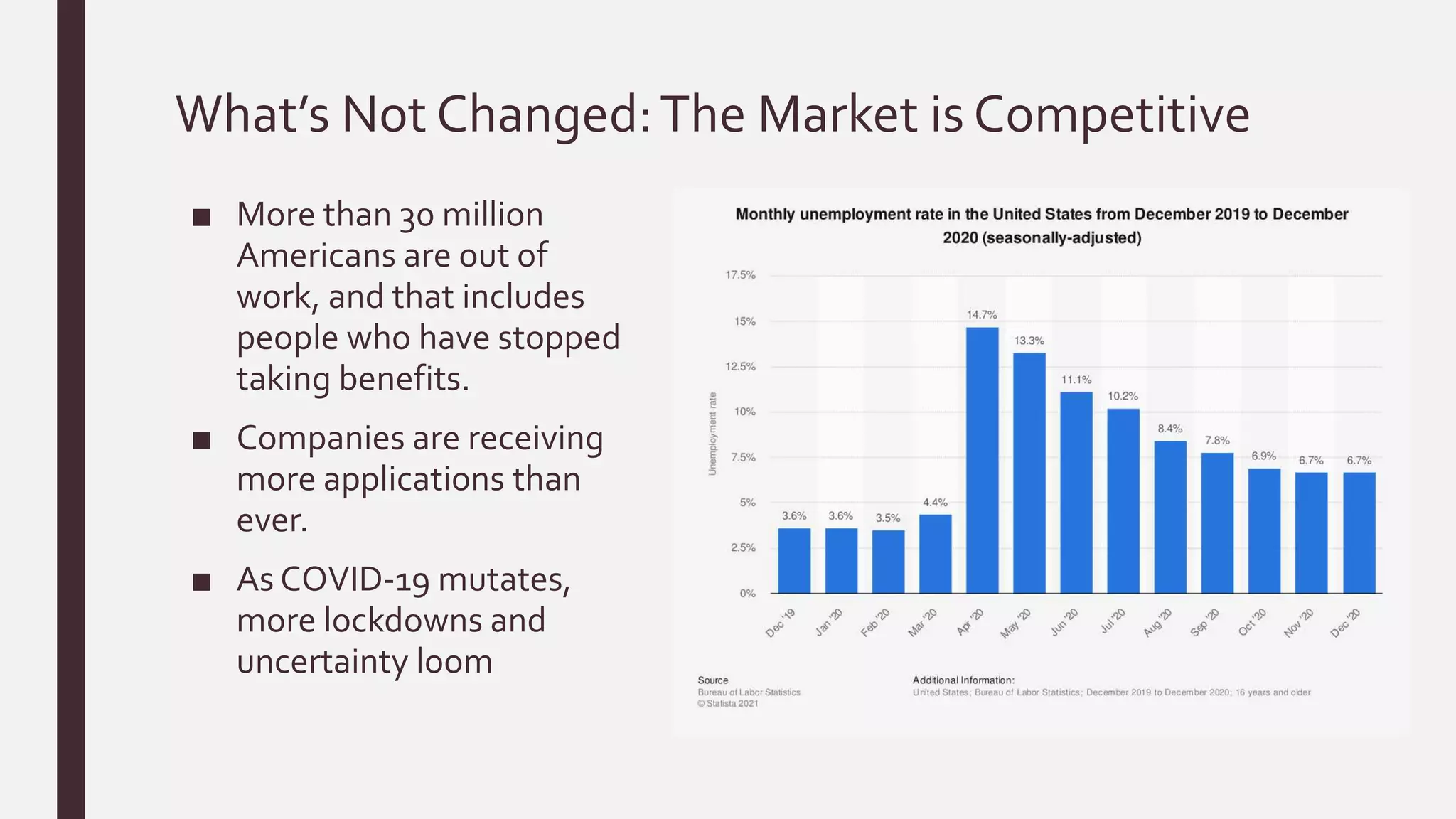
■ More than 30 million
Americans are out of
work, and that includes
people who have stopped
taking benefits.
■ Companies are receiving
more applications than
ever.
■ As COVID-19 mutates,
more lockdowns and
uncertainty loom
What’s Not Changed: Interview Homework
■ It’s a competitive market
and employers can take
advantage.
■ More than ever,
employers need to find a
way to weed out the
great from the good.
The Onus is OnYou to Stand Out
■ Don’t depend on luck.
■ Build the skills.
■ Create the confidence.
■ Stop selling yourself
short.
How this PresentationWas Created
■ 40+ mock interview
sessions and 5+ resume
review sessions in 2020
onAlbert’s List.
■ A lot of conversations
with job seekers.
■ Join us for future sessions
or sit in the hot seat
yourself.
■ Email
albert@ajobslist.com.
BEST PRACTICE #1:TELLTHE BEST
STORY
An Interview is MoreThanAnswers
■ It’s not just the what or
the how, but also the
why.
■ Stories help you stand
out from a competitive
market.
■ Luckily, interview stories
offer a model you can
use.
What’s in a Story?
■ What: Explain the
challenge?
■ Who:Which people were
involved?
■ Why: Describe why the
problem was important.
■ How: How was the
problem solved?
■ Other Elements: Hero,
Good News, Business
success
The STAR Method
■ Situation
■ Task
■ Action
■ Result
WhatAbout Personal Questions?
■ Your authenticity matters.
■ Reflecting on your journey
will help you a lot here.
■ Know how your career
connects.Why did you take
your previous jobs?
Finally, a Note About COVID-19
■ 2020 is a mulligan—every
employer understands
that COVID-19 happened.
■ Keep your answers
short—whether furlough
or layoff.
Example Storytelling Questions
■ Walk me through your resume.
■ Why do you want to work here?
■ Tell me about a time when you…
■ Can you explain why you did…
■ Name a project you are proud of…
BEST PRACTICE #2: POSITION
YOURSELF
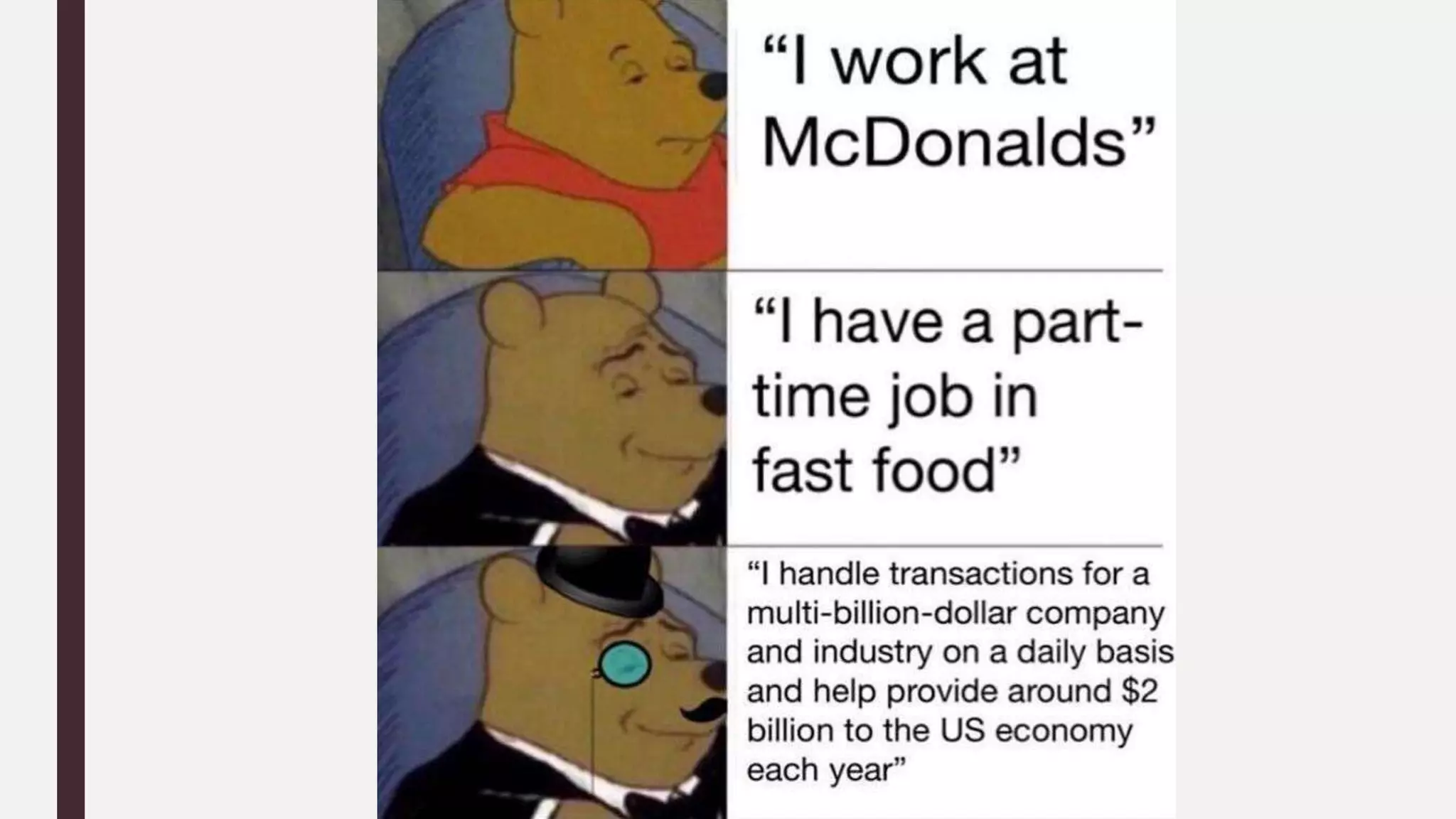
Lessons #1 From 2020
■ Job seekers regularly sell
themselves short on their
resumes and job
interviews.
■ Minimizing project and
career successes.
■ Ignoring what hiring
managers care about
(more on that later).
Where Does SellingYourself Short
Appear?
■ Resume
■ Interviews
■ Online Presence
■ Networking
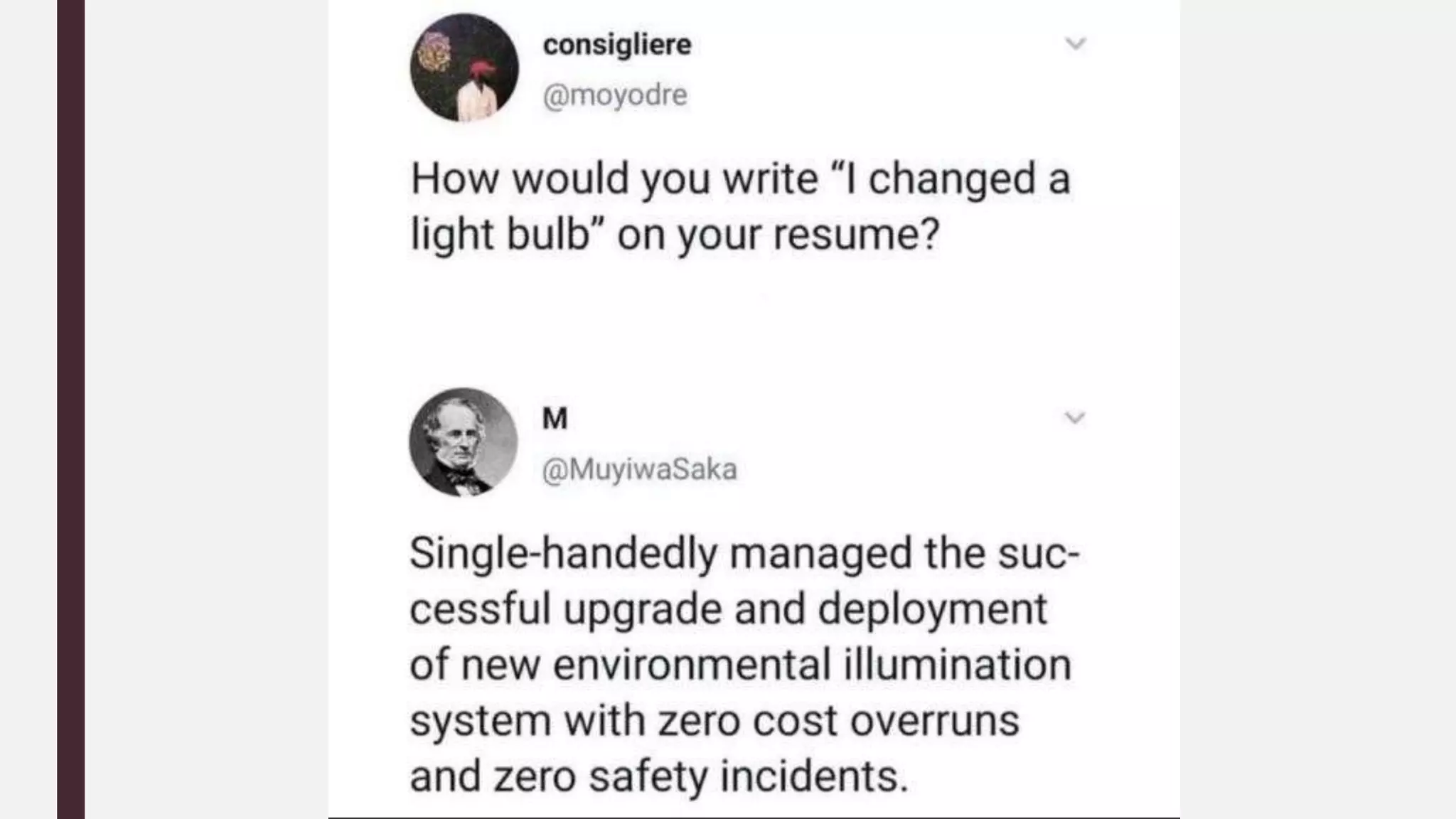
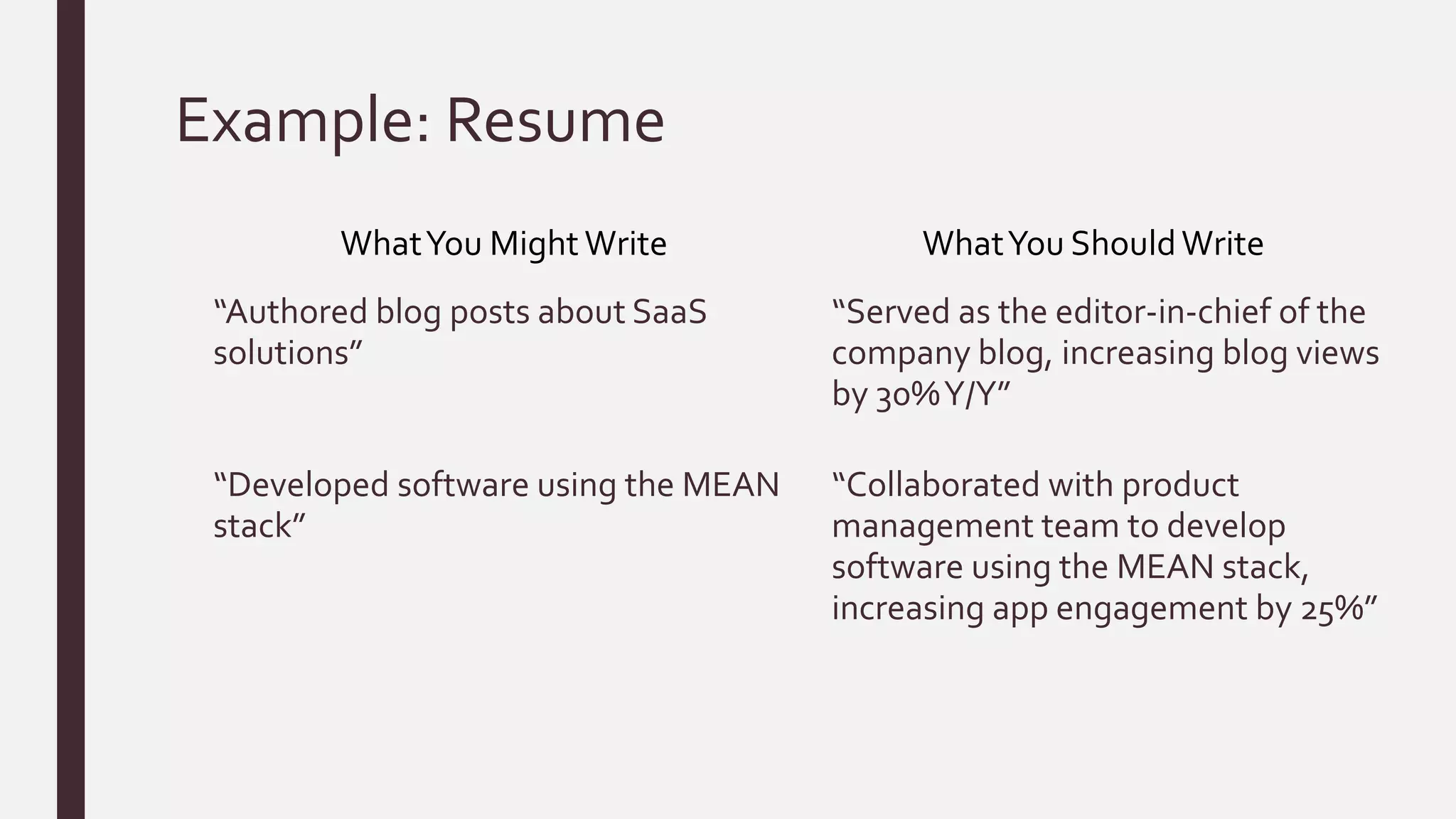
Example: Resume
“Authored blog posts about SaaS
solutions”
“Served as the editor-in-chief of the
company blog, increasing blog views
by 30%Y/Y”
WhatYou Might Write WhatYou ShouldWrite
“Developed software using the MEAN
stack”
“Collaborated with product
management team to develop
software using the MEAN stack,
increasing app engagement by 25%”
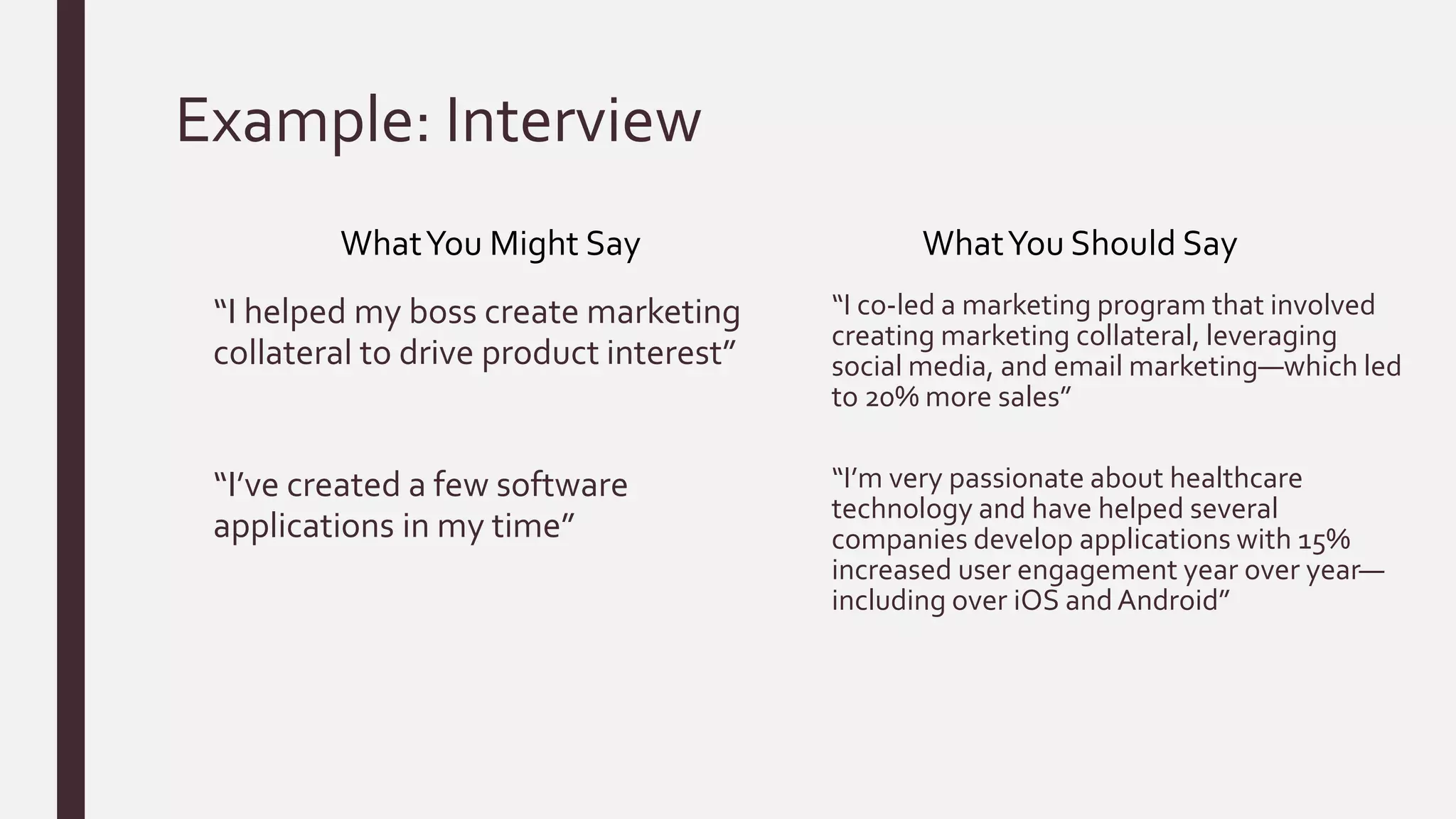
Example: Interview
“I helped my boss create marketing
collateral to drive product interest”
“I co-led a marketing program that involved
creating marketing collateral, leveraging
social media, and email marketing—which led
to 20% more sales”
WhatYou Might Say WhatYou Should Say
“I’ve created a few software
applications in my time”
“I’m very passionate about healthcare
technology and have helped several
companies develop applications with 15%
increased user engagement year over year—
including over iOS and Android”
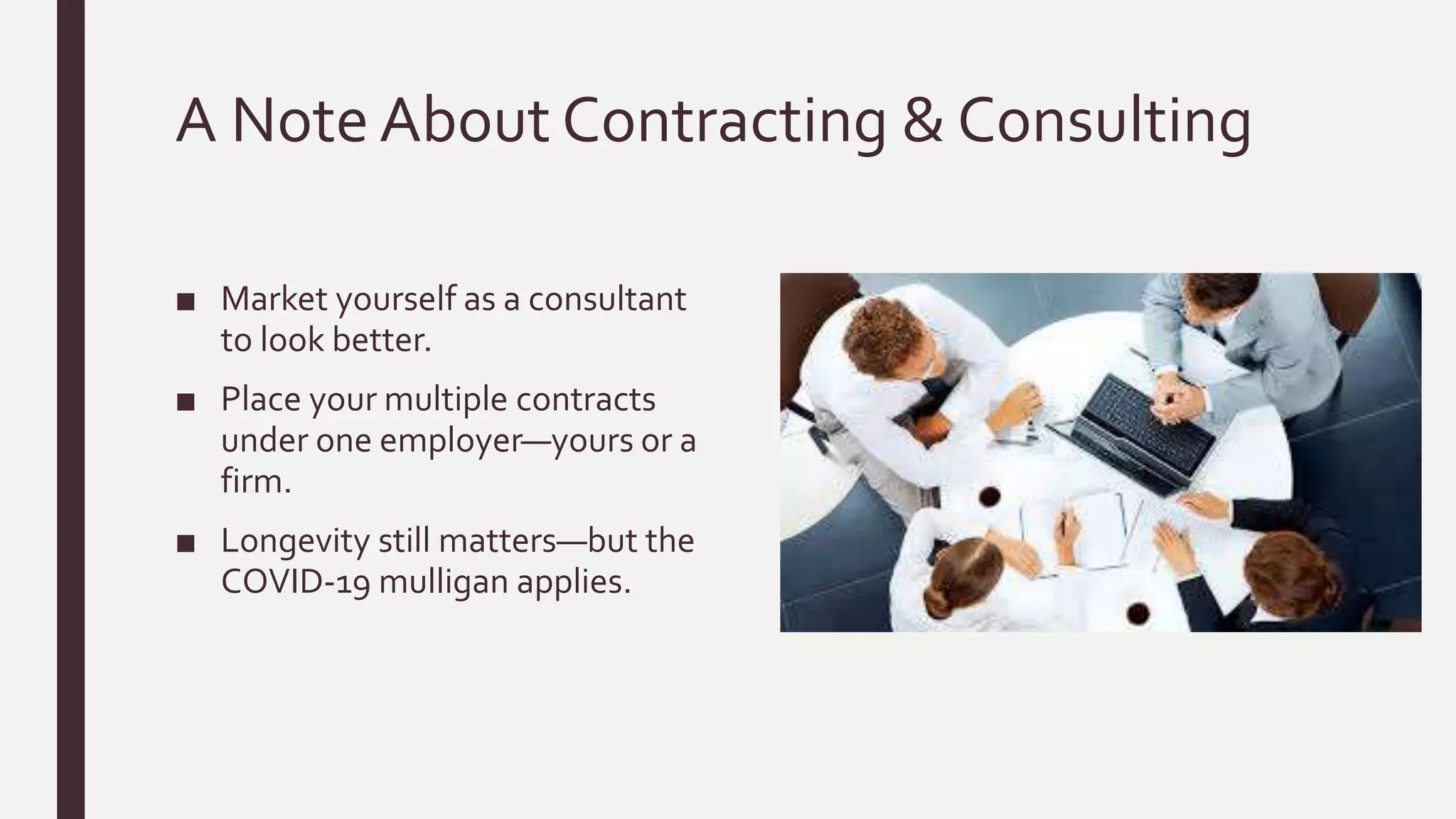
A Note About Contracting & Consulting
■ Market yourself as a consultant
to look better.
■ Place your multiple contracts
under one employer—yours or a
firm.
■ Longevity still matters—but the
COVID-19 mulligan applies.
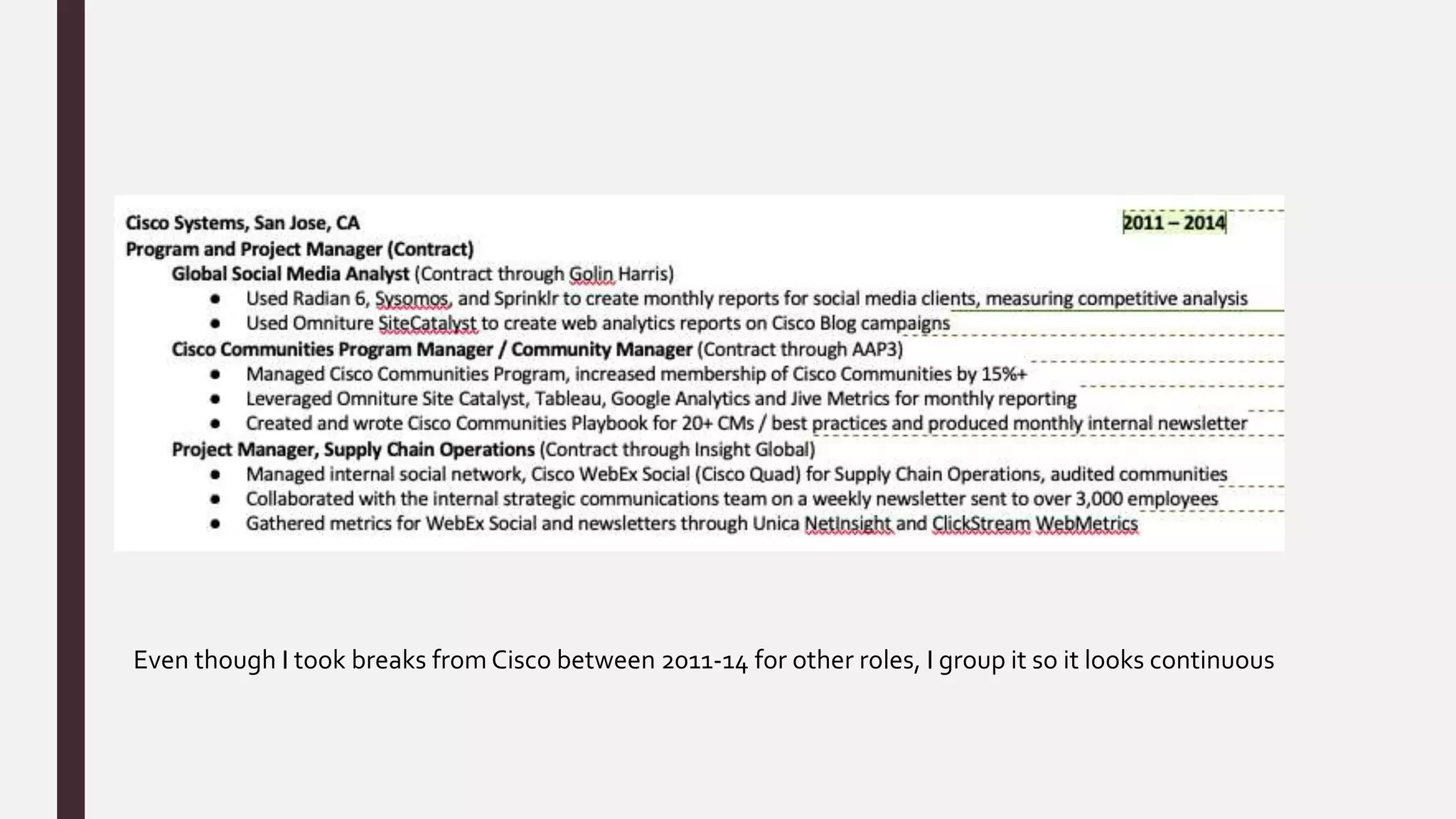
Even though I took breaks from Cisco between 2011-14 for other roles, I group it so it looks continuous
What’s the Lesson?
■ Where possible, go into
detail about what you
have done and done well.
■ When in doubt, don’t
hold back.
■ Focus on the strategic
value to your future
employer.
Example QuestionsTo ShowcaseYour
Potential
■ Tell me about your proudest project…
■ Share a time you were successful…
■ What would you like to accomplish in your next role?
■ What are you most passionate about?
BEST PRACTICE #3: DON’TTELLA LIE
Yes,There areTrick Questions
■ Hiring managers will ask
questions that could trip
you.
■ Knowing the answers to
these questions in
advance helps.
■ Writing them out helps as
well.
Why AskTrick Questions?
■ Assessment of risk.
■ Understanding how you operate
under pressure.
■ Seeing how you think.
■ Weeding out the bad candidates
in the interview process.
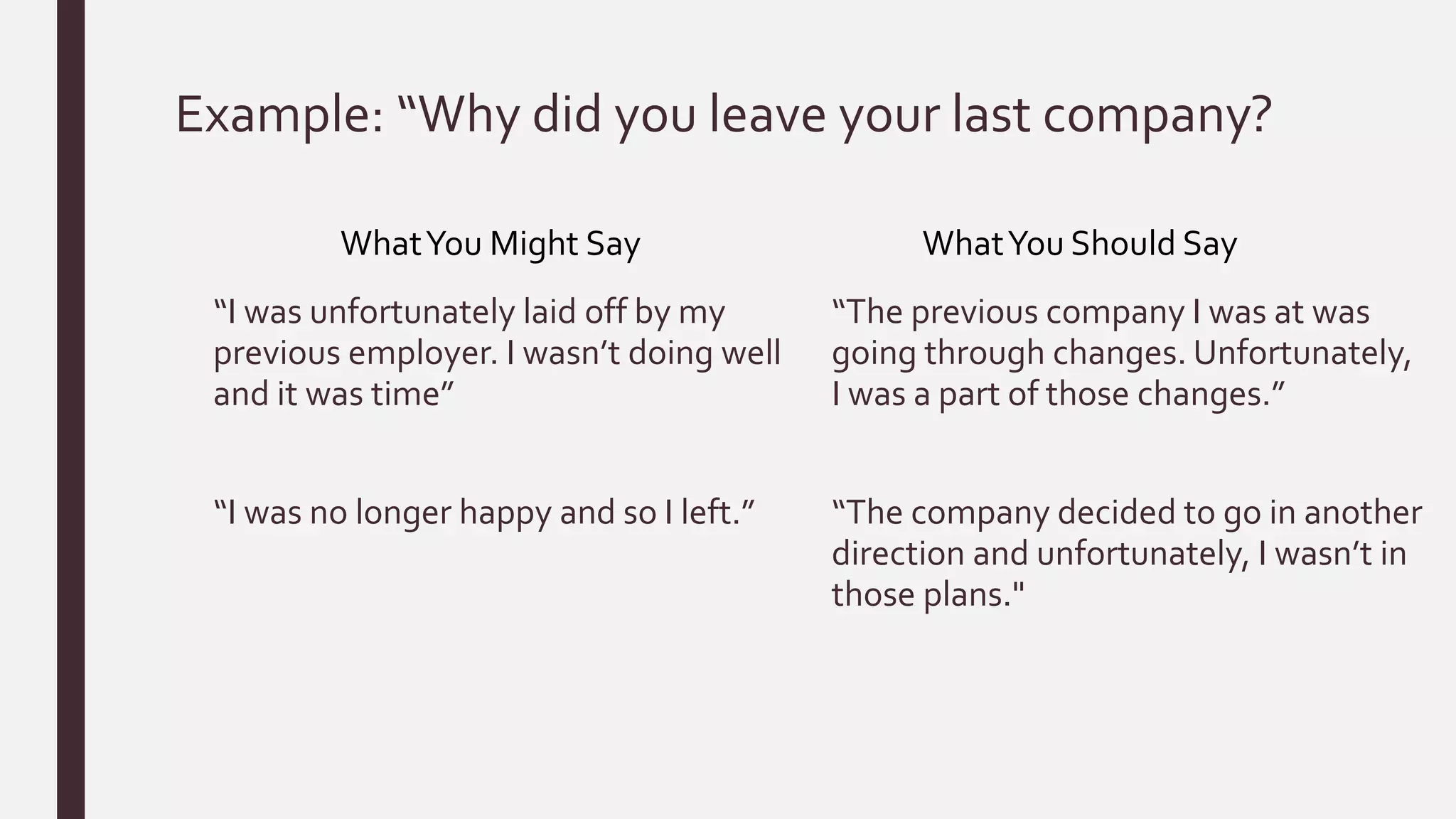
Example: “Why did you leave your last company?
“I was unfortunately laid off by my
previous employer. I wasn’t doing well
and it was time”
“I was no longer happy and so I left.”
“The previous company I was at was
going through changes. Unfortunately,
I was a part of those changes.”
“The company decided to go in another
direction and unfortunately, I wasn’t in
those plans."
WhatYou Might Say WhatYou Should Say
How to NavigateTheTough Questions
■ Reduce your risk as much
as possible.
■ Script your answers far in
advance.
■ Understand that it is
sometimes filler.
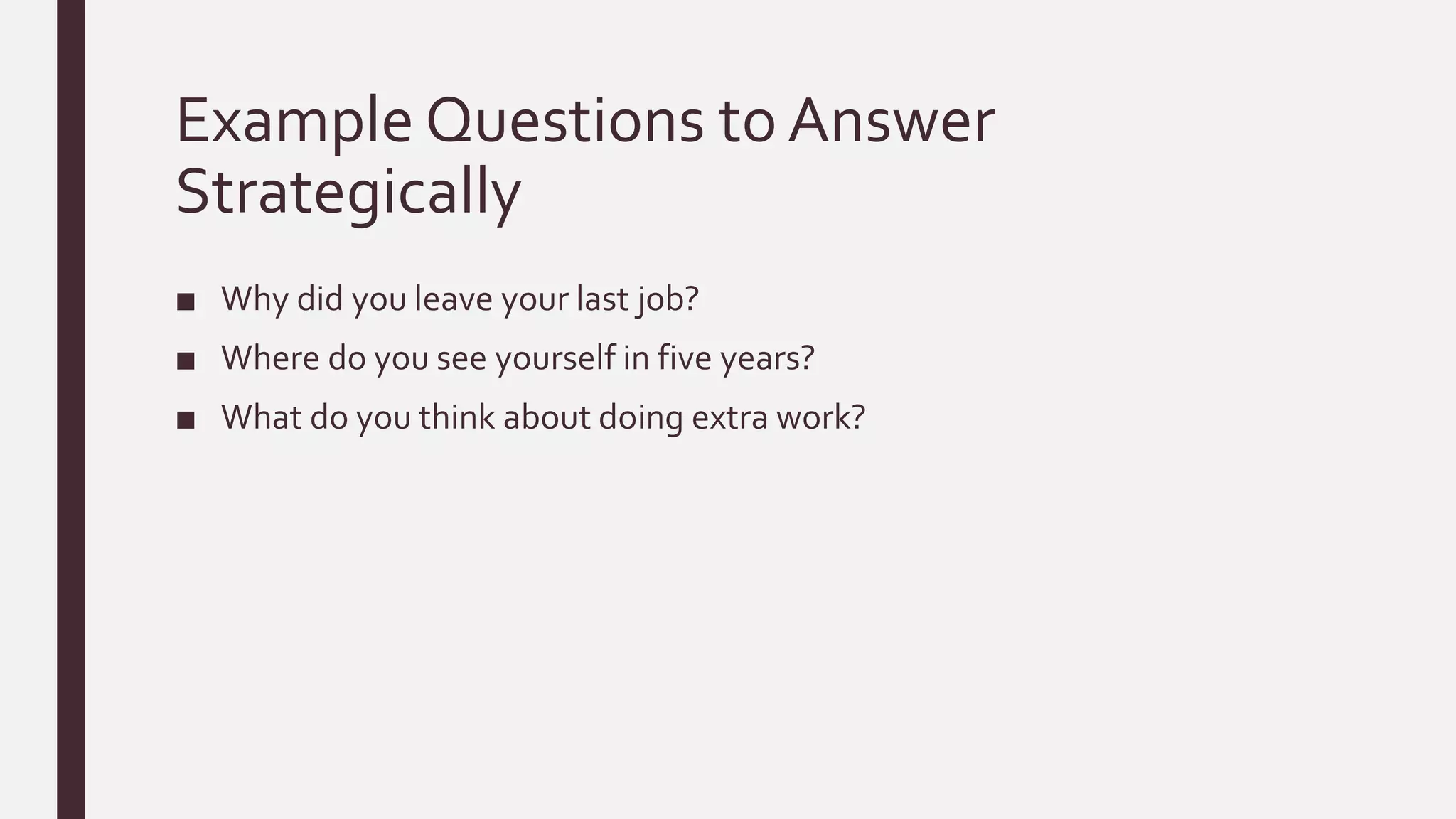
Example Questions to Answer
Strategically
■ Why did you leave your last job?
■ Where do you see yourself in five years?
■ What do you think about doing extra work?
BEST PRACTICE #4: KNOWWHAT’S
AT STAKE
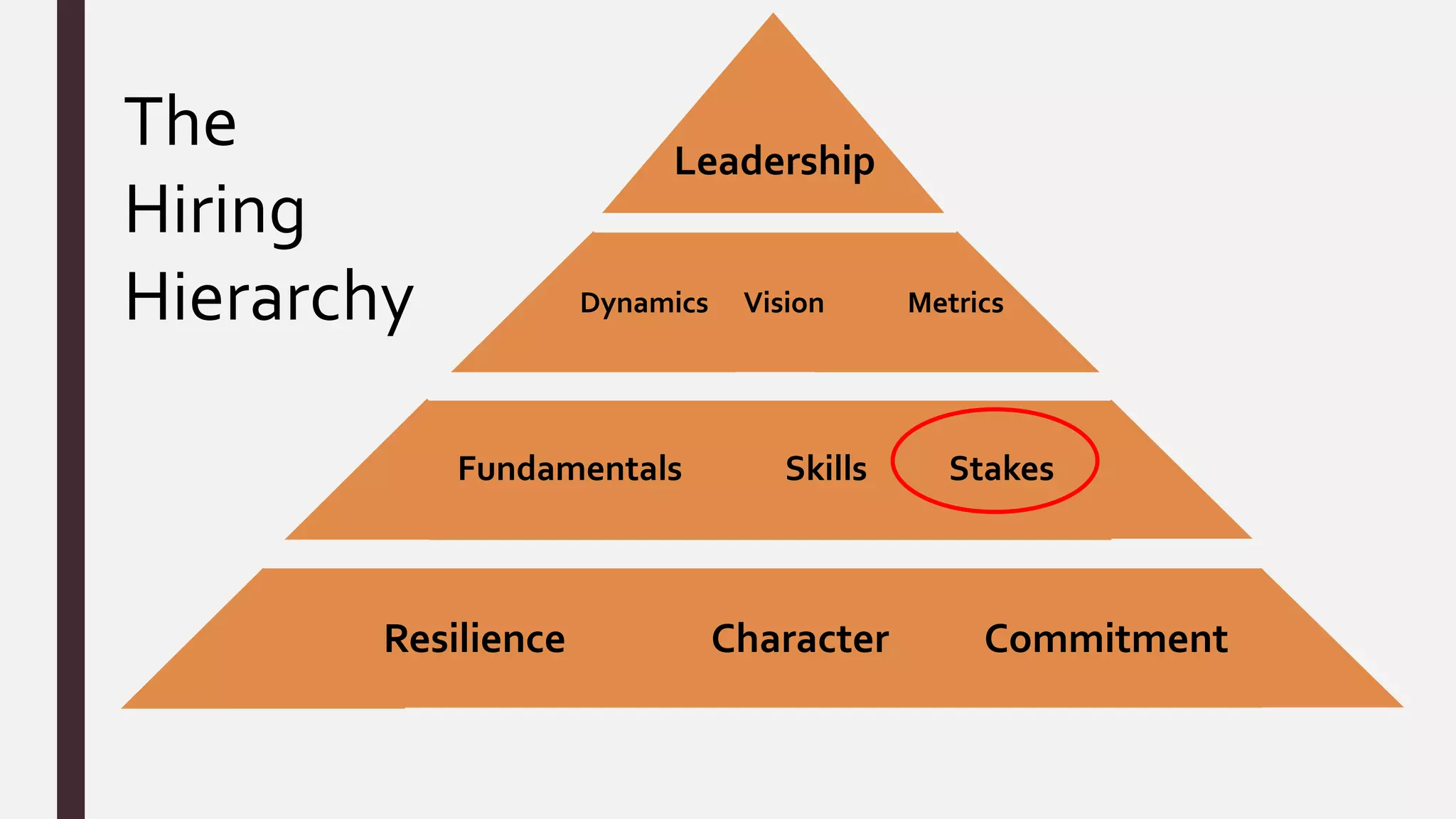
The
Hiring
Hierarchy
Fundamentals Skills Stakes
Resilience Character Commitment
Dynamics Vision Metrics
Leadership
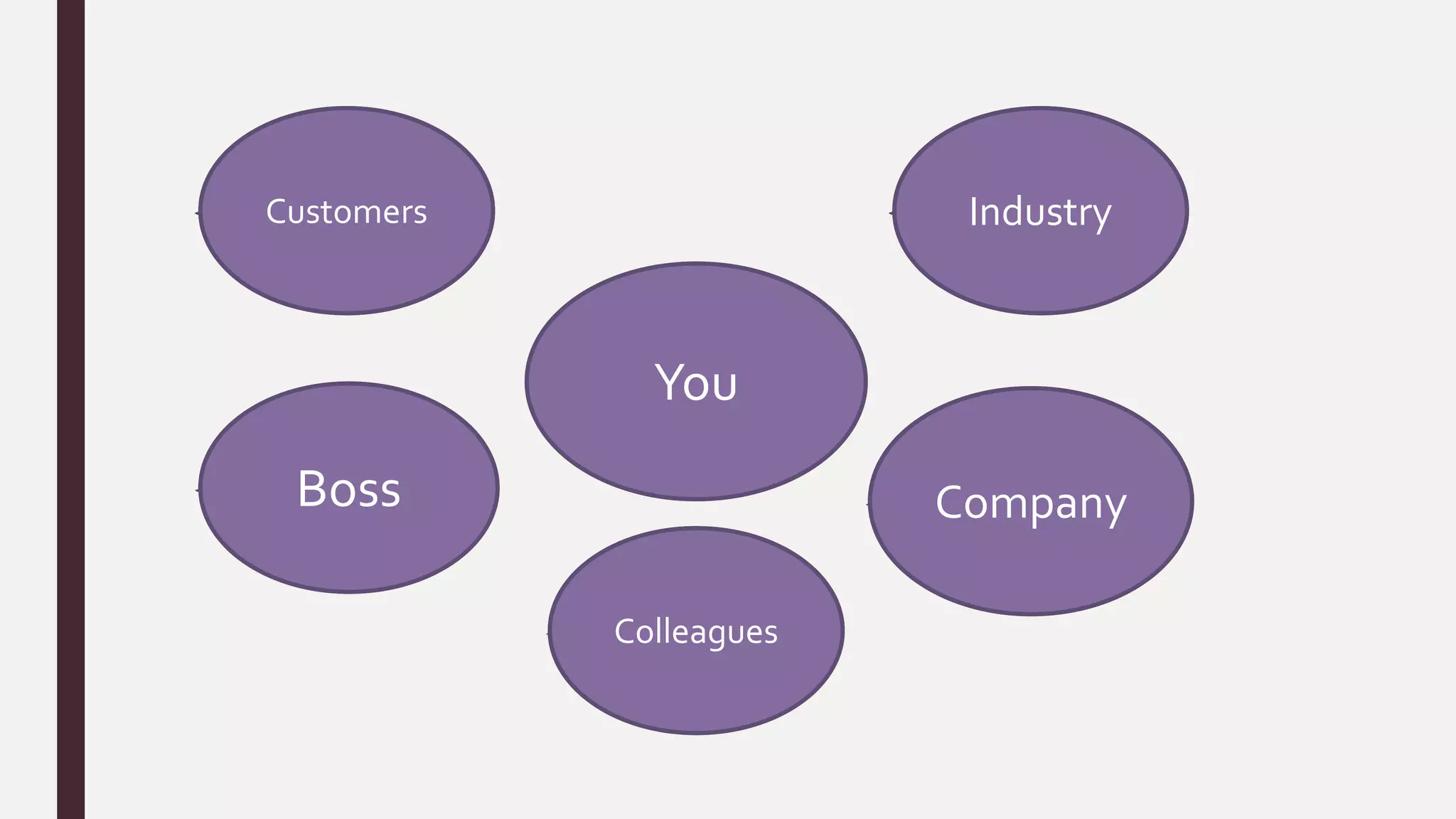
You
Boss
Colleagues
Company
Customers Industry
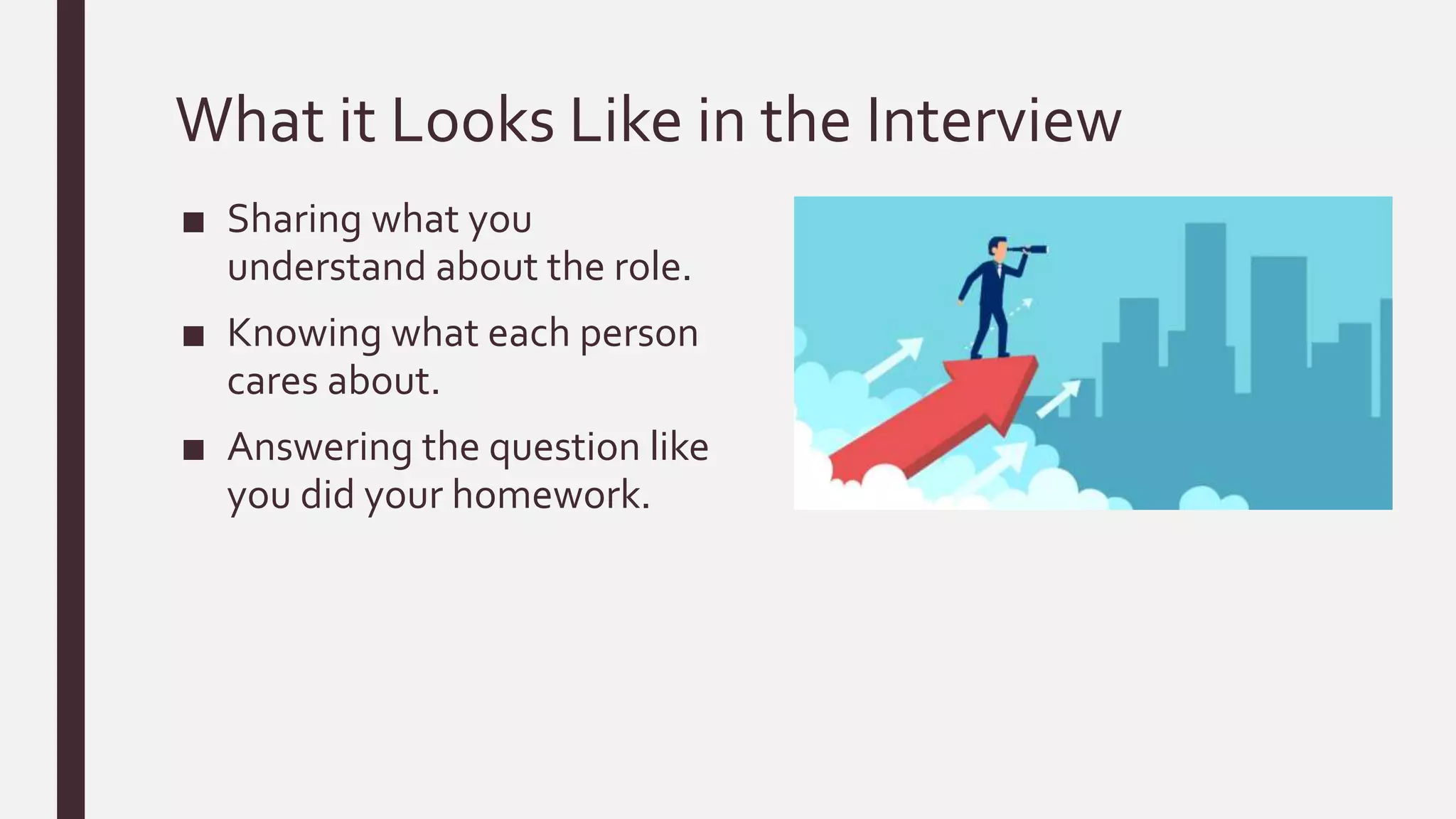
What it Looks Like in the Interview
■ Sharing what you
understand about the role.
■ Knowing what each person
cares about.
■ Answering the question like
you did your homework.
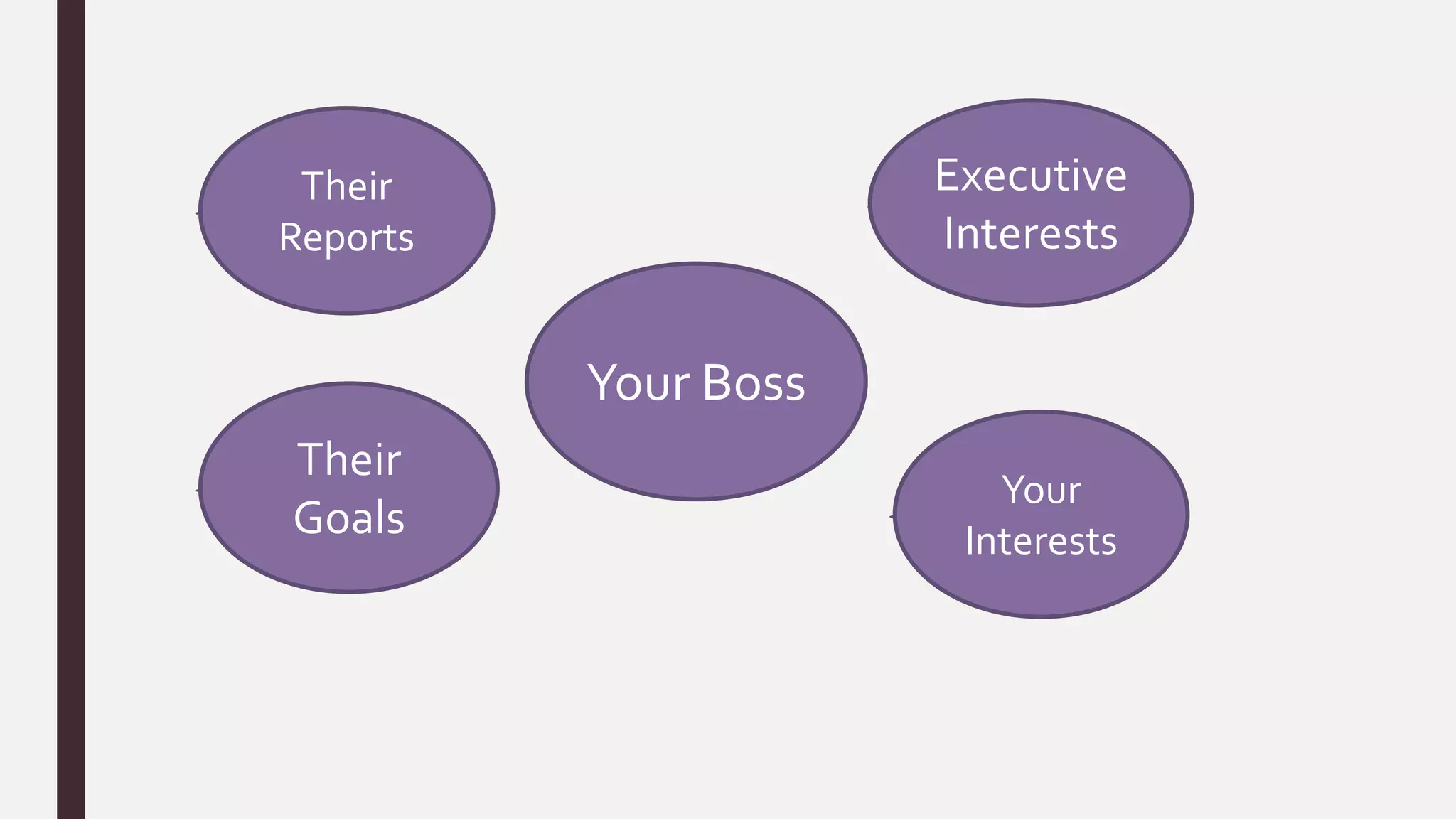
Your Boss
Their
Goals
Your
Interests
Executive
Interests
Their
Reports
What are your Boss’ stakes?
■ Why are they in the job?
■ What are their goals?
■ How do you fit with their goals?
■ What pressure(s) do they face?
Getting clear on your Boss
What matters to you + what matters to the boss
And
Where the two intersect
Questions to ask your boss
■ What can I do to make you look really good?
■ What are your top priorities today?
■ What is your vision for this role?
■ How do you lead?
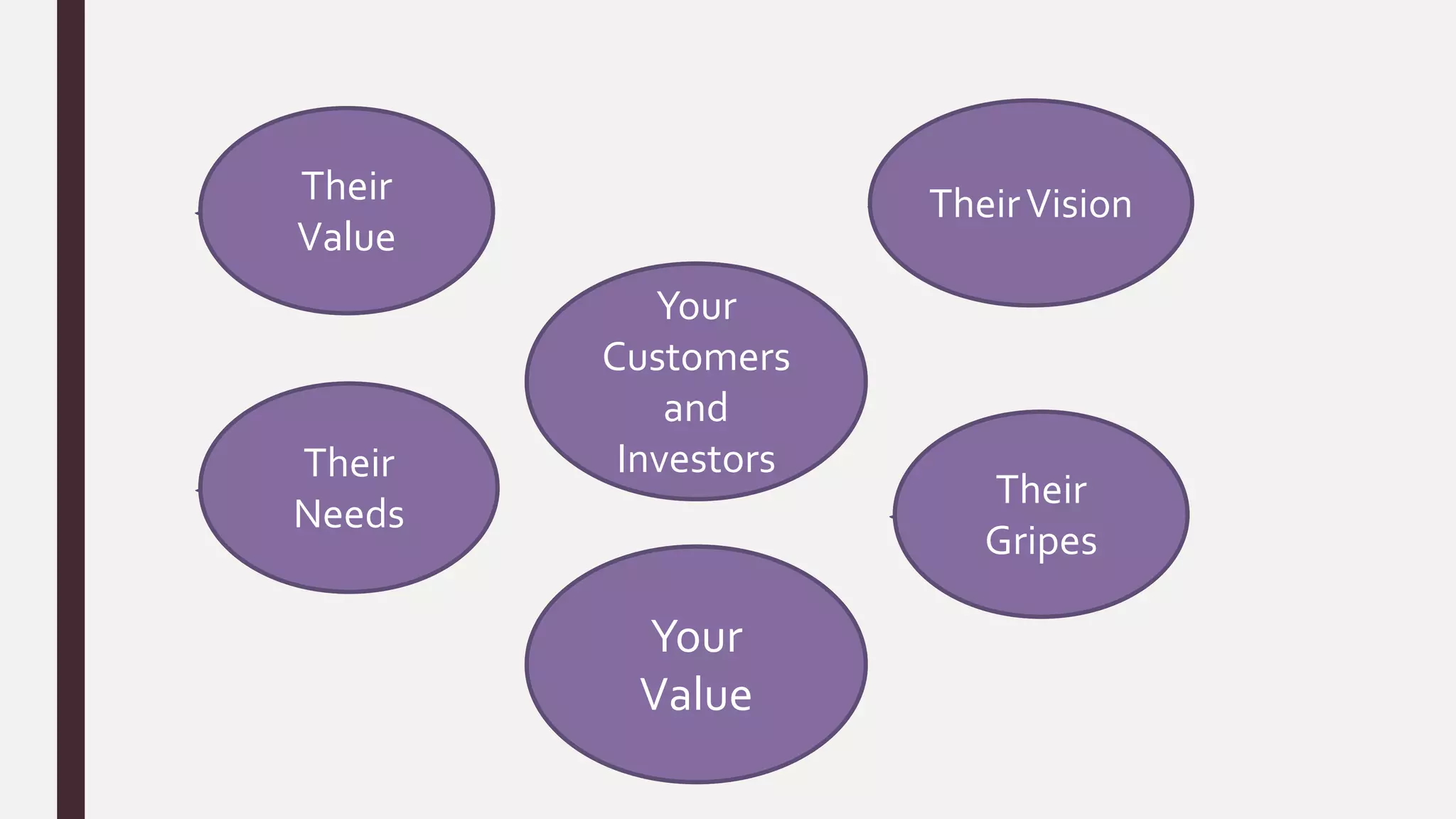
Your
Customers
and
Investors
Their
Needs
Their
Gripes
TheirVision
Their
Value
Your
Value
Example:What is at stake for your
customers and investors?
■ They pay your bills (#1)
■ They serve the vision
■ They make your executives nervous
■ They make you pivot
■ Essentially… they own you
Write it out for your next job interview!
Example: Getting clear on your
customers and investors
What matters to you + what matters to them
And
Collaborating towards success
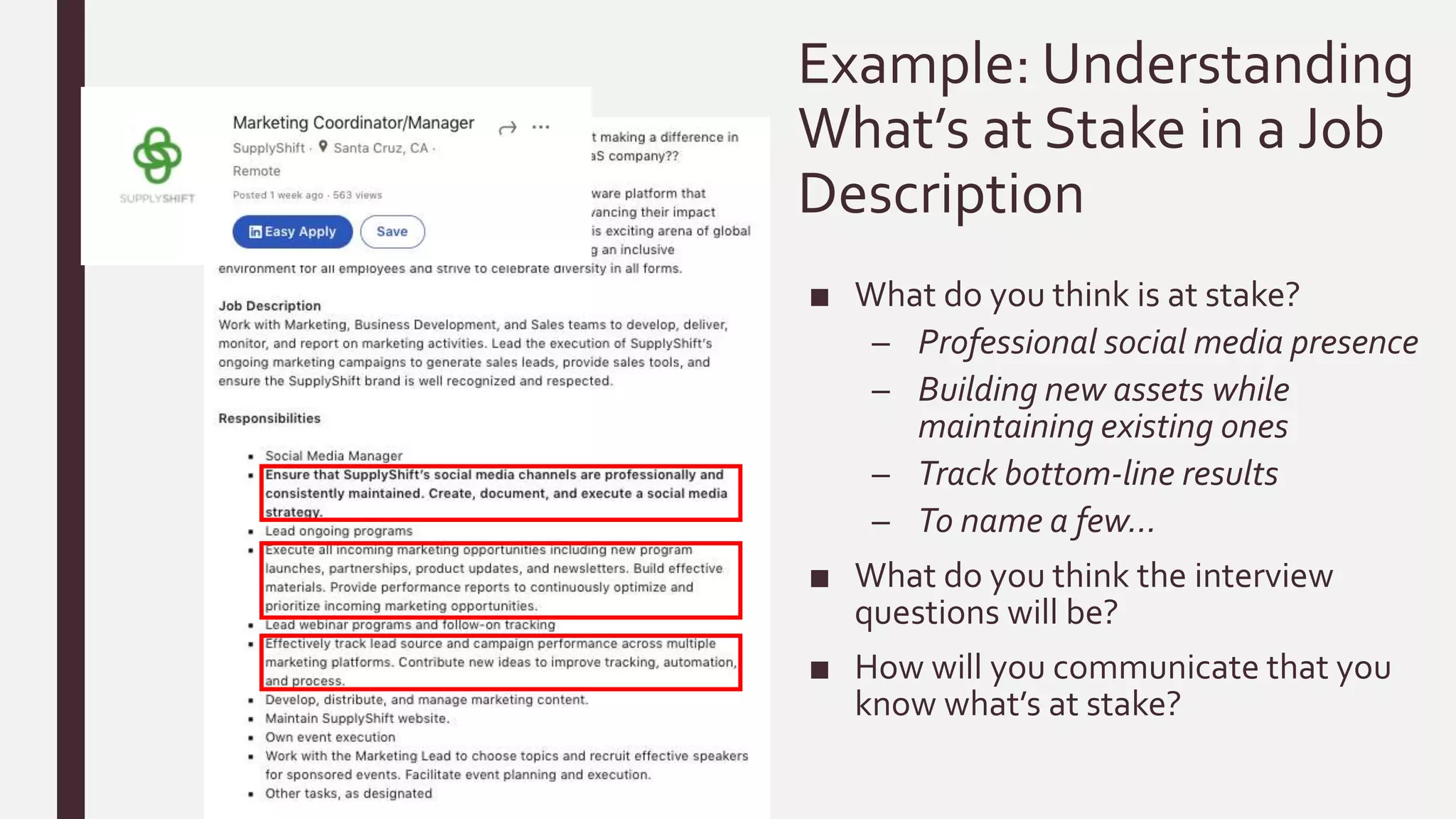
Example: Understanding
What’s at Stake in a Job
Description
■ What do you think is at stake?
– Professional social media presence
– Building new assets while
maintaining existing ones
– Track bottom-line results
– To name a few…
■ What do you think the interview
questions will be?
■ How will you communicate that you
know what’s at stake?
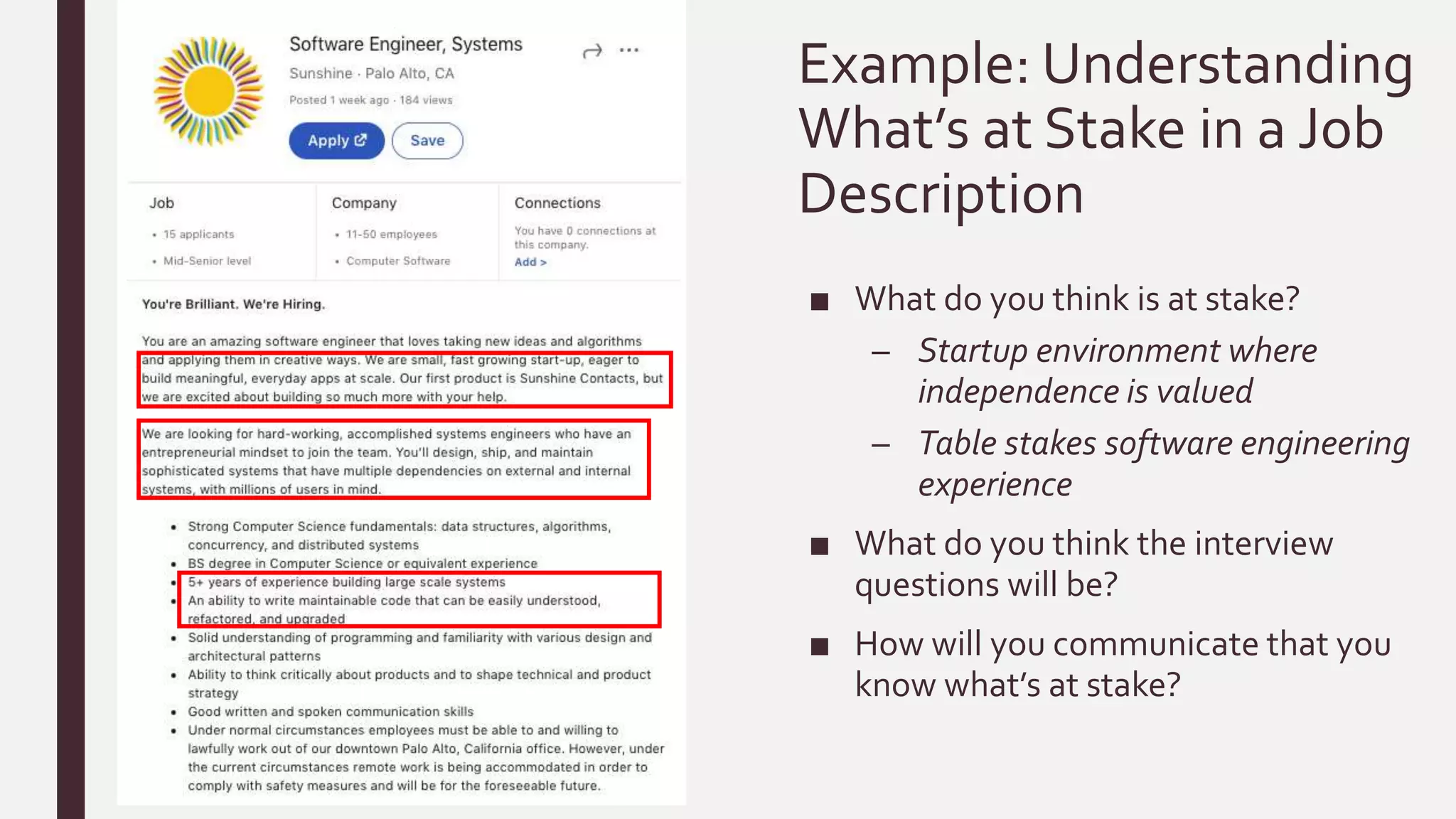
Example: Understanding
What’s at Stake in a Job
Description
■ What do you think is at stake?
– Startup environment where
independence is valued
– Table stakes software engineering
experience
■ What do you think the interview
questions will be?
■ How will you communicate that you
know what’s at stake?
GREAT—NOW HOW DO
I GET HIRED?
Connect toYour Next Job
■ More than 30 million Americans are jobless
■ It’s not who you know or what you know — it is who knows you
■ Consider reaching out
■ Focus your networking
Interview InYour Favor
■ Best Practice #1: Learn toTell a Story
■ Best Practice #2: Don’t SellYourself Short
■ Best Practice #3: Play the Game inYour Favor
■ Best Practice #4: KnowWhat’s at Stake
Level UpYour Skills
■ Many places are offering free courses (Ivy Leagues, Udemy):
https://coronavirus.providence.org/blog/uf/609098130
■ Consider a certification (HubSpot, Salesforce)
■ Invest in yourself (LinkedIn Learning, Lynda)
■ Take advantage of scholarships
– Google: https://grow.google/certificates/
– Udacity: https://www.udacity.com/scholarships
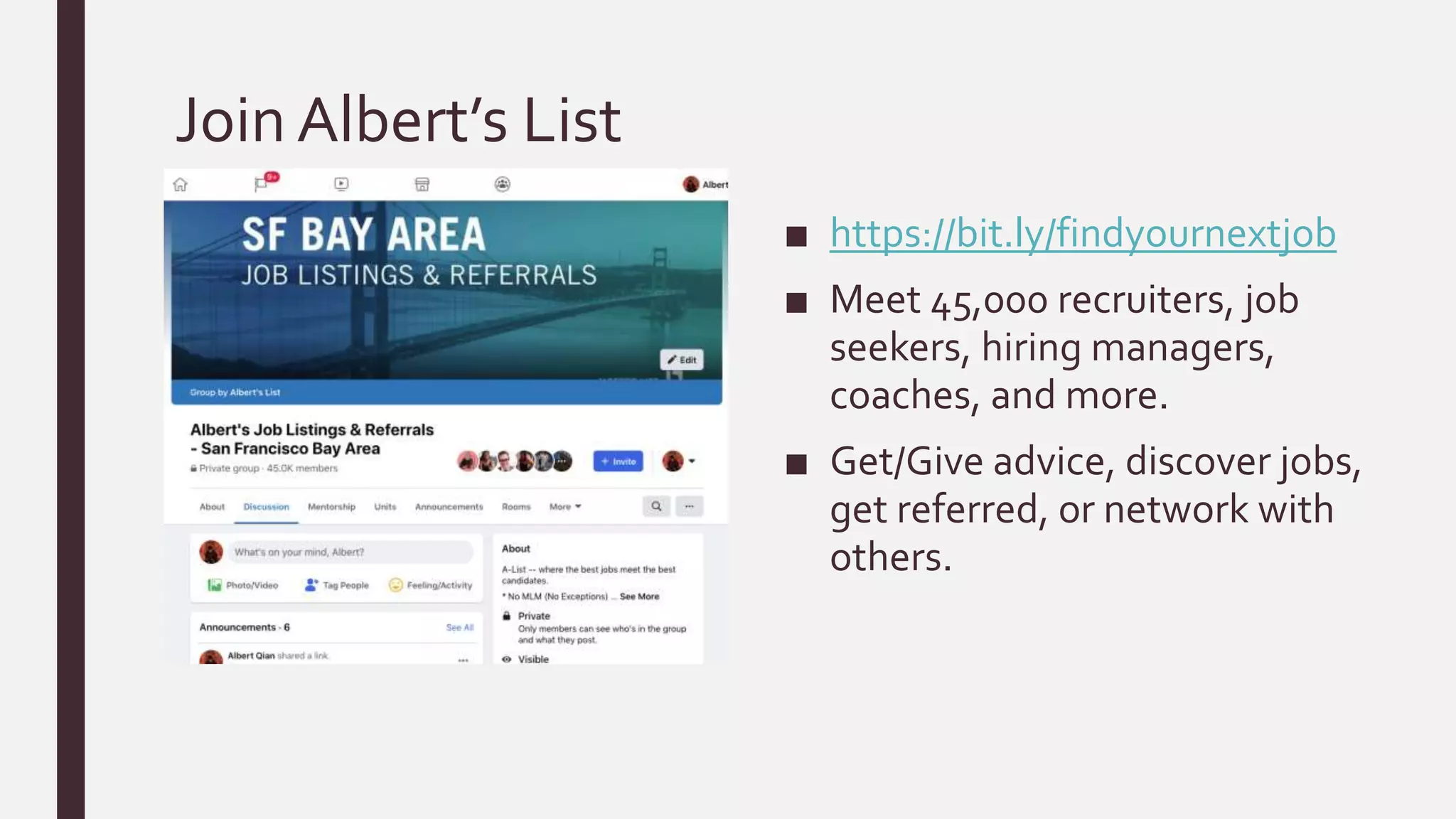
Join Albert’s List
■ https://bit.ly/findyournextjob
■ Meet 45,000 recruiters, job
seekers, hiring managers,
coaches, and more.
■ Get/Give advice, discover jobs,
get referred, or network with
others.
Q&A + Let’s Connect
■ Connect with me on LinkedIn:
www.linkedin.com/in/albertqian
■ Send me an email: albert@ajobslist.com
■ Follow me onTwitter: @albertqian
THANKYOU

Resume and Interview Tips to Stand Out in 2021

  • 1.
    STANDING OUT IN YOURJOB SEARCH IN 2021 Albert Qian Albert’s List January 14, 2020
  • 2.
    About Me ■ Contentstrategist and writer for tech companies in the San Francisco Bay Area ■ Founded Albert’s List, a community of 45,000 members on Facebook to support and connect job seekers to various resources — bit.ly/findyournextjob ■ Born and raised in the San Francisco BayArea.
  • 3.
    The Problem Too manyof us are sitting at our desks suffering in a state of silence and hoping someone will finally notice us. Is this you? 🙌 🙌
  • 4.
    The Solution Find away to get noticed. Stand up for what makes you amazing. Show up like never before. Is this what you want? 🙌
  • 5.
    Agenda ■ The Stateof the Job Search ■ Best Practice #1: Learn toTell a Story ■ Best Practice #2: Don’t SellYourself Short ■ Best Practice #3: Play the Game inYour Favor ■ Best Practice #4: KnowWhat’s at Stake ■ Great—Now How Do I Get Hired?
  • 6.
    THE STATE OFTHEJOB SEARCH
  • 7.
    What’s Changed: Interviewsare Remote ■ 62% of workers are now remote. ■ Many interview processes are occurring over Zoom. ■ After the pandemic is over, remote work will continue. ■ Dressing for the Interview: Business casual or formal still good, sweats good for bottom
  • 8.
    What’s Changed: COVID-19is an Excuse ■ 2020 is a mulligan—every employer understands that COVID-19 happened. ■ Indicate as such on your resume and within your interview. ■ Employers and hiring managers should understand that everyone went through financial challenges and more.
  • 9.
    What’s Not Changed:TheMarket is Competitive ■ More than 30 million Americans are out of work, and that includes people who have stopped taking benefits. ■ Companies are receiving more applications than ever. ■ As COVID-19 mutates, more lockdowns and uncertainty loom
  • 10.
    What’s Not Changed:Interview Homework ■ It’s a competitive market and employers can take advantage. ■ More than ever, employers need to find a way to weed out the great from the good.
  • 11.
    The Onus isOnYou to Stand Out ■ Don’t depend on luck. ■ Build the skills. ■ Create the confidence. ■ Stop selling yourself short.
  • 12.
    How this PresentationWasCreated ■ 40+ mock interview sessions and 5+ resume review sessions in 2020 onAlbert’s List. ■ A lot of conversations with job seekers. ■ Join us for future sessions or sit in the hot seat yourself. ■ Email albert@ajobslist.com.
  • 13.
  • 14.
    An Interview isMoreThanAnswers ■ It’s not just the what or the how, but also the why. ■ Stories help you stand out from a competitive market. ■ Luckily, interview stories offer a model you can use.
  • 15.
    What’s in aStory? ■ What: Explain the challenge? ■ Who:Which people were involved? ■ Why: Describe why the problem was important. ■ How: How was the problem solved? ■ Other Elements: Hero, Good News, Business success
  • 16.
    The STAR Method ■Situation ■ Task ■ Action ■ Result
  • 17.
    WhatAbout Personal Questions? ■Your authenticity matters. ■ Reflecting on your journey will help you a lot here. ■ Know how your career connects.Why did you take your previous jobs?
  • 18.
    Finally, a NoteAbout COVID-19 ■ 2020 is a mulligan—every employer understands that COVID-19 happened. ■ Keep your answers short—whether furlough or layoff.
  • 19.
    Example Storytelling Questions ■Walk me through your resume. ■ Why do you want to work here? ■ Tell me about a time when you… ■ Can you explain why you did… ■ Name a project you are proud of…
  • 20.
    BEST PRACTICE #2:POSITION YOURSELF
  • 23.
    Lessons #1 From2020 ■ Job seekers regularly sell themselves short on their resumes and job interviews. ■ Minimizing project and career successes. ■ Ignoring what hiring managers care about (more on that later).
  • 24.
    Where Does SellingYourselfShort Appear? ■ Resume ■ Interviews ■ Online Presence ■ Networking
  • 25.
    Example: Resume “Authored blogposts about SaaS solutions” “Served as the editor-in-chief of the company blog, increasing blog views by 30%Y/Y” WhatYou Might Write WhatYou ShouldWrite “Developed software using the MEAN stack” “Collaborated with product management team to develop software using the MEAN stack, increasing app engagement by 25%”
  • 26.
    Example: Interview “I helpedmy boss create marketing collateral to drive product interest” “I co-led a marketing program that involved creating marketing collateral, leveraging social media, and email marketing—which led to 20% more sales” WhatYou Might Say WhatYou Should Say “I’ve created a few software applications in my time” “I’m very passionate about healthcare technology and have helped several companies develop applications with 15% increased user engagement year over year— including over iOS and Android”
  • 27.
    A Note AboutContracting & Consulting ■ Market yourself as a consultant to look better. ■ Place your multiple contracts under one employer—yours or a firm. ■ Longevity still matters—but the COVID-19 mulligan applies.
  • 28.
    Even though Itook breaks from Cisco between 2011-14 for other roles, I group it so it looks continuous
  • 29.
    What’s the Lesson? ■Where possible, go into detail about what you have done and done well. ■ When in doubt, don’t hold back. ■ Focus on the strategic value to your future employer.
  • 30.
    Example QuestionsTo ShowcaseYour Potential ■Tell me about your proudest project… ■ Share a time you were successful… ■ What would you like to accomplish in your next role? ■ What are you most passionate about?
  • 31.
    BEST PRACTICE #3:DON’TTELLA LIE
  • 32.
    Yes,There areTrick Questions ■Hiring managers will ask questions that could trip you. ■ Knowing the answers to these questions in advance helps. ■ Writing them out helps as well.
  • 33.
    Why AskTrick Questions? ■Assessment of risk. ■ Understanding how you operate under pressure. ■ Seeing how you think. ■ Weeding out the bad candidates in the interview process.
  • 34.
    Example: “Why didyou leave your last company? “I was unfortunately laid off by my previous employer. I wasn’t doing well and it was time” “I was no longer happy and so I left.” “The previous company I was at was going through changes. Unfortunately, I was a part of those changes.” “The company decided to go in another direction and unfortunately, I wasn’t in those plans." WhatYou Might Say WhatYou Should Say
  • 35.
    How to NavigateTheToughQuestions ■ Reduce your risk as much as possible. ■ Script your answers far in advance. ■ Understand that it is sometimes filler.
  • 36.
    Example Questions toAnswer Strategically ■ Why did you leave your last job? ■ Where do you see yourself in five years? ■ What do you think about doing extra work?
  • 37.
    BEST PRACTICE #4:KNOWWHAT’S AT STAKE
  • 38.
    The Hiring Hierarchy Fundamentals Skills Stakes ResilienceCharacter Commitment Dynamics Vision Metrics Leadership
  • 39.
  • 40.
    What it LooksLike in the Interview ■ Sharing what you understand about the role. ■ Knowing what each person cares about. ■ Answering the question like you did your homework.
  • 41.
  • 42.
    What are yourBoss’ stakes? ■ Why are they in the job? ■ What are their goals? ■ How do you fit with their goals? ■ What pressure(s) do they face?
  • 43.
    Getting clear onyour Boss What matters to you + what matters to the boss And Where the two intersect
  • 44.
    Questions to askyour boss ■ What can I do to make you look really good? ■ What are your top priorities today? ■ What is your vision for this role? ■ How do you lead?
  • 45.
  • 46.
    Example:What is atstake for your customers and investors? ■ They pay your bills (#1) ■ They serve the vision ■ They make your executives nervous ■ They make you pivot ■ Essentially… they own you Write it out for your next job interview!
  • 47.
    Example: Getting clearon your customers and investors What matters to you + what matters to them And Collaborating towards success
  • 48.
    Example: Understanding What’s atStake in a Job Description ■ What do you think is at stake? – Professional social media presence – Building new assets while maintaining existing ones – Track bottom-line results – To name a few… ■ What do you think the interview questions will be? ■ How will you communicate that you know what’s at stake?
  • 49.
    Example: Understanding What’s atStake in a Job Description ■ What do you think is at stake? – Startup environment where independence is valued – Table stakes software engineering experience ■ What do you think the interview questions will be? ■ How will you communicate that you know what’s at stake?
  • 50.
  • 51.
    Connect toYour NextJob ■ More than 30 million Americans are jobless ■ It’s not who you know or what you know — it is who knows you ■ Consider reaching out ■ Focus your networking
  • 52.
    Interview InYour Favor ■Best Practice #1: Learn toTell a Story ■ Best Practice #2: Don’t SellYourself Short ■ Best Practice #3: Play the Game inYour Favor ■ Best Practice #4: KnowWhat’s at Stake
  • 53.
    Level UpYour Skills ■Many places are offering free courses (Ivy Leagues, Udemy): https://coronavirus.providence.org/blog/uf/609098130 ■ Consider a certification (HubSpot, Salesforce) ■ Invest in yourself (LinkedIn Learning, Lynda) ■ Take advantage of scholarships – Google: https://grow.google/certificates/ – Udacity: https://www.udacity.com/scholarships
  • 54.
    Join Albert’s List ■https://bit.ly/findyournextjob ■ Meet 45,000 recruiters, job seekers, hiring managers, coaches, and more. ■ Get/Give advice, discover jobs, get referred, or network with others.
  • 55.
    Q&A + Let’sConnect ■ Connect with me on LinkedIn: www.linkedin.com/in/albertqian ■ Send me an email: albert@ajobslist.com ■ Follow me onTwitter: @albertqian
  • 56.