Pharmaceutical Quality System (ICH Q 10 Model) Elements of PQS  Management & Applications
Presentation Outline Elements of PQS Management of each PQS element  Applications of each PQS element  What is Change? Change Management Examples where Change Control is required
Elements of PQS Process performance and Product quality monitoring system Corrective action  and  preventive action  (CAPA) system  Change management system  Management review of process performance and product quality
Elements of PQS Intent of including these elements in Q10 model is to enhance these elements  to promote the lifecycle approach to product quality.
Elements of PQS Should be applied in a manner that is appropriate and proportionate to each of the product lifecycle stages, recognizing the differences among the stages and the different goals of each stage.
Elements of PQS To evaluate the opportunities for innovative approaches to improve  Product Quality  throughout the  product lifecycle .
Process Performance, Product Quality Monitoring System Planning and executing a system for the monitoring of process performance and product quality to ensure that  a state of control is maintained.
Product Performance & Product Quality Monitoring System To provide assurance of the  continued capability  of processes and controls to produce a product of desired quality and to identify areas for  continual improvement .
Effective Monitoring System Establish the  control strategy , using  quality risk management; parameters and attributes related to drug substance and drug product materials and components facility and equipment operating conditions,  in-process controls, finished product specifications, and  the associated methods and frequency of monitoring and control.
Effective Monitoring System The control strategy should facilitate timely  feedback / feed forward   and appropriate  Corrective action and Preventive action.
Effective Monitoring System Provide the tools for measurement and analysis of parameters and attributes identified in the control strategy (e.g., data management and statistical tools).  Analyze parameters and attributes identified in the control strategy to verify continued operation within  a state of control.
Effective Monitoring System Identify sources of variation affecting process performance and product quality for potential  continual improvement  activities to reduce or control variation.
Effective Monitoring System Include feedback on product quality from both internal and external sources (e.g., complaints, product rejections, non-conformances, recalls, deviations, audits and regulatory inspections, and findings).
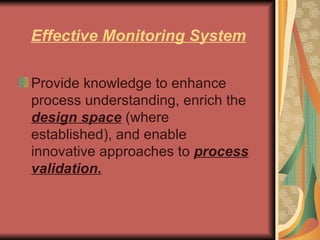
Effective Monitoring System Provide knowledge to enhance process understanding, enrich the  design space   (where established), and enable innovative approaches to  process validation.
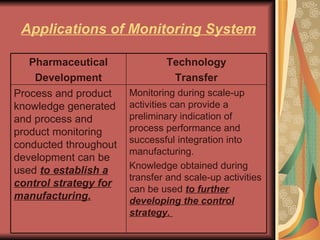
Applications of Monitoring System Monitoring during scale-up activities can provide a preliminary indication of process performance and successful integration into manufacturing. Knowledge obtained during transfer and scale-up activities can be used  to further developing the control strategy.  Process and product knowledge generated and process and product monitoring conducted throughout development can be used  to establish a control strategy for manufacturing. Technology Transfer Pharmaceutical Development
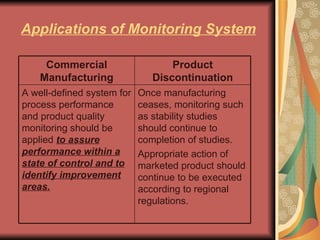
Applications of Monitoring System Once manufacturing ceases, monitoring such as stability studies should continue to completion of studies. Appropriate action of marketed product should continue to be executed according to regional regulations. A well-defined system for process performance and product quality monitoring should be applied  to assure performance within a state of control and to identify improvement areas. Product Discontinuation Commercial Manufacturing
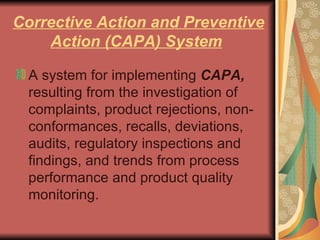
Corrective Action and Preventive Action (CAPA) System   A system for implementing  CAPA,  resulting from the investigation of complaints, product rejections, non-conformances, recalls, deviations, audits, regulatory inspections and findings, and trends from process performance and product quality monitoring.
Corrective Action and Preventive Action (CAPA) System   A structured approach to the investigation process should be used with the objective of determining the  root cause.  The level of effort, formality, and documentation of the investigation should be commensurate  with the level of risk , in line with ICH Q9.
Corrective Action and Preventive Action (CAPA) System   CAPA methodology should result in  product and process improvements  and  enhanced product and process understanding.
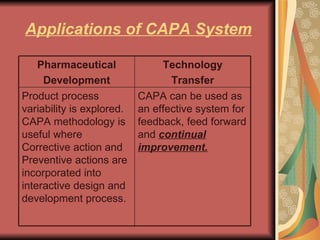
Applications of CAPA System CAPA can be used as an effective system for feedback, feed forward and  continual improvement.   Product process variability is explored. CAPA methodology is useful where Corrective action and Preventive actions are incorporated into interactive design and development process. Technology Transfer Pharmaceutical Development
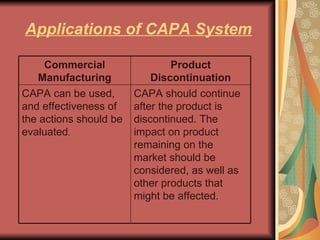
Applications of CAPA System CAPA should continue after the product is discontinued. The impact on product remaining on the market should be considered, as well as other products that might be affected. CAPA can be used, and effectiveness of the actions should be evaluated . Product Discontinuation Commercial Manufacturing
Change Management System Change  is the result of  Innovation,  Continual Improvement,  The outputs of process performance and product quality monitoring, and  CAPA.
Change Management System To evaluate, approve, and implement these changes properly, there should be an  effective  change management system.
Change Management System There is generally a difference in formality of change management processes prior to the initial regulatory submission and after submission, where changes to the regulatory filing might be required under regional requirements.
Change Management System Ensures that  continual improvement  is undertaken in a  timely and effective manner.   Provides a  high degree of assurance  that there are  no unintended consequences of the change.
Change Management System Should include, as appropriate for the stage of the product life cycle; Quality risk management to evaluate proposed changes.  The level of effort and formality of the evaluation should correspond to the level of risk.
Change Management System Proposed changes should be evaluated relative to the marketing authorization, including design space, where established, and/or current product and process understanding.
Change Management System There should be an assessment to determine whether a change to the regulatory filing is required under regional requirements.
Change Management System Working within the design space is not considered a change from a regulatory filing perspective (ICH8). Still, from a PQS standpoint all changes should be evaluated by a company’s change management system.
Change Management System Proposed changes should be evaluated by expert teams contributing the appropriate expertise and knowledge from relevant areas (e.g., Pharmaceutical Development, Manufacturing, Quality, Regulatory Affairs, and Medical)  to ensure the change is technically justified.
Change Management System Prospective evaluation criteria for a proposed change should be set.
Change Management System After implementation, an evaluation of the change should be undertaken  to confirm that change objectives were achieved  and that  there was no deleterious impact on product quality.
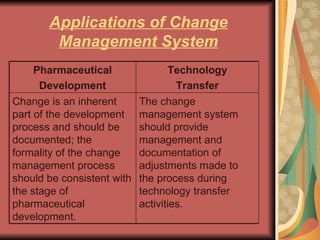
Applications of Change Management System The change management system should provide management and documentation of adjustments made to the process during technology transfer activities. Change is an inherent part of the development process and should be documented; the formality of the change management process should be consistent with the stage of pharmaceutical development. Technology Transfer Pharmaceutical Development
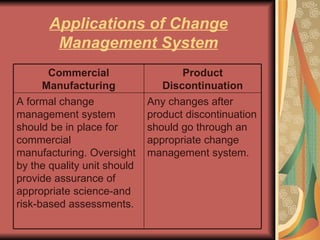
Applications of Change Management System Any changes after product discontinuation should go through an appropriate change management system.  A formal change management system should be in place for commercial manufacturing. Oversight by the quality unit should provide assurance of appropriate science-and risk-based assessments. Product Discontinuation Commercial Manufacturing
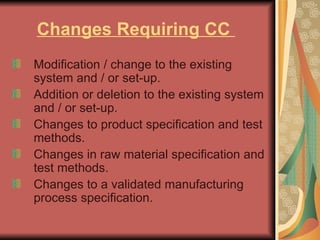
Changes Requiring CC  Modification / change to the existing system and / or set-up.  Addition or deletion to the existing system and / or set-up.  Changes to product specification and test methods.  Changes in raw material specification and test methods.  Changes to a validated manufacturing process specification.
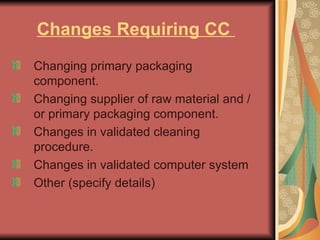
Changes Requiring CC  Changing primary packaging component.  Changing supplier of raw material and / or primary packaging component. Changes in validated cleaning procedure. Changes in validated computer system Other (specify details)
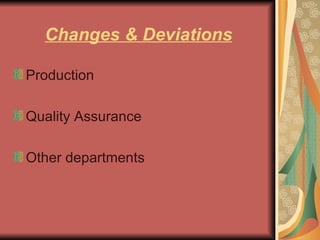
Changes & Deviations Production Quality Assurance Other departments
Management Review System Provides assurance that process performance and product quality are managed over the lifecycle.
Management Review System Management review can be a series of reviews at various levels of management, depending on the size and complexity of the company.  Ensures a timely and effective communication and escalation process to raise appropriate quality issues to senior levels of management for review.
Management Review System Management review should include the results of regulatory inspections and findings, audits and other assessments, and commitments made to regulatory authorities .
Management Review System MRS should include periodic quality reviews, such as:  Measures of customer satisfaction such as product quality complaints and recalls.  Conclusions of process performance and product quality monitoring.  The effectiveness of process and product changes including those arising from CAPA.
Management Review System MR should include any follow-up actions from previous management reviews. MR should identify appropriate actions, such as: Improvements to manufacturing processes and products  Provision, training, and/or realignment of resources
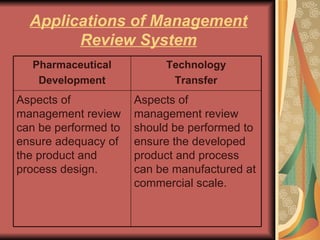
Applications of Management Review System Aspects of management review should be performed to ensure the developed product and process can be manufactured at commercial scale. Aspects of management review can be performed to ensure adequacy of the product and process design. Technology Transfer Pharmaceutical Development
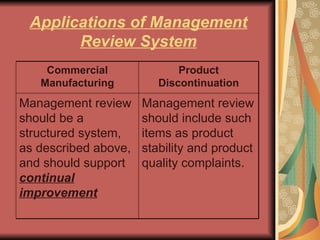
Applications of Management Review System Management review should include such items as product stability and product quality complaints.  Management review should be a structured system, as described above, and should support  continual improvement Product Discontinuation Commercial Manufacturing
QUESTIONS?
THANKS

Pqs220610.Ppt

  • 1.
    Pharmaceutical Quality System(ICH Q 10 Model) Elements of PQS Management & Applications
  • 2.
    Presentation Outline Elementsof PQS Management of each PQS element Applications of each PQS element What is Change? Change Management Examples where Change Control is required
  • 3.
    Elements of PQSProcess performance and Product quality monitoring system Corrective action and preventive action (CAPA) system Change management system Management review of process performance and product quality
  • 4.
    Elements of PQSIntent of including these elements in Q10 model is to enhance these elements to promote the lifecycle approach to product quality.
  • 5.
    Elements of PQSShould be applied in a manner that is appropriate and proportionate to each of the product lifecycle stages, recognizing the differences among the stages and the different goals of each stage.
  • 6.
    Elements of PQSTo evaluate the opportunities for innovative approaches to improve Product Quality throughout the product lifecycle .
  • 7.
    Process Performance, ProductQuality Monitoring System Planning and executing a system for the monitoring of process performance and product quality to ensure that a state of control is maintained.
  • 8.
    Product Performance &Product Quality Monitoring System To provide assurance of the continued capability of processes and controls to produce a product of desired quality and to identify areas for continual improvement .
  • 9.
    Effective Monitoring SystemEstablish the control strategy , using quality risk management; parameters and attributes related to drug substance and drug product materials and components facility and equipment operating conditions, in-process controls, finished product specifications, and the associated methods and frequency of monitoring and control.
  • 10.
    Effective Monitoring SystemThe control strategy should facilitate timely feedback / feed forward and appropriate Corrective action and Preventive action.
  • 11.
    Effective Monitoring SystemProvide the tools for measurement and analysis of parameters and attributes identified in the control strategy (e.g., data management and statistical tools). Analyze parameters and attributes identified in the control strategy to verify continued operation within a state of control.
  • 12.
    Effective Monitoring SystemIdentify sources of variation affecting process performance and product quality for potential continual improvement activities to reduce or control variation.
  • 13.
    Effective Monitoring SystemInclude feedback on product quality from both internal and external sources (e.g., complaints, product rejections, non-conformances, recalls, deviations, audits and regulatory inspections, and findings).
  • 14.
    Effective Monitoring SystemProvide knowledge to enhance process understanding, enrich the design space (where established), and enable innovative approaches to process validation.
  • 15.
    Applications of MonitoringSystem Monitoring during scale-up activities can provide a preliminary indication of process performance and successful integration into manufacturing. Knowledge obtained during transfer and scale-up activities can be used to further developing the control strategy. Process and product knowledge generated and process and product monitoring conducted throughout development can be used to establish a control strategy for manufacturing. Technology Transfer Pharmaceutical Development
  • 16.
    Applications of MonitoringSystem Once manufacturing ceases, monitoring such as stability studies should continue to completion of studies. Appropriate action of marketed product should continue to be executed according to regional regulations. A well-defined system for process performance and product quality monitoring should be applied to assure performance within a state of control and to identify improvement areas. Product Discontinuation Commercial Manufacturing
  • 17.
    Corrective Action andPreventive Action (CAPA) System A system for implementing CAPA, resulting from the investigation of complaints, product rejections, non-conformances, recalls, deviations, audits, regulatory inspections and findings, and trends from process performance and product quality monitoring.
  • 18.
    Corrective Action andPreventive Action (CAPA) System A structured approach to the investigation process should be used with the objective of determining the root cause. The level of effort, formality, and documentation of the investigation should be commensurate with the level of risk , in line with ICH Q9.
  • 19.
    Corrective Action andPreventive Action (CAPA) System CAPA methodology should result in product and process improvements and enhanced product and process understanding.
  • 20.
    Applications of CAPASystem CAPA can be used as an effective system for feedback, feed forward and continual improvement. Product process variability is explored. CAPA methodology is useful where Corrective action and Preventive actions are incorporated into interactive design and development process. Technology Transfer Pharmaceutical Development
  • 21.
    Applications of CAPASystem CAPA should continue after the product is discontinued. The impact on product remaining on the market should be considered, as well as other products that might be affected. CAPA can be used, and effectiveness of the actions should be evaluated . Product Discontinuation Commercial Manufacturing
  • 22.
    Change Management SystemChange is the result of Innovation, Continual Improvement, The outputs of process performance and product quality monitoring, and CAPA.
  • 23.
    Change Management SystemTo evaluate, approve, and implement these changes properly, there should be an effective change management system.
  • 24.
    Change Management SystemThere is generally a difference in formality of change management processes prior to the initial regulatory submission and after submission, where changes to the regulatory filing might be required under regional requirements.
  • 25.
    Change Management SystemEnsures that continual improvement is undertaken in a timely and effective manner. Provides a high degree of assurance that there are no unintended consequences of the change.
  • 26.
    Change Management SystemShould include, as appropriate for the stage of the product life cycle; Quality risk management to evaluate proposed changes. The level of effort and formality of the evaluation should correspond to the level of risk.
  • 27.
    Change Management SystemProposed changes should be evaluated relative to the marketing authorization, including design space, where established, and/or current product and process understanding.
  • 28.
    Change Management SystemThere should be an assessment to determine whether a change to the regulatory filing is required under regional requirements.
  • 29.
    Change Management SystemWorking within the design space is not considered a change from a regulatory filing perspective (ICH8). Still, from a PQS standpoint all changes should be evaluated by a company’s change management system.
  • 30.
    Change Management SystemProposed changes should be evaluated by expert teams contributing the appropriate expertise and knowledge from relevant areas (e.g., Pharmaceutical Development, Manufacturing, Quality, Regulatory Affairs, and Medical) to ensure the change is technically justified.
  • 31.
    Change Management SystemProspective evaluation criteria for a proposed change should be set.
  • 32.
    Change Management SystemAfter implementation, an evaluation of the change should be undertaken to confirm that change objectives were achieved and that there was no deleterious impact on product quality.
  • 33.
    Applications of ChangeManagement System The change management system should provide management and documentation of adjustments made to the process during technology transfer activities. Change is an inherent part of the development process and should be documented; the formality of the change management process should be consistent with the stage of pharmaceutical development. Technology Transfer Pharmaceutical Development
  • 34.
    Applications of ChangeManagement System Any changes after product discontinuation should go through an appropriate change management system. A formal change management system should be in place for commercial manufacturing. Oversight by the quality unit should provide assurance of appropriate science-and risk-based assessments. Product Discontinuation Commercial Manufacturing
  • 35.
    Changes Requiring CC Modification / change to the existing system and / or set-up. Addition or deletion to the existing system and / or set-up. Changes to product specification and test methods. Changes in raw material specification and test methods. Changes to a validated manufacturing process specification.
  • 36.
    Changes Requiring CC Changing primary packaging component. Changing supplier of raw material and / or primary packaging component. Changes in validated cleaning procedure. Changes in validated computer system Other (specify details)
  • 37.
    Changes & DeviationsProduction Quality Assurance Other departments
  • 38.
    Management Review SystemProvides assurance that process performance and product quality are managed over the lifecycle.
  • 39.
    Management Review SystemManagement review can be a series of reviews at various levels of management, depending on the size and complexity of the company. Ensures a timely and effective communication and escalation process to raise appropriate quality issues to senior levels of management for review.
  • 40.
    Management Review SystemManagement review should include the results of regulatory inspections and findings, audits and other assessments, and commitments made to regulatory authorities .
  • 41.
    Management Review SystemMRS should include periodic quality reviews, such as: Measures of customer satisfaction such as product quality complaints and recalls. Conclusions of process performance and product quality monitoring. The effectiveness of process and product changes including those arising from CAPA.
  • 42.
    Management Review SystemMR should include any follow-up actions from previous management reviews. MR should identify appropriate actions, such as: Improvements to manufacturing processes and products Provision, training, and/or realignment of resources
  • 43.
    Applications of ManagementReview System Aspects of management review should be performed to ensure the developed product and process can be manufactured at commercial scale. Aspects of management review can be performed to ensure adequacy of the product and process design. Technology Transfer Pharmaceutical Development
  • 44.
    Applications of ManagementReview System Management review should include such items as product stability and product quality complaints. Management review should be a structured system, as described above, and should support continual improvement Product Discontinuation Commercial Manufacturing
  • 45.
  • 46.