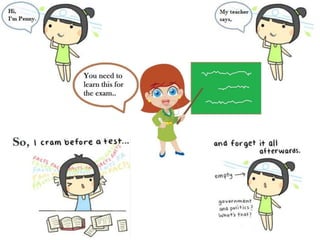

Can you identify yourself with Penny?
I guess we all can.
Because this is what our assessment
system is like.
It teaches us to memorize.
Is that QUALITY LEARNING?
This question introduces a new
concept
School Based Assessment
In Bangladesh
Wasima Nahrin
Department of Educational Evaluation and Research
Institute of Education and Research
University of Dhaka
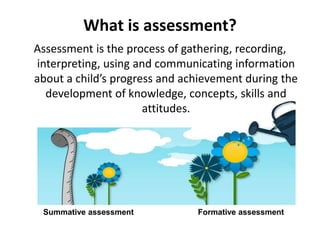
What is assessment?
Assessment is the process of gathering, recording,
interpreting, using and communicating information
about a child’s progress and achievement during the
development of knowledge, concepts, skills and
attitudes.
Summative assessment Formative assessment
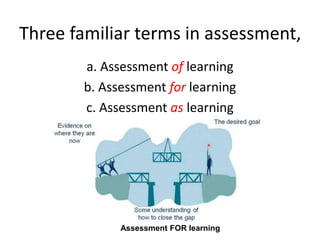
Three familiar terms in assessment,
a. Assessment of learning
b. Assessment for learning
c. Assessment as learning
Assessment FOR learning
What is School Based Assessment(SBA)?
An assessment embedded in the teaching and
learning process within the broader
educational philosophy of ‘assessment for
learning’.
History of SBA
1978; SBA first introduced in HKALE (Hong Kong Advanced
Level Examination) AL examination for Chemistry so that
there could be an assessment of laboratory work.
September 2000; School-based Assessment (SBA) was first
proposed in the Reform Proposals for the Education System
in Hong Kong.
By 2006, school based assessment had been implemented
in 13 'A' Level subjects and 13 Certificate of Education
subjects, including English language.
Introducing SBA in Bangladesh
In 2003, The Secondary Education Sector Improvement Project
(SESIP) developed SBA system for classes VI–IX under the
leadership of the National Curriculum and Text Book Board
(NCTB) Secondary Assessment Unit.
In 2005, Ministry of Education (MOE) under the Government of
the Peoples of Bangladesh circulated a notice (MOE, 2005) on
implementing SBA system for the students of classes VI-IX in all
the secondary schools in Bangladesh.
In 2006, School Based Assessment got introduced in secondary
classrooms of Bangladesh.
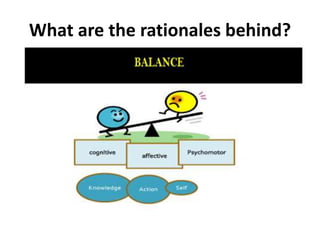
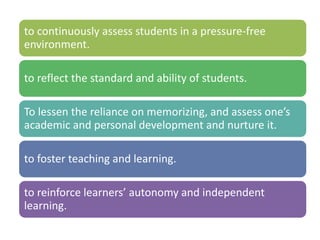
What are the rationales behind?
to continuously assess students in a pressure-free
environment.
to reflect the standard and ability of students.
To lessen the reliance on memorizing, and assess one’s
academic and personal development and nurture it.
to foster teaching and learning.
to reinforce learners’ autonomy and independent
learning.
What are the Characteristics?
Run by the
teacher
Criterion based
assessment
Formative
-continuous
-diagnostic
Emphasizes on
record keeping Varied methods
-observation
-oral
-writing
Diagnose student
overall learning
process (intellect,
moral, emotion,
physical)Encourage self-
evaluation
Emphasize on
individual
development
Systematic
Enable further
action
SBA: A Criterion Based Assessment
Criteria is a basis to assess individual students
throughout the year in each subject under SBA:
a. Attendance in class and interest in learning
b. Assessment (class-wise)
c. Assignments (individual/in group)
d. Behavior, values and honesty
e. Presentation of speech (individual and group
discussions)
SBA: A Criterion Based Assessment (contd.)
f. Leadership qualities
g. Discipline
h. Participation in cultural activities
i. Performance in sports and games
j. Practical classes in science subjects.
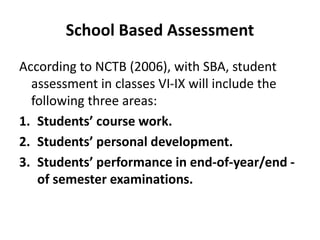
School Based Assessment
According to NCTB (2006), with SBA, student
assessment in classes VI-IX will include the
following three areas:
1. Students’ course work.
2. Students’ personal development.
3. Students’ performance in end-of-year/end -
of semester examinations.
1. Students’ coursework
Includes learning activities under six criteria
undertaken by the students both in school and at
home.
 Class tests
 Class work
 Homework
 Assignments
 Oral presentation
 Group work
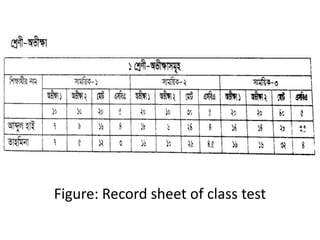
Class test
Instructions for assessment:
• Careful scoring.
• Written or verbal feedback.
• No matter how many tests
are given, total score of a
student will be converted into 5.
Figure: Record sheet of class test
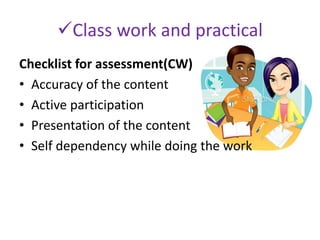
Class work and practical
Checklist for assessment(CW)
• Accuracy of the content
• Active participation
• Presentation of the content
• Self dependency while doing the work
Figure: record sheet of class work
Class work and practical (contd.)
Checklist for assessment(practical)
• Instructions following capability
• Use of apparatus and other instruments
• Interest and motivation in work
• Individual/group work fitness
Figure: Record sheets of class work and practical
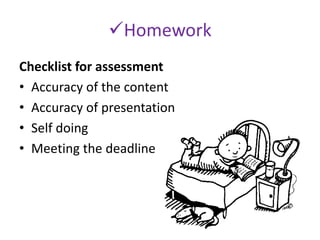
Homework
Checklist for assessment
• Accuracy of the content
• Accuracy of presentation
• Self doing
• Meeting the deadline
Assignment
Checklist for assessment
• Instructions following capability
• Getting grab on the content
• Completing homework by own self
• Presentation of the report
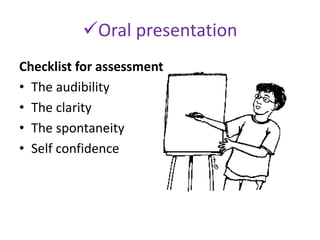
Oral presentation
Checklist for assessment
• The audibility
• The clarity
• The spontaneity
• Self confidence
Group work
Checklist for assessment
• Active discussion and participation of each
member of the group
• Motivating each others
• Willingness of listening to
others and being considerate
to others’ opinions.
• coming to a general conclusion from different
viewpoints.
2. Students personal development
Includes three areas:
 student behavior at school
Personal and social values
Participation at co-curricular activities
Student behavior at school
Checklist for assessment:
• Being respectful to school regulations
• Being decent in behavior
• Being considerate to others
• Being co-operative
• Leadership skills
• Motivation and hard work
Figure: Record sheet of student behavior
Personal and social values
Checklist for assessment:
• Differentiating between right and wrong
• Consciousness about duties and rights as a student
and a member of a family as well
• Considerate attitude towards people of different
culture, religion and capability
• Taking pride for nation, community, family, school
and for country.
• Consciousness about social problems and taking
action accordingly
Participation at co-curricular
activities
Instructions for assessment:
• Making a list of those(students and teachers) who
actively participates in cultural programs.
• Making a register of students who regularly
participates in Boys’ scout/Girls’ guide activities.
• Making a list of students who participates in different
sports activities throughout the year.
3. Students’ performance in end-of-
year/end - of semester examinations
Class test = 5
Class work = 5
Practical work = 5
Assignment = 5
Home work = 5
Oral presentation = 5
Final
semester
exam(70
marks)
Student
course
work (30
marks)
Total of
100 marks
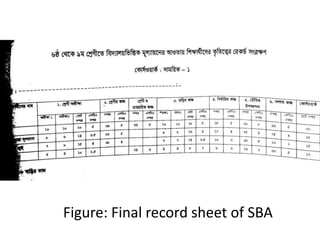
Figure: Final record sheet of SBA
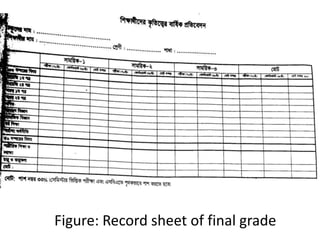
Figure: Record sheet of final grade
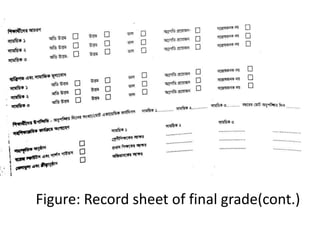
Figure: Record sheet of final grade(cont.)
Concerns
• Teacher-student ratio in a classroom.
• Teacher training.
• Teacher pay scale.
• Sincerity of teachers.
• Number of teachers in school.
• Making families and teachers understand the
necessity of SBA.
• Making technology available for students.
This presentation is finally over

School Based Assessment (SBA)

  • 2.
    Can you identifyyourself with Penny? I guess we all can. Because this is what our assessment system is like. It teaches us to memorize. Is that QUALITY LEARNING?
  • 3.
  • 4.
    School Based Assessment InBangladesh Wasima Nahrin Department of Educational Evaluation and Research Institute of Education and Research University of Dhaka
  • 5.
    What is assessment? Assessmentis the process of gathering, recording, interpreting, using and communicating information about a child’s progress and achievement during the development of knowledge, concepts, skills and attitudes. Summative assessment Formative assessment
  • 6.
    Three familiar termsin assessment, a. Assessment of learning b. Assessment for learning c. Assessment as learning Assessment FOR learning
  • 7.
    What is SchoolBased Assessment(SBA)? An assessment embedded in the teaching and learning process within the broader educational philosophy of ‘assessment for learning’.
  • 8.
    History of SBA 1978;SBA first introduced in HKALE (Hong Kong Advanced Level Examination) AL examination for Chemistry so that there could be an assessment of laboratory work. September 2000; School-based Assessment (SBA) was first proposed in the Reform Proposals for the Education System in Hong Kong. By 2006, school based assessment had been implemented in 13 'A' Level subjects and 13 Certificate of Education subjects, including English language.
  • 9.
    Introducing SBA inBangladesh In 2003, The Secondary Education Sector Improvement Project (SESIP) developed SBA system for classes VI–IX under the leadership of the National Curriculum and Text Book Board (NCTB) Secondary Assessment Unit. In 2005, Ministry of Education (MOE) under the Government of the Peoples of Bangladesh circulated a notice (MOE, 2005) on implementing SBA system for the students of classes VI-IX in all the secondary schools in Bangladesh. In 2006, School Based Assessment got introduced in secondary classrooms of Bangladesh.
  • 10.
    What are therationales behind?
  • 11.
    to continuously assessstudents in a pressure-free environment. to reflect the standard and ability of students. To lessen the reliance on memorizing, and assess one’s academic and personal development and nurture it. to foster teaching and learning. to reinforce learners’ autonomy and independent learning.
  • 12.
    What are theCharacteristics? Run by the teacher Criterion based assessment Formative -continuous -diagnostic Emphasizes on record keeping Varied methods -observation -oral -writing Diagnose student overall learning process (intellect, moral, emotion, physical)Encourage self- evaluation Emphasize on individual development Systematic Enable further action
  • 13.
    SBA: A CriterionBased Assessment Criteria is a basis to assess individual students throughout the year in each subject under SBA: a. Attendance in class and interest in learning b. Assessment (class-wise) c. Assignments (individual/in group) d. Behavior, values and honesty e. Presentation of speech (individual and group discussions)
  • 14.
    SBA: A CriterionBased Assessment (contd.) f. Leadership qualities g. Discipline h. Participation in cultural activities i. Performance in sports and games j. Practical classes in science subjects.
  • 15.
    School Based Assessment Accordingto NCTB (2006), with SBA, student assessment in classes VI-IX will include the following three areas: 1. Students’ course work. 2. Students’ personal development. 3. Students’ performance in end-of-year/end - of semester examinations.
  • 16.
    1. Students’ coursework Includeslearning activities under six criteria undertaken by the students both in school and at home.  Class tests  Class work  Homework  Assignments  Oral presentation  Group work
  • 17.
    Class test Instructions forassessment: • Careful scoring. • Written or verbal feedback. • No matter how many tests are given, total score of a student will be converted into 5.
  • 18.
    Figure: Record sheetof class test
  • 19.
    Class work andpractical Checklist for assessment(CW) • Accuracy of the content • Active participation • Presentation of the content • Self dependency while doing the work
  • 20.
    Figure: record sheetof class work
  • 21.
    Class work andpractical (contd.) Checklist for assessment(practical) • Instructions following capability • Use of apparatus and other instruments • Interest and motivation in work • Individual/group work fitness
  • 22.
    Figure: Record sheetsof class work and practical
  • 23.
    Homework Checklist for assessment •Accuracy of the content • Accuracy of presentation • Self doing • Meeting the deadline
  • 24.
    Assignment Checklist for assessment •Instructions following capability • Getting grab on the content • Completing homework by own self • Presentation of the report
  • 25.
    Oral presentation Checklist forassessment • The audibility • The clarity • The spontaneity • Self confidence
  • 26.
    Group work Checklist forassessment • Active discussion and participation of each member of the group • Motivating each others • Willingness of listening to others and being considerate to others’ opinions. • coming to a general conclusion from different viewpoints.
  • 27.
    2. Students personaldevelopment Includes three areas:  student behavior at school Personal and social values Participation at co-curricular activities
  • 28.
    Student behavior atschool Checklist for assessment: • Being respectful to school regulations • Being decent in behavior • Being considerate to others • Being co-operative • Leadership skills • Motivation and hard work
  • 29.
    Figure: Record sheetof student behavior
  • 30.
    Personal and socialvalues Checklist for assessment: • Differentiating between right and wrong • Consciousness about duties and rights as a student and a member of a family as well • Considerate attitude towards people of different culture, religion and capability • Taking pride for nation, community, family, school and for country. • Consciousness about social problems and taking action accordingly
  • 31.
    Participation at co-curricular activities Instructionsfor assessment: • Making a list of those(students and teachers) who actively participates in cultural programs. • Making a register of students who regularly participates in Boys’ scout/Girls’ guide activities. • Making a list of students who participates in different sports activities throughout the year.
  • 32.
    3. Students’ performancein end-of- year/end - of semester examinations Class test = 5 Class work = 5 Practical work = 5 Assignment = 5 Home work = 5 Oral presentation = 5 Final semester exam(70 marks) Student course work (30 marks) Total of 100 marks
  • 33.
  • 34.
    Figure: Record sheetof final grade
  • 35.
    Figure: Record sheetof final grade(cont.)
  • 36.
    Concerns • Teacher-student ratioin a classroom. • Teacher training. • Teacher pay scale. • Sincerity of teachers. • Number of teachers in school. • Making families and teachers understand the necessity of SBA. • Making technology available for students.
  • 37.