FUTURE PERSPECTIVES AND TRENDS IN
CURRICULUM
Joshua T. Soriano
Discussant
Objective:
• Student will about the perspectives and trends in
curriculum, including technology, changing needs of
learners and global issues.
Course task:
Conformed your curriculum according to the standard
of LRMDS and on futuristic trends in curiculum.
LET'S Go to the future ....
“The study of future is intellectually stimulating and seeks to
empower students. It draws on the innate capacity of the
human mind to engage in foresight, or futures thinking
enhanced by concepts, tools and techniques. When this
enhanced capacity to engage with ‘the future’ is
implemented in specific areas” (Slaughter, R., 2008)
ACTIVITY: MY FUTURE CURRICULUM
DEVELOPER
Mechanics:
1. Divide the class into two groups
2. Each group shall present an item from their stuff
corresponding to the the first letter of the English alphabet
Example : letter A = apple item ....another item
for B, C, D and so on...(1 point per item)
3. Each group will be given five (5) minutes to arrange
it in alphabetical order
ACTIVITY: MY FUTURE CURRICULUM
DEVELOPER
• 4. After the given time, conceptualize icons or symbols
that best represent a 21st century curriculum developer
(50 points)
• 5. Select a representative to explain and present your
output
• 6. The group with the highest number of points is declared
as the winner.
Our past ...
Understanding our Past
No one can predict the future with any high degree of
accuracy. Indeed, if we know anything about the future at
all, it is that the future will be very different from life today.
So trying to understand the future by studying the past
requires caution.
Key trends
With this understanding of the past it is possible to see how
the key trends shaping human society will effect us over the
next decade. (UNESCO, 2010 )
Eight of these trends are:
Increasing cultural differences
Globalization
Increasing gender equity
Eight of these trends are ... (continuation)
Advances in biotechnology
Religious revival
Rising environmental concern
Increasing poverty
Technology
Emerging trends in 21st century Curriculum
• 1) App Innovation and Gamification
“Mathalicious” and “Get the Math,” which provide practical,
true-to-life experiences. In DepEd a Gamath competititon is
being participated by Math and STEM teachers.
As students become comfortable utilizing online games to
learn, educators can entice students via new apps to fine-
tune skill-specific areas, such as mathematics and science.
Emerging trends in 21st century
2) Digital literacy
Digital literacy may
encompass simple student
tasks, such as creating
classroom presentations, or
more intricate, collaborative
work, such as video clip
creations or posting online
“mind-maps” using digital
tools.
Emerging trends in 21st century Curriculum
3. Library Media Specialist
They not only must establish
technology policies and
become responsible for
budget oversight, but they
must also plan the physical
and virtual library space, and
create a welcoming, positive
and innovative atmosphere.
The LRMDS ...
Emerging trends in 21st century Curriculum
4. Self-Directed
Professional Development
Schools are turning to self-
directed, online modules to
provide educators
opportunities to complete
interactive learning
components to remain
abreast of the latest
developments in education.
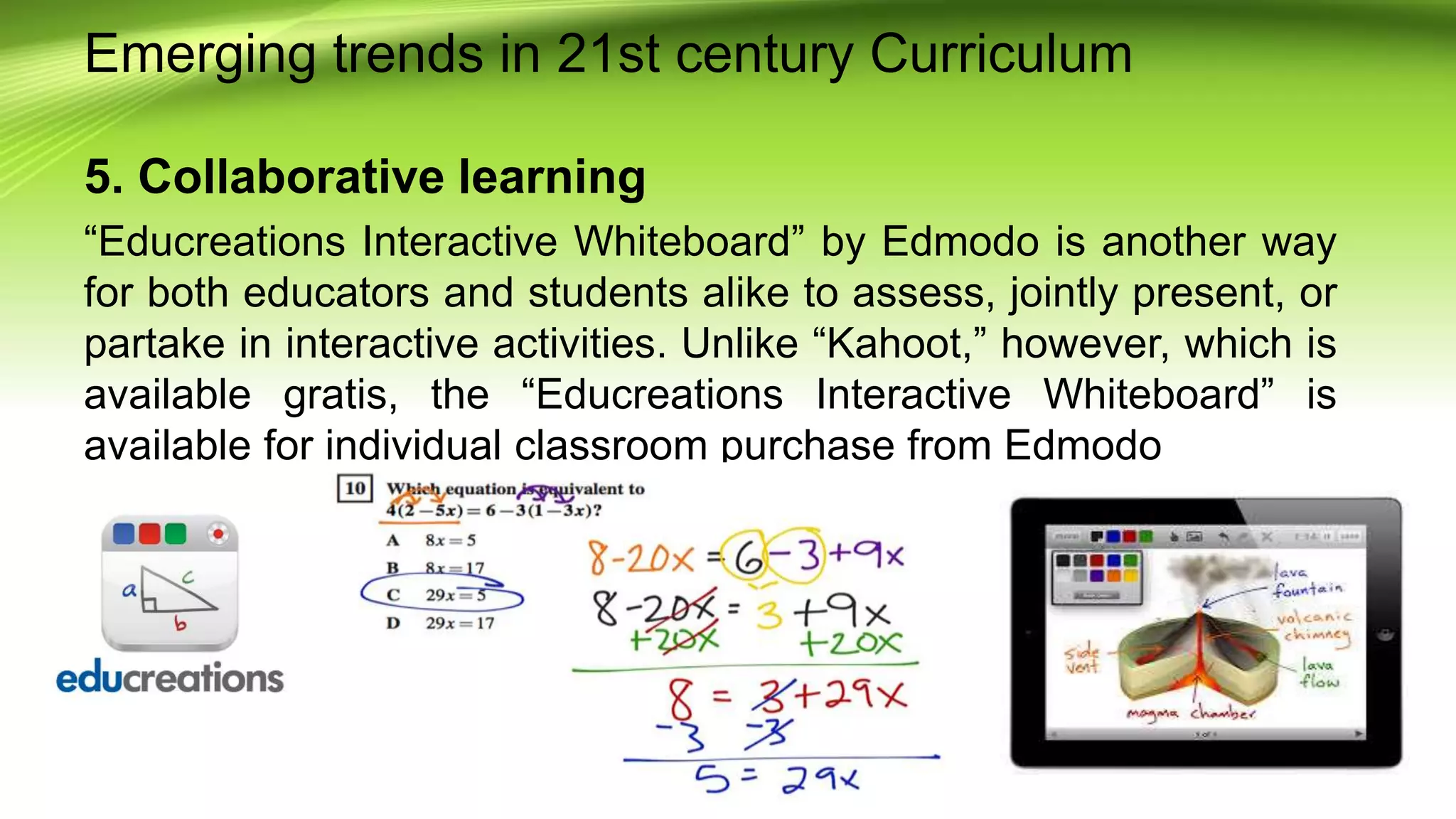
5. Collaborative learning
“Educreations Interactive Whiteboard” by Edmodo is another way
for both educators and students alike to assess, jointly present, or
partake in interactive activities. Unlike “Kahoot,” however, which is
available gratis, the “Educreations Interactive Whiteboard” is
available for individual classroom purchase from Edmodo
Emerging trends in 21st century Curriculum
Trends in Curriculum Assessment
1. Portfolio Assessment
• Traditional Portfolio • Digital portfolio
Trends in Curriculum Assessment
2. Standardized Assessment
• Considering the validity
and reliability of an
instrument
Trends in Curriculum Assessment
3. Authentic Assessment
The 21st Century Teacher and Learner
Proper guidance is needed for the learners ...
• Guidance from
teachers and
parents or gurdian
is indeed
important to
regulate the
information
acquaired by our
learners in this
digital era.
Sources:
• Slaughter, R. (2008) Futures Education: Catalyst for our
Times, Journal of Futures Studies, 12(3), pp.15-30.
• https://www.gettingsmart.com/2017/07/5-emerging-trends-
in-21st-century-education/
• http://www.unesco.org/education/tlsf/journal/tlsf_journal.ht
ml
Activity reference:
• http://www.unesco.org/education/tlsf/mods/theme_a/intera
ct/www.worldwatch.org/features/timeline/timeline.htm
THANK YOU !!!

Future perspectives and trends in curriculum

  • 1.
    FUTURE PERSPECTIVES ANDTRENDS IN CURRICULUM Joshua T. Soriano Discussant
  • 2.
    Objective: • Student willabout the perspectives and trends in curriculum, including technology, changing needs of learners and global issues. Course task: Conformed your curriculum according to the standard of LRMDS and on futuristic trends in curiculum.
  • 3.
    LET'S Go tothe future .... “The study of future is intellectually stimulating and seeks to empower students. It draws on the innate capacity of the human mind to engage in foresight, or futures thinking enhanced by concepts, tools and techniques. When this enhanced capacity to engage with ‘the future’ is implemented in specific areas” (Slaughter, R., 2008)
  • 4.
    ACTIVITY: MY FUTURECURRICULUM DEVELOPER Mechanics: 1. Divide the class into two groups 2. Each group shall present an item from their stuff corresponding to the the first letter of the English alphabet Example : letter A = apple item ....another item for B, C, D and so on...(1 point per item) 3. Each group will be given five (5) minutes to arrange it in alphabetical order
  • 5.
    ACTIVITY: MY FUTURECURRICULUM DEVELOPER • 4. After the given time, conceptualize icons or symbols that best represent a 21st century curriculum developer (50 points) • 5. Select a representative to explain and present your output • 6. The group with the highest number of points is declared as the winner.
  • 6.
    Our past ... Understandingour Past No one can predict the future with any high degree of accuracy. Indeed, if we know anything about the future at all, it is that the future will be very different from life today. So trying to understand the future by studying the past requires caution.
  • 7.
    Key trends With thisunderstanding of the past it is possible to see how the key trends shaping human society will effect us over the next decade. (UNESCO, 2010 ) Eight of these trends are: Increasing cultural differences Globalization Increasing gender equity
  • 8.
    Eight of thesetrends are ... (continuation) Advances in biotechnology Religious revival Rising environmental concern Increasing poverty Technology
  • 9.
    Emerging trends in21st century Curriculum • 1) App Innovation and Gamification “Mathalicious” and “Get the Math,” which provide practical, true-to-life experiences. In DepEd a Gamath competititon is being participated by Math and STEM teachers. As students become comfortable utilizing online games to learn, educators can entice students via new apps to fine- tune skill-specific areas, such as mathematics and science.
  • 10.
    Emerging trends in21st century 2) Digital literacy Digital literacy may encompass simple student tasks, such as creating classroom presentations, or more intricate, collaborative work, such as video clip creations or posting online “mind-maps” using digital tools.
  • 11.
    Emerging trends in21st century Curriculum 3. Library Media Specialist They not only must establish technology policies and become responsible for budget oversight, but they must also plan the physical and virtual library space, and create a welcoming, positive and innovative atmosphere.
  • 12.
  • 13.
    Emerging trends in21st century Curriculum 4. Self-Directed Professional Development Schools are turning to self- directed, online modules to provide educators opportunities to complete interactive learning components to remain abreast of the latest developments in education.
  • 14.
    5. Collaborative learning “EducreationsInteractive Whiteboard” by Edmodo is another way for both educators and students alike to assess, jointly present, or partake in interactive activities. Unlike “Kahoot,” however, which is available gratis, the “Educreations Interactive Whiteboard” is available for individual classroom purchase from Edmodo Emerging trends in 21st century Curriculum
  • 15.
    Trends in CurriculumAssessment 1. Portfolio Assessment • Traditional Portfolio • Digital portfolio
  • 16.
    Trends in CurriculumAssessment 2. Standardized Assessment • Considering the validity and reliability of an instrument
  • 17.
    Trends in CurriculumAssessment 3. Authentic Assessment
  • 18.
    The 21st CenturyTeacher and Learner
  • 19.
    Proper guidance isneeded for the learners ... • Guidance from teachers and parents or gurdian is indeed important to regulate the information acquaired by our learners in this digital era.
  • 21.
    Sources: • Slaughter, R.(2008) Futures Education: Catalyst for our Times, Journal of Futures Studies, 12(3), pp.15-30. • https://www.gettingsmart.com/2017/07/5-emerging-trends- in-21st-century-education/ • http://www.unesco.org/education/tlsf/journal/tlsf_journal.ht ml
  • 22.

Editor's Notes

  • #12 Considering how new digital formats should be arranged in new workstations and deciding which specific formats to choose could affect physical layout, budget planning and alignment and common space issues.
  • #14 One recently-published article offers a tempting feast of online options for educators to choose from. Since states are increasingly demanding that certified educators update their skills to remain in compliance with ethical and legal guidelines and become familiar with the latest standards,