 Rubrics are multidimensional sets of
scoring guidelines that can be used to
provide consistency in evaluating student
work.
 They spell out scoring criteria so that
multiple teachers, using the same rubric
for a student’s or pupil’s/pupils’ essay or
any work for example, would arrive at the
same score or grade.
There are:
 Rubrics are great for students.
 They let students know what is expected
of them, and demystify grades by clearly
stating, in age appropriate vocabulary,
the expectations for a project.
 They also help students see that
learning is about gaining specific skills
(both in academic subjects and in
problem-solving and life skills) and they
give students the opportunity to do self-
assessment to reflect on the learning
process.
They provide a way for a student and a
teacher to measure the quality of a body of
work.
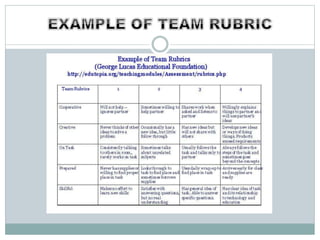
2 COMMON TYPES OF RUBRICS:
TEAM AND PROJECT RUBRICS
1. TEAM RUBRICS is a guideline that lets
each member know what is expected of
him/her.
 It contains detailed descriptions for
tasks that will be done while the
students are working as a team, and
states acceptable degrees of behavior.
 It also defines the consequences for a
team member who is not participating,
and list actions or tasks required of
each team member for the completion
of a successful project, such as the
following:
- Did the person participate in the
planning process?
- How involved was each member?
- Was the team member’s work to the
best of his/her ability?
- Shows the quantitative value of the
behaviors actions
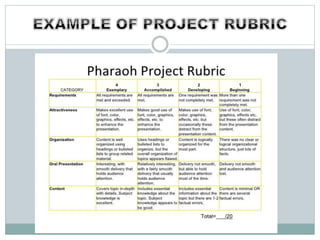
2. PROJECT RUBRICS:
- Lists the requirements for the completion of a
project-based-learning lesson. It is usually
some sort of presentation; a word processed
document, a poster, a model, a multimedia
presentation, as a combination of
presentations.
- Teacher can create a project rubric, or
students can collaborate, helping set the
goals for the project and suggest how their
work should be evaluated.
- Together, the teacher and the students can
answer the following questions:
 What is the quality of the work?
 How do you know the content is accurate?
 How well was the presentation designed?
 What was the main idea?
Rubric is a scoring guide that seeks to evaluate a
student’s performance based on the sum of full range
of criteria rather than a single numerical score. It is
an Authentic Tool used to measure students’ work. It
is a set of guidelines for distinguishing between
performances or products of different quality. It is a
working guide for students know how their work will
be judged. It is designed to simulate real life activity
where students are engaged in solving real life
problems. It can be holistic or analytic. A holistic
rubrics describes the overall quality of a performance
or product. An analytic rubric describes the quality of
performance or product in relation to a specific
criterion.
 It improves students’ performance by clearly showing the
students how their work will be evaluated and what is
expected of them.
 It helps students/learners become better judges of the
quality of their own work.
 It allows assessment to be more objective and consistent.
 It reduces the amount of time of teachers spend evaluating
students work.
 It helps the teacher to clarify his/her criteria in specific
terms. It promotes student awareness on the criteria to use
in assessing peer performance.
 It provides useful feedback to the teacher regarding the
effectiveness of instruction. It provides students with more
feedback about their strengths and weaknesses.
 It is easy to use and easy to explain.
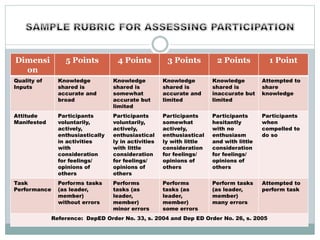
Dimensi
on
5 Points 4 Points 3 Points 2 Points 1 Point
Quality of
Inputs
Knowledge
shared is
accurate and
broad
Knowledge
shared is
somewhat
accurate but
limited
Knowledge
shared is
accurate and
limited
Knowledge
shared is
inaccurate but
limited
Attempted to
share
knowledge
Attitude
Manifested
Participants
voluntarily,
actively,
enthusiastically
in activities
with
consideration
for feelings/
opinions of
others
Participants
voluntarily,
actively,
enthusiastical
ly in activities
with little
consideration
for feelings/
opinions of
others
Participants
somewhat
actively,
enthusiastical
ly with little
consideration
for feelings/
opinions of
others
Participants
hesitantly
with no
enthusiasm
and with little
consideration
for feelings/
opinions of
others
Participants
when
compelled to
do so
Task
Performance
Performs tasks
(as leader,
member)
without errors
Performs
tasks (as
leader,
member)
minor errors
Performs
tasks (as
leader,
member)
some errors
Perform tasks
(as leader,
member)
many errors
Attempted to
perform task
Reference: DepED Order No. 33, s. 2004 and Dep ED Order No. 26, s. 2005
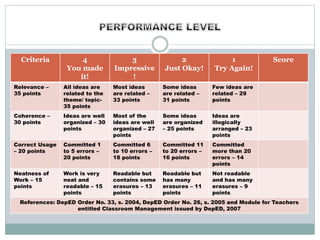
Criteria 4
You made
it!
3
Impressive
!
2
Just Okay!
1
Try Again!
Score
Relevance –
35 points
All ideas are
related to the
theme/ topic-
35 points
Most ideas
are related –
33 points
Some ideas
are related –
31 points
Few ideas are
related – 29
points
Coherence –
30 points
Ideas are well
organized – 30
points
Most of the
ideas are well
organized – 27
points
Some ideas
are organized
– 25 points
Ideas are
illogically
arranged – 23
points
Correct Usage
– 20 points
Committed 1
to 5 errors –
20 points
Committed 6
to 10 errors –
18 points
Committed 11
to 20 errors –
16 points
Committed
more than 20
errors – 14
points
Neatness of
Work – 15
points
Work is very
neat and
readable – 15
points
Readable but
contains some
erasures – 13
points
Readable but
has many
erasures – 11
points
Not readable
and has many
erasures – 9
points
References: DepED Order No. 33, s. 2004, DepED Order No. 26, s. 2005 and Module for Teachers
entitled Classroom Management issued by DepED, 2007
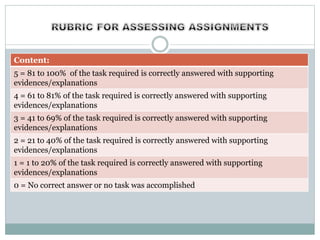
Content:
5 = 81 to 100% of the task required is correctly answered with supporting
evidences/explanations
4 = 61 to 81% of the task required is correctly answered with supporting
evidences/explanations
3 = 41 to 69% of the task required is correctly answered with supporting
evidences/explanations
2 = 21 to 40% of the task required is correctly answered with supporting
evidences/explanations
1 = 1 to 20% of the task required is correctly answered with supporting
evidences/explanations
0 = No correct answer or no task was accomplished
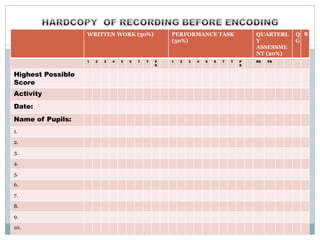
WRITTEN WORK (30%) PERFORMANCE TASK
(50%)
QUARTERL
Y
ASSESSME
NT (20%)
Q
G
R
1 2 3 4 5 6 7 T P
S
1 2 3 4 5 6 7 T P
S
RS PS
Highest Possible
Score
Activity
Date:
Name of Pupils:
1.
2.
3.
4.
5.
6.
7.
8.
9.
10.

What is rubrics file 2

  • 2.
     Rubrics aremultidimensional sets of scoring guidelines that can be used to provide consistency in evaluating student work.  They spell out scoring criteria so that multiple teachers, using the same rubric for a student’s or pupil’s/pupils’ essay or any work for example, would arrive at the same score or grade.
  • 3.
    There are:  Rubricsare great for students.  They let students know what is expected of them, and demystify grades by clearly stating, in age appropriate vocabulary, the expectations for a project.  They also help students see that learning is about gaining specific skills (both in academic subjects and in problem-solving and life skills) and they give students the opportunity to do self- assessment to reflect on the learning process.
  • 4.
    They provide away for a student and a teacher to measure the quality of a body of work. 2 COMMON TYPES OF RUBRICS: TEAM AND PROJECT RUBRICS 1. TEAM RUBRICS is a guideline that lets each member know what is expected of him/her.  It contains detailed descriptions for tasks that will be done while the students are working as a team, and states acceptable degrees of behavior.
  • 5.
     It alsodefines the consequences for a team member who is not participating, and list actions or tasks required of each team member for the completion of a successful project, such as the following: - Did the person participate in the planning process? - How involved was each member? - Was the team member’s work to the best of his/her ability? - Shows the quantitative value of the behaviors actions
  • 6.
    2. PROJECT RUBRICS: -Lists the requirements for the completion of a project-based-learning lesson. It is usually some sort of presentation; a word processed document, a poster, a model, a multimedia presentation, as a combination of presentations. - Teacher can create a project rubric, or students can collaborate, helping set the goals for the project and suggest how their work should be evaluated. - Together, the teacher and the students can answer the following questions:  What is the quality of the work?  How do you know the content is accurate?  How well was the presentation designed?  What was the main idea?
  • 7.
    Rubric is ascoring guide that seeks to evaluate a student’s performance based on the sum of full range of criteria rather than a single numerical score. It is an Authentic Tool used to measure students’ work. It is a set of guidelines for distinguishing between performances or products of different quality. It is a working guide for students know how their work will be judged. It is designed to simulate real life activity where students are engaged in solving real life problems. It can be holistic or analytic. A holistic rubrics describes the overall quality of a performance or product. An analytic rubric describes the quality of performance or product in relation to a specific criterion.
  • 8.
     It improvesstudents’ performance by clearly showing the students how their work will be evaluated and what is expected of them.  It helps students/learners become better judges of the quality of their own work.  It allows assessment to be more objective and consistent.  It reduces the amount of time of teachers spend evaluating students work.  It helps the teacher to clarify his/her criteria in specific terms. It promotes student awareness on the criteria to use in assessing peer performance.  It provides useful feedback to the teacher regarding the effectiveness of instruction. It provides students with more feedback about their strengths and weaknesses.  It is easy to use and easy to explain.
  • 9.
    Dimensi on 5 Points 4Points 3 Points 2 Points 1 Point Quality of Inputs Knowledge shared is accurate and broad Knowledge shared is somewhat accurate but limited Knowledge shared is accurate and limited Knowledge shared is inaccurate but limited Attempted to share knowledge Attitude Manifested Participants voluntarily, actively, enthusiastically in activities with consideration for feelings/ opinions of others Participants voluntarily, actively, enthusiastical ly in activities with little consideration for feelings/ opinions of others Participants somewhat actively, enthusiastical ly with little consideration for feelings/ opinions of others Participants hesitantly with no enthusiasm and with little consideration for feelings/ opinions of others Participants when compelled to do so Task Performance Performs tasks (as leader, member) without errors Performs tasks (as leader, member) minor errors Performs tasks (as leader, member) some errors Perform tasks (as leader, member) many errors Attempted to perform task Reference: DepED Order No. 33, s. 2004 and Dep ED Order No. 26, s. 2005
  • 10.
    Criteria 4 You made it! 3 Impressive ! 2 JustOkay! 1 Try Again! Score Relevance – 35 points All ideas are related to the theme/ topic- 35 points Most ideas are related – 33 points Some ideas are related – 31 points Few ideas are related – 29 points Coherence – 30 points Ideas are well organized – 30 points Most of the ideas are well organized – 27 points Some ideas are organized – 25 points Ideas are illogically arranged – 23 points Correct Usage – 20 points Committed 1 to 5 errors – 20 points Committed 6 to 10 errors – 18 points Committed 11 to 20 errors – 16 points Committed more than 20 errors – 14 points Neatness of Work – 15 points Work is very neat and readable – 15 points Readable but contains some erasures – 13 points Readable but has many erasures – 11 points Not readable and has many erasures – 9 points References: DepED Order No. 33, s. 2004, DepED Order No. 26, s. 2005 and Module for Teachers entitled Classroom Management issued by DepED, 2007
  • 11.
    Content: 5 = 81to 100% of the task required is correctly answered with supporting evidences/explanations 4 = 61 to 81% of the task required is correctly answered with supporting evidences/explanations 3 = 41 to 69% of the task required is correctly answered with supporting evidences/explanations 2 = 21 to 40% of the task required is correctly answered with supporting evidences/explanations 1 = 1 to 20% of the task required is correctly answered with supporting evidences/explanations 0 = No correct answer or no task was accomplished
  • 14.
    WRITTEN WORK (30%)PERFORMANCE TASK (50%) QUARTERL Y ASSESSME NT (20%) Q G R 1 2 3 4 5 6 7 T P S 1 2 3 4 5 6 7 T P S RS PS Highest Possible Score Activity Date: Name of Pupils: 1. 2. 3. 4. 5. 6. 7. 8. 9. 10.