9
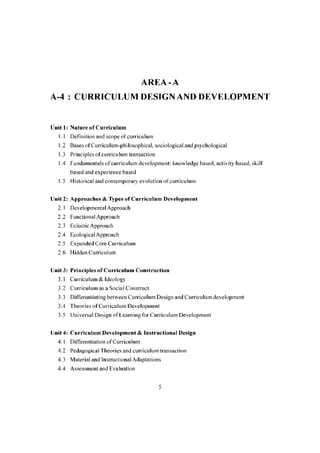
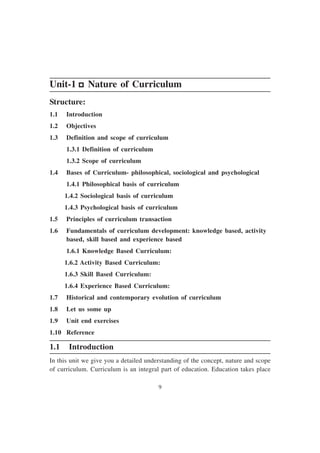
Unit-1 p
p
p
p
p Nature of Curriculum
Structure:
1.1 Introduction
1.2 Objectives
1.3 Definition and scope of curriculum
1.3.1 Definition of curriculum
1.3.2 Scope of curriculum
1.4 Bases of Curriculum- philosophical, sociological and psychological
1.4.1 Philosophical basis of curriculum
1.4.2 Sociological basis of curriculum
1.4.3 Psychological basis of curriculum
1.5 Principles of curriculum transaction
1.6 Fundamentals of curriculum development: knowledge based, activity
based, skill based and experience based
1.6.1 Knowledge Based Curriculum:
1.6.2 Activity Based Curriculum:
1.6.3 Skill Based Curriculum:
1.6.4 Experience Based Curriculum:
1.7 Historical and contemporary evolution of curriculum
1.8 Let us some up
1.9 Unit end exercises
1.10 Reference
1.1 Introduction
In this unit we give you a detailed understanding of the concept, nature and scope
of curriculum. Curriculum is an integral part of education. Education takes place
10
in both natural and contrived environments. Learners and teachers are two living
factors of education. Their interaction does not take place in vacuum. This medium
is curriculum. Curriculum is the certain pre-decided learning experiences. In this
unit, we will learn about the concept of curriculum, the bases to form curriculum,
principle of curriculum transactions and evolution of the curriculum. Hence, in this
unit you will gain an understanding of curriculum different interpretations of
curriculum, its growth, and historical background,role of curriculum in ever changing
societal demands and to achieve the teaching learning objectives.A curriculum
means, the total situation (all situations) selected and organizedby the institution
and made available to the teacher to operate and to translatethe ultimate aim of
education into reality.There is available a multiplicity of concepts of curriculum
sinceeducationists give their own different interpretations of the content andfunctions
of curriculum. Let us discuss three such concepts by three differentthinkers, which
represent three major contributions to the body of knowledge on curriculum. The
first concept, stated by Albert Oliver, refers to curriculummerely as the educational
program consisting of three important elements,such as studies, activities and guidance.
The second concept, described byPhilip Phenix, is based on a carefully thought out
scheme of values whichconstitute the aims and objectives, or purposes of education.
The thirdconcept, given by Hilda Taba, looks at curriculum as the function of the
publicschool, she list the three functions as preserving and transmitting culturalheritage,
serving as an instrument for transformation of culture, and workingas a means for
individual development.Curriculum may be defined as the “social environmental
in motion”. It is thesum total of all the activities and experiences provided by the
schools to thelearners for achieving the desired objectives. The courses of studies
are merelya suggestion for curriculum activities and procedures, a guide for teaching
tofollow.
Curriculum is one of the most important items in the educative process. Thecurriculum,
in fact, is the fundamental problem which determines the ‘warp’and ‘woof’ of the
process of education. What to do and how to do is the veryessence of curriculum.
1.2 Objectives
After studying the unit you should be able to
• Define curriculum
• Explain different concepts related to curriculum
11
• Describe different bases of curriculum
• Explain different process for curriculum transaction
• Illustrate different approaches of curriculum development
1.3 Definition And Scope of Curriculum
1.3.1 Definition of curriculum
Curriculum is a very familiar word heard in the context of formal education system.
Curriculum can be viewed in both broad and narrow ways. In narrow sense of the
popular notion curriculum is a set of subject or content taught to the students in
school, college or university. In broad sense curriculum consists of all experiences
a learner gains in school, colleges or in the university.
Curriculum is from New Latin (a post-medieval form of Latin used mainly in
churches and schools and for scientific coinages), in which language it means “a
course of study.” It shares its ultimate root in classical Latin, where it meant
“running” or “course” (as in “race course”), with words such as corridor, courier,
and currency, all of which come from Latin currere “to run.” The Latin meaning
of the term “curriculum” is race course used by chariots. It is any path or course
of study to be undertaken by educational institutions within a specified time frame.
Sanskrit equivalent of the term “curriculum”is “pathyakram”. Dewal (2004) has
explained the term to mean the sequence of course of study including the content
and its process. According to Dewal “pathyakram” encompasses the content, its
processes, a sequence of study pertinent to the stage of education. The word “path”
in his opinion has a similar meaning to the words ‘vidya’ and ‘shïksha’ Sanskrit
meaning of the term curriculum in Dewal’s view would imply the following:
1) A course of study
2) A sequence of the course depending on the stage of education
3) The content and processes arranged in a definite hierarchy
4) The sequence of study begins with process of understanding, to acquire and
to think or to reflect
It is important to note that while curriculum encompasses a wide variety of potential
educational and instructional practices, educators often have a very precise, technical
meaning in mind when they use the term.
12
Depending on how broadly educators define or employ the term, curriculum typically
refers to the knowledge and skills students are expected to learn, which includes
the learning standards or learning objectives they are expected to meet; the units
and lessons that teachers teach; the assignments and projects given to students; the
books, materials, videos, presentations, and readings used in a course; and the
tests, assessments, and other methods used to evaluate student learning.
In the words of Cunningham, curriculum is a tool in the hands of the artist (theteacher)
to mould his material (the pupil) according to his ideal (objective) inhis studio (the
school). The material is highly self active, self-determininghuman being who reacts
and responds consciously.
Caswell and Campbell (1935): curriculum is composed of all of the experiences
children have under the guidance of the teacher.”
Galen Saylor, William M. Alexander, and Arthur J. Lewis (1974): “We define
curriculum as a plan for providing sets of learning opportunities to achieve broad
goals and related specific objectives for an identifiable population served by a
single school center for persons to be educated.”
Albert Oliver (1977): curriculum is “the educational program of the school” and
divided into four basic elements: 1) program of studies, 2) program of experiences,
3) program of service, 4) hidden curriculum.
A total guided learning experiences designed to facilitate learners learning for
establishing quality relationship between what is learnt and what operates outside
the school. Development is a process of achieving both quantitative and qualitative
increase of somebody or something or an event thereby constituting a new stage
in a changing situation.
Curriculum as a Plan
Oliva (1982) stated that “Curriculum is a plan or programme for allexperiences
which the learner encounters under the direction of the school.”
Carter V. Good (1959) defined curriculum as “a general overall plan of thecontent
or specific materials of instruction that the school should offer thestudent by way
of qualifying him for gradation on certification for entranceinto a professional or
a vocational field.”Tyler and Hilda Taba (1962) define curriculum “as a plan for
action, or awritten document, which includes strategies for achieving desired goals
orends.”
13
Galen Saylor defines curriculum “as a plan for providing sets of learningopportunities
for persons to be educated”. Curriculum as an ExperienceTanner and Tanner (1980)
stated that “Curriculum is that reconstruction ofknowledge and experiences
systematically developed under the auspices of theschool (or university) to enable
the learner to increase his or her control ofknowledge and experience.”
The Secondary Education Commission (1952-54) states that “curriculumincludes
totality of experiences pupil receives through the manifold activitiesthat go on in
the school, classroom, library, laboratory, workshop, play groundand in numerous
informal contacts between teachers and pupils.” In otherwordsthe whole life of
school is curriculum which can touch the life ofstudents at all levels and helps in
evolution of a balanced personality.
According to Crow and Crow, “curriculum includes all the learnersexperiences in
and outside the school that are included in a programme whichhas been devised
to help to develop mentally, physically, emotionally,spiritually and morally.”
Franklin Boobit (1918) defined that “Curriculum is that series of things whichchildren
and youth must do and experience by way of developing abilities todo the things
well that make up the affairs of adult life; and to be in allrespects of what adults
should be”
Krug (1957) defined as “Curriculum consists of all the means of instructionused
by the school to provide opportunities for student learning experiences leading to
desired learning outcome”.
Curriculum as a Subject Matter
Doll (1978) defined that Curriculum is both a subject to be taught at collegesand
universities and a field in which practitioners work. Curriculum is theformal and
informal content and process by which learners gain knowledgeand understanding,
develop skills and alter attitudes, appreciations and valuesunder the auspices of
that school”.
Curriculum can be considered in terms of subject matter (Tamil, English,Mathematics,
Science, and Social Science) or content (the way of organization andassimilation
of information). Historically and currently the dominant conceptof the curriculum
is that of subjects and subject matter there in to be taught byteachers and learned
14
by students. Curriculum refers to the set of subjects orcourse offered and also
those required or recommended or grouped for otherpurposes; thus such terms as
the college ‘preparatory curriculum’ ‘sciencecurriculum’ and ‘premedical curriculum’
are commonly used.
Curriculum as an Objective
B.F. Skinner views the curriculum as being formulated according tobehaviouristic
objectives. The curriculum is the series of experiences whichchildren and youth
must have by way of attaining activity-based objectives.
W. W. Chatters (1923) viewed curriculum as a series of objectives thatstudents
must attain by way of a series of learning experiences.
Edgar Bruce stated that the curriculum is “an educational instrument, plannedand,
used by the school to effect the purposes” (Edgar Bruce).
According to Payne, “curriculum consists of all the situations that schools mayselect
and consciously organize for the purpose of developing the personalityof its pupils
and for making behaviour changes in them.”
Bobbit (1918) has defined curriculum “that series of things which children andyouth
must do and experience by way of developing abilities to do the thingswell that
make up the affairs of adult life: and to be in all respects of what adults should
be”. Here Bobbit determined curriculum objectives based onskills and knowledge
needed by adults.
Ralph Tyler (1949) has presented the same views about the curriculum but hecombined
curriculum and instruction in his approach. Probably he thought thatcurriculum
and instruction cannot be separated otherwise the aims andobjectives of curriculum
planning will not be attained.
Curriculum as a system
Curriculum can be considered as a system for dealing with people and theprocesses
or organization of personnel and procedures for implementing thesystem (Babcock,
McNeil, Untruth).
Curriculum as a field of study
Curriculum can also be viewed as a field of study, comprising its ownfoundations
and domains of knowledge, as well as its own research, theory,and principles
(Orlosky and Smith, Schubert and Tanners).
15
The definition of curriculum as product imparts a concrete meaning to the term
restricted to the list of courses and syllabi prepared by the school or university.
Curriculum as programme refers to the course of study offered by a school or
university. This is most widely accepted definition of curriculum. Another aspect
to define it is curriculum as intended learning outcomes.This definition of curriculum
refers to the learning outcomes which are intended for the learners. Here the
definition of curriculum is based on “what is to be learnt” and “how is to be
learnt”. In this definition learning outcomes are directly linked to the objectives.
1.3.2 Scope of Curriculum
Curriculum, is therefore, very comprehensive in its scope. It touches allaspects of
the life of the pupils- the need and interest of the pupils,environment which should
be educationally congenial to them, ways andmanners in which their interests can
be handled and warmed up, theprocedures and approaches which cause effective
learning among them, thesocial efficiency of the individuals and how they fit in
with the communityaround. It is intimately related with the individual as a member
of the society.It embodies the educational philosophy, the values which it aims to
achievethe purposed it wants philosophy, the values it aims to achieve purposes
itwants to realize and the specific goals that it wants to achieve. The emphasis ison
the child. In the total education of the child, all the subjects’ likes history,geography,
science and language are but tools. These are the means, andtherefore, the children
must not be made to fit in such study.
1.4 Bases of Curriculum- Philosophical, Sociological and
Psychological
The foundations of curriculum set the external boundaries of the knowledge of
curriculum and define what constitutes valid source of information from which
come accepted theories, principles and ideas relevant to the field ofcurriculum.
The foundations of curriculum represent the external boundariesof the field. The
foundations of curriculum are considered usually fromphilosophical, sociological
and psychological points of view. From thephilosophical point of view, education
aims to achieve self-realization andvalues. From the sociological point of view,
education aims to perpetuate thecultural heritage, to establish a social order which
is in conformity with thecultural heritage as well as to meet the needs and aspirations
16
of people. Fromthe psychological point of view, education aims to develop
physical(cognitive), mental (cognitive) and emotional (affective) characteristics.
1.4.1 Philosophical basis of curriculum
Based upon fundamental beliefs that arise from one’s philosophy of education
curricular decisions involve consideration of several topics and issues. Precisely
for this reason, we consider philosophy one of the major foundation areas in
curriculum. In this section, we shall explore several different philosophies of education
that influence curricular decisions. Philosophy and curriculum.
Studying philosophy helps us deal with our own personal systems of beliefs and
values, i.e., the way we perceive the world around us and how we define what is
important to us. As philosophical issues have always influenced society and institutions
of learning, a study of the philosophy of education in terms of curriculum development
is essential. In essence, a philosophy of education influences, and to a large extent
determines, our educational decisions and alternatives. Those who are responsible
for curricular decisions, therefore, should be clear about what they believe. If we
are unclear or confused about our own beliefs, then our curricular plans are bound
to be unclear and confusing. One important step in developing a personal philosophy
of education is to understand the various alternatives that others have developed
over the years. Here we shall look into the following four major philosophical
positions that have, hitherto, influenced curriculum development.
i) Idealism
ii) Realism
iii) Pragmatism
iv) Existentialism.
I) Idealism
The doctrine of idealism suggests that matter is an illusion and that reality is that
which exists mentally. It emphasises moral and spiritual reality as the chief explanation
of the world and considers moral values absolute, timeless and universal. If we
apply this view to education what would be the implications for the role of teachers
and curriculum in education? Obviously, teachers would act as role models of
enduring values. And the school must be highly structured and ought to advocate
17
only those ideas that demonstrate enduring values. The materials used for instruction,
therefore, would centre around broad ideas particularly those contained in great
works of literature and/or scriptures. Since it is based on broad ideas and concepts,
idealism is not in line with the beliefs of those who equate learning with acquisition
of specific facts from various sources.
II) Realism:
Aims of the education according to realism are to give the pupil a complete
knowledge and understanding of human society, human nature, motives, and
institutions. Subject matter consists of modern languages because they enable
individuals to read, write and conduct all types of social interactions. Branches of
natural sciences are suggested to be offered in realism to give the pupil requisite
skills and knowledge to apply in real situations. Regarding teaching methods,
Synthetic method of teaching is applied in classroom.
III) Pragmatism:
In contrast to the traditional philosophies, i.e., idealism and realism, pragmatism
gives importance to change, processes and relativity, as itsuggests that the value
of an idea lies in its actual consequences. The actual consequences are related to
those aims that focus on practical aspects in teaching and learning. According to
pragmatists, learning occurs as the person engages in transacting with the environment.
Basic to this interaction is the nature of change. In this sense, whatever values and
ideas are upheld currently would be considered tentative since further social
development must refine or change them. To consider, therefore, what is changeless
(idealism) and inherited theperceived universe (realism) and to discard social and
or perceptualchange is detrimental to the overall development and growth of children.
Curriculum, according to the pragmatists, should be so planned that it teaches the
learner how to think critically rather than what to think. Teaching should, therefore,
be more exploratory in nature than explanatory. And, learning takes place in an
active way as learners solve problems which help them widen the horizons of their
knowledge and reconstruct their experiences in consonance with the changing
world. The role is not simply to disseminate information but to construct situations
that involve both direct experience with the world of the learner and opportunities
to understand these experiences.
18
IV) Existentialism
This doctrine emphasizes that there are no values outside human beings, and thus,
suggests that human beings should have the freedom to make choices and then be
responsible for the consequences of those choices.According to this philosophy,
learners should be put into a number of choice-making situations, i.e., learners
should be given freedom tochoose what to study. It emphasizes that education
must centre on the perceptions and feelings of the individual in order to
facilitateunderstanding of personal reactions or responses to life situations.
Of primary concern in this process is the individual. Since life is based upon
personal meanings, the nature of education, the existentialists would argue, should
be largely determined by the learner. Individual learners should not be forced into
pre-determined programmes of study. Whatever the learner feels he or she must
learn should be respected and facilitated by the system. An existentialist curriculum,
therefore, would consist of experiences and subjects that lend themselves to
philosophical dialogue and acts of making choices, stressing self-expressive activities
that illustrate emotions and insights. The teacher, then, takes on a non-directive
role. The teacher is viewed as a partner in the process of learning. As a professional,
the teacher serves as a resource facilitating the individual’s search for personal
meaning rather than imposing some predetermined values or interests on learners.
Existentialism has gained greater popularity in recent years. Today, many educationists
talk about focusing on the individual, promoting diversity in the curriculum and
emphasizing the personal needs and interests of learners. Here, perhaps, we can
recall the philosophy that underlies the open distance education system. Learner-
autonomy, which the existentialists seem to suggest, has been and remains the
prime characteristic feature of the distance mode of teaching-learning. Because of
the explosion in knowledge and tremendous growth in information technology, the
curriculum of the past seems to be obsolete. To plug the gap between the needs
of the learner, the society and the curriculum content, rethinking in the area of
curriculum development appears to be unavoidable. What might have been relevant
in a particular situation need not necessarily always be so. In essence, social
changes demand changes in the existing pattern of education. The inherent potentiality
of the system of distance education enables it to accommodate and cater to these
changes. It should be clear from the above discussion that by and large, in operational
terms, both pragmatism and existentialism find ample expression in open distance
education.
19
Although aspects of educational philosophy can be derived from the roots of idealism,
realism, pragmatism and existentialism, a common approach is to provide a pattern
of educational philosophies which derives from the major schools of philosophy
some of which have been touched upon above. Here, we shall be looking into the
following four educational philosophies for their implications in the area of curriculum
development.
i) Perennialism
ii) Progressivism
iii) Essentialism
iv) Reconstructionism.
Let us discuss each one of these
I) Perennialism
It advocates the permanency of knowledge that has stood the test of time and
values that have moral and spiritual bases. The underlying idea is that education
is constant, absolute and universal. Obviously,”perennialism” in education is born
of “idealism” in general philosophy. The curriculum of the perennialist is subject-
centered. It draws heavily on defined disciplines or logically organised bodies of
content, but it emphasizes teaching learning of languages, literature, sciences and
arts. The teacher is viewed as an authority in a particular discipline and teaching
is considered an art of imparting information, knowledge and stimulating discussion.
In such a scheme of things, students are regarded immature as they lack the judgement
required to determine what should be studied, and also that their interests demand
little attention as far as curriculum development is concerned. There is usually
only one common curriculum for all students with little room for elective subjects.
According to this point of view putting some students through an academic curriculum
and others through a vocational curriculum is to deny the latter genuine equality
of educational opportunity. Such views appeal to those educators who stress intellectual
meritocracy. Their emphasis is on testing students, enforcing tougher academic
standards or programmes, and on identifying and encouraging talented students.
II) Progressivism
This emerged as a protest against perennialist thinking in education. It was considered
a contemporary reformist movement in educational, social and political affairs
20
during the 1920’s and 30’s. According to progressivist thought, the skills and tools
of learning include problem solving methods and scientific inquiry. In addition,
learning experiences should include cooperative behaviour and self-discipline, both
of which are important for democratic living. The curriculum, thus, was
interdisciplinary in nature and the teacher was seen as a guide for students in their
problem-solving and scientific projects. Although the progressive movement in
education encompassed many different theories and practices, it was united in its
opposition to the following traditional attributes and practices: the authoritarian
teacher; excessive dependence on textbook methods; memorization of factual data
and learning by excessive drilling; static aims and materials that reject the notion
of a changing world; and attempts to isolate education from individual experiences
and social reality. Although the major thrust of progressive education waned in the
1950’s with the advent of “essentialism”, the philosophy has left its imprint on
education and educational practices of today. Contemporary progressivism is expressed
in several movements including those for a socially relevant curriculum, i.e., a
match between subjects taught and student needs which is one of the theoretical
bases of distance education.
III) Essentialism
This philosophy, rooted partly in idealism and partly in realism, evolved mainly as
a critique of progressive thought in education. Yet, the proponents of essentialism
do not totally reject progressive methods as they do believe that education should
prepare the learner to adjust to a changing society. Thus, in essentialism learning
should consist in mastering the subject matter that reflects currently available
knowledge in various disciplines. Teachers play a highly directive role by disseminating
information to students. According to this viewpoint, the main arms of the institution
(be it a school or a college) get side tracked,when, at the expense of cognitive
needs, it attempts to pay greater attention to the social and psychological problems
of students.
In recent years, the essentialist position has been stated vociferously by critics who
claim that educational standards softened during the 1960s and early 1970s. The
most notable achievements of the essentialists have been the widespread
implementation of competency based programmes, the establishment of grade-
level achievement standards, and the movement to reemphasize academic subjects
in schools/colleges. In many ways, the ideas of essentialism lie behind attacks on
21
the quality of education by the media and by local pressure groups, which includes,
to a good extent, attaches on distance education.
IV) Reconstructionism
It views education as a means of reconstructing society. The reconstructionists
believe that as school/college is attended by virtually all youth, it must be used as
a means to shape the attitudes and values of each generation. As a result, when the
youth become adults they will share certain common values, and thus the society
will have reshaped itself. As for the curriculum, it must promote new social,
economic and political education. The subject matter is to be used as a vehicle for
studying social problems which must serve as the focus of the curriculum.
• The following gives you a view of the reconstructionist programme of education:
• critical examination of the cultural heritage of a society as well as the entire
civilization;
• scrutiny of controversial issues;
• commitment to bring about social and constructive change;
• cultivation of a planning-in-advance attitude that considers the
• Realities of the world we live in; andenhancement of cultural renewal and
internationalism.
Stemming from this view, reconstruction expands the field of curriculum to include
intuitive, personal, mystical, linguistic, political and social systems of theorizing.
In general, the curriculum advocated byrestructionists emphasizes the social sciences-
history, political science, economics, sociology, psychology and philosophy-and
not the pure sciences. The thrust is on developing individual self-realization and
freedom through cognitive and intellectual activities, and thus, on liberating people
from the restrictions, limitations and controls of society. The idea is that we have
had enough of discipline-based education and narrow specialization, and that we
don’t need more specialists now, we need more “good” people if we want to
survive.
In essence, what we need is a prudent philosophy-one that is politically and
economically feasible and that serves the needs of students and society. It is here
that open distance education comes forth with its promises for the future.Ideas
22
about curriculum and teaching do not arise in a vacuum. As curriculum development
is heavily influenced by philosophy, those involved in such planning should be
clear about contemporary, dominant philosophy. If we are not clear aboutour philosophy
of education, our curriculum plans and teaching procedures will tend to be inconsistent
and confused. This being so, we should be aware of the fact that development and
awareness of a personal philosophy of education is a crucial professional responsibility.
Further, we need to be constantly open to new ideas and insights that may lead to
a revision or refinement of our philosophies. Our position should be that no single
philosophy, old or new, should serve as the exclusive guide for making decisions
about curriculum. What we, as curriculum specialists, need to do, is to adopt an
eclectic approach, in which there is no emphasis on the extremes of subject matter
or socio-psychological development, excellence or quality.
1.4.2 Sociological basis of curriculum
The Sociological Foundation refers to issues from society that has an influence on
curriculum. Since the school exists within a given society; and the fact that the
‘products’ of the school i.e. the ‘graduates’ go back to the society, makes the latter
an inevitable determinant of the curriculum. There are many aspects of the society
that need consideration in curriculum making. The expectation and aspiration of a
changing society are reflectedthrough the educational system of a country. “The
school” according to JohnDewey, “must become the child’s habitant to be a miniature
community, andembryonic society”. Education is process that takes place in society
for societyand by society. The changing nature of culture aspect has its impact
oneducation. Social changes must not only be reflected in education but also be
influencedby it. Changes occur in the cultural sphere and every sector of natural
life.Curriculum is relevant, should take out of these changes and promote
desirablechanges in the learners Education has to adjust itself to the changing
situations. Or else itwill be isolated from life; in short, it will remain unrealistic,
useless andmeaningless.Society by dynamic, it grows and changes and as such
these include:
• Changes occurring in societal structures;
• Transmission of culture;
• social problems as issues for Curriculum
• Economics issues.
23
• Transmission of Culture
Culture in any society incorporates valued traditions. In this context, curriculum
can be considered to be a reflection or a piece of the culture. These traditions
include those in the wider society as well as traditions upheld in the school system.
Influence of various Interest groups: Certain groups who have an influence on
school curriculum include: Parents, religious groups such as churches, Donors,
Trade Unions such as the Kenya National Union of Teachers, Boards of Governors
and the media. Each of these groups has certain values that they would want
incorporated into the curriculum. As much as possible, their inputs should be
considered to ensure their support in curriculum implementation.
Social Problems as issues for curriculum: Every society battles with certain issues
that have an influence on curriculum. These include:
Equality and Equity issues;such as class systems in society; racial or ethnic issues;
gender; issues of access to education and equality of opportunityfactors that affect
equality of opportunity include financing of education, fees payments and distances
to schools.
Crime, Delinquency and Security issues: The curriculum would need to focus on
knowledge, fairness and avoidance of the issues raised.
Health Issues: Health challenges in many parts of the world currently include HIV/
Aids, Drug abuse, pollution and other environmental is-sues, family life education
including Birth control and family planning. HIV/Aids have in many African countries
wrecked havoc leaving many learners as orphaned and vulnerable. Curriculum
planning must take that issue into consideration.
Economic Issues: There is need to incorporate in the curriculum knowledge, skills
and attitudes that would facilitate economic growth at a personal and national
level.
Any discussion of curriculum should consider the social setting and its influence
on curricular decisions. Social pressures influence the characteristics of students
who experience the curriculum in the educational institutions which are established
and maintained by society. Students live in a world larger than the college/school
and learn a great deal from experiences in that part of their lives. What a learner
acquires in the college/school and outside may be complementary or conflicting to
24
each other. The latter case gives rise to the complaint that what is learned in
college/school has little to do with the real world. But, in the former case the
college/school may be a major factor in the improvement of society by helping
young people to develop the capacity to respond intelligently to social problems.
In this way, the curriculum serves not only the needs of the learner, but also the
needs of society. For these reasons, in developing curricular plans, we must consider
the characteristics of contemporary society as well as those that are expected to
emerge in the future. Of course, curriculum planning and course content basically
depends on an analysis of the nature of society.Keeping these facts in view, we
shall now discuss how society influences the making of curriculum. Most of us
regard education as synonymous with schooling. But, in actual fact even a society
that has no formal colleges/schools still educates its young through ceremonies,
rituals, stories, observation and emulation of parents, elders, etc. The norms of
society govern interpersonal relations and produce a model personality-the
attitudes,feelings and behaviour patterns most members of a society share. It also
assigns specific roles to each of its members and expects them to conform to
certain established behavioural patterns. Sex roles-the way boys and girls, men and
women are supposed to act-provide a good example for this type ofsocialisation.
Sex roles vary from one culture to the other, but within a given set-up they are
rather well-defined. This leads us to conclude that besides the classroom-curriculum,
society also plays a vital role in shaping the attitudes of the young. Clearly, global
aspects of human growth and development are accomplished partly by the structured
curriculum in use in colleges, schools and partly by society. Does this mean that
a curriculum should mirror current social forces? A curriculum while reflecting
contemporary social forces should also be able to respond to the dynamics of
change. By implication, the curriculum should not only reflect society but also
help to shape it.
The Role of the Textbook and ‘National Standards’ The Secondary
EducationCommission (1952) had pointed out that the then curriculum was
‘narrow,bookish and theoretical’ with an overloaded syllabus and unsuitable text
books.It had suggested that the curriculum should not be divided into a number
ofwatertight subjects, but that all subjects should be interrelated and shouldinclude
relevant and significant content so that it could touch the lives ofstudents. It also
recommended that a high powered committee be set up inevery State for selecting
25
textbooks and for laying down appropriate criteria,emphasizing that ‘No single
textbook should be prescribed for any subject ofstudy, but a reasonable number
which satisfy the standards laid down, shouldbe recommended, leaving the choice
to the schools concerned’.The notions of curriculum and syllabi as existing in the
three National Curricular Frameworks (NCFs) are close to each other. The NCF 75
actuallydefines the curriculum and syllabi. However, this notion of curriculum
andsyllabi do not include aims of education; it rather sees the aims as guidingthe
curriculum from outside. The other two documents also do not take up thetask of
defining but largely follow the same definition. All the NCFsemphasize the concerns
and issues but do not make a very clear connectionbetween the concerns, aims, and
curricular content. The pedagogy and theview on knowledge also remain hazily
defined. Thus, though the NCFs seemto have some form of definition for curriculum
and syllabus, the relativeimportance of elements within the form and their
interconnections remaineither unexplored or even entirely neglected.The curriculum
reforms have been taken up by Government of India throughNCERTand developed
National Curriculum Frame work -2005. The majorissues of curriculum at school
education level have been discussed i.e,information loaded textbooks, and memory
based examinations dull routineand board teaching and rote systems of learning.
And no clear connectionbetween concerns, aims and curricular contains. The pedagogy
and the viewon knowledge also remain somewhat not well defined. The following
are theguiding principles reflected in the NCF 2005 document for the
undertakingcurricular reforms and development of syllabus and textbooks and will
beconsidered for state level curriculum reforms and textbook development:
l Connecting knowledge to life outside the school
l Ensuring that learning is shifted away from rote methods
l Enriching the curriculum to provide for overall development ofchildren rather
that remain textbook centric
l Making examinations more flexible and integrated into classroom lifeand
l Nurturing an over-riding identify informed by caring concerns withinthe
democratic polity of the country.
The following aresome of the reforms recommended by different bodies/agencies
of Education:
26
l The University Education Commission 1952-53 recommended adiversified
curriculum with some core subjects at the higher secondarystage.
l The Secondary Education Commission 1964-66 considered theworking of the
entire system of education in the country and madesuggestions for restructuring
the curriculum in the light of explosion ofknowledge.
l The recommendations of the Education Commission led to theformulation of
the National Policy of Education, 1968 which envisaged+2+3 pattern of education
for the entire country.
l In 1975, a new curriculum for the pattern of 10+2+3 system wasformulated by
the NCERT.
l In 1977, the Ishwarbai Patel Committee, appointed by the Governmentof India,
suggested the Inclusion of Society Useful Productive Work(SUPW)at the school
stage.
l THE 1977-78 Committees on Vocational course at the +2 stage, headedby
Dr.Malcolm S. Adiseshiah reviewed the vocational courses andsuggested
guidelines for introducing changes in vocational courses.
l The National Policy on Education 1986 provided a new direction tothe curriculum.
It envisages curriculum as an important instruction inrealizing the ideals of
society as enshrined in the constitution.
The visible face of reforms in curriculum consists of changes in the syllabi
andtextbooks, but the invisible face is far more complex. Even in the limitedcontext
of syllabi and textbook, popular perception of curricular reformsfocuses on ‘revision’,
updating or improvement. It is seldom recognized andexpected that curricular reforms
may require a deeper redesigning ofpedagogic relations and may, therefore, require
a longer gestation periodbefore their impact is felt. The Indian case of recent
curricular reforms hasboth these faces.
The formulation of the National Curricular Framework (NCF-2005) by theNCERT
initiated a vast debate across the country on priorities and problemsregarding how
knowledge is selected and represented across the school curriculum and on how it
is handled by teachers in the classroom. The newsyllabusand textbooks brought
out by NCERT since 2006 have deepened thisdebate, and many other initiatives
have enabled the debate to be absorbed andpursued at different levels of administration
27
in the states. Many states havedecided to adopt the new textbooks; several others
have created their own,negotiating the NCF perspective with the help ofNCERT’s
exemplar material.Teacher education is currently a major priorityof curricular reforms
in India. NCF-2005 has been followed up by a NationalCurriculum Framework for
Teacher Education (NCFTE, 2009). The NationalCouncil of Teacher Education
(NCTE), the organization statutorilyresponsible for teacher education, has started
reviewing the curriculum of
teachertraining followed in different states. This exercise is being guided bythe
pedagogic perspective articulated in NCF-2005 and the legal framework ofthe
Right to Education (RTE) act. Together, these 2 documents place theteacher in the
role of a social architect whose professional awareness andacumen are expected to
address the deeper anxieties and priorities NCF-2005resonates. These relate to the
endemic problems of discrimination in theclassroom. Curriculum and pedagogy
are at the heart of RTE’s goals ofachieving universality of elementary education
while ensuring gender parityand equality among all social groups in an inclusive
classroom environment.
These goals cannot be achieved by changes in the syllabus and textbooksalone.
Teachers’ belief and commitment to these changes are going to play acrucial role
in taking the NCFinitiative forward. NCERThas broadened thescope of curricular
reforms in order to create an ethos conducive to change.The national curriculum
needs to be realized in action through variousinstructional materials, appropriate
teaching, and learning and evaluationnorms. The national, state and other educational
authorities have to be stronglycommitted and deeply involved in these programmes.
The curriculum guides,model syllabi and exemplary materials are being produced
by the NCERT at the national level. Necessary review materials are being undertaken
forbringing about desired improvements.
University Grants Commission (UGC)
University Grants Commission constituted a committee in 1986 to examinethe
existing curriculum. The committee will examine the existing curriculum in the
respective subject of different universities in the country in terms ofquality as well
as workload. The committee examined how the new curriculumcould promote
human resource development and identified are which arecrucial to make education
meaningful in the task of national development.
28
l The committee devised a model curriculum which would be relevant tothe
requirement of the country.
l The committee suggested the textual materials which would berequired to
follow the new curriculum.
l The committee suggested ways and means for preparing textbooks,teaching
aids, and library as well as laboratory equipments inimplementing the proposed
curriculum.
l It also indicated how the teachers are to be trained in order to impart education
according to the revised curriculum.Recommendations of the committee are
as follows:
For Implementing the Curriculum: the curriculum prepared by thecurriculum
development centre to be discussed and modification made beforeit is accepted
and implemented. To enable focused discussion in thecurriculum the following
suggestions are made.
l A national meeting on UGC officials, the curriculum committeemembers and
twenty invited teacher educators from all over thecountry to discuss the curriculum.
l Regional seminars, organized by UGC in collaboration with sixdepartments of
education at which teacher educators, administrators,research workers and other
professional in the field of teachereducation including those from under graduate
programmes to discussand react the curriculum.
l State level seminars organized by the UGC and the universitydepartment of
education at which concerned teaching faculty ofmaster’s course in education
discuss and give the reaction to thecurriculum.
l A national survey to be conducted on existing conditions in teachingdepartments.
l Arrangement of national level lectures on the curriculum to the placethe curriculum
in a wider perspective.
l Publication of articles in the media by eminent educationists, on theexisting
conditions are insisting the need for change and presenting thepossibilities of
new curriculum.
29
Specific literature to be prepared and seminars to be organized on themodalities
for use of modules in teaching.
Development of Materials to Support the Curriculum: Creative workshopsto
be organized for preparation of materials to support curriculum such asbasic
books, technology software, reading lists etc. Agencies and Bodies for the
implementation of the Curriculum: ANational Curriculum Development Centre
to be established by the UGC.
l Six Regional Curriculum Development Centers need to be indentified
l Ten teachers training Institutions are to be established
l Curriculum development cells to be established
l A statutory body for National Curriculum Development in HigherEducation is
to be constituted
Development of Curriculum as an Area of Inquiry:
l Capabilities of Departments of Education need to be strengthened tocontribute
to curriculum studies
l Publication of Journal of curriculum Studies and Curriculum Bulletinwith
widespread circulation through a net work of state, regional andnational agencies
l Research scholars are to be allotted especially for research incurriculum at the
doctoral and post doctoral levels. Research associatesand research assistants
for curriculum research to be appointed in alluniversity departments of education.
l Curriculum research to be included in the research agenda of nationalagencies.
l Experts in curriculum studies form Foreign Universities be invited asvisiting
professors in department of education.
Presently, the responsibility for development of higher education is shared bya
number of agencies. There are separate structures for higher education inagriculture,
engineering and medicine. This separation in the decision makingand funding
mechanisms has become more of a problem because variousdisciplines are emerging,
and the courses of study have to be developed
Keeping in view the need for developing compatible inter-faces with otherrelated
disciplines. In order to remedy this problem it is proposed to establishan apex body
30
at the national level for higher education to deal with policyaspects of higher
education and to undertake integrated planning and toreinforce programmes of
post-graduate education and inter-disciplinaryresearch. For areas such as agriculture,
medicine, engineering, distancelearning etc. separate bodies will be set up. These
bodies structured on the lines of the University Grants Commission, along with
UGC itself, willoversee all operational aspects of higher education. The details of
thelegislation and/or other means for the establishment of these bodies will beworked
out. The major functions to be performed by the apex body are:
l To advise Government on Policy
l To coordinate activities of the other bodies in different fields
l To encourage inter-disciplinarily and promotion of interfaces amongdifferent
areas
l To allocate resources
l Establishment and management of common infrastructures andinstitutions
l Coordination of policy concerning external academic relation
Contemporary society is changing so swiftly that we have difficulty coping with
it, adjusting ourselves to the present and preparing for the future. Contrary to this
fact, our colleges/schools appear to be conservative institutions that usually lag
behind the change.There are different types of agencies that play major roles in
curriculuminfluence system: official, quasi-official, and unofficial. The official
agencieshave binding legal authority over curriculum decisions. Basically, while
thecentre is responsible for providing general direction in terms of educationalpolicy
and curriculum, education is predominantly a state subject, and therunning of this
vast school network is the responsibility of individual stategovernments.The
involvement of non-governmentagencies will prove of critical importance in evolving
curricula and pedagogysuitable for local needs and demands, while keeping in
mind the importantissue of equity in educational opportunities. The old established
stateinstitutions for educational research have repeatedly shown themselvesincapable
of genuine innovation, being by and large content with periodicallybringing out
further batches of ‘old wine in new bottles’.The community based organizations
and people’s movements are not for themost part, equipped with the technical
expertise and the broader national andinternational perspective needed to develop
31
appropriate curricula andpedagogy for local needs within the larger mainstream.
Specialist technicalsupport organization, along with colleges and departments of
education andsocial work in universities, has a crucial role to play in this area.
This is alsothe area where non-government organization can play a useful and
appropriaterole. This would create a space for them to work positively and dynamically
inthe field of education and at the same time ensure that the structuraladjustments,
globalization, privatization or whatever new jargon emerges toexplain away that
abdication.Social needs and aspirations are changing. As the level of students of
a groupof people increases, as the economic conditions develop, the needs
andaspirations also change. Growth and development are the
distinguishingcharacteristics of human life, individual as well as collective. Individual
has togrow physically economically, culturally and spiritually. Society has also
tobecome more and more refined. We have to plan for this growth anddevelopment
upward. Simultaneously, the technology is fast developing. It isan age of technology
that we living. Educational technology has brought inchanges in the concepts in
the aids, in the strategies that we use forinstructional purposes. The hardware made
available to the teacher and thesoftware that he can prepare or get from other
sources, have helped him toplan more and more effective and efficient instructional
designs and carrythem through in the classroom. Curriculum content should be
based on currentinformation and not the past information that has been proved to
be false ornot useful of usable. To make education respond to social changes, a
curriculum should be framed keeping in mind, among other things, the following:
i) Technological innovation;
ii) Social innovation;
iii) Cultural diffusion.
i) Technological innovation
Today, the young are growing up in a world that is very different from that of a
generation or two ago. Connected with this is the fact that ours is a society based
on information. In addition to the creation of new kinds of jobs, this new information
society will influence all the other aspects of the workplace. At one level, such
influence will motivate societies to use computers and other information-processing
devices to replace manual workers, at another, the locale of the workplace will also
be affected. In agricultural and industrial phases, workers have had to be brought
32
to a central location where goods are produced. Given the availability of
communications technology, this kind of centralization will no longer be necessary
for every activity. One can simply work at home using microcomputers. And,
increased value will be placed upon persons who can network their credentials to
fill the emerging needs of the information society.
Underlying all this is a serious challenge to the ethics of work that has pervaded
our society and schools or colleges. Among the values the schools or colleges have
promoted are those related to the productive industrial worker-punctuality, loyalty,
acceptance, appearance etc. the decentralized information-society, workers will
find themselves largely working alone, setting flexible work patterns, working
hours and servicing more than one employer. Furthermore, having been replaced
by new technology, many will have difficulty finding new jobs because they lack
certain skills. Thus, the combination of the growth of technology and of the information
society may lead to a serious review of the traditional ethics of work and its place
in our society. Obviously, curriculum will have to undergo a change in order to
match with and capture social changes.
It can easily be observed that technological innovation in themultifarious fields of
commerce, science and education, is fast developingsuch that it is difficult to
foresee the technological revolution in themillennium, inclusive of educational
changes. For certain,however,technological changes in education will make its
impact on the delivery ofmore effective, efficient and humanizing teaching-and-
learning. But presently,we can identify three current trends that could carry on to
the nature ofeducation in the future. The first trend is the paradigm shift fromteacher-
centered to student-centered approach learning. The second is thebroadening realization
that education is not simply a delivery of facts and information, but an educative
process of cultivating the cognitive, affective,psychomotor, and much more the
contemplative intelligence of the learners ofa new age. But the third and possibly
the more explosive trend is the increasein the use of new information and
communication technology or ICT.
ii) Social innovation
The structure of the family determines certain value system for the student. The
students must be provided with thesevalues when they undergo for certain courses.
The nuclear family is very much focused on the child. Parental pressure is more
to fulfill the expectation from the child.
33
iii) Cultural diffusion
As we are moving away from “a melting-pot” society to a “salad bowl”one, the
increasing trend away from a homogeneous culture towards one of diversity/plurality
is quite conspicuous.This shift of movement can be attributed to the following
phenomena:
Diversity in values and life-styles (being different is now a socially sanctioned
idea); renewed interest in ethno-history (people have developed a new interest in
their own histories and personal heritage); anddevelopment in telecommunications
(people have been reminded of their links with cultures in other parts of the
world).
Traditionally, an educational institution has been viewed as the major social agent
in the “melting-pot” process. Now it is caught in an ambiguous position between
its traditional role and the emerging trend towards diversity. The question as to
how the curriculum should portray cultural values, then gains importance in curriculum
development today. Having reviewed the social changes and pointed to their impact
on curriculum planning, we might say that the human society is, in general,in
transition from an industrial to post-industrial phase of our history, though at
different stages of advancement. Identifying the general direction that the new
phase will take is particularly challenging since there is no historical precedent for
post-industrialism. As long as a society is dynamic, the debate over the aims of
education will stir up changes. Perhaps this is good, perhaps this is what makes
society viable and able to resist decay.
If we look into the aims and priorities of education from the turn of this century
onwards, we can identify links in the chain of evolution which has caused socio-
educational changes. To illustrate the point, in the early twentieth century, rigorous
intellectual training was considered the ultimate goal of education. However, in the
second and the third decades of the century, progressive educationists insisted on
broadening the scope of school-curriculum, which was purely academic, by
incorporating non-academic and vocational elements in the curriculum.Educational
aims should be flexible and able to change in accordance with changing social
needs. School and college in this society will have a curriculum to meet these
needs.
34
1.4.3 Psychological basis of curriculum
By providing a basis for understanding the teaching learning process, educational
psychology deals with how people learn. By implication, it emphasizes the need
to recognize diversity among learners. However, it is also true that people share
certain common characteristics. Among these are basic psychological needs which
are necessary for individuals to lead a full and happy life.Education has become
child-centred in other words, it has been psychologised.Psychological foundation
consists of the accumulated knowledge whichguides the learning process and allows
the teacher who is executing thecurriculum to make intelligent decisions regarding
the behaviour of the learner. In this section, we shall be talking about the major
learning theories and their contribution to curriculum development. Besides, we
shall touch upon the basic psychological needs of individuals and reflect on their
translation into curriculum.We shall at this juncture remind ourselves that our
main thrust will be on the contributions made by the theories of learning for
curriculum development. That we are now formulating educational objectives in
terms of the leaner’sbehavioural changes is just one indication of how psychology
is influencingeducational thought and practice. Selection of curriculum content
and itsorganization are based on various theories of psychology such as the laws
oflearning (viz,. Law of readiness, law of exercise and law of effect: law ofremembering
and forgetting), theories of interest and attention, transfer oflearning growth and
development of physic and mental, intelligence, creativityand personality development.
It is agreed by all that curriculum should beorganized on the theories of learning
and motivation and on the aptitudes andabilities of the learners. Let us therefore
make it clear that we are not, right now, interested in studying the theories of
learning in detail, which has already been done to some extent in earlier courses
on distance education.
Learning theories and curriculum
For the sake of convenience we have classified the major theories of learning into
the following groups:
i) Behaviorist theories which deal with various aspects of stimulus response and
reinforcement scheme;
ii) Cognitivist theories which view the learner in relationship with the total
environment; and
35
iii) Phenomenology which emphasizes the affective domain of learning.
Let us take up each of them in the given order and examine its contribution to
curriculum development.
i) Behaviourism and Curriculum
The behaviourist school, which represents traditional psychology, is rooted in a
corresponding philosophical speculation about the nature of learning. It has particularly
dominated psychology in the first half of the twentieth century. After a few decades
of being in the wilderness it has recently gained currency once again with the
advent of individualized education.
Without going into the details we shall touch upon the main, characteristic features
of the behaviourist school of thought.Essentially, learning is considered a habit-
formation and teaching is regarded as arranging learning experiences in such a way
as to promote desirable behaviour. Further, behaviourism maintains that what is
learnt in one situation can be transferred to other situations as well.
Broadly, Behaviourist advocates that:
Behaviour is likely to be influenced by the conditions under whichlearning takes
place;attitudes to and abilities of learning can change or improve over timethrough
the application of proper stimuli;learning experiences can be designed and controlled
to create desired learning; selective reinforcement is essential; and rote learning
and memorization of knowledge are unnecessary. Having thus touched upon the
crux of behaviourism, we shall now turn to our attention to its contribution to
curriculum development. It provides the following significant guidelines.
A curriculum, according to behaviourists, should be based on the following concerns:
i) Remedial measures, acquisition of skills, considerations of basic or advanced
learning;
ii) Well-defined, short-term and long-term objectives;
iii) Appropriate instructional materials and media to suit the learner’s abilities; ,
iv) Shaping behaviour through prescribed tasks, phase by phase activities, close
supervision of activities and positive reinforcement;
v) Diagnosing, assessing and reassessing the learners’ needs, objectivesactivities,
tasks and instruction with a view to improving the curriculum.
36
We can observe manifestations of these guidelines in the theories, principles
or trends related to:
• Individualized education (and to some extent, open system of education);
instructional design and systems;
• Teacher-training techniques such as simulation teaching, microteaching,
competency-performance based teacher education; educational technology
including programmed instruction (which provides, with modifications, a base
for self- instructional materials in use in the distance mode of teaching learning).
ii) Cognitivism and Curriculum
Today most psychologists explain the phenomenon of human growth and development
in cognitive, social, psychological and physical terms. They also note that learning
is primarily cognitive in nature. Growth and development refer to changes in the
structure and function of human characteristics. Most cognitivists believe that
growth and development occur in progressive stages. One example is Piaget’s
(Piaget, 1950) description of cognitive development in terms of stages from birth
to maturity.Most curriculum specialists tend to show greater adherence to cognitivism
than to behaviourism. This might be because the cognitive approach leads to logical
methods for organising and interpreting learning; and the cognitive approach is
rooted in the tradition of teaching based on subject matter. Curriculum specialists
must know that curriculum has to play a vital role to actually realize this objective.
iii) Phenomenology and Curriculum
Phenomenologistspoint out that the way we look at ourselves is crucial for
understanding our behaviour and that we respond to an organisation or pattern of
stimuli and not to an isolated stimulus.Itemphasizes that learning must be explained
in terms of the “wholeness” of the problem. Here you can draw a parallel with
cognitivism. But what differentiates phenomenology from cognitivism is that the
former stresses the affective and the latter the cognitive aspects of learning. Because
each individual has specific needs and interests related to his or her self-fulfillment
and self-realisations, there cannot be a generally prescribed humanistic curriculum.
Humanistic learning may enhance the mental health of the learners, harmonizepersonal
feelings among students and teachers, and improve various aspects of human awareness
among students, teachers, and curriculum specialists.
37
1.5 Principles of Curriculum Transaction
Curriculum Transaction incorporates effective planning for providing learning
experiences for its learners, organization of planning, administration/implementation
of the organized planning and evaluation of the implementations by the implementer
and the experts in the relevant field. Curriculum Transaction is the effective and
desired implementation of the curriculum contents on the basis of aims and objectives
listed in the curriculum. Curriculum Transaction incorporates effective planning
for providing learning experiences for its learners, organization of planning,
administration/implementation of the organized planning and evaluation of the
implementations by the implementer and the experts in the relevant field.
Components
Curriculum Transaction includes both planning curriculum in a subject area for
different levels of study and continuously monitoring their implementation.
Curriculum Transaction is the effective and desired implementation of the curriculum
contents on the basis of aims and objectives listed in the curriculum.
Curriculum Transaction incorporates:
• Effective planning for providing learning experiences for its learners,
• Organization of planning,
• Administration/implementation of the organized planning
• Evaluation of the implementations by the implementer and the experts in the
relevant field.
Some of the requirements of effective curriculum transaction are:
• Planning
• Clarity of thought
• Knowing how we will transact
• Review of the work
• Team responsibility
• Clarity of communication
38
• Addressing different levels of children
• Knowing, observing and understanding children at all times
• Time management
• Alertness
• Material organization
• Ready alternatives
• Curriculum Transaction approaches are
• Group work
• Project work
• Seminar presentations
• Assignments
• Symposia
• Discussions
• Workshop practices
• Preparation of learning materials
• Paired leaning
• Criticism and discussion classes
• Remedial Teaching
Major emphasis should be given on effective transaction of curriculum in any
educational program. The main responsibility of the curriculum transaction lies on
the teachers and trainers who may use different types of pedagogies to create a
nice academic environment in the institution and students can be benefited in
gaining knowledge and developing skills as per industry demand. Curriculum is
implemented by teachers, and depends moreover on the quality of teaching and
learning strategies, learning materials and assessment. Quality education should
not be regarded as a process of consumption, but as a process of interaction
between teachers and students. A wide range of teaching techniques is used in
institutions. The set of teaching techniques strongly depends on the instructional
39
form of education. Apart from the ubiquitous lecture, the additional consultation
teaching elements may be Seminar (small group teaching), Tutorials, Research
seminar, Exercise classes or courses, Workshops (classroom based practical classes),
Problem-solving sessions, Laboratory teaching, Demonstration classes, Placement
(internship/traineeship), Work based practice, Fieldwork, Online / Distance or e-
learning. Use of teaching elements depends on the focus of the teaching and the
intended learning outcomes for the students.
1.6 Fundamentals of Curriculum Development: Knowledge
Based, Activity Based, Skill Based and Experience Based
1.6.1 Knowledge based Curriculum:
In knowledge based curriculum not just ‘any’ knowledge will do. This is what
leads people to attack this type of curriculum as elitist or obsessed with the works
of ‘dead, male and pale’ people. This is a ‘canonical’ approach which favours some
‘great books’, ideas and and thefacts over others, ‘the best that has been thought
and said and done’ to paraphrase Arnold. The sequencing of this knowledge is vital
– it is about building up an understanding of how different disciplines work.
Domains are extremely important in a knowledge-based curriculum. The idea is to
introduce children to the culture(s) to which they ostensibly ‘belong’ – locally,
nationally and internationally. That these cultures don’t rub along seamlessly is
part of what is taught. This is enculturation warts and all. A great history curriculum,
for example, is not about brainwashing a child into thinking they belong to a
master-race or class. This approach requires the teacher to be an expert in their
field. They are the sage on the stage and they stand on the shoulders of giants who
have, over time, made each domain what it is today. It is also central to the
knowledge based ideal that the subjects are academic. ‘What knowledge’ to teach
is informed by the traditions, arguments and conversations in each domain. That
this might be due to the arbitrary practices of time doesn’t matter but a good
knowledge based curriculum will recognize these controversies at its heart.
Learning on the other hand aims to build upon the knowledge that the pupil
already has. There are clear learning objectives set out which link to the activity
undertaken, helping the child to see how their existing knowledge will help them
to complete the task.Clear guidelines will be set at the beginning of the task which
help the learner to see a clear path to the finish. Along the way they can apply the
40
knowledge they already have, whilst also learning new things. This linear structure
helps the pupil to see how they are progressing and can help to highlight where,
if any, the gaps are in their knowledge. Using this method, regular feedback is
given to help the children know where they have gone wrong and where they are
correct. This means that their learning is assessed along the way ensuring that they
are making progress. Learning a lot of facts at once can be confusing for children,
especially when they have a range of subjects to learn, so it is important to use the
knowledge based technique as it means you can easily pin-point where more focus
is needed. By drawing on the knowledge a child already has it boosts their confidence
as it proves to them that they already have some, if not all, the information they
need to complete the required task. And even if they don’t, they know where they
need to put more focus. For teachers this can mean having more one to one time
with pupils to talk through how they are finding the task/subject and giving any
additional help they may need. This can seem time consuming but it will ensure
that all pupils are engaged and learning during the lessons, and that they will all
succeed.
1.6.2 Activity Based Curriculum:
“Activity curriculum means curriculum design in which the interests and purposes
of children determine the educational programme of activities being planned co-
operatively by teacher and pupils and activity learning/ teaching means any learning
or teaching situation, such as project work which is characterized by participation
on the part of learner, as opposed to passive learning of information from a lecture,
talk or observed demonstration.” (International Dictionaryof Education). Activity
curriculum is also called ‘Project curriculum or Experience curriculum’ whereas
its origin can be traced back to the beginning of the twentieth century, its fundamental
ideas date back toRousseau and a few others as far back as even to Plato. In1897,
Deweyused the term ‘activity programme’, a form of activity curriculum. Inthe
same year, Dewey established a laboratory at the University ofChicago which was
a joint venture of parents, teachers and educators.They placed emphasis on occupations
(cooking, sewing, embroidery,carpentry etc.) rather than on conventional subjects,
but at the sametime, it may be mentioned that this does not mean vocational
training. This approach thus provides a sound base of experimentalbackground.
According to the opinions of Bruner, Piaget and otheradvocates of scientific revolution,
the children are to be given first handexperiences suggested under play category.
41
Student laboratory work has been regarded as an essential step in the socialization
of students into the state of scientific literacy, or even into professional science.
The laboratory work not only provides the setting for students to acquire technical
and manipulative skills but can also be used to achieve a myriad of other educational
objectives. The effects of the practical laboratory matriculation examination in
Israel point out the place that laboratory has occupied in the high school Biology
curriculum and it clearly shows that the impact of this enquiry-oriented problem-
solving examination has been two-fold. It simulated and forced school to build and
operate well-equipped laboratories run by specially trained laboratory technicians
and more importantly, it has resulted in students and teachers actively spending a
substantial portion of their time working in their laboratory and performing genuine
investigation.
1.6.3 Skill Based Curriculum:
Learningcenterson developing and applying specific skills that can then be used to
obtain the required knowledge. The classroom environment will encourage
independence, as well as combining active-learning and collaboration to help the
children retain the knowledge. This process allows the pupils to ‘access, process
and then express’ the knowledge they have learnt rather than simply writing it
down. Tasks can include working together to assess one another’s knowledge and
to help each other to progress and learn. This form of learning is effective for
helping children improve their selfconfidence, which in turn will help them to do
well. It also means that they will be more receptive to other, possibly harder,
subjects as they will feel they have the skills and ability to tackle the problems in
front of them It not only helps children to learn what they need to succeed in
education, but helps to develop life skills that can help the child to grow and
progress as a person as well. The main skills this way of learning will help are
interaction and team-work, as the children work together to solve problems and
help each other to achieve the aims. From a teacher’s point of view, it changes the
way lesson planning is done. Whereas before the focus would have been on how
they could teach the class about a certain topic, skills based learning means that
the focus is on how that topic can help the children to develop and learn certain
skills. Productive employment is a basic individual right since it not only provides
a wage but also an expressionof self-fulfillment and dignity advancing the global
jobs agenda requires preparing and enabling people to acquireand succeed in jobs
42
through skills development. Skill based education improves functional and analytical
abilityand thereby opens up opportunities for individuals and also groups to achieve
greater access to labour marketsand livelihoods. A better educated labour force is
essential if we are to meet the labour supply requirements offaster growth. Education
is not only an instrument of enhancing efficiency but is also an effective tool of
wideningand augmenting democratic participation and upgrading the overall quality
of individual and societal life. Peoplewith more education and skills are more
valued by employers and are better able to take advantage of neweconomic
opportunities and productivity-boosting technologies, and to raise the productivity
of their co-workers ortheir businessesGovernment of India is now looking at skill
development as an important link in generating employment and in thenation’s
growth; it’s a evident from the Finance Ministers budget speech. According to the
Finance Minister Skill Indiaprograme would be successful if it works in coordination’s
with Make in India programe, the four other flagship programsof the Government
of India- Digital India, Smart city, Clean India and Clean Ganga- also need millions
of skilled hands.
1.6.4 Experience Based Curriculum:
Life has boundless experiences. Every moment human or child gains experience,
from experiences we learn and modify our behavior. Therefore, education is termed
as reconstruction of experiences. In the field of curriculum, various experiences
are to be taken into account for a suitable educational system. Through experiences
child learns the lessons of life and becomes active in his day-today programmes.
Overall, the experiences are divided into two types direct and indirect. These are
given below.
(i)Direct Experiences:
The child learns directly when he actively participates in teaching-learning situation.
While organizing picnic, excursion and working in laboratory, the child learns.
(ii) Indirect Experiences:
Sometimes we learn from different sources. The sources may be newspaper, radio,
T.V. and others. The child gets knowledge indirectly. These are second-hand information
but true.
43
Importance of Experience-Centered Curriculum:
(i) Experience-centered curriculum is framed according to the psychological
bases of education.
(ii) The child gets direct experience when the information presented is live.
(iii) It creates a social environment.
(iv) It develops social qualities like cooperation, sympathy, love, belongingness
and others.
(v) The teaching-learning situation is controlled.vi) The education is providing
according to the needs and necessities of the child.
(vii) The child comes in direct contact in life situations.
(ix) Experiences are generated out of curiosity.
(x) It develops group loyalties.
1.7 Historical and Contemporary Evolution of Curriculum
Several factors have appeared to cause the differences that currently exist between
the career and technical and technical curriculum and curricula in other areas. Perhaps
the foremost of these is historical influence. History has an important message to
convey about antecedents of the contemporary career and technical and technical
curriculum and provides a most meaningful perspective to the curriculum
developer. Curriculum as we know it today has evolved over the years from a
narrow set of disjointed offerings to a comprehensive array of relevant student
learning experiences. Perhaps one of the earliest forms of systematic curriculum
building in career and technical education may be attributed to Victor Della Vos,
director of the imperial Technical School of Moscow. At the Philadelphia Centennial
Exposition of 1876, Della Vos demonstrated a new approach to teaching the mechanical
arts that “became a catalyst for career and technical education in the United States”
(Lannie, 1971). Rather than leaning through conscious imitation, the Russian system
utilized shops where formal instruction in the mechanical arts could be provided. This
system attempted to teach mechanical arts fundamentals:
(a) In the least possible time;
(b) In such a way as to make possible the giving of adequate instruction to a large
number of students at one time;
44
(c) By a method that would give to the study of practical shop work the character
of a sound, systematical acquirement of knowledge; and
(d) So as to enable the teacher to determine the progress of each student at any
time.
The present-day curriculum may be perceived as being a basic part of the broader
area known as education. Education itself is often viewed as an amorphous term
that defies description and explanation. In actuality, education is a concept that
each curriculum developer needs to define and refine before the curriculum
development process is carried out.
In contemporary society, education may be viewed as comprised of two basic
elements: formal education and informal education. Formal education is that which
occurs in a more structured educational setting. Representative of this element
would be school and school-related activities such as taking a course, participating
in a school athletic event, holding employment as part of a formal cooperative
career and technical education program, or being involved in a student club or
organization. Informal education (often called non-formal education) consists of
education that typically takes place away from the school environment and is not
a part of the planned educative process.Central to this element is the fact that a
person chooses to engage in a non-school activity, and this participation results in
some form of education.Education extends far beyond the four walls of the school
and encompasses more than what is under a teacher’s direction. Career awareness,
exploration, and preparation may take place through one’s personal initiative or by
way of a parent’s encouragement. Education in its formal and informal spheres
encompasses a great portion of one’s life. From early childhood through adulthood,
opportunities exist for participation in formal and informal education, and the
extent of a person’s participation often corresponds with his or her capabilities to
perform various roles in later life. Curriculum development focuses primarily on
content and areas related to it. It encompasses the macro or broadly based activities
that impact on a wide range of programs, courses, and student experiences. In
fact, the curriculum should define the institution’s mission and goals. Curriculum
activities are typically conducted prior to and at a higher level than instructional
development. In contrast, instructional development is more of a micro activity
that builds on curriculum development through planning for and preparation of
specific learning experiences within courses. As a curriculum is being developed,
45
the career and technical educator is obligated to deal with these concerns in such
a way that quality is built into the “finished product” or graduate. Any curriculum
that is not developed systematically, or that becomes static or irrelevant, will soon
have an adverse effect or all who come in contact with it. In order to avoid this
difficulty, curriculum developers must give consideration to the basic character of
the curriculum and build in those factors that contribute to its quality.
In this unit, we dealt with the definition and scope of the curriculum. We explained
the different bases of curriculum, we explored that each base, its importance since
it contributes ideas that are crucial in framing the curriculum. At the end we
discussed historical and contemporary evolution of curriculum.
1.8 Let’s Sum Up
In this unit we dealt with the definition and scope of the curriculum. Curriculum
is the sum of total of all experiences to be provided to the learners and transected
by teachers. It can also be defined as the planned & guided learning experiences
formulated through a systematic reconstruction of knowledge. The developed
curriculum should be filtered through evaluation techniques. For this different
models are to be employees and ultimately finalized. A good curriculum is the
important one for the development of a child, system and finally for national
development. Of course, we know that sometimes we can have good instructors
and good students, but without a valid curriculum, necessary skills to be successful
in the workplace may not be learned. We explained the bases of curriculum. Curriculum
can be developed on philosophical,sociological and psychological bases. We explored
each base, its importance since it contributes ideas that are crucial in framing the
curriculum. At the end we discussed historical and contemporary evolution of
curriculum.
1.9 Unit End Exercises
1. Define curriculum.
2. Explain Different Kinds of Curriculum
3. Explain Types Of Curriculum
4. Define Activity Based Curriculum
46
5. Define Skills Based Curriculum
6. Define Knowledge Based Curriculum
7. Define Experience Based Curriculum
8. What are the main principles to develop curriculum according to Realism?
9. According to Behaviourists what are the features of curriculum development?
10. How does sociology influence curriculum formation?
1.10 References
Ackerman, D., & Perkins, D. (Eds.). (1989). Integrating thinking and learning
skills across the curriculum. Alexandria, VA: Association for Supervision and
Curriculum Development.
Clandinin, J. D., & Connelly, M. F. (1992). Teachers as curriculum maker. In:
Jackson, P., Handbook of Research on Curriculum. New York Macmillan.
Ellis, Arthur K. (2004). Exemplars of curriculum theory. Eye on Education. New
York, NY: Guilford Press.
English, F. (1980). Curriculum mapping. Educational Leadership, 1(37): pp. 558-
559.
Evens, P. &Varma. V. (1990). Special Education Past, Present and Future, The
Falmer Press.
Finch, C.R. & Crunkilton, J. R. (1999). Curriculum Development in career and
technical education (pp. 3-22). Boston: Allyn and Bacon.
Fullan, M. (2004). The new meaning of educational change (3rd ed.). New York:
Teachers College,pp. 112-122.
Knowlton, D. (2003). Preparing students for educated living: virtues of problem-
based Learning across the higher education curriculum. New Directions for Teaching
and Learning, 24(95),pp. 5-12.
Mark, M., Henry, G, and Julnes, G. (2000). Evaluation: an integrated framework
for understanding, guiding, and improving policies and programs. San Francisco:
Jossey-Bass.
Wiggins, G., &McTighe, J. (2005). Understanding by design. Alexandria, VA:
Association for Curriculum and Development.
47
Unit-2 p
p
p
p
p Approaches and Types of Curriculum
Development
Structure
2.1. Introduction
2.2. Objectives
2.3. Approaches of Curriculum
2.4. Developmental Approach
2.5. Functional Approach
2.5.1. Functional approach is adult referenced
2.5.2. The Scope of the Functional Curriculum Approach:
:
:
:
:
2.6. Eclectic Approach
2.6.1. Approaches Methods
2.6.2. Advantages
2.7. Ecological Approach
2.7.1. Steps in designing an individualized ecological curriculum
as follows
2.8. Types of Curriculum
2.9. Expanded Core Curriculum
2.9.1. The following are the nine areas of the Expanded Core Curriculum
2.9.2. Importance of Expanded Core Curriculum
2.9.3. Role of administrator
2.10. Hidden Curriculum
2.10.1. Definition Hidden Curriculum
2.10.2. Cultural expectations
48
2.10.3. Cultural values
2.10.4. Cultural perspectives
2.10.5. Curricular topics
2.10.6. Teaching strategies
2.10.7. School structures
2.10.8. Institutional rules
2.10.9. Approaches to Hidden Curriculum
2.10.10. Factors Affecting Hidden Curriculum of Schools
2.10.11. Role of Teacher in Hidden Curriculum
2.11. Let us sum up
2.12. Unit End Exercises
2.13. References
2.1 Introduction
We have discussed the definition, nature, scope and principles of curriculum in
the previous unit having discussed the general concept of curriculum we now come
to the approaches and types of curriculum development.As you know by now curriculum
includes broadly all planned experiences, which are provided to a learner in a controlled
learning environment like a school, a college, a university or any other educational
institution. So it involves several approaches to design and development of curriculum.
Educators and Scholars define curriculum in different ways, in part because they
bring to that task different perceptions of what curriculum should be. Some educators
see the curriculum as a list of subjects to be studied, while others see it as entire
course content. Still others perceive curriculum as a set of planned learning experiences
offered by teachers. Another group state that curriculum is a written plan of action.
Therefore there are different approaches and types of curriculum development procedures
propagated by various Educators. In this second unit, we shall discuss the various
approaches of curriculum, its scope and characteristics. We shall particularly examine
the areas on Expanded Core Curriculum and Hidden Curriculum.
49
2.2 Objectives
After the completion of this unit the Teacher Educators will be able to-
• understand the various approaches of curriculum development.
• discuss the developmental approach of curriculum development.
• explain functional approach of curriculum development.
• discuss the eclectic approach of curriculum development.
• describe the ecological approach of curriculum development.
• know the different types of curriculum.
• discuss the expanded core curriculum.
• state about hidden curriculum.
2.3. Approaches of Curriculum:
There are varied approaches to development of curriculum. Some are common in
both general and special education while some are more suitable for children with
special needs. It is the responsibility of the teacher to select a suitable approach or a
combination of more than one approach with the aim to reach the student with the
most suited curriculum and instructional process. Some of the commonly used
approaches include.
• Developmental Approach
• Functional Approach
• Eclectic Approach
• Ecological Approach
2.4. Developmental Approach:
DevelopmentalApproach pertains to integration of academic learning and developmental
tasks aiming at accomplishing the ultimate goal of individual potentials, and the
global needs and motives. The curriculum includes instructions for achieving maximum
possible personal enhancement and social competence.
DevelopmentalApproach of the curriculum focuses on the learner’s growth (Physical
and mental) activities, aptitude and interest. The programme should be related closely
50
to each child as an individual, his development in term of capacities and limitations,
keeping in mind, the developmental norms and the tasks that he is expected to perform
in that age. The aim is to help the individual to grow up and to lead a productive
adult life. The teacher has to diagnose the special needs, deficit skills and unique
talents of each child and then develop a programme as a personal package with all
the necessary content, materials and techniques of training and management.
In the light of this, the Developmental Approach of curriculum is designed to be
flexible and open-ended, rather than pre-determined, maximizing the potential for
growth and development. Process or developmental curricula are based upon intrinsic
principles and procedures rather than upon extrinsic objectives. Typically, they are
predicated around a view of what an autonomous adult should become as a result of
their education and a learning process (often dialogical, inquiry-based and experiential)
that helps achieve this state. According to Kelly (1999), a process curriculum is
fundamentally a curriculum based upon democratic values, comprising a set of structured
activities enabling students to practice citizenship, to develop the capacity to question
critically. Typically, teachers using the process approach will discuss and make sense
of the core concepts or big ideas of education (the broad goals or purposes) and
develop fit-for-purpose practices (content and pedagogy) to realize them.
However, Stenhouse acknowledged two important caveats in relation to the
developmental model. First, much depends on the quality of the teacher:
§ Any process model rests on teacher judgment rather than on teacher direction. It
is far more demanding on teachers and thus far more difficult to implement in
practice. (Stenhouse, 1975)
§ Second, ‘the process model of curriculum development raises problems for the
assessment of student work’ (Stenhouse, 1975). There is tension between the
desire to assess objectively through formal, public examinations and the informal,
critical, developmental learning that Stenhouse advocates.
2.5. Functional Approach:
Ideally in special education as in regular education, the curriculum should be derived
from an analysis of the needs of the individual and the role he is expected to perform
in the society. Therefore, a good curriculum should be given importance on imparting
social competencies to children with intellectual disability so they live as independently
as possible in the community. With the trend toward inclusive education, the curriculum
for children with mental retardation is generally an adaptation of the regular education
51
curriculum with a focus on vocational education. This training allows for appropriate
job placement of the child when he is ready for it. Such a curriculum includes functional
reading, writing, arithmetic, time, travel, money and other related skills. Generalization
or transfer of classroom learning to application of skill in natural environment is an
important aspect of this curriculum. Curriculums used with children who are moderately
and severely retarded emphasize training as on functional activities. The content of
the curriculum are chosen from various tasks that have a high probability of beings
required in day-to-day living. These tasks include personal, social, occupational and
recreational activities.Academic skills are incorporated where the children have ability
to learn. Considering the unique needs of the child, the content, process and materials
are planned to achieve independent functioning level.
Therefore, a functional approach to the curriculum designing means the programmes
should be planned and implemented with view to improve functional competencies
of children in activities of daily living (ADL) such as brushing, dressing, eating,
drinking, toileting, communicating and so on. These activities make the child competent
in performing day-to-day tasks and attain an independent level of functioning. Functional
academics are incorporated when the children have required ability.
The functional approach to educating students with or without disabilities is based
on a distinctive philosophy of education that provides both the format and content of
a curriculum and requires an instructional methodology that emphasizes the application
of knowledge and skills in reality contexts (Bender & Valletutti, 1996; Valletutti &
Bender, 1996).
Some professionals view this approach as being different from the developmental
approach in its emphasis on teaching age-appropriate skills that are immediately
applicable to diverse life settings (Diamond, 1998; Gast & Schuster, 1993). Patton,
Beirne-Smith, and Payne (1990), on the other hand, have posited: “The functional
curriculum is a hybrid of the developmental and the behavioural curricula. It attempts
to incorporate the best features of the two. Insofar as it emphasizes teaching interrelated
classes of behaviour and generalization within task classes, it is developmental, but
it is behavioural in its emphasis on teaching skills that the infant or child needs now
or will need” (p. 298).
According to Kirk and Gallagher (1989), “Over the years, from research, common
sense, and experience, a philosophy of teaching students with multiple and severe
handicaps has evolved. Today our objective is to teach functional age-appropriate
skills within the integrated school and community setting and to base our teaching
52
on the systematic evaluation of students’ progress” (p. 467). Educators using the
functional approach first identify life skills, which are articulated as instructional
goals and objectives, and then seek to facilitate a student’s acquisition of these skills
through real and simulated instructional experiences (Carr & Harris, 2001).
2.5.1. Functional approach is adult referenced:
It is a top-down approach that identifies behaviours deemed essential to a student’s
successful adjustment as a functioning adult, as opposed to being a bottom-up design,
which is characterized by a child-oriented focus (Polloway, Patton, Payne, & Payne,
1989).Afunctional approach fosters the development of skills that increase autonomy,
as in self-care activities, as well as functional core academic skills, and encourages
constructive co-dependency, as in cooperative enterprises and mutual problem solving
in the home, school, community, and workplace. It endeavours to make individuals
as successful as possible in meeting their own needs and in satisfying the requirements
of living in a community. It also strives to make the individual’s life as fulfilling and
pleasurable as possible (Cegelka & Greene, 1993). The functional approach also
determines the road map of the instructional process. It requires that specified content
and instructional skills be taught in the reality contexts of classrooms. That is, skills
are to be taught directly through typical home, school, or community activities, or, if
a natural setting is not feasible, indirectly through classroom simulations (Brown,
Nietupski, & Hamre-Nietupski, 1976; Polloway et al., 1989). Conducting an ecological
inventory has been suggested as a strategy for generating a functional curriculum
that is community referenced. The steps involved in this process include identifying
curricular domains (e.g., vocational, leisure, communication, and academic core content),
describing present and future environments, prioritizing the activities relevant to
success in the community environments, specifying the information and skills needed
to perform these activities, conducting a discrepancy analysis to determine required
knowledge and skills missing from the student’s behavioural repertoire, determining
needed adaptations, and, finally, developing a meaningful Individualized Education
Program (IEP) (Brown et al., 1979).
A functional curriculum identifies what is to be taught, whereas the functional approach
to instruction determines how a specific skill is to be taught. A functional curriculum
is, in most cases, absolutely essential to instructional programs employed in special
classes or special schools, but it is particularly valuable to teachers of general or
inclusive classes. These teachers must make functional adaptations to existing curricula
if life skills are to be addressed, even in view of the requirements fundamental to the
core academic subjects.
53
Therefore, teachers must, when possible, integrate those elements of core academic
curricula that need adaptations to life skills or analyze the academically driven goals
and objectives of curricula, identify their potential practical applications, and implement
these applications in their reality context. Developing a Functional Curriculum the
No Child Left Behind Act (NCLB) requires a standard-based approach to the
development and implementation of curriculum for students with significant cognitive
disabilities. Integrating meaningful content outcomes for students with significant
cognitive and physical disabilities into the general education classroom has been the
goal of inclusive educational practices for the past decade, particularly with the
reauthorizations of the Individuals with Disabilities Education Act (IDEA) in 1997
and 2004 (Twenty-Five Years, 2002). Although educators may remain divided on the
intrinsic educational value of this approach, the impact on curriculum and assessment
has been undeniable.The convergence of these curriculum changes and the accountability
mandates require a reconceptualization of functional skills and academic content
areas. Both special educators and general educators are redefining the general curriculum
to reflect the inclusion of functional skills and their community implementation.
These skills are to be translated into the tasks of daily living, and specific outcomes
for individual students are to be identified. Expanded strategies for instruction within
authentic settings must become the focus of a standards-based program for students
with significant disabilities.An analysis of the social roles that people play as children,
adolescents, and adults serves as the foundation for designing a functional curriculum
(Bender & Valletutti, 1982; Valletutti & Bender, 1982). Social competency is thus
primary in a functional curriculum. “Social competency dimensions are critical to
the child’s acceptability in the classroom, peer relationships, the efficiency and success
of academic efforts, current life adjustment, and future social and vocational success”
(Reschly, 1993, p. 232). Closely allied to the concept of life-skills curriculum is the
concept of social competence, often referred to as “adaptive behaviour.” Adaptive
behaviour refers to the individual’s effectiveness in meeting the demands and standards
of his or her environment based on age and the cultural group to which the individual
belongs (Grossman, 1983).According to Drew, Logan, and Hardman (1992),”Adaptive
skills are necessary to decrease an individual’s dependence on others and increase
opportunities for school and community participation” (p. 257). Drew et al. specified
that “adaptive skill content areas for school-age retarded children include motor,
self-care, social, communication, and functional academic skills” (p. 258). Curricular
models based on the concept of career education emphasize effective participation
by the individual in all of life’s “occupations.” Career education, thus, requires an
educational program that starts early in the school career and continues into adulthood
54
(Clark, 1979). Brolin’s (1986) life-centered career education (LCCE) model identifies
22 major competencies needed for effective functioning in school, family, and
community. These skills are divided into three domains: daily living, personal/social,
and occupational. Cronin and Patton (1993) have produced a life-skills instructional
guide for students with special needs. This guide provides information that addresses
the importance of life-skills instruction and insight as to how to identify major life
demands and specific life skills. Professional sources such as these yields a wealth
of information on ways of integrating real-life content into the curriculum. Developers
of functional-skills curricula, whether identified as life skills, adaptive behaviour,
content based, or career education, must examine the content faced by members of
society and specify the behaviours expected of them as they function at different
stages in their lives. The long-range orientation of education, however, requires that
competencies needed by adults be given programming priority with an individualized
outcome approach for students with disabilities. Functionally oriented curricula must
have an adult-outcomes emphasis. This is especially true for those students with
disabilities and their nondisabled peers for whom postsecondary alternatives other
than traditional higher education are appropriate. Life-skills outcomes curricula have
abandoned a vocational myopia and now deal more comprehensively and realistically
with the many elements needed for successful personal and social adjustment in
adulthood (Cronin & Gerber, 1982). Students categorized as having diverse learning
and behavioural disabilities, as well as students who are at risk for school failure but
have not been so classified, are required to have research-based instructional
opportunities and are more likely to be stimulated by learning activities that emphasize
their present and future priorities, needs, and concerns. Regardless of age or grade,
students should be prepared for the challenges of life that will occur after they graduate
or pursue postsecondary options. If the functional and social roles are accepted, then
teachers, parents, counsellors, and other trainers must decide which competencies
should be included in a curriculum with such a non-traditional approach. This task is
not an esoteric or an insurmountable one. However, through an examination of their
own lives and the lives of other adults, educators can easily identify what life skills
should be included in a functional curriculum. Moreover, listening and attending to
the writings of the students themselves, especially during the adolescent years, will
also prove a superb source of functional instructional goals and objectives (Polloway
et al., 1989) . The process of selecting the goals and objectives and establishing the
functional priorities of a life-skills curriculum requires the designer to focus on core
academic tasks consistent with the general curricula. The determinant of task inclusion
is whether the skill in question is aligned or likely will be needed by the individual
55
now or at some time in the future. Patton et al. (1990) have suggested that the selection
should be governed by an objective’s adaptive potential and its direct and frequent
application to the individual’s environment, the likelihood of its successful acquisition,
its potential for improving the quality and level of services available to the individual,
and its impact on the reduction of dangerous or harmful behaviours. Once the functional
curriculum has been developed, the student’s Individualized Education Program (IEP)
or Individualized Family Service Plan (IFSP) must be formulated based on core content
priorities within the general curriculum, with attention to the establishment of
instructional priorities. Priorities are determined, in part, on the basis of answers to
the following questions:
• Will the acquisition of a skill with less-than-obvious functional relevance lead
to the later development of a key functional skill? For example, will it be important
to teach an individual to hop and skip because these movements will be incorporated
in games, sports, and other leisure activities, such as dancing?
• Is the skill of practical or current value to the individual as he or she functions
on a daily basis?
• Will the skill be needed by the individual in the future?Askill that is immediately
needed must be assigned greater priority than a skill needed in the future. Age
appropriateness is always to be honoured whether it applies to the choice of
suitable instructional materials or to establishing instructional priorities.
• Has the individual demonstrated an actual need for the development of a particular
skill? Teachers, support personnel, and other instructors need to observe the
Functional Assessment and Curriculum individual to identify the areas in which
he or she is experiencing difficulty and utilize these observations in setting
programming priorities.
• Has the individual expressed the desire to acquire a specific skill? Students will
often ask for needed assistance in acquiring a skill that has psychological importance.
These self-identify needs should never be ignored and often will determine
educational priorities.
• Do the parents believe that the acquisition of a particular skill will increase their
child’s adaptive behaviour or performance in the home?
• Will the individual’s acquisition of a specific skill improve his or her performance
in school-, community-, and home-related tasks?
56
• Does the skill have survival value? Clearly, teaching a person how to cross a
street safely has greater priority than teaching a youngster to chant or sing a
nursery rhyme.
• Will the development of a particular skill facilitate the acquisition of skills pertinent
to the goals of other human-services professionals who are providing related
services? On the basis of the responses to these questions, and with essential
and mandated input from parents and relevant human-services professionals,
teachers and trainers must develop the student’s IFSP or IEP with relevant
instructional priorities based on participation in the general curriculum uniquely
addressed in various ways with specialized materials and resources.
2.5.2. The Scope of the Functional Curriculum Approach
A functional curriculum, if it is to meet the needs of students with disabilities, should
be formulated in terms of the social roles people are expected to play. Suggested
instructional activities should be designed to assist students to fill these roles as
successfully and productively as possible even when the curriculum is organized
around traditional academic core subject areas, and even when it is arranged
around special skill areas such as vocational, leisure, motor, communication,
and interpersonal skills. Included among these roles are the individual as a-
• socially competent person who works cooperatively with others for mutually
agreed upon goals.
• capable student who learns from others, and, as a helper, assists others to learn.
• contributing member of a family unit.
• successful member of his or her own personal community (e.g., as a neighbour
and friend).
• responsible and responsive citizen of the general community.
• skilled consumer of goods and services and participant in financial transactions.
• productive worker.
• skilful participant in diverse leisure-time activities.
• competent traveller who moves about the community while meeting all other
social roles.
Assessment and the CurriculumAssessment is fundamental to the educational decision-
making process for all students. For students with significant cognitive disabilities,
57
the process of assessing the student’s current level of performance in functional academic
and life skills is especially important to identify academic content to be taught, as
well as lessons, and resources needed. For comprehensive assessment students must
be viewed within the context of their grade-appropriate level, school, family, and
community. The importance of evaluation and assessment was firmly established for
special education through the enactment of the IDEA Amendments of 1997, Public
Law 105-17. Through the amendments in 2004 the IDEA again requires that local
school systems implement specific procedures for the evaluation and assessment
process for all students with disabilities. When developing an assessment protocol
for children, it is always important to select and administer measures in a way that is
not discriminatory on a racial or cultural basis. Assessment measures should be
administered in the child’s native language or other mode of communication and
take into consideration any sensory, manual, or speaking impairment that is presented
by the student. Input from the parent or Functional Assessment and Curriculum
individuals who are familiar with the child should be included, and the student should
participate in the assessment.
Although standardized assessments are useful in measuring student achievement,
developmental measures, such as checklists and portfolios, can be useful in documenting
growth. NCLB requires that each state measure every child’s progress in reading and
math in Grades 3–8.Assessing and Monitoring Progress of Functional Skills (AMPFS),
the instrument designed for this edition, can be used by the classroom teacher to
obtain a continuing point-in-time measure of the student’s progress. Teachers can
apply this information within the classroom to adjust instructional objectives and
reinstruct to assist the student in achieving the goals. By assessing a student’s initial
abilities, with degrees of support, a pre-test baseline is established. The teacher then
prioritizes the objectives and selects intervention activities that best meet the student’s
current needs. Mastery of a specific skill and data on successful intervention strategies
are documented. This simple checklist system is used to note when the skill or progress
toward the skill was observed. By revisiting this checklist at predetermined times a
post measure of success or partial accomplishment can be documented. This information
will help to determine if specific goals and objectives need to be repeated or adjusted
and can also be used for reporting to school teams, interdisciplinary staff, and parents.
The AMPFS checklists are provided at the end of this introduction and have been
developed to address progress on specific goals and objectives undertaken by the
student. Document the present status of a student’s ability by noting the date of the
assessment on the instrument with the use of the following scale. Not Evident Emerging
58
with Assistance Independentand termed as Not evident: An objective is considered
to be not evident if there is no outcome measure that reflects an observable and
measurable response or if the behaviour cannot be performed. This would also include
those objectives that do not align with the state standards. Emerging: An objective is
considered to be emerging if it is in the process of development or if the objective is
intermittent in performance by the student. This would also apply if the sub skills
required to complete the objective are not entirely performed by the student. With
assistance:An objective is considered to be performed with assistance when the student
requires intervention and support by the instructor to perform the objective consistently.
Prompts used can be of a verbal, nonverbal, gestural, or physical nature. Independent:
An objective is considered to be independent in performance if the objective and
related sub skills are performed consistently and without support. The data must be
measurable and observable as well as being able to measure the student’s response.
The objective must also be aligned with state standards. For easy reference, theAMPFS
is designed to record the teaching priorities for each goal, comments on individual
needs, and the date each goal is mastered.Although assessment is focused and defined
for the student, the integration of the assessment information within the student’s
instructional program allows teachers to make effective decisions on behalf of students.
Current educational best practices link the outcomes of assessment to interventions
that are specific to functional skills and behaviours. Fundamental to the process of
identifying the child’s learning status in multiple contexts is the embedding of measurable
skills within the functional curriculum. When developing instructional plans, previous
assessment data can be useful in the selection Introduction and Curriculum overview.
The functionalApproach of curriculum development is basically Activity based. The
entire curriculum is based upon the activity and functionality of the pupils. As early
as in 1896, Dewey used the expression “Activity Programme” and set up a laboratory
school based on various activities. Dewey was of the view that activities should be
based on occupations rather selected in terms of conventional studies.
Meriam in 1904 developed elementary school curriculum at University of Missouri
which was based on pupil activities and there was a complete absence of conventional
subjects in this curriculum.
Four categories of activities were used in this curriculum and these were observation,
play, stories and handicrafts.
The entire curriculum was based on five principles
i) It should fulfil the immediate needs of pupils.
59
ii) It should be expressed in terms of concrete everyday activities of pupils rather
than in term of more generalisations.
iii) The curriculum should provide for individual difference to meet the needs and
ability level related requirements of individuals.
iv) The curriculum should provide an acquaintance with both work and leisure.
v) The curriculum should be organised
Both Dewey and Meriam are of the view that the skills of three Rs should be used as
means of enriching the activities of children rather than as ends towards which the
activities are directed, a further similarity between them is that they attempted to
make school a part of life of the community and insisted on removing the heavy
insulation between school and life of people in community. In 1920’s, major experimental
schools based on activity curriculum were established by Kilpatrick and Cooling in
western countries and by Mahatma Gandhi and Zakir Hussain in India. Cooling’s
curriculum was similar to that of Meriam. It included play, excursion, story and hand
activities.
This curriculum was based on four principles:
i) Play represents those experiences where pupils are engaged in group activities
such as games, folk dancing, dramatisation or social parties.
ii) Excursion projects should involve studies of problems with environment and
activities of people.
iii) Story projects should include purpose of enjoying the story in its various forms
viz; oral, song, picture or phonograph-based.
iv) Hand project represent the purpose of expressing ideas in concrete forms such
as craft work, growing plants etc.
Mahatma Gandhi and Zakir Hussain in India developed an indigenous curriculum
supported by the community. According to their concept of education, the curriculum
should centre on some form of manual and productive work. Handicraft activities
should be related to the environment and occupation of people in the community.
Gandhi’s ‘Basic education’ was a self-supporting system of elementary education in
which teaching of essential knowledge was combined with income earning activities.
The focus in curriculum was on integration of physical environment, social environment
and craft work. Recent development in the area of curriculum suggests activity based
curriculum at school level.
60
The world conference on ‘Education for All’ held at Jomtien, Thailand 1990 and
International Commission on Education for 21st Century, have also suggested that
school education should develop such skills among pupils which lay the foundation
for life-long learning. The activities included in curriculum should meet the basic
learning needs of children and should provide such essential tools of learning as
knowledge, skills, value and attitude which can make them self-reliant. The curriculum
should be defined in terms of concrete everyday activities of pupils.
2.6. Eclectic Approach:
Eclecticism has been derived from the verb root “elect”. To elect means to choose
and pick up. The good ideas, concept and principles from various schools of thought
have been chosen, picked up and blended together to make a complete philosophy.
Thus eclecticism is a philosophy of choice. Eclecticism is nothing but fusion of
knowledge from all sources. It is a peculiar type of educational philosophy which
combines all good ideas and principles from various philosophies. Eclecticism is a
conceptual approach that does not hold rigidly to a single paradigm or set of assumptions,
but instead draws upon multiple theories, styles, or ideas to gain complementary
insights into a subject, or applies different theories in particular cases. It can sometimes
seem inelegant or lacking in simplicity, and eclectics are sometimes criticized for
lack of consistency in their thinking. It is, however, common in many fields of study.
Eclectic or Integrated Knowledge curriculum presents knowledge in a more holistic
manner. An integrated approach to knowledge was seen as a way of avoiding an
unreasonable multiplication of the subjects that students have to study.
Throughout the twentieth century there have been debates on:
• Whether curriculum should approach knowledge as an integrated whole and
• If integration is desirable, by what principles it should be achieved.
Francis Parker believed that knowledge as naturally encountered by the child in daily
life should serve as the basis for integration. Two different designs of integrated
knowledge curriculum are the correlation curriculum and the broad-fields curriculum.
The correlated curriculum would leave the traditional subjects intact but would articulate
their contents to emphasize a set of commonalities. The purpose of this approach is
to decrease the fragmentation of learning that arises from compartmental subjects.
Subjects are not modified in any way; they are simply arranged so that linkages become
obvious. The broad-fields curriculum encompasses several related but specialised
subjects. For example, a course in general science can draw content from physics,
chemistry, botany, zoology and geology.
61
2.6.1. Approaches Methods
There are varied approaches and methods used for language teaching. In eclectic
approach, the teacher can choose from these different methods and approaches:
Grammar-translation Method: It is a method of teaching languages by which students
learn grammatical rules and then apply those rules by translating between the
target language and the native language.
Direct Method: In this method the teacher refrains from using the students’ native
language. The target language is directly used for teaching all the four skills—
listening, speaking, reading and writing.
Structural-situational Approach: In this approach, the teacher teaches language
through a careful selection, gradation and presentation of vocabulary items and
structures through situation based activities.
Audio-lingual/Audio-visual Method: In this style of teaching students are taught through
a system of reinforcement. Here new words and grammar are directly taught
without using the students’native language. However, unlike direct method, audio-
lingual method does not focus on vocabulary. Instead, the teacher focuses on
grammar through drill and practice.
Bilingual Method: The word ‘bilingual’ means the ability to speak two languages
fluently. In bilingual method, the teacher teaches the language by giving mother
tongue equivalents of the words or sentences. This method was developed by
C.J. Dodson.
Communicative Language Teaching: This approach lays emphasis on oral method
of teaching. It aims to develop communicative competence in students.
Total-Physical Response: It is based on the theory that memory is enhanced through
association with physical response.
The Silent Way: In this method the teacher uses a combination of silence and gestures
to focus students’ attention. It was developed by Caleb Gattegno.
2.6.2. Advantages
• The teacher has more flexibility.
• No aspect of language skill is ignored.
• There is variety in the classroom.
• Classroom atmosphere is dynamic.
62
• These types of programs not only negotiate teacher skill-development within an
improved recognition of and respect for cross-cultural and multi-linguistic classroom
settings, but also encourage student pride in their heritage, language, communication
preferences and self-identity.
2.7. Ecological Approach:
Wallace and Larsen (1978) have pointed that if a child is to be assessed, it is essential
that various environmental factors should be taken into consideration to determine
their influence in either imitating a skill or behaviour. For instance, a child with mild
mental retardation in an urban environment becomes a cause of concern to parents as
early as at pre-school (LKG/UKG) level, when the parents find him to be subnormal
in school. On the other hand, “in a rural area even with mild mental retardation
might be well accepted without any problem. He might be performing the major
work output expected of him in the rural area, which maybe agriculture, dairy or
poultry farming which his fellow men do. An ecological orientation to a curriculum
means the programme should be planned and implemented, keeping in view the
environment factors that influence a child life. Ecology includes all the factors affecting
a child such as natural geographical, urban, rural, social, cultural and vocational
factors. The curriculum has to help each child to be productive and effective members
of community when grows up. It is more relevant if it include all the environment
factors or situations in which the child lives at present. In other words, the curriculum
should incorporate instructions in those situations which are closely related to his
natural environment viz, personal, social, school, recreational and vocational settings
while planning the curriculum the teacher assesses the students present and future
environment and then, compares the environmental details to the child’s abilities.
This generates a picture of discrepancy between the environmental demand on him
and the child’s current abilities. Then the teacher will follow accordingly curriculum
to fill the gap.
An ecological curriculum is designed by conducting ecological inventories in which
team members identify important home and community environments, priority activities
within these environments and the skills needed to participate in these activities.
Four of five life domains make up the framework for the ecological curriculum.
These include domestic, vocational, community, recreation/leisure, and school which,
if preferred, may be included as a sub domain under community.An ecological curriculum
is designed by conducting ecological inventories in which team members identify
important home and community environments, priority activities within these
environments and the skills needed to participate in these activities.
63
2.7.1. Rainforth, et al. (1992) defines the major steps in designing an individualized
ecological curriculum as follows:
Establish the Planning Team
The core team consists of the student, the student’s parents, general education teacher
(s), special education teacher(s), and related service professionals.
Envision a Desirable Future
A desirable future is one in which a person with disabilities is a participating member
of a family and an integrated community. Building on the child’s capacities and interests
is central to designing an educational program.
Identify Environments for Participation
Within the life domains, the educational team identifies the environments where it is
most desirable for the student with severe disabilities to participate. The student’s
current home, school, and community environments are considered, and particular
attention is placed on integrated or “typical” environments used by peers without
disabilities, even if the integrated environments are not currently used by or available
to the student. Following are considerations for each environment:
Domestic Environments:
The team considers the student’s life in and around his/her actual home. Team members
identify specific areas within and around the home (e.g., bedroom, bathroom, and
yard) where greater student participation is desired.
School Environments:
For children younger than 5, integrated preschools and day care settings would be
among the age-appropriate school environments.
Vocational Environments:
For young children, the vocational domain is usually in the home and school
environments where children may have chores and class or school jobs.
Community Environments:
These include transportation systems, streets and sidewalks, and all businesses, services,
and facilities in the community. For young children, school environments would have
priority over other community environments. Therefore, children might receive
instruction related to riding the bus and crossing streets. Others would be based on
family needs.
64
Leisure Environments:
These will often overlap with environments previously identified because leisure
activities occur in all these environments. Selection would reflect student interests
and preferences. It may also be highly dependent upon interests and priorities of
family members and typical peers, since they ultimately enable the student to access
the environments.
Typically, more environments are identified that can be addressed instructionally in
one school year. Therefore, it becomes necessary to prioritize. One strategy for
prioritization is to project a time frame for each identified environment: 1) high priority
for this year, 2) will become a priority within the next 3 years, and 3) will not be a
priority until 3 or more years from now. High priority should be given to environments
that are appropriate to the student’s chronological age and that promote social integration.
Identify Priority Activities and Routines:
The team identifies the activities and routines that typically occur in the priority
instructional environments. Priority activities and routines are identified considering
the student’s chronological age, preference, and abilities, the family’s preferences,
the activities that offer the greatest opportunity for active inclusion in integrated
environments now, and the possibilities for the future. Once environments in which
the student will participate are identified, the next steps in designing an individualized,
ecological curriculum are to identify priority activities and routines and to identify
priority skills.
Identify Priority Skills as priority activities and routines are identified; the team
also identifies the skills that are typically required for participation.
An Individualized Curriculum
As the team identifies priority environments, activities, and skills for each student,
an individualized curriculum begins to take shape. As this individualized curriculum
develops, teams may discover that there is overlap of priority environments and activities
amongst students making it possible to implement for a group of students. The biggest
variations will be in the skills selection for each individual. Creating and using an
ecological curriculum is a process which occurs over a period of time. Early curriculum
development provides the foundation for use with students later, making the process
easier and faster each time it is used.
Using the ecological approach to curriculum development provides students with
severe disabilities a more relevant and successful instructional program. Another
65
result is that team members find their own work more meaningful and rewarding.
Further, positive collaboration occurs between school personnel and families because
of the significant input required from all concerned.
2.8. Types of Curriculum:
There are many types of curriculum design, but here we will discuss only the few.
Types or patterns are being followed in educational institutions.
A. Core curriculum
B. Hidden curriculum
Needs a little discussion:
2.9. Expanded Core Curriculum:
The term Expanded Core Curriculum (ECC) is used to define concepts and skills
that often require specialized instruction with students who are blind or visually
impaired in order to compensate for decreased opportunities to learn incidentally by
observing others.
2.9.1. The following are the nine areas of the Expanded Core Curriculum
Assistive Technology:
Assistive technology is an umbrella term that includes assistive and adaptive tools as
well as instructional services that can enhance communication, access, and learning.
It can include electronic equipment such as switches, mobile devices, and portable
note takers; computer access such as magnification software, screen readers, and
keyboarding; and low-tech devices such as an abacus, braille.
Career Education:
Career education will provide students with visual impairments of all ages the opportunity
to learn through hands-on experiences about jobs that they may not otherwise be
aware of without the ability to observe people working. They also learn work-related
skills such as assuming responsibility, punctuality, and staying on task. Career education
provides opportunities for students to explore and discover strengths and interests
and plan for transition to adult life.
66
Compensatory Skills:
Compensatory skills include skills necessary for accessing the core curriculum including
concept development; communication modes; organization and study skills; access
to print materials; and the use of Braille / Nemeth, tactile graphics, object and / or
tactile symbols, sign language, and audio materials.
Independent Living Skills:
Independent living skills include the tasks and functions people perform in daily life
to increase their independence and contribute to the family structure. These skills
include personal hygiene, eating skills, food preparation, time and money management,
clothing care, and household tasks. People with vision typically learn such daily
routines through observation, whereas individuals with visual impairments often need
systematic instruction and frequent practice in these daily tasks.
Orientation and Mobility (O & M):
Orientation and Mobility instruction enables students of all ages and motor abilities to
be oriented to their surroundings and to move as independently and safely as possible.
Students learn about themselves and their environments, including home, school,
and community. O & M lessons incorporate skills ranging from basic body image,
spatial relationships, and purposeful movement to cane usage, travel in the community,
and use of public transportation. Having O & M skills enables students to acquire
independence to the greatest extent possible, based on their individual needs and
abilities.
Recreation and Leisure:
Being unable to observe others reduces awareness of recreation and leisure options.
Instruction in recreation and leisure skills will ensure that students with visual
impairments will have opportunities to explore, experience, and choose physical and
leisure-time activities, both organized and individual, that they enjoy. This instruction
should focus on the development of life-long skills.
Self-Determination:
Self-determination includes choice-making, decision-making, problem solving, personal
advocacy, assertiveness, and goal setting. Students with visual impairments often
have fewer opportunities to develop and practice the specific skills that lead to self-
determination. Students who know and value who they are and who have self-
determination skills become effective advocates for themselves and therefore have
more control over their lives.
67
Sensory Efficiency:
Sensory efficiency includes instruction in the use of vision, hearing, touch, smell,
and taste. It also addresses the development of the proprioceptive, kinaesthetic, and
vestibular systems. Learning to use their senses efficiently, including the use of optical
devices, will enable students with visual impairments to access and participate in
activities in school, home, and community environments.
Social Interaction Skills:
Social interaction skills include awareness of body language, gestures, facial expressions,
and personal space. Instruction also includes learning about interpersonal relationships,
self-control, and human sexuality. Almost all social skills are learned by visually
observing other people. Instruction in social interaction skills in school, work, and
recreational settings is crucial. Having appropriate social skills can often mean the
difference between social isolation and a fulfilling life as an adult.
Assumptions:
While the concepts and skills affiliated with the expanded core curriculum (ECC)
have been described for many years as those needed for students with visual impairments,
the term “expanded core curriculum” (or “ECC”) may be new to administrators, and
possibly to VI professionals.
Assessment and instruction for students with visual impairments in the ECC domains
may be completed by the VI professional, or other members of the educational team,
including family members.
Districts who have not been active in ensuring that each student has been assessed in
all of the ECC domains, may develop a plan to identify priority domains and timelines
for completion of the assessments.
While all students should be periodically assessed in all of the ECC domains, not all
students will require instruction in every domain every year.
Due to the non-traditional, but required nature of the ECC domains and the requirement
in IDEA that instruction takes place in the home, school, and community, districts
may need.
2.9.2. Importance of Expanded Core Curriculum
In short, systematically addressing the expanded core curriculum makes a dramatic
difference on how prepared students are for their next environment. Expanded core
curriculum considers:
68
• Students with visual impairments attend postsecondary institutions at a rate that
is comparable to students without disabilities.
• 29.4% of students with visual impairments are competitively employed versus
69% youths in general.
• 46.4% of students with visual impairments live independently versus 60% youths
in general.
• “Vocational skills training for youths with visual impairments needs to incorporate
the use of compensatory skills.” (Nagle, 2001).
2.9.3. Role of administrator
As an administrator, you have the unique role of ensuring that the ECC will be
implemented in your district. Implementation will include issues related to staffing,
service provision, and professional development.
Role of VI professionals in the ECC and staffing issues:
Teachers certified in visual impairments (TVIs) and orientation and mobility specialists
(COMS / O&Ms) certainly play a large role in providing assessment and instruction
in the ECC. VI professionals are not the only key players. They provide:
• assessment and evaluation,
• direct instruction,
• consultation,
• collaboration, and
• facilitation with community and state wide resources.
However, the scope of the competencies in the ECC and the need for instruction in
the home, school, and community will require increased participation and creativity.
VI professionals and others may require periodic changes in work shifts, collaboration
with non-traditional partners, and various types of transportation support. Solid
supervisory / administrative support also includes ensuring that there is:
• evidence of ECC assessments in evaluation reports,
• evidence of IEP goals based on ECC evaluations, and
• evidence of ECC instruction during staff observations, including the performance
evaluation.
• support staff
69
There are innumerable ways to support this change to an ECC-based VI program.
Here are just a few examples:
• Support training for VI/O&M staff on addressing ECC needs through conferences,
regional service centres, and other professional development activities.
• Provide resources for ongoing data collection to VI/O&M staff to complete ECC
checklists/evaluations as part of FVE/LMA and O&M evaluations.
• Provide strong support and time for collaborative team discussions on
multidisciplinary approaches to addressing student ECC needs. Collaboration
requires time; without it, meetings collapse or become non-productive.
• Encourage creativity to meet the ECC instructional options.
• Consider time outside of the regular school day to accomplish ECC instruction
• Flexible schedules
• Before and after school
• Summer instruction
• Facilitate transportation
• Facilitate community exploration and experiences
• Starting with assessment
• As in other programmatic areas, a VI program based on the ECC requires plans
for assessment and instruction.
Many districts find that they have not completed assessments in all areas of the ECC.
The VI professional or other team member may say “She / He can do that,” but not
have data to show whether target behaviour is age appropriate or generalizes to other
settings or environments. For example, the classroom social skills may not be the
skills most desired on the playground, at church, or in a social gathering.
The hardest part is just getting started. However, armed with a plan and a timeline,
completing assessments in all required areas can be accomplished.
Step 1: Evaluate student needs
Review the existing documentation on your students. Look for the following documents:
Student information needed to support either a caseload analysis or the ECC is very
similar. Each will support the other.
70
• Eye examination report
• Referral and parental permission
• Functional vision evaluation and learning media assessment
• Additional evaluations, such as an O&M evaluation, assistive technology, adapted
P.E. evaluation, clinical low-vision evaluation, and others, depending on individual
students.
• Data-driven evaluations in all areas of the ECC. Multiple formal and informal
evaluations and checklists exist.
Two excellent resources are Evals:
Evaluating Visually Impaired Students from TSBVI and ECC checklists, including
those developed by Education Service Centre–Region.
In addition to checking on the existence of the evaluations, review evaluations for
completeness and connectivity.
• Do the evaluations offer a complete picture of the student’s abilities and needs?
• Do the evaluations seem to relate to each other? Do the evaluations map a plan
for the future?
• Do recommendations provide functional activities that classroom staff and family
members can understand?
• Do the evaluations go beyond the basic requirements of regulations to meet all
the current and anticipated future needs of individual students?
Step 2: Prioritize domains for additional assessment
It isn’t always possible to address all areas that may arise from your review at once.
Gather feedback from students, parents, general and special educators, and support
staff. Then determine a plan to address areas of concern as you build capacity ensuring
that in the future all students are fully assessed. For example, set goals for the next
round of assessments, including:
• Domains that are especially sparse will be an early focus.
• Each VI professional will complete assessments on four students.
• Complete assessments on all 1st- through 3rd-graders this year and 5th- through
8th-graders next year.
• Focus on new students and re-evaluations.
71
Step 3: Develop an assessment plan:
It all starts with a plan. It doesn’t have to happen all at once. Gather your resources
Once your priorities are set, determine how you will address the additional evaluations
needed.
Resources like Evals: Evaluating Visually Impaired Students (EVIS) can be
invaluable. Evals provides a detailed listing of specific areas addressed in school
curricula. It specifically references the Texas Educational Knowledge and Skills (TEKS)
that are basic building blocks of knowledge and skills in Texas. While the names and
organizations will differ from state to state, the knowledge and skills will be
equivalent. Evals has thousands of specific skills that you can use to form checklists
to meet your specific needs.
• The ECC Checklists from the Region Education Service Center bring all of
the Evals data into a single document. The checklists can also be used to track
progress over a period of years.
• An important consideration when using multiple assessment partners, especially
when using checklists, is having a common understanding of the criteria for
completion. This can be a common problem when one person thinks a student’s
skill is “good enough” and another thinks it is still “emerging.” This can be due
to expectations or issues in generalizations across environments. Regardless,
consistency in scoring is a key factor to viable assessments.
• One way to ensure consistency in scoring criteria is to have a common scoring
tool used across as many assessments as is reasonable. One tool could be the
scoring criteria developed by Functional Resources for the Functional Skills
Screening. There is a basic variation for different environment and employment
situations.
Determine your assessment partners:
Some skills can be assessed in special education classes, including early childhood
and life-skills type classes. General educators, including vocational and physical
education specialists, are valuable assessment partners. Parents can assist with
assessments in the home and community. Students may attend special events, such
workshops or camps, where the assessments take place.
The assessment partners may need training on how to use specific assessment
instruments. It may be as little as helping them understand the criteria for “independent”
72
on a checklist, or it may be more extensive. If more extensive help is needed, professional
development should be part of the implementation plan and the schedule should be
adjusted as appropriate.
Access to the ECC has provided the vehicle for transforming students with visual
impairments’ independence and opportunity for enhanced postsecondary outcomes.
Develop an assessment schedule:
Depending on your plan to develop comprehensive evaluations for the ECC, your
schedule for assessments may be part of the re-evaluation process. Or the assessments
may be scheduled to happen during the year in accordance with other academic and
non-academic events. It could also take place during the summer, or while on field
trips. The important thing is to have a schedule, one that is well known and viable for
all team members.
2.10. Hidden Curriculum:
The educational system of every society is not unconcerned with implicit and explicit
transfer of norms and distinctive approaches to the learners. The students spend a
long time in schools which constitutes the most influential periods of their personal
development. They are introduced to explicit and designed educational programs
and obtain experiences which shape their culture and values. The effectiveness of
these experiences is much more than direct methods and informed educational
endeavours. The Hidden curriculum consists of teaching items which are not officially
intended and developed by school and educational system. The educational authorities
use the concepts of “hidden curriculum” and “invisible curriculum” to explain teachings
and attitudes influenced by these implicit factors (Alavi,Abdollahi andAhmadi, 2008).
The sociologists, educational researchers and psychologists usually use this concept
to describe non-official system of an educational centre. The hidden curriculum is
not written down or officially taught by lecturers but whole educational system teaches
it in an implicit manner. Despite of the lecturer’s level of skill and the progress in the
curriculum, the learners are exposed to something which is not explicitly acknowledged.
Every educational system endeavours to transfer different types of knowledge and
skills to students through design and development of definite curricula so as to prepare
them to undertake their roles and responsibilities in the real life. In educational systems,
students receive highly valuable experiences the greatest part of which is unavailable
in curricula. The students actually learn more than what they are systematically taught
by teachers in the schools (Alikhani, 2004). Through cirricula, especially hidden
73
ones, students get informed of a variety of scientific, economical, social, political
and historical knowledge, and become aware of concepts such as respect, righteousness,
patience, obligation, sense of responsibility, attention to collective interests, equality,
law abiding, and … (Alkhani, 2004).
2.10.1. Definition Hidden Curriculum
The term “hidden curriculum” was used by P.W. Jackson (1960) in his book “Life in
Classroom” and it was promoted by Benson Snydey in 1971 (Ghorchian, 1995). Before
naming this phenomenon as “hidden curriculum”, these teaching materials were
emphasized by experts; after terming this phenomenon as “hidden curriculum”, different
experts such as sociologists, educational psychologists and educational planners
contributed to conceptual analysis and development of a theoretical framework for
this term. The majority of published works on this subject reviews and criticizes the
viewpoints, values, norms and skills which the students learn with no explicit association
to teaching items. The function of hidden curriculum has been defined in different
ways. These definitions range from embedding values, socializations based on dominant
policies, education of obedient World individuals, promotion of existing social hierarchy
to functions which might be considered as “social control” (Alavi et.al, 2008).
Portlli (1993) in a paper titled “The Logic of Hidden Curriculum” stated: “the term
“hidden” in hidden curriculum can have different meanings:
1. Something which hides itself and takes an active role in its hiddenness (this
thing is termed as “X”);
2. Something hidden by another thing. In this case the hider know the place of X
and it is inclined to hide X;
3. X is hidden but it has no previous intention of being hidden, nobody intends to
hide it and X might not know it is hidden”.
The “hiddenness” in hidden curriculum might not be assigned the first meaning but
attributing the second and third meanings to it is possible. It means that the hidden
curriculum is intentionally hidden from someone or its presence or essence is unknown
or unclear without any definite intention behind such a curriculum.Another noteworthy
point is that “hidden” describes an association. X might be hidden for A but visible
to B. Therefore, one can manifest a hidden curriculum despite of the fact that it
might be referred to as hidden because it is still hidden for another person (Portlli,
1994). Martin also stated: “A hidden curriculum might be discovered and stay invisible
despite of that. This is because finding a hidden curriculum is not the same as explaining
it and stating it.”
74
As the term “hidden curriculum” implies at face value, it refers to the aspects of
curriculum such as content, books, methods, etc. But this concept includes all implicit
materials and concepts in principles and structure of educational system (e.g. order
in class and group activities) and communication and interaction patterns in school
(e.g. reciting lessons, listening, information, etc.). As a result, it is better to call
hidden curriculum as “implicit education” because it consists of all teachings which
are provided beyond the objectives of official learning (Saidi, Razvani, & Kianinazhad,
2002).
Eisner (1994) regarded “hidden curriculum” as a set of learning in an educational
system realized within the dominant culture in an educational environment which
are provided for the students without awareness of faculty members and students.
Ausbrooks (2000) defined the term “hidden curriculum” in the following manner:
“A hidden curriculum consists of implicit messages in the social environment of an
educational centre which are unformulated but are felt by everybody. Hidden curriculum
is a body of knowledge learnt by students through their presence in the school (Razvani,
2002) .
Bloom (1981) believed that curriculum consists of explicit and implicit curriculum.
He believed that explicit curriculum includes written principles and objectives of
schools and educational centers while hidden curriculum is undeveloped and non-
defined. He presumed that the hidden curriculum in an education system is made
during everyday life and interactions in learning settings. He considered curriculum
in terms of a process and a result which is simultaneously visible and hidden, essential
and behavioural.
McLaren (1989) believed that a hidden curriculum is different from a planned curriculum
and viewed it from critical and political-identity viewpoints. He stated that: “A hidden
curriculum is associated with implicit methods through which knowledge and behaviour
are generated. It means that hidden curriculum is related to what happens beyond
official and planned educational material. It is a part of managerial and bureaucratic
pressure of school through which the students are forced to obey the dominant ideologies
and social activities associated with power, authority, behaviour and morality (Fathi
& Ajargah, 2008).
One might say all of the above definitions have a common point and it is their conceptual
opposition to explicit curriculum. Hidden curriculum is a map designed and implemented
75
to obtain a definite and announced objective. On this basis, “hidden curriculum”
could be considered a program for which there is no real objective and the results of
which are not stated or predefined: whether intentional or without any intention.
Of course, one can define hidden curriculum from two aspects (Razvani & Kianinezhad,
2002). From the viewpoint of resolution, it consists of real learning of students which
might not have been determined beforehand: whether intentioned by planner in a
micro-plan or it might have been obtained in practice; that is, to be the expected
outcome of learning. From the viewpoint of “process”, it consists of factors and
procedures of formation of a hidden curriculum distinct from those of resolution.
These factors include all or some factors pointed to in different definitions of hidden
curriculum such as the structure of an educational system, physical and psychological
environments of school, principles of school, teachers-students and student-student
teachings, type of explicit curriculum from viewpoints of design, structure and content
of educational material, familial background of students and developments and even
changes of an educational system.
Hidden curriculum refers to the unwritten, unofficial, and often unintended lessons,
values, and perspectives that students learn in school. While the “formal” curriculum
consists of the courses, lessons, and learning activities students participate in, as
well as the knowledge and skills educators intentionally teach to students, the hidden
curriculum consists of the unspoken or implicit academic, social, and cultural messages
that are communicated to students while they are in school.
The hidden-curriculum concept is based on the recognition that students absorb lessons
in school that may or may not be part of the formal course of study—for example,
how they should interact with peers, teachers, and other adults; how they should
perceive different races, groups, or classes of people; or what ideas and behaviours
are considered acceptable or unacceptable.
The hidden curriculum is described as “hidden” because it is usually unacknowledged
or unexamined by students, educators, and the wider community. And because the
values and lessons reinforced by the hidden curriculum are often the accepted status
quo, it may be assumed that these “hidden” practices and messages don’t need to
change—even if they are contributing to undesirable behaviours and results, whether
it’s bullying, conflicts, or low graduation and college-enrolment rates, for example.
It should be noted that a hidden curriculum can reinforce the lessons of the formal
curriculum, or it can contradict the formal curriculum, revealing hypocrisies or
inconsistencies between a school’s stated mission, values, and convictions and what
76
students actually experience and learn while they are in school. For example, a school
may publicly claim in its mission or vision statement that it’s committed to ensuring
that all students succeed academically, but a review of its performance data may
reveal significant racial or socioeconomic discrepancies when it comes to test scores,
graduation rates, and other measures of success. And because what is not taught in
school can sometimes be as influential or formative as what is taught, the hidden
curriculum also extends to subject areas, values, and messages that are omitted from
the formal curriculum and ignored, overlooked, or disparaged by educators. While
the hidden curriculum in any given school encompasses an enormous variety of potential
intellectual, social, cultural, and environmental factors—far too many to extensively
catalogue here—the following examples will help to illustrate the concept and how
it might play out in schools:
2.10.2. Cultural expectations
The academic, social, and behavioural expectations established by schools and educators
communicate messages to students. For example, one teacher may give tough
assignments and expect all students to do well on those assignments, while another
teacher may give comparatively easy assignments and habitually award all students
passing grades even when their work quality is low. In the high-expectations class,
students may learn much more and experience a greater sense of accomplishment,
whereas students in the low-expectations class may do just enough work to get by
and be comparatively uninterested in the lessons they are being taught. Similarly,
schools may unconsciously hold students from different cultural backgrounds—for
example, minorities, recently arrived immigrant students, or students with disabilities—
to lower academic expectations, which may have unintended or negative effects on
their academic achievement, educational aspirations, or feelings of self-worth.
2.10.3. Cultural values
The values promoted by schools, educators, and peer groups, such as cliques, may
also convey hidden messages. For example, some schools may expect and reward
conformity while punishing nonconformity, whereas other schools might celebrate
and even encourage nonconformity. In one school, students may learn that behaviours
such as following the rules, acting in expected ways, and not questioning adults are
rewarded, while in other schools students learn that personal expression, taking initiative,
or questioning authority are valued and rewarded behaviours. Similarly, if biased or
prejudicial behaviours and statements are tolerated in a school, students may embrace
the values that are accepted or modelled—either explicitly or implicitly—by adults
and other students.
77
2.10.4. Cultural perspectives
How schools recognize, integrate, or honour diversity and multicultural perspectives
may convey both intentional and unintended messages. For example, some schools
may expect recently arrived immigrant students and their families to “assimilate”
into American culture—for example, by requiring the students to speak English in
school at all times or by not providing translated informational materials or other
specialized assistance. Other schools, however, may actively integrate or celebrate
the multicultural diversity of the student body by inviting students and parents to
share stories about their home country, for example, or by posting and publishing
informational materials in multiple languages. In one school, non American cultures
may be entirely ignored, while in another they may be actively celebrated, with students
and their families experiencing feelings of either isolation or inclusion as a result.
2.10.5. Curricular topics
The subjects that teachers choose for courses and lessons may convey different
ideological, cultural, or ethical messages. For example, the history of the United
States may be taught in a wide variety of ways using different historical examples,
themes, and perspectives. Ateacher may choose to present the history of the world or
the United States from the perspective of the European settlers and explorers, or she
may choose to present it from the perspective of displaced NativeAmericans or colonized
African andAsian peoples. In the first case, teaching American history from a strictly
Eurocentric perspective would likely minimize or ignore the history and suffering of
NativeAmericans (a common educational practice in past decades). Curricular topics
may also often intersect with, or be influenced by, political, ideological, and moral
differences that are broadly contentious in American society—e.g., teaching evolution
in science courses, multiculturalism in social studies, or sex education in health courses.
2.10.6. Teaching strategies
The way that schools and teachers choose to educate students can convey both intentional
and unintended messages. For example, if students earn good grades or extra credit
for turning in homework on time, listening attentively, participating during class,
raising their hands, and generally doing things they are told to do, the students may
learn that compliance is important and that certain behaviours will be academically
rewarded and allowed to compensate for learning deficiencies. On the other hand,
instructional strategies such as project based learning or community-based learning,
to name just two of many possible options, may communicate specific messages—
for example, that skills such as critical thinking and problem solving, and attributes
78
such as persistence, resourcefulness, and self-motivation, are valued and important
(in the case of project-based learning) or that being informed about and involved in
local issues are valued and important (in the case of community-based learning).
2.10.7. School structures
The way that a school or academic program is organized and operated can convey
messages to students. For example, if non-English-speaking students are largely separated
from their peers for most of the school day, or students with physical or learning
disabilities are enrolled in specialized programs that are relegated to windowless
classrooms in the basement, these organizational decisions may have unintended
effects on the students’sense of cultural belonging, self-worth, or academic potential.
In addition, the structure of a school program can also mirror or reinforce cultural
biases or prejudices. For example, students of colour and students from lower-income
households are often disproportionately represented in lower level courses, and special-
education programs may inadvertently reinforce some of the social stigmas that children
and adults with disabilities experience outside of school.
2.10.8. Institutional rules
The formal rules in a school may communicate a wide variety of intentional and
unintentional messages to students. For example, some schools require students to
wear school uniforms, some ban certain types of attire (short skirts, clothing with
images and language considered to be inappropriate), and others have very liberal or
permissive clothing policies. While the intent of formal school rules and policies is
to tell students how they are expected to behave, the degree to which they are enforced
or unenforced, or the ways in which they are enforced, may communicate messages
the undermine or contradict their stated intent. In this case, stricter dress-code policies
may communicate that students will be judged on appearances both inside and outside
of school, while looser policies might communicate that they will be judged on other
qualities.
2.10.9. Approaches to Hidden Curriculum
Bain (1985) in her paper called “The hidden curriculum Re-examined” mentioned
four general approaches opted for to understanding hidden curricula and associated
studies in this field (excerpted from Lindabin, 1986):
v The first general approach takes a non-theoretical stance towards hidden curriculum.
The representative of this approach is “Life in Classroom” by Philip Jackson
(1967). Jackson merely described the events of a classroom without associating
his observations to any theory of society and school. In this regard, his work is a
79
non-theoretical one. From his viewpoint, daily activities of school constitute a
powerful mechanism to transfer distinctive values and beliefs to students.
v The second general approach takes a functional view to hidden curriculum the
major representative of which is Robert Deribin. He is among those few experts
who have positive viewpoints of hidden curriculum. Deribin believed that hidden
curriculum is an effective mechanism for transferring fundamental norms to
students.
v The adaptive approach to hidden curriculum is represented by Bowles and Gentis
(1976) in “Schooling in Capitalist America”. The most significant principle of
this approach is the convergence of school and society which possess inequalities.
In this approach, the school is regarded as a regenerative factor of unequal hierarchies
and unfair relations in the society. They believe that through daily discipline in
schools, the students understand the concepts of social stratum, eligibility of
hierarchies and their lack of control over their works.
v This approach can be regarded as the most serious works on hidden curriculum
based on a neo-Marxist approach to theory of adaptation. Therefore, the schools
should not be regarded as the regenerative entities but places with high potential
for social development. To understand a hidden curriculum, the researcher should
study the ongoing culture of the schools and analyze its association with the
society. This approach is also called “Theory of Resistance to Hidden Curriculum”
because it adheres to the view that students resist to school teachings and this
resistance might lead to recreation and development. This approach was criticized
by some critics using the term “hyper-resistance” but no alternative theory was
developed for it. The basic idea behind this approach is viewing the hidden
curriculum as a broad set of realities in an educational system which deeply
affects the formation of viewpoints and values of students.
2.10.10. Factors Affecting Hidden Curriculum of Schools
A. The principles and rules of schools:
These are influential upon formation of a hidden curriculum. There are principles
decided upon in schools for running different affairs such as grouping students,
development methods, evaluation methods (i.e. type of test, test scores, etc.), discipline
problems, encouragement and punishment issues, participation in running school
affairs, etc. These principles affect the personality of students. Several factors as an
instance is investigated here, one of which would be the method of evaluation and
teacher’s reaction to the scores. If the teacher humiliates a weak student, he/she might
80
reinforce this negative attitude in such students and they will lose confidence in
making up for losses. These negative perceptions are a part of hidden curriculum.
The type of learning activities (personal or in group) is also influential upon their
results. Those students who act in groups attain skills and qualifications which are
unattainable with individualistic activities (Maleki, 1995).
B. Interpersonal Relationships:
Different human relationships form in schools each of which has its own educational
consequences. One of these relationships is established between educational personnel
and students. The school personnel’s viewpoints are significant in such a relationship.
If they have distinctive hierarchical perceptions, students’ lifestyle and social stratum
influence the hierarchical decisions. Because the children of those families that school
employees respect more will receive more attention while others remain unprivileged
and neglected (Maleki, 1995).
C. Interactions between teachers and students:
Behaviour and perception of teacher affects those of students. If a teacher has an
open attitude and provides sufficient opportunity for the learners, such efforts will
reinforce the endeavours, abilities and self-confidence of students. If teachers act
based on their wills and viewpoints and act in a dominant manner, the students’
abilities will remain passive and they might grow similar dominative approach towards
others (Maleki, 1995).
D. The association between education and hidden curriculum:
Hidden curriculum is an unpredictable aspect of learning. Educational design without
attention to this aspect is negligence of a major part of factors which significantly
affect the students’ learning. Teachers usually pay attention to influential explicit
factors affecting education and ignore implicit factors affecting students’learning. It
is essential to identify and clarify influential factors affecting hidden curriculum and
control them in design and implement procedures. One of the factors which lessen
the gap between explicit and hidden curriculum is student’s participation in education
process (Maleki, 1995). Therefore, teachers should identify the influential factors
affecting a hidden curriculum and consider them to act more rationally during design
and implementation of educational processes.
81
2.10.11. Role of Teacher in Hidden Curriculum
The hidden curriculum begins early in a child’s education. Students learn to form
opinions and ideas about their environment and their classmates. For example, children
learn ‘appropriate’ways to act at school, meaning what’s going to make them popular
with teachers and students. They also learn what is expected of them; for example,
many students pick up on the fact that year-end test scores are what really matter.
These attitudes and ideas aren’t taught in any formal way, but kids absorb and internalize
them through natural observation and participation in classroom and social activities.
Areas of hidden curriculum in our schools that mold perspectives of students deal
with issues such as gender, morals, social class, stereotypes, cultural expectations,
politics, and language. Gender roles, for example, become very apparent in early
grades when socializing becomes divided into boys and girls. Many books at this
young age support the idea of gender separation, which, in turn, encourages these
norms in early years. The importance of boys’athletics used to be a clear example of
hidden curriculum, but since the passage of Title IX, many school districts have
strived for a greater balance for girls’ and boys’ teams.
Hidden curriculum is often found within the formal curriculum of a school; this may
be partially in what is not taught. For example, if an English class only assigns reading
material with Caucasian main characters or with stories set in the United States, this
may teach students, including English learners, that our school systems don’t appreciate
other cultures and languages. The influence of this can lead to a negative self-image
or a hatred for reading.
2.11. Let us sum up
In this unit we have discussed about the different approaches of curriculum development
because approaches indicate the organisation of different learning situations in the
curriculum, in order to achieve the desired objectives. The developmental model has
some flexibility and open-endedness while the functional model is activity based.
The ecological approach deals with the curriculum through four or five life domains
which includes domestic, vocational, community, recreation / leisure, and school.
Then various types of curriculum have been given in this unit. Only expanded core
and hidden curriculum have been discussed in details in this unit. The expanded core
curriculum is very much convenient for a learner who is visually impaired. Hidden
curriculum refers to the unwritten, unofficial, and often unintended lessons, values,
and perspectives that students learn in school.
82
2.12. Unit End Exercises
1. Which is the best approach of curriculum development according to you? Give
reasons.
2. Explain two main characteristics of ecological approach of curriculum.
3. Why functional curriculum approach is important in Disability Studies? Explain-
4. What is the main focus of ecological approach of curriculum?
5. What is the administrator’s role in expanded core curriculum?
6. What is hidden curriculum?
7. What is the main objective of hidden curriculum?
8. Write down the purposes of functional approach of curriculum.
9. Write any two scope of functional approach.
10. What do you mean by invisible curriculum?
2.13. Reference
Alikhani, H. (2004). The investigation of unintended messages of social settings of intermediate
schools of Isfahan and solutions to reduce their negative consequences (Doctoral
dissertation), Tarbiat Modares University Press, Department of Humanities.
Aggarwal, D. (2007). Curriculum development: Concept, Methods and Techniques. New
Delhi: Book Enclave.
Alexander, R. J. (2001). Culture and pedagogy: International comparisons in primary
education. Blackwell: Oxford and Boston.
Ausbrooks, T. (2000). What is school’s hidden curriculum teaching your child.
Azimpour , E, Khalilzade, Ahad (2015),. Hidden Curriculum, World Essays Journal
Bender, M., Valletutti, P. J., & Baglin, C, A, (1996). A functional curriculum for teaching
students with disabilities. Vol. 1: Self-care, motor skills, household management, &
living skills. Austin.
Bain, L. (1985). The hidden curriculum re-examined, Quest 37, 145 -153
Brown, L. F., Nietupski, J., & Hamre-Nietupski, S. (1976). The criterion of ultimate functioning
and public school services for severely handicapped students. In M. A. Thomas (Ed.),
83
Hey don’t forget about me: Education’s investment in the severely, profoundly, and
multiply handicapped (pp. 2–15). Reston, VA: Council for Exceptional Children.
Carr, J. F., & Harris, D. E. (2001). Succeeding with standards: Linking curriculum, assessment,
and action planning. Alexandria, VA: Association for Supervision and Curriculum
Development
Cegelka, P. T., & Greene, G. (1993). Transition to adulthood. In A. E. Blackhurst & W. H.
Berdine (Eds.), An introduction to special education (3rd ed., pp. 137–175). New York:
HarperCollins.
Cronin, M. E., & Gerber, P. J. (1982). Preparing the learning disabled adolescent for adulthood.
Topics in Learning & Learning Disabilities, 2, 55–68.
Cronin, M. E., & Patton, J. R. (1993). Life skills instruction for all students with special
needs: A practical guide for integrating real-life content into the curriculum. Austin,
TX: PRO-ED
Daniels, H., & Goodland, J. (1979). Curriculum Enquiry the Study of Curriculum Practices.
, New York : McGraw Hill.
Daniels, H., & Porter, J. (2011). Educational theories, cultures and learning: A critical
perspective. London: Routledge.
Drew, C. J., Logan, D. R., & Hardman, M. L. (1992). Mental retardation: A life cycle
approach (5th ed.). New York: Merrill/Macmillan.
Diamond, R. M. (1998). Designing and assessing courses and curricula: A practical guide
(2nd ed.). San Francisco: Jossey-Bass.
Eisner, E. (1994). Educational imagination: On the design and evaluation of school program
. New York: Macmillan College Publishing Company.
Ghorchian, N. (1995). An analysis of continuous curriculum: A new discussion of unknown
educational aspects, Seasonal Publication of Higher Education Research and Planning,
Grossman, H. J. (1983). Classification in mental retardation. Washington, DC: American
Association on Mental Deficiency.
Gast, D. L., & Schuster, J. W. (1993). Students with severe developmental disabilities. In A.
E. Blackhurst & W. H. Berdine (Eds.), An introduction to special education (3rd ed.,
pp. 455– 491). New York: Harper Collins.
Jacobs, H. H. (1997). Mapping the Big Picture: Integrating Curriculum and Assessment K-
12 (Professional Development).Association for Supervision & Curriculum Development,
Alexandria.
84
Kirk, S. A., & Gallagher, J. J. (1989). Educating exceptional children (6th ed.). Boston:
Houghton Mifflin.
Morris, M. B. (2016). Curriculum Studies Guide Books. Retrieved from DOI: https://doi.org/
10 .3726/978-1-4539-1658-2
Maleki, H. (1998). Curriculum planning (guideline). Tehran: Madrese Publication.
Maheshwari , V.K.,(Oct 30, 2018), THE HIDDEN CURRICULUM- Unformulated implicit messages
in the school environment, Roorkee, India
Mitra,A, (2017). Curriculum Designing, Adaptation and Evaluation, Self Learning Materials,
Netaji Subhash Open University. Kolkata.
Nagle,S. 2001. Transition to Employment and Community Life. Journal of Visual Impairments
and Blindness
Ornstein, A. C., Pojak, E. F., & Ornstein, S. B. (2006). Contemporary issues in curriculum.
, Boston : Allyn & Bacon.
Portlli, G.P. (1993). Exposing the hidden curriculum. Curriculum Studies, 25 (4), 343 -
358.
Polloway, E. A., Patton, J. R., Payne, J. S., & Payne, R. A. (1989). Strategies for teaching
learners with special needs (4th ed.). New York: Merrill.
Patton, J. R., Beirne-Smith, M., & Payne, J. S. (1990). Mental retardation (3rd ed.). Columbus,
OH: Merrill.
Razvani, M., & Kianinezhad, R. (2002). Attention to hidden curriculum as an explicit necessity
to realize values of religious teachings, Tehran: Tarbiat Modares University Press.
Reschly, D. J. (1993). Special education decision making and functional/behavioral assessment.
In E. L. Meyen, G. A. Vergason, & R. J. Whelan (Eds.), Challenges facing special
education (pp. 227–240). Denver: Love
Rainforth, B, et al.(1992). Collaborative teams for students with severe disabilities: Integrating
therapy and educational services. Baltimore, MD: Brookes Publishing Co.
The Eclectic Approach of Curriculum. (2017, September 3). Retrieved from https://
gyanaurtakneek.blogspot.com › 2017/09 › the-ec.
Wiles, J. (2009). Leading Curriculum Development. New Jersey: Corwin Press.
Wiles, J.W., & Joseph, B. (2006). Curriculum Development: A Guide to Practice. London:
Pearson Publication.
85
Westbrook, J., Durrani, N., Brown, R., Orr D., Pryor J, Boddy, J., & Salvi, F. (2013). Pedagogy,
Curriculum, Teaching Practices and Teacher Education in Developing Countries. Final
Report. Education Rigorous Literature Review. Department for International Development.
Wiggins, G., & Mc Tighe, J. (2005). Understanding by Design. Alexandria : Association for
Supervision and Curriculum Development.
Wiles, J. W., & Bondi, J. C. (2010). Curriculum Development: A Guide to Practice. New
Jersey: Prentice Hall.
Wikipedia. (n.d.). Hidden Curriculum. Retrieved from https://en.wikipedia.org › wiki ›
Hidden_curriculum
Willings, C. (2019, August 4). Teaching Students with Visual Impairments. Retrieved from
https://www.teachingvisuallyimpaired.com/ecc.html
86
Unit : 3 p
p
p
p
p Principles of Curriculum Construction
Structure
3.1 Introduction
3.2 Objectives
3.3 Curriculum and Ideology
3.3.1 Theoretical framework
3.3.2 Understanding of Ideology
3.3.3 The Curriculum Ideologies: Types or Forms
3.3.4 Significance of Ideology in Curriculum Discourse
3.4 Curriculum as a social Construct
3.4.1 Meaning of Social Construct/ Constructionism:
3.4.2 History and development
3.4.3 Postmodernism
3.4.4 Curriculum as Social Construct
3.4.5 Influence of Social constructs
3.4.6 Key elements of Social constructs
3.4.7 Curriculum and Pedagogical Practice
3.5 Differentiating between Curriculum Design and Curriculum Development
3.5.1 Curriculum Design
3.5.2 Principles of Curriculum Design
3.5.3 Types of Curriculum Design:
3.5.4 Curriculum Development
3.5.5 Curriculum Development Process
3.5.6 Curriculum Revision
87
3.5.7 Need for Curriculum Change
3.6 Theories of Curriculum Development
3.6.1 Scientific/Technical
3.6.2 Non-Scientific/Non-technical Model
3.7 Universal Design of Learning for Curriculum Development
3.7.1 Meaning
3.7.2 Focus of UDL:
3.7.3 Principles of Universal Design
3.7.4 Attributes of UDL
3.7.5 Curriculum development in the light of UDL
3.7.6 Role of teachers in UDL curriculum
3.8 Let us sum up
3.9 Unit End Exercises
3.10 References
3.1 Introduction
In the past, the term ‘curriculum’ signified a course of studies followed by a pupil in
a teaching institution. In the English-speaking tradition it was used as equivalent to
the French concept programme d’études. Today, it means in general terms, the contract
between society, the State and educational professionals with regard to the educational
activities that learners should undergo during a certain phase of their lives to learn
something desirable.
The Secondary Education Commission, 1952-1953 assert “Curriculum is the totality
of experiences that pupils receive through the manifold activities that go in the Institution,
in the classroom, library, laboratory, workshop, playground and in the numerous informal
contacts between the teachers and pupils Curriculum organisation is a scientific process
which involves basic principles on which its credibility exists”. It is not just collection
of topics, because it reflects ethos (philosophy / culture)of the society: themes of the
subject and learning variability. The social needs and the local needs of the learner
88
should be taken in to account while we construct the curriculum. It should be reflect
the values of democracy, ethos and main concerns of the country.
In the previous Units, you have learnt the nature, scope and bases of curriculum and
principles of curriculum transaction. You have also studied various approaches and
types of curriculum development. Having studied the basics of curriculum development,
we shall now discuss the principles curriculum construction. The purpose of this
Unit is to introduce to you the principles upon which curriculum construction has
emerged in the context from time to time in educational practices. In this Unit, we
shall study different ideology and its influence in curriculum construction.This discourse
intends to develop in you the theoretical framework of curricular ideologies and its
significance in curriculum studies. You will be also exposed to curriculum as a social
construct in the subsequent section. This subunit will throw light on the changing
curriculum and reminds us about the social and political process involved in the
curriculum construction. In this unit, we shall try to understand the differentiation
between curriculum design and curriculum development and specifically to conceptualize
the principles of curriculum design. The unit also offers the theories of curriculum
development that are dealt with vivid nature of various models governing the process
of curriculum development.With a bouquet of interlinked concepts, ideas and knowledge
of theoretical background, you will be able to transact the curriculum more efficiently.
Moreover, this Unit will also present before you and discuss the concept of universal
design for learning and its implication in curriculum development for diverse learners.
With all these promulgation and thoughts rather indents will take you to the following
subunits discussed on the theories, ideology, design, development, social construct
and universal design for learning reinforcing the dominion of Curriculum.
3.2 Objectives
After going through this unit, the learners will be able to:
• identify the different ideology and its influence in curriculum studies
• reflect critically upon curriculum as a social construct
• gain an understanding of different aspects of Curriculum Design and Curriculum
Development
• review and interpret the various theories of Curriculum Development
89
• explore the knowledge and be adept with Universal design for Learning for
Curriculum Development
3.3 Curriculum and Ideology
3.3.1 Theoretical framework
An ideology is a collection of ideas, a comprehensive vision, a way of looking at
things, or a worldview that embodies the way a person or a group of people believes
the world should organized and function. It is “a certain ethical set of ideals, principles,
doctrines, myths or symbols of a social movement, institution, class, or large group
that explains how society should work, and offer some political and cultural blueprint
for a certain social order” (Wikipedia, n.d.,).
Ideology is used to distinguish between motives that underlie behavior and articulated
beliefs.It is encountered that expressed intent (or philosophy) is frequently contradicted
by actual behaviour. Thus, curriculum ideologies refer to people’s endeavors while
they engage in curriculum activity or think about curriculum issues. Curriculum
ideologies do not refer to all beliefs systems of people, or even to all belief systems
related to education. The competition between the four visions (or the four ideologies)
of education has stimulated advocates of each to develop increasingly powerful curricula,
instructional methods, and research bases. The result is improved instruction for
children/learners.
The competition between the various visions of education has also made it difficult
for educators and the stakeholders to reach a consensus on the nature and purposes
of any stage of curriculum (School, College, and University). Seemingly irresolvable
disagreements include the reading controversies over which/what are important over
the other.
3.3.2 Understanding of Ideology
Social sciences have been enriched by this intense debate on ideology-its nature and
formation, its circulation and hegemony. Although there is a difference of opinion
among social scientists, it is not altogether impossible to have a comprehensive
understanding of ideology on which we can have a reasonable amount of consensus.
Ideology is a perspective or a worldview reflecting the nature of society a specific
social group seeks to create: its polity, economy, culture, and network of relationships.
90
Ideology is essentially sociological, not psychological. In other words, ideology is
not about one’s personal likes and dislikes. Instead, it is a well-articulated worldview
of a specific social group at a certain juncture of history. It is in this sense that one
can say that Brahminism or Gandhism or Marxism is an ideology. Ideology is not
necessarily false or erroneous. As a perspective, it may be partial, incomplete or
fragmented. It is, therefore, not proper to distinguish ‘objective’ science from ‘subjective
‘ ideology. In fact, science itself can be seen as an ideology of some kind. It is better
to see ideology as a representation of the world, may be an incomplete and inadequate
representation. A dynamic society is one having multiple ideologies.
Far from being static and homogeneous, a dynamic society is an arena of conflict.
This conflict manifests itself in the form of ideological struggles. Not all ideologies
have, however, the equal power to establish their supremacy or hegemony. It is more
likely that the dominant and privileged classes are more successful-particularly because
of their control over mass media and educational institutions-in giving a ‘universal’
character to their ideology. Yet, it should not be forgotten that history is in continual
flux, and even marginalized ideologies assert themselves, and resist the dominant
ideology (IGNOU M.Ed SLM, 2016).
3.3.3 The Curriculum Ideologies: Types or Forms
There are at least four curriculum ideologies, namely, (i) scholar academic ideology,
(ii) social efficiency ideology, (iii) student-centred ideology and (iv) social reconstruction
ideology. The scholar academic ideology (also known as humanist disciplinarian
(Kliebard, 1986)) or intellectual traditionalist (Schubert, 1996) deals with disciplining
students by transmitting discipline specific knowledge (Cotti & Schiro, 2004). This
ideology ensures that students develop a discipline-specific thinking ability and therefore
reflect disciplines they specialized in (Schiro, 2008; Cotti & Schiro, 2004). In the
social efficiency ideology, the objective is preparing students for particular roles in
society as adults (Schiro, 2008). This ideology is inspired by Bobbitt’s (1918:42)
views that “education that prepares for life is one that prepares for the specific activities.
The curriculum will then be that series of experiences which children and youth
must have by way of attaining those objectives ... that series of things which children
and youths must do and experience by way of developing abilities to do the things
well that make up the affairs of adult life; and to be in all respects what adults should
be.”
91
The Social Efficiency ideology, the ScholarAcademic ideology, the Learner Centered
ideology, and the Social Reconstruction ideology are the names given to the curriculum
ideologies as deciphered from the various literatures of curriculum studies.
A. The Scholar Academic Ideology
The Scholar Academic ideology is examined by exploring the period of curriculum
development that resulted from the work of Charles Eliot and the Committee of Ten
in the 1890s, the “new curriculum” movement of the 1960s, and E. D. Hirsch’s cultural
literacy movement at the end of the 20th century.
ScholarAcademics believe that over the centuries our culture has accumulated important
knowledge that has been organized into the academic disciplines found in universities.
The purpose of education is to help children learn the accumulated knowledge of our
culture: that of the academic disciplines. Acquiring an understanding of an academic
discipline involves learning its content, conceptual frameworks, and ways of thinking.
Teachers should be mini-scholars who have a deep understanding of their discipline
and can clearly and accurately present it to children.
Scholar Academics presume the following:
• Academic disciplines, the world of the intellect, and the world of knowledge are
a lot corresponding.
• The central task of education is taken to be the extension of the components of
this correspondence, both on the cultural level, as reflected in the discovery of
new truth, and on the individual level, as reflected in the enculturation of individuals
into civilization’s accumulated knowledge and ways of knowing.
An academic discipline is viewed as a hierarchical community of people in search of
truth within one part of the universe of knowledge. The hierarchical communities
consist of inquirers into the truth (the scholars at the top of the hierarchy), teachers
of the truth (those who disseminate the truth that has been discovered by the scholars),
and learners of the truth (students whose job it is to learn the truth so that they may
become proficient members of the discipline).
The aim of education for Scholar Academics is the extension of their disciplines by
introducing young people into them in the following manner:
• It makes youth members of a discipline by first moving them into it as students
and then moving them from the bottom of the hierarchy toward its top.
92
• Extension of a discipline is accomplished through the transmission of its knowledge
and ways of thinking to students.
• The curriculum provides the means of this transmission, and it derives both its
meaning and its reason for existence from the academic disciplines.
• Eventually to construct curriculum in such a way that it reflects the essence of
their discipline.
B. The Social Efficiency Ideology
The nature of the Social Efficiency ideology will be explored by examining the tradition
linking Franklin Bobbitt, Ralph Tyler, and the Race to the Top Fund (and its predecessor,
the No Child Left Behind Act).
Social Efficiency advocates believe that the purpose of schooling is to efficiently
meet the needs of society by training youth to function as future mature contributing
members of society. Their goal is to train youth in the skills and procedures they will
need in the workplace and at home to live productive lives and perpetuate the functioning
of society.
Followers to the Social Efficiency ideology believe the essence of learners lies in
their competencies and the activities they are capable of performing. Children/learners
achieve an education by learning to perform the functions necessary for social
productivity. Teachers manage instruction by selecting and using educational strategies
designed to help learners acquire the behaviors prescribed by their curriculum. Instruction
is guided by clearly defined behavioral objectives, and learners may require a lot of
practice to gain and maintain mastery of skills.
Social Efficiency educators’ works are as under:
• To determine the needs of society (or another more specialized client or teachers
to be precise).
• The things that will accomplish these needs are called the terminal objectives of
the curriculum.
• Educators must then find the most efficient way of producing a product—the
educated person—who meets the terminal objectives of the curriculum and thus
accomplish the needs of society (or the client or the learner to be premise).
Social Efficiency ideologists believe the most efficient achievement of a curriculum’s
terminal objectives results from applying the routines of scientific procedure to
93
curriculum making. Central to Social Efficiency conceptions of scientific procedure
is the assumption that change in human behavior (that is, learning) takes place within
a fairly direct cause-effect, action-reaction, or stimulus-response context.This conception
requires Social Efficiency educators to predetermine the relationships between cause
and effect, action and reaction, and stimulus and response and to envisage the causes,
actions, and stimuli (that is, the learning experiences) that will lead to the desired
effects, reactions, and responses. Thus, three things that play an important role in the
Social Efficiency ideology are:
• The concept of learning (or change in human behavior),
• The creation and sequencing of learning experiences (the causes, actions, and
stimuli which lead to the desired effects, reactions, and responses), and
• Accountability to the client for whom educators work.
C. The Learner Centered Ideology
Tracing the evolution of the Learner Centered ideology will lead us to an examination
of the continuity of belief uniting the work of Francis Parker in the 19th century, the
progressive education movement in the first half of the 20th century, and the open
education, developmentally appropriate practice, and constructivist movements of
the last 50 years.
Learner Centered proponents focus not on the needs of society or the academic
disciplines, but on the needs and concerns of individuals. They believe schools should
be enjoyable places where people develop naturally according to their own innate
natures. The goal of education is the growth of individuals, each in harmony with his
or her own unique intellectual, social, emotional, and physical attributes.
Learner Centered educators presume the following:
• People contain their own capabilities for growth,
• They are the agents, who must actualize their own capabilities,
• They are essentially good in nature.
• The people are viewed as the source of content for the curriculum;
• Their ends are considered to be the appropriate ends for the curriculum.
This leads Learner Centered advocates to treat the concept of growth as the central
theme of their endeavors. Growth of learners in terms of their unfolding in conformity
94
with the laws of their being becomes educators’ objective. As a result, education
involves drawing out the inherent capabilities of people. It is a facilitator of healthy,
virtuous, and beneficial growth if what is drawn out is naturally coaxed out of people’s
innate abilities.
The potential for growth lies within people. However, people are stimulated to grow
and construct meaning as a result of interacting with their physical, intellectual, and
social environments. Learning is thus considered a function of the interaction between
a person and his or her environment. Because individuals’ interactions with their
environment are assumed to be unique to the individual involved in the interaction,
it is further assumed that the result of learning (the construction of meaning) is also
unique to the individual.
Learner Centered curricula are thus thought of as contexts, environments, or units of
work in which students can make meaning for themselves by interacting with other
students, teachers, ideas, and things. It is the job of educators to carefully create
those contexts, environments, or units of work, which will stimulate growth in people
as they construct meaning (and thus learning and knowledge) for themselves.
D. The Social Reconstruction Ideology
Examination of the Social Reconstruction ideology advents with an investigation of
the tradition, publicly initiated by George Counts, that has evolved into the present
social justice movement.
Social Reconstructionists are conscious of the problems of our society and the injustices
done to its members, such as those originating from racial, gender, social, and economic
inequalities. They assume that the purpose of education is to facilitate the construction
of a new and more just society that offers maximum satisfaction to all of its members.
Social Reconstructionists view curriculum from a social perspective supported by
the following assumptions:
• They assume that our current society is unhealthy. They believe it’s very survival
is threatened.
• They assume that something can be done to keep society from destroying itself.
This involves developing a vision of a society that is better than the existing
one, a society in which its problems and conflicts are resolved.
• They assume that action must be directed toward reconstructing society along
the lines suggested by the vision.
95
Social Reconstructionists assume that education is the social process through which
society is reconstructed. They have faith in the ability of education, through the medium
of curriculum, to teach people to understand their society in such a way that they can
develop a vision of a better society and act to bring that vision into existence.
As a result, Social Reconstructionists view education from a social perspective, the
nature of society as it is and as it should be become the determinants of most of their
assumptions. They consider human experience to be shaped most powerfully by cultural
factors—and assume that meaning in people’s lives is determined by their social
experiences. They believe that truth and knowledge are based in and defined by cultural
assumptions.
Notwithstanding Social Reconstructionists believe that there is no good individual,
good education, truth, or knowledge apart from some conception of the nature of the
good society. Since society is undergoing a crisis, it follows that the good person, the
good education, truth, and knowledge are also undergoing a crisis. The aim ofSocial
Reconstructionists is to rectify this situation by eliminating from their culture aspects
that they consider undesirable, substituting in their place social values that they consider
desirable, and by doing so to reconstruct their culture so that its members will attain
maximum satisfaction of their material, spiritual, and intellectual wants.
Each curriculum ideology has specific features which relate to the aim of the subject,
content knowledge, and the instructional process, the roles of the students and teachers,
as well as assessment. The ideologies of particular groups carry cultural impulses to
dominate rival ideologies and control aspects of their culture (here, education). The
consequence of this in our culture, in which adherents of four curriculum ideologies
vie for control over our educational system, is that proponents of each ideology attempt
to convert other people to their viewpoint as they assert that their educational perspective
is the only proper, natural, and acceptable way of viewing the field. These attempts
result in constant pressure on teachers, educators, and members of the general public
to accept one ideology and reject the others. It is as though four great magnets tug on
all of us who are interested in education, pulling us in four different directions.
3.3.4 Significance of Ideology in Curriculum Discourse:
Curriculum ideology relates to distinguish between the curriculum domain, the
instructional domain, the epistemological domain, the learning theory domain, the
psychoanalytic domain, the developmental domain, and so on, when discussing the
endeavors of persons interested in curriculum. This is because people often behave
96
differently when working within these different areas of discourse, just as teachers
often relate differently to their own children and to their students. A person often
behaves differently when acting on (or thinking about) curriculum issues from how
he or she acts (or thinks) as a psychologist, parent, philosopher, or epistemologist.
The conceptual systems people use are often tied to the role in which they see themselves
functioning.
Perspective on and understanding of these curriculum ideologies can have several
benefits:
• First, when educators understand their own conceptual frameworks and the range
of ideological options available to them, it can help them to more effectively
clarify and accomplish their own curriculum and instructional goals.
• Second, when educators have perspective on and understand the range of
philosophical beliefs that colleagues can hold, this can enable them to better
understand the nature of curriculum disagreements that inevitably take place in
schools, be more accepting of others, and more effectively work with people of
differing opinions.
• Third, when educators understand the way in which language is used differently
in each of the four ideologies, it can assist them in more effectively communicating
and negotiating curriculum decisions with colleagues, curriculum committees,
school boards, and their communities.
• Fourth, when educators have perspective on and understand the differences between
the curriculum frameworks influencing the current public dialogue about education,
it can facilitate their ability to more effectively contribute to the public debate
about educational issues.
• Fifth, when educators have an understanding of the ideological pressures exerted
on them by society and colleagues, this can help them put those pressures in
perspective and minimize—as warranted—their influence (Cotti & Schiro, 2004).
In addition, when working with others on curriculum, if educators can acknowledge
and clarify the conflicts and tensions that exist among colleagues who hold different
beliefs about education and who use words in different ways to express their beliefs,
there arises the potential to enable those colleagues to better understand and appreciate
their differences and to more constructively work together (Block, 2010).
97
All these ideological influences, you may be wondering, have made it impossible to
arrive at an objective/scientific/apolitical/non controversial curriculum. Yes, it is true
that a living in a dynamic society is one that cannot come to a final conclusion on its
educational agenda, because diverse and conflicting interests govern such a society.
But then, you need not forget your own constructive role as a student of education. If
you feel that a good society is one that is democratic, egalitarian, gender sensitive
and sustainable, you should to work for the appropriate curriculum. It also strives for
open classrooms that rejoice shared trust and respect between the teacher and the
taught. It thinks of a process of evaluation that, far from declaring one’s ‘failure’and
eliminating people, helps the young learner to discover his/her hidden potential. Thus,
thinking about education becomes truly meaningful when you get inspired to intervene,
and work for a life asserting curriculum (IGNOU M.Ed SLM, 2016).
3.4 Curriculum as a Social Construct
3.4.1 Meaning of Social Construct/ Constructionism:
A social construct or construction concerns the meaning, notion, or connotation placed
on an object or event by a society, and adopted by the inhabitants of that society with
respect to how they view or deal with the object or event. In that respect, a social
construct as an idea would be widely accepted as natural by the society.
A major focus of social constructionism is to uncover the ways in which individuals
and groups participate in the construction of their perceived social reality. It involves
looking at the ways social phenomena are developed, institutionalized, known, and
made into tradition by humans.
Like social constructionism, social constructivism states that people work together
to construct artefacts. While social constructionism focuses on the artifacts that are
created through the social interactions of a group, social constructivism focuses on
an individual’s learning that takes place because of his or her interactions in a group.
3.4.2 History and development
Constructionism became prominent in the U.S. with Peter L. Berger and Thomas
Luckmann’s 1966 book, The Social Construction of Reality. Berger and Luckmann
argue that all knowledge, including the most basic, taken-for-granted common sense
knowledge of everyday reality, is derived from and maintained by social interactions.
When people interact, they do so with the understanding that their respective perceptions
98
of reality are related, and as they act upon this understanding their common knowledge
of reality becomes reinforced. Since this common sense knowledge is negotiated by
people, human typifications, significations and institutions come to be presented as
part of an objective reality, particularly for future generations who were not involved
in the original process of negotiation. For example, as parents negotiate rules for
their children to follow; those rules confront the children as externally produced
“givens” that they cannot change. Berger and Luckmann’s social constructionism
has its roots in phenomenology.
During the 1970s and 1980s, social constructionist theory underwent a transformation
as constructionist sociologists engaged with the work of Michel Foucault and others
as a narrative turn in the social sciences was worked out in practice. This particularly
affected the emergent sociology of science and the growing field of science and
technology studies. In particular, Karin Knorr-Cetina, Bruno Latour, Barry Barnes,
Steve Woolgar, and others used social constructionism to relate what science has
typically characterized as objective facts to the processes of social construction, with
the goal of showing that human subjectivity imposes itself on those facts we take to
be objective, not solely the other way around
3.4.3 Postmodernism
Social constructionism can be seen as a source of the postmodern movement, and
has been influential in the field of cultural studies. Some have gone so far as to
attribute the rise of cultural studies (the cultural turn) to social constructionism. Within
the social constructionist strand of postmodernism, the concept of socially constructed
reality stresses the ongoing mass-building of worldviews by individuals in dialectical
interaction with society at a time. The numerous realities so formed comprise, according
to this view, the imagined worlds of human social existence and activity, gradually
crystallized by habit into institutions propped up by language conventions, given
ongoing legitimacy by mythology, religion and philosophy, maintained by therapies
and socialization, and subjectively internalized by upbringing and education to become
part of the identity of social citizens.
However, Social constructionism falls toward the nurture end of the spectrum of the
larger nature and nurture debate. Consequently, critics have argued that it generally
ignores the contribution made by physical and biological sciences. It particularly
denies the influences of biology on behaviour and culture, or suggests that they are
unimportant to achieve an understanding of human behaviour. The view of most
99
psychologists and social scientists is that behaviour is a complex outcome of both
biological and cultural influences.Social constructionism has been criticized for having
an overtly narrow focus on society and culture as a causal factor in human behavior,
excluding the influence of innate biological tendencies.
3.4.4 Curriculum as Social Construct
Studies in Social Construction look at the processes that shape curriculum. It is of
interest to teachers, students and researchers who want to understand the social
construction process. Moreover, it is of special value for those who care about the
how and why of curriculum. This is because the artefacts that are created through the
social interactions of a group should posit in the curriculum of any stage specific
education.
Too often, educators and administrators think of curriculum as an engineering design
that simply tells teachers what to do and when, a perspective that could gain ground
in a standards-driven view of education. Goodson’s interpretation of curriculum
construction defies simplistic definition and resists reduction of curriculum to a magic
recipe. The Curriculum should examine the intersections of the social constructs in
terms of social class, history, politics, and thus view an emerging changed curriculum.
Nevertheless curriculum as it is—a remarkably complex construction rooted in the
past, active in the present, and often creative of the future. Most importantly, curriculum
is a social construction made in a variety of arenas and at a variety of levels. He
argues that, if we are to understand schooling, we must recognize that curriculum
often sets the parameters of practice and of possibility, and therefore deserves our
attention.
3.4.5 Influence of Social constructs
The Changing Curriculum reminds us about the political and social processes involved
in curriculum construction. It is an invitation and an enticement for the education
process in particular. In today’s society, social and economic changes have forced
educators to rethink their educational aims and to foresee the skills that students are
likely to need in their future lives. The socio-technical developments of today’s society
have made it easy to document human action and interaction (Pea, 2006; Rostvall &
West, 2005).
The socio-cultural approach has its origins in the developmental theory of Vygotsky
(1962, 1978). In this approach, language and other semiotic tools are viewed as significant
mediators in the social construction of proximal zones for learning, during which
100
socially shared meaning-making rouses new perspectives yet to be discovered (Moll,
1990; Tharp & Gallimore, 1988; Vygotsky, 1962, 1978; Wells, 1999). In the socio-
cultural approach, learning is regarded as a situated process that must be considered
in the broader socio-cultural and historical context where it occurs (Wertsch, 1991).
The notion of context is regarded as a dynamic process that is continuously shaped
in the social interactions of the classroom community (Duranti & Goodwin, 1992;
Mercer, 2004). Learning and teaching are viewed as a socially constructed phenomenon
situated in the socio-cultural context of an activity and are constantly defined and
redefined within and across the different social groups (Castanheira et al., 2001 &
Goodson, 1997).
3.4.6 Key elements of Social constructs
Keeping the consideration of social constructs and its premise as obtained from the
above discussion, let us take following key beliefs as identified by Beck and
Kosnik (2006) and Kim (2001):
• Knowledge is constructed by students-Every student construct information at
his/her own process and ways.
• Knowledge is Experience-Based-It observes learning by experience and not mere
acquisition.
• Learning has a social dimension- No knowledge can be learnt in isolation.
• All aspects of a person (i.e., attitude, emotions, values, and actions) are connected-
Social constructs in the form of these attributes are evitable.
• All learning communities are inclusive and equitable.
While not attempting to destroy the traditional views, social constructionism offers a
significant alternative. In doing so it also offers a new way of understanding existing
educational practices and opens the door to new ranges of possibility. Let us now
discuss on the following parameters or extension of social constructs:
The social construction of knowledge:
We might say that all meaningful propositions about the real and the good have their
origins in relationships.This is to bring into sharp focus the site of knowledge generation:
the ongoing process of coordinating action among persons. It is to foreground the
moment-to-moment interchange between and among interlocutors, and locate meaning
101
within the patterns of interdependency. Individuals in isolation do not thereby cease
to be intelligible;
However, this is to trace the intelligibility of their private actions to a preceding
immersion in relationship. Individuals may carry out actions traditionally indexed as
“thought,” or “feeling;” however, these actions may properly be viewed as forms of
relationship carried out on the site of the individual.
Nevertheless, social constructionism finds a much closer supporter in works that can
usefully be termed social constructivist. By social constructivism we mean to delineate
a body of work in which both cognitive processes and the social milieus are pivotal.
Vygotskian formulations and other action theories are exemplary (Holzman, 1999;
Kozulin, 1998). Social constructionism is quite congenial with such inquiries in the
importance placed on the social sphere. In a certain sense, both look at human knowledge
or rationality as a by-product of the socials. In both cases, the relationship precedes
the individual. Further, while the specific role of the teacher is different, both view
the relationship between teacher and student as pivotal to the educational process.
Both regard this knowledge construction and the other aspects of pedagogy to be
placed in the curriculum on priority. Hence, contemporary curriculum must provide
for the genesis of knowledge. As propounded by eminent social constructionist and
ratified by constructivist,
“Knowledge is not passively received either through the senses or by way of
communication, but is actively built up by the cognising subject. Knowledge is not
thus a reflection of the world as it is. In the words of Von Glasersfeld (1979), “We
redefine ‘knowledge’ as pertaining to invariance in the living organism’s experience
rather than to entities, structures and events in an independently existing world.
Correspondingly, we redefine ‘perception.’ It is not the reception or duplication of
information that is coming in from outside, but rather the construction of invariance
by means of which the organism can assimilate and organize its experience.
3.4.7 Curriculum and Pedagogical Practice:
Taking into account the various tenets discussed so far, following stipulations are
assimilated:
• There is no attempt in what follows to abandon traditions of longstanding. As
constructionism makes no claims to being a first philosophy, a foundation upon
which a new world may be erected.
102
• There is no attempt to replace all traditions in the name of truth, ethical principle,
political vision or any other universal criterion.
• The hope is to augment and expand on existing resources in the service of planetary
well-being.
• There are no policies or pedagogies that cannot be understood through the lens
of social constructionism.
• All traditional practices - for good or ill and with varied efficacy - serve to
construct worlds of the real and the good.
• In effect, all make a certain input to the sea of intelligibility.
• From a constructionist perspective, all knowledge is perspective and value saturated.
The images, metaphors, and narratives as social constructs views knowledge and
stresses thatit is imperative to enrich the spectrum of possibilities. It may be unanimously
put that many existing innovations are indeed congenial to constructionist intelligibility.
At the same time, one senses a horizon of potential that we are only beginning to
appreciate.
Let us now explore five domains of particular relevance here (Kenneth J. Gergen,
n.d):
A. From Hierarchy to Heterarchy
It is often referred to as nutritionist model by Paulo Freire (1985). Consistent with
traditional views of knowledge as cumulative (exogenic) and universal (endogenic),
educational institutions are built around. The model is essentially hierarchical, with
the ultimate authority residing in the communities of knowledge-production itself.
Typically these are experts in the field, like scientists and scholars. These experts
discover or reveal the truth that students will ultimately be taught or “fed,” in Freire’s
terms. Next within the hierarchy are educational experts such as curriculum designers,
who package the knowledge into educational units. It is followed by administrators
and bureaucrats who select among these units. Teachers are the last to enter, as
instruments to dispense the educational nutrients to the students. Students are expected
merely to consume the knowledge.
B. Beyond Disciplines of Knowledge
It is well known fact that education is about enhancing the quality and efficacy of
public deliberation and action, there is much to be said for curricula released from
103
the demands of disciplinarity. However, in pre-professional education a premium
may be placed on liberating the discourses and practices from their disciplinary
lodgements. From a constructionist perspective issues of practical public (or private)
concern may set the agendas for education; the disciplines may supply relevant resources.
As students confront major issues of the times, they would not be constrained by the
few tools of a constricted subject matter. Rather, they would be free to roam across
whatever domains arenecessary in terms of their goals - ransacking, borrowing,
extricating, annexing,combining, reformulating and amalgamating in any way necessary
for the mosteffective outcome.Such practice is setting knowledge free and the principles
and practices embraced to the open movement in educational podium two decades
ago: the Open Movement and emergence of OER or open educational resources. The
use and usage policy of such resources/knowledge have been well defined and clearly
discussed from time to time.
C. Toward Meaning in Practice
Education functions to produce learned or knowledgeable individuals, who either by
dint of what they know and/or their rational abilities is equipped for effective action
in whatever situations life has to offer. Inscribed on their mental slates are maps of
what there is, along with the details of history, the proper modes of deduction, and so
on. Education is for purposes of mastery and storage of knowledge; subsequent life
provides the conditions for its use. Paulo Freire (1972) has voiced one of the most
stinging critiques of the resulting mode of education:
“The teacher talks about reality as if it were motionless, static, compartmentalized,
and predictable. Or else he expounds on a topic completely alien to the existential
experience of the students. His task is to “fill” the students with the contents of his
narration – contents which are detached from reality, disconnected from the totality
that engendered them and could give them significance. Words are emptied of their
concreteness and become a hollow, alienated, and alienating verbosity.”
D. Towards a Reflexive Deliberation
This concern with reflexive deliberation takes on added dimension in light of
longstanding discussions of the “hidden curriculum, “a term referring to beliefs and
values that schools teach implicitly. As the hidden curriculum argument suggests, all
discursive practices carry with them an associated range of values and practices.
Thus, to incorporate a professional discourse (and the modes by which it is taught) is
also by indirection to absorb its implicated orderings for cultural life. In addition to
104
pedagogies of appreciation and critique, it is essential to develop modes of creative
interchange, practices that will enable creative amalgams to replace conflict and hostility.
E. Towards a Generative Relationship
These concerns with collaborative inquiry may be viewed as but a beginning of
exploration into the enormous potential of relationship centered education. This is
further substantiated by inquiries into forms and potential of dialogue in the classroom
(Barbules, 1993; Wells, 1999), and by explorations into the importance of the friendship
relationship in teacher-student relations (Rawlins, 2000). It further expands the concept
of relationship to include more than the social relationships within the class. It is
here that the pedagogical innovations fostered by the social constructivists can play
a particularly important role. Inspired by Vygotsky’s work, the concept of relationship
is expanded to include the various tools and materials meet in the educational process
Though controversial in many respects, it should finally be understood that there is
nothing within these arguments that demands a desertion of traditional educational
practices. All practices construct the world in their own way, carry values of certain
sorts, and lend themselves to certain futures at the expense of others. What is being
proposed is an alternative epistemology to that offered by the existing traditions,
with which we might open new possibilities in education. A social constructionist
view of knowledge argues strongly for greater democracy in negotiating what counts
in educational practice, the local embedding of curricula, the breaking of disciplinary
boundaries, the flexibility of disciplinary discourses in societal relevant practices,
educational practice in societal issues, and a shift from subject and child centered
modes of education to a focus on relationships – extended so far as practicable. Many
of these emphases are not new to the dialogues on education. And in this sense social
constructionism does lend strong support to certain forms of practice.
3.5 Differentiating between Curriculum Design and Curriculum
Development
3.5.1 Curriculum Design:
There has been considerable debate in the education literature (Barrow, 1984; Goodlad,
1984 ; Pratt, 1994 ; Miller & Seller, 1985 ) about the importance and place of curriculum
theory and curriculum design. Barrow provided a useful perspective on the debate:
Curriculum design is a realistic impression. That is, it should not direct people adept
at telling formally how curricula should be set out, or laying down an invariant order
105
of steps to be taken in formulating a curriculum. The pragmatic ideology will be
justified only when people design particular curricula in intelligent ways. Much of
the divergence between designers and between theories of curriculum design is essentially
irrelevant, since it boils down to hair-splitting about how best to start tackling the
problem, and how best to make an impact, rather than arguing about what a coherent
curriculum proposal should involve.
The teacher education literature has not given curriculum design the attention it deserves
( Haughey, 1992 ; Pratt, 1994 ; Sanders, 1990 ). Second, aspiring technology teachers
should have an opportunity to reflect on their own attitudes and beliefs about learning
(Hansen, 1995 ). The understanding gained by having some way to conceptualize
personal attitudes and beliefs about learning, according to Feiman-Nemser, is a crucial
element in a teacher’s development. This is especially so in technological education
because of the eclectic nature of the belief systems held by technologists/technicians
with business and industry backgrounds or ideological tendencies. Also, there is a
need to explore an epistemological foundation for technological education. The
“technological method” (Savage &Sterry, 1990) notwithstanding, the difference between
knowing and doing in the building of an epistemological and pedagogical rationale
for technological education is important for education practitioners to understand.
Next, the curriculum development process needs to be more clearly understood, fully
appreciated, and consistently applied at all levels in school systems. The task analysis
method of developing curriculum (Fryklund, 1970) has been an integral part of
technological teacher education for years. Despite the out datedness of task analysis,
more needs to be done to expose the lineage of scientific curriculum making ( Kliebard,
1992 ) and test its applicability in today’s techno centric society (Glatthorn, 2005).
3.5.2 Principles of Curriculum Design:
Here is a quick reflection on the characteristics or principles of Curriculum design. It
is often interpreted as curriculum planning too. The following principles are:
1. It is concerned with the experiences of learners.
2. It involves decisions about both content and process.
3. It involves decision about a variety of issues and topics like goals, objectives,
curricular approaches, evaluation of programmes and new programmes.
4. Curriculum design involves many groups like, teachers, students, curriculum
administrators, policy makers, citizens, scholars and other related stakeholders
in this purview.
5. It takes place in many levels like, specific teaching-learning level, local level,
National level. It should ensure participation from of different groups.
106
6. It is a continuous process, as one process leads the other. This includes:
• Formulating goals and objectives
• Defining organizing centers
• Selection of learning activities
• Programme evaluation
• Periodic analysis
• Recommendations for improvement
• Programme modification, if required
The figure below provides some underlying aspects that have a critical influence in
designing of a curriculum at any level.
Fig: Aspects underlying curriculum Design
Source: Google images1
Curriculum design is a complex process which involves both convergent and divergent
thinking. Here, ideas are generated; the scope is widened and then drawn into instructional
patterns. Having discussed the above principles or characteristics of curriculum design,
let us now reflect upon academic principles determining and guiding the content of
curriculum that is stated below:
107
(1) Aims of education and objectivity:
Life is complex. A curriculum should reflect the complexities of life. In other words,
in farming the curriculum one should take into consideration the aims and objectives
of education.
(2) Child-centric principle:
The curriculum should be framed according to the actual needs, interests and capacities
of the child. That means a curriculum must be child-centric as modern education is
child-centred.
(3) Principles of civic and social needs:
Man is a social being. He lives in the society. The child develops in the society.
Modern education aims at both developments of the individuality of the child as well
as the development of the society.
(4) Principle of conservation:
Man has conserved experiences very carefully for better adaptability. Education is
regarded as a means of deserving the cultural heritage of humanity. The school serves
two-fold functions in this regard- preservation of the past experiences and transmission
of experiences.
(5) Principles of creativeness:
Education not only conserves that past experiences of humanity but also helps an
individual to develop his innate potentialities.
(6) Principle of forward-looking:
The aim of life-centered education is not limited to the present life-situations in the
family and society. Hence, education must prepare the child of shouldering future
responsibilities. So in farming the curriculum we must take into consideration the
future needs of the child as well as the needs of the society.
(7) Principle of preparation for living:
The children should know the various activities of the environment around them and
how these activities are enabling people to meet their basic needs of food, shelter,
clothing, recreation, health and education.
(8) Principle of integration and correlation:
108
Subjects should be arranged logically and psychologically in accordance with the
child’s developing interests.
(9) Principle of learning ability:
Every item should be learnt. An item should not only be learnable, it should also
have utility.
(10) Principle of individual difference:
The curriculum should be framed in such a way that every individual can have opportunity
for self-expression and development. The curriculum should be based on the psychology
of individual difference, which can meet the complexities of modern democratic
society.
(11) Principle of social relevancy and utility:
Subjects should not be determined on the basis of their disciplinary value but on the
basis of their intrinsic value, social relevancy and utility.
(12) Principle for utilization of leisure:
Variety of subjects such as games and sports, fine arts, subjects of aesthetic value are
to be introduced in the school programme to utilize leisure.
(13) Principle of variety and flexibility:
The curriculum should include such activities and experiences, which may facilitate
his normal development. The curriculum for girls should naturally be different from
that of boys; boys and girls have different needs and attitudes.
(14) Principle of time:
Relative significance and importance of each subject in the curriculum has to be
judged and determined in the light of the time available in the timetable, which is
regarded as the mirror of the school programme (2013).
3.5.3 Types of Curriculum Design:
They are namely three:
1. Subject-centered-revolves around subject/discipline. This can lead to problems
with student engagement and motivation and may cause students who are not
responsive to this model to fall behind.
109
2. Learner-centered-revolves around student needs, interests and goals. It
acknowledges that students are not uniform but individuals, and therefore should
not, in all cases, be subject to a standardized curriculum. This approach aims to
empower learners to shape their education through choices.
3. Problem-centered-revolves to increase the relevance of the curriculum and
encourages creativity, innovation and collaboration in the classroom. The drawback
to this format is that it does not always consider individual learning styles.
Adopting and implementing a curriculum design process that is phenomenologically
rooted requires autonomy on the part of the curriculum designer. Prospective teachers
have to become their own educational architects rather than relying on higher authority
prescriptions for what and how to teach.
3.5.4 Curriculum Development:
Meaning:
Curriculum development is a local, regional, or state/provincial level process that
student teachers often have difficulty comprehending (Hansen, Fliesser, Froelich, &
McClain, 1992). In their eyes, it is something undertaken by authorities (e.g., regional
advisory committee members or school board writing teams) with years of experience
in the school system. The expectation of the teacher candidates, often enough, is that
they will learn how to teach and thereby become effective at transmitting the knowledge,
skills, and attitudes associated with a particular subject or program. Education
practitioners with years in the profession know differently. Successful practice in the
classroom is inextricably linked to curriculum development-the everyday decisions
about both what to teach and how to teach.Apropos to this, curriculum development
is an eclectic approach.
It is defined as a process of selecting, organizing, executing and evaluating learning
experiences on the basis of the needs, abilities and interest of the learners and the
nature of the society or community.
Hence, according to Ralph Tyler, steps in Curriculum development are:
1. Formulation of Educational objectives: Data required for formulating educational
objectives on the following
• Philosophy
• Needs of the society
110
• Needs of the student
• Resources available in the society
• Level of the students
• Specifications of positions to be held by the student on the completion of the
programme
• Minimum facilities required
• Future trends
2. Selection of learning experiences: requires the following
• Should be consistent with the philosophy and objectives
• Should be varied and flexible
• Opportunity for self-activity
• Opportunity for development of independent thinking and decision making
• Should be adapted to the needs of the students
• Continuity, correlation and integration of theory and practice
• Planned and evaluated co-operatively by the teacher and the student
• Select according to relative importance
3. Organization of learning experiences: encompasses
• Principles of continuity, sequence and integration
• Continuity: building each experiences one after another
• Sequence: building one over the other more deeply
• Integration: relating the experiences to get a whole view
• Vertical (continuity and sequence)and horizontal organization(integration)
4. Evaluation of the curriculum: is done by
• Consists of finding out to what extend the objectives are being achieved.
• Objectives for evaluation should be in terms of behaviour
• Be comprehensive enough to measure adequately the significant behaviour.
111
• Techniques and methods used in evaluation should be on the basis of specific
behaviors expected and measured.
Fig: Cyclic aspects of Curriculum development process
Source: Google images2
3.5.5 Curriculum Development Process:
The following 5 steps to curriculum development are discussed below.
1. Plan
To manage this process, it is invaluable for committees to establish a manageable
framework for continuous program assessment and development by establishing a
strategic planning process based on the following questions(Wolf, 2007):
• Why? (What are your specific goals and objectives for curriculum assessment
and improvement?)
• Who? (Who will you involve? Who are the target stakeholders?)
• When? (What are your timelines?)
• How? (What assessment method is most appropriate?)
• What? (What data will be collected to help inform?)
2. Vision
An outcomes-based approach to education is inherently dependent upon the identification
and communication of clearly defined learning outcomes, which describe the essential
112
and disciplinary knowledge and abilities that students should possess upon completion
of the program. The articulation of meaningful and measurable learning outcomes
that are contextualized within the discipline may require substantial consultations
with a range of stakeholders (e.g. alumni, students, faculty, employers) (Green et al.
2009). As a valuable first step it is often helpful to discuss, communicate, and review
the broader context of the program:
• What is the purpose of the program? Why should it be offered? What is the
need?
• What will make this program innovative and distinctive?
• What unique areas of focus or strengths does this program offer?
• How will this program contribute to students’ academic and professional
development?
• How will it be of benefit to them?
• How will the program fulfill its vision and goals? What signature pedagogies
(i.e. teaching/learning/assessment activities) should the instructors and students
be involved in?
3. Assess
Learning outcomes provide an opportunity for programs to effectively review and
enhance the alignment between the planned, delivered and experienced curriculum
(Bath et al., 2004).Acomprehensive approach to learning outcomes assessment ensures
that decisions related to change are informed by data collected from multiple sources.
Recommended methods include multi-stakeholder questionnaires, focus groups and
Strength,Weaknesses, Opportunities and Threats (SWOT) analysis, curriculum mapping,
curriculum embedded assessment, and reviews of both scholarly literature and of
analogous programs.
4. Improve and Align
Data collected through learning outcomes assessment can be used not only to account
for student learning, but also ought to be used to engage faculty in critical discussions
related to curriculum improvement. Data can be used to help ensure that decisions
related to the alignment between the intended learning outcomes and the educational
experiences embedded within the curriculum are evidenced-based. It is at this stage
113
that instructors and curriculum committees improve, validate and align the curriculum
by identifying and leveraging the program strengths, and developing recommendations
and strategies to deal with the gaps, redundancies and challenges apparent in the
curriculum. Committees may wish to explore specifically:
• The essential educational experiences that allow students to successfully develop
and achieve the intended learning outcomes, including assessment and feedback
strategies and signature teaching and learning activities;
• The progression of student learning throughout the program, including foundational
and capstone experiences, and course sequences and scaffolding; and,
• Course weighting and the balance of between core and elective requirements.
5. Monitor and Adapt
An outcomes-based approach to curriculum development requires developing a focus
on continuous improvement (Wolf, 2007). In order to monitor and advance our academic
programs, it is important to assess continually that the intended student learning
outcomes are actually being achieved within the curriculum. An ongoing multi-
stakeholder curriculum plan provides an opportunity for instructors to collaboratively
discuss and propose changes to the curriculum based on data from multiple sources.
In order for this process to succeed, learning outcomes must be part of a living curriculum
– that is they must be clearlyarticulated in a way that is contextualized within the
discipline, communicated broadly, continually reviewed and monitored, and effectively
integrated into decision-making processes. Learning outcomes provide an opportunity
for programs, departments and instructors to create a curriculum that is reviewed
and enhanced regularly to support alignment between the planned, enacted and
experienced curriculum (Bath et al., 2004).
3.5.6 Curriculum Revision
Means changing or altering the existing curriculum and making the curriculum different
in some way.
• To improve the existing curriculum
• Alteration can be in any area where there is a deficit
• The philosophy, objectives, courses, teaching – learning methods or evaluatory
procedures
114
• Approaches: Addition, deletion or reorganization
3.5.7 Need for Curriculum Change
• To restructure the curriculum according to the needs of learner’s society.
• To eliminate unnecessary units, teaching methods and contents.
• To introduce latest and updated methods of teaching and content, new knowledge
and practices.
3.6 Theories of Curriculum Development
There is no single curriculum that is ‘best’ for all situations. Not only does geographic
location depends on the type of curriculum taught, but the demographics of the population
matters as well. Some curriculums are based heavy of science and technology while
another is focused mainly on the arts. However, a comparison of different curricula
shows certain approaches to be generally more effective than others. Comprehensive
programmes addressing health, nutrition and development have proven to be the
most effective in early childhood, especially in programmes directed at very young
and vulnerable children (Wikipedia). This requires a genuine commitment from agencies
and individuals to work together, to plan projects collaboratively, and to involve
parents and communities.[3]Any successful education system needs an effective planning
and should be more clear in its terms, means and ends. As discussed in the previous
subunits, curriculum should be developed with perspective which is very systematic
endeavour. It starts with goals, content, methods, learning experience, material and
evaluation. Also, the other point of view should be derived from various sources
such as students, society, disciplines or subject matter. Various approaches are used
in developing curricula. Commonly used approaches consist of analysis (i.e. need
analysis, task analysis), design (i.e. objective design), selecting (i.e. choosing appropriate
learning/teaching methods and appropriate assessment methods) formation (i.e.,
formation of the curriculum implementation committee / curriculum evaluation
committee) and review (i.e., curriculum review committee).
Broadly there are two approaches to curriculum development. They are as under:
3.6.1 Scientific/Technical:
This is very scientific, rational and systematic approach which demands an effective
and rigorous planning as a means to attain expected results. It would be convenient
115
to know the achievement of goals through systematic evaluation process. Curriculum
construction should follow four steps:
i. Selecting objectives
ii. Dividing objectives into ideals and activities
iii. Analysing them into limits and working units
iv. Collecting the methods of achievements
Let us discuss few models under scientific/technical category:
A. Tyler’s Model
The Tyler Model, developed by Ralph Tyler in the 1940’s, is the quintessential prototype
of curriculum development in the scientific approach. One could almost dare to say
that every certified teacher in America and maybe beyond has developed curriculum
either directly or indirectly using this model or one of the many variations.
Tyler did not intend for his contribution to curriculum to be a lockstep model for
development. Originally, he wrote down his ideas in a book Basic Principles of
Curriculum and Instruction for his students to give them an idea about principles for
to making curriculum. The brilliance of Tyler’s model is that it was one of the first
models and it was and still is a highly simple model consisting of four steps.
• Determine the school’s purposes (i.e., objectives)
• Identify educational experiences related to purpose
• Organize the experiences
• Evaluate the purposes
B. Taba’s Model
Hilda Taba created a multi-purpose teaching model that utilizes the use of multiple
processes:
• listing,
• grouping,
• labeling,
• regrouping, and
• synthesizing.
116
Taba supports inductive (teacher) approach. Taba is of belief that teachers are aware
of the students’ needs and hence they should be the one to develop the curriculum.
The main idea of this model is that the students are at the forefront to the curriculum.
The Taba model encourages higher-order thinking skills in the classroom. It allows
students to start with a concept and dig deeper into that particular concept.
Merits of this model
The focus is on open-ended questions versus a right/wrong answer. The open-endedness
of the questions requires more abstract thinking from the students, challenging them
more and more. Through this type of questioning, classroom discussions become
more relevant and assessing student learning becomes easier.
Demerits of the model
The Taba model is not an easy instructional method to grasp, making it more of a
challenge to students of all backgrounds.
This method of teaching is harder to use across the curriculum. Although easier to
use in LanguageArts with Literary and Informational Text, extra support and research
may be required to use in subjects such as Math.
C. Saylor and Alexander Model
Galen Saylor and William Alexander (1974) viewed curriculum development as
consisting of four steps. According to them, curriculum is “a plan for providing sets
of learning opportunities to achieve broad educational goals and related specific
objectives for an identifiable population served by a single school centre”. The four
steps are:
A. Goals, Objectives and Domains:
The model indicates that curriculum planners begin by specifying the major educational
goals and specific objectives they wish to accomplish. Each major goal represents a
curriculum domain and they advocate 4 major goals or domains: personal development,
human relations, continued learning skills and specialisation. The goals, objectives
and domains are selected after careful consideration of several external variables
such as findings from educational research, accreditation standards, views of community
groups and others.
B. Curriculum Designing:
Once the goals, objectives and domains have been established, planners move into
the process of designing the curriculum. Here decision is made on the appropriate
117
learning opportunities for each domain and how and when these opportunities will
be provided. Will the curriculum be designed along the lines of academic disciplines,
or according to student needs and interests or along themes? These are some of the
questions that need to be answered at this stage of the development process.
C. Curriculum Implementation:
After the designs have been created the next step is implementation of the designs by
teachers. Based on the design of the curriculum plan teachers would specify instructional
objectives and then select relevant teaching methods and strategies to achieve the
desired learning outcomes among students in the classroom
D. Evaluation:
Finally, curriculum planner and teachers engage in evaluation. The model proposed
that evaluation should be comprehensive using a variety of evaluation techniques.
Evaluation should involve the total educational programme of the school and the
curriculum plan, the effectiveness of instruction and the achievement of students.
Through the evaluation process, curriculum planner and developers can determine
whether or not the goals of the school/Institution and the objectives of instruction
have been met.
3.6.2 Non-Scientific/Non-technical Model:
The emphasis so far has been on scientific approaches to curriculum development,
which is considered rational, universal, and objective. However, a minority of educators
support a non-scientific approach to curriculum development, which is seen as personal,
subjective, transactional, and aesthetic. Supporters of non-scientific models see learning
as a holistic process rather than as segmented subjects.
Non-scientific approaches are not common. However, it is necessary to provide some
idea to alternatives to scientific approaches. Teachers need to decide for themselves
the most appropriate form of curriculum development for their students.
The common characteristics of this category are:
1. Flexible and less structured without predetermined objectives to guide the teaching-
learning process. It considers that the curriculum evolves rather than being planned
precisely.
2. Based on the progressive philosophy where the needs and interests of individual
learners and the needs of the society are the main concerns
118
3. Give recognition to the importance of music, arts, literature, health education &
humanities.
4. The approaches in this category are humanistic and reconceptualist as this category
prefers child centered and problem centered designs
Let us now discuss on few models under this category:
A. Allan Glatthorn’s Naturalistic Model:
The naturalistic model is looser, more flexible and less rational. It is more responsive
to the political realities and tends to top-down, moving from the larger to the smaller.
It should result in curriculum that is easier to implement and works well with teacher’s
planning styles.
It purports the following criteria:
• Assess the alternatives
• Stake out the territory
• Develop a constituency
• Build a knowledge base
• Block in the unit
• Plan quality learning experiences
• Develop the course examination
• Develop the learning scenarios
Allan Glatthorn’s Types of Curriculum Operating in Schools are:
• Recommended Curriculum- encompasses the curriculum requirements of policy-
making group, such as federal and state governments. It is a curriculum that
stresses “oughtness,” identifying the skill and concepts that ought to be emphasized,
according to the perception and value systems for the sources
• Written Curriculum - seems intended primarily to ensure that the educational
goals of the system are being accomplished; it is curriculum of control.
• Taught Curriculum - it is the delivered curriculum, a curriculum that an observer
would see in action as the teacher taught
119
• Supported Curriculum - It includes materials resources that support and help in
the implementation of the written curriculum such as textbook, computers, audio-
visual materials, laboratory equipment, playgrounds, zoos, and other facilities.
• Assessed/Tested Curriculum - It is the set of learning that are assessed in teacher-
made classroom test, in district developed curriculum-referenced test, and in
standardized test.Assessment tools like pencil-and-paper test, authentic instrument
like portfolio are being utilized
• Learned Curriculum - it refers to the learning outcomes achieved by the students,
these are indicated by the result of tests and changes in behavior which can
either be cognitive, affective, or psychomotor.
• Hidden Curriculum - it is the unintended curriculum which is not deliberately
planned but may modify behavior or influence outcomes. It is made up of peer
influence, social environment, physical condition, teacher-learner interaction,
mood of the teacher and many other factors.
B. Weinstein and Fantini Model
It is a humanistic approach to a non-technical model of curriculum development. It
favors the artistic, physical and cultural aspects of subject matter. It considers the
need for self-actualisation and self-reflectiveness among learners. It focuses on the
sociophychological dynamics of classrooms and schools.
This model is based on the belief that teachers generate new content and techniques
by keeping the learner central to the whole process. They can assess the relevance of
the existing curriculum, content and the instructional methods employed. Based on
the assessment the curriculum is modified to meet the learner needs.
Steps of the Model:
1. First step in the process of curriculum development is to identify the learner
group. Since learners are taught in groups, their interests and characteristics
form the basis of teaching.
2. Next is the identification of student concerns, and because of this the model is
called non-scientific or non-technical. Concerns of the learner determine
organization of content.
3. Organization of ideas and content based on learner needs. The sources of content
could be Learners/students’ feelings, students’ identity, experiences of a growing
120
person, and students/knowledge of the social content. The type of content thereby
determine the skills to be developed by the students.
4. The last stage is the identification of teaching procedures.
The model aims to develop feelings of self-worth in the learners after interaction
with content and teachers. It emphasizes enhancement of self-image of the learner
and instils in them a confidence and belief in themselves (Omstein and Hunkins,
1981) (IGNOU M.Ed SLM, 2016).
C. Roger’s Model of Interpersonal Relations
A humanistic curriculum is a curriculum based on intercultural education that allows
for the plurality of society while striving to ensure a balance between pluralism and
universal values. In terms of policy, this view sees curriculum frameworks as tools to
bridge broad educational goals and the processes to reach them.Ahumanistic curriculum
development perspective holds that for curriculum frameworks to be legitimate, the
process of policy dialogue to define educational goals must be participatory and inclusive.
Central to this view is that curriculum policy and content must both be guided by the
principles of social and economic justice, equality and environmental responsibility
that constitute the pillars of sustainable development (Wikipedia).
Carl Rogers (1979) has developed a model for changing human behaviour which can
be used for curriculum development. In this model the emphasis is on human experiences
rather than content or learning activities. He believes that by interacting in a group,
learners can solve their problems. They express themselves honestly and explore
each other’s feelings.
Rogers purports that the group experience “permits individuals to know themselves
and each other more fully than is possible in the usual social or working relationships,
the climate of openness, risk taking and honesty generates trust”, which permits each
participant to “test out and adopt more innovative and constructive behaviours.” The
model promotes curriculum change by changing the participants involved in curriculum
development” (Omstein and Hunkins, 1981) (IGNOU M.Ed SLM, 2016).
3.7 Universal design for Learning for Curriculum Development
3.7.1 Meaning:
Universal Design for Learning (UDL) is a framework that provides all learners equal
opportunities to learn. It encourages teachers to design flexible curricula that meet
121
the needs of all learners. Using UDL principles in general education classrooms makes
curriculum and instruction accessible and engaging. Curriculum barriers are reduced;
learning is supported; learners gain knowledge, skills, and enthusiasm for learning;
and their learning is validly assessed (Rose & Meyer, 2014).
3.7.2 Focus of UDL:
UDL focuses on the ability of teachers to meet the diverse learning needs of all
learners, even those with impairments that affect their mobility, vision, hearing, and
learning. Teachers must recognize that there are multiple and flexible ways of providing
effective instruction while adhering to curricular standards and objectives. Thanks
to technology, universal design enables learners to respond to and interact with curricula
and achieve learning standards.
They reach and engage the maximum number of learners. They recognize that Learner
possess different skills, experiences, and learning styles. They emphasize flexible
and customizable curricula. They use multiple modes of presenting content, engaging
Learner, and assessing comprehension.
In what ways does UDL provide curriculum transaction (teaching-learning) in real
situation?
The answer is- many people think of access in the purely physical sense.
Let us go through some examples:
i. A student in a wheel chair might use an elevator to access higher floors in a
building. Although, this type of access is very important, access to learning is
far more complex. The UDLframework addresses this complexity by encouraging
thoughtful planning of flexible curricula (goals, methods, materials, and
assessments) from the start, which meet the needs of all learners.
ii. Only providing Learner with paper text could be problematic, but providing
Learner with flexible digital text is one way to make instructional materials
more accessible to all Learners.
iii. A student who has difficulty accessing printed text due to a visual impairment
or dyslexia could still ‘access’ the same text by using text-to-speech feature
iv. While a student who needs cognitive access could use comprehension supports,
such as vocabulary definitions, highlighted abstract literary concepts, foreign
language translations, or animated coaches that assist with answering
comprehension questions.
122
3.7.3 Principles of Universal Design:
The principles of UD intend to focus attention on those characteristics of design that
most impact all users — younger and older, larger and smaller, left- and right-handed,
with and without disabilities. The UD enable to better integrate features that meet
the needs of as many users as possible toward the focus of Universal Design. The
UD may be applied in different ways, depending on the design of discipline/ subject
of study. These can be clubbed as under (Rose & Meyer, 2014):
1. Equitable use. The design is useful and marketable to people with diverse abilities.
Career services example: Job postings in formats accessible to people with a
broad range of abilities, disabilities, ages, racial, and ethnic backgrounds.
2. Flexibility in use. The design accommodates a wide range of individual preferences
and abilities. Campus museum example: A design that allows a visitor to choose
to read or listen to the description of the contents of display cases.
3. Simple and intuitive use. Use of the design is easy to understand, regardless of
the user’s experience, knowledge, language skills, or current concentration level.
Assessment example: Testing in a predictable, straightforward manner.
4. Perceptible information. The design communicates necessary information
effectively to the user, regardless of ambient conditions or the user’s sensory
abilities. Dormitory example: An emergency alarm system with visual, aural,
and kinaesthetic characteristics.
5. Tolerance for error. The design minimizes hazards and the adverse consequences
of ac-accidental or unintended actions. Instructional software example:Aprogram
that provides guidance when the student makes an inappropriate selection.
6. Low physical effort. The design can be used efficiently and comfortably and
with a minimum of fatigue. Curriculum example: Software with on-screen control
buttons that are large enough for Learner with limited fine motor skills to select
easily.
7. Size and space for approach and use. Appropriate size and space is provided for
approach, reach, manipulation, and use regardless of the user’s body size, posture,
or mobility. Science lab example: An adjustable table and work area that is usable
by Learner who are right- or left-handed and have a wide range of physical
characteristics and abilities.
123
3.7.4 Attributes of UDL
Here, an outline is provided, the detail discussion is done in the next subunit. Universal
Design for Learning is about providing multiple means of:
Presentation - to offer learners various ways of acquiring information and knowledge.
Expression -to provide learner alternatives for demonstrating what they know.
Engagement - to tap into Learner’interests, challenge them appropriately, and motivate
them to learn.
These three attributes are considered as the backbone of UDL, according to the Center
for Applied Special Technology (CAST, 2011) and is a widely accepted one.
i. UDL surrounds accessible features into curriculum design from the beginning;
it is “proactive”, like having built-in accommodations that provide immediate
accessibility for all Learner.
ii. UDL characteristically provides multiple (alternative) and flexible instructional
practices to ensure that all Learner can access, participate in, and progress in the
curriculum.
iii. UDL meets the diverse learning needs of all Learners.
iv. UDL correspond to the concepts of differentiated instruction (DI); that there are
four classroom elements that should be taken into account to ensure differentiated
instruction:
1. content,
2. process,
3. product, and
4. Learning environment.
Digital technology makes UDL curriculum solutions possible.
For example, digitized textbooks enable Learner to take responsibility for their own
learning by allowing them to highlight words, enlarge text type, increase the volume,
use links to look up unfamiliar words, just to name a few. Teachers can easily infuse
digitized texts into their instructional methods and other classroom technologies;
and technology in turn offers the flexibility “upfront” that is needed when addressing
Learner’ diverse learning needs. A teacher’s first step in adopting a UDL framework
in the classroom is to assess and identify the Learner’ diverse learning needs.
124
Here, in this section, let us clear some doubts on terminologies that are used more
often in the discourse of UDL curriculum:
What is the difference between UDL and Assistive Technology (AT)?
Assistive technology devices and services are considered by the individualized education
plan (IEP) team.AT strategies are developed for the individual student whereas UDL
benefits all Learners.
What is the difference between UDL and Accommodations?
Appropriate instructional accommodations do not change curriculum content and
standards or decrease content difficulty. Teachers provide accommodations to Learner
with disabilities as add-ons to the standard curriculum materials and methods. UDL
inserts accommodations, or “front-loads” them and integrates them into the overall
design of curriculum instruction.
Multiple means of Representation
The Centre for Applied Special Technology (CAST), defines UDL as “a research-
based set of principles that together form a practical framework for using technology
to maximize learning opportunities for every student” (Rose & Meyer, 2002)
When UDL is applied, curriculum designers create products to meet the needs of
Learner with a wide range of abilities, learning styles, and preferences. The UDL
curriculum “reflects an awareness of the unique nature of each learner and the need
to address differences” by proposing:
i. Multiple means of representation, to give learners various ways of acquiring
information and knowledge;
ii. Multiple means of action and expression, to provide learner’s alternatives for
demonstrating what they know; and
Multiple means of action and engagement, to tap into learners’interests, offer appropriate
challenges, and increase motivation. (Rose & Meyer, 2002)
Multiple means of Actions & Expressions
It is the how of learning. It rests on the following attributes:
i. Providing multiple means of action and expression means providing different
ways for Learner to demonstrate what they know and what they have learned.
ii. Assessments are designed to measure knowledge, skills, and abilities.
125
iii. Providing Learner with a single method of evaluation such as multiple choice
exams or written assignments can create barriers for Learner with Learning
Disabilities and Learner from different cultural backgrounds.
iv. Application of Universal Design for Learning (UDL) to assessment used in
education has the potential to ensure that the variability among learners is addressed.
(Adapted from CAST, 2011)
Multiple means of Engagement
Engagement represents a crucial element to learning, and learners differ markedly in
the ways in which they can be engaged or motivated to learn. There are a variety of
sources that can influence individual variation in affect including neurology, culture,
personal relevance, subjectivity, and background knowledge, along with a variety of
other factors. For example, some learners are highly engaged by impulse and novelty
while other are disengaged, even frightened, by those aspects, preferring strict routine.
Some learners might like to work alone, while others prefer to work with their peers.
In reality, there is not one means of engagement that will be optimal for all learners
in all contexts. Hence providing multiple options for engagement is an essential
prerequisite.
How can education change to meet the demands of effectively educating an increasingly
diverse student population with the skills, knowledge, and abilities’ they need to be
productive and successful citizens in the 21stcentury? The key to this locking condition
is the environment (CAST, 2011)
Role of external environment in UDL Curriculum:
Since it is important to design the external environment so that it can provide support,
motivation and engagement, it is also important to develop learners’ innate abilities
to regulate their own emotions and motivations. These can be achieved by (CAST,
2011):
i. The ability to self-regulate -at coping and engaging with the environment. It is a
critical aspect of human development.
ii. It is seen that individuals develop self-regulatory skills on their own, either by
trial and error or by observing successful adults; many others have significant
difficulties in developing these skills.
iii. Some classrooms do not address these skills explicitly, leaving them as part of
the “hidden” curriculum that is often inaccessible or invisible to many.
126
iv. Those teachers and settings that address self-regulation explicitly will be most
successful in applying the UDL principles through modelling and prompting in
a variety of methods.
v. Asuccessful approach requires providing sufficient alternatives to support learners
with very diverse aptitudes and prior experience to effectively manage their own
engagement and affect.
vi. One possible key is to create classrooms, teachers, and schools that embrace the
progressive and inclusive practices supported by Universal Design for Learning
(UDL).
3.7.5 Curriculum development in the light of UDL:
Learners differ in the ways that they can traverse a learning environment and express
what they know. Individuals with significant movement impairments (e.g., cerebral
palsy), those who struggle with strategic and organizational abilities (executive function
disorders), those who have language barriers, and so forth - all approach learning
tasks very differently. Some may be able to express themselves well in written text
but not speech, and vice versa. It should also be recognized that action and expression
require a great deal of strategy, practice, and organization, and this is another area in
which learners can differ. In reality, there is not one means of action and expression
that will be optimal for all learners; providing options for action and expression is
essential.
There is no medium of expression that is equally suited for all learners or for all
kinds of communication. On the contrary, there are media, which appear poorly suited
for some kinds of expression, and for some kinds of learning. While a learner with
dyslexia may excel at story-telling in conversation, he may falter when telling that
same story in writing. It is important to provide alternative modalities for expression,
both to the level the playing field among learners and to allow the learner to suitably
express knowledge, ideas and concepts in the learning environment.
3.7.6 Role of teachers in UDL curriculum:
i. Teachers as facilitators are the key to UDL implementation.
ii. They can promote the use of UDL by serving on curriculum selection committees
and encouraging school districts to purchase curriculum materials that incorporate
UDL principles;
127
iii. Adopting UDL principles in designing and planning curricula for their classrooms;
Demonstrating and sharing how to use UDL principles with their teaching
colleagues;
iv. Requesting professional development on UDL for all educators in their school
or district;
v. Collaborating with colleagues on experiences with UDL and how to better
implement UDL in the future
3.8 Let us sum up
One of the most important activities of the university is the development of curriculum
or course outlines in consonance with the national and international demands and
realities. This unit has given thrust on the theoretical aspects and their influence in
details. The first subunit dealt with the major ideologies of the curriculum-their scope
and influence in curriculum construction. It is thus taken into account that philosophy
and sociology forms the integral part of curriculum thoughts and ideas. The curriculum
processes take into account the psychological and sociological surface for its garnishing.
The second subunit discussed the notion that curriculum is a social construct. It examined
the social and political processes in line with the curriculum construction. The third
subunit emerged with the principles and steps in curriculum design and curriculum
development. The fourth subunit clearly discussed the various models of curriculum
development with their nature of strengths and weaknesses in curriculum development.
Furthermore, the convergence of academic disciplines in the form of broad field and
problem-orientation to knowledge incorporating a variety of theoretical perspectives
requires innovative procedures for the development of curriculum. The fifth subunit
opened a new dimension of study with UDL as a construct for curriculum development
for diverse learners. For this purpose, it is imperative that university teachers are
aware of modern trends in the development of curriculum.
Developing, designing and implementing an education curriculum are no easy task.
With the rise of educational technology and the diverse types of students attending
higher educational institutions these days, instructors have their work cut out for
them. But by following the fundamental guidelines and framework of curriculum
development, educators will be setting themselves and all kinds of diverse students/
learners up ready for a long-term success.
128
3.9 Unit End Exercises
1. What is meant by Ideology? Cite one example
2. List two attributes of social construct.
3. Write few lines on the scope of constructivism.
4. What are the needs of curriculum design?
5. What are the characteristics of curriculum development?
6. Briefly describe any one model of curriculum development.
7. What is meant by UDL?
8. What are the curricular aspects discussed in UDL?
9. Why curriculum revision is necessary?
10. Give examples of inclusive learning environment.
3.10 References
Bantwini BD (2010). How teachers perceive the new curriculum reform: Lessons
from a school district in the Eastern Cape Province, South Africa. International
Journal of Educational Development, 30:83-90.
Bath, D. Smith, C., Stein, S. and Swann, R. (2004). Beyond mapping and embedding
graduate attributes: bring together quality assurance and action learning to create
a validated and living curriculum. Higher Education Research and Development
23(3): 313-328.
Blank RK, PorterA& Smithson J (2001). NewTools forAnalyzing Teaching, Curriculum
and Standards in Mathematics & Science. Results from Survey of Enacted
Curriculum Project Final Report. Washington, DC: Council of Chief State School
Officers. Available at seconline.wceruw.org/reference/secnewtoolsreport.pdf.
Accessed on 04.12.19.
Bobbitt F (1918). The curriculum. Boston, MA: Riverside Press.
Britton M, Letassy N, Medina MS & Er N (2008).A Curriculum Review and Mapping
Process Supported by an Electronic Database System. American Journal of
129
Pharmaceutical Education, 72(5):1-6.Available at http://www.ncbi.nlm.nih.gov/
pmc/articles/PMC2630156/pdf/ajpe99.pdf. Accessed on 04.12.19
Cotti R &Schiro M (2004). Connecting teacher beliefs to the use of children’s literature
in the teaching of mathematics. Journal of Mathematics Teacher Education, 7:329-
356.
Creswell JW (2008). Educational Research: Planning, conducting, and evaluating
quantitative and qualitative research (3rd ed). Boston: Pearson Education
International.
De Villiers R (2011). Student teachers’ views: what is an interesting Life Sciences
curriculum? South African Journal of Education, 31:535-548.
Department of Basic Education (2010). Life Sciences. Curriculum and Assessment
Policy Statement (CAPS). Pretoria: Department of Basic Education. Available
at www.thutong.doe.gov.za. Accessed 4.12.19
Evans L & Davies K (2000). No Sissy Boys Here: A Content Analysis of the
Representation of Masculinity in Elementary School Reading Textbooks. Sex
Role, 42:255-270.
Ferreira R, Lucen A, Stoffels NT &Soobrayan V (2003). More than an academic
jaunt, Reflections on a qualitative research workshop. Perspectives in Education,
21(2):149-154.
Fórólfsson M & Lárusson E (2010). ‘Transformation’of the intended science curriculum:
A tension between instrumental and liberal purposes. Paper presented at the
annual Icelandic Social Science Conference, fjóöarspegill, in October 2009.
Available at http://skemman.is/en/stream/get/1946/6698/18636/3/205-
213_MeyvantThorolfsson.tilb%C3%BAi_.pdf. Accessed 22 March 2013.
Glatthorn (2005) Foundation of Curriculum, Urbana, pp. 73-100.
Goodlad JI &Associates (1979). Curriculum inquiry: the study of curriculum practice.
New York: McGraw-Hill
Goodson, I.F. (1997) The Changing Curriculum Studies in Social Construction New
York: Peter Lang, pp 210
Goodson , I., &Mangan, I. (1991). An alternative paradigm for educational research.
In I. Goodson & M. Mangan (Eds.), Qualitative educational research studies:
Methodologies in transition, pp. 9-48.
130
Google images1,2
https://www.google.com/search?q=principles+
of+curriculum+construction& tbm=isch&source= iu&ictx=1&fir=
sYn4HWNF6GPDsM %253A%252Cw7Ew97xM206VRM%252C_&vet=
1&usg=AI4_kRXNuUh_gQruu29ueHwZ6DoeqkB1w&sa= X&ved=
2 a h U K E w j m 2 b T j i Z n m A h X X F 3 I K H S 6 k C 3 4 Q 9 Q E
wEnoECAgQHg#imgdii=XWpNDKgIuBgBdM:&imgrc=8l-wCicNU-
03tM:&vet=1
Green, W., Hammer, S. and Star, C. (2009). Facing up to the challenge: why is it so
hard to develop graduate attributes. Higher Education Research and Development
28: 17-29.
Gregg SC, Eisenberg D, Duffy AJ & Longo WE (2008). Design, Management, and
Critical Evaluation of a Surgical Basic/Clinical Science Curriculum: The Role
of an Educational Chief Resident. Journal of Surgical Education, 65:36-42.Accessed
4.12.19
Hodson D (2004). Going Beyond STS: Towards a Curriculum for Socio-political
Action. The Science Education Review, 3:2-7. Available at http://
www.scienceeducationreview.com/open_access/hodson-action.pdf. Accessed
4.12.19
Houang RT & Schmidt WH (2009). TIMSS international curriculum analysis and
measuring educational opportunities. Available at http://
w w w. i e a . n V f i l e a d m i n u s e r _ u p l o a d / I R C / I R C 2 0 0 8 / P a p e r s /
IRC2008_Houang_Schmidt.pdf. Accessed 4.12.19.
Kliebard H.M (1986). The struggle for the American curriculum 1893-1958. Boston:
Routledge & Kegan Paul
MartoneA& Sireci SG (2009). EvaluatingAlignment Between Curriculum,Assessment,
and Instruction. Review of Educational Research, 79:1332-1361.
MES-014, Knowledge and Curriculum: Societal Context of Education, (2008) M.Ed SLM,
IGNOU
Mnguni, Lindelani. (2013). The curriculum ideology of the South African secondary
school Biology. South African Journal of Education, 33(2), 1-11. from http://
www.scielo.org.za/scielo.php?script= sci_arttext&pid= S02560100201
3000200012&lng= en&tlng=en. Retrieved on 04.12.19
Nicholls J (2003). Methods in school textbook research. International journal of historical
learning, teaching and research, 3(2) pp1-17
131
Nieuwenhuis J (2007). Analysing qualitative data. In K Maree (ed). First steps in
research. Pretoria: Van Schaik Publishers
Plaza CM, Draugalis JR, Slack MK, Skrepnek GH & Sauer KA (2007). Curriculum
Mapping in Program Assessment and Evaluation. American Journal of
Pharmaceutical Education, 71(2):1-8.
Posner GJ (1992). Analyzing the curriculum. New York: McGraw-Hill.
Ravitch D (2000). The Great School Wars: A History of the New York City Public
Schools. Baltimore: Johns Hopkins University Press.
Roberts DA (1982). Developing the concept of “curriculum emphases” in science
education. Science Education, 66:243-260. Available at http://www.kcvs.ca/
martinEdCI/literatae/literacy/roberts.pdf. Accessed 22 March- 2013.
Rogers, Carl (1979): On Becoming, New York: Delacorte.
Schiro MS (2008). Curriculum theory: Conflicting visions and enduring concerns.
Los Angeles, CA: Sage Publications
Schubert WH (1996). Perspectives on four curriculum traditions. Educational Horizons,
74:169-176.
Van Deventer K (2009). Perspectives of teachers on the implementation of Life
Orientation in Grades R-11 from selected Western Cape schools. South African
Journal of Education, 29:127-145
Wolf, P. (2007).Amodel for facilitating curriculum development in higher education:
a faculty-driven, data-informed, and educational developer-supported approach.
New Directions for Teaching and Learning 112: 15-20.
Some contents of this Unit were created using the following Commonwealth of
Learning OER materials in accordance with the CC-BY-SAcopyright guidelines.
Available in the COL repository at: http://oasis.col.org/bitstream/handle/11599/2483/
2013_VUSSC_Curriculum-Leadership.pdf?sequence=1&isAllowed=y. Retrieved
on 04.12.19
Available in the NSOU-OER repository:
3
Capacity building & Professional Development Teachers and Teacher Educators for
Successful Implementation of Inclusiveness SLM, (2017) NSOU-CEMCA CC-
BY-SA
https://en.wikipedia.org/wiki/Social_constructionism retrieved on 04.12.19
https://www.up.ac.za/article/2749614/groenkloof-campus-faculty-of-
education.Education Association of South Africa (EASA) Faculty of Education,
University of Pretoria, Groenkloof Campus. Retrieved on 04.12.19
https://en.wikipedia.org/wiki/Curriculum_development. Retrieved on 04.12.19
132
Unit-4
4
4
4
4 p
p
p
p
p Curriculum Develoment & Instructional
Design
Structure
4.1 Introduction
4.2 Objectives
4.3 Differentiation of Curriculum
4.3.1 Methods of Curriculum Differentiation
4.3.2 Curriculum Differentiation Models
4.4 Pedagogical Theories and Curriculum Transaction
4.4.1Pedagogical theories
(I) Herbatianism
(II) The New London Group
(III) Learning Theories
4.4.2 Relevance of the Learning Theories to Pedagogy
4.4.3 Curriculum Transaction
4.4.4 Bases of transaction of curriculum
4.5 Material and Instructional Adaptations
4.5.1 Materials
4.5.2 Sources of Curriculum Materials
4.5.3 Instructional Adaptations
4.6 Assessment and Evaluation
4.6.1 Types of Assessment / Evaluation
4.6.2 Curriculum Evaluation
[I] Models of Curriculum Evaluation
[II] Interpretation of Evaluation Results and Method
4.6.3 Tools of Assessment / Evaluation
133
4.7 Let us sum up
4.8 Unit End Exercises
4.9 References
4.1 Introduction
“A curriculum is more for teachers than it is for pupils. If it cannot change, move,
perturb, inform teachers, it will have no effect on those whom they teach. It must be
first and foremost a curriculum for teachers. If it has any effect on pupils, it will
have it by virtue of having had an effect on teachers.” - Bruner (1977)
We have discussed the principles of Curriculum Construction in the previous unit.
Having discussed the principles of curriculum construction we now come to the
curriculum development and instructional design. It is a comprehensive process by
which a continuous flow of learning experience is provided to the learners for their
conceptual and societal developments.
In thisunit, certain aspects of curriculumdevelopment and instructional design have
beencovered. Here, we shall discuss the methods and models of curriculum differentiation
in detail. We shall deliberate upon the pedagogical theories and how such theories
influence curriculum transaction and the bases of curriculum transaction. Transaction
of the curricular contentafter itsdifferentiation as per requirement is the most crucial
issue in the entire process of curriculum design and development.At this point we
will also view the importance of curriculum materials and its rational adaptation in
instruction. This unit also throws light on the role of assessment and
evaluation.Contemporary views on the topics covered have been presented here with
a focus on the development of an SLM for the M. Ed. Special Education (Hearing
Impaired and Intellectual Disabilities) course.
4.2 Objectives
After completing the unit the M.Ed. trainees will be able to:
v bring the meaning of differentiation of curriculum;
v mention the methods of curriculum differentiation;
v explain the different curriculum differentiation models;
134
v discuss the pedagogical theories stemming from some of the learning theories;
v explain the curriculum transaction methods;
v define the curriculum materials;
v mention the dimensions of curriculum materials;
v discuss the scopes of curriculum materials;
v identify the different sources of curriculum materials;
v explain the meaning of instructional adaptations;
v discuss the different instructional adaptations for curriculum transaction;
v distinguishbetween assessment and evaluation;
v discuss the different types of assessment/evaluation; and
v discuss the different tools for assessment/evaluation.
4.3 Differentiation of Curriculum
4.3.1 Methods of Curriculum Differentiation
Differentiation of Curriculum means modifications to the regular curriculum by adjusting
process, skills and content, and learning environment to suit the students in need. It needs
to include extension and enrichment programmes to broaden the curriculum to develop
students’ skills and abilities to a degree of complexity on par with their cognitive abilities
The following methods can assist in differentiating a curriculum:
• Assessing learners’ prior skills and comprehension; pre-testing for students who
have been already presented with the curriculum core topics.
• Utilising tiered tasks.
• Acceleration for learners in need to encourage independent study.
• Grouping flexibility to allow the learners to work with like-minded peers.
• Planning autonomous research tasks where learners’ learn how to extend and
direct their own learning.
These are not only applicable in the educational setting of a school but can equally
be tailored, adapted and applied at home when engaging children in specific activities
135
to cater to their interests. Curriculum differentiation in its many forms is one useful
strategy for serving the individual needs of gifted and talented students.As discussed
the need for teacher, parent and student input is necessary to gauge the extent of
curriculum differentiation which is needed for each child.
4.3.2 Curriculum Differentiation Models
Curriculum planning and differentiation for gifted learners can be facilitated by the
use of a curriculum model. However, it is important to note that differentiated curricula
then need to be tailored to individual gifted student’s needs. There is no ‘one-size-
fits-all’. Therefore, assessment and evaluation of curriculum practices need to be
fluid and ongoing to best meet the changing needs of the gifted learners.
In order to develop a curriculum that both challenges and stimulates the students
with special needs, there needs to be an ideal provided between student’s capacity to
learn and experience level. Both Kaplan’s and Maker’scurriculum differentiation models
demonstrate how content, instruction and learning processes can be adjusted to
sufficiently meet the learner’s educational needs.
Ø The Kaplan Model
The Kaplan model (1986) is a useful model and thinking method for planning curriculum
differentiation which centres learning on a theme. This is very relevant for giftedstudents
because of their holistic approaches to learning; making connections with knowledge faster
and easier than non-gifted peers. Kaplan stresses that once curriculum has been differentiated
it then needs to be individualised for each student; this should reflect “the needs, learning
abilities and interests of individual gifted students.”
The model aims to:
• Interpret key areas of the differentiated curriculum; put them into practice
• To identify the development of a differentiated curriculum
• To develop an all-inclusive, versatile and integrated curriculum structure to guide
teaching/learning of gifted students.
The ideas for the curriculum design of this model are:
• focusing on major ideas and issues;
• activities which show a correlation between the topics;
• emphasising research;
• teaching thinking skills, high-order thinking;
136
• increasing speed and complexity of work; and
• self-direction by students is a major focus.
Ø Maker’s Model for Curriculum Differentiation
Maker’s model(1982) of a differentiated curriculum recommends curriculum
differentiation by adopting the following steps:
Learning setting: To make an environment for learning, which best supports a learners’
skills; risk-taking (educational), building knowledge and abilities in a flexible and
safe environment. The learning environment needs to be -
• learner orientated: centering around learner’s curiosity, ideas including their
input instead of the instructors’/teachers’;
• encourage autonomy: encouraging as well as allowing pupil’s ideas;
• receptive: allowing innovative materials, people and thoughts, and inter-disciplinary
skills to evolve;
• tolerant: allowing a tolerance of people’s opinions, ideas prior to assessing anything;
• complexity: incorporating resource variety; ideas, methods, media and projects;
and
• very mobile: allowing and supporting students to get up from their desks, mix
into different groups, classroom and school.
Modifying Content: With an endeavour to take away upper limits to teaching and
learning, and utilise students’ own skills to enrich and diversify their skill foundations.
These are encouraged via –
• abstractness: in content moving beyond just definitions and facts towards crucial
ideas, associations with key ideas ;
• intricacy: shifting content, intertwined connections instead of looking at single
parts;
• diversity: in content going away from items offered by the usual curriculum;
• investigating authentic personalities: studying individual/ populations of people
for what they did with regard to problem-solving in specific situations; and
• methods of investigation: counting processes utilised via specialists functioning
in specific areas.
137
Process adjustment: Endeavor to encourage higher-level thinking with creative abilities,
as well as encouraging productive employment and managing information which
learners’ already know. These are encouraged and made easier by using –
• high-level thinking: following the Bloom’s Taxonomy of Cognitive Processes
(1984), logic problems, problem-solving and critical thinking;
• creative thinking: intuitive approaches, imagination and brain-storming;
• open-mindedness: encourage risk-taking behaviour; encouraging students to
believe that there is often no incorrect/correct answers;
• grouping interaction: highly motivated students with special needs can bounce
ideas about sparking new concepts and directions in particular tasks;
• variable pace: enabling learners to go quickly beyond lower-order thinking but
permitting increased time for responding completely to higher-order thinking
tasks;
• variety in the learning process: adjust to different styles of learning;
• de-briefing: teaching awareness and articulation of conclusions and thought
processes in answering tasks, problems and projects; and
• encouraging freedom of choice: allowing learners to evaluate topic choices,
products, methods and learning environments.
Modifying the product: Students need to be encouraged and given chance to
produce end-products which adequately demonstrate and show their capability,
especially important for gifted students with learning disabilities. To encourage
this, followings may be incorporated:
• real-life problems: which are authentic and pertinent for pupils and the task;
• real-life audience: by using suitable viewers to see the final products;
• real deadlines: enabling skills of time-management and real-life scheduling to
be learned;
• transformations: which means transforming learning instead of just reiterating;
and
• appropriately evaluating – using self and peer evaluations, real-life audiences,
using previously established “real world” measures for assessing and evaluating
the end-products and skills learnt.
138
4.4 Pedagogical Theories and Curriculum Transaction
4.4.1 Pedagogical theories:
Pedagogical Theories postulate how things should be taught and/or how one can bring someone
to learn. They often are based on learning theory which helps us understand the way we
learn. Therefore, under a more practical perspective, pedagogical theories are very much
related to the pedagogic strategy.They stem from different perspectives. Pedagogical
theories stemming from:
(I) Herbatianism,(II) The new London group and (III) Learning theories have been
discussed here.
(I) HERBATIANISM
Johann Friederich Herbart (1776-1841) is regarded as the father of pedagogy as
his works conceptualized pedagogy. In his theory, he identified five components
of pedagogy, as listed below:
1. Preparation: involves getting ready for the instructional process;
2. Presentation: refers to the actual teaching and learning process;
3. Association: the process of bringing ideas or events together;
4. Generalization: refers to reasoning from detailed facts to general principles,
and
5. Application: refers to putting into practice what is learnt.
For effective pedagogy, teachers should incorporate the above components in
their teaching and learning. Herbart also highlighted the relationship between
an individual’s development and its societal impact. His works led to the rise of
Herbatianism- a movement associated with his views.
(II) THE NEW LONDON GROUP
The new London group (1996), refers to an international consortium of academics
researching literacy pedagogies. Their research identified four major components
of pedagogy namely - Situated practice, Overt instruction, Critical framing and
Transformed practice
1. Situated practice: It takes learners through the processes that yield the desired
knowledge. Basically it involves tangible activities (projects, practical, etc.) and
social contexts of learning (learner interactions).
139
2. Overt instruction:It involves construction of knowledge from what learners already
know and also by identifying learner’s specific needs for further attention.
3. Critical framing: It is an aspect of pedagogy where learners stand back from
what they have learnt and view it critically in relation to its context. Learners
are guided to critically analyze and question the ideologies at hand and their
relevance. In critical framing, emphasis is placed on critique.
4. Transformed practice: It as an authentic learning experience where students
are both products and transmitters of literacy learning, including student-teacher
role reversals. Transformed practices enables learners put into practice the learned
knowledge and are able to work in a new situation. It helps them develop an
ability to act based on their understanding and apply knowledge acquired to
solve problems.
Generally, these four pedagogical aspects are neither hierarchical nor sequential
but can be interdependent.
(III) LEARNING THEORIES
Pedagogical theories also stem from leaning theories. Learning theories serve as
conceptual framework to teaching & learning. The major learning theories are
Behaviourist learning theories, Constructivist learning theories and Cognitive learning
theories.
[A] Behaviouristor AssociationistLearning Theories:These focus on learning as
an aspect of conditioning and as such put emphasis on behaviour modification. There
are three types of conditioning as explained below.
1. Classical conditioning:
Ivan Pavlov, a Russian psychologist (1849-1936) proposed it. It explains behaviour
as becoming a reflex action/response to an antecedent stimulus. Like so many major
scientific advances, Pavlov’s contribution to psychologystarted with a simple observation.
One day, he realized that the dogs he was studyingwere salivating before they actually
tasted their food. In fact, the dogs beganto salivate the moment they saw the bowls
that contained the food or wheneverthe lab technician who usually delivered the
food walked into the room. Pavlov’sgenius was in recognizing that this behavioural
response was a window into the working mind. Unlike innate reflexes, such as salivating
when actually tastingthe food, salivating at the sight of a bowl or of a person is not
automatic. Therefore,that response must have been acquired through experience by
associating two stimuli with each other. In other words, the dogs showed learning by
140
classical conditioning.This insight led Pavlov to devote the rest of his life to studying
thebasic principles of learning.
Classical conditioning always begins with a stimulus that naturally elicits aresponse.
In other words, the stimulus produces the response, much like a reflex.In the case of
Pavlov’s research, the presentation of food causes the salivary reflexand no learning
is required to produce the salivation.
Pavlov called the food the unconditioned stimulus (US),because nothing is learned
about the stimulus. He called the salivationelicited by food the unconditioned response
(UR).The response is “unconditioned”because it is an unlearned behaviour, like any
simple reflex.
Then, a neutral stimulus is presented. The neutral stimulus can be anythingthat the
dog can see or hear, but it must not be associated with the UR. Pavlov useda metronome
as the neutral stimulus. The metronome is a device that helps musicians keep time to
music by making rhythmic clicking sounds, but it does not causesalivation.
The next step in the process is the conditioning trials. Now the neutral stimulus
ispresented along with the unconditioned stimulus that reliably produces the
unconditioned response. Recall that the unconditioned stimulus here was thefood,
and the neutral stimulus was the clicking of a metronome. This is whenthe dog begins
to associate the two stimuli, food and the clicking metronome,and we say the animal
is learning.
In the next step, the critical trials, we see evidence that the dog has learned the association
between the food and the metronome. This is because presenting the clicking metronome
alone, without the presence of the food, makes the dog salivate.We now say that the
animal has been classically conditioned. At thispoint, the metronome is called the
conditioned stimulus (CS),because its clickingsound causes the dog to salivate only
after the dog has gone through the process of conditioning. In our example, the dog
has learned the relationship between the metronome and the food. Similarly, the salivation
elicited by the metronome isnow called the conditioned response (CR),because it is a
behaviour that occursonly after conditioning.
In this case, both the unconditioned and the conditioned responses are salivation, but
they are not identical. The conditioned responseusually is weaker than the unconditioned
response. Thus the metronome soundalone produces less saliva than the food does.
Learning varies in Classical Conditioning
Like many other scientists of his time and in the decades since, Pavlov believedthat
conditioning is how animals adapt to their environments. By learning topredict what
141
objects bring pleasure or pain—for instance, learning that the clickingof a metronome
predicts the appearance of food—animals acquire new adaptive behaviours.
Acquisition: The gradual formation of a learned association between a
conditionedstimulus (here, a metronome) and an unconditioned stimulus (here, food)to
produce the conditioned response (here, salivation) is known as acquisition.
From his research, Pavlov concluded that for an animal to acquire a learned association,
the two stimuli must occur at the same time. But later research hasshown that the
strongest conditioning occurs when the conditioned stimulus is presented slightly
before the unconditioned stimulus. Thus, in the case of Pavlov’sdogs, if the metronome
(CS) comes just
beforethe food (US), this will produce astronger acquisition of a salivation response
(CR) than if the metronome comesat the same time as, or after, the food.The metronome’s
role in predicting the foodis an important part of classical conditioning because it
alerts the dog that foodis coming.
Extinction:But what happens in this example if the food is never againpresented
with the metronome? In other words, once the salivation behaviour(CR) is acquired,
how long does it continue even without presentation of thefood (US)?
Animals sometimes have to learn when associations are no longeradaptive. Normally,
after standard classical conditioning, the metronome (CS)leads to salivation (CR)
because the animal learns to associate the metronomewith the food (US). If the
metronome is presented many times and food doesnot arrive, the animal learns that
the metronome is no longer a good predictorof food. Because of this new learning,
the animal’s conditioned salivary responseto the metronome gradually disappears.
This process is known as extinction.
The conditioned response is extinguished when the conditioned stimulus isno longer
paired with the arrival of the unconditioned stimulus.Extinction is actually a form of
learning that takes the place of the previous association.Through extinction, the animal
learns that the original association nolonger holds true.Although extinction reduces
the strength of the associative bond, it does not completely eliminate that bond.
Spontaneous recovery:
Imagine that a long time after extinction, the soundof the metronome is again presented.
In this case, the most adaptive response by thedog is to see if the metronome will
once again predict the arrival of food. When this occurs, the extinguished conditioned
response of salivation is reactivated in a process called spontaneous recovery. This
142
recovery will fade quickly and lead to extinction once again, however, unless the CS
is paired with the US again. Even asingle presentation of the CS with the US will
reestablish the CR, but the response willget weaker again if CS-US pairings do not
continue.
Generalization, Discrimination, and Second-order conditioning:Inany learning
situation, hundreds of possible stimuli can be associated with the unconditioned stimulus
to produce the conditioned response. Howdoes the brain determine which stimulus
is worth responding to?
Stimulus generalization occurs when stimulithat are similar, but not identical, to the
CS produce theCR. Generalization is adaptive, because in nature animals seldom
repeatedly experience the CS in an identical way. Slight differences in background
noise, temperature,
light,and so on lead to slightly different perceptions of the CS. Thanks to these different
perceptions, animals learnto respond to variations in the CS.
Of course, generalization has limits. Sometimes it is important for animals to distinguish
among similar stimuli. In stimulus discrimination, ananimal learns to differentiate
between two similar stimuliif one is consistently associated with the US and the
otheris not. Pavlov and his students demonstrated that dogs could learn to make very
fine distinctions betweensimilar stimuli.
Now consider what might happen if another stimulus is added to the situation.You
know that in one of Pavlov’s early studies, a dog learned to associate atone (CS) and
food (US) so that the tone (CS) led to salivation (CR). In a second training session, a
black square was repeatedly presented at the same time asthe tone (CS). The dog
salivated (CR) even though no food (US) was presented. After a few trials, the black
square was presented alone, and again the dog salivated (CR). In such cases, the first
conditioned stimulus (the tone) became associated with another stimulus (the black
square), which was then indirectly associated with the US (food). Effectively, the
black square became the second conditioned stimulus (CS-2), which elicited the
conditioned response of salivationeven when presented alone, without the US or the
original CS. This phenomenon is known as second-order conditioning. Second-order
conditioning helps account for the complexity of learned associations, especially in
people. For instance, suppose a child has been conditioned to associate money with
desirable objects, such as candy and toys. Now suppose thatwhenever the child’s
uncle visits, the uncle gives the child some money. Through second-order conditioning,
the child will learn to associate the uncle with money.If the child feels affection for
the uncle, some of that affection will come from the association with money.
143
We learn fear responses through classical conditioning. According to classical-
conditioning theory, phobias develop through generalization of a fear experience, as
when a person stung by a bee develops a fear of all flying insects.
Counterconditioning:
Here the general idea is that the CSCR1 (fear) connection can be broken by developing
a CS CR2 (relaxation) connection. However, psychologists now believe that in breaking
such a connection, repeated exposureto the feared stimulus is more important than
relaxation.
Adaptation and Cognition influence Classical Conditioning
Pavlov’s original explanation for classical conditioning was that any two events presented
together would produce a learned association. In other words, any object or phenomenon
could be converted to a conditioned stimulus when associated with any unconditioned
stimulus. Pavlov and his followers believed thatthe strength of the association was
determined by factors such as the intensity ofthe conditioned and unconditioned stimuli.
For example, alouder metronome or a larger piece of meat would produce stronger
associations than a quieter metronome or a smallerpiece of meat. In the mid-1960s, a
number of challenges toPavlov’s theory suggested that some conditioned stimuli were
more likely to produce learning than others.
Evolutionary influences:Animals may learn adaptive responses that are related to
the potential dangers associated with the stimuli. The psychologist Martin Seligman
(1970) has argued that animals are genetically programmed, or biologically prepared,
to fear specific objects. Preparedness helps explain why animals tendto fear potentially
dangerous things (e.g., snakes, fire, heights) rather than objectsthat pose little threat
(e.g., flowers, shoes, babies).
Cognitive influences: Classical conditioning is a way that animals come to predict
the occurrence of events.The psychologist Robert Rescorla (1966) conducted one of
the first studies that highlighted the role of cognition in learning. He argued that for
learning to take place, the conditioned stimulus must accurately predict the unconditioned
stimulus. For instance, a stimulus that occurs before the US is more easily conditioned
than one that comes after it. Even though both are close to the US in time, the stimulus
that comes before the US is more easily learned because it predicts the US.
The cognitive model of classical learning states that an animal learns to expect that
some predictors (potential CSs) are better than others. According to this model, the
144
strength of the CS-US association is determined by how unexpected or surprising
the US is. When an animal encounters a new stimulus, it pays attentionto it. The
more surprising the US, the harder an animal tries to understand how it happened.
Figuring out the US helps the animal predict when it will happen again. The result of
this effort is greater classical conditioning of the new event (CS) thatpredicted the
US.
2. Operant conditioning:
This is where antecedent stimulus is followed by a consequence of behaviour through
reinforcement or punishment. Operant conditioning was proposed by Burrhus Fredric
Skinner
(1904 - 1990) commonly referred to as B.F. Skinner. This approach considers causes
of an action and its consequences which he referred as operant conditioning. Operant
conditioning deals with intentional actions that have an effect on the surrounding
environment. In his works, Skinner concluded that reinforced behaviour tends to be
repeated/strengthened and vice versa i.e.,behaviour not reinforced tends to diminish/
die out.
He identified three responses that can follow behaviour. Those are as follows:
Neutral operant: These are responses from the environment that neither increase nor
decrease the probability of behaviour being repeated.
Reinforces:These are responses from the environment that increases the probability
of behaviour being repeated. Reinforcers can be either positive or negative. Positive
reinforcement strengthens behaviour by giving rewarding consequences to an individual.
Negative reinforcement refers to removal of an unpleasant behaviour in order to
strengthen a given behaviour.
Punisher: These are responses from the environment that decrease the likely hood of
a behaviour being repeated. It weakens/eliminates a given behaviour. Generally, a
punisher acts the opposite of reinforcement.
Thus, the type of associative learning, where we learn the relationship between a
behaviour and its consequences, and the relationship affects our future actions, is
called operant conditioning.
To test his theory, Skinner developed a simple device thatis now known as a Skinner
box. Inside the box, a lever that can be pressed (operant) is connected to a food
supply (reinforcer).An animal, usually a rat or pigeon, is placed in the Skinner
box.Through operant conditioning, the animal learns that pressingthe lever results in
having a food.
145
Shaping:In operant conditioning, providing the reinforcer before the animaldisplays
the appropriate behaviour usually does not lead to learning. Inside a Skinnerbox, an
animal has so little to do that it usually makes the right correct response:It presses
the lever or key fairly quickly. Outside a Skinner box, however, the same animal
might be distracted and take longer to perform the action you are lookingfor. Rather
than wait for the animal to spontaneously perform the action, you canuse an operant-
conditioning technique to teach the animal to do so. This powerful process, called
shaping, consists of reinforcing behaviours that are increasingly similar to the desired
behaviour.
For example, suppose you are trying to teach your dog to roll over. At first, you
reward the dog for any behaviour that even slightly resembles rolling over, suchas
lying down. Once this behaviour is established, you selectively reinforce it.That is,
you reward the dog each time it gets closer to performing the behaviour you want.
For instance, you might reward the dog for rolling onto one side. Nextyou might
reward it for lying on its back. This system eventually produces the desired behaviour
as the animal learns what behaviour is being reinforced.
Shaping has also been used to teach people, like - people with psychological disorders
can learn appropriate social skills,children with autism spectrum disorder can learn
language,and individuals with differences in developmental abilities can learn life
skills. More generally, parents and educators often use shaping to encourage appropriate
behaviour inchildren. For example, they praise children for their first,often unreadable,
attempts at handwriting.
Reinforcers can be conditioned: The mostobvious reinforcers are those necessary
for survival, suchas food or water. Because they satisfy biological needs,they are
called primary reinforcers. From an evolutionary standpoint, the learning value of
primary reinforcers makes a great deal of sense:Animals that repeatedly perform
behaviours that are reinforced by food or waterare more likely to survive and pass
along their genes.
However, many apparent reinforcers do not directly satisfy biological needs. Receiving
a good-marks on your term paper, a compliment on your project, or araise at work
can all be reinforcing. Events or objects that serve as reinforcers butdo not satisfy
biological needs are called secondary reinforcers. These reinforcers are established
through classical conditioning. We learn to associate a neutral stimulus, such as money,
with a primary reinforcer such as food. Money isreally only pieces of metal or pieces
of paper, but these and other neutral objects become meaningful conditioned stimuli
thanks to their associations with unconditioned stimuli.
146
Reinforcer potency: Some reinforcers are more powerful than others.The psychologist
David Premack (1959; Holstein & Premack, 1965) theorized about how a reinforcer’s
value could be determined. The key is the amount of timean animal, when free to do
anything, engages in a specific behaviour associated with the reinforcer. For instance,
given freedom of choice, children more often eat ice cream than spinach. Ice cream
is therefore more reinforcingfor children than spinach is. One great advantage of
Premack’stheory is that it can account for differences in individual peoples’values.For
people who eat ice cream more often than spinach, ice cream serves asa stronger
reinforcer.
Alogical application of Premack’s theory, called the Premack principle,is that a more
valued activity can be used to reinforce the performance of a less valued activity.
When parents tell their children, “Eat your spinachand then you’ll get dessert,” they’re
using the Premack principle. You’veprobably used it on yourself a few times: “After
I finish this examination,I’ll watch that new movie”.
Reinforcement and Punishment Influence Operant Conditioning:
Reinforcement and punishment have opposite effects on behaviour. Reinforce
mentmakes a behaviour more likely to be repeated, and punishment makes that behaviour
less likely to occur
again. Furthermore, in both positive reinforcement and positive punishment, a stimulus
is added. But in negative reinforcement or negative punishment, a stimulus is removed.
The operant conditioning terminology canbe confusing, so let’s look at each of these
concepts next.
Positive and Negative Reinforcement: Both positive and negative reinforcement
increase the like lihood of a certain behaviour. Positive reinforcementis the addition
of a stimulus that increases the probability that a behaviour will be repeated. Positive
reinforcement is often called reward, and when behaviours are rewarded, the actions
increase in frequency. For example, feeding a ratafter it presses a lever will increase
the probability that the rat will press the lever again. Similarly, when you receive
praise from your boss or an increase in pay, your response is to work harder.
In contrast, negative reinforcement increases behaviour by removing a stimulus. Negative
reinforcement occurswhen a rat presses a lever to turn off a painful electric shock.
The rat will be morelikely to press the lever again in the future. However, be aware
that negative reinforcement is not the same as punishment.Negative reinforcement is
common in everyday life. You take a pill to get rid ofa headache. You close your door
147
to shut out noise. You change the channel to avoid watching an awful show. You pick
up a crying baby. In each case, you are trying tostop a stimulus. If the action you take
successfully reduces the stimulus, then thenext time you have a headache, hear noise
in your room, see an awful programme, orare with a crying baby, the more likely you
are to repeat the behaviour that reducedthe stimulus.Your behaviour has been negatively
reinforced.
Note, however, that while picking up the crying infant is negatively reinforcing for
you, it positively reinforces the infant for crying! The infant learns that crying increases
the likelihood of being picked up and comforted.Likewise, a parent who gives a
child candy to stop a tantrumis negatively reinforced (the tantrum stops), but the
child ispositively reinforced to have more tantrums in the future.
Positive and Negative Punishment: By contrast,both positive and negative punishment
reduce the likelihood that a behaviour will be repeated. Positive punishmentis when
the addition of a stimulus decreases the probability of a behaviour being repeated.
This happens when a rat receives an electric shock for pressing a lever, which makesit
less likely to press the lever again. If a driver gets a fine, then he has experienced
positive punishment, which should make him less likely to neglect traffic rules in the
future. However, by removing a stimulus, negative punishment decreases the likelihood
that a behaviour will berepeated. For example, when a driver loses driving privileges
forspeeding, he has received negative punishment that should prevent speeding by
him in thefuture.As these examples show, negative and positive forms of punishment
should produce the same result.
Schedules of Partial Reinforcement: How often should a reinforce be given? To
produce fast learning, behaviour might be reinforced eachtime it occurs. This process
is known as continuous reinforcement. In the realworld, behaviour is seldom reinforced
continuously. Animals do not find foodeach time they look for it, and people do not
receive praise each time they behave acceptably. Instead, occasional reinforcement
of behaviour is more common. Thisis called partial reinforcement.
The effect of partial reinforcement on conditioning depends on the
reinforcementschedule. Partial reinforcement can be given on a predictable basis,which
is called a fixed schedule, or on an unpredictable basis, called a variable schedule.
Partial reinforcement can also be given based on either the passage oftime, called an
interval schedule, or the number of behavioural responses, called aratio schedule.
Crossing how reinforcement is given with how consistently it isgiven provides the
four most common schedules of reinforcement.
148
Many jobs pay employees on a fixed interval schedule (FI),where reinforcement is
given after a fixed amount of time has passed. For example, say people earn
Rs.100/- for each hour they work. One feature of fixed interval schedules is a
scalloping pattern. Scalloping refers to a series of circle segments that look like the
edge ofa scallop shell. The rises in this pattern mean that behaviour continually
increasesjust before the opportunity for reinforcement, and then behaviour drops
off after reinforcement. You’re probably familiar with this pattern inyour academic
life so far that have regularly scheduled examinations. Students often slackoff a bit
after an exam and then “cram” their studying into the time just before thenext
exam.
Variable interval schedules (VI)provide reinforcement after an unpredictable amount
of time has passed. A good example of a VI schedule is the popquiz schedule, in
which students know that they could face a quiz at any time.
As you might guess, VR schedules lead to more consistent response rates than FI
schedules. In a class with pop quizzes, you cannot slack offin studying, because
you need to be ready for a quiz at any time.By contrast, in a fixed ratio schedule
(FR),reinforcement is given after
afixed number of responses. Fixed ratio schedules often elicit more robustresponding
than FI schedules.
Variable ratio schedules (VR)provide reinforcement after an unpredictable number
of responses. Besides affecting the number of responses, the schedule of reinforcement
also affects how long a behaviour persists. Continuous reinforcement is highly
effective for teaching a behaviour. If the reinforcement is stopped, however, the
behaviour isquickly extinguished. For instance, normally when you put money in
a vendingmachine, it gives you a product in return. If it fails to do so, you quickly
stop putting your money into it. By contrast, at a casino you might drop a lot of
money into a slotmachine that rarely rewards you with a jackpot. Psychologists
explain this persistentbehaviour as the effect of a variable ratio schedule of
reinforcement: Peopleput money in slot machines because the machines sometimes
provide monetaryrewards.
The partial-reinforcement extinction effect says that behaviour goes on longerunder
partial reinforcement than it does under continuous reinforcement. Duringcontinuous
reinforcement, the learner easily can detect when reinforcement hasstopped. But
when the behaviour is reinforced only some of the time, the learnerneeds to keep
repeating the behaviour over time to notice the absence of reinforcement.Thus,
when reinforcement is less frequent during training, the behaviouris more resistant
to extinction.
149
To condition a behaviourso that it persists, you need to reinforce it continuouslywhen
it is first being learned and then slowly change tousing partial reinforcement. Parents
naturally follow this strategy in teaching their children behaviours such as toilettraining.
The persistence of partially reinforced behaviours also provides an important lesson
for trying to extinguish unwanted behaviours. For instance, suppose your catmeows
when demanding to be fed. You try to ignore it,because you don’t want to reinforce
the behaviour. But oncein a while, you break down and feed the cat. You’ve justmade
it even harder to extinguish the behaviour. The longeryou take to break down, the
more persistent the cat willbe. Toextinguish the behaviour, you have to consistently
withhold reinforcement. The same is true
for a child whodemands a chocolate at the grocery store. To stop the childfrom making
demands, you refuse to buy the chocolate.Then, any other time the child demands
that you buy anitem, you refuse again and again.
Operant Conditioning affects our lives:
Now imagine that a child demands a chocolate at a grocery store, the parent saysno,
and the child throws a temper tantrum. The exasperated parent yells, “If youdon’t
stop screaming, you’re going to get a smacked bottom!” Will this approach produce
the desired behaviour?
Parental punishment is ineffective:
To make their children behave,parents sometimes use punishment as a means of
discipline. Many contemporarypsychologists believe that punishment is often applied
ineffectively, and that itmay have unintended and unwanted consequences. Research
has shown that for punishment to be effective, it must be reasonable, unpleasant, and
applied immediatelyso that the relationship between the unwanted behaviour and the
punishmentis clear.
Obviously, this means there is considerablepotential for confusion.Sometimes
punishment is wrongly applied after a behaviour that is actuallydesirable. For example,
if a student is punished after admitting to cheating on anexam, he may then associate
the punishment with being honest rather than withthe original offense. As a result,
the student learns not to tell the truth. As Skinneronce pointed out, one thing people
learn from punishment is how to avoid
it. Rather than learning how to behave appropriately, they may learn not to getcaught.
Punishment can also lead to negative emotions, such as fear and anxiety.Through
classical conditioning, these emotions may become associated withthe person who
150
administers the punishment. If a child learns to fear a parent orteacher, the long-term
relationship between child and adult may be damaged.
In addition, punishment often fails to offset the reinforcing aspects of theundesired
behaviour. In real life, any behaviour can be reinforced in multiple ways.For instance,
thumb sucking may be reinforced because it makes a child feel good,because it provides
relief from negative emotions, and because it eases hunger.Punishment may not be
enough to offset such rewards, and it may reinforce thechild’s secrecy about thumb
sucking.
For these and other reasons, most psychologists agree with Skinner’s recommendation
that reinforcement is a better way than punishment to teach desirablebehaviour. A
child complimented for being a good student islikely to perform better academically
than one punished for doing poorly. Afterall, reinforcing good behaviour tells the
child what to do. Punishing the child forbad behaviour does not tell the child how to
improve.One form of
punishment that most psychologists believe is especially ineffectiveis physical
punishment, such as spanking. Even so, spanking is very common.
Many countrieshave banned physicalpunishment in homes or schools. Even the United
Nations has passed resolutions discouraging it! Researchers have provided evidence
of many negative outcomes associatedwith spanking, especially severe spanking.
These problemsinclude poor parent/child relations, weaker moral values, mental health
problems,increased delinquency, and future child abuse. One concern is that physical
punishment teaches the child that violence is an appropriate behaviour for adults.
Manypsychologists believe that any form of punishment is less effective than using
positive
reinforcement to increase the likelihood of engaging in better behaviours. Byrewarding
the behaviours they wish to see, parents are able to increase those behaviourswhile
building more positive bonds with their children.
Behaviour modification:Behaviour modification is the use of operant conditioning
techniques to eliminate unwanted behaviours and replace them withdesirable ones.
The general reasoning behind behaviour modification is that most kkunwanted
behaviours can be unlearned. Conditioning strategies are widely used, forexample,
to teach people to be more productive at work, to save energy, and to drivemore
safely.
151
Children with severe learning disabilities can be trained to communicateand to interact.
Operant conditioning techniquesare also effective for treating many psychological
conditions.One widespread behaviour modification method draws on the principle
ofsecondary reinforcement. Chimpanzees can be trained to perform tasks inexchange
for tokens, which they can later trade for food. The tokens thus reinforcebehaviour,
and the chimps work as hard to obtain the tokens as they work to obtainfood. Prisons,
mental hospitals, schools, and classrooms often use token economies,in which people
earn tokens for completing tasks and lose tokens for behaving badly. The people can
later trade their tokens for objects or privileges. Here, the rewards not only reinforce
good behaviour but also give participants asense of control over their environment.
Biology and Cognition Influence Operant Conditioning
Behaviourists such as B. F. Skinner believed that all behaviour could be explained
bystraightforward conditioning principles. In reality, reinforcement explains only certain
human
behaviours. On the one hand, biologicalfactors can either increase the effects of
reinforcers or limit their effects onlearning.On the other hand, reinforcement does
not always have to be present forlearning to take place.
Dopamine activity affects reinforcement: Skinnerand other traditional behaviourists
defined reinforcement strictly in terms ofwhether it increased behaviour. They were
uninterested in
whyit increased behaviour—whether any personal feelings might be involved, for
instance!After all, theybelieved that mental states were impossible to study empirically.
Studies of learning have made it clear, however, that positive reinforcement works in
two ways: It provides the subjective experience of pleasure, andit increases the desire
for the object or event that produced the pleasure. If you behave in a way that produces
a favorable outcome —for instance, studying for anexam and then getting a very
good mark —the experience creates responses in the brain that support studying for
exams again.
Both the liking and wanting involved in positive reinforcement are a result of biological
factors, particularly the neurotransmitter dopamine. When hungry rats are givenfood,
they experience increased dopamine release in the regions of the brain that process
reward information: the greater the hunger, the greater the dopaminerelease. Food
tastes better when you are hungry, andwater is more rewarding when you are thirsty,
because more dopamine is released when you have been deprived.
152
In operant conditioning, dopamine has a biological influence on how reinforcing
something is. Drugs that block dopamine’s effects disrupt operant conditioning.On
the other hand, drugs that enhance dopamine activation, such ascocaine and
amphetamines, increase the reinforcing value of stimuli. This effect helps explain
why dopamine is involved inaddictive behaviour, especially in terms of increased
desire for an addictivesubstance.
Biology constrains reinforcement: Though behaviour can be shaped through
reinforcement, we now know that animals have a hard timelearning behaviours that
run counter to their evolutionary adaptation. A good example of such biological
constraints comes from the experience of Marianand Keller Breland.These psychologists
used operant-conditioning techniques to train animals for commercials (Breland &
Breland, 1961). Many oftheir animals refused to perform certain tasks they had been
taught. For instance, a raccoon learned to place coins in a piggy bank, but eventually
it refused to perform this task. Instead, the raccoon stood over thepiggy bank and
briskly rubbed the coins in its paws. This rubbing behaviour was not reinforced; in
fact, it delayed reinforcement. One explanation for the raccoon’s behaviour is that
the task it was supposed to perform was incompatible with its innate, biologically
determined, adaptive behaviours. The raccoon associatedthe coin with food and treated
it the same way: Rubbing food between the paws is hardwired for raccoons.
Conditioning is most effective when the association between the response and the
reinforcement is consistent with the animal’s built-in biological predispositions.For
instance, the psychologist Robert Bolles has argued that animals havebuilt-in defense
reactions to threatening stimuli (Bolles, 1970). Pigeons can be trained to peck at
keys to obtain food or secondary reinforcers, but it is difficult to train them to peck at
keys to avoid electric shock. They can learn to avoid shockby flapping their wings,
however, because wing flapping is their natural means ofescape.
Learning without reinforcement
Another challenge to the idea that reinforcement is responsible for all behaviour is
the fact that learning can take place without reinforcement. Edward Tolman, an early
cognitive theorist, argued that reinforcement has more impact on performance than
on acquisition of knowledge through learning.
Tolman’s research investigated the answer to this question. In his experiments,rats
had to learn to run through complex mazes to obtain food. Tolman believedthat each
rat developed a cognitive map.That is, during an experiment, each ratheld in its brain
a representation of the particular maze. That representation was based on the things
153
and spaces the rat had seen inside the maze. The rat used thisknowledge of the
environment to help it find the food quickly.
To test his theory, Tolman and his students studied three groups of rats. The rats in
Group 1 traveled through the maze, but received no reinforcement: They reached the
“goal box,” but found no food in the box. On latertrials, rats continued to wander
through the maze slowly, making many “wrongturns” on the way to the goal box.
The rats in Group 2 received reinforcement onevery trial because there was food in
the goal box. On each of the following trials,these rats found the box faster and with
fewer errors. The rats in Group 3 started receiving reinforcement only after the first
10 trials. For the first 10 days, they performed as slowly and incorrectly as the unrewarded
rats in Group 1. But therats in Group 3 showed something amazing when they received
their first reward on day 11. Suddenly, these rats very quickly and accurately navigated
the maze to get to the goal box. In fact, they performed even better than rats in Group
2 that had been rewarded regularly (Tolman & Honzik, 1930). Tolman’s results suggest
that the third group of rats had learned a cognitive map of the maze all along. However,
based on their performance once the reinforcement began, the Group 3 rats did not
use that map to reveal their learning until they started being rewarded. In other words,
they were learning even without reinforcement, a situation Tolman termed latent
learning.The reinforcement led to demonstration of this learning over time through
improvedperformance.
Another form of learning that takes place without reinforcement is insight learning.In
this form of problem solving, a solution suddenly emerges after adelay—a period of
either inaction or thinking through the problem. You probably have had this sort of
experience. After mulling over a problem for a whileand seeming to get nowhere,
suddenly you know the answer. The presence of reinforcement does not fully explain
insight learning, but it helps determine whether the behaviour will be repeated.
3. Social learning theory: It is a type of conditioning where an observable behaviour
is learned.
Observational learning
Observational learning occurs when an individual either acquires or changesa behaviour
after viewing at least one performance of that behaviour. This kind oflearning is a
powerful adaptive tool for both humans and other animals. Offspring can learn basic
skills by watching adults perform those skills. They can learn which things are safe
to eat by watching what adults eat, and they can learn to fear dangerous objects and
situations by watching adults avoid them. Young childrenare sponges, absorbing
154
everything that goes on around them. This behaviour can be a bad thing too. When a
young child starts to curse, you know the child learned that behaviour from an adult,
a sibling, or a peer.
Bandura’s research reveals learning through observation: The psychologist Albert
Bandura conducted the most thorough work on observational learning in the 1960s.
In a now-classic series of studies, Bandura dividedpreschool children into two groups.
One group watched a film of an adult playingquietly with a large inflatable doll
called Bobo. The other group watched a film ofthe adult attacking Bobo furiously:
whacking the doll with a mallet, punching it inthe nose, and kicking it around the
room. When the children were later allowed to play with a number of toys, including
the Bobo doll, those who had seen the more aggressive display were more thantwice
as likely to act aggressively toward the doll (Bandura, Ross, & Ross, 1961).Bandura’s
results suggest not only that people learn through observation, butthat exposing children
to violence is associated with acting aggressively.
Learning through modeling: Can you remember learning to tie yourshoes? It probably
happened as you watched your parents using slow and exaggerated motions, repeated
many times. After your parents demonstrated how to tie shoes, you would have tried
it yourself, making an effort to imitate them. Because humans can learn through
observation, they readily
imitate the actions of othersand learn new things. The imitation of observed behaviour
is commonly calledmodeling.
Within a few days (or even hours) of birth, human newborns will modelactions seen
in others, such as sticking out the tongue and making facial expressions. Infants will
continue to model gestures and other actions as theydevelop.
Modeling in humans is influenced by many factors. Generally, we are more likely to
imitate the actions of models who are attractive, have high status, andare somewhat
similar to ourselves. In addition, modeling is effective only if the observer is physically
capable of imitating the behaviour.
The influence that models have on behaviour often occurs implicitly—we are not
aware that our behaviours are being altered.People might not even be aware that they
have changed their ways of speaking ordressing to resemble those of celebrities.
Overwhelming evidence says, however,that we imitate what we see in others. We
especially model the behaviours of the people we admire.
155
Adolescent smoking is a particularly striking example of modeling behaviour.For
example, adolescents whose favorite actors smoke in movies are much more likely
to smoke.In addition, the more smoking that adolescents observe in movies, the more
positive their attitudes about smoking become, and the more likely they are tobegin
smoking. Surprisingly, these effectsare strongest among children whose parents do
not smoke. Why would this beso? Movies tend to glamorize the habit, often presenting
images of smokers asmature, cool, and attractive —things adolescents want to be,
and different from how they see their parents. Adolescents do not generally decide to
smoke after watching one movie that makes smoking seem glamorous. But repeated
demonstrations shape their attitudes about smoking and subsequently lead to imitation.
As adolescent viewers learn to associate smoking with people they admire, evenfictional
movie characters, they incorporate the general message that smokingis desirable.
Learning through vicarious conditioning:
Another factor that determines whether a person imitates a model is whether he or
she observes the model being rewarded for performing the behaviour. In the study
mentioned earlier, Bandura and colleagues showed children a film of an adult
aggressivelyplaying with a Bobo doll, but this time the film ended in one of three
differentways (Bandura et al., 1963).
In the first version, the control condition, the adult experienced no consequences for
the aggressive behaviour. In the second version,the adult was rewarded for the aggressive
behaviour with candy and praise. In the third version, the adult was punished for the
behaviour by being both spanked andverbally reprimanded.
When the children were subsequently allowed to play with the Bobo doll,those who
observed the model being rewarded for aggressive behaviour were muchmore likely
to be aggressive toward the doll than were the children who watchedthe control condition
of the film. In contrast, those who saw the model being punished were less likely to
be aggressive than were those in the control group.
Through vicarious conditioning,people learn about the consequences of anaction by
watching others being rewarded or punished for performing the action.This, in turn,
affects people’s own likelihood to engage in that behaviour at a later time.
These findings do not mean that the children who did not show aggression did not
learn the behaviour. Later, the children were offered small gifts to performthe model’s
actions, and all—even those who had watched the model being punished—performed
the aggressive actions reliably.
156
A keydistinction in learning is between the acquisition of a behaviour andits performance.
In this case, all the children acquired the behaviour.In other words, they learned it.
But only those who saw themodel being rewarded performed the behaviour. That is,
not untilthe children themselves were actually rewarded for acting in thatway did
they all perform the behaviour. Direct rewards prompted the children in the control
group to reveal the behaviour they hadacquired.
Biology influences observational learning
What happens in the brain during observational learning? When you watchsomeone
performing an action, mirror neurons in your brain become activated (Iacoboni, 2009).
Mirror neurons are especially likely to become activated when you observe someone
making a movement that has some goal, such as reaching fora glass of water. Your
mirror neurons are not activated when you see just the waterglass or when you see a
person just sitting. But these same mirror neurons becomea ctivated when you reach
for a glass of water. Every time you watch another person engaging in an action,
similar neural circuits are firing in your brain and in theother person’s brain.
Scientists are debating the function of mirror neurons. This system may support
observational learning. However, the firing of mirror neurons in theobserver’s brain
does not always lead that person to actually imitate the behaviour being observed.
Therefore, some theorists think that mirror neurons mayhelp us explain and predict
others’ behaviour. In other words, mirror neurons may allow us to step into the shoes
of people we observe so we can better understand
those people’s actions. One theory is that mirror neurons are the neural basis for
empathy. Empathy is the emotional response of feeling what other people are
experiencing, such as our flinching when someone else receives apaper cut.
Implication of Behaviourism to curriculum:
Implications of Behaviourism to curriculum are discussed below:
1. Learners should be told the explicit outcomes of the learning so that they can set
expectations and can judge for themselves whether or not they have achieved
the outcome of the online lesson.
2. Curriculum designers have to define sequences of instructions using conditional
or unconditional branching to other instructional units and pre-determining choices
within the course.
3. Learners must be tested to determine whether or not they have achieved the
learning outcomes.
157
4. The behaviouristic approach for learning suggests to demonstrate the required
operation, procedure or skill, and to break it down into its parts with appropriate
explanation before learners are expected to copy the desired behaviours.
5. Learners are supposed to build proficiency from frequent review or revision
with check tests at strategic points or repeat practice with feedback.
[B] Cognitive Learning Theories:
Cognitive theorists believe that learning involves the integration of events into an
active storage system comprised of organizational structures termed schemata (Baron
& Byrne, 1987). Schemata serve a number of functions in human cognition. In addition
to storing any information in long-term memory, they formulate frameworks into
which new information must fit in order to be understood. Furthermore, schemata
regulate attention, organize searches of the environment, and”fill in the gaps” during
information processing. Thus, the mind uses schemata to selectively organize and
process all the information individuals receive from the world. This comprehensive
network is managed by an executive monitor that coordinates the vast flow of sensory
input. The system chooses, arranges and encodes for storage new information based
on the individual’s interests, motivations, and particularly, perceptions. Within this
process, attention deals with what an individual notices, while encoding involves the
preparation of data for storage. When encoding new information, schemata seldom
copy the input exactly as received; instead, it is changed or distorted to fit the individual’s
existing framework of schemata, or script. Similarly, when retrieving information
from memory, schemata only select that which corresponds to the currently active
script. Therefore, one’s learning and application of knowledge depends on his schematic
framework. The processing of information for storage includes several key cognitive
components. When one experiences sensory input, the raw data is briefly captured in
a sensory buffer. This receiver has unlimited capacity, but information disappears
quickly unless attention transfers it to short-term memory (STM). STM holds
approximately seven items, although chunking techniques can cluster information to
increase this amount. Working memory (WM) is similar to STM, except that this
store is utilized for specific mental operations such as addition. Information that is
encoded into long-term memory (LTM) is organized, meaningful, and permanent;
additionally, LTM has unlimited capacity. Within LTM are two categories of memory:
semantic and episodic. Semantic memory consists of information that is received
directly from the environment (e.g., addresses, equations, directions), while episodic
memory revolves around events experienced by the individual. Each of these components
plays an active role within the realm of information processing.
158
Meaningful learning occurs when knowledge stored in long-term memory is shifted
to shortterm memory to integrate new information into the mind. The most important
cognitive associations occur when individuals relate stored knowledge to sensory
input and consequently encode the stimuli into long-term memory (i.e., new schemata);
therefore, cognitive learning emphasizes the internal mental processes of association.
This concept differs from the behavioural view of association which is based upon
external motivation.
According to Gestalt theory, stimuli only have meaning as they are cognitively organized
by the person. Learning is based on changes in the perceptual process; thus, true
learning, or insight, occurs when the individual perceives new relationships within
the field. For example, if a person does not understand how to use a certain tool,
insight willnot occur until he or she figures out the relationship between me tool and
its function. After that point of discovery, his or her perception of the object will be
consistently linked to its usage. Gestaltists’ holistic emphasis on perception, fields,
and insight provided the basis for a number of cognitive concepts, including schemata.
Though behaviourism became the dominant movement during the next few decades,
Gestalt theory was the true beginning of cognitive psychology.
Jean Piaget was another key contributor to psychology with his emphasis on cognitive
growth and development. For Piaget, knowledge is created through a dynamic and
evolving relationship between internal structures, cognitive processes, and the
environment.
Individuals interact with their world by constantly collecting and organizing information.
As one develops and learns, one’s relationship to environmental objects undergoes
consistent fluctuationand transformation; the individual cannot, however, be separated
from these objects. During this growth of intellect, one formulates new mental structures
(similar to schemata).
In assimilation, the individual integrates new information into the existing components.
Analogous to many biological processes (e.g., digestion), assimilation involves the
“filtering of the stimulus through an action structure so that the structures are themselves
enriched”.Accommodation occurs when one’s internal structures adjust to the diversity
of environmental stimuli. Many times, accommodation results in the reorganization
of structures as individuals change their ways of thinking. To prevent fragmentation
and disarray within cognitive growth, the active process of equilibration regulates
assimilation and accommodation by maintaining stability within the individual. Piaget
also formulated cognitive levels of development: preoperational,concrete operations,
and formal operations.
159
Many cognitive theorists would continually build upon Piaget’s ideas in their
studies.Jerome S. Bruner was one such individual. Bruner supported Piaget’s findings
regarding the nature of knowledge at different stages of development, but hewent on
to describe the levels of process involved in this growth. Bruner’s examination of
symbolic representation includes three components: enactive, iconic, and symbolic.
Individuals experience these stages of development until they master all three (Bruner,
1966).
Knowledge in the enactive stage of cognition is manifested through one’s actions.
For example, one can demonstrate how to ride a bicycle quite easily, but it is extremely
difficult to tell how it is done. The iconic level involves one’s visual organization
and summarization of images. In this stage, the person can recognize specific visual
patterns as related to particular situations. Of course, one’s perception of the scenario
can greatly affect how one visualizes the event or object. In the symbolic stage,
experiences are described through symbolic systems such as language (Bruner, 1966).
Bruner went on to stress the importance of language in human cognition. By using
these concepts, he formulated a prescriptive, instructional theory for effective teaching
(Bruner, 1966). Bruner’s emphases on symbolic systems and language became key
components of cognitive psychology.
Implication of Cognitive Learning Theories to curriculum:
Cognitive learning theories hold a unique place in history. They explore the captivating
depths of the mind from the perspective ofprocess.According to these theories, one’s
ability to learn stems from the way one perceives, organizes, stores, and
retrievesinformation. Cognitive approaches can be applied to any discipline. Primary
emphases involve problem-solving and the facilitation of storage and retrieval of
information for application. The ongoing study and enhancement of these processes
can only benefit our ability to learn more efficiently and effectively.
Perhaps the most important contribution to cognitive psychology involved the emergence
of the computer in the 1950s. The computer functions ofstorage, retrieval, manipulation,
and problem solving were deemed to be analogousto human cognition. The mind of
the learner was seen as an intricate representation of computer-like processing (Friedman,
et al., 1986).As an increasing number of theorists embraced this concept, the information
processing model became dominant within cognitive psychology.
These theories focus on the complexities of human memory as influencing learning.
Thus, instructional strategies should foster learner retention. The theories also place
160
emphasis on the importance of prior knowledge, as having a huge impact on teaching
and learning. Therefore, instruction should be done in a sequential manner that
incorporates teaching from known to unknown, simple to complex and/or concrete
to abstract. Generally, all learning theories are geared towards boosting knowledge
acquisition, absorption; processing and retention. Teachers should interpret and apply
these theories in their day-to-day pedagogical activities during curriculum transaction.
[C] Constructivist Learning Theories:
Constructivism is a learning theory found in psychology which explains how people
might acquire knowledge and learn. It, therefore, has direct application to education.
The theory suggests that humans construct knowledge and meaning from their
experiences. Constructivism is not a specific pedagogy. Piaget’s theory of Constructivist
learning has had wide ranging impact on learning theories and teaching methods in
education and is an underlying theme of many education reform movements. Research
support for constructivist teaching techniques has been mixed, with some research
supporting these techniques and other research contradicting those results.
These theories emphasize on active involvement of learners during knowledge
construction. It focuses on practical activities. A reaction to didactic approaches such
as behaviourism and programmed instruction, constructivism states that learning is
an active, contextualized process of constructing knowledge rather than acquiring it.
Knowledge is constructed based on personal experiences and hypotheses of the
environment. Learners continuously test these hypotheses through social negotiation.
Each person has a different interpretation and construction of knowledge process.
The learner is not a blank slate (tabula rasa) but brings past experiences and cultural
factors to a situation.
A common misunderstanding regarding constructivism is that instructors should never
tell students anything directly but, instead, should always allow them to construct
knowledge for themselves. This is actually confusing a theory of pedagogy (teaching)
with a theory of knowing. Constructivism assumes that all knowledge is constructed
from the learner’s previous knowledge, regardless of how one is taught. Thus, even
listening to a lecture involves active attempts to construct new knowledge.
Various educationists, psychologists, and researchers have put a number of constructivist
theories forward. Some of the famous contributors in the Constructivist theory are
Lev Semyonovich Vygotsky(1896 – 1943), Jean Piaget(1896 – 1980), John Dewey
(1859 – 1952) and Jerome Seymour Bruner (1915 – 2016).
161
Vygotsky’ssocial development theory is one of the foundations for constructivism.
This Social Development Theory argues that social interaction precedes development
while consciousness and cognition are the end product of socialization and social
behaviour. However, Vygotsky’s work was largely unknown to the West until it was
published in 1962.
Vygotsky’s theory is one of the foundations ofconstructivism. It asserts three major
themes regarding social interaction, the more knowledgeable other, and the zone of
proximal development.
Social interaction
Social interaction plays a fundamental role in the process of cognitive development.
In contrast to Jean Piaget’s understanding of child development(in which development
necessarily precedes learning), Vygotsky felt social learning precedes development.
He states:
“Every function in the child’s cultural development appears twice: first, on the social
level, and later, on the individual level; first, between people (interpsychological)
and then inside the child (intrapsychological)”.
The more knowledgeable other (MKO)
The MKO refers to anyone who has a better understanding or a higher ability level
than the learner, with respect to a particular task, process, or concept. The MKO is
normally thought of as being a teacher, coach, or older adult, but the MKO could
also be peers, a younger person, or even computers.
The zone of proximal development (ZPD)
ZPD is the distance between a student’s ability to perform a task under adult guidance
and/or with peer collaboration and the student’s ability solving the problem
independently. According to Vygotsky, learning occurs in this zone.
Vygotsky focused on the connections between people and the sociocultural context
in which they act and interact in shared experiences. According to Vygotsky, humans
use tools that develop from a culture, such as speech and writing, to mediate their
social environments. Initially children develop these tools to serve solely as social
functions, ways to communicate needs. Vygotsky believed that the internalization of
these tools led to higher thinking skills.
Jean Piaget (1896 - 1980) did lots of research on children’s development where he
developed his theory of cognitive development. In the theory, he describes a child’s
162
development as a sequence of learning that goes beyond simple rote learning.He
identified four stages of development in a child as listed:
Sensory motor stage,
Pre-operational stage,
Concrete operational stage, and
Formal operational stage.
Sensory motor stage: According to Piaget, this stage spans from birth to two years.
In this stage, children experience the world through senses and movement. The
stage has six sub-stages:
• Simple reflexes:It runs from birth to a month. A child has no sense of object
permanency in their minds; their actions are mainly through reflexes.
• Primary circular reactions: It runs from a month to about four months. Primary
circular reactions refer to a situation whereby an infant will try to re-produce an
event that accidentally happened. Basically, in this sub-stage they learn to coordinate
sensation.
• Secondary circular reaction:It spans from four months to about eight months.
In this sub-stage they are object oriented. They are also aware of things beyond
their own body.
• Coordination of secondary circular reaction: It runs from eight months to
about twelve months. In this sub-stage infants can do things intentionally.
• Tertiary circular reaction:It spans from twelve to eighteen months.During this
sub-stage the infant makes explorations of new possibilities.
• Internalization of schemata: This is the last sub-stage. It runs from eighteen
months to about two years. It is a transitional phase between sensory motor and
pre-operation stage.
Pre-operational stage: This is the second stage. It spans from two to seven years. It
starts when the child begins to learn to speak. In this stage children are not
capable of concrete or abstract logic, they are also egocentric i.e., cannot see
things from a different point of view.
The stage has two sub-stages:
• Symbolic function sub-stage:It runs from two years to about four years. In this
sub-stage children majorly use symbols to represent physical models around
them e.g., using drawings.
163
• Intuitive thought sub-stage: It spans from four years to seven years. In this
sub-stage there is an emergence of some reasoning.They tend to ask lots of questions
characterized by the urge to know more. Irreversibility, centration, and lack of
conservation are other characteristics of this stage.
Concrete operational stage: According to Piaget, this stage spans from seven to
twelve years. A normal child, after attaining this stage, have developed a sense of
conservation and can think logically. Despite their logical thought, children still require
more of concrete learning.
Formal operational stage: It spans from twelve years to fifteen years onwards. In
this stage, children are capable of abstract and rational thought. Hence, they can
learn abstractly and they also display more skills geared towards problem solving.
Cognitive development of children occur through the four stages discussed above.
However, the duration in each stage may vary from child to child depending on nature
and nurture.
Implication of Constructivist Learning Theories to curriculum.
Many schools have traditionally held a transmissionist or instructionist model in
which a teacher or lecturer ‘transmits’information to students. In contrast, Vygotsky’s
theory promotes learning contexts in which students play an active role in learning.
Roles of the teacher and student are therefore shifted, as a teacher should collaborate
with his or her students in order to help facilitate meaning construction in students.
Learning therefore becomes a reciprocal experience for the students and teacher.
4.4.2 Relevance of the Learning Theories to Pedagogy:
(A) Following are the major implications of behavioural theories to instruction &
pedagogical strategies:
• Instructors ought to reinforce learners;
• Instructors need to employ punishers, and
• Behaviour modeling is of paramount importance.
(B) Jean Piaget’s theory and other constructivist theories have direct implications to
classroom instruction and pedagogical strategies as explained below:
• Age consideration:This call for teachers to provide appropriate learning activities
for curriculum transaction depending on learner’s developmental level.
164
• Individual differences:Due to nature and nurture, children exhibit
differences.Teachers should, therefore, attend to learners at individual level from
time to time, avoid making comparisons and allow learners progress at an
appropriate pace for them. Appropriate curricular materials should also be provided
in the case of learners with special needs.
• Assimilation: It is the process of fitting in new information to the already existing
way of thinking (mental schemes) in the learners’minds. To achieve this, teaching
should be built from prior knowledge.
• Learning by doing:Efficacious learning occurs when leaners are engaged in activity
based instruction.
• Active receptors of stimulus: Learners are active receptors of stimulus. As such,
they should be fully involved in the process of knowledge acquisition &
construction. Teachers should employ teaching methods that actively involve
the learners.
4.4.3 Curriculum Transaction:
Curriculum Transaction incorporates effective planning for providing learning experiences
for its learners, organization of planning, administration/implementation of the organized
planning and evaluation of the implementations by the implementer and the experts in the
relevant field.It is the effective and desired implementation of the curriculum contents
on the basis of aims and objectives listed in the curriculum.
Every curriculum transaction needs to follow the steps mentioned below:
Planning:Content analysis is the first step in the process of planning for curriculum
transaction. Thereafter, instructional objectives are formulated based on the content
analysis.
Modes of action and specific activities are then selected from among the various
alternatives available for accomplishing those pre-defined objectives.
The three centripetal levels of planning for curriculum transaction at the pre-instructional
phase are (i) Course planning; (ii) Unit planning; and (iii) Lesson Planning. All these
three levels of planning are of vital importance.
Clarity of thought:For a better curriculum transaction, clarity of thought of the teachers
regarding the ultimate aims and objectives of the curriculum is crucial.
Organizing:The next step in the process of curriculum transaction is to formulate
instructional objectives which unequivocally spell out the objectives of a given
instructional task and provide a basis for deciding methods, media, teaching-learning
165
activities and evaluation procedures during curriculum transactions. They also specify
the learning outcomes, which would accrue out of instructional process. Instructional
objectives are very important from the viewpoint of learners as they can organize
their learning activities and prepare themselves for examinations. Instructional objectives
which a teacher formulates for classroom instruction basically pertain to the three
domains of human abilities (as propounded by Benjamin Bloom, 1956) i.e., cognitive,
affective and psychomotor domains.
Clarity of communication:After deciding the basic instructional objectives, specific
needs of the different levels of learners (on the basis of their learning abilities) should
be addressed while communicating clearly in the classroom. To do that effectively,
teachers should be involved in knowing, observing and understanding the children
of their class at all times.
Time management: Time management should be given its due importance during
curriculum transaction.
Selection of teaching methods:Selection of teaching methods for curriculum transaction
depends upon the following factors:
Teacher’s Ability: The use of a method by a teacher depends upon his/her competence
to use that particular method.
Learners’Characteristics: Learner’s characteristics such as their previous knowledge,
socio-economic conditions, mental level, home background, maturity level, interests,
aptitudes, study habits, etc. do influence the selection of methods by the concerned
teachers.
Availability of Resources: The use of a method is dependent on the availability of
resources. For example, availability of resources like projectors, computer, TV, Internet,
blackboard, smartboard, maps, charts, posters, etc. decides the selection of a particular
method. Thus, availability of resources necessary for curricular transaction also restricts
the selection of teaching methods.
Room set up:Size of the class determines what method is to be selected for transactions
of a particular content. Therefore, room set up is to be given due importance for
curriculum transaction.
The way teachers reach out to the children:The way teachers reach out to the
children determines the success of a curriculum transaction.
166
Ready alternatives:Teachers should be always alert with the ready alternatives for
effective curricular transactions depending on the real classroom-situations.
4.4.4 Bases of transaction of curriculum:
However, it is necessary to keep in mind that transaction of curriculum is based upon
various other things discussed below:
Social philosophy of the society: The social philosophy of the society exerts influence
on curriculum transaction.
National needs: National needs also influence curriculum transactions in one way or
the other.
Nature of the course of study: Nature of a particular course of study ultimately determines
the entire route of curriculum transaction.
Type of examination system:Type of examination system is an influencing factor on
the curriculum transaction process.
Recommendation of commissions and committees: Finally, the recommendations of
commissions and committees exert an overwhelming effect on curriculum transactions.
But, at the ground reality it is felt that curricular transactions are a series of micro-
operations which have to involve the active and motivated contributions of several
participants such as the pupils, teachers, parents, school administrators, textbook
writers etc.In the process, the intended (official or mandated) curriculum gets transformed
in various ways owing to these mediations. From this it follows that what finally
reaches or is realized in classrooms in particular schools/institutions is quite different
from what is idealized at the design and formulation stage of a curriculum.
4.5 Material and Instructional Adaptations
4.5.1Materials
Curriculum materials are educational resources that provide curriculum and instructional
experiences for students. These materials are used by educators to develop curricula
and lesson plans and may also be used in actual instructional situations with the
students.
These materials can take a variety of forms. They may include: curriculum frameworks
(which generally specify what students should be learning); curricular programmes,
167
including those that focus either on a full year of instruction or on a shorter period of
time or on a single unit; textbooks, including trade books and class sets of books;
teacher-created materials; and other resources, such as professional publications that
focus on curriculum. Therefore, Curriculum materials are the physical resources used
to support the presentation of and interaction with the curriculum contents. Conventional
curriculum materials include textbooks, workbooks, charts and posters, etc.
There are four dimensions of curriculum materials -
a) scope of materials with regard to content;
b) the comprehensiveness of materials with regard to instruction;
c) the flexibility of materials with regard to use, and
d) support for teachers’ learning.
The broader the scope of curriculum materials, the more likely there are to be
opportunities for teachers to learn how to integrate the different components of a
subject. Materials that are more comprehensive in nature may provide more opportunities
for teachers to learn not only what to teach, but how to teach the material. Materials
that provide for some flexibility in how they are implemented may also provide more
opportunities for teachers to actually interact with the curriculum and make decisions
about how best to use the materials to support student learning.
4.5.2 Sources of Curriculum Materials
By sources of curriculum materials is meant storehouses to which the teacher goes
from time to time for useful materials so that he can make his teaching as effective as
possible and can best fulfil the established aims of a particular curriculum. There
ought to be great diversity in
teaching methods if the interest of pupils is to be aroused and remain constant.Again,
because of individual differences among pupils, a variety of experiences must be
provided.
Although an abundance of curriculum materials is desirable, they should not: be
selected indiscriminately. Having and using a great volume and variety of materials
is in itself of no consequence, unless the materials selected and used actually result
in growth and development of the pupils and help them accomplish the aims of the
curriculum. The materials should be such that they will motivate pupils’ interest in
the subject. They should be used at the appropriate classes, and at the appropriate
time.
168
Curriculum materials may be said, in general, to be of two types: (1) those for the use
of teachers and (2) those for the use of students. If a teacher reads only the textbook
in preparation for a class, he will find that his sources of ideas, examples, and illustrations
are few, and his pupils will find the work uninteresting.
Sources of Written Materials
The main sources of written materials are (1) textbooks, (2) workbooks or guides,
(3) side readings, (4) general reading materials, (5) periodicals, (6) pamphlets and
bulletins, and (7) reference books.
1. Textbooks
While the textbook should not be considered the only source of curriculum materials,
it none the less occupies an important place in the curriculum. The textbook, however,
has its limitations, of which for example, space limitation is one. It is difficult under
the circumstances for a textbook to have enough space for reading materials, illustrations,
and exercises. Any textbook containing enough materials for a year’s work would
have to be quite voluminous. The greatest limitation of the textbook, perhaps, lies in
the fact that it is not edited to meet the particular needs of a particular community,
school, or class; it is edited in accordance with the general standards of textbook
compilation, by an author or publisher who usually desires national circulation and
therefore attempts to meet as many common, general needs as he can.
Textbooks serve the valuable purpose of helping the teacher and the class organize
their work. If the textbook is good it provides a sequential outline which may, in
general, be followed, with materials from outside the textbook fitted into their proper
place in the sequence. The textbook presents basic materials which may not be available
from any other source.Often it is a good idea not to have simply one textbook, but
sets of supplementary textbooks.
2. Workbooks or Guides
It would be ideal if the teacher organized exercises himself based upon the material
he is using and according to the special needs of his students, and this should be
encouraged. At the same time, authors of textbooks should be encouraged to work
out series of useful exercises with careful lesson directions based upon the texts and
have them published in the form of workbooks or guidebooks or companions since
each author knows best those things requiring extensive drill by students in the lesson
units of his book. This will save the teacher
169
much time and energy and give the student a definite and clear understanding of the
lesson he is preparing or is reviewing.
By the help of a workbook or a guide, the student can see clearly the points needing
emphasis in the lesson he is preparing, and after the lesson he can test how well he
has understood the lesson he has just gone through.A great deal of teaching involves
meaningful drill. Perhaps the most important function that the workbook can perform
is to furnish a great volume and variety of interesting and meaningful drill
exercises.
3. Side Readings
It usually happens that there are several students in the class who show a special
talent for a particular subject. There is no reason why such students should stay at the
average level of the class; they should be advised to do side readings according to the
level of their ability. Or it sometimes happens that the whole class attains a higher
level than that of the textbook in use. In this case, too, the teacher should give the
class some suitable side readings either for use in the class or for home reading with
some definite assignments. Again it may happen that the class finishes the textbook
far ahead of schedule. The common practice is to go over the textbook again, but it
can be very monotonous and students may lose interest. Therefore, new and fresh
materials should be introduced if at all possible. For slow students, reading materials
below the average level of the class can be provided. And for the average student, as
well as all others, the introduction of new and fresh materials from time to time can
keep interest alive.
In all these cases and many others similar to these, the teacher will be greatly helped
if he has a wide knowledge of the sources of readings. Hence, every educational
institution needs an organized library.
4. General Reading Materials
Secondary school pupils study a great variety of subjects, including History, Geography,
Chemistry, Physics, Social Sciences, etc. Students usually show greater interest in
readings on general knowledge than in highly literary readings, especially at this
time when the social sciences are given special prominence in secondary education.
However, more attention should be paid to the grade placement of materials, both in
the textbooks and in supplementary materials in the field of general knowledge.
5. Periodicals
One of the general aims of education demands that the pupil should be trained to be
a good citizen, and a good citizen must be well informed. It may be said that the
170
whole system of a democratic government depends to a great degree upon an informed
citizenry. Since information is chiefly carried in periodicals, daily, weekly, and monthly,
it is necessary, in educating the pupils to be well-informed citizens, to teach them to
read periodicals. Periodicals constitute another important source of regular and special
curricular materials (e.g., school magazine).
Therefore, schools should regularly subscribe to a number of periodicals including
both newspapers and magazines. These should be easily accessible by the students.
6. Reference Books
By reference books that class of books is meant which consists of dictionaries,
encyclopedias, yearbooks, atlases, etc.
Audio-Visual Aids as Curriculum Materials
The principal kinds of audio-visual aids which can be useful as curriculum materials
are (1) objects, (2) models, (3) flat pictures and illustrations, (4) maps, charts, and
graphs, (5) recording equipment, (7) motion pictures, (8) slides and film strips, (9)
projector, (10) community resources etc.
1. Objects
In identifying a new word with the object it represents, the best way, especially with
young people, is to actually show the object or point to it. The student learns the
word by actually seeing the object.
2. Models
It is not always easy to procure actual objects because of their size and weight, and
often because objects given in the text are not found in a particular country. In such
cases, models are the second-best thing.
Unless pupils actually see an object or at least a model of it, it is often very difficult
for them to visualize it in their minds and in many cases, they get a totally incorrect
impression.
3. Flat Pictures and Illustrations
There are cases where objects or models are difficult to procure. In such cases, pictures,
illustrations, and diagrams should be the teacher’s next choice. The teacher should
know where he can find useful pictures.
Schools may build up a collection of flat pictures, mounted on cardboard. These
pictures can be secured from magazines, newspapers, and other sources. These can
171
include pictures of common objects, buildings, persons, animals, plants, foods, and
a host of other subjects. As the pictures are collected, they should be classified under
topics for ready reference, be indexed and filed. Ideally, these should be kept in the
school library, available for the use of all classes.
An important source of pictures for use in class is for the pupils and teachers to take
snapshots on field trips or on their own individual trips, and make them available for
class use.
4. Maps, Charts, and Graphs
Maps, charts, and graphs constitute another important source of visual aids.All maps,
it must be noted, should be strictly up-to-date as to the matter they present, and
should be corrected or replaced when
5.Recording, Equipment necessary. .
With the recording equipment, the voice and speech of each student may be recorded,
then played back. No person hears his own voice as it sounds to other people, and
most people are quite surprised to hear their own speech played back to them. Records
of speech will reveal deficiencies to the pupil in a way that nothing else will.
Recording equipment is also useful in making records of radio programmes. The
greatest difficulty in using radio broadcasts in the school programme is that programmes
are likely not to fit into what the class is doing at the time, and once used they can
never be used again. This can be avoided by making records of good programmes
which will be of use later, then taking them from the files when they are needed.
6. Motion Pictures
Motion pictures prepared purely for teaching are as yet little known in India. Owing
to financial and technical difficulties, it may take time before motion pictures are
generally available in this country for the purpose of teaching.
Motion pictures are a powerful source of curriculum materials. This is particularly
true of what are known as “documentary” films, which are produced to portray factually
some event
or series of events, institutions, etc. Teachers ought to point out to pupils that commercial
films do not and are not meant to give a factual treatment of their subject. Commercial
films are made primarily to serve the purpose of entertainment. They tell a story, and
in most cases the story is fictional.
172
7. Slides and Film Strips
The principal shortcoming of flat pictures is that one can be viewed by only one
pupil at a time. This can be overcome by using slides. They can be flashed on the
screen for all pupils to see. They can also be used in the same way that objects and
models are used.
8. Opaque Projector
With the opaque projector, which often is combined with a slide projector, any non-
transparent picture can be flashed onto a screen. The teacher or pupils can clip pictures,
maps, or charts from magazines or newspapers and reproduce them easily on the
screen for all to study, or a page of a book or portion of a page can be projected
without removing it from the book. The uses of this device are almost unlimited.
9. Community Resources
It is a sound educational principle that in every subject the maximum use should be
made of resources existing in the community. However, the availability of suitable
community resources varies with the subject.
10. Other Audio-Visual Aids
The use of the blackboard should not be forgotten as an important visual aid. It is
indispensable in teaching different subjects.The blackboard may be used for illustrations
about which the teacher and the pupils talk. It may be used to write words, phrases,
sentences and work out sums amongst various other activities.
There are other sources of curriculum materials than those enumerated here. Songs
constitute a useful material source. Specially designed games constitute another. Songs
and games, especially in the lower grades, are useful means of arousing pupils’ interest
in learning.
However, it can be concluded that apart from a variety of curriculum materials, much
depends on the teacher’s originality and resourcefulness. In a nutshell, it can be said
that Curriculum Materials is a generic term used to describe the resources teachers
use to deliver the curricular contents. They support the students’ learning. Ideally,
curricular materials are tailored to the content in which they are being used, to the
students in whose class they are being used and the teacher. These materials come in
many shapes and sizes, but they all have in common the ability to support student
learning.
173
Some Special Education Materials to aid incurriculum transactions
A few of the materials available to aid in curriculum transaction are mentioned below:
• Autism, ADHD, and Dyslexia-related Products and Therapeutic Toys:These toys
can also be used as curriculum materials.
• The MotivAider: It is a behaviour management tool to help children withADHD
and other attention issues to manage their own behaviour.
• Special NeedsToys: Special needs toys are there for children and adults, specializing
in MultiSensory Environments.
• Handwriting Problem Solutions: There are resources for handwriting solutions,
like - Equipment, Teaching Strategies for Kids with Writing Disabilities.
• Custom Keyboarding Software: Unique software and typing books for students
with Cerebral Palsy, missing fingers, Learning Disabilities, Dyslexia, Visually
Impaired, etc. on all grade levels with Real Human Voice are also available to be
picked as curriculum materials for use by the children with special needs.
4.5.3 Instructional Adaptations
Teachers in the general education setting are expected to implement both curricular
and instructional adaptations in an effort to meet the needs of diverse learners. Curricular
adaptations are defined as any adjustments or modifications in learning expectations,
curriculum, content, the environment, instruction, or materials used for learning that
enhance a person’s performance or allows at least partial participation in an activity.
On the other hand, instructional adaptations have been defined as the practice of
changing the manner in which instruction is delivered in order to meet the needs of
individual students including grouping strategies, formats for evaluation, and methods
of presenting lessons.
Adapting instruction and curriculum is one component of inclusive schools.
Implementing curricular and instructional adaptations is one way that teachers can
meet the individual learning needs of all students. There are many instances where it
is appropriate and necessary for teachers to make curricular and instructional adaptations
for students. When teachers are making decisions regarding instruction, the effective
school correlate of high expectations for all students should be remembered. This
includes having high expectations for students with disabilities. It is suitable to adapt
to content objectives and instructional delivery methods when a student is not successful
in the general education setting. Adaptations are often needed if special education
174
students are to receive appropriate instruction in the content areas. Learning core
subjects - such as Social Studies, Science, and Math with peers are beneficial in the
long term for students with disabilities, including those with severe disabilities. When
the course content is relevant and meaningful to students with disabilities, curricular
and instructional adaptations should be made to facilitate learning. Teachers may
choose to implement a more structured process when determining whether adaptations
are necessary for student success.
Winter (1997) developed a process for implementing instructional adaptations entitled
SMART. SMART is an acronym for Select, Match, Adapt, Relevant, and Test. This
is intended to suggest the five central planning elements when determining what
adaptations are needed. These five elements can be used in isolation or together
when determining the adaptations that may be necessary for students. In this process,
teachers are to compare curricular content with student learning styles and capabilities
and then make appropriate selections.
The selection of curriculum and instructional approaches should be flexible and create
a setting that is suitable for various learning styles and capabilities. Another element
in this approach of Winter’s process is that of matching the student’s educational
opportunities with the student’s strengths, not his or her weaknesses.Another component
of the SMART structure asks teachers to determine any appropriate adaptations for
the student. Again, any instructional adaptation should be relevant for the student.
The goal is for teachers to focus on a student’s capabilities instead of his or her
disabilities when making adaptations. The final element of Winter’s process is testing.
Teachers need to develop testing measures that test the whole child and not isolated
skills and concepts. When making adaptations for testing tools, teachers can implement
alternative assessment techniques. Such assessments are tailored for students who
may need to document progress over time.
Following a structured process such as SMART could be beneficial for teachers who
are determining when to make adaptions for students in the general education setting.
When teachers determine if adaptations should be made, the goals of adaptations
need to be considered.
However, there are other ways to make instructional adaptations. Yessledyke and
Algozzine (1990) found that one-way teachers can adapt their instruction is to use
specific strategies such as peer tutoring, cooperative learning, behaviour management
systems, and technology. Class wide peer tutoring provides each student with chances
to work at his or her own instructional level, work as a tutor and tutee, communicate
175
with students with various skill and ability levels, and be engaged in arrangements
that centeron a collective performance. Another instructional adaptation is the use of
advanced organizers.
Hence, there are numerous instructional adaptation types teachers can use to increase
student learning and participation in inclusive settings. Deschenes et al. (1994) provided
a model that includes nine types of adaptations. These types of adaptations are
summarized below:
1. Size: Adapt the number of items that the student is expected to complete.
2. Time: Adapt the time allowed for learning, task completion or assessment.
3. Level of support: Increase the amount of individualized assistance for the student.
4. Input: Adapt the method of instructional delivery.
5. Difficulty: Adapt the problem or skill levels, or the rules on how the student can
do the work.
6. Output: Adapt how the student can respond to the instruction.
7. Participation: Adapt the level to which the student is involved in the task.
8. Alternate goals: Adapt the goals or objectives, while using the same materials.
9. Substitute curriculum: Provide different instruction and materials to meet the
students’ individual goals. Classroom teachers should choose adaptations that
allow students to remain actively engaged and participating in the lesson and
any corresponding activities whenever possible.
Generally, teachers implement a wide variety of instructional adaptations in an effort
to meet student needs. However, they do not always find that all types of adaptations
are as readily implemented as others. Adaptations that are rated most feasible are
those which relyon using positive methods and multi-sensory techniques that can be
readily integrated into daily classroom routines. Adaptations that are less favourably
rated involve dealing with students individually.
Teachers use typical adaptations more frequently than substantial adaptations. Typical
adaptations include altering the format of directions, assignments or testing
procedures.
176
Substantial adaptations include changing the difficulty level for students, such as:
implementing altered objectives, assigning less complex work, and providing texts
with lower readability levels.
4.6 Assessment and Evaluation
The term ‘Evaluation’is often used interchangeably with ‘Assessment’. This is because
there is a considerable overlap in their meanings. Both involve measurements designed
to describe the amount of certain attributes andboth involve procedures for obtaining
these measurements which can involve tests as well as less objective instruments
such as rating scales. There is a tendency, however, for ‘Evaluation’ to be used in a
more general way, involving a wide range of measures with a great acceptance of
subjective judgments. There is
also a tendency for ‘Evaluation’ to be used more when the subject of the evaluation
is not a person (or group of persons) but the success of a curriculum or method of
teaching, etc. The term ‘Assessment’ is, therefore, used more usually in situations
where the procedures involve more objective instruments, and when these instruments
are measuring personal attributes.Again, assessment is a process by which information
is obtained related to some known objective or goal. However, here both the terms –
‘Assessment’ and ‘Evaluation’ have been used interchangeably.
4.6.1 Types of Assessment / Evaluation
Keeping in view the purposes of evaluation, a difference is made between process
and product evaluation. The former is referred to as formative evaluation and the
later as summative evaluation. Formative evaluation is a method of judging the worth
of a programme while the programme activities are forming or happening. Its focus
is operation, while summative evaluation refers to procedures of judging the quality
or value of the results of a programme i.e., it focuses on the outcomes.
The above-specified distinction between process and product evaluation has been
introduced here primarily in hopes of bringing the evaluation process closer to the
teaching and learning processes. Often in the past, evaluation has been entirely summative
in nature - taking place only at the end of the unit, chapter, course or semester when
it is too late at least for that particular group of students to modify the process.
Summative Evaluation:
The summative evaluation has its primary goals as grading or certifying students,
judging the effectiveness of teacher and comparing the curricula. Some teachers apply
177
programme summative evaluation rather frequently. They may wish to grade student
performance every few weeks or at the end of each chapter or unit of instruction.
This intermediate evaluation can be distinguished from an evaluation that takes place
at the end of a much longer period of time such as a course or semester. Longer-term
summative evaluation determines the extent to which a student has realized the entire
range of outcomes. Intermediate summative evaluation, on the other hand, is concerned
with more direct, less generalizable and less transferable outcomes.
The primary purpose of summative student evaluation, intermediate or long- term, is
to collect information about student learning to make judgment about their levels of
achievement and to use this judgment in making education or curricular decisions.
For this purpose information is collected by teachers in many ways and precision is
one of the key issues in the acquisition of such information. Sometimes there are
clear measurement instruments or scale for this purpose.
Formative evaluation:
Formative evaluation as the name implies intervenes during the formation of the
student, not when the process is thought to be completed. It points to the areas of
needed remediation so that immediately subsequent instruction and study can be
made more pertinent and beneficial.
However, under any circumstances no such tools are available to use hence teachers
need to resort to subjective judgment on the basis of the information they have.
Judgments such as ‘good-bad’, ‘like-dislike’, and ‘desirable-undesirable’ are constantly
being made by all of us. We have difficulty refraining from making a judgment about
anything that comes within our view, whether it is a person, a thing, an idea, or a
situation.
In every class during every lesson, teachers evaluate their students. They do this
spontaneously without the intrusion of anything that would normally be called a test.
Often the teacher’s cue is a momentary facial expression, a tone of voice, a shift in
posture; at other times, of course, he takes account of children’s answer to questions.
These cues, often called the room behaviou‘language of class r’ continually tell the
teacher how well (s)he is communicating with the students.
The busy teacher, however, responsible for the varied work of a large and varied
class, can hardly be expected to have the time, energy, or expertise on his or her own
to specify all the objectives and develop all the techniques and instruments necessary
to evaluate adequately all aspects of student learning. In this background, formative
evaluation is considered very handy.
178
4.6.2 Curriculum Evaluation
Evaluation essentially is the provision of information for the sakeof facilitating decision
making at various stages of curriculumdevelopment. This information may pertain
to the programme as acomplete entity or only to some of its components. Evaluation
alsoimplies the selection of criteria, collection and analysis of data. It includes obtaining
information for use in judging the worth of a programme and procedure. It is a
comprehensive term and transcends standardized tests covering all means of ascertaining
the results ofconstruction. Evaluation of curriculum is an integral and essential part
of the whole process of curriculum development. It is a continuous activity and not a
“tail-end-process”.
Evaluation and planning of a curriculum are complementary processes which occur
almost simultaneously and continuously. Curriculum planning is made on the basis
of evaluation and vice versa.
The importance of evaluation of a curriculum is designated below-
• It helps in determining the outcomes of a programme.
• It helps in deciding whether to accept or reject a programme.
• It helps to ascertain the need for the revision of the coursecontent.
• It helps in future development of the curriculum material forcontinuous
improvement.
• It helps in improving methods of teaching and instructionaltechniques.
[a] Models of Curriculum Evaluation
There are different models of curriculum evaluation.Here we willdiscuss about some
important models. First we will start with the Metfessel-Michael Model.
(i) Metfessel-Michael Model
This model was propounded by Metfessel and Michael in 1967.It consists of 8 steps
as discussed below:
1. Involve the total school community as facilitators of programme evaluation.
2. Formulate cohesive model of goals and specific objectives.
3. Translate specific objectives into a communicable form applicable to facilitating
lesarning in the school environment.
179
4. Select or construct instruments to furnish measures allowing inferences about
programme effectiveness.
5. Carry out periodic observations using content-valid tests, scales, and other
behavioural measures.
6. Analyze data using appropriate statistical methods.
7. Interpret the data using standards of desired levels of performance over all measures.
8. Develop recommendations for the further implementation, modification, and
revision of broad goals and specific objectives.
This model is heavily influenced by the work of Tyler. Its major contribution was in
expanding the possibilities regarding alternative instruments.
(ii) CIPP Evaluation Model
CIPP Evaluation Model is a Programme evaluation model which was developed by
Daniel Stufflebeam and colleagues in the 1960s.CIPP is an acronym for Context,
Input, Process and Product. It is a curriculum evaluation model that requires the
evaluation of context, input,process and product in judging a programme’s value.
CIPP is adecision-focused approach to evaluation and emphasises the systematic
provision of information for programme management and operation.
Thus, the CIPP framework was developed as a means of linking evaluation with
programme decision-making. It aims to provide ananalytic and rational basis for
programme decision-making, based ona cycle of planning, structuring, implementing
and reviewing andrevising decisions, each examined through a different aspect
ofevaluation –context, input, process and product evaluation.The CIPP model is an
attempt to make evaluation directly relevant to the needs of decision-makers during
the phases and activities of a programme. Stufflebeam’s context, input, process, and
product (CIPP) evaluation model is recommended as a framework to systematically
guide the conception, design, implementation, and assessment of service-learning
projects, and provide feedback and judgment of the project’s effectiveness for continuous
improvement.
Four aspects of CIPP evaluation
These aspects are context, inputs, process, and product. These fouraspects of CIPP
evaluation assist a decision-maker to answer four basic questions:
180
• What should we do?
This involves collecting and analysing need assessment data todetermine goals, priorities
and objectives. For example, a contextevaluation of a literacy programme might involve
an analysis of theexisting objectives of the literacy programme, literacy achievement
test scores, staff concerns (general and particular), literacy policiesand plans and
community concerns, perceptions or attitudes and needs.
• How should we do it?
This involves the steps and resources needed to meet the new goalsand objectives
and might include identifying successful externalprogrammes and materials as well
as gathering information.
• Are we doing it as planned?
This provides decision-makers with information about how wellthe programme is
being implemented. By continuously monitoring theprogramme, decision-makers learn
such things as how well it is followingthe plans and guidelines, conflicts arising,
staff support and morale,strengths and weaknesses of materials, delivery and
budgetingproblems.
• Did the programme work?
By measuring the actual outcomes and comparing them to the anticipated outcomes,
decision-makers are better able to decide if the programme should be continued,
modified, or dropped altogether. This is the essence of product evaluation.
Using CIPP in the different stages of the evaluation
The CIPP model is unique as an evaluation guide as it allow sevaluators to evaluate
the programme at different stages, namely: befor ethe programme commences by
helping evaluators to assess the need andat the end of the programme to assess whether
or not the programme had an effect.CIPP model allows you to ask formative questions
at the beginning of the programme, then later gives you a guide of how to evaluate
the programmes impact by allowing you to ask summative questions on all aspects
of the programme.
• Context: What needs to be done? [Formative]
Were the important needs addressed? [Summative]
• Input: How should it be done? [Formative]
Was a defensible design employed? [Summative]
181
• Process: Is it being done? [Formative]
Was the design well executed? [Summative]
• Product: Is it succeeding? [Formative]
Did the effort succeed? [Summative]
(iii) Congruence-Contingency Model
This model was developed by Stake (1967) stressed on establishing formal evaluation
procedure. The formal procedures will help increase the objectivity in evaluation. As
they aim at furnishing data, we can make descriptions and judgements of the curriculum
being evaluated. As they aim at furnishing data, we can make descriptions and
judgements of the curriculum being evaluated. Stake argued that we should not rely
on the Statements of objectives/aims.According tothis model, the data can be collected
under the following 3 bodies:
Antecedent: It is any condition prior to teaching and learning that may influence the
possible outcomes.
Transactions: It means transaction between teachers and students, students and students
and among students and resource people.
Outcomes: It leads to ultimate aims or these are the consequence of education—
immediate and long-range, cognitive and conative, personal and community-wide.
The term ‘contingencies’ here refer to the relationships among thevariables in 3
categories: antecedents, transactions and outcomes. Once the evaluator collects views
on a curriculum from various sources likestudents, teachers, support staff, etc. he
puts them on a matrix to identify the congruencies and contingencies among them.
The model clearly shows that it provides an organizational framework that pointsto
the data to be considered and compares what is planned and what has occurred.
(iv) Discrepancy Evaluation Model
This model was developed by Malcolm Provus (1971). It has the following four
components:
• Determine curriculum standards
• Determine curriculum performance
• Compare curriculum with standards
• Determine whether any discrepancy exist betweenperformance and standard
182
If there is any discrepancy observed, it is reported and decisionmakers make decisions
at each stage. Once the discrepancy is observed,it is recycled before going to the next
stage. The role of the evaluatoris to identify the discrepancy and also suggest the
corrective possibleactions. Here the decision maker makes the final decisions.
The following are the stages of this model:
• Designing
• Installation
• Processes
• Products
• Cost
(v) Connoisseurship Model
This model developed by Eisner (1985), tries to furnish aqualitative description of
educational life as a consequence of new programmes. He states, for example, that if
an individual is to be anilluminating critic of painting, film etc., he/she must be a
connoisseur.In other words, he/she must possess a great deal of knowledge about
and experience with the type of phenomenon he/she is to criticize.Further, the critics
need to have an awareness and appreciation of thesubtle qualities of the situation and
write about the nuances of the situation in ways that help others to become more
aware of the phenomenon under consideration. In essence, Eisner points out
thateducational connoisseurship is the art of appreciating what iseducationally significant.
But such appreciation is made public through criticism —the description, interpretation
and assessment of the situation. In discussing his approach to evaluation, he relies on
the following elements instead of scientific validity:
Referential Adequacy:
It requires the critic to check the critical observation and interpretations are empirically
grounded. It allows the reader toexperience the evaluated phenomenon in a new and
better way.
Structural Corroboration:
It is a continuous inquiry about whether the various parts to the criticism fit together
as a consistent whole. Besides he stresses theimportance of analyzing the works of
students during the evaluation process by noting down what is said and done, rather
than what is not done. Eisner, thus, advocates describing the ‘tone’of the curriculumin
action and the educational scene.
183
All the models except Eisner’s Connoisseurship model are constructed in the same
manner, i.e., they consist of logical step sarranged in a sequence. The steps in some
of the models are adopted from system analysis which follows an eight step cycle.
The first step is identifying the need, stating objectives, pointing out major constraints,
developing alternative systems, selecting the best alternative, putting one into practice,
evaluating the system and getting feedback for modifications. Eisner’s model is based
on describing phenomena in different areas of experience. The participants of the
curricular programmes are the judges since they are involved in the actions. The
participants are teachers, students and administrators.Qualitative techniques are used
to gather data from them e.g., interviews, autobiographies etc. in the final report data
are organized,summarized and interpreted (Doll, 1996).
[b] Interpretation of Evaluation Results and Method
Evaluation may take place at different stages of the curriculum development programme,
and may focus on different aspects of the curriculum. Different types of evaluation
are, therefore, necessary and their use depends on the judgement and inclinations of
the evaluator.Among the different types of evaluation that may be carried out are
formative evaluation, summative evaluation, and new wave evaluation,e.g., illuminative
evaluation, democratic evaluation.
(a) Formative Evaluation
It is carried out during the course of the curriculum development programme with a
view to clarifying and adjusting the curriculum programme or the materials produced
by the curriculum project. It is‘a part of making a curriculum’. Formative evaluation
is, therefore, a necessity throughout the tenure of the curriculum development project.
During the process of development of the programme at different stages, different
aspects can be done to improve the programme. For instance, if a curriculum is being
designed for teacher education, rightfrom objectives at every stage the formative
evaluation is done and the feedback can be taken to rectify the problems or to fine
tune the programme. Likewise, any programme, while in the process of development
- before going to the real field implementation can be modified and fine-tuned, and it
can avoid certain irreparable damages.
(b) Summative Evaluation
It is carried out on the completed curriculum project, usually by potential users who
want to decide which curriculum to elect, orwhether a certain curriculum will suit
their purpose. The methodemployed for this is usually the biological model, where
experimental groups of pupils use the project’s materials and teaching methods,whereas
controlled groups of pupils are subjected to traditionalmaterials and teaching methods.
184
The two types of groups aresubsequently tested and the results compared. However,
this method quite often does not yield significant results. Also, the project materialis
often radical, and so does not have a comparable counterpart in the existing syllabuses.
In any case, the merit of the curriculum, as judgedby summative evaluation, is subject
to the needs of the user.
(c) Diagnostic Evaluation
Diagnostic evaluation is directed towards two purposes either for placement of students
properly at the outset of an instructional level, or to discover the underlying cause of
deviancies in student learning in any field of study.
(d) Intrinsic and Pay-off Evaluation
Evaluators may look at a curricular programme directly whileothers could study it
quantitatively after it is implemented. The firsttype is called intrinsic evaluation by
Michael Scriven (1978). The evaluators merely answer the question, “How good is
the curriculum?”instead of evaluating it on any criteria. Scriven cites the example of
studying an axe to explain intrinsic evaluation. An individual would study an axe by
examining the following aspects:
design of the bit,
the material used,
the weight distribution, and
shape and fit of the handle.
People assume that an axe of such dimensions would cut trees but they do not try it
directly! Intrinsic evaluation of curricula implies that evaluators study the content,
its sequence, organization, accuracy,learning experiences provided etc. They believe
that with an accurate content and organization, students’learning would be stimulated.
Mostof the times evaluators tend to neglect the concept of intrinsic evaluation. Instead
of asking the question, “How good is the curriculum?’ they ask, “How well does the
course or curriculumachieve its goals?”
Educators must however establish the worth of the curriculum, its goals, objectives
and related content.According to Scriven, pay-off evaluation occurs when the effects
of the delivered curriculum are examined and its worth has been established. The
effects of the curriculum on learners can be determined since this evaluation involves
185
judgements based on pretest post-test scores or experimental group tests and control
group tests and other parameters. Apart from students, its effects can be examined on
teachers, parents and administrators. This allows evaluators to measure the Curriculum
Evaluation attainment of objectives by learners which intrinsic evaluators cannot
gauge.
On the other hand, supporters of intrinsice valuation counter that outcomes of curriculum
do not actually showup because the present testing instruments and scoring procedures
are laced with their short-comings. They also feel that to examine the fullworth of a
curriculum, the materials should be looked at directly rather than at students’ test
scores.
(e) Scientistic and Humanistic Evaluation
Cronbach (1982) has identified two approaches to evaluation -
the scientistic ideals approach and the humanistic ideals approach.
He has presented these two approaches at the two ends of an evaluation continuum.
The scientistic end advocates experimentation and the humanistic end does not have
faith in experimentation. The scientisticideals believer focusses on experiment:
“A true experiment ... concentrates on outcome or impact and embodies three procedures:
(1) Two or more conditions are in place at least one of them being the consequence
of deliberative intervention.
(2) Persons or institutions are assigned to conditions in a way that creates equivalent
groups. (3) All participants are assessed on the same outcome measures”
- (Cronbach, 1982).
In this approach all efforts are focussed on the learners. Students’achievements in
different situations are compared by way of test scores.Quantitative measures are
adopted for data collection and statistical tools are employed for data analysis.The
humanistic ideals approach according to Cronbach is on the other end of the evaluation
continuum. He describes it as very different from the scientific ideals approach:
“Writers at the humanistic extreme find experiments unacceptable. For them, naturalistic
case studies are the panacea. A humanist wouldstudy a programme already in place,
not one imposed by the evaluator.If persons are assigned to a treatment, that is because
the policy under study calls for assignment; assignments are not made for the sake of
research. The programme is to be seen through the eyes of its developers and clients.
Naturalistic investigators would ask different questions of different programmes.
186
Benefits are to be described, not reduced to a quality. Observations are to be opportunistic
and responsive to the local scene and not pre-structured. Analysis of data collected
through humanistic approach differs significantly from that collected through scientific
approach. Data collected through the former are more qualitative than quantitative.The
techniques employed are basically observation, interviews, personal meetings and
discussions with participants.
However, curriculum evaluators tend to adopt a middle approach i.e., somewhere
between the two ends of the continuum.
(f) Case-Study Method of Evaluation
It is a non-traditional method of evaluation. It is essentiallyqualitative-contextual in
nature, though it does not preclude quantitative measurements. It has some of the
advantages listed below-
• Case-studies are based on direct experience, and therefore credible, though difficult
to organize. Their credibility base gives a natural basis to ‘generalisations’.
• Case-studies handle the complexities of the situation, and givea subtle picture
offering alternative interpretations.
• Case-studies form a bank of descriptive material that may give opportunities for
alternative interpretations at a later date orto different evaluators or for different
purposes.
• Case-studies originate from the ‘action’ and so are capable ofa variety of uses as
feedback, for example, for administrative purposes improvement of teacher
efficiency, information about socio-economic status of students etc.
• Case-studies, though often lengthy, contain information more accessible to people
and so contribute to the democratization of the curriculum process.
• The case-study method of evaluation is therefore interpretativeand subjective
and suggests ‘participant observation’.
(g) Democratic Evaluation
It is another version of a ‘new-wave’ evaluation technique. Like illuminative evaluation
it is also based on social anthropological models. It emphasises participation and
right to information of otherparties apart from the sponsors of the curriculum
development programme about the evaluation process.
Apart from the above mentioned techniques of curriculum evaluation, other techniques
are often applied as per necessity. One of these is longitudinal evaluation by which
187
the curriculum is evaluated over a period of time to judge its effects on students and
on education, ingeneral, and to propose changes where necessary.
4.6.3 Tools of Assessment /Evaluation
Examination, tests and assignments are the most commonly used approaches to assess
or, evaluate students’learning. Negotiated and computer-based assessments are emerging
approaches that are rapidly gaining popularity.
Examination: To examine somebody or something is to inspect it closely. Hence, an
examination is a detailed inspection or analysis of an object or person. In an academic
or professional context, examinations are tests which aim to determine the ability of
a student. Examinations are usually written tests, although some may be practical or
have practical
components, and vary greatly in structure, content and difficulty depending on the
subject, the age group of the tested persons and the profession.
Tests: These are systematic procedures devised to sample and measure relevant
knowledge and skills. Tests are a standard set of questions to be answered. As a
result of a person’s answer to such a series of questions, a measure is obtained (that
is a numerical value of the characteristics of that person). Test is, therefore, a tool of
measurement.
A test is an assessment, often administered on paper or on the computer, intended to
measure the test-takers’ or respondents’ (often a student) knowledge, skills, aptitudes,
etc. Test scores
are interpreted with regard to a norm or criterion, or occasionally both. The norm
may be established independently, or by statistical analysis of a large number of
subjects.
A standardized test is one that is administered and scored in a consistent manner to
ensure legal defensibility. The basic component of a test is an item, which is stored in
an item bank. Items are often colloquially referred to as ‘questions’, but not every
item is phrased as a question; it may be such things as a true/false statement or a task
that must be performed (if a performance test).
Kinds of Tests:
Classification by the nature of test items:
a. Subjective
188
b. Objective
Classification by the purpose of use:
a. Criterion-referenced
b. Norm-referenced
Classification by professional acceptability:
a. Formal.(standardized)
b. Informal
Functional classification:
a. Informal and Standardized tests (classification by professional acceptability).
b. Mastery survey or diagnostic tests
c. Speed vs. Power tests
d. Criterion-referenced vs. Norm-referenced tests (classification by the purpose of
use).
e. Objective vs. Subjective (classification by the nature of test items).
f. Problem situation tests
ClassroomAssessment:An increasingly popular form of informal assessment is called
Classroom Assessment Techniques. These are specific short techniques that can be
applied in a classroom situation to see how well the class is doing at achieving the
objectives for a lesson. Often the techniques take five minutes or less to implement
and give the teacher useful information about what learning objective needs to be
emphasized more, revisited, explained in a different way, or requires more application
time with the students.
Assignments: Assignments are an unsupervised piece of work that often combines
formative and summative evaluation tasks. Any of the methods below can be set as
assignments although restrictions in format, such as word practicality, limits and due
dates, are often put on the tasks:
Negotiated assignment:Negotiated assignment involves agreements between staff
and students on issues associated with learning and assessment.The most common
negotiated method is to develop written learning contract that outlines the conditions
of assessments
189
Computer-Based Assessment:A Computer-Based Assessment (CBA), also known as
Computer-Based Testing (CBT), e-exam, computerized testing and computer-
administered testing, is a method of administering tests in which the responses are
electronically recorded, assessed, or both. As the name implies, Computer-Based
Assessment makes use of a computer or an equivalent electronic device (i.e., handheld
computer). CBA systems enable educators and trainers to author, schedule, deliver
and report on surveys, quizzes, tests and exams. This may be a stand-alone system or
a part of a virtual learning environment, possibly accessed via the World Wide Web.
4.7 Let us sum up
Curriculum differentiations are extension and enrichment programmes to broaden a
curriculum to develop students’ skills and abilities to a degree of complexity on par
with their cognitive abilities.It can be done by adopting specific methods as per
requirements. After settling down with a curriculum, its transaction follows different
pedagogical theories which, in turn, stems from different learning theories. Suitable
materials and instructional adaptations from a pool of choices are to be made to
effectively transact the curriculum. Finally, after a curriculum is transacted for a
particular course, suitable evaluation method is to be followed for measuring the
success of the process and product of that curriculum. This is because what finally
reaches or is realized in classrooms in particular schools/institutions is quite different
from what is idealized at the design and formulation stage of a curriculum.
4.8 Unit End Exercises
Notes: (a) Write your answers in the specified space.
(b) Find your answers from the text of the Unit.
1. State the meaning of curriculum differentiation.
2. Mention the different methods of curriculum differentiation.
3. Discuss the different curriculum differentiation models.
4. Where do pedagogical theories come from?
5. Discuss the relevance of some learning theories with respect to pedagogical
theories.
190
6. How curriculum is transacted?
7. Briefly discuss some of the curriculum materials.
8. What is meant by an instructional adaptation?
9. Distingusish between assessment and evaluation.
10. Briefly discuss the different curriculum evaluation models.
4.9 References
Aggarwal, J.C. (1997). Essentials of Examination System: Evaluation, Tests and
Measurement. New Delhi: Vikas Publishing House Pvt. Ltd.
Bandura, A, Ross, D., & Ross, S. A. (1961). Transmission of aggression through
imitation of aggressive models. Journal of Abnormal and Social Psychology,
66, 3–11.
Bandura, A., Ross, D., & Ross, S. A. (1963). Vicarious reinforcement and imitative
learning.The Journal of Abnormal and Social Psychology, 67(6), 601–607.
Baron, R.A., & Byrne, D. (1987). Social psychology: Understanding human interaction
(5th ed.). Allyn & Bacon.
Bhattacharyya, K. & Roy, S.K. (2019). Policy and Practice Relating to Curriculum,
Pedagogy and Assessment in Secondary Education. New Delhi: Kunal Books.
Bloom, B.S. (Ed.), Engelhart, M.D., Furst, E.J., Hill, W.H., &Krathwohl, D.R. (1956).
Taxonomy of educational objectives: The classification of educational goals.
Handbook 1: Cognitive domain. New York: David McKay.
Bloom, B.S. &Krathwohl, D.R. (1984).Taxonomy of Educational Objectives, Handbook
1: Cognitive Domain. Boston: Addison Wesley Publishing Company.
Bohning, K. (2000). Curricular and instructional adaptations for special needs students
in the general education setting. Graduate Research Papers. 421.
https://scholarworks.uni.edu/grp/421
Bolles, R. C. (1970). Species-specific defense reactions andavoidance learning.
Psychological Review, 77, 32–48.
Braggett, E. (1997).Differentiated Programmes for Secondary Schools: Units of Work
for Gifted and Talented Students. Melbourne: Hawker Brownlow Education.
Breland, K., & Breland, M. (1961). The misbehaviour of organisms.American
Psychologist, 16, 681–684.
191
Bruner, J. S. (1966).Toward aTheory of Instruction. Cambridge, MA: Harvard University
Press.
…………….. (1977). The process of education. Cambridge, MA: Harvard University
Press.
Cronbach, L. J. (1982). Designing Evaluations of Educational and Social Programmes.
San Francisco: Jossey-Bass Publishers.
Deschenes, C., Ebeling, D., & Sprague, J. (1994).Adapting curriculum and instruction
in inclusive classrooms: A teacher’s desk reference. Bloomington, IN: Institute
for the Study of Developmental Disabilities.
Doll, R. C. (1996).Curriculum Improvement, Decision Making and Process. London:
Allyn & Bacon.
Eisner, E. W. (1985). The Art of Educational Evaluation: A Personal View. London:
Falmer Press.
Friedman, S. L., Klivington, K.A. and Peterson, R.W., eds. (1986). The Brain, Cognition,
and Education. Orlando: Academic.
Holstein, S. B., &Premack, D. (1965). On the different effects ofrandom reinforcement
and presolution reversal on humanconcept-identification. Journal of Experimental
Psychology,
70, 335–337.
Iacoboni, M. (2009). Imitation, empathy, and mirror neurons.Annual Review of
Psychology, 60, 653–670.
Kaplan, S. (1986).The Grid: A Model to Construct Differentiated Curriculum for the
Gifted. In J. Renzulli(Ed.), Systems and Models for Developing Programmes
for the Gifted and Talented(pp. 180-193).Connecticut: Creative Learning Press.
Kuo, LH,Wei, HM,Chen,LM, Wang,MC, Ho,MK,Yang, HJ. (2012).An Evaluation
Model of Integrating Emerging Technology into Formal Curriculum. International
Journal of Education and Information Technologies,6(3), 250 – 259.
Maker, C. J. (1982).Teaching models in the education of the gifted. Austin, TX: Pro-
Ed.
Metfessel, N.S., & Michael, W.B. (1967). A Paradigm Involving Multiple Criterion
Measures for the Evaluation of the Effectiveness of School Programmes.
Educational and Psychological Measurement, 27, 931-943.
192
New London group (1996). A Pedagogy of Multiliteracies: Designing Social Future.
Harvard Educational review.
Premack, D. (1959). Toward empirical behaviour laws: 1. Positivereinforcement.
Psychological Review, 66, 219–233.
Provus, M. (1971). Discrepancy Evaluation. Berkeley, California: McCutchan.
Rescorla, R. (1966). Predictability and number of pairingsin Pavlovian fear conditioning.
Psychonomic Science, 4,383–384.
Scriven, M. (1978). The Methodology of Evaluation.In J.R. Gress and D.E.
Purpel(Ed.),Curriculum: An Introduction to the Field. California: McCutchan.
Seligman, M. E. P. (1970). On the generality of the laws of learning. Psychological
Review, 77, 406–418.
Stake, R.E. (1967).The Countenance of Educational Evaluation.Teachers College
Record, 68, 523- 540.
Stufflebeam, D. L. (1966). A depth study of the evaluation requirement. Theory Into
Practice, 5, 121–34.
Tolman, E. C., & Honzik, C. H. (1930). Introduction and removal of reward, and
maze performance in rats. University of California Publications in Psychology,
4, 257–275.
Vygotsky, L. (1978). Interaction between learning and development.Readings on the
development of children, 23(3), 34-41.
Winter, S. (1997). “SMART” planning for inclusion. Childhood Education, 73 (4),
21-218.
Ysseldyke, J. E., &Algozzine, B. (1990). Introduction to Special Education (2nd
ed.).
Boston, MA: Houghton Mifflin.
193
Unit - 5 p
p
p
p
p Critical Issues in Curriculum
Structure
5.1 Introduction
5.2 Objectives:
5.3 Organisation of learning opportunities for diverse needs
5.4 Designing integrated and inter-disciplinary learning experiences
5.5 Collaborative curriculum
5.6 Alignment of curriculum and modes of assessment
5.7 Curricular Trends
5.8 Let us sum up
5.9 Unit-end Exercises
5.10 References:
5.1 Introduction
In the previous unit you studied about the curriculum development and instructional
design. We learnt that the relevance of learning theories to pedagogy theories for
curriculum transaction. You also learnt the sources of curriculum materials and its
adaption. In this unit we will discuss the nature and need of curriculum adaptation
along with collaborative curriculum, curriculum trends, organisation of learning
opportunities for diverse needs, more about design of integrated and inter-disciplinary
learning experiences and need and modality of alignment of curriculum and modes of
assessment.
Changes in society constantly demand new knowledge and skills and require the
continuous development of our educational system. We all follow a curriculum in
any formal mode of education, be it elementary, middle or higher education. But
what is curriculum and what are its purposes? The way in which curriculum is defined
reflects our approach to curriculum and five basic types of definitions are widely
accepted. Curriculum has been defined in many ways. Some basic approaches have
given rise to basic definitions of curriculum, which are briefly discussed here.We
194
shall also discuss issues related to collaborative curriculum that serves the diverse
needs of learners and the unit ends with a discussion on contemporary curriculum
trends and changes needed for the fast evolving societal needs. This unit will provide
the trainee the foundational know-how and theoretical understanding of nature of
curriculum and its design, help them to develop an understanding of the organisation
of learning opportunities for diverse needs, develop insight into the design of integrated
and inter-disciplinary learning experiences, understand what is Collaborative curriculum,
develop an understanding of alignment of curriculum and modes of assessment and
develop
5.2 Objectives:
After completing the course teacher educators will be able to
• Understand the nature of curriculum and its design
• Develop an understanding of the organisation of learning opportunities for diverse
needs
• Develop insight into the design of integrated and inter-disciplinary learning
experiences
• Understand what is Collaborative curriculum
• Develop an understanding of alignment of curriculum and modes of assessment
• Develop awareness about Curricular trends
5.3 Organisation of learning opportunities for diverse needs
Zeichner (1992) has summarized successful teaching approaches for diverse learners.
From his review, he highlighted certain key elements for effective teaching for diverse
students:
i. Teachers communicate high expectations for the success of all students and a
belief that all students can succeed.
ii. Teachers are personally committed to achieving equity for all students and believe
that they are capable of making a difference in their students’ learning.
iii. Teachers have developed a bond with their students and cease seeing their students
as “the other.”
195
iv. Schools provide an academically challenging curriculum that includes attention
to the development of higher-level cognitive skills.
v. Instruction focuses on students’ creation of meaning about content in an interactive
and collaborative learning environment.
vi. Teachers help students see learning tasks as meaningful.
vii. Curricula include the contributions and perspectives of the diverse groups that
compose the society.
viii. Teachers provide a “scaffolding” that links the academically challenging curriculum
to the cultural resources that diverse students bring to school.
ix. Community members and parents or guardians are encouraged to become involved
in students’ education and are given a significant voice in making important
school decisions related to programs (such as resources and staffing).
x. Teachers are involved in decision-making outside the classroom that are aimed
at achieving a more just and humane society.
The importance of the following to cater to educational needs of diverse students
emerge as crucial in the modern educational scenario:
i. Graphic organizers
ii. Audio and/or visual aids
iii. Seating
iv. Guided or Cloze Notes
v. Chunked Text
vi. Scaffolding/Break Down Into Chunks
vii. Word Banks
viii. Breaks
ix. Sentence Starters
x. Small Groups
xi. Checklists
Some other common strategies proposed by MirelaTemo (2018) are as follows:
• Target setting and tracking – making regular and effective use of as wide a range
of data as possible: prior attainment, teacher assessment, comparative data (national
196
and local data), attendance and exclusions data, gifted and talented profiles,
baseline assessment, and any student or parent surveys undertaken by the school.
• Focused assessment – using assessment information to tailor teaching to the
needs of students and to engage in a dialogue with students about their progress
and learning.
• The learning environment – create a learning environment to suit a range of
learning activities (flexible approaches to timetabling, maximising use of the
learning space).
• Curriculum organisation – aiming to enable all learners to fully access the
curriculum.
• Support children’s wider needs – trying to consider what barriers might exist
beyond the classroom and seeing if the school has resources to address them.
This could include personal tutors or mentoring (Corporate report, Department
for Children, Schools and Families departmental report 2008).
Actively trying to address diverse learning needs is a fundamental part of the philosophy
of inclusive education. More than particular techniques, it is getting to know our
students and reacting to them with subtle, flexible and responsive approaches that
allows every individual to learn.
5.4 Designing integrated and inter-disciplinary learning experiences
To understand ways of designing integrated and interdisciplinary learning experiences
we need to develop clarity of perception regarding integrated and interdisciplinary
nature of a curriculum. Here we will first discuss in brief what we mean by integration
in curriculum and the different types of curriculum integration.
Curriculum Integration
An integrated curriculum is described as one that connects different areas of study by
cutting across subject-matter lines and emphasizing unifying concepts. Integration
focuses on making connections for students, allowing them to engage in relevant,
meaningful activities that can be connected to real life. The National Council of
Teachers of English (NCTE) offered the following definitions in 1935:
Correlation may be as slight as casual attention to related materials in other subject
areas . . . a bit more intense when teachers plan it to make the materials of one
subject interpret the problems or topics of another.Fusion designates the combination
197
of two subjects, usually under the same instructor or instructors.Integration: the
unification of all subjects and experiences.
Three approaches to integration are widely accepted—
• multidisciplinary,
• interdisciplinary, and
• transdisciplinary.
Multidisciplinary Integration
Multidisciplinary approaches focus primarily on the disciplines. Teachers who use
this approach organize standards from the disciplines around a theme. The following
diagram shows the relationship of different subjects to each other and to a common
theme. There are many different ways to create multidisciplinary curriculum, and
they tend to differ in the level of intensity of the integration effort. The following
descriptions outline different approaches to the multidisciplinary perspective.
[Source: Meeting Standards through Integrated Curriculum by Susan M. Drake and
Rebecca C. Burns]
Intra -disciplinary Approach
When teachers integrate the sub-disciplines within a subject area, they are using an
intra-disciplinary approach. Integrating reading, writing, and oral communication in
language arts is a common example. Teachers often integrate history, geography,
economics, and civics in an intra-disciplinary social studies program. Integrated science
198
integrates the perspectives of subdisciplines such as biology, chemistry, physics, and
earth/space science. Through this integration, teachers expect students to understand
the connections between the different sub-disciplines and their relationship to the
real world. The program reports a positive impact on achievement for students who
participate.
Fusion
In this multidisciplinary approach, teachers fuse skills, knowledge, or even attitudes
into the regular school and college curriculum. In some schools, for example, students
learn respect for the environment in every subject area.At Mount Rainier Elementary
in Washington State, teachers incorporate the theme of peace into every thread of the
school’s curriculum (Thomas-Lester, 2001). Students begin each week promising to
be peaceful, respectful, and responsible. They follow a list of responsibilities and
learn about peace in their classes. In reading, for example, students analyze positive
characteristics of people in stories; in social studies, they learn the importance of
cultures working together. The school records the number of days without a fight as
“peace days”; teachers write the accumulated number of peace days on the blackboard
in every classroom. Teachers wear peace signs, and students greet each other with
the peace sign.Fusion can involve basic skills. Many schools emphasize positive
work habits in each subject area. Educators can fuse technology across the curriculum
with computer skills integrated into every subject area. Literacy across the curriculum
is another example of fusion. The November 2002 issue of Educational Leadership
featured the theme of “Reading and Writing in the Content Areas” and focused on
how to fuse literacy into the curriculum.To prepare students for the compulsory 10th
grade literacy test, 9th grade teachers at North Park Secondary School in the Peel
District School Board in Ontario developed subject-specific tasks for literacy skills.
For example, students practiced skills related to developing supported opinions on
disposal of hazardous waste in science, immigration policies in geography, correct
approaches to problem solving in math, the influence of peer pressure in family studies,
and part-time employment and its impact on teens in business studies. Teaching literacy
skills across the curriculum facilitated a low-risk environment for the eventual testing
in the next year (Patten, 2001).
Inter-disciplinary Integration
In this approach to integration, teachers organize the curriculum around common
learnings across disciplines. They chunk together the common learning embedded in
the disciplines to emphasize interdisciplinary skills and concepts. The disciplines
are identifiable, but they assume less importance than in the multidisciplinary approach.
199
[Source: Meeting Standards through Integrated Curriculum by Susan M. Drake and
Rebecca C. Burns]
Trans-disciplinary Integration
In the trans-disciplinary approach to integration, teachers organize curriculum around
student questions and concerns. Students develop life skills as they apply interdisciplinary
and disciplinary skills in a real-life context. Two routes lead to trans-disciplinary
integration:
• project-based learning
• negotiating the curriculum.
Project-Based Learning. In project-based learning, students tackle a local problem.
Some schools call this problem-based learning or place-based learning. According to
Chard (1998), planning project-based curriculum involves three steps:
• Teachers and students select a topic of study based on student interests, curriculum
standards, and local resources.
200
• The teacher finds out what the students already know and helps them generate
questions to explore.
• The teacher also provides resources for students and opportunities to work in
the field.
Students share their work with others in a culminating activity. Students display the
results of their exploration and review and evaluate the project.Studies of project-
based programs show that students go far beyond the minimum effort, make connections
among different subject areas to answer open-ended questions, retain what they have
learned, apply learning to real-life problems, have fewer discipline problems, and
have lower absenteeism (Curtis, 2002). Student assessment consists of teamwork,
critical thinking skills, problem solving, and time management.
Negotiating the Curriculum: In this version of the trans-disciplinary approach, student
questions form generally the basis for curriculum.
Integrated Learning
Integrative learning is the process of making connections among concepts and
experiences so that information and skills can be applied to novel and complex issues
or challenges. Integrated learning refers to instructional strategies that employ web-
based technologies in online or blended course to create rich and active learner-
focused environments. A blended course is one that combines online and face-to-
face instruction. Integration focuses on making connections for students, allowing
them to engage in relevant, meaningful activities that can be connected to real life.
Integrated learning usually refers to a pedagogical design that integrates a rich set of
teaching, learning and technological components. Integrated learning implies the
following:
• Integration of different pedagogical strategies, including individual, group and
class work
• Integration of direct teaching, learning activities and distance work
• Use of different technologies
• Integration of theoretical and practical (e.g. workplace) knowledge.
When designing learning opportunities for students, regardless of the teaching and
learning framework, Loepp (1999) stated - “The focus should be on designing a
curriculum that is relevant, standards based and meaningful for students. At the same
time, the curriculum should challenge students to solve real-world problems.” (p.
21)
201
There are several broad dimensions to curriculum integration:
(a) the curriculum is organized around the real world;
(b) pertinent knowledge is organized without regard to subject area lines;
(c) learning is not based on an eventual test, but rather the content; and
(d) real application and problem solving are used to connect the content to real-
world applications (Beane, 1996).
Designing Integrated Learning Experiences:
Now we will see what influence does integrated curriculum have teaching and learning
on students? The influences may be summarized in the following manner:
• It encourages students to see the interconnectedness and interrelationships between
the curriculum areas.
• It helps in skill development around a particular theme that is relevant to the
learners in the class.
• It provides opportunities to learn more about the content.
• Students can develop clarity of understanding of content through a range of
purposeful graded activities.
• Students remain active learners who research, interpret, communicate and process
learning to both others and themselves.
• Inquiry approaches allow them to construct meaningful learning,
• The areas are grouped according to learning needs and there is ample opportunity
to promote cooperative learning.
• Students are able to use their prior experiences to construct learning.
• Effective integrated learning provides opportunities for experience-based learning.
• Integrated units are child-centred, they provide opportunities for cross-cultural
sharing.
• Create opportunities for children to display competence are given rather than
relying on a written or oral test.
Now we will discuss in brief some strategies of designing integrated learning experiences.
Some of the ways of creating integrated learning experiences are as follows:
202
• Personally engaging learning: Take a moment to reflect on your own powerful
experiences of learning at any age, either inside or outside school. Based on an
experience that first comes to mind, do a ‘quick write’ on an index card, noting
what you learned. Share brief accounts of these experiences with your teaching
partners (or in 2s or 3s); identify key points/common threads and write these on
flip-chart paper and post. Circulate and read colleagues’ posters. Choose three
points from among those posted that you would like to emphasize in designing
integrated learning opportunities for students; mark these with sticky dots.
• Passions and aspirations for students’ learning: In the context of your discipline,
field or program area, what questions, issues, inquiry, and/or learning do you
care deeply about? What enduring learning do you want students to gain from
studying and working with you? Select a course/program that will be the starting-
point for designing integrated learning. Think of actual students and imagine
their lives, three or more years from now, in multiple contexts (further education,
workplace, community, family, another country, etc.). What do you want students
to know and be able to do as a result of their participation in the course? Write
each of your responses to this question on a sticky-note (one point per note).
Treat this as a brainstorming activity, getting down as many responses as you
can (try to avoid single word responses).
• Essential integration of expectations for student learning: Compare sticky-notes
with your potential teaching collaborator and share expectations and make new
sticknotes if new expectations come to mind during your conversation. Cluster
and chunk sticky-notes on a sheet of flip-chart paper and look for meaningful
connections (related themes, issues, concepts, expected understanding, habits
of mind, abilities, skill sets, attitudes, etc.). Move sticky-notes around until the
clusters make sense to everyone. Label clusters using additional sticky-notes or
marking pens; take time to find the appropriate words that best describe the
expectation for learning that is common to the cluster. Set sticky-notes to the
side which do not represent genuine common ground. You will be using this
flip-chart sheet as a working diagram for designing assignments so make sure it
is clear and well organized.
• Schedule that creates a space for integrated learning: Make a schedule that details
your typical week: class times, office hours, any standing obligations, etc. Share
schedules with your partner(s). Pour over your schedules to find any common
time when students and faculty could meet face-to-face as a community of learners.
Your task is to either find time or make time, even if it falls outside of scheduled
203
classes and office hours. Be very specific about total time available (e.g. one
hour on most Thursdays, total 10 hours; one two-hour block in total on such-
and-such a day). Make a diagram showing this ‘common time.’ Identify a time
each week when you could meet with your partner(s) to plan, assess, and reflect
on work. Use sticky-notes for details and place on flipchart diagram.
• Assignments as assessments: Designing down for integration in the context of
student work and your passions and aspirations for student learning, what stands
out as a good assignment and why? What’s been your experience of unsuccessful
assignments? Do a ‘quick write’ on an index card and share your insights with
your partner(s).
• Pairing with another team, discuss this question: What are the characteristics of
good assignments? Write key points on flip-chart paper and post. Read colleagues’
work and use sticky dots to identify five essential characteristics. With the sticky-
note diagram of shared expectations for student learning in team members’view,
brainstorm possibilities for integrated student learning, using the diagram as a
common reference. After generating a number of ideas, choose one to work with
that is appropriate for the time you have available for face-to-face learning. Invent
an assignment where students will be able to provide evidence of learning, where
they can ‘use what they know.’ Consider these questions: Does the assignment
foster personal engagement? Is the assignment designed with the characteristics
of ‘good’ assignments in mind? Is what you care deeply about present?
Adopting a student’s perspective, use the method of ‘designing down’ from the
integrated learning assignment to create a sequence of work/assignments so all
students have opportunities to develop the understanding and required abilities
to do well: what themes, issues, and concepts do they need to know and understand?
what habits of mind, abilities, skill sets do they need to practice? Highlight
these on your diagram. Think of actual students who have studied with you: are
there abilities they bring to doing this assignment? What do they need to really
work on? Do a‘quick write’; share with your partner(s). Where will this learning
occur—during my class time? In time set aside for collaboration? Return to the
time schedule and map out the implications.
• Choose a day/time to meet to continue planning: At this meeting refine your
assignment to fit the circumstances of your work. Plan to address this question:
How will we encourage students’ self-reflection and articulation of their own
learning needs/experiences?
204
Designing Inter-disciplinary Learning Experiences
It is schooling that has reduced knowledge to ‘subjects’and teaching to mere telling.
(Alexander 2008, p. 141)
The extraordinary complexity of knowledge in today’s world creates a paradox. Its
sheer volume and intricacy demand disciplinary specialization, even sub-specialization.
Innovative research and scholarship increasingly require immersion in the details of
one’s disciplinary dialogue, and departments are ideal settings for helping learners to
do this. However, departments limit the ability of the human intellect to tackle problems
that transcend disciplinary boundaries.In the conclusion to her landmark book Inter-
disciplinary: History, Theory, and Practice, Julie Thompson Klein(1990) noted the
limited understanding of interdisciplinary work and the need for “compiling narratives
in order to understand how interdisciplinary work is actually done”(p.3). In its 2005
report on facilitating interdisciplinary studies, the National Academy of Sciences
repeated what Klein said earlier: “Social-science research has not yet fully elucidated
the complex social and intellectual processes that make for successful interdisciplinary
research.Adeeper understanding of these processes will further enhance the prospects
for creation and management of successful interdisciplinary research projects.”(p.195)
In learning across disciplines, a particular mind set is required and most learners are
needed to be prepared fully to enter into another cognitive world, suspending judgment
until they obtained some mastery of new and apparently unrelated ideas and methods.
When new ideas and ways of thinking do not fit fairly easily into their own cognitive
structures, it is a common tendency of human mind to shut them out. This tendency
can be mitigated only when the curriculum is designed in a way conducive to
interdisciplinary negotiations and the teacher succeeds in explicitly structuring the
series of curricular content to focus on commonalities, contrasts, and synergies across
ways of knowing. Designing interdisciplinary learning experiences is of paramount
importance to develop this way of thinking and information processing that goes a
long way in pursuit of knowledge in future.
•
•
•
•
• Experiential Learning :
The concept of experiential learning is not new in education. Educational theorists
and prolific authors such as Dewey, Rogers, and Kolb had established the framework
and background decades earlier for learning through experiences. Experiential learning
is a philosophy and a method whereby educators purposefully engage students in
direct experiences and focused reflection in order to increase knowledge, develop
skills, and clarify values. The theory is termed experiential learning to emphasize the
205
central role that experience plays in the learning process (Kolb, Boyatzis, & Mainemelis,
2001).Experiential learning theory defines learning as the process whereby knowledge
is created through the transformation of experience (Kolb, 1984). In Rogers’ (1994)
description of the experiential learning theory, he visualized learning into two major
types -
a. cognitive and
b. experiential.
Cognitive learning was characterized as academic knowledge-the type of learning
one engages in through memorization of vocabulary words, multiplication tables,
and other types of rote practices. Rogers described this type of learning as meaningless.
Conversely, he viewed experiential learning as applied-the application of knowledge-
and thereby, significant.
Experiential learning is parallel to personal change and growth. These concepts and
explanations of experiential learning exemplify the goals of the Interdisciplinary learning
experiences.
Prerequisites for Designing Interdisciplinary Learning Experiences
For designing interdisciplinary learning experiences, certain prerequisites must be
met. Some of them are discussed here.
• Assessing Students and Setting:Analyzing the environment and students’diverse
learning styles help in customizing a unit with an interdisciplinary approach to
meet their needs and interests. For example, if the majority of the students are
found to struggle to contextualize many math skills, this insight can help in
making interdisciplinary lessons about applying math to social sciences, science
and language classes. This will be discussed as a strategy later in this unit.
To learn more about your students, we may look into or reflect upon their:
a. Engagement levels during different lessons
b. Abilities to work by themselves and in groups
c. Progression throughout the year or past years
To evaluate the classroom environment, we may consider if:
a. Involving other teachers is needed or possible
b. Dedicating enough time and resources to the unit is feasible
206
c. Expanding learning locations by pursuing field trips or outdoor studies is needed
d. A proper assessment will reveal what you can and should do.
• Creation of an Organizing Centre: Running an interdisciplinary unit without an
organizing centre is like assigning a project without instructions. The organizing
centre is the overarching focus. All of your activities and lessons must relate to
it. And all the approaches and subjects students use will connect with it. Let’s
use the War of 1757 [battle of Plassey] as an example. Organizing centres can
take the form of:
a. Topics — causes of the war.
b. Issues — Are lessons from the war relevant today?
c. Themes — Foreign domination die to betrayal and lack of unity among
contemporary Indian powers.
d. Works — Primary documents and secondary novels, drama, stories written and
films made on the battle and/or related themes.
e. Problems — What can we do to prevent future conflicts threatening national
integrity and internal strifes?
With an organizing centre decided, teachers can have an easier time focusing throughout
the next step.
• Developing Essential Questions: Like a mind map to a writer, students need
help applying ideas and subjects to an organizing centre. That’s where essential
questions come in. When facing a new activity, students should be able to reference
its underlying essential question and after giving some thought they should be
able to understand how it applies to the organizing centre. Each essential question
should be:
a. Somewhat complicated, encouraging students to divide it into simpler problems
b. Rooted in concepts that are clearly applicable across subjects
c. Amenable to be completed within the allotted time frame
d. Relevant and interesting to students
e. By framing and contextualizing your organizing centre with essential essentials,
students should make natural connections between skills and disciplines.
• Plan and Run Activities: Each exercise or lesson should introduce or reinforce
ideas and skills, borrowing from different subjects to indicate the importance of
207
combining disciplines. To address the essential question, teachers could set up
learning stations here each one could teach students about issues — geographical,
historical, political, economic, sociological and more which are relevant to the
topic. Like any lesson or unit plan, teachers would vary activity types to raise
engagement levels and give students chances to reflect on content and their work.
• Review of Student Performance and the Unit Itself: This is not only an exercise
in giving feedback to the class, but helps in designing future interdisciplinary
lessons. To review student performance, teachers may consider evaluating:
a. Products
b. Teamwork
c. Participation
d. Critical thinking
To review the interdisciplinary unit itself, consider reflecting upon:
a. Student engagement
b. Connections with different subjects
c. Effectiveness of the organizing centre
d. Relevancy and applicability of essential questions
If the reviews are positive, the teachers can plan the next interdisciplinary unit.
Now we will discuss some common strategies for promoting interdisciplinary learning.
Some of the ways in which interdisciplinary experiential learning experiences may
be designed are briefly discussed below:
• Timetabling arrangements: The school may use a mixture of structures for the
timetabling of these activities. These may include discrete subject-based lessons
alongside ‘collapsed’ timetable days in which pupils could work on a topic over
an extended period of time.
• A common approach, key question and outcome: All subject teachers can agree
upon establishment of an enquiry-based approach. This will include the formation
of a key question that would emerge through discussion between the staff. The
focus question may be: What can we learn from a study of the diverse subjects/
topics chosen today? Finally, all staff would agree on a specific outcome like a
project report or a presentation or a short film (if the institution provides needed
facilities) to which all pupils would contribute.
208
• Learning objectives: Learning objectives may remain firmly within the domain
of the curriculum (i.e. to express knowledge, to acquire abstract concepts, etc.).
Drama may be integrated as a modality as it is considered to provide an experiential
pedagogy that enhanced the affective features of learning, for example a sense
of relevance and a community of learners.
• Cross-referencing: Teachers can incorporate the practice of cross-referencing
each other’s’lessons on a regular basis. This must be a conscious decision taken
by the team and the considerable benefits of this have been noted by researchers.
• Collaborative planning and the pace of learning: The opportunities for collaborative
cross-curricular planning saves time for all the members of staff. They can build
on each other’s work in new ways. All the pupils can make links in intuitive
ways within and between curriculum content due to collaborative lesson design.
This allows teachers and students to move at a faster pace through their wider
curriculum materials.
• Characteristics of lessons: In the Lessons the teachers may try to incorporate
social interaction, humour and a sense of fun, which pupils and teachers have
been found to note elements atypical of their experience of traditional subject
bound pedagogy.
• Discourse: Drama and collaborative work across disciplines may be integrated
in the curriculum transaction for designing interdisciplinary learning experiences.
Drama’s potential to enable discourse and dialogue is a central characteristic
feature across all activities.Through this teachers would be drawn to the employment
of patterns of talk and multimodal discourse that are atypical of the more traditional
non-interactive/authoritative talk. Collaborative group work presents another
form of discourse that gives students a greater degree of choice over the type of
discourse to employ within their learning. This results in the ‘democratisation’
of the class and students perceiving themselves to be more autonomous in their
learning. In a subject in which there tends to be little dialogic discourse, drama
may provide interventions to promote dialogic learning in relation to subject-
specific objectives. Dorion (2009) shows how drama’s multimodal characteristics
highlight imagination and embodied knowledge, the latter of which has gained
in significance as education moves from primarily visual towards more ‘virtual’
worlds of learning. The drama activities show that more use can be made of
non-visual sensations in order to promote cognitive learning. (p. 22)
209
• Novel imagery: The use of novel or striking imagery is perceived as a means to
develop pupil attention to specific topics. Dorion (2009) cites an example for
science education: The teacher substituted the apparatus for the stretching of a
copper wire with a scaled-up and theatrical apparatus for stretching one of the
students. The teacher assessed later that the students had a greater understanding
of procedural knowledge than through her traditional approach with a previous
class. (p. 14)
• Multimodality: Verbal, non-verbal and other forms of social interaction within
the lessons, asserted Dorion (2009), can‘highlight particular aspects of knowledge’
(p.5).Dorion (2009) also asserts teachers may use a ‘multimodal toolkit’ (p.15)
from which they choose combinations of modes to focus particular features of
knowledge.
• Anthropomorphic analogies: Students have been found to note that use of physical
simulations made things easier to understand than the traditional approach of
diagrams on a whiteboard.
• Thought experiments: Physical simulations and associated anthropomorphic
analogies empower students’ visualisation processes. Dorion (2009) cites an
example: while explaining an ionic structure, the teacher played the role of the
nucleus and three students played the role of electrons.Another student commented
that: “So … if we had like 20 more people, he’d have no control over the one
that’s furthest away.” (p.16). Drama enabled a fair visualisation of the electron
position and ionic bond, allowing clarity of knowledge promoted by interdisciplinary
learning experience.
• News Analysis: The teacher may start the class with this minds-on exercise that
provides real-world inter-disciplinary problems. To launch the exercise, he must
play a news clip that discusses a local, national or international topic. Then,
students are given a related question to solve either individually or in teams. For
example, the clip can be about a store shutting down. Using skills and concepts
from different subjects, students are asked to determine an ideal new location
for it. They can volunteer to present their solutions, answering questions from
classmates.
• Historical Pen Pals: History may be personalised by integration of language
skills, especially creative writing skills and critical thinking that clarifies the
course of historical events, implications and causes. Each student takes the role
of a historical figure and writes to a classmate about events he or she faced.
210
Drawing on resources such as videos and textbooks, the exercise allows the
writer to process content from different and relevant subjects. Let’s say a student
takes the role of Archimedes. He or she can write about his discoveries, building
knowledge of physics, math and other subjects in the process in tandem with an
exercise in writing and self-expression in the target language.
• Math and Science Gym: We may combine math, biology and physical science
with physical education by delivering ongoing lessons that explain and explore
certain motions. The learners may be made to practice long jumps, while the
teachers may be able to briefly delve into physics and body mechanics, using a
spring to illustrate the downward application of force. Then, students can exercise
their math skills by estimating and measuring how far they jumped. Respiration
and jumping associated panting may be discussed as well. These demonstrations
and activities can also supplement lessons about lifting, throwing and other actions
— potentially generating interest in students who do not enjoy gym.
• Field Study: We may introduce new learning environments by using an outdoor
field study as the basis for a short unit. Like any unit that uses an interdisciplinary
approach, it must be rooted in an organizing centre with a defined focus or purpose.
For example, the field study can concentrate on finding local bugs and animals.
Then, we can base our unit on exploring a specific theme related to wildlife.
Students could:
a. Read and evaluate relevant poetry and prose piece.
b. Write and submit profiles about wildlife they spotted
c. Watch and discuss/review documentaries about animals, such as Planet Earth
d. Research and deliver presentations about how certain environments sustain wildlife
e. To launch the in-class part of the unit, we can hold a class-wide discussion about
how the field study connected with past lessons.
f. Collection of botanical samples can be done as well and details of species may
be discussed.
• Weather Activity: We can connect science with social studies by presenting a
unit that explores the impact of weather. Many elementary science curricula
have units about weather and atmosphere, which we can supplement by studying
how they affect societies. For example, learners may be urged to examine diverse
regions and countries, looking into how climate influences labour, agriculture
211
and cultural practices. Students can deliver products that depict how weather
has historically shaped life and ecology in the area.
• Book Analysis: Every book lends itself to unique inter-disciplinary activities.
We may start by dissecting the setting. For example, if it takes place several centuries
ago, students can recreate the era’s scientific breakthroughs by making small models
of old buildings, windmills or simple telescopes with the aid of science teachers. A
book’s theme can also draw on different subjects. While reading George Orwell, we
can set up learning stations that teach philosophy and political ideologies. Historical
stories, excerpts or novels set against the backdrop of Indian history may be used to
initiate discussions and activities related to Geographical features of the country that
facilitated influx of Aryans and later European traders. Different trade routes may be
discussed as well as a part of India’s colonial history.Students can also re-enact scenes
from dialogue-heavy novels, putting themselves in characters’ shoes.
5.5 Collaborative curriculum
Some major approaches to curriculum design and adaptation according to evolving
social needs are discussed briefly here. The first approach follows a behavioural
approach. A definition popularized by Tyler and Hilda Taba, reflects a linear view of
curriculum and defines curriculum as a plan for achieving goals. The plan refers to a
sequence of steps. Many following a behavioural, managerial or systems approach to
curriculum follow this definition. J. Galen Saylor,(ref entry) for instance, in Curriculum
Planning for Better Teaching and Learning (1981) defines curriculum as “a plan for
providing sets of learning opportunities for persons to be educated” [p. 10]. Again
David Pratt (1980), in his Curriculum Design and Development, defines curriculum
in the following way -
“Curriculum is an organized set of formal education and/or training intentions” [p.4]
Jon Wiles & Joseph Bondi(2011) too, in their book titled Curriculum Development:
A Guide to Practice, define curriculum as a plan and perceive a curriculum as a four-
step plan involving the following:
i. Purpose
ii. Design
iii. Implementation
iv. Assessment
212
They argue that a curriculum worker has the basic function of realizing the Plan’s
“intent” as completely as possible [p. 131].The second approach that defines a curriculum
is the Humanistic Approach and curriculum is treated as dealing with learners’
experiences. Anything planned in or outside school can be perceived as curriculum
and this is rooted in views of Dewey, Hollis Caswell and Doak Campbell. In the
words of Gene Shepherd and William Regan, ,(ref entry) “The curriculum consists
of the ongoing experiences of children under the guidance of the school.” Curriculum
has also been perceived as a linear or nonlinear system. Collaborative curriculum
emerge as a crucial modality of addressing diverse needs these days and this section
will discuss the same in brief.
Collaborative curriculum planning is the process to determine the most appropriate
curriculum options and adjustments for a student with disability.Collaborative curriculum
planning should take place within the broader context of personalised planning that
includes interventions and other supports to address identified student learning and
support needs. This involves a team who has significant knowledge and understanding
of the student. The team comprises parents/carers, teachers and other significant
individuals in the student’s life. It also includes the student themselves.
What is decided through collaborative curriculum planning?During collaborative
curriculum planning, it is important to consider the following:
• the needs, strengths, goals, interests and prior learning of the student as they
transition through stages of schooling
• whether adjustments are needed for teaching, learning and assessment in relation
to each subject
• the sequence and emphasis to be given to particular areas of syllabus content
• how the student will demonstrate achievement of outcomes and the method of
reporting.
Through collaborative curriculum planning, the following can be determined:
• Outcomes and content most appropriate for the student in each key learning
area. For example, it may be more appropriate for a Stage 2 student to work on
one or more Stage 1 outcomes in the English KLA. Or, a student in Stage 4 may
213
work on one or more Stage 3 outcomes in the Mathematics KLA. It is important
to ensure age-appropriate content addresses the outcomes of earlier stages.
• Adjustments or support required for particular teaching, learning and assessment
opportunities. For example, scaffolds or visual organisers may be needed to
supplement multi-step or complex instructions.
• Learning goals for the student. For example, incorporating communication goals
into a problem-solving task in a Mathematics lesson.
• Pattern of study most appropriate for the student. For example, selecting a
combination of regular and Life Skills courses (Years 7–12).
Merits:
Benefits of collaborative curriculum design cited by Voogt et al (2016) include:
• changes to teacher learning
• uptake of pedagogy
• increased subject knowledge
• making connections within and between subjects
• development of curriculum expertise
• strategies to involve external stakeholders
• curriculum change
• concrete curriculum products
• higher quality curriculum and materials
• logical structure
• cultural change
• build relational trust
• provide developmental feedback to learners
Designing Collaborative Curriculum
Voogt, Westbroek, Handelzalts, Walraven, McKenney, Pieters and de Vries (2011)
view collaborative curriculum design through Clark and Hollingsworth’s (2002)
Interconnected Model of Professional Growth.
214
Voogt et al (2011) use the model to map the experience of teams, concluding that it is
possible to plot the learning process of groups and use the model to set out how, in
groups, people might react in different ways to the same thing. For example, if one
group member creates a resource that is then used by other members of the group,
the resource itself could be a feature of any one of the domains. For the creator this
could mean enactment between the personal and external domains, for the user it
may be a reaction between external and personal, or external and consequence.
According to Clark and Hollingsworth it is important that all four domains are addressed
for professional growth and curriculum change to be embedded. Voogt et al (2016)
identify expert coaching as a central feature to support collaborative curriculum design
and the work of Voogt et al (2011) suggests that Clarke and Hollingsworth’s model
could be used to plot individual change pathways as reflection within the coaching
process; supporting the study and adaptation of materials, and increasing awareness
of limitations both for teams as a whole and for individual members across each of
the domains.
Again, Collaborative curriculum planning is best undertaken as part of a broader
personalised planning context for students with disability. Personalised planning for
students with disability is best supported by a process that involves the following
four key actions:
i. Gathering Information: Information may be garnered on the following for an
effective collaborative curriculum planning. Teachers must get to know the student
and consider their background, strengths, interests and learning and support needs.
Gather information about their previous and current capabilities. Information is
gathered on -
215
• previous student plans or profiles
• assessment and diagnostic data
• knowledge of the student from their parents and/or carers
• medical and health care reports
• work samples and observations
• conversations with the student.
ii. Meet and discuss
Teachers must make time for the team to meet and engage in open, collaborative
discussions about the student’s long term goals. Analyse information gathered and
seek to gain a mutual understanding of the adjustments or support required to meet
the specific needs of the student. Respectful acknowledgment of the expertise of all
stakeholders will encourage ongoing communication. Questions to consider during
this stage may include:
• what are the long term goals of the student and what resources and support is
needed?
• what curriculum pathway will best meet the needs of the student?
• what adjustments are required to teaching, learning and assessment activities?
iii. Plan and implement
In collaborative curriculum, teachers must select and confirm the options, adjustments,
interventions or any other supports that will address the specific needs of the
student. Document the agreed decisions made during collaborative discussions
through a personalised student plan. Identify any specific resources including
training and/or equipment that may be required. Personalised student plans may
relate to one or more of the following aspects:
• curriculum, learning and/or assessment
• communication
• social and/or emotional health
• attendance
• behaviour
• transition
216
• mobility and/or accessibility
• health and/or personal care
• sensory needs.
iv. Monitor and review
Collaborative curriculum planners should establish a process and a timeframe for
the monitoring and review of planning decisions. Ongoing consultation may be required
to evaluate the effectiveness of adjustments and supports and whether they continue
to meet the identified needs of the student. The use of data to inform student progress
will help the team to consider if any new or additional supports are required.
Factors affecting Collaborative Curriculum Construction
When planning effective learning and assessment activities, teachers should consider
whether the teaching, learning and assessment approaches are appropriate to the
curriculum outcomes being addressed. It may be done by the following -
• Classroom and assessment activities should be clearly related to the curriculum
outcomes.
• Students should be provided with opportunities to demonstrate what they know
and can do.
• A variety of assessment approaches may be used so that students have the
opportunity to show what they know and can do in different ways.
• A single activity can often provide information about more than one syllabus
outcome; for example, an assessment activity may show a student’s knowledge,
problem-solving and evaluation skills.
The curriculum outcomes are used as key reference points for decisions about students’
progress and achievement. The curriculum outcomes may be said to be serving the
following purpose:
• indicate the knowledge, understanding and skills expected to be acquired by
most students by the end of a stage as a result of effective teaching and learning
• are derived from the syllabus objectives
• present a sequence of learning for each stage and take into account prior and
subsequent learning of students.
Curriculum outcomes are used by teachers to achieve the following:
217
• plan and develop learning and assessment opportunities
• monitor student progress
• assess and measure student achievement against intended learning at each stage
• report student progress and achievement during, and at the end of, a stage.
Steps of Collaborative Curriculum Planning
The steps are outlined below:
Step 1: What evidence of learning is required?
Evidence of learning assists teachers in making professional judgments about student
progress and achievement in relation to syllabus outcomes. The criteria should be
based on the outcomes to assess and monitor student learning. A range of evidence
should be used to determine the level of achievement of outcomes and to plan the
next steps in the learning process.
Step 2: Gathering Evidence. The criteria used to assess student progress can be
incorporated across a range of assessment strategies that include:
• informal and formal activities
• teacher- or student-directed activities
• a diversity of approaches: assessment for, as and of learning.
Evidence gathered by teachers may include:
• observations
• anecdotal records
• analysis of work samples against criteria
• conferences/discussions with students
• student reflections.
Evidence of student achievement may include:
• research projects
• practical tasks and demonstrations
• response tasks, including tests
• performances and presentations
218
• resubmissions following feedback
• peer and self-assessment.
Teachers may plan for and gather evidence about student achievement in a variety of
ways at key points during, and at the end of, a unit, a term or a semester. This evidence
can assist teachers in making professional judgements about a student’s progress and
achievement of syllabus outcomes, and provides feedback about how students can
improve their learning.
Evidence may include –
• teacher observation,
• questioning,
• peer evaluation and
• self-evaluation,
• formalised assessment activities, such as:
a) gathering a range of students’ work samples at various stages of an activity,
including anecdotal records and students’ oral, written and multimedia work
samples
b) assessing students’ integrated use of knowledge, understanding and skills rather
than discrete facts and skills used in isolation
c) providing students with an opportunity to present to an identified audience (real
or simulated)
d) providing students with authentic and contextual learning opportunities
e) analysing the quality of student responses against criteria, including rubrics
f) observing students during learning activities and participation in a group activity
g) evaluating student achievement across time, including student portfolios
h) facilitating student discussion or conferences
i) reviewing student reflections about what they have learnt and how to improve.
Step 3: Determining what content, learning experiences and instructions will allow
students to demonstrate these outcomes? The content describes in more detail:
• how the outcomes are to be interpreted and used
• the intended learning appropriate for the stage.
219
A range of teaching, learning and assessment activities and strategies can provide
students with opportunities to demonstrate achievement of outcomes. Teachers
make decisions about
• the type and sequence of instruction,
• the emphasis to be given to particular areas of content, and
• any adjustments or support required based on the needs, interests and abilities
of their students.
The context and learning experiences should be designed to build on students’
knowledge, understanding and skills. Teachers may select the context taking
into account:
• students’ past and current learning experiences and performances
• students’ achievement in relation to outcomes achieved previously
• students’ interests, learning needs and cultural background
• other factors, such as local resources.
Step 4: Providing Feedback
Appropriate feedback during, and at the end of, teaching, learning and assessment
activities may guide and clarify student learning and understanding.Teachers
should consider the following while considering feedback:
• the most effective form of feedback for students based on the criteria provided
• how feedback contributes to and improves future learning.
Feedback may take a variety of forms, including digital and other modes. It may
be formal or informal, and include:
• oral feedback from the teacher, student and their peers and/or through group
work activities, forums and conferences
• self-assessment by students based on the criteria
• written feedback based on the criteria for assessing learning
• provision of exemplar responses to assist students in further analysing their work.
Feedback enables students to recognise their strengths as well as areas for
development, and to identify and plan with their teacher the next steps in their
learning. Students should be provided with opportunities to improve their
220
knowledge, understanding and skills through feedback so that the feedback meets
the following criteria:
• It is timely, specific and related to the learning and assessment intention
• is constructive and provides meaningful information to students about their learning
in a variety of forms
• focuses on the activity and corrects misunderstandings
• identifies and reinforces students’ strengths
• provides information about how they can improve
• facilitates the development of and provides opportunities for self-assessment
and reflection during the learning process
• informs future teaching and learning opportunities.
Feedback can occur at any point in the teaching, learning and assessment cycle.
It may:
• include regular teacher–student dialogue to guide student learning
• focus on particular knowledge, understanding and skills related to content, and/
or processes applied to an activity.
• Students may benefit from opportunities to self-assess, self-monitor and make
judgements about their work in relation to standards and should be provided
with regular opportunities to reflect on their learning.
Forms of feedback
The nature of the assessment activity and the context of the learning influences
the type of feedback provided to students. Feedback may take a variety of forms,
including digital and other modes. It may be formal or informal, and should
encourage teacher–student dialogue about learning. It may include:
• oral feedback from the teacher, student and their peers, such as collaborative
activities and conferencing
• written feedback from the teacher and/or peers, based on the criteria for assessing
learning.
Teachers may consider the following forms of feedback to support teaching,
learning and assessment:
• whole-class discussions to clarify the task during the activity, including blogs,
wikis and forums
221
• whole-class or individual student comments about aspects of the activity where
students performed well, and how to improve
• peer and self-assessments and self-reflections
• checklists, criteria sheets, comments or grades
• ongoing oral or written comments, including questioning students’ understanding
• cues, reinforcements or prompts to redirect learning
• drafts and resubmissions
• peer collaborations using online tools
• written, audio or digital annotations
• discussion of a range of student work samples and other examples beyond the
classroom in relation to criteria.
Feedback to support student learning
Providing students with advice about how they can improve their learning is a
key element of effective feedback. Students benefit from opportunities to:
• rehearse and practise
• consult a range of reference points, including teachers, adults, peers and resources,
including digital resources
• reflect on their learning and plan how to improve their knowledge, understanding
and skills.
Feedback supports student learning when it achieves the following:
• clarifies learning in relation to outcomes, criteria and standards
• is based on a standards-referenced approach rather than comparisons with other
students
• recognises improvements made over time in comparison to prior work samples
• offers alternatives or asks students to think of alternatives
• focuses on the activity rather than the student
• is descriptive and questioning
• values student work and focuses on the quality rather than the quantity
• models how to apply a particular skill
222
• facilitates self-reflection
• encourages positive motivational beliefs and self-esteem
• is timely and provides opportunities for students to act upon advice.
Step 5: Gathering sufficient evidence that students have made progress as a result
of these experiences. Progress, in relation to the assessment criteria, can be used
by students and teachers to:
• determine how well students have demonstrated achievement of outcomes
• plan the next steps in learning.
Teachers can adjust future learning experiences to meet the needs of their students
where appropriate. Students may engage with:
• similar learning experiences in relation to selected outcomes
• similar learning experiences in a new context
• different outcomes.
Students can plan with their teachers the next steps in their learning. They may
reflect on:
• what they learned
• what strategies they used to learn
• how well they learned
• how they can improve their learning.
Some points to remember when planning learning and assessment opportunities
are as follows:
• Will the activity provide useful information about what students have learned?
• Is it easy to administer and relatively simple to prepare and use?
• Is it easy to analyse evidence and provide meaningful feedback?
• What steps can be built in to provide a level of achievement and challenge
appropriate for all students?
• How will information be collected and recorded?
• How will results be communicated to students and others?
• How can students, parents and other teachers be helped to make the best use of
the results?
Choosing the appropriate Collaborative Curriculum Planning
Decisions about the most appropriate curriculum options for a student with disability
can be made using the following:
223
[Source: https://educationstandards.nsw.edu.au/wps/portal/nesa/home]
224
5.6 Alignment of curriculum and modes of assessment
Over the last decade, assessment and accountability have emerged as areas of significance
in educational policy and practice, though this has been happening from two distinct
perspectives. On the one hand, considerable investment has been made in strengthening
the role of externally mandated and reported assessment for accountability purposes.
Against this backdrop on the other hand, educators are focusing on improving student
learning across the whole curriculum through policies and programs to improve practical
knowledge and assessment expertise of teachers.
The focus on assessment stems from recognition that good assessment plays a significant
role in education, and that the links between curriculum and assessment are inseparable.
As a recent major report in the United States (NRC 2001) indicated, how do we
know what students know? If we don’t know what they know, how do we develop
effective instruction? What is it that we value that they should know? Hence, effective
assessment is seen as enhancing learning as well as allowing a means for providing
[Source: https://educationstandards.nsw.edu.au/wps/portal/nesa/home]
225
information on student achievement and learning needs. The NRC report considered
the impact of modern theories of learning and the need for modern techniques of
assessment to reflect instructional philosophies such as constructivism—the recognition
that we do not so much teach in a transmissive sense as provide situations that facilitate
students making meaning in their own terms, based on their own prior experiences
and knowledge—and emphases on students’development of effective learning processes,
such as metacognition and reflection, and problem solving, as much as discipline
content in the traditional sense.
Inclusive schooling for diverse learners is a critical issue in the pathway of learning.
By the elementary level of education, students have attained some of the basic curriculum
knowledge and skills to embark on wider learning adventures. Both the nature of the
learning and the diversity of expectations on students continue to increase in demand
and volume. At the same time, students’ lives outside school are becoming more
complex and distracting. Family, friendships, extracurricular activities, sport, computers
and other technology compete with the school for student attention. It is an easy time
for students to become at risk and disengage from schooling. Effective pedagogy
needs to ensure students in these critical years engage with their learning and become
effective learners. Effective pedagogy requires effective assessment, assessment that
provides the critical links between what is valued as learning, ways of learning, ways
of identifying need and improvement, and perhaps most significantly, ways of bridging
school and other communities of practice. The middle years of schooling encompass
students at critical ages of learning, highly self-aware, needing to build confidence,
needing to be recognised for their individuality and their strengths (Stevenson 1992),
needing stimulation and opportunities to demonstrate their intellectual strengths and
curiosity, and seeking autonomy and independence. Nothing can be so dampening
on learning as narrowly-construed assessment that serves only to reinforce a sense of
failure and diminish self-esteem.As the following discussion shows, effective curriculum
not only needs to accommodate these characteristics of the learner, but also to recognise
the rapidly changing environment in which schooling now takes place.
Assessment of varying nature and significance occurs in schools. Research has estimated
that teachers spend more than one-third to one-half of their class time engaged in one
or another type of assessment activity (Stiggins& Conklin 1992). This proportion is
most likely increased when we consider the amount of time teachers spend in questioning
children individually in order to gauge their level of understanding and to provide
effective feedback to move learning on. There is a sense in which we can ask,when
are teachers not assessing? However, when teachers and others talk about assessment,
226
the tendency is to focus on tasks and tests that report what a child is able to do at a
certain point in time. This is generally referred to as summative assessment, the
summing-up of student achievement at a single point, even though this might be
drawn from a large amount of evidence collected over time. The ongoing activity of
a teacher in gauging student knowledge and understanding, provision of feedback
orally or in writing, in order to promote learning, is generally referred to as formative
assessment. A specific use of formative assessments, both formal and informal, is to
provide diagnostic information— either through summative forms and reporting where
a student’s achievement might lie in comparison with peers or on a learning continuum,
in order to identify that the student might be experiencing difficulty, or in formative
forms—in terms of identifying specific gaps in knowledge or processes or learning
difficulties or disabilities that need to be addressed. Recent research in assessment
like that by William et al. (2004), shows that the most powerful assessment that
occurs for students is formative assessment—‘rich questioning, comment-only marking
(no grades), sharing criteria with learners, and student peer-assessment and self-
assessment’ (p. 54), assessment that in the end results in improved student achievement.
The examples of effective formative assessment noted by William and colleagues
demonstrate that formative assessment can include informal classroom observations
as well as more formalised activities. The focus is on the nature of the feedback, the
need for constructive feedback and the use to which feedback is put. Summative
assessments in classrooms can also be based on informal and formal activities. The
most valuable sources of information for most teachers in the middle years will include
on-going observations made of student work and understanding. These can be recorded
through anecdotal records or more formalised checklists (Forster & Masters, 1996).
Recent accountability policies the government have resulted in the introduction of
external testing programs along with internal comprehensive continuous assessment.
A major practical difference between classroom-based assessments and external
assessments is that the former can be based on a range of activities and formats with
recorded outcomes built up over a period of time, while the latter tend to be one-off,
usually paper-and-pencil tests, although practices that incorporate external set tasks
and standardised grading schemes, overseen by teachers, can also occur. The differences
between teacher-derived classroom-based assessments and external tests are not only
practical, different theoretical models and philosophies underpin different types of
assessment and, according to context; different assessments are more suitable for
classroom contexts than others:
227
We can describe assessment models [often referred to as paradigms of measurement
and assessment] as being on a continuum that has psychometric and measurement
models of testing at one end and interpretive/constructivist models of assessment at
the other.
Most external tests are developed using psychometric or measurement principles,
like the tests of literacy achievement that students undertake. Student performance is
usually reported as a score on a dimension; while a student’s score can be described
in terms of what a typical student with that score can do, it can also be reported in
terms of other children’s scores in the school, across the state and even internationally.The
descriptive interpretation is usually an inference to an overall rating of proficiency,
based on the type of items the student has been able to do. So, for example, for the
results for Reading Literacy for the international 2003 OECD, a 14-year-old student
who achieved at Level 2, one of the lower levels, is described as being able to:
• cope with basic reading tasks such as locating straightforward information;
• make low-level inferences, using some outside knowledge to help understand a
well-defined part of a text;
• apply their own experience and attitudes to help explain a feature of a text
Psychometric measurement has derived from application of principles of scientific
certainty to educational assessment. The focus is usually on inference from a test
score of the degree to which a student has achieved on some underlying trait or
ability, such as, in this case, reading literacy. The other theoretical end of the assessment
continuum described by Stobart&Gipps (2003) reflects the type of summative assessment
developed by the teacher that usually takes place in a classroom, assessment that is
much more contextualised in the curriculum of the classroom, the achievements and
standards of the students, and the general community contexts of schooling.
Contextualising assessments, as well as providing more open-ended activities (as
opposed to test items), and engaging students in peer- and self-assessments, reflects
modern interactionist and constructive philosophies of curriculum.
Various procedures exist for aligning classroom assessment to curriculum. For example,
Australian practices of teachers meeting and discussing student examples of work
and standards to reach consensus of comparability is a mode of framing and modifying
assessment for aligning it to curriculum and is referred to in some situations as ‘social
moderation’. These processes allow diversity of assessment tasks to suit contexts,
rather than standardisation, as long as statements of desired standards are available
for consideration.Thus, in the classroom a teacher may determine a student’s performance
228
in terms of the demonstrated work in order to improve learning, and may also make
reference to achievement of more genericstatements, such as syllabus outcome
statements, for comparability and reporting purposes. However, classroom assessments
are not usually used to make inferences about underlying attributes or traits. For
example, to assess writing skills mentioned in the curriculum, the teacher is likely to
focus on multiple contexts of performance such as writing in different genres, drafting
and revision skills, even computer literacy, as elements that create the effective writer.
Principles of effective assessment practice aligned to curriculum suitable for inclusive
education generally endorse contextualised activities, that is, activities that engage
students in-
• meaningful tasks, and
• opportunities to demonstrate strengths rather than weaknesses.
For example, the Australasian Curriculum Assessment and Certification Authorities
(ACACA 1995) principles state that –
Effective assessment in high-stakes certification ‘in order to avoid being itself a barrier
to students’ demonstrating their command of [an area] … should involve a range and
balance of types of assessment instruments and modes of response, including a balance
and range of visual and linguistic material that involves a range and balance of conditions’
(p. 3), echoing theAmerican Educational ResearchAssociation (AERA2000) principle
of protection against high-stakes decisions based on a single test—that decisions
that affect individual student’s life chances or educational opportunities should not
be made on the basis of test scores alone.
Ways of Aligning Assessment with Curriculum
In this section, we focus on ways to reframe school assessment, aligning it with
curriculum so that it has positive consequences for learning. Generally the worth of
assessment lies in the following:
• its contribution to learning
• the improvement of learning over time
• extending to diagnosing difficulties
• monitoring individual
• whole cohort progress over time
229
Usually schools may develop their own learning and assessment activities with associated
criteria (the dimensions of performance that are important) and standards (the different
levels of quality of performance on each criterion that a student may demonstrate).
This use of the terms ‘criteria’ and ‘standards’ is common in Queensland secondary
school practice and in general refers to a system of criteria-referenced or criteria-
based assessment of performance with descriptive standards (rather than norm-based
assessment against other students). The term ‘rubric’, often used inAmerican writing
on assessment, usually represents such a set of criteria and standards descriptors. All
frameworks recognise that students learn and demonstrate achievement at different
paces and that optimum learning environments will present appropriate learning activities
for all students.
The diversity of student cohorts in today’s classrooms is well recognised. The undeniable
fact is that students come to school with existing knowledge and skills, as well as
repertoires of practice in literacy and numeracy that cover a wide range, in terms of
both how they are constituted and stages of development. A powerful factor shaping
learning growth is assessment.Assessment constitutes of:
• Historical factor: enacted at particular times and in particular places;
• Value-laden elements: reflective of value systems that routinely work to shape
the selection (inclusion/exclusion) of activities/tasks and resources involved in
undertaking assessment; and
• Factors constructive of student identity: shaping student understandings about
who they are, what their place in the world is, and even what their short- to
midterm futures might hold.
We identify the hallmarks of quality assessment as assessment that makes provision
for:
• Connectedness and responsiveness: taking account of students’ interests, capabilities
and repertoires of practice both inside and outside schooling, including the actual
and virtual communities in which students live; Explicit recognition of the increasing
autonomy of middle year students as learners: providing students with a role in
negotiating selection of goals, timing and manner of reaching these, through to
assessment;
• A tailored, diverse and yet balanced range of learning and assessment options
and modes: ensuring students can extend their knowledge and existing strengths
in working with particular combinations of knowledge, modes and resources,
while encouraging risk-taking beyond this;
230
• Room for teacher and student talk and other interactions around quality: enabling
students to engage productively in self-assessment as a means to improve learning;
and
• The deliberate integration of a mix of new, emerging and traditional technologies
in assessment practices: providing opportunities for students to use both to facilitate
communication and learning between teacher and students and among peers.
Given this framing, some key considerations for assessment aligned to curriculum
are:
• What assessment helps one to see how students are learning and where they are
having difficulty?
• What is the link between the desired learning outcomes, the pedagogical practices,
and the development of systematic (but not necessarily formal) assessment
processes?
• What information might be expected or collected from what students do as they
complete teacher-generated learning and assessment activities?
• What is the sufficiency of the range of assessment methods and modes used in
the classroom and how are these presented to students?
• What challenges face assessment aligned to present curriculum in the future?
Now with these concerns in mind the teacher must align assessment techniques with
the curriculum .Effective assessment can take many forms, from simple to complex.
Let us now discuss a number of them and the design of some tasks specifically for
formative purposes, below.
• Know your students
Getting to know students as people is important. Students are all different, and you
need to have some idea of their interests and activities in and out of school. A core
issue of engaging students in learning as their outside world becomes less restricted
is finding a match between student interests and activities and schooling. Sometimes
simple scales or structured interviews can be used to determine how students feel
about the curriculum that is often imposed in the early middle years. Guidance staff
may be able to assist you in choosing or constructing suitable instruments.
• Referral
As a teacher of students in the middle years, you should increase your understanding
of the needs of your students by working collaboratively with guidance and support
231
staff. Difficulties in basic areas of learning such as literacy and numeracy need keen
attention during these years of schooling. It is not necessary for most teachers to
become familiar with diagnostic tools in literacy and numeracy, but you should know
some of the indicators of learning difficulties so you can request advice and assistance.
These often show up in students’written work as spelling, grammatical and organisational
problems and in subjects where they need to use mathematical concepts, such as
science, practical arts and geography. As a middle years teacher you may be working
with multiple classes as a specialist teacher or subject specialist, and you may be
tempted to assume that English or mathematics specialists will handle such learning
difficulties. All teachers, however, must contribute to literacy and numeracy ‘across
the curriculum’.
• Self- and other- assessment
If students are supported to become self-directed learners, then much assessment
needs to be in their hands also:
If formative assessment [by students] is to be effective, pupils should be trained …
so that they can understand the main purposes of their learning and thereby grasp
what they need to do to achieve (Black &Wiliam 1998).
Gibbons (2002) shows how teachers can provide scales and checklists that students
can use to consider their progress. A further way to widen the basis of assessments,
formative and summative, and provide effective feedback, is to involve others in the
judgement process. Peers can often offer critical insights into each other’s work.
Mentors, who might be more competent students or people who support student learning
in community placements, bring fresh and sometimes more expert insights into student
learning.
• Effective feedback
Finally, as a teacher, you should ensure that comments on a student’s work also offer
guidance for improvement, tap deep knowledge, avoid comparisons with other students
and counter the sometimes negative effects of external testing regimes. Conversely,
research has also shown that false praise is not effective for students and has a negative
impact on achievement. Students know when praise is not warranted and both they
and parents are equally frustrated. Comment on the positive but also suggest where
work can be improved.
232
Designing specific assessments
Some examples of modified assessment in alignment with the curriculum are now
discussed below.
• Open-ended tasks or items :
Specific activities or tasks may be devised to assist in formative assessment drawing
from a wide choice in items. In high stakes standardised tests, an item such as ‘Simplify,
if possible, 5x - 2y’ might be regarded as unfair, because it violates the assumption
that tricks are not allowed. However, if developed for diagnostic purposes and allowing
students to provide an open-ended response with reasons for their answer, this item
enables you to determine whether students can recognise the end of the process of
simplification of algebraic expressions. Teaching then can target any identified
weaknesses, which is the essence of formative assessment. If such a question is used
for formative assessments, it does not need to be ‘returned’with a ‘mark’. The essential
component of the feedback is to give learning guidance about the appropriateness of
the student’s response and where to go.
• Dynamic assessment
A stronger form of formative assessment is dynamic assessment, which comes from
the Vygotskian (1978) notion of teaching as support to enable performance of new
skills or attainment of new knowledge. In dynamic assessment, the key indicator is
the type and amount of support, rather than the success or failure of students on
assessment tasks. Dynamic assessment takes time to prepare, but can inform not
only you as a teacher, but also students, who should gain insight into why they have
found tasks impossible. It is especially useful for students from different cultural
backgrounds and students with disabilities. While most often used in one-to-one
situations, it can be used in a class by numbering prompts and having students note
when they are successful.
• Keeping anecdotal records
As part of assessment that is criteria-based and closely related to teaching and learning,
anecdotal records can play an important part.Anecdotal records (or observation notes)
can serve both formative and summative purposes. Their advantage is that they allow
you to observe learning and ‘record a wide range of actual… experiences’ (Boyd-
Batstone 2004, p. 230). The techniques are commonly practised by early year’s teachers
but are gaining recognition for their usefulness for older students due to their effective
ways of providing rich, contextualised information.
233
Some teachers find it useful to keep logs of their observations during the course of
the term, using any convenient method, such as file cards or a tape recorder at the
end of the lesson. Another useful opportunity for adding to the information is during
student ‘conferences’, which are used frequently by English teachers, but could be
helpful in all subject areas. The essential prerequisite for many of the assessment
approaches described is having some time to talk with students individually. Through
ongoing observation, you will be monitoring student understanding and development
in a systematic way.
Observations must be recorded as soon as possible if they are to capture important
qualitative and quantitative information, and impressions that may need to be confirmed
later. To do this, target about a fifth of the students each lesson/day. By carrying a
pen and some sticky labels (with the date and the students’ initials), it becomes routine
to obtain useful data. Boyd-Batstone (2004) describes a series of steps that can be
easily implemented by teachers. Although Boyd-Batstone writes in terms of literacy,
her method is easily extended across the curriculum to key learning areas and to
integrated topics. Indeed, literacy will be evident in all of these, though the focus of
note-making may vary. The following verbs are useful in note making in English:
spell, use alphabetical order, recognise, describe, link ideas. Others might apply in
science, and practical content areas.
You may find it helpful to keep a notebook with a page for each student in which
each completed adhesive label can be added, along with any longer notes you might
make upon reflection. You may develop your own shorthand for recording, such as
ID for ‘identified’. (Another approach might be to use a handheld electronic device.)
At the end of each term, a summary of the anecdotal records can be written, along
with steps to be taken that can be used in planning, and for reporting to the students
and their parents (Rose & Meyer 2002).
• Think aloud
As a teacher, you will be constantly challenged to understand your students’thinking;
unless there are observable elements such as reading aloud, writing or practicalactivities,
windows into students’ thinking can be scarce. Think aloud are opportunities for
students to verbalise their thoughts as they carry out a task such as performing actions
or reading. While they can be used in instruction, the focus here is on illuminating
student understanding. The evidence obtained using think aloud is metacognitive,
that is, it reveals strategies and misconceptions in a very immediate fashion.
234
It may be best to introduce students to think aloud by demonstrating the technique in
a couple of situations, such as reading a section from a textbook and carrying out a
task such as writing a letter, navigating a website (displayed on a large screen) or
assembling some apparatus for an experiment. Another approach is to provide a list
of probes, such as, ‘What does that mean?’, ‘Why do you do this next?’, ‘I thought
that would happen’, ‘I remember that from last week’, and then ask students to verbalise
or jot down thoughts as they carry out a task. If it is text-based, red dots can be
placed strategically to prompt think aloud. Block and Israel (2004) suggest that
metacognitive bookmarks can be used to help students assess their own understanding;
by providing them with a list of strategies, they can note the page/paragraph where
they used each strategy and later can write how the strategy used helped them. The
same approach can be adapted to suit practical task completion, going beyond overall
success, which might be mainly a memory activity to enable analysis of whether
understanding has been achieved, thereby increasing the likelihood that the skills
will transfer to new learning situations.
• Computer assessments
Information and communication technologies are another developing means of
assessment. While current computer forms of achievement tests are traditional in
format, they may offer additional resources for diagnosis. In literacy and numeracy,
important information such as speed of response, an indicator of learning difficulties,
is easily measured using computer presentation (Singleton 1997). The Australian
Council for Educational Research has been exploring a service whereby parents can
purchase an online literacy assessment. Computer-based assessment programs are
available to diagnose severe reading difficulties (Turner & Smith 2003) and mathematics
difficulties (Butterworth 2003).
• Linkages
What is the link between the curriculum with desired learning outcomes, pedagogical
practices and the development of systematic (but not necessarily formal) assessment
processes? This question points to the crucial relationship between curriculum, teaching,
learning and assessment. It is widely recognised that some summative assessments
can have a narrowing effect on teaching and learning. This is especially the case
where teachers feel constrained in their practice to teach to ‘the test’, spending
considerable classroom time rehearsing students for test-taking. Teachers may also
feel anxious about how their students will compare with other students and reflect on
their teaching, even though the repertoires of practice different groups of students
bring to the classroom may be quite varied. However, the potential for standardised
235
external or school-derived tests to regulate, even shrink, learning possibilities needs
to be avoided.
The converse of this undesired consequence of standardised testing is that, in a true
learning culture, assessment activities become productively interwoven with learning
and teaching. That is to say, assessment is taken to be continuous (rather than an end-
point or terminal) in nature. This is not to suggest that the students are continually
being assessed. Instead, it is to make clear that while you are expected to teach students
what they need to know and be able to do to succeed at any assessment activities,
teaching and learning occur as students undertake the activities, and vice versa, while
you observe limitations as well as strengths in particular achievements.
Before assessment is planned and implemented, however, you need to establish goals
that are realistically attainable for individual students. (When task demands exceed a
student’s current levels of knowledge, skills and strategies, then it is the task that
sets the student up for failure from the beginning.) Optimally, in the middle years,
goals should be collaboratively established, involving both you and the student in an
assessment partnership. It is the learning goals, therefore, and your decisions about
what counts as valued learning that inform how you design and implement assessment
activities. Further, in response to these goals, you with the students may well jointly
decide upon a range of activities, with students able to exercise choice, selecting
those they wish to engage with. In short, right through the middle years it is not
necessarily the case that all students need to complete the same learning and assessment
activities simultaneously. So, far from wholly regulating learning, assessment should
strive to open up learning and teaching possibilities, providing options for engaging
learners in suitably challenging activities.
• Information
Assessment is modified or strategized in alignment with curriculum on the basis of
evidence from observations, both planned and incidental, with observations routinely
occurring in the course of classroom interactions and recorded, as previously discussed.
Also important are consultations, including those consultations that you have with
students, individually and in small groups, as well as consultations with other teachers,
parents, and education and health professionals, as appropriate. Given your position
to make first-hand observations of students as they learn in a range of settings, it is
you as a teacher who is best placed to identify the need to call on advice from others,
or to share insights about a student’s progress, especially where that progress is being
impacted by variables that can be addressed directly by others.
236
Summative information derived from a focused analysis of work in progress or final
versions of completed work can also be vital in developing a performance profile of
student growth over time. Such focused analysis is best informed by external or
teacher-generated statements of assessment expectations, sometimes written up as
criteria and standards-grading specifications. The advantage of using these guides is
that they can work not only to direct your attention to particular features of the work,
but they also direct student attention to what they should attend to in undertaking the
task. Optimally, teachers and students collaborate around the identification of features
to be included in the assessment specifications, with this being integral to how learning
occurs and is progressed. Andrade (2001) reported on the impact of such statements
on the writing of Year 8 students and found that essay gradings improved where they
were used, and that students learned the sorts of criteria that were characteristic of
good writing. Such research builds on significant writing by Sadler (1989) that the
essence of good assessment to inform student learning is to make explicit the implicit,
that is, the expectations that you hold as a teacher for successful demonstration of
learning.
Complementing the assessment information generated from observation, consultation
and focused analysis is the information that students themselves provide as they
participate in self- and peer-assessment activities, discussed previously in our
consideration of formative assessment. Taken together, this toolkit of assessment
techniques not only sets you up with useful ways of collecting and interpreting assessment
information, but provides a way for students to be active insiders, a part of the classroom
assessment culture. It is through actively engaging students in reflecting on their
learning that you can access key assessment insights not otherwise available, moving
to putting in place responsive interventions where necessary.
It is suggested that you gather with your students a comprehensive amount of varied
evidence on student learning and achievement.Away to organise this and to demonstrate
student learning over a semester or year is to have students amass and organise evidence
of their learning outcomes into portfolios. While it is relatively easy for students to
collect such evidence, much can be gained by having them develop their own frameworks
for presenting the portfolio evidence.
5.7 Curricular Trends
J. J. Schwab (1972) in his article titled “The practical: A language for curriculum”
pertinently pointed out that – “[T]he field of curriculum is moribund, unable by its
237
present methods and principles to continue its work and desperately in search of new
and more effective principles and methods. … The field has reached this unhappy
state by inveterate and unexamined reliance on theory in an area where theory is
partly inappropriate in the first place and where the theories extant, even where
appropriate, are in-adequate to the tasks which the curriculum field sets them.” (p.79)
Contemporarycurriculum changes manifest in a set of inter-related trends or features.
The curriculum approaches briefly touched upon in the beginning of the unit project
modalities that have been further modified and integrated into a new meaningful
whole according to needs of diverse learners in the fast evolving society with
crosscurrents of diverse needs. Some of these have been identified byLe Métais (2003),
Obanya (2009), Mkpa (2010), Priestly (2011) and Yates (2012) as:
• Global developments have significantly influenced national and regional curriculum
activities on both fronts: by Millennial Goals and projects related to a ‘global
citizen’; and by the pervasive influence of international assessments and rankings
promoted as authoritative measures of what is being achieved after taking into
cognizance the diversity of learners.
• There is a growing recognition that education and the curriculum should prepare
diverse students for workplace, citizenship and daily living. Hence teaching and
learning processes are being focused on how to prepare students for learning,
living and thriving in the dynamic, cluttered, chaotic information environment
of these first decades of the 21st century as well as how to prepare students for
a changing world.
• Most countries have undertaken major reforms of their curriculum within the
past 15 years with increased emphasis on skills and dispositions, which are perceived
as relevant to lifelong learning, employment and social participation. Most national
curricula incorporate higher order thinking skills, multiple intelligences, technology
and multimedia, the multiple literacy of the 21st century and authentic assessments.
• Life-long learning, creativity, Science, Technical and Vocational Education,
Mathematics andglobal citizenship skills are part of the curriculum in all countries.
Even in countries where the curriculum isstructured in terms of individual subject
areas, an interdisciplinary approach to learning is increasinglyencouraged.
• Educational content and teaching-learning materials now appear to be more
functional, diversified,and operational in nature.An increased emphasis is placed
on relevance, flexibility, needs, and competencein curriculum delivery.
238
• Demographics, population, health, nutrition, and environment are becoming
dominant factors inwhat appears to be a value-oriented instructional design process
focused on the global community. Moreover,the very nature of educational structure
that drives curriculum and educational methodologies is undergoing asignificant
change.
• Currently a movement is toward Information and Communications Technology,
low-cost, portablehandheld devices for student use that can be connected through
global networks and tailored for specifictasks or applications. These advancements
in technology are leading to a multitude of approaches that areblending a milieu
of curriculum that caters to the needs of learners worldwide.
• There is emphasis on the need for teachers to use differentiated curriculum,
multiple learning styles and engage in transformational teaching.
• Information professionals have also created directories, in nearly all subjects in
the curriculum, of what are viewed as the most useful and appropriate in their
respective disciplines. Many online instructionaldelivery formats have been made
available for teachers to access and use in curriculum delivery (forexample, schemes
of work, lesson plans and ideas, exemplification of learners’ work).
• Further, many countries have introduced National Qualifications Frameworks;
the shift to learning outcomes,and the move from subject specific to generic
curriculum criteria. For instance in Nigeria, Obioma (2007:1-2)noted that some
key curricular issues in the 9-year Basic Education Curriculum (BEC) include:
a. Identification of minimum competencies and aligning these to the methodology
of classroom transactions(including pedagogical skills needed), instructional
materials andsuggested evaluation activities
b. Linking learning to the world of work of learners in the cultural context
c. Emphasis on functional literacy, numeracy and strategic communication skills.
d. Infusion of relevant and functional entrepreneurial skills using the relevant subject
contents as drivers
e. Consolidation of some contents and subjects in the basic education context
thus reducing subject/content overload
f. The inclusion of strategic life-long skills as well as positive national values,
civic, moral and ethical education as a course of study,
g. Infusion of elements of critical thinking Infusion of such emerging issues as
HIV/AIDS education, anticorruption studies, and capital market studies, etc.
239
h. Curriculum made flexible for adaptation to the socially marginalised (including
nomadic and other migrant groups), vulnerable communities, adult and special
needs learners.
5.8 Let us sum up
We began our discussion with the organisation of learning opportunities for diverse
needs and discussed the various ways of adapting assessment to curriculum for diverse
needs in tandem with collaborative curriculum and designing of interdisciplinary
learning experiences.Actively trying to address diverse learning needs is a fundamental
part of the philosophy of inclusive education. More than particular techniques, it is
getting to know our students and reacting to them with ‘subtle, flexible and responsive
approaches’ that allows every individual to learn. To understand ways of designing
integrated and interdisciplinary learning experiences we need to develop clarity of
perception regarding integrated and interdisciplinary nature of a curriculum.An integrated
curriculum is described as one that connects different areas of study by cutting across
subject-matter lines and emphasizing unifying concepts. Integration focuses on making
connections for students, allowing them to engage in relevant, meaningful activities
that can be connected to real life.In learning across disciplines, a particular mind set
is required and most learners are needed to be prepared fully to enter into another
cognitive world, suspending judgment until they obtained some mastery of new and
apparently unrelated ideas and methods. When new ideas and ways of thinking do
not fit fairly easily into their own cognitive structures, it is a common tendency of
human mind to shut them out. This tendency can be mitigated only when the curriculum
is designed in a way conducive to interdisciplinary negotiations and the teacher succeeds
in explicitly structuring the series of curricular content to focus on commonalities,
contrasts, and synergies across ways of knowing. Designing interdisciplinary learning
experiences is of paramount importance to develop this way of thinking and information
processing that goes a long way in pursuit of knowledge in future. Some prerequisites
for designing interdisciplinary learning experiences are assessing students and setting,
creation of an organizing centre, developing essential questions, planning activities,
timely review of student performance and curriculum as well, timetable arrangement,
key questions, collaborative planning, discourse, thought experiments etc.This was
followed by a discussion on Collaborative curriculum planning which is the process
to determine the most appropriate curriculum options and adjustments for a student
with disability. Collaborative curriculum planning should take place within the broader
context of personalised planning that includes interventions and other supports to
240
address identified student learning and support needs. This involves a team who has
significant knowledge and understanding of the student. The team comprises parents/
carers, teachers and other significant individuals in the student’s life. It also includes
the student themselves. Principles of effective assessment practice aligned to curriculum
suitable for inclusive education generally endorse contextualised activities, that is,
activities that engage students in-meaningful tasks, and opportunities to demonstrate
strengths rather than weaknesses.
Assessment is aligned to curriculum for diverse learners. Complementing the assessment
information generated from observation, consultation and focused analysis is the
information that students themselves provide as they participate in self- and peer-
assessment activities, discussed previously in our consideration of formative assessment.
Taken together, this toolkit of assessment techniques not only sets you up with useful
ways of collecting and interpreting assessment information, but provides a way for
students to be active insiders, a part of the classroom assessment culture. It is through
actively engaging students in reflecting on their learning that you can access key
assessment insights not otherwise available, moving to putting in place responsive
interventions where necessary. It is suggested that you gather with your students a
comprehensive amount of varied evidence on student learning and achievement. A
way to organise this and to demonstrate student learning over a semester or year is to
have students amass and organise evidence of their learning outcomes into portfolios.
While it is relatively easy for students to collect such evidence, much can be gained
by having them develop their own frameworks for presenting the portfolio evidence.
Recent curricular trends include life-long learning, creativity, Science, Technical and
Vocational Education, Mathematics and global citizenship skills, with educational
content and teaching-learning materials now appearing to be more functional, diversified,
and operational in nature.The last section examined the curricular trends that highlighted
importance of taking into cognizance the diversity of learners, inclusion of strategic
life-long skills as well as positive national values, civic, moral and ethical education
as a course of study, infusion of relevant and functional entrepreneurial skills using
the relevant subject contents as drivers, consolidation of some contents and subjects
in the basic education context thus reducing subject/content overload in tandem with
the needs for curriculum to be made flexible for adaptation to the socially marginalised
(including nomadic and other migrant groups), vulnerable communities, adult and
special needs learners in te modern diverse society.
241
5.9 Unit-end Exercises
i. Discuss strategies of designing integrated learning experiences.
ii. Discuss merits of collaborative curriculum. How can collaborative curriculum
be planned for learners with special needs.
iii. Why is it important that assessment be aligned to curriculum for learners with
special needs?
iv. Discuss the current curriculum trends.
5.10 References:
i. Alexander, R.J. (2008). Essays on Pedagogy. London: Routledge.
ii. Alexander, RJ. (2008). Towards Dialogic Teaching: Rethinking Classroom Talk.
York: Dialogos.
iii. Beane, James(1996). On the Shoulders of Giants! The Case for Curriculum
Integration, Middle School Journal, 28:1, 6-11, DOI: 10.1080/
00940771.1996.11496182
iv. Black, Paul & William, Dylan (1998) ‘Assessment and Classroom Learning’,
Assessment in Education: Principles, Policy & Practice, 5:1, pp.7-74.
v. Boyd-Batstone, Paul. (2004). Focused Anecdotal Records Assessment: A Tool
for Standards-based, Authentic Assessment. Reading Teacher - READ TEACH.
58. pp.230-239.
vi. Coates, M (2005).Personalizing Learning – Transforming Education for Every
Child. London: Network Continuum Education.
vii. Corporate report, Department for Children, Schools and Families departmental
report (2008) retrieved from https://www.gov.uk/government/publications/
department-for-children-schools-and-families-departmental-report-2008 on 21st
November, 2019.
viii. Cowley S (2018) DCSF (2008) Personalised Learning –APractical Guide. London:
West-Burnham
ix. Cowley S (2018).The Ultimate Guide to Differentiation: Achieving Excellence
for All. London: Bloomsbury.
242
x. DCSF (2008) Personalised Learning – A Practical Guide. London: DCSF.
xi. Development. Englewood Cliffs, N. J.: Prentice-Hall.
xii. Dorion, K. (2009). Science through drama: a multiple case exploration of the
characteristics of drama activities used in secondary science lessons. International
Journal of Science Education. 31(16). pp.2247-2270.
xiii. EyiucheOlibie, (2013).Emergent Global Curriculum Trends: Implications for
Teachers as Facilitators of Curriculum Change,Journal of Education and Practice,
ISSN 2222-1735 (Paper) ISSN 2222-288X (Online). Vol.4, No.5.
xiv. Forster, M. & Masters, G. (1996) Performance, Assessment Resource Kit,
Melbourne: ACER
xv. Forster, M. & Masters, G. (1996) Projects,Assessment Resource Kit, Melbourne:
ACER
xvi. Gipps, C. &Stobart, G. (2003). Alternative Assessment, in: T. Kellahgan& D.
Stufflebeam (Eds.) International Handbook of Educational Assessment. Dordrecht:
Kluwer Academic Publishers.
xvii. https://educationstandards.nsw.edu.au/wps/portal/nesa/home
xviii. Klein, JulieThompson (1990). Interdisciplinarity: History, Theory, and Practice.
Detroit: Wayne State University Press.
xix. Klein, Julie Thompson (1996).Crossing Boundaries: Knowledge, Disciplinarities,
and Interdisciplinarities. Charlottesville: University Press of Virginia.
xx. Klein, Julie Thompson (2000). “A Conceptual Vocabulary of Interdisciplinary
Science.” In Peter Weingart and NicoStehr (eds.). Practising Interdisciplinarity.
Toronto: University of Toronto Press.
xxi. Kolb, D.A. (1984). Experiential Learning: Experience as the Source of Learning
and
xxii.Kolb, D. A., Boyatzis, R. E., &Mainemelis, C. (2001). Experiential learning
theory: Previous research and new directions. In R. Sternberg and L. Zhang (Eds.)
Perspectives on cognitive learning, and thinking styles. Mahwah, NJ: Lawrence
Erlbaum Associates.
xxiii. Loepp, L.F. (1999). Models of curriculum integration. http://scholar.lib.vt.edu/
ejournals/JOTS/Summer-Fall-1999.
243
xxiv. Myra H. Strober(2011). Interdisciplinary Conversations: Challenging Habits
of Thought. Stanford University Press: Stanford, CA.
xxv. Pratt, David (1980). Curriculum Planning: A Handbook for Professionals.
New York: Harcourt Brace College Publishers.
xxvi. Schwab, J. J. (1972). The practical: A language for curriculum. “ In D. E.
Purpel& M. Belanger (Eds. ), Curriculum and the Cultural Revolution (p.
79). Berkeley CA: McCutchan.
xxvii. Schwab, Joseph J. (1969). “The Practical: A Language for Curriculum” ,
School Review 78:1, pp.1–23.
xxviii. Temo, Mirela (2018). Supporting the Diverse Needs of Learners. Impact:
Journal of the Chartered College of Teaching.
xxix. Voogt, J., Westbroek, H., Handelzalts,A., Walraven,A., McKenney,S., Pieters,
J. and de Vries, B. (2011) Teacher learning in collaborative curriculum design.
Teaching and Teacher Education. 27 (8). pp.1235-1244
xxx. Voogt,J.M., Pieters J.M &Handelzalts, A. (2016) Teacher collaboration in
curriculum design teams: effects, mechanisms, and conditions. Educational
Research and Evaluation. 22:3-4. pp.121-140
xxxi. West-Burnham J and Coates M (2005) Personalizing Learning – Transforming
Education for Every Child. London: Network Continuum Education.
xxxii. Wiles, Jon &Bondi, Joseph (2011). Curriculum Development: A Guide to
Practice. Florida: Prentice Hall.
xxxiii. William, Pinar et al. (2004). What is Curriculum Theory.London: Lawrence
Earlbaum Associates Publishers.
Zeichner, Kenneth M. (1992). EducatingTeachers for Cultural Diversity. NCRTL
Special Report. National Center for Research onTeacher Learning, East Lansing,
MI.
244
Curriculum Design for Special Education

Curriculum Design for Special Education

  • 10.
    9 Unit-1 p p p p p Natureof Curriculum Structure: 1.1 Introduction 1.2 Objectives 1.3 Definition and scope of curriculum 1.3.1 Definition of curriculum 1.3.2 Scope of curriculum 1.4 Bases of Curriculum- philosophical, sociological and psychological 1.4.1 Philosophical basis of curriculum 1.4.2 Sociological basis of curriculum 1.4.3 Psychological basis of curriculum 1.5 Principles of curriculum transaction 1.6 Fundamentals of curriculum development: knowledge based, activity based, skill based and experience based 1.6.1 Knowledge Based Curriculum: 1.6.2 Activity Based Curriculum: 1.6.3 Skill Based Curriculum: 1.6.4 Experience Based Curriculum: 1.7 Historical and contemporary evolution of curriculum 1.8 Let us some up 1.9 Unit end exercises 1.10 Reference 1.1 Introduction In this unit we give you a detailed understanding of the concept, nature and scope of curriculum. Curriculum is an integral part of education. Education takes place
  • 11.
    10 in both naturaland contrived environments. Learners and teachers are two living factors of education. Their interaction does not take place in vacuum. This medium is curriculum. Curriculum is the certain pre-decided learning experiences. In this unit, we will learn about the concept of curriculum, the bases to form curriculum, principle of curriculum transactions and evolution of the curriculum. Hence, in this unit you will gain an understanding of curriculum different interpretations of curriculum, its growth, and historical background,role of curriculum in ever changing societal demands and to achieve the teaching learning objectives.A curriculum means, the total situation (all situations) selected and organizedby the institution and made available to the teacher to operate and to translatethe ultimate aim of education into reality.There is available a multiplicity of concepts of curriculum sinceeducationists give their own different interpretations of the content andfunctions of curriculum. Let us discuss three such concepts by three differentthinkers, which represent three major contributions to the body of knowledge on curriculum. The first concept, stated by Albert Oliver, refers to curriculummerely as the educational program consisting of three important elements,such as studies, activities and guidance. The second concept, described byPhilip Phenix, is based on a carefully thought out scheme of values whichconstitute the aims and objectives, or purposes of education. The thirdconcept, given by Hilda Taba, looks at curriculum as the function of the publicschool, she list the three functions as preserving and transmitting culturalheritage, serving as an instrument for transformation of culture, and workingas a means for individual development.Curriculum may be defined as the “social environmental in motion”. It is thesum total of all the activities and experiences provided by the schools to thelearners for achieving the desired objectives. The courses of studies are merelya suggestion for curriculum activities and procedures, a guide for teaching tofollow. Curriculum is one of the most important items in the educative process. Thecurriculum, in fact, is the fundamental problem which determines the ‘warp’and ‘woof’ of the process of education. What to do and how to do is the veryessence of curriculum. 1.2 Objectives After studying the unit you should be able to • Define curriculum • Explain different concepts related to curriculum
  • 12.
    11 • Describe differentbases of curriculum • Explain different process for curriculum transaction • Illustrate different approaches of curriculum development 1.3 Definition And Scope of Curriculum 1.3.1 Definition of curriculum Curriculum is a very familiar word heard in the context of formal education system. Curriculum can be viewed in both broad and narrow ways. In narrow sense of the popular notion curriculum is a set of subject or content taught to the students in school, college or university. In broad sense curriculum consists of all experiences a learner gains in school, colleges or in the university. Curriculum is from New Latin (a post-medieval form of Latin used mainly in churches and schools and for scientific coinages), in which language it means “a course of study.” It shares its ultimate root in classical Latin, where it meant “running” or “course” (as in “race course”), with words such as corridor, courier, and currency, all of which come from Latin currere “to run.” The Latin meaning of the term “curriculum” is race course used by chariots. It is any path or course of study to be undertaken by educational institutions within a specified time frame. Sanskrit equivalent of the term “curriculum”is “pathyakram”. Dewal (2004) has explained the term to mean the sequence of course of study including the content and its process. According to Dewal “pathyakram” encompasses the content, its processes, a sequence of study pertinent to the stage of education. The word “path” in his opinion has a similar meaning to the words ‘vidya’ and ‘shïksha’ Sanskrit meaning of the term curriculum in Dewal’s view would imply the following: 1) A course of study 2) A sequence of the course depending on the stage of education 3) The content and processes arranged in a definite hierarchy 4) The sequence of study begins with process of understanding, to acquire and to think or to reflect It is important to note that while curriculum encompasses a wide variety of potential educational and instructional practices, educators often have a very precise, technical meaning in mind when they use the term.
  • 13.
    12 Depending on howbroadly educators define or employ the term, curriculum typically refers to the knowledge and skills students are expected to learn, which includes the learning standards or learning objectives they are expected to meet; the units and lessons that teachers teach; the assignments and projects given to students; the books, materials, videos, presentations, and readings used in a course; and the tests, assessments, and other methods used to evaluate student learning. In the words of Cunningham, curriculum is a tool in the hands of the artist (theteacher) to mould his material (the pupil) according to his ideal (objective) inhis studio (the school). The material is highly self active, self-determininghuman being who reacts and responds consciously. Caswell and Campbell (1935): curriculum is composed of all of the experiences children have under the guidance of the teacher.” Galen Saylor, William M. Alexander, and Arthur J. Lewis (1974): “We define curriculum as a plan for providing sets of learning opportunities to achieve broad goals and related specific objectives for an identifiable population served by a single school center for persons to be educated.” Albert Oliver (1977): curriculum is “the educational program of the school” and divided into four basic elements: 1) program of studies, 2) program of experiences, 3) program of service, 4) hidden curriculum. A total guided learning experiences designed to facilitate learners learning for establishing quality relationship between what is learnt and what operates outside the school. Development is a process of achieving both quantitative and qualitative increase of somebody or something or an event thereby constituting a new stage in a changing situation. Curriculum as a Plan Oliva (1982) stated that “Curriculum is a plan or programme for allexperiences which the learner encounters under the direction of the school.” Carter V. Good (1959) defined curriculum as “a general overall plan of thecontent or specific materials of instruction that the school should offer thestudent by way of qualifying him for gradation on certification for entranceinto a professional or a vocational field.”Tyler and Hilda Taba (1962) define curriculum “as a plan for action, or awritten document, which includes strategies for achieving desired goals orends.”
  • 14.
    13 Galen Saylor definescurriculum “as a plan for providing sets of learningopportunities for persons to be educated”. Curriculum as an ExperienceTanner and Tanner (1980) stated that “Curriculum is that reconstruction ofknowledge and experiences systematically developed under the auspices of theschool (or university) to enable the learner to increase his or her control ofknowledge and experience.” The Secondary Education Commission (1952-54) states that “curriculumincludes totality of experiences pupil receives through the manifold activitiesthat go on in the school, classroom, library, laboratory, workshop, play groundand in numerous informal contacts between teachers and pupils.” In otherwordsthe whole life of school is curriculum which can touch the life ofstudents at all levels and helps in evolution of a balanced personality. According to Crow and Crow, “curriculum includes all the learnersexperiences in and outside the school that are included in a programme whichhas been devised to help to develop mentally, physically, emotionally,spiritually and morally.” Franklin Boobit (1918) defined that “Curriculum is that series of things whichchildren and youth must do and experience by way of developing abilities todo the things well that make up the affairs of adult life; and to be in allrespects of what adults should be” Krug (1957) defined as “Curriculum consists of all the means of instructionused by the school to provide opportunities for student learning experiences leading to desired learning outcome”. Curriculum as a Subject Matter Doll (1978) defined that Curriculum is both a subject to be taught at collegesand universities and a field in which practitioners work. Curriculum is theformal and informal content and process by which learners gain knowledgeand understanding, develop skills and alter attitudes, appreciations and valuesunder the auspices of that school”. Curriculum can be considered in terms of subject matter (Tamil, English,Mathematics, Science, and Social Science) or content (the way of organization andassimilation of information). Historically and currently the dominant conceptof the curriculum is that of subjects and subject matter there in to be taught byteachers and learned
  • 15.
    14 by students. Curriculumrefers to the set of subjects orcourse offered and also those required or recommended or grouped for otherpurposes; thus such terms as the college ‘preparatory curriculum’ ‘sciencecurriculum’ and ‘premedical curriculum’ are commonly used. Curriculum as an Objective B.F. Skinner views the curriculum as being formulated according tobehaviouristic objectives. The curriculum is the series of experiences whichchildren and youth must have by way of attaining activity-based objectives. W. W. Chatters (1923) viewed curriculum as a series of objectives thatstudents must attain by way of a series of learning experiences. Edgar Bruce stated that the curriculum is “an educational instrument, plannedand, used by the school to effect the purposes” (Edgar Bruce). According to Payne, “curriculum consists of all the situations that schools mayselect and consciously organize for the purpose of developing the personalityof its pupils and for making behaviour changes in them.” Bobbit (1918) has defined curriculum “that series of things which children andyouth must do and experience by way of developing abilities to do the thingswell that make up the affairs of adult life: and to be in all respects of what adults should be”. Here Bobbit determined curriculum objectives based onskills and knowledge needed by adults. Ralph Tyler (1949) has presented the same views about the curriculum but hecombined curriculum and instruction in his approach. Probably he thought thatcurriculum and instruction cannot be separated otherwise the aims andobjectives of curriculum planning will not be attained. Curriculum as a system Curriculum can be considered as a system for dealing with people and theprocesses or organization of personnel and procedures for implementing thesystem (Babcock, McNeil, Untruth). Curriculum as a field of study Curriculum can also be viewed as a field of study, comprising its ownfoundations and domains of knowledge, as well as its own research, theory,and principles (Orlosky and Smith, Schubert and Tanners).
  • 16.
    15 The definition ofcurriculum as product imparts a concrete meaning to the term restricted to the list of courses and syllabi prepared by the school or university. Curriculum as programme refers to the course of study offered by a school or university. This is most widely accepted definition of curriculum. Another aspect to define it is curriculum as intended learning outcomes.This definition of curriculum refers to the learning outcomes which are intended for the learners. Here the definition of curriculum is based on “what is to be learnt” and “how is to be learnt”. In this definition learning outcomes are directly linked to the objectives. 1.3.2 Scope of Curriculum Curriculum, is therefore, very comprehensive in its scope. It touches allaspects of the life of the pupils- the need and interest of the pupils,environment which should be educationally congenial to them, ways andmanners in which their interests can be handled and warmed up, theprocedures and approaches which cause effective learning among them, thesocial efficiency of the individuals and how they fit in with the communityaround. It is intimately related with the individual as a member of the society.It embodies the educational philosophy, the values which it aims to achievethe purposed it wants philosophy, the values it aims to achieve purposes itwants to realize and the specific goals that it wants to achieve. The emphasis ison the child. In the total education of the child, all the subjects’ likes history,geography, science and language are but tools. These are the means, andtherefore, the children must not be made to fit in such study. 1.4 Bases of Curriculum- Philosophical, Sociological and Psychological The foundations of curriculum set the external boundaries of the knowledge of curriculum and define what constitutes valid source of information from which come accepted theories, principles and ideas relevant to the field ofcurriculum. The foundations of curriculum represent the external boundariesof the field. The foundations of curriculum are considered usually fromphilosophical, sociological and psychological points of view. From thephilosophical point of view, education aims to achieve self-realization andvalues. From the sociological point of view, education aims to perpetuate thecultural heritage, to establish a social order which is in conformity with thecultural heritage as well as to meet the needs and aspirations
  • 17.
    16 of people. Fromthepsychological point of view, education aims to develop physical(cognitive), mental (cognitive) and emotional (affective) characteristics. 1.4.1 Philosophical basis of curriculum Based upon fundamental beliefs that arise from one’s philosophy of education curricular decisions involve consideration of several topics and issues. Precisely for this reason, we consider philosophy one of the major foundation areas in curriculum. In this section, we shall explore several different philosophies of education that influence curricular decisions. Philosophy and curriculum. Studying philosophy helps us deal with our own personal systems of beliefs and values, i.e., the way we perceive the world around us and how we define what is important to us. As philosophical issues have always influenced society and institutions of learning, a study of the philosophy of education in terms of curriculum development is essential. In essence, a philosophy of education influences, and to a large extent determines, our educational decisions and alternatives. Those who are responsible for curricular decisions, therefore, should be clear about what they believe. If we are unclear or confused about our own beliefs, then our curricular plans are bound to be unclear and confusing. One important step in developing a personal philosophy of education is to understand the various alternatives that others have developed over the years. Here we shall look into the following four major philosophical positions that have, hitherto, influenced curriculum development. i) Idealism ii) Realism iii) Pragmatism iv) Existentialism. I) Idealism The doctrine of idealism suggests that matter is an illusion and that reality is that which exists mentally. It emphasises moral and spiritual reality as the chief explanation of the world and considers moral values absolute, timeless and universal. If we apply this view to education what would be the implications for the role of teachers and curriculum in education? Obviously, teachers would act as role models of enduring values. And the school must be highly structured and ought to advocate
  • 18.
    17 only those ideasthat demonstrate enduring values. The materials used for instruction, therefore, would centre around broad ideas particularly those contained in great works of literature and/or scriptures. Since it is based on broad ideas and concepts, idealism is not in line with the beliefs of those who equate learning with acquisition of specific facts from various sources. II) Realism: Aims of the education according to realism are to give the pupil a complete knowledge and understanding of human society, human nature, motives, and institutions. Subject matter consists of modern languages because they enable individuals to read, write and conduct all types of social interactions. Branches of natural sciences are suggested to be offered in realism to give the pupil requisite skills and knowledge to apply in real situations. Regarding teaching methods, Synthetic method of teaching is applied in classroom. III) Pragmatism: In contrast to the traditional philosophies, i.e., idealism and realism, pragmatism gives importance to change, processes and relativity, as itsuggests that the value of an idea lies in its actual consequences. The actual consequences are related to those aims that focus on practical aspects in teaching and learning. According to pragmatists, learning occurs as the person engages in transacting with the environment. Basic to this interaction is the nature of change. In this sense, whatever values and ideas are upheld currently would be considered tentative since further social development must refine or change them. To consider, therefore, what is changeless (idealism) and inherited theperceived universe (realism) and to discard social and or perceptualchange is detrimental to the overall development and growth of children. Curriculum, according to the pragmatists, should be so planned that it teaches the learner how to think critically rather than what to think. Teaching should, therefore, be more exploratory in nature than explanatory. And, learning takes place in an active way as learners solve problems which help them widen the horizons of their knowledge and reconstruct their experiences in consonance with the changing world. The role is not simply to disseminate information but to construct situations that involve both direct experience with the world of the learner and opportunities to understand these experiences.
  • 19.
    18 IV) Existentialism This doctrineemphasizes that there are no values outside human beings, and thus, suggests that human beings should have the freedom to make choices and then be responsible for the consequences of those choices.According to this philosophy, learners should be put into a number of choice-making situations, i.e., learners should be given freedom tochoose what to study. It emphasizes that education must centre on the perceptions and feelings of the individual in order to facilitateunderstanding of personal reactions or responses to life situations. Of primary concern in this process is the individual. Since life is based upon personal meanings, the nature of education, the existentialists would argue, should be largely determined by the learner. Individual learners should not be forced into pre-determined programmes of study. Whatever the learner feels he or she must learn should be respected and facilitated by the system. An existentialist curriculum, therefore, would consist of experiences and subjects that lend themselves to philosophical dialogue and acts of making choices, stressing self-expressive activities that illustrate emotions and insights. The teacher, then, takes on a non-directive role. The teacher is viewed as a partner in the process of learning. As a professional, the teacher serves as a resource facilitating the individual’s search for personal meaning rather than imposing some predetermined values or interests on learners. Existentialism has gained greater popularity in recent years. Today, many educationists talk about focusing on the individual, promoting diversity in the curriculum and emphasizing the personal needs and interests of learners. Here, perhaps, we can recall the philosophy that underlies the open distance education system. Learner- autonomy, which the existentialists seem to suggest, has been and remains the prime characteristic feature of the distance mode of teaching-learning. Because of the explosion in knowledge and tremendous growth in information technology, the curriculum of the past seems to be obsolete. To plug the gap between the needs of the learner, the society and the curriculum content, rethinking in the area of curriculum development appears to be unavoidable. What might have been relevant in a particular situation need not necessarily always be so. In essence, social changes demand changes in the existing pattern of education. The inherent potentiality of the system of distance education enables it to accommodate and cater to these changes. It should be clear from the above discussion that by and large, in operational terms, both pragmatism and existentialism find ample expression in open distance education.
  • 20.
    19 Although aspects ofeducational philosophy can be derived from the roots of idealism, realism, pragmatism and existentialism, a common approach is to provide a pattern of educational philosophies which derives from the major schools of philosophy some of which have been touched upon above. Here, we shall be looking into the following four educational philosophies for their implications in the area of curriculum development. i) Perennialism ii) Progressivism iii) Essentialism iv) Reconstructionism. Let us discuss each one of these I) Perennialism It advocates the permanency of knowledge that has stood the test of time and values that have moral and spiritual bases. The underlying idea is that education is constant, absolute and universal. Obviously,”perennialism” in education is born of “idealism” in general philosophy. The curriculum of the perennialist is subject- centered. It draws heavily on defined disciplines or logically organised bodies of content, but it emphasizes teaching learning of languages, literature, sciences and arts. The teacher is viewed as an authority in a particular discipline and teaching is considered an art of imparting information, knowledge and stimulating discussion. In such a scheme of things, students are regarded immature as they lack the judgement required to determine what should be studied, and also that their interests demand little attention as far as curriculum development is concerned. There is usually only one common curriculum for all students with little room for elective subjects. According to this point of view putting some students through an academic curriculum and others through a vocational curriculum is to deny the latter genuine equality of educational opportunity. Such views appeal to those educators who stress intellectual meritocracy. Their emphasis is on testing students, enforcing tougher academic standards or programmes, and on identifying and encouraging talented students. II) Progressivism This emerged as a protest against perennialist thinking in education. It was considered a contemporary reformist movement in educational, social and political affairs
  • 21.
    20 during the 1920’sand 30’s. According to progressivist thought, the skills and tools of learning include problem solving methods and scientific inquiry. In addition, learning experiences should include cooperative behaviour and self-discipline, both of which are important for democratic living. The curriculum, thus, was interdisciplinary in nature and the teacher was seen as a guide for students in their problem-solving and scientific projects. Although the progressive movement in education encompassed many different theories and practices, it was united in its opposition to the following traditional attributes and practices: the authoritarian teacher; excessive dependence on textbook methods; memorization of factual data and learning by excessive drilling; static aims and materials that reject the notion of a changing world; and attempts to isolate education from individual experiences and social reality. Although the major thrust of progressive education waned in the 1950’s with the advent of “essentialism”, the philosophy has left its imprint on education and educational practices of today. Contemporary progressivism is expressed in several movements including those for a socially relevant curriculum, i.e., a match between subjects taught and student needs which is one of the theoretical bases of distance education. III) Essentialism This philosophy, rooted partly in idealism and partly in realism, evolved mainly as a critique of progressive thought in education. Yet, the proponents of essentialism do not totally reject progressive methods as they do believe that education should prepare the learner to adjust to a changing society. Thus, in essentialism learning should consist in mastering the subject matter that reflects currently available knowledge in various disciplines. Teachers play a highly directive role by disseminating information to students. According to this viewpoint, the main arms of the institution (be it a school or a college) get side tracked,when, at the expense of cognitive needs, it attempts to pay greater attention to the social and psychological problems of students. In recent years, the essentialist position has been stated vociferously by critics who claim that educational standards softened during the 1960s and early 1970s. The most notable achievements of the essentialists have been the widespread implementation of competency based programmes, the establishment of grade- level achievement standards, and the movement to reemphasize academic subjects in schools/colleges. In many ways, the ideas of essentialism lie behind attacks on
  • 22.
    21 the quality ofeducation by the media and by local pressure groups, which includes, to a good extent, attaches on distance education. IV) Reconstructionism It views education as a means of reconstructing society. The reconstructionists believe that as school/college is attended by virtually all youth, it must be used as a means to shape the attitudes and values of each generation. As a result, when the youth become adults they will share certain common values, and thus the society will have reshaped itself. As for the curriculum, it must promote new social, economic and political education. The subject matter is to be used as a vehicle for studying social problems which must serve as the focus of the curriculum. • The following gives you a view of the reconstructionist programme of education: • critical examination of the cultural heritage of a society as well as the entire civilization; • scrutiny of controversial issues; • commitment to bring about social and constructive change; • cultivation of a planning-in-advance attitude that considers the • Realities of the world we live in; andenhancement of cultural renewal and internationalism. Stemming from this view, reconstruction expands the field of curriculum to include intuitive, personal, mystical, linguistic, political and social systems of theorizing. In general, the curriculum advocated byrestructionists emphasizes the social sciences- history, political science, economics, sociology, psychology and philosophy-and not the pure sciences. The thrust is on developing individual self-realization and freedom through cognitive and intellectual activities, and thus, on liberating people from the restrictions, limitations and controls of society. The idea is that we have had enough of discipline-based education and narrow specialization, and that we don’t need more specialists now, we need more “good” people if we want to survive. In essence, what we need is a prudent philosophy-one that is politically and economically feasible and that serves the needs of students and society. It is here that open distance education comes forth with its promises for the future.Ideas
  • 23.
    22 about curriculum andteaching do not arise in a vacuum. As curriculum development is heavily influenced by philosophy, those involved in such planning should be clear about contemporary, dominant philosophy. If we are not clear aboutour philosophy of education, our curriculum plans and teaching procedures will tend to be inconsistent and confused. This being so, we should be aware of the fact that development and awareness of a personal philosophy of education is a crucial professional responsibility. Further, we need to be constantly open to new ideas and insights that may lead to a revision or refinement of our philosophies. Our position should be that no single philosophy, old or new, should serve as the exclusive guide for making decisions about curriculum. What we, as curriculum specialists, need to do, is to adopt an eclectic approach, in which there is no emphasis on the extremes of subject matter or socio-psychological development, excellence or quality. 1.4.2 Sociological basis of curriculum The Sociological Foundation refers to issues from society that has an influence on curriculum. Since the school exists within a given society; and the fact that the ‘products’ of the school i.e. the ‘graduates’ go back to the society, makes the latter an inevitable determinant of the curriculum. There are many aspects of the society that need consideration in curriculum making. The expectation and aspiration of a changing society are reflectedthrough the educational system of a country. “The school” according to JohnDewey, “must become the child’s habitant to be a miniature community, andembryonic society”. Education is process that takes place in society for societyand by society. The changing nature of culture aspect has its impact oneducation. Social changes must not only be reflected in education but also be influencedby it. Changes occur in the cultural sphere and every sector of natural life.Curriculum is relevant, should take out of these changes and promote desirablechanges in the learners Education has to adjust itself to the changing situations. Or else itwill be isolated from life; in short, it will remain unrealistic, useless andmeaningless.Society by dynamic, it grows and changes and as such these include: • Changes occurring in societal structures; • Transmission of culture; • social problems as issues for Curriculum • Economics issues.
  • 24.
    23 • Transmission ofCulture Culture in any society incorporates valued traditions. In this context, curriculum can be considered to be a reflection or a piece of the culture. These traditions include those in the wider society as well as traditions upheld in the school system. Influence of various Interest groups: Certain groups who have an influence on school curriculum include: Parents, religious groups such as churches, Donors, Trade Unions such as the Kenya National Union of Teachers, Boards of Governors and the media. Each of these groups has certain values that they would want incorporated into the curriculum. As much as possible, their inputs should be considered to ensure their support in curriculum implementation. Social Problems as issues for curriculum: Every society battles with certain issues that have an influence on curriculum. These include: Equality and Equity issues;such as class systems in society; racial or ethnic issues; gender; issues of access to education and equality of opportunityfactors that affect equality of opportunity include financing of education, fees payments and distances to schools. Crime, Delinquency and Security issues: The curriculum would need to focus on knowledge, fairness and avoidance of the issues raised. Health Issues: Health challenges in many parts of the world currently include HIV/ Aids, Drug abuse, pollution and other environmental is-sues, family life education including Birth control and family planning. HIV/Aids have in many African countries wrecked havoc leaving many learners as orphaned and vulnerable. Curriculum planning must take that issue into consideration. Economic Issues: There is need to incorporate in the curriculum knowledge, skills and attitudes that would facilitate economic growth at a personal and national level. Any discussion of curriculum should consider the social setting and its influence on curricular decisions. Social pressures influence the characteristics of students who experience the curriculum in the educational institutions which are established and maintained by society. Students live in a world larger than the college/school and learn a great deal from experiences in that part of their lives. What a learner acquires in the college/school and outside may be complementary or conflicting to
  • 25.
    24 each other. Thelatter case gives rise to the complaint that what is learned in college/school has little to do with the real world. But, in the former case the college/school may be a major factor in the improvement of society by helping young people to develop the capacity to respond intelligently to social problems. In this way, the curriculum serves not only the needs of the learner, but also the needs of society. For these reasons, in developing curricular plans, we must consider the characteristics of contemporary society as well as those that are expected to emerge in the future. Of course, curriculum planning and course content basically depends on an analysis of the nature of society.Keeping these facts in view, we shall now discuss how society influences the making of curriculum. Most of us regard education as synonymous with schooling. But, in actual fact even a society that has no formal colleges/schools still educates its young through ceremonies, rituals, stories, observation and emulation of parents, elders, etc. The norms of society govern interpersonal relations and produce a model personality-the attitudes,feelings and behaviour patterns most members of a society share. It also assigns specific roles to each of its members and expects them to conform to certain established behavioural patterns. Sex roles-the way boys and girls, men and women are supposed to act-provide a good example for this type ofsocialisation. Sex roles vary from one culture to the other, but within a given set-up they are rather well-defined. This leads us to conclude that besides the classroom-curriculum, society also plays a vital role in shaping the attitudes of the young. Clearly, global aspects of human growth and development are accomplished partly by the structured curriculum in use in colleges, schools and partly by society. Does this mean that a curriculum should mirror current social forces? A curriculum while reflecting contemporary social forces should also be able to respond to the dynamics of change. By implication, the curriculum should not only reflect society but also help to shape it. The Role of the Textbook and ‘National Standards’ The Secondary EducationCommission (1952) had pointed out that the then curriculum was ‘narrow,bookish and theoretical’ with an overloaded syllabus and unsuitable text books.It had suggested that the curriculum should not be divided into a number ofwatertight subjects, but that all subjects should be interrelated and shouldinclude relevant and significant content so that it could touch the lives ofstudents. It also recommended that a high powered committee be set up inevery State for selecting
  • 26.
    25 textbooks and forlaying down appropriate criteria,emphasizing that ‘No single textbook should be prescribed for any subject ofstudy, but a reasonable number which satisfy the standards laid down, shouldbe recommended, leaving the choice to the schools concerned’.The notions of curriculum and syllabi as existing in the three National Curricular Frameworks (NCFs) are close to each other. The NCF 75 actuallydefines the curriculum and syllabi. However, this notion of curriculum andsyllabi do not include aims of education; it rather sees the aims as guidingthe curriculum from outside. The other two documents also do not take up thetask of defining but largely follow the same definition. All the NCFsemphasize the concerns and issues but do not make a very clear connectionbetween the concerns, aims, and curricular content. The pedagogy and theview on knowledge also remain hazily defined. Thus, though the NCFs seemto have some form of definition for curriculum and syllabus, the relativeimportance of elements within the form and their interconnections remaineither unexplored or even entirely neglected.The curriculum reforms have been taken up by Government of India throughNCERTand developed National Curriculum Frame work -2005. The majorissues of curriculum at school education level have been discussed i.e,information loaded textbooks, and memory based examinations dull routineand board teaching and rote systems of learning. And no clear connectionbetween concerns, aims and curricular contains. The pedagogy and the viewon knowledge also remain somewhat not well defined. The following are theguiding principles reflected in the NCF 2005 document for the undertakingcurricular reforms and development of syllabus and textbooks and will beconsidered for state level curriculum reforms and textbook development: l Connecting knowledge to life outside the school l Ensuring that learning is shifted away from rote methods l Enriching the curriculum to provide for overall development ofchildren rather that remain textbook centric l Making examinations more flexible and integrated into classroom lifeand l Nurturing an over-riding identify informed by caring concerns withinthe democratic polity of the country. The following aresome of the reforms recommended by different bodies/agencies of Education:
  • 27.
    26 l The UniversityEducation Commission 1952-53 recommended adiversified curriculum with some core subjects at the higher secondarystage. l The Secondary Education Commission 1964-66 considered theworking of the entire system of education in the country and madesuggestions for restructuring the curriculum in the light of explosion ofknowledge. l The recommendations of the Education Commission led to theformulation of the National Policy of Education, 1968 which envisaged+2+3 pattern of education for the entire country. l In 1975, a new curriculum for the pattern of 10+2+3 system wasformulated by the NCERT. l In 1977, the Ishwarbai Patel Committee, appointed by the Governmentof India, suggested the Inclusion of Society Useful Productive Work(SUPW)at the school stage. l THE 1977-78 Committees on Vocational course at the +2 stage, headedby Dr.Malcolm S. Adiseshiah reviewed the vocational courses andsuggested guidelines for introducing changes in vocational courses. l The National Policy on Education 1986 provided a new direction tothe curriculum. It envisages curriculum as an important instruction inrealizing the ideals of society as enshrined in the constitution. The visible face of reforms in curriculum consists of changes in the syllabi andtextbooks, but the invisible face is far more complex. Even in the limitedcontext of syllabi and textbook, popular perception of curricular reformsfocuses on ‘revision’, updating or improvement. It is seldom recognized andexpected that curricular reforms may require a deeper redesigning ofpedagogic relations and may, therefore, require a longer gestation periodbefore their impact is felt. The Indian case of recent curricular reforms hasboth these faces. The formulation of the National Curricular Framework (NCF-2005) by theNCERT initiated a vast debate across the country on priorities and problemsregarding how knowledge is selected and represented across the school curriculum and on how it is handled by teachers in the classroom. The newsyllabusand textbooks brought out by NCERT since 2006 have deepened thisdebate, and many other initiatives have enabled the debate to be absorbed andpursued at different levels of administration
  • 28.
    27 in the states.Many states havedecided to adopt the new textbooks; several others have created their own,negotiating the NCF perspective with the help ofNCERT’s exemplar material.Teacher education is currently a major priorityof curricular reforms in India. NCF-2005 has been followed up by a NationalCurriculum Framework for Teacher Education (NCFTE, 2009). The NationalCouncil of Teacher Education (NCTE), the organization statutorilyresponsible for teacher education, has started reviewing the curriculum of teachertraining followed in different states. This exercise is being guided bythe pedagogic perspective articulated in NCF-2005 and the legal framework ofthe Right to Education (RTE) act. Together, these 2 documents place theteacher in the role of a social architect whose professional awareness andacumen are expected to address the deeper anxieties and priorities NCF-2005resonates. These relate to the endemic problems of discrimination in theclassroom. Curriculum and pedagogy are at the heart of RTE’s goals ofachieving universality of elementary education while ensuring gender parityand equality among all social groups in an inclusive classroom environment. These goals cannot be achieved by changes in the syllabus and textbooksalone. Teachers’ belief and commitment to these changes are going to play acrucial role in taking the NCFinitiative forward. NCERThas broadened thescope of curricular reforms in order to create an ethos conducive to change.The national curriculum needs to be realized in action through variousinstructional materials, appropriate teaching, and learning and evaluationnorms. The national, state and other educational authorities have to be stronglycommitted and deeply involved in these programmes. The curriculum guides,model syllabi and exemplary materials are being produced by the NCERT at the national level. Necessary review materials are being undertaken forbringing about desired improvements. University Grants Commission (UGC) University Grants Commission constituted a committee in 1986 to examinethe existing curriculum. The committee will examine the existing curriculum in the respective subject of different universities in the country in terms ofquality as well as workload. The committee examined how the new curriculumcould promote human resource development and identified are which arecrucial to make education meaningful in the task of national development.
  • 29.
    28 l The committeedevised a model curriculum which would be relevant tothe requirement of the country. l The committee suggested the textual materials which would berequired to follow the new curriculum. l The committee suggested ways and means for preparing textbooks,teaching aids, and library as well as laboratory equipments inimplementing the proposed curriculum. l It also indicated how the teachers are to be trained in order to impart education according to the revised curriculum.Recommendations of the committee are as follows: For Implementing the Curriculum: the curriculum prepared by thecurriculum development centre to be discussed and modification made beforeit is accepted and implemented. To enable focused discussion in thecurriculum the following suggestions are made. l A national meeting on UGC officials, the curriculum committeemembers and twenty invited teacher educators from all over thecountry to discuss the curriculum. l Regional seminars, organized by UGC in collaboration with sixdepartments of education at which teacher educators, administrators,research workers and other professional in the field of teachereducation including those from under graduate programmes to discussand react the curriculum. l State level seminars organized by the UGC and the universitydepartment of education at which concerned teaching faculty ofmaster’s course in education discuss and give the reaction to thecurriculum. l A national survey to be conducted on existing conditions in teachingdepartments. l Arrangement of national level lectures on the curriculum to the placethe curriculum in a wider perspective. l Publication of articles in the media by eminent educationists, on theexisting conditions are insisting the need for change and presenting thepossibilities of new curriculum.
  • 30.
    29 Specific literature tobe prepared and seminars to be organized on themodalities for use of modules in teaching. Development of Materials to Support the Curriculum: Creative workshopsto be organized for preparation of materials to support curriculum such asbasic books, technology software, reading lists etc. Agencies and Bodies for the implementation of the Curriculum: ANational Curriculum Development Centre to be established by the UGC. l Six Regional Curriculum Development Centers need to be indentified l Ten teachers training Institutions are to be established l Curriculum development cells to be established l A statutory body for National Curriculum Development in HigherEducation is to be constituted Development of Curriculum as an Area of Inquiry: l Capabilities of Departments of Education need to be strengthened tocontribute to curriculum studies l Publication of Journal of curriculum Studies and Curriculum Bulletinwith widespread circulation through a net work of state, regional andnational agencies l Research scholars are to be allotted especially for research incurriculum at the doctoral and post doctoral levels. Research associatesand research assistants for curriculum research to be appointed in alluniversity departments of education. l Curriculum research to be included in the research agenda of nationalagencies. l Experts in curriculum studies form Foreign Universities be invited asvisiting professors in department of education. Presently, the responsibility for development of higher education is shared bya number of agencies. There are separate structures for higher education inagriculture, engineering and medicine. This separation in the decision makingand funding mechanisms has become more of a problem because variousdisciplines are emerging, and the courses of study have to be developed Keeping in view the need for developing compatible inter-faces with otherrelated disciplines. In order to remedy this problem it is proposed to establishan apex body
  • 31.
    30 at the nationallevel for higher education to deal with policyaspects of higher education and to undertake integrated planning and toreinforce programmes of post-graduate education and inter-disciplinaryresearch. For areas such as agriculture, medicine, engineering, distancelearning etc. separate bodies will be set up. These bodies structured on the lines of the University Grants Commission, along with UGC itself, willoversee all operational aspects of higher education. The details of thelegislation and/or other means for the establishment of these bodies will beworked out. The major functions to be performed by the apex body are: l To advise Government on Policy l To coordinate activities of the other bodies in different fields l To encourage inter-disciplinarily and promotion of interfaces amongdifferent areas l To allocate resources l Establishment and management of common infrastructures andinstitutions l Coordination of policy concerning external academic relation Contemporary society is changing so swiftly that we have difficulty coping with it, adjusting ourselves to the present and preparing for the future. Contrary to this fact, our colleges/schools appear to be conservative institutions that usually lag behind the change.There are different types of agencies that play major roles in curriculuminfluence system: official, quasi-official, and unofficial. The official agencieshave binding legal authority over curriculum decisions. Basically, while thecentre is responsible for providing general direction in terms of educationalpolicy and curriculum, education is predominantly a state subject, and therunning of this vast school network is the responsibility of individual stategovernments.The involvement of non-governmentagencies will prove of critical importance in evolving curricula and pedagogysuitable for local needs and demands, while keeping in mind the importantissue of equity in educational opportunities. The old established stateinstitutions for educational research have repeatedly shown themselvesincapable of genuine innovation, being by and large content with periodicallybringing out further batches of ‘old wine in new bottles’.The community based organizations and people’s movements are not for themost part, equipped with the technical expertise and the broader national andinternational perspective needed to develop
  • 32.
    31 appropriate curricula andpedagogyfor local needs within the larger mainstream. Specialist technicalsupport organization, along with colleges and departments of education andsocial work in universities, has a crucial role to play in this area. This is alsothe area where non-government organization can play a useful and appropriaterole. This would create a space for them to work positively and dynamically inthe field of education and at the same time ensure that the structuraladjustments, globalization, privatization or whatever new jargon emerges toexplain away that abdication.Social needs and aspirations are changing. As the level of students of a groupof people increases, as the economic conditions develop, the needs andaspirations also change. Growth and development are the distinguishingcharacteristics of human life, individual as well as collective. Individual has togrow physically economically, culturally and spiritually. Society has also tobecome more and more refined. We have to plan for this growth anddevelopment upward. Simultaneously, the technology is fast developing. It isan age of technology that we living. Educational technology has brought inchanges in the concepts in the aids, in the strategies that we use forinstructional purposes. The hardware made available to the teacher and thesoftware that he can prepare or get from other sources, have helped him toplan more and more effective and efficient instructional designs and carrythem through in the classroom. Curriculum content should be based on currentinformation and not the past information that has been proved to be false ornot useful of usable. To make education respond to social changes, a curriculum should be framed keeping in mind, among other things, the following: i) Technological innovation; ii) Social innovation; iii) Cultural diffusion. i) Technological innovation Today, the young are growing up in a world that is very different from that of a generation or two ago. Connected with this is the fact that ours is a society based on information. In addition to the creation of new kinds of jobs, this new information society will influence all the other aspects of the workplace. At one level, such influence will motivate societies to use computers and other information-processing devices to replace manual workers, at another, the locale of the workplace will also be affected. In agricultural and industrial phases, workers have had to be brought
  • 33.
    32 to a centrallocation where goods are produced. Given the availability of communications technology, this kind of centralization will no longer be necessary for every activity. One can simply work at home using microcomputers. And, increased value will be placed upon persons who can network their credentials to fill the emerging needs of the information society. Underlying all this is a serious challenge to the ethics of work that has pervaded our society and schools or colleges. Among the values the schools or colleges have promoted are those related to the productive industrial worker-punctuality, loyalty, acceptance, appearance etc. the decentralized information-society, workers will find themselves largely working alone, setting flexible work patterns, working hours and servicing more than one employer. Furthermore, having been replaced by new technology, many will have difficulty finding new jobs because they lack certain skills. Thus, the combination of the growth of technology and of the information society may lead to a serious review of the traditional ethics of work and its place in our society. Obviously, curriculum will have to undergo a change in order to match with and capture social changes. It can easily be observed that technological innovation in themultifarious fields of commerce, science and education, is fast developingsuch that it is difficult to foresee the technological revolution in themillennium, inclusive of educational changes. For certain,however,technological changes in education will make its impact on the delivery ofmore effective, efficient and humanizing teaching-and- learning. But presently,we can identify three current trends that could carry on to the nature ofeducation in the future. The first trend is the paradigm shift fromteacher- centered to student-centered approach learning. The second is thebroadening realization that education is not simply a delivery of facts and information, but an educative process of cultivating the cognitive, affective,psychomotor, and much more the contemplative intelligence of the learners ofa new age. But the third and possibly the more explosive trend is the increasein the use of new information and communication technology or ICT. ii) Social innovation The structure of the family determines certain value system for the student. The students must be provided with thesevalues when they undergo for certain courses. The nuclear family is very much focused on the child. Parental pressure is more to fulfill the expectation from the child.
  • 34.
    33 iii) Cultural diffusion Aswe are moving away from “a melting-pot” society to a “salad bowl”one, the increasing trend away from a homogeneous culture towards one of diversity/plurality is quite conspicuous.This shift of movement can be attributed to the following phenomena: Diversity in values and life-styles (being different is now a socially sanctioned idea); renewed interest in ethno-history (people have developed a new interest in their own histories and personal heritage); anddevelopment in telecommunications (people have been reminded of their links with cultures in other parts of the world). Traditionally, an educational institution has been viewed as the major social agent in the “melting-pot” process. Now it is caught in an ambiguous position between its traditional role and the emerging trend towards diversity. The question as to how the curriculum should portray cultural values, then gains importance in curriculum development today. Having reviewed the social changes and pointed to their impact on curriculum planning, we might say that the human society is, in general,in transition from an industrial to post-industrial phase of our history, though at different stages of advancement. Identifying the general direction that the new phase will take is particularly challenging since there is no historical precedent for post-industrialism. As long as a society is dynamic, the debate over the aims of education will stir up changes. Perhaps this is good, perhaps this is what makes society viable and able to resist decay. If we look into the aims and priorities of education from the turn of this century onwards, we can identify links in the chain of evolution which has caused socio- educational changes. To illustrate the point, in the early twentieth century, rigorous intellectual training was considered the ultimate goal of education. However, in the second and the third decades of the century, progressive educationists insisted on broadening the scope of school-curriculum, which was purely academic, by incorporating non-academic and vocational elements in the curriculum.Educational aims should be flexible and able to change in accordance with changing social needs. School and college in this society will have a curriculum to meet these needs.
  • 35.
    34 1.4.3 Psychological basisof curriculum By providing a basis for understanding the teaching learning process, educational psychology deals with how people learn. By implication, it emphasizes the need to recognize diversity among learners. However, it is also true that people share certain common characteristics. Among these are basic psychological needs which are necessary for individuals to lead a full and happy life.Education has become child-centred in other words, it has been psychologised.Psychological foundation consists of the accumulated knowledge whichguides the learning process and allows the teacher who is executing thecurriculum to make intelligent decisions regarding the behaviour of the learner. In this section, we shall be talking about the major learning theories and their contribution to curriculum development. Besides, we shall touch upon the basic psychological needs of individuals and reflect on their translation into curriculum.We shall at this juncture remind ourselves that our main thrust will be on the contributions made by the theories of learning for curriculum development. That we are now formulating educational objectives in terms of the leaner’sbehavioural changes is just one indication of how psychology is influencingeducational thought and practice. Selection of curriculum content and itsorganization are based on various theories of psychology such as the laws oflearning (viz,. Law of readiness, law of exercise and law of effect: law ofremembering and forgetting), theories of interest and attention, transfer oflearning growth and development of physic and mental, intelligence, creativityand personality development. It is agreed by all that curriculum should beorganized on the theories of learning and motivation and on the aptitudes andabilities of the learners. Let us therefore make it clear that we are not, right now, interested in studying the theories of learning in detail, which has already been done to some extent in earlier courses on distance education. Learning theories and curriculum For the sake of convenience we have classified the major theories of learning into the following groups: i) Behaviorist theories which deal with various aspects of stimulus response and reinforcement scheme; ii) Cognitivist theories which view the learner in relationship with the total environment; and
  • 36.
    35 iii) Phenomenology whichemphasizes the affective domain of learning. Let us take up each of them in the given order and examine its contribution to curriculum development. i) Behaviourism and Curriculum The behaviourist school, which represents traditional psychology, is rooted in a corresponding philosophical speculation about the nature of learning. It has particularly dominated psychology in the first half of the twentieth century. After a few decades of being in the wilderness it has recently gained currency once again with the advent of individualized education. Without going into the details we shall touch upon the main, characteristic features of the behaviourist school of thought.Essentially, learning is considered a habit- formation and teaching is regarded as arranging learning experiences in such a way as to promote desirable behaviour. Further, behaviourism maintains that what is learnt in one situation can be transferred to other situations as well. Broadly, Behaviourist advocates that: Behaviour is likely to be influenced by the conditions under whichlearning takes place;attitudes to and abilities of learning can change or improve over timethrough the application of proper stimuli;learning experiences can be designed and controlled to create desired learning; selective reinforcement is essential; and rote learning and memorization of knowledge are unnecessary. Having thus touched upon the crux of behaviourism, we shall now turn to our attention to its contribution to curriculum development. It provides the following significant guidelines. A curriculum, according to behaviourists, should be based on the following concerns: i) Remedial measures, acquisition of skills, considerations of basic or advanced learning; ii) Well-defined, short-term and long-term objectives; iii) Appropriate instructional materials and media to suit the learner’s abilities; , iv) Shaping behaviour through prescribed tasks, phase by phase activities, close supervision of activities and positive reinforcement; v) Diagnosing, assessing and reassessing the learners’ needs, objectivesactivities, tasks and instruction with a view to improving the curriculum.
  • 37.
    36 We can observemanifestations of these guidelines in the theories, principles or trends related to: • Individualized education (and to some extent, open system of education); instructional design and systems; • Teacher-training techniques such as simulation teaching, microteaching, competency-performance based teacher education; educational technology including programmed instruction (which provides, with modifications, a base for self- instructional materials in use in the distance mode of teaching learning). ii) Cognitivism and Curriculum Today most psychologists explain the phenomenon of human growth and development in cognitive, social, psychological and physical terms. They also note that learning is primarily cognitive in nature. Growth and development refer to changes in the structure and function of human characteristics. Most cognitivists believe that growth and development occur in progressive stages. One example is Piaget’s (Piaget, 1950) description of cognitive development in terms of stages from birth to maturity.Most curriculum specialists tend to show greater adherence to cognitivism than to behaviourism. This might be because the cognitive approach leads to logical methods for organising and interpreting learning; and the cognitive approach is rooted in the tradition of teaching based on subject matter. Curriculum specialists must know that curriculum has to play a vital role to actually realize this objective. iii) Phenomenology and Curriculum Phenomenologistspoint out that the way we look at ourselves is crucial for understanding our behaviour and that we respond to an organisation or pattern of stimuli and not to an isolated stimulus.Itemphasizes that learning must be explained in terms of the “wholeness” of the problem. Here you can draw a parallel with cognitivism. But what differentiates phenomenology from cognitivism is that the former stresses the affective and the latter the cognitive aspects of learning. Because each individual has specific needs and interests related to his or her self-fulfillment and self-realisations, there cannot be a generally prescribed humanistic curriculum. Humanistic learning may enhance the mental health of the learners, harmonizepersonal feelings among students and teachers, and improve various aspects of human awareness among students, teachers, and curriculum specialists.
  • 38.
    37 1.5 Principles ofCurriculum Transaction Curriculum Transaction incorporates effective planning for providing learning experiences for its learners, organization of planning, administration/implementation of the organized planning and evaluation of the implementations by the implementer and the experts in the relevant field. Curriculum Transaction is the effective and desired implementation of the curriculum contents on the basis of aims and objectives listed in the curriculum. Curriculum Transaction incorporates effective planning for providing learning experiences for its learners, organization of planning, administration/implementation of the organized planning and evaluation of the implementations by the implementer and the experts in the relevant field. Components Curriculum Transaction includes both planning curriculum in a subject area for different levels of study and continuously monitoring their implementation. Curriculum Transaction is the effective and desired implementation of the curriculum contents on the basis of aims and objectives listed in the curriculum. Curriculum Transaction incorporates: • Effective planning for providing learning experiences for its learners, • Organization of planning, • Administration/implementation of the organized planning • Evaluation of the implementations by the implementer and the experts in the relevant field. Some of the requirements of effective curriculum transaction are: • Planning • Clarity of thought • Knowing how we will transact • Review of the work • Team responsibility • Clarity of communication
  • 39.
    38 • Addressing differentlevels of children • Knowing, observing and understanding children at all times • Time management • Alertness • Material organization • Ready alternatives • Curriculum Transaction approaches are • Group work • Project work • Seminar presentations • Assignments • Symposia • Discussions • Workshop practices • Preparation of learning materials • Paired leaning • Criticism and discussion classes • Remedial Teaching Major emphasis should be given on effective transaction of curriculum in any educational program. The main responsibility of the curriculum transaction lies on the teachers and trainers who may use different types of pedagogies to create a nice academic environment in the institution and students can be benefited in gaining knowledge and developing skills as per industry demand. Curriculum is implemented by teachers, and depends moreover on the quality of teaching and learning strategies, learning materials and assessment. Quality education should not be regarded as a process of consumption, but as a process of interaction between teachers and students. A wide range of teaching techniques is used in institutions. The set of teaching techniques strongly depends on the instructional
  • 40.
    39 form of education.Apart from the ubiquitous lecture, the additional consultation teaching elements may be Seminar (small group teaching), Tutorials, Research seminar, Exercise classes or courses, Workshops (classroom based practical classes), Problem-solving sessions, Laboratory teaching, Demonstration classes, Placement (internship/traineeship), Work based practice, Fieldwork, Online / Distance or e- learning. Use of teaching elements depends on the focus of the teaching and the intended learning outcomes for the students. 1.6 Fundamentals of Curriculum Development: Knowledge Based, Activity Based, Skill Based and Experience Based 1.6.1 Knowledge based Curriculum: In knowledge based curriculum not just ‘any’ knowledge will do. This is what leads people to attack this type of curriculum as elitist or obsessed with the works of ‘dead, male and pale’ people. This is a ‘canonical’ approach which favours some ‘great books’, ideas and and thefacts over others, ‘the best that has been thought and said and done’ to paraphrase Arnold. The sequencing of this knowledge is vital – it is about building up an understanding of how different disciplines work. Domains are extremely important in a knowledge-based curriculum. The idea is to introduce children to the culture(s) to which they ostensibly ‘belong’ – locally, nationally and internationally. That these cultures don’t rub along seamlessly is part of what is taught. This is enculturation warts and all. A great history curriculum, for example, is not about brainwashing a child into thinking they belong to a master-race or class. This approach requires the teacher to be an expert in their field. They are the sage on the stage and they stand on the shoulders of giants who have, over time, made each domain what it is today. It is also central to the knowledge based ideal that the subjects are academic. ‘What knowledge’ to teach is informed by the traditions, arguments and conversations in each domain. That this might be due to the arbitrary practices of time doesn’t matter but a good knowledge based curriculum will recognize these controversies at its heart. Learning on the other hand aims to build upon the knowledge that the pupil already has. There are clear learning objectives set out which link to the activity undertaken, helping the child to see how their existing knowledge will help them to complete the task.Clear guidelines will be set at the beginning of the task which help the learner to see a clear path to the finish. Along the way they can apply the
  • 41.
    40 knowledge they alreadyhave, whilst also learning new things. This linear structure helps the pupil to see how they are progressing and can help to highlight where, if any, the gaps are in their knowledge. Using this method, regular feedback is given to help the children know where they have gone wrong and where they are correct. This means that their learning is assessed along the way ensuring that they are making progress. Learning a lot of facts at once can be confusing for children, especially when they have a range of subjects to learn, so it is important to use the knowledge based technique as it means you can easily pin-point where more focus is needed. By drawing on the knowledge a child already has it boosts their confidence as it proves to them that they already have some, if not all, the information they need to complete the required task. And even if they don’t, they know where they need to put more focus. For teachers this can mean having more one to one time with pupils to talk through how they are finding the task/subject and giving any additional help they may need. This can seem time consuming but it will ensure that all pupils are engaged and learning during the lessons, and that they will all succeed. 1.6.2 Activity Based Curriculum: “Activity curriculum means curriculum design in which the interests and purposes of children determine the educational programme of activities being planned co- operatively by teacher and pupils and activity learning/ teaching means any learning or teaching situation, such as project work which is characterized by participation on the part of learner, as opposed to passive learning of information from a lecture, talk or observed demonstration.” (International Dictionaryof Education). Activity curriculum is also called ‘Project curriculum or Experience curriculum’ whereas its origin can be traced back to the beginning of the twentieth century, its fundamental ideas date back toRousseau and a few others as far back as even to Plato. In1897, Deweyused the term ‘activity programme’, a form of activity curriculum. Inthe same year, Dewey established a laboratory at the University ofChicago which was a joint venture of parents, teachers and educators.They placed emphasis on occupations (cooking, sewing, embroidery,carpentry etc.) rather than on conventional subjects, but at the sametime, it may be mentioned that this does not mean vocational training. This approach thus provides a sound base of experimentalbackground. According to the opinions of Bruner, Piaget and otheradvocates of scientific revolution, the children are to be given first handexperiences suggested under play category.
  • 42.
    41 Student laboratory workhas been regarded as an essential step in the socialization of students into the state of scientific literacy, or even into professional science. The laboratory work not only provides the setting for students to acquire technical and manipulative skills but can also be used to achieve a myriad of other educational objectives. The effects of the practical laboratory matriculation examination in Israel point out the place that laboratory has occupied in the high school Biology curriculum and it clearly shows that the impact of this enquiry-oriented problem- solving examination has been two-fold. It simulated and forced school to build and operate well-equipped laboratories run by specially trained laboratory technicians and more importantly, it has resulted in students and teachers actively spending a substantial portion of their time working in their laboratory and performing genuine investigation. 1.6.3 Skill Based Curriculum: Learningcenterson developing and applying specific skills that can then be used to obtain the required knowledge. The classroom environment will encourage independence, as well as combining active-learning and collaboration to help the children retain the knowledge. This process allows the pupils to ‘access, process and then express’ the knowledge they have learnt rather than simply writing it down. Tasks can include working together to assess one another’s knowledge and to help each other to progress and learn. This form of learning is effective for helping children improve their selfconfidence, which in turn will help them to do well. It also means that they will be more receptive to other, possibly harder, subjects as they will feel they have the skills and ability to tackle the problems in front of them It not only helps children to learn what they need to succeed in education, but helps to develop life skills that can help the child to grow and progress as a person as well. The main skills this way of learning will help are interaction and team-work, as the children work together to solve problems and help each other to achieve the aims. From a teacher’s point of view, it changes the way lesson planning is done. Whereas before the focus would have been on how they could teach the class about a certain topic, skills based learning means that the focus is on how that topic can help the children to develop and learn certain skills. Productive employment is a basic individual right since it not only provides a wage but also an expressionof self-fulfillment and dignity advancing the global jobs agenda requires preparing and enabling people to acquireand succeed in jobs
  • 43.
    42 through skills development.Skill based education improves functional and analytical abilityand thereby opens up opportunities for individuals and also groups to achieve greater access to labour marketsand livelihoods. A better educated labour force is essential if we are to meet the labour supply requirements offaster growth. Education is not only an instrument of enhancing efficiency but is also an effective tool of wideningand augmenting democratic participation and upgrading the overall quality of individual and societal life. Peoplewith more education and skills are more valued by employers and are better able to take advantage of neweconomic opportunities and productivity-boosting technologies, and to raise the productivity of their co-workers ortheir businessesGovernment of India is now looking at skill development as an important link in generating employment and in thenation’s growth; it’s a evident from the Finance Ministers budget speech. According to the Finance Minister Skill Indiaprograme would be successful if it works in coordination’s with Make in India programe, the four other flagship programsof the Government of India- Digital India, Smart city, Clean India and Clean Ganga- also need millions of skilled hands. 1.6.4 Experience Based Curriculum: Life has boundless experiences. Every moment human or child gains experience, from experiences we learn and modify our behavior. Therefore, education is termed as reconstruction of experiences. In the field of curriculum, various experiences are to be taken into account for a suitable educational system. Through experiences child learns the lessons of life and becomes active in his day-today programmes. Overall, the experiences are divided into two types direct and indirect. These are given below. (i)Direct Experiences: The child learns directly when he actively participates in teaching-learning situation. While organizing picnic, excursion and working in laboratory, the child learns. (ii) Indirect Experiences: Sometimes we learn from different sources. The sources may be newspaper, radio, T.V. and others. The child gets knowledge indirectly. These are second-hand information but true.
  • 44.
    43 Importance of Experience-CenteredCurriculum: (i) Experience-centered curriculum is framed according to the psychological bases of education. (ii) The child gets direct experience when the information presented is live. (iii) It creates a social environment. (iv) It develops social qualities like cooperation, sympathy, love, belongingness and others. (v) The teaching-learning situation is controlled.vi) The education is providing according to the needs and necessities of the child. (vii) The child comes in direct contact in life situations. (ix) Experiences are generated out of curiosity. (x) It develops group loyalties. 1.7 Historical and Contemporary Evolution of Curriculum Several factors have appeared to cause the differences that currently exist between the career and technical and technical curriculum and curricula in other areas. Perhaps the foremost of these is historical influence. History has an important message to convey about antecedents of the contemporary career and technical and technical curriculum and provides a most meaningful perspective to the curriculum developer. Curriculum as we know it today has evolved over the years from a narrow set of disjointed offerings to a comprehensive array of relevant student learning experiences. Perhaps one of the earliest forms of systematic curriculum building in career and technical education may be attributed to Victor Della Vos, director of the imperial Technical School of Moscow. At the Philadelphia Centennial Exposition of 1876, Della Vos demonstrated a new approach to teaching the mechanical arts that “became a catalyst for career and technical education in the United States” (Lannie, 1971). Rather than leaning through conscious imitation, the Russian system utilized shops where formal instruction in the mechanical arts could be provided. This system attempted to teach mechanical arts fundamentals: (a) In the least possible time; (b) In such a way as to make possible the giving of adequate instruction to a large number of students at one time;
  • 45.
    44 (c) By amethod that would give to the study of practical shop work the character of a sound, systematical acquirement of knowledge; and (d) So as to enable the teacher to determine the progress of each student at any time. The present-day curriculum may be perceived as being a basic part of the broader area known as education. Education itself is often viewed as an amorphous term that defies description and explanation. In actuality, education is a concept that each curriculum developer needs to define and refine before the curriculum development process is carried out. In contemporary society, education may be viewed as comprised of two basic elements: formal education and informal education. Formal education is that which occurs in a more structured educational setting. Representative of this element would be school and school-related activities such as taking a course, participating in a school athletic event, holding employment as part of a formal cooperative career and technical education program, or being involved in a student club or organization. Informal education (often called non-formal education) consists of education that typically takes place away from the school environment and is not a part of the planned educative process.Central to this element is the fact that a person chooses to engage in a non-school activity, and this participation results in some form of education.Education extends far beyond the four walls of the school and encompasses more than what is under a teacher’s direction. Career awareness, exploration, and preparation may take place through one’s personal initiative or by way of a parent’s encouragement. Education in its formal and informal spheres encompasses a great portion of one’s life. From early childhood through adulthood, opportunities exist for participation in formal and informal education, and the extent of a person’s participation often corresponds with his or her capabilities to perform various roles in later life. Curriculum development focuses primarily on content and areas related to it. It encompasses the macro or broadly based activities that impact on a wide range of programs, courses, and student experiences. In fact, the curriculum should define the institution’s mission and goals. Curriculum activities are typically conducted prior to and at a higher level than instructional development. In contrast, instructional development is more of a micro activity that builds on curriculum development through planning for and preparation of specific learning experiences within courses. As a curriculum is being developed,
  • 46.
    45 the career andtechnical educator is obligated to deal with these concerns in such a way that quality is built into the “finished product” or graduate. Any curriculum that is not developed systematically, or that becomes static or irrelevant, will soon have an adverse effect or all who come in contact with it. In order to avoid this difficulty, curriculum developers must give consideration to the basic character of the curriculum and build in those factors that contribute to its quality. In this unit, we dealt with the definition and scope of the curriculum. We explained the different bases of curriculum, we explored that each base, its importance since it contributes ideas that are crucial in framing the curriculum. At the end we discussed historical and contemporary evolution of curriculum. 1.8 Let’s Sum Up In this unit we dealt with the definition and scope of the curriculum. Curriculum is the sum of total of all experiences to be provided to the learners and transected by teachers. It can also be defined as the planned & guided learning experiences formulated through a systematic reconstruction of knowledge. The developed curriculum should be filtered through evaluation techniques. For this different models are to be employees and ultimately finalized. A good curriculum is the important one for the development of a child, system and finally for national development. Of course, we know that sometimes we can have good instructors and good students, but without a valid curriculum, necessary skills to be successful in the workplace may not be learned. We explained the bases of curriculum. Curriculum can be developed on philosophical,sociological and psychological bases. We explored each base, its importance since it contributes ideas that are crucial in framing the curriculum. At the end we discussed historical and contemporary evolution of curriculum. 1.9 Unit End Exercises 1. Define curriculum. 2. Explain Different Kinds of Curriculum 3. Explain Types Of Curriculum 4. Define Activity Based Curriculum
  • 47.
    46 5. Define SkillsBased Curriculum 6. Define Knowledge Based Curriculum 7. Define Experience Based Curriculum 8. What are the main principles to develop curriculum according to Realism? 9. According to Behaviourists what are the features of curriculum development? 10. How does sociology influence curriculum formation? 1.10 References Ackerman, D., & Perkins, D. (Eds.). (1989). Integrating thinking and learning skills across the curriculum. Alexandria, VA: Association for Supervision and Curriculum Development. Clandinin, J. D., & Connelly, M. F. (1992). Teachers as curriculum maker. In: Jackson, P., Handbook of Research on Curriculum. New York Macmillan. Ellis, Arthur K. (2004). Exemplars of curriculum theory. Eye on Education. New York, NY: Guilford Press. English, F. (1980). Curriculum mapping. Educational Leadership, 1(37): pp. 558- 559. Evens, P. &Varma. V. (1990). Special Education Past, Present and Future, The Falmer Press. Finch, C.R. & Crunkilton, J. R. (1999). Curriculum Development in career and technical education (pp. 3-22). Boston: Allyn and Bacon. Fullan, M. (2004). The new meaning of educational change (3rd ed.). New York: Teachers College,pp. 112-122. Knowlton, D. (2003). Preparing students for educated living: virtues of problem- based Learning across the higher education curriculum. New Directions for Teaching and Learning, 24(95),pp. 5-12. Mark, M., Henry, G, and Julnes, G. (2000). Evaluation: an integrated framework for understanding, guiding, and improving policies and programs. San Francisco: Jossey-Bass. Wiggins, G., &McTighe, J. (2005). Understanding by design. Alexandria, VA: Association for Curriculum and Development.
  • 48.
    47 Unit-2 p p p p p Approachesand Types of Curriculum Development Structure 2.1. Introduction 2.2. Objectives 2.3. Approaches of Curriculum 2.4. Developmental Approach 2.5. Functional Approach 2.5.1. Functional approach is adult referenced 2.5.2. The Scope of the Functional Curriculum Approach: : : : : 2.6. Eclectic Approach 2.6.1. Approaches Methods 2.6.2. Advantages 2.7. Ecological Approach 2.7.1. Steps in designing an individualized ecological curriculum as follows 2.8. Types of Curriculum 2.9. Expanded Core Curriculum 2.9.1. The following are the nine areas of the Expanded Core Curriculum 2.9.2. Importance of Expanded Core Curriculum 2.9.3. Role of administrator 2.10. Hidden Curriculum 2.10.1. Definition Hidden Curriculum 2.10.2. Cultural expectations
  • 49.
    48 2.10.3. Cultural values 2.10.4.Cultural perspectives 2.10.5. Curricular topics 2.10.6. Teaching strategies 2.10.7. School structures 2.10.8. Institutional rules 2.10.9. Approaches to Hidden Curriculum 2.10.10. Factors Affecting Hidden Curriculum of Schools 2.10.11. Role of Teacher in Hidden Curriculum 2.11. Let us sum up 2.12. Unit End Exercises 2.13. References 2.1 Introduction We have discussed the definition, nature, scope and principles of curriculum in the previous unit having discussed the general concept of curriculum we now come to the approaches and types of curriculum development.As you know by now curriculum includes broadly all planned experiences, which are provided to a learner in a controlled learning environment like a school, a college, a university or any other educational institution. So it involves several approaches to design and development of curriculum. Educators and Scholars define curriculum in different ways, in part because they bring to that task different perceptions of what curriculum should be. Some educators see the curriculum as a list of subjects to be studied, while others see it as entire course content. Still others perceive curriculum as a set of planned learning experiences offered by teachers. Another group state that curriculum is a written plan of action. Therefore there are different approaches and types of curriculum development procedures propagated by various Educators. In this second unit, we shall discuss the various approaches of curriculum, its scope and characteristics. We shall particularly examine the areas on Expanded Core Curriculum and Hidden Curriculum.
  • 50.
    49 2.2 Objectives After thecompletion of this unit the Teacher Educators will be able to- • understand the various approaches of curriculum development. • discuss the developmental approach of curriculum development. • explain functional approach of curriculum development. • discuss the eclectic approach of curriculum development. • describe the ecological approach of curriculum development. • know the different types of curriculum. • discuss the expanded core curriculum. • state about hidden curriculum. 2.3. Approaches of Curriculum: There are varied approaches to development of curriculum. Some are common in both general and special education while some are more suitable for children with special needs. It is the responsibility of the teacher to select a suitable approach or a combination of more than one approach with the aim to reach the student with the most suited curriculum and instructional process. Some of the commonly used approaches include. • Developmental Approach • Functional Approach • Eclectic Approach • Ecological Approach 2.4. Developmental Approach: DevelopmentalApproach pertains to integration of academic learning and developmental tasks aiming at accomplishing the ultimate goal of individual potentials, and the global needs and motives. The curriculum includes instructions for achieving maximum possible personal enhancement and social competence. DevelopmentalApproach of the curriculum focuses on the learner’s growth (Physical and mental) activities, aptitude and interest. The programme should be related closely
  • 51.
    50 to each childas an individual, his development in term of capacities and limitations, keeping in mind, the developmental norms and the tasks that he is expected to perform in that age. The aim is to help the individual to grow up and to lead a productive adult life. The teacher has to diagnose the special needs, deficit skills and unique talents of each child and then develop a programme as a personal package with all the necessary content, materials and techniques of training and management. In the light of this, the Developmental Approach of curriculum is designed to be flexible and open-ended, rather than pre-determined, maximizing the potential for growth and development. Process or developmental curricula are based upon intrinsic principles and procedures rather than upon extrinsic objectives. Typically, they are predicated around a view of what an autonomous adult should become as a result of their education and a learning process (often dialogical, inquiry-based and experiential) that helps achieve this state. According to Kelly (1999), a process curriculum is fundamentally a curriculum based upon democratic values, comprising a set of structured activities enabling students to practice citizenship, to develop the capacity to question critically. Typically, teachers using the process approach will discuss and make sense of the core concepts or big ideas of education (the broad goals or purposes) and develop fit-for-purpose practices (content and pedagogy) to realize them. However, Stenhouse acknowledged two important caveats in relation to the developmental model. First, much depends on the quality of the teacher: § Any process model rests on teacher judgment rather than on teacher direction. It is far more demanding on teachers and thus far more difficult to implement in practice. (Stenhouse, 1975) § Second, ‘the process model of curriculum development raises problems for the assessment of student work’ (Stenhouse, 1975). There is tension between the desire to assess objectively through formal, public examinations and the informal, critical, developmental learning that Stenhouse advocates. 2.5. Functional Approach: Ideally in special education as in regular education, the curriculum should be derived from an analysis of the needs of the individual and the role he is expected to perform in the society. Therefore, a good curriculum should be given importance on imparting social competencies to children with intellectual disability so they live as independently as possible in the community. With the trend toward inclusive education, the curriculum for children with mental retardation is generally an adaptation of the regular education
  • 52.
    51 curriculum with afocus on vocational education. This training allows for appropriate job placement of the child when he is ready for it. Such a curriculum includes functional reading, writing, arithmetic, time, travel, money and other related skills. Generalization or transfer of classroom learning to application of skill in natural environment is an important aspect of this curriculum. Curriculums used with children who are moderately and severely retarded emphasize training as on functional activities. The content of the curriculum are chosen from various tasks that have a high probability of beings required in day-to-day living. These tasks include personal, social, occupational and recreational activities.Academic skills are incorporated where the children have ability to learn. Considering the unique needs of the child, the content, process and materials are planned to achieve independent functioning level. Therefore, a functional approach to the curriculum designing means the programmes should be planned and implemented with view to improve functional competencies of children in activities of daily living (ADL) such as brushing, dressing, eating, drinking, toileting, communicating and so on. These activities make the child competent in performing day-to-day tasks and attain an independent level of functioning. Functional academics are incorporated when the children have required ability. The functional approach to educating students with or without disabilities is based on a distinctive philosophy of education that provides both the format and content of a curriculum and requires an instructional methodology that emphasizes the application of knowledge and skills in reality contexts (Bender & Valletutti, 1996; Valletutti & Bender, 1996). Some professionals view this approach as being different from the developmental approach in its emphasis on teaching age-appropriate skills that are immediately applicable to diverse life settings (Diamond, 1998; Gast & Schuster, 1993). Patton, Beirne-Smith, and Payne (1990), on the other hand, have posited: “The functional curriculum is a hybrid of the developmental and the behavioural curricula. It attempts to incorporate the best features of the two. Insofar as it emphasizes teaching interrelated classes of behaviour and generalization within task classes, it is developmental, but it is behavioural in its emphasis on teaching skills that the infant or child needs now or will need” (p. 298). According to Kirk and Gallagher (1989), “Over the years, from research, common sense, and experience, a philosophy of teaching students with multiple and severe handicaps has evolved. Today our objective is to teach functional age-appropriate skills within the integrated school and community setting and to base our teaching
  • 53.
    52 on the systematicevaluation of students’ progress” (p. 467). Educators using the functional approach first identify life skills, which are articulated as instructional goals and objectives, and then seek to facilitate a student’s acquisition of these skills through real and simulated instructional experiences (Carr & Harris, 2001). 2.5.1. Functional approach is adult referenced: It is a top-down approach that identifies behaviours deemed essential to a student’s successful adjustment as a functioning adult, as opposed to being a bottom-up design, which is characterized by a child-oriented focus (Polloway, Patton, Payne, & Payne, 1989).Afunctional approach fosters the development of skills that increase autonomy, as in self-care activities, as well as functional core academic skills, and encourages constructive co-dependency, as in cooperative enterprises and mutual problem solving in the home, school, community, and workplace. It endeavours to make individuals as successful as possible in meeting their own needs and in satisfying the requirements of living in a community. It also strives to make the individual’s life as fulfilling and pleasurable as possible (Cegelka & Greene, 1993). The functional approach also determines the road map of the instructional process. It requires that specified content and instructional skills be taught in the reality contexts of classrooms. That is, skills are to be taught directly through typical home, school, or community activities, or, if a natural setting is not feasible, indirectly through classroom simulations (Brown, Nietupski, & Hamre-Nietupski, 1976; Polloway et al., 1989). Conducting an ecological inventory has been suggested as a strategy for generating a functional curriculum that is community referenced. The steps involved in this process include identifying curricular domains (e.g., vocational, leisure, communication, and academic core content), describing present and future environments, prioritizing the activities relevant to success in the community environments, specifying the information and skills needed to perform these activities, conducting a discrepancy analysis to determine required knowledge and skills missing from the student’s behavioural repertoire, determining needed adaptations, and, finally, developing a meaningful Individualized Education Program (IEP) (Brown et al., 1979). A functional curriculum identifies what is to be taught, whereas the functional approach to instruction determines how a specific skill is to be taught. A functional curriculum is, in most cases, absolutely essential to instructional programs employed in special classes or special schools, but it is particularly valuable to teachers of general or inclusive classes. These teachers must make functional adaptations to existing curricula if life skills are to be addressed, even in view of the requirements fundamental to the core academic subjects.
  • 54.
    53 Therefore, teachers must,when possible, integrate those elements of core academic curricula that need adaptations to life skills or analyze the academically driven goals and objectives of curricula, identify their potential practical applications, and implement these applications in their reality context. Developing a Functional Curriculum the No Child Left Behind Act (NCLB) requires a standard-based approach to the development and implementation of curriculum for students with significant cognitive disabilities. Integrating meaningful content outcomes for students with significant cognitive and physical disabilities into the general education classroom has been the goal of inclusive educational practices for the past decade, particularly with the reauthorizations of the Individuals with Disabilities Education Act (IDEA) in 1997 and 2004 (Twenty-Five Years, 2002). Although educators may remain divided on the intrinsic educational value of this approach, the impact on curriculum and assessment has been undeniable.The convergence of these curriculum changes and the accountability mandates require a reconceptualization of functional skills and academic content areas. Both special educators and general educators are redefining the general curriculum to reflect the inclusion of functional skills and their community implementation. These skills are to be translated into the tasks of daily living, and specific outcomes for individual students are to be identified. Expanded strategies for instruction within authentic settings must become the focus of a standards-based program for students with significant disabilities.An analysis of the social roles that people play as children, adolescents, and adults serves as the foundation for designing a functional curriculum (Bender & Valletutti, 1982; Valletutti & Bender, 1982). Social competency is thus primary in a functional curriculum. “Social competency dimensions are critical to the child’s acceptability in the classroom, peer relationships, the efficiency and success of academic efforts, current life adjustment, and future social and vocational success” (Reschly, 1993, p. 232). Closely allied to the concept of life-skills curriculum is the concept of social competence, often referred to as “adaptive behaviour.” Adaptive behaviour refers to the individual’s effectiveness in meeting the demands and standards of his or her environment based on age and the cultural group to which the individual belongs (Grossman, 1983).According to Drew, Logan, and Hardman (1992),”Adaptive skills are necessary to decrease an individual’s dependence on others and increase opportunities for school and community participation” (p. 257). Drew et al. specified that “adaptive skill content areas for school-age retarded children include motor, self-care, social, communication, and functional academic skills” (p. 258). Curricular models based on the concept of career education emphasize effective participation by the individual in all of life’s “occupations.” Career education, thus, requires an educational program that starts early in the school career and continues into adulthood
  • 55.
    54 (Clark, 1979). Brolin’s(1986) life-centered career education (LCCE) model identifies 22 major competencies needed for effective functioning in school, family, and community. These skills are divided into three domains: daily living, personal/social, and occupational. Cronin and Patton (1993) have produced a life-skills instructional guide for students with special needs. This guide provides information that addresses the importance of life-skills instruction and insight as to how to identify major life demands and specific life skills. Professional sources such as these yields a wealth of information on ways of integrating real-life content into the curriculum. Developers of functional-skills curricula, whether identified as life skills, adaptive behaviour, content based, or career education, must examine the content faced by members of society and specify the behaviours expected of them as they function at different stages in their lives. The long-range orientation of education, however, requires that competencies needed by adults be given programming priority with an individualized outcome approach for students with disabilities. Functionally oriented curricula must have an adult-outcomes emphasis. This is especially true for those students with disabilities and their nondisabled peers for whom postsecondary alternatives other than traditional higher education are appropriate. Life-skills outcomes curricula have abandoned a vocational myopia and now deal more comprehensively and realistically with the many elements needed for successful personal and social adjustment in adulthood (Cronin & Gerber, 1982). Students categorized as having diverse learning and behavioural disabilities, as well as students who are at risk for school failure but have not been so classified, are required to have research-based instructional opportunities and are more likely to be stimulated by learning activities that emphasize their present and future priorities, needs, and concerns. Regardless of age or grade, students should be prepared for the challenges of life that will occur after they graduate or pursue postsecondary options. If the functional and social roles are accepted, then teachers, parents, counsellors, and other trainers must decide which competencies should be included in a curriculum with such a non-traditional approach. This task is not an esoteric or an insurmountable one. However, through an examination of their own lives and the lives of other adults, educators can easily identify what life skills should be included in a functional curriculum. Moreover, listening and attending to the writings of the students themselves, especially during the adolescent years, will also prove a superb source of functional instructional goals and objectives (Polloway et al., 1989) . The process of selecting the goals and objectives and establishing the functional priorities of a life-skills curriculum requires the designer to focus on core academic tasks consistent with the general curricula. The determinant of task inclusion is whether the skill in question is aligned or likely will be needed by the individual
  • 56.
    55 now or atsome time in the future. Patton et al. (1990) have suggested that the selection should be governed by an objective’s adaptive potential and its direct and frequent application to the individual’s environment, the likelihood of its successful acquisition, its potential for improving the quality and level of services available to the individual, and its impact on the reduction of dangerous or harmful behaviours. Once the functional curriculum has been developed, the student’s Individualized Education Program (IEP) or Individualized Family Service Plan (IFSP) must be formulated based on core content priorities within the general curriculum, with attention to the establishment of instructional priorities. Priorities are determined, in part, on the basis of answers to the following questions: • Will the acquisition of a skill with less-than-obvious functional relevance lead to the later development of a key functional skill? For example, will it be important to teach an individual to hop and skip because these movements will be incorporated in games, sports, and other leisure activities, such as dancing? • Is the skill of practical or current value to the individual as he or she functions on a daily basis? • Will the skill be needed by the individual in the future?Askill that is immediately needed must be assigned greater priority than a skill needed in the future. Age appropriateness is always to be honoured whether it applies to the choice of suitable instructional materials or to establishing instructional priorities. • Has the individual demonstrated an actual need for the development of a particular skill? Teachers, support personnel, and other instructors need to observe the Functional Assessment and Curriculum individual to identify the areas in which he or she is experiencing difficulty and utilize these observations in setting programming priorities. • Has the individual expressed the desire to acquire a specific skill? Students will often ask for needed assistance in acquiring a skill that has psychological importance. These self-identify needs should never be ignored and often will determine educational priorities. • Do the parents believe that the acquisition of a particular skill will increase their child’s adaptive behaviour or performance in the home? • Will the individual’s acquisition of a specific skill improve his or her performance in school-, community-, and home-related tasks?
  • 57.
    56 • Does theskill have survival value? Clearly, teaching a person how to cross a street safely has greater priority than teaching a youngster to chant or sing a nursery rhyme. • Will the development of a particular skill facilitate the acquisition of skills pertinent to the goals of other human-services professionals who are providing related services? On the basis of the responses to these questions, and with essential and mandated input from parents and relevant human-services professionals, teachers and trainers must develop the student’s IFSP or IEP with relevant instructional priorities based on participation in the general curriculum uniquely addressed in various ways with specialized materials and resources. 2.5.2. The Scope of the Functional Curriculum Approach A functional curriculum, if it is to meet the needs of students with disabilities, should be formulated in terms of the social roles people are expected to play. Suggested instructional activities should be designed to assist students to fill these roles as successfully and productively as possible even when the curriculum is organized around traditional academic core subject areas, and even when it is arranged around special skill areas such as vocational, leisure, motor, communication, and interpersonal skills. Included among these roles are the individual as a- • socially competent person who works cooperatively with others for mutually agreed upon goals. • capable student who learns from others, and, as a helper, assists others to learn. • contributing member of a family unit. • successful member of his or her own personal community (e.g., as a neighbour and friend). • responsible and responsive citizen of the general community. • skilled consumer of goods and services and participant in financial transactions. • productive worker. • skilful participant in diverse leisure-time activities. • competent traveller who moves about the community while meeting all other social roles. Assessment and the CurriculumAssessment is fundamental to the educational decision- making process for all students. For students with significant cognitive disabilities,
  • 58.
    57 the process ofassessing the student’s current level of performance in functional academic and life skills is especially important to identify academic content to be taught, as well as lessons, and resources needed. For comprehensive assessment students must be viewed within the context of their grade-appropriate level, school, family, and community. The importance of evaluation and assessment was firmly established for special education through the enactment of the IDEA Amendments of 1997, Public Law 105-17. Through the amendments in 2004 the IDEA again requires that local school systems implement specific procedures for the evaluation and assessment process for all students with disabilities. When developing an assessment protocol for children, it is always important to select and administer measures in a way that is not discriminatory on a racial or cultural basis. Assessment measures should be administered in the child’s native language or other mode of communication and take into consideration any sensory, manual, or speaking impairment that is presented by the student. Input from the parent or Functional Assessment and Curriculum individuals who are familiar with the child should be included, and the student should participate in the assessment. Although standardized assessments are useful in measuring student achievement, developmental measures, such as checklists and portfolios, can be useful in documenting growth. NCLB requires that each state measure every child’s progress in reading and math in Grades 3–8.Assessing and Monitoring Progress of Functional Skills (AMPFS), the instrument designed for this edition, can be used by the classroom teacher to obtain a continuing point-in-time measure of the student’s progress. Teachers can apply this information within the classroom to adjust instructional objectives and reinstruct to assist the student in achieving the goals. By assessing a student’s initial abilities, with degrees of support, a pre-test baseline is established. The teacher then prioritizes the objectives and selects intervention activities that best meet the student’s current needs. Mastery of a specific skill and data on successful intervention strategies are documented. This simple checklist system is used to note when the skill or progress toward the skill was observed. By revisiting this checklist at predetermined times a post measure of success or partial accomplishment can be documented. This information will help to determine if specific goals and objectives need to be repeated or adjusted and can also be used for reporting to school teams, interdisciplinary staff, and parents. The AMPFS checklists are provided at the end of this introduction and have been developed to address progress on specific goals and objectives undertaken by the student. Document the present status of a student’s ability by noting the date of the assessment on the instrument with the use of the following scale. Not Evident Emerging
  • 59.
    58 with Assistance Independentandtermed as Not evident: An objective is considered to be not evident if there is no outcome measure that reflects an observable and measurable response or if the behaviour cannot be performed. This would also include those objectives that do not align with the state standards. Emerging: An objective is considered to be emerging if it is in the process of development or if the objective is intermittent in performance by the student. This would also apply if the sub skills required to complete the objective are not entirely performed by the student. With assistance:An objective is considered to be performed with assistance when the student requires intervention and support by the instructor to perform the objective consistently. Prompts used can be of a verbal, nonverbal, gestural, or physical nature. Independent: An objective is considered to be independent in performance if the objective and related sub skills are performed consistently and without support. The data must be measurable and observable as well as being able to measure the student’s response. The objective must also be aligned with state standards. For easy reference, theAMPFS is designed to record the teaching priorities for each goal, comments on individual needs, and the date each goal is mastered.Although assessment is focused and defined for the student, the integration of the assessment information within the student’s instructional program allows teachers to make effective decisions on behalf of students. Current educational best practices link the outcomes of assessment to interventions that are specific to functional skills and behaviours. Fundamental to the process of identifying the child’s learning status in multiple contexts is the embedding of measurable skills within the functional curriculum. When developing instructional plans, previous assessment data can be useful in the selection Introduction and Curriculum overview. The functionalApproach of curriculum development is basically Activity based. The entire curriculum is based upon the activity and functionality of the pupils. As early as in 1896, Dewey used the expression “Activity Programme” and set up a laboratory school based on various activities. Dewey was of the view that activities should be based on occupations rather selected in terms of conventional studies. Meriam in 1904 developed elementary school curriculum at University of Missouri which was based on pupil activities and there was a complete absence of conventional subjects in this curriculum. Four categories of activities were used in this curriculum and these were observation, play, stories and handicrafts. The entire curriculum was based on five principles i) It should fulfil the immediate needs of pupils.
  • 60.
    59 ii) It shouldbe expressed in terms of concrete everyday activities of pupils rather than in term of more generalisations. iii) The curriculum should provide for individual difference to meet the needs and ability level related requirements of individuals. iv) The curriculum should provide an acquaintance with both work and leisure. v) The curriculum should be organised Both Dewey and Meriam are of the view that the skills of three Rs should be used as means of enriching the activities of children rather than as ends towards which the activities are directed, a further similarity between them is that they attempted to make school a part of life of the community and insisted on removing the heavy insulation between school and life of people in community. In 1920’s, major experimental schools based on activity curriculum were established by Kilpatrick and Cooling in western countries and by Mahatma Gandhi and Zakir Hussain in India. Cooling’s curriculum was similar to that of Meriam. It included play, excursion, story and hand activities. This curriculum was based on four principles: i) Play represents those experiences where pupils are engaged in group activities such as games, folk dancing, dramatisation or social parties. ii) Excursion projects should involve studies of problems with environment and activities of people. iii) Story projects should include purpose of enjoying the story in its various forms viz; oral, song, picture or phonograph-based. iv) Hand project represent the purpose of expressing ideas in concrete forms such as craft work, growing plants etc. Mahatma Gandhi and Zakir Hussain in India developed an indigenous curriculum supported by the community. According to their concept of education, the curriculum should centre on some form of manual and productive work. Handicraft activities should be related to the environment and occupation of people in the community. Gandhi’s ‘Basic education’ was a self-supporting system of elementary education in which teaching of essential knowledge was combined with income earning activities. The focus in curriculum was on integration of physical environment, social environment and craft work. Recent development in the area of curriculum suggests activity based curriculum at school level.
  • 61.
    60 The world conferenceon ‘Education for All’ held at Jomtien, Thailand 1990 and International Commission on Education for 21st Century, have also suggested that school education should develop such skills among pupils which lay the foundation for life-long learning. The activities included in curriculum should meet the basic learning needs of children and should provide such essential tools of learning as knowledge, skills, value and attitude which can make them self-reliant. The curriculum should be defined in terms of concrete everyday activities of pupils. 2.6. Eclectic Approach: Eclecticism has been derived from the verb root “elect”. To elect means to choose and pick up. The good ideas, concept and principles from various schools of thought have been chosen, picked up and blended together to make a complete philosophy. Thus eclecticism is a philosophy of choice. Eclecticism is nothing but fusion of knowledge from all sources. It is a peculiar type of educational philosophy which combines all good ideas and principles from various philosophies. Eclecticism is a conceptual approach that does not hold rigidly to a single paradigm or set of assumptions, but instead draws upon multiple theories, styles, or ideas to gain complementary insights into a subject, or applies different theories in particular cases. It can sometimes seem inelegant or lacking in simplicity, and eclectics are sometimes criticized for lack of consistency in their thinking. It is, however, common in many fields of study. Eclectic or Integrated Knowledge curriculum presents knowledge in a more holistic manner. An integrated approach to knowledge was seen as a way of avoiding an unreasonable multiplication of the subjects that students have to study. Throughout the twentieth century there have been debates on: • Whether curriculum should approach knowledge as an integrated whole and • If integration is desirable, by what principles it should be achieved. Francis Parker believed that knowledge as naturally encountered by the child in daily life should serve as the basis for integration. Two different designs of integrated knowledge curriculum are the correlation curriculum and the broad-fields curriculum. The correlated curriculum would leave the traditional subjects intact but would articulate their contents to emphasize a set of commonalities. The purpose of this approach is to decrease the fragmentation of learning that arises from compartmental subjects. Subjects are not modified in any way; they are simply arranged so that linkages become obvious. The broad-fields curriculum encompasses several related but specialised subjects. For example, a course in general science can draw content from physics, chemistry, botany, zoology and geology.
  • 62.
    61 2.6.1. Approaches Methods Thereare varied approaches and methods used for language teaching. In eclectic approach, the teacher can choose from these different methods and approaches: Grammar-translation Method: It is a method of teaching languages by which students learn grammatical rules and then apply those rules by translating between the target language and the native language. Direct Method: In this method the teacher refrains from using the students’ native language. The target language is directly used for teaching all the four skills— listening, speaking, reading and writing. Structural-situational Approach: In this approach, the teacher teaches language through a careful selection, gradation and presentation of vocabulary items and structures through situation based activities. Audio-lingual/Audio-visual Method: In this style of teaching students are taught through a system of reinforcement. Here new words and grammar are directly taught without using the students’native language. However, unlike direct method, audio- lingual method does not focus on vocabulary. Instead, the teacher focuses on grammar through drill and practice. Bilingual Method: The word ‘bilingual’ means the ability to speak two languages fluently. In bilingual method, the teacher teaches the language by giving mother tongue equivalents of the words or sentences. This method was developed by C.J. Dodson. Communicative Language Teaching: This approach lays emphasis on oral method of teaching. It aims to develop communicative competence in students. Total-Physical Response: It is based on the theory that memory is enhanced through association with physical response. The Silent Way: In this method the teacher uses a combination of silence and gestures to focus students’ attention. It was developed by Caleb Gattegno. 2.6.2. Advantages • The teacher has more flexibility. • No aspect of language skill is ignored. • There is variety in the classroom. • Classroom atmosphere is dynamic.
  • 63.
    62 • These typesof programs not only negotiate teacher skill-development within an improved recognition of and respect for cross-cultural and multi-linguistic classroom settings, but also encourage student pride in their heritage, language, communication preferences and self-identity. 2.7. Ecological Approach: Wallace and Larsen (1978) have pointed that if a child is to be assessed, it is essential that various environmental factors should be taken into consideration to determine their influence in either imitating a skill or behaviour. For instance, a child with mild mental retardation in an urban environment becomes a cause of concern to parents as early as at pre-school (LKG/UKG) level, when the parents find him to be subnormal in school. On the other hand, “in a rural area even with mild mental retardation might be well accepted without any problem. He might be performing the major work output expected of him in the rural area, which maybe agriculture, dairy or poultry farming which his fellow men do. An ecological orientation to a curriculum means the programme should be planned and implemented, keeping in view the environment factors that influence a child life. Ecology includes all the factors affecting a child such as natural geographical, urban, rural, social, cultural and vocational factors. The curriculum has to help each child to be productive and effective members of community when grows up. It is more relevant if it include all the environment factors or situations in which the child lives at present. In other words, the curriculum should incorporate instructions in those situations which are closely related to his natural environment viz, personal, social, school, recreational and vocational settings while planning the curriculum the teacher assesses the students present and future environment and then, compares the environmental details to the child’s abilities. This generates a picture of discrepancy between the environmental demand on him and the child’s current abilities. Then the teacher will follow accordingly curriculum to fill the gap. An ecological curriculum is designed by conducting ecological inventories in which team members identify important home and community environments, priority activities within these environments and the skills needed to participate in these activities. Four of five life domains make up the framework for the ecological curriculum. These include domestic, vocational, community, recreation/leisure, and school which, if preferred, may be included as a sub domain under community.An ecological curriculum is designed by conducting ecological inventories in which team members identify important home and community environments, priority activities within these environments and the skills needed to participate in these activities.
  • 64.
    63 2.7.1. Rainforth, etal. (1992) defines the major steps in designing an individualized ecological curriculum as follows: Establish the Planning Team The core team consists of the student, the student’s parents, general education teacher (s), special education teacher(s), and related service professionals. Envision a Desirable Future A desirable future is one in which a person with disabilities is a participating member of a family and an integrated community. Building on the child’s capacities and interests is central to designing an educational program. Identify Environments for Participation Within the life domains, the educational team identifies the environments where it is most desirable for the student with severe disabilities to participate. The student’s current home, school, and community environments are considered, and particular attention is placed on integrated or “typical” environments used by peers without disabilities, even if the integrated environments are not currently used by or available to the student. Following are considerations for each environment: Domestic Environments: The team considers the student’s life in and around his/her actual home. Team members identify specific areas within and around the home (e.g., bedroom, bathroom, and yard) where greater student participation is desired. School Environments: For children younger than 5, integrated preschools and day care settings would be among the age-appropriate school environments. Vocational Environments: For young children, the vocational domain is usually in the home and school environments where children may have chores and class or school jobs. Community Environments: These include transportation systems, streets and sidewalks, and all businesses, services, and facilities in the community. For young children, school environments would have priority over other community environments. Therefore, children might receive instruction related to riding the bus and crossing streets. Others would be based on family needs.
  • 65.
    64 Leisure Environments: These willoften overlap with environments previously identified because leisure activities occur in all these environments. Selection would reflect student interests and preferences. It may also be highly dependent upon interests and priorities of family members and typical peers, since they ultimately enable the student to access the environments. Typically, more environments are identified that can be addressed instructionally in one school year. Therefore, it becomes necessary to prioritize. One strategy for prioritization is to project a time frame for each identified environment: 1) high priority for this year, 2) will become a priority within the next 3 years, and 3) will not be a priority until 3 or more years from now. High priority should be given to environments that are appropriate to the student’s chronological age and that promote social integration. Identify Priority Activities and Routines: The team identifies the activities and routines that typically occur in the priority instructional environments. Priority activities and routines are identified considering the student’s chronological age, preference, and abilities, the family’s preferences, the activities that offer the greatest opportunity for active inclusion in integrated environments now, and the possibilities for the future. Once environments in which the student will participate are identified, the next steps in designing an individualized, ecological curriculum are to identify priority activities and routines and to identify priority skills. Identify Priority Skills as priority activities and routines are identified; the team also identifies the skills that are typically required for participation. An Individualized Curriculum As the team identifies priority environments, activities, and skills for each student, an individualized curriculum begins to take shape. As this individualized curriculum develops, teams may discover that there is overlap of priority environments and activities amongst students making it possible to implement for a group of students. The biggest variations will be in the skills selection for each individual. Creating and using an ecological curriculum is a process which occurs over a period of time. Early curriculum development provides the foundation for use with students later, making the process easier and faster each time it is used. Using the ecological approach to curriculum development provides students with severe disabilities a more relevant and successful instructional program. Another
  • 66.
    65 result is thatteam members find their own work more meaningful and rewarding. Further, positive collaboration occurs between school personnel and families because of the significant input required from all concerned. 2.8. Types of Curriculum: There are many types of curriculum design, but here we will discuss only the few. Types or patterns are being followed in educational institutions. A. Core curriculum B. Hidden curriculum Needs a little discussion: 2.9. Expanded Core Curriculum: The term Expanded Core Curriculum (ECC) is used to define concepts and skills that often require specialized instruction with students who are blind or visually impaired in order to compensate for decreased opportunities to learn incidentally by observing others. 2.9.1. The following are the nine areas of the Expanded Core Curriculum Assistive Technology: Assistive technology is an umbrella term that includes assistive and adaptive tools as well as instructional services that can enhance communication, access, and learning. It can include electronic equipment such as switches, mobile devices, and portable note takers; computer access such as magnification software, screen readers, and keyboarding; and low-tech devices such as an abacus, braille. Career Education: Career education will provide students with visual impairments of all ages the opportunity to learn through hands-on experiences about jobs that they may not otherwise be aware of without the ability to observe people working. They also learn work-related skills such as assuming responsibility, punctuality, and staying on task. Career education provides opportunities for students to explore and discover strengths and interests and plan for transition to adult life.
  • 67.
    66 Compensatory Skills: Compensatory skillsinclude skills necessary for accessing the core curriculum including concept development; communication modes; organization and study skills; access to print materials; and the use of Braille / Nemeth, tactile graphics, object and / or tactile symbols, sign language, and audio materials. Independent Living Skills: Independent living skills include the tasks and functions people perform in daily life to increase their independence and contribute to the family structure. These skills include personal hygiene, eating skills, food preparation, time and money management, clothing care, and household tasks. People with vision typically learn such daily routines through observation, whereas individuals with visual impairments often need systematic instruction and frequent practice in these daily tasks. Orientation and Mobility (O & M): Orientation and Mobility instruction enables students of all ages and motor abilities to be oriented to their surroundings and to move as independently and safely as possible. Students learn about themselves and their environments, including home, school, and community. O & M lessons incorporate skills ranging from basic body image, spatial relationships, and purposeful movement to cane usage, travel in the community, and use of public transportation. Having O & M skills enables students to acquire independence to the greatest extent possible, based on their individual needs and abilities. Recreation and Leisure: Being unable to observe others reduces awareness of recreation and leisure options. Instruction in recreation and leisure skills will ensure that students with visual impairments will have opportunities to explore, experience, and choose physical and leisure-time activities, both organized and individual, that they enjoy. This instruction should focus on the development of life-long skills. Self-Determination: Self-determination includes choice-making, decision-making, problem solving, personal advocacy, assertiveness, and goal setting. Students with visual impairments often have fewer opportunities to develop and practice the specific skills that lead to self- determination. Students who know and value who they are and who have self- determination skills become effective advocates for themselves and therefore have more control over their lives.
  • 68.
    67 Sensory Efficiency: Sensory efficiencyincludes instruction in the use of vision, hearing, touch, smell, and taste. It also addresses the development of the proprioceptive, kinaesthetic, and vestibular systems. Learning to use their senses efficiently, including the use of optical devices, will enable students with visual impairments to access and participate in activities in school, home, and community environments. Social Interaction Skills: Social interaction skills include awareness of body language, gestures, facial expressions, and personal space. Instruction also includes learning about interpersonal relationships, self-control, and human sexuality. Almost all social skills are learned by visually observing other people. Instruction in social interaction skills in school, work, and recreational settings is crucial. Having appropriate social skills can often mean the difference between social isolation and a fulfilling life as an adult. Assumptions: While the concepts and skills affiliated with the expanded core curriculum (ECC) have been described for many years as those needed for students with visual impairments, the term “expanded core curriculum” (or “ECC”) may be new to administrators, and possibly to VI professionals. Assessment and instruction for students with visual impairments in the ECC domains may be completed by the VI professional, or other members of the educational team, including family members. Districts who have not been active in ensuring that each student has been assessed in all of the ECC domains, may develop a plan to identify priority domains and timelines for completion of the assessments. While all students should be periodically assessed in all of the ECC domains, not all students will require instruction in every domain every year. Due to the non-traditional, but required nature of the ECC domains and the requirement in IDEA that instruction takes place in the home, school, and community, districts may need. 2.9.2. Importance of Expanded Core Curriculum In short, systematically addressing the expanded core curriculum makes a dramatic difference on how prepared students are for their next environment. Expanded core curriculum considers:
  • 69.
    68 • Students withvisual impairments attend postsecondary institutions at a rate that is comparable to students without disabilities. • 29.4% of students with visual impairments are competitively employed versus 69% youths in general. • 46.4% of students with visual impairments live independently versus 60% youths in general. • “Vocational skills training for youths with visual impairments needs to incorporate the use of compensatory skills.” (Nagle, 2001). 2.9.3. Role of administrator As an administrator, you have the unique role of ensuring that the ECC will be implemented in your district. Implementation will include issues related to staffing, service provision, and professional development. Role of VI professionals in the ECC and staffing issues: Teachers certified in visual impairments (TVIs) and orientation and mobility specialists (COMS / O&Ms) certainly play a large role in providing assessment and instruction in the ECC. VI professionals are not the only key players. They provide: • assessment and evaluation, • direct instruction, • consultation, • collaboration, and • facilitation with community and state wide resources. However, the scope of the competencies in the ECC and the need for instruction in the home, school, and community will require increased participation and creativity. VI professionals and others may require periodic changes in work shifts, collaboration with non-traditional partners, and various types of transportation support. Solid supervisory / administrative support also includes ensuring that there is: • evidence of ECC assessments in evaluation reports, • evidence of IEP goals based on ECC evaluations, and • evidence of ECC instruction during staff observations, including the performance evaluation. • support staff
  • 70.
    69 There are innumerableways to support this change to an ECC-based VI program. Here are just a few examples: • Support training for VI/O&M staff on addressing ECC needs through conferences, regional service centres, and other professional development activities. • Provide resources for ongoing data collection to VI/O&M staff to complete ECC checklists/evaluations as part of FVE/LMA and O&M evaluations. • Provide strong support and time for collaborative team discussions on multidisciplinary approaches to addressing student ECC needs. Collaboration requires time; without it, meetings collapse or become non-productive. • Encourage creativity to meet the ECC instructional options. • Consider time outside of the regular school day to accomplish ECC instruction • Flexible schedules • Before and after school • Summer instruction • Facilitate transportation • Facilitate community exploration and experiences • Starting with assessment • As in other programmatic areas, a VI program based on the ECC requires plans for assessment and instruction. Many districts find that they have not completed assessments in all areas of the ECC. The VI professional or other team member may say “She / He can do that,” but not have data to show whether target behaviour is age appropriate or generalizes to other settings or environments. For example, the classroom social skills may not be the skills most desired on the playground, at church, or in a social gathering. The hardest part is just getting started. However, armed with a plan and a timeline, completing assessments in all required areas can be accomplished. Step 1: Evaluate student needs Review the existing documentation on your students. Look for the following documents: Student information needed to support either a caseload analysis or the ECC is very similar. Each will support the other.
  • 71.
    70 • Eye examinationreport • Referral and parental permission • Functional vision evaluation and learning media assessment • Additional evaluations, such as an O&M evaluation, assistive technology, adapted P.E. evaluation, clinical low-vision evaluation, and others, depending on individual students. • Data-driven evaluations in all areas of the ECC. Multiple formal and informal evaluations and checklists exist. Two excellent resources are Evals: Evaluating Visually Impaired Students from TSBVI and ECC checklists, including those developed by Education Service Centre–Region. In addition to checking on the existence of the evaluations, review evaluations for completeness and connectivity. • Do the evaluations offer a complete picture of the student’s abilities and needs? • Do the evaluations seem to relate to each other? Do the evaluations map a plan for the future? • Do recommendations provide functional activities that classroom staff and family members can understand? • Do the evaluations go beyond the basic requirements of regulations to meet all the current and anticipated future needs of individual students? Step 2: Prioritize domains for additional assessment It isn’t always possible to address all areas that may arise from your review at once. Gather feedback from students, parents, general and special educators, and support staff. Then determine a plan to address areas of concern as you build capacity ensuring that in the future all students are fully assessed. For example, set goals for the next round of assessments, including: • Domains that are especially sparse will be an early focus. • Each VI professional will complete assessments on four students. • Complete assessments on all 1st- through 3rd-graders this year and 5th- through 8th-graders next year. • Focus on new students and re-evaluations.
  • 72.
    71 Step 3: Developan assessment plan: It all starts with a plan. It doesn’t have to happen all at once. Gather your resources Once your priorities are set, determine how you will address the additional evaluations needed. Resources like Evals: Evaluating Visually Impaired Students (EVIS) can be invaluable. Evals provides a detailed listing of specific areas addressed in school curricula. It specifically references the Texas Educational Knowledge and Skills (TEKS) that are basic building blocks of knowledge and skills in Texas. While the names and organizations will differ from state to state, the knowledge and skills will be equivalent. Evals has thousands of specific skills that you can use to form checklists to meet your specific needs. • The ECC Checklists from the Region Education Service Center bring all of the Evals data into a single document. The checklists can also be used to track progress over a period of years. • An important consideration when using multiple assessment partners, especially when using checklists, is having a common understanding of the criteria for completion. This can be a common problem when one person thinks a student’s skill is “good enough” and another thinks it is still “emerging.” This can be due to expectations or issues in generalizations across environments. Regardless, consistency in scoring is a key factor to viable assessments. • One way to ensure consistency in scoring criteria is to have a common scoring tool used across as many assessments as is reasonable. One tool could be the scoring criteria developed by Functional Resources for the Functional Skills Screening. There is a basic variation for different environment and employment situations. Determine your assessment partners: Some skills can be assessed in special education classes, including early childhood and life-skills type classes. General educators, including vocational and physical education specialists, are valuable assessment partners. Parents can assist with assessments in the home and community. Students may attend special events, such workshops or camps, where the assessments take place. The assessment partners may need training on how to use specific assessment instruments. It may be as little as helping them understand the criteria for “independent”
  • 73.
    72 on a checklist,or it may be more extensive. If more extensive help is needed, professional development should be part of the implementation plan and the schedule should be adjusted as appropriate. Access to the ECC has provided the vehicle for transforming students with visual impairments’ independence and opportunity for enhanced postsecondary outcomes. Develop an assessment schedule: Depending on your plan to develop comprehensive evaluations for the ECC, your schedule for assessments may be part of the re-evaluation process. Or the assessments may be scheduled to happen during the year in accordance with other academic and non-academic events. It could also take place during the summer, or while on field trips. The important thing is to have a schedule, one that is well known and viable for all team members. 2.10. Hidden Curriculum: The educational system of every society is not unconcerned with implicit and explicit transfer of norms and distinctive approaches to the learners. The students spend a long time in schools which constitutes the most influential periods of their personal development. They are introduced to explicit and designed educational programs and obtain experiences which shape their culture and values. The effectiveness of these experiences is much more than direct methods and informed educational endeavours. The Hidden curriculum consists of teaching items which are not officially intended and developed by school and educational system. The educational authorities use the concepts of “hidden curriculum” and “invisible curriculum” to explain teachings and attitudes influenced by these implicit factors (Alavi,Abdollahi andAhmadi, 2008). The sociologists, educational researchers and psychologists usually use this concept to describe non-official system of an educational centre. The hidden curriculum is not written down or officially taught by lecturers but whole educational system teaches it in an implicit manner. Despite of the lecturer’s level of skill and the progress in the curriculum, the learners are exposed to something which is not explicitly acknowledged. Every educational system endeavours to transfer different types of knowledge and skills to students through design and development of definite curricula so as to prepare them to undertake their roles and responsibilities in the real life. In educational systems, students receive highly valuable experiences the greatest part of which is unavailable in curricula. The students actually learn more than what they are systematically taught by teachers in the schools (Alikhani, 2004). Through cirricula, especially hidden
  • 74.
    73 ones, students getinformed of a variety of scientific, economical, social, political and historical knowledge, and become aware of concepts such as respect, righteousness, patience, obligation, sense of responsibility, attention to collective interests, equality, law abiding, and … (Alkhani, 2004). 2.10.1. Definition Hidden Curriculum The term “hidden curriculum” was used by P.W. Jackson (1960) in his book “Life in Classroom” and it was promoted by Benson Snydey in 1971 (Ghorchian, 1995). Before naming this phenomenon as “hidden curriculum”, these teaching materials were emphasized by experts; after terming this phenomenon as “hidden curriculum”, different experts such as sociologists, educational psychologists and educational planners contributed to conceptual analysis and development of a theoretical framework for this term. The majority of published works on this subject reviews and criticizes the viewpoints, values, norms and skills which the students learn with no explicit association to teaching items. The function of hidden curriculum has been defined in different ways. These definitions range from embedding values, socializations based on dominant policies, education of obedient World individuals, promotion of existing social hierarchy to functions which might be considered as “social control” (Alavi et.al, 2008). Portlli (1993) in a paper titled “The Logic of Hidden Curriculum” stated: “the term “hidden” in hidden curriculum can have different meanings: 1. Something which hides itself and takes an active role in its hiddenness (this thing is termed as “X”); 2. Something hidden by another thing. In this case the hider know the place of X and it is inclined to hide X; 3. X is hidden but it has no previous intention of being hidden, nobody intends to hide it and X might not know it is hidden”. The “hiddenness” in hidden curriculum might not be assigned the first meaning but attributing the second and third meanings to it is possible. It means that the hidden curriculum is intentionally hidden from someone or its presence or essence is unknown or unclear without any definite intention behind such a curriculum.Another noteworthy point is that “hidden” describes an association. X might be hidden for A but visible to B. Therefore, one can manifest a hidden curriculum despite of the fact that it might be referred to as hidden because it is still hidden for another person (Portlli, 1994). Martin also stated: “A hidden curriculum might be discovered and stay invisible despite of that. This is because finding a hidden curriculum is not the same as explaining it and stating it.”
  • 75.
    74 As the term“hidden curriculum” implies at face value, it refers to the aspects of curriculum such as content, books, methods, etc. But this concept includes all implicit materials and concepts in principles and structure of educational system (e.g. order in class and group activities) and communication and interaction patterns in school (e.g. reciting lessons, listening, information, etc.). As a result, it is better to call hidden curriculum as “implicit education” because it consists of all teachings which are provided beyond the objectives of official learning (Saidi, Razvani, & Kianinazhad, 2002). Eisner (1994) regarded “hidden curriculum” as a set of learning in an educational system realized within the dominant culture in an educational environment which are provided for the students without awareness of faculty members and students. Ausbrooks (2000) defined the term “hidden curriculum” in the following manner: “A hidden curriculum consists of implicit messages in the social environment of an educational centre which are unformulated but are felt by everybody. Hidden curriculum is a body of knowledge learnt by students through their presence in the school (Razvani, 2002) . Bloom (1981) believed that curriculum consists of explicit and implicit curriculum. He believed that explicit curriculum includes written principles and objectives of schools and educational centers while hidden curriculum is undeveloped and non- defined. He presumed that the hidden curriculum in an education system is made during everyday life and interactions in learning settings. He considered curriculum in terms of a process and a result which is simultaneously visible and hidden, essential and behavioural. McLaren (1989) believed that a hidden curriculum is different from a planned curriculum and viewed it from critical and political-identity viewpoints. He stated that: “A hidden curriculum is associated with implicit methods through which knowledge and behaviour are generated. It means that hidden curriculum is related to what happens beyond official and planned educational material. It is a part of managerial and bureaucratic pressure of school through which the students are forced to obey the dominant ideologies and social activities associated with power, authority, behaviour and morality (Fathi & Ajargah, 2008). One might say all of the above definitions have a common point and it is their conceptual opposition to explicit curriculum. Hidden curriculum is a map designed and implemented
  • 76.
    75 to obtain adefinite and announced objective. On this basis, “hidden curriculum” could be considered a program for which there is no real objective and the results of which are not stated or predefined: whether intentional or without any intention. Of course, one can define hidden curriculum from two aspects (Razvani & Kianinezhad, 2002). From the viewpoint of resolution, it consists of real learning of students which might not have been determined beforehand: whether intentioned by planner in a micro-plan or it might have been obtained in practice; that is, to be the expected outcome of learning. From the viewpoint of “process”, it consists of factors and procedures of formation of a hidden curriculum distinct from those of resolution. These factors include all or some factors pointed to in different definitions of hidden curriculum such as the structure of an educational system, physical and psychological environments of school, principles of school, teachers-students and student-student teachings, type of explicit curriculum from viewpoints of design, structure and content of educational material, familial background of students and developments and even changes of an educational system. Hidden curriculum refers to the unwritten, unofficial, and often unintended lessons, values, and perspectives that students learn in school. While the “formal” curriculum consists of the courses, lessons, and learning activities students participate in, as well as the knowledge and skills educators intentionally teach to students, the hidden curriculum consists of the unspoken or implicit academic, social, and cultural messages that are communicated to students while they are in school. The hidden-curriculum concept is based on the recognition that students absorb lessons in school that may or may not be part of the formal course of study—for example, how they should interact with peers, teachers, and other adults; how they should perceive different races, groups, or classes of people; or what ideas and behaviours are considered acceptable or unacceptable. The hidden curriculum is described as “hidden” because it is usually unacknowledged or unexamined by students, educators, and the wider community. And because the values and lessons reinforced by the hidden curriculum are often the accepted status quo, it may be assumed that these “hidden” practices and messages don’t need to change—even if they are contributing to undesirable behaviours and results, whether it’s bullying, conflicts, or low graduation and college-enrolment rates, for example. It should be noted that a hidden curriculum can reinforce the lessons of the formal curriculum, or it can contradict the formal curriculum, revealing hypocrisies or inconsistencies between a school’s stated mission, values, and convictions and what
  • 77.
    76 students actually experienceand learn while they are in school. For example, a school may publicly claim in its mission or vision statement that it’s committed to ensuring that all students succeed academically, but a review of its performance data may reveal significant racial or socioeconomic discrepancies when it comes to test scores, graduation rates, and other measures of success. And because what is not taught in school can sometimes be as influential or formative as what is taught, the hidden curriculum also extends to subject areas, values, and messages that are omitted from the formal curriculum and ignored, overlooked, or disparaged by educators. While the hidden curriculum in any given school encompasses an enormous variety of potential intellectual, social, cultural, and environmental factors—far too many to extensively catalogue here—the following examples will help to illustrate the concept and how it might play out in schools: 2.10.2. Cultural expectations The academic, social, and behavioural expectations established by schools and educators communicate messages to students. For example, one teacher may give tough assignments and expect all students to do well on those assignments, while another teacher may give comparatively easy assignments and habitually award all students passing grades even when their work quality is low. In the high-expectations class, students may learn much more and experience a greater sense of accomplishment, whereas students in the low-expectations class may do just enough work to get by and be comparatively uninterested in the lessons they are being taught. Similarly, schools may unconsciously hold students from different cultural backgrounds—for example, minorities, recently arrived immigrant students, or students with disabilities— to lower academic expectations, which may have unintended or negative effects on their academic achievement, educational aspirations, or feelings of self-worth. 2.10.3. Cultural values The values promoted by schools, educators, and peer groups, such as cliques, may also convey hidden messages. For example, some schools may expect and reward conformity while punishing nonconformity, whereas other schools might celebrate and even encourage nonconformity. In one school, students may learn that behaviours such as following the rules, acting in expected ways, and not questioning adults are rewarded, while in other schools students learn that personal expression, taking initiative, or questioning authority are valued and rewarded behaviours. Similarly, if biased or prejudicial behaviours and statements are tolerated in a school, students may embrace the values that are accepted or modelled—either explicitly or implicitly—by adults and other students.
  • 78.
    77 2.10.4. Cultural perspectives Howschools recognize, integrate, or honour diversity and multicultural perspectives may convey both intentional and unintended messages. For example, some schools may expect recently arrived immigrant students and their families to “assimilate” into American culture—for example, by requiring the students to speak English in school at all times or by not providing translated informational materials or other specialized assistance. Other schools, however, may actively integrate or celebrate the multicultural diversity of the student body by inviting students and parents to share stories about their home country, for example, or by posting and publishing informational materials in multiple languages. In one school, non American cultures may be entirely ignored, while in another they may be actively celebrated, with students and their families experiencing feelings of either isolation or inclusion as a result. 2.10.5. Curricular topics The subjects that teachers choose for courses and lessons may convey different ideological, cultural, or ethical messages. For example, the history of the United States may be taught in a wide variety of ways using different historical examples, themes, and perspectives. Ateacher may choose to present the history of the world or the United States from the perspective of the European settlers and explorers, or she may choose to present it from the perspective of displaced NativeAmericans or colonized African andAsian peoples. In the first case, teaching American history from a strictly Eurocentric perspective would likely minimize or ignore the history and suffering of NativeAmericans (a common educational practice in past decades). Curricular topics may also often intersect with, or be influenced by, political, ideological, and moral differences that are broadly contentious in American society—e.g., teaching evolution in science courses, multiculturalism in social studies, or sex education in health courses. 2.10.6. Teaching strategies The way that schools and teachers choose to educate students can convey both intentional and unintended messages. For example, if students earn good grades or extra credit for turning in homework on time, listening attentively, participating during class, raising their hands, and generally doing things they are told to do, the students may learn that compliance is important and that certain behaviours will be academically rewarded and allowed to compensate for learning deficiencies. On the other hand, instructional strategies such as project based learning or community-based learning, to name just two of many possible options, may communicate specific messages— for example, that skills such as critical thinking and problem solving, and attributes
  • 79.
    78 such as persistence,resourcefulness, and self-motivation, are valued and important (in the case of project-based learning) or that being informed about and involved in local issues are valued and important (in the case of community-based learning). 2.10.7. School structures The way that a school or academic program is organized and operated can convey messages to students. For example, if non-English-speaking students are largely separated from their peers for most of the school day, or students with physical or learning disabilities are enrolled in specialized programs that are relegated to windowless classrooms in the basement, these organizational decisions may have unintended effects on the students’sense of cultural belonging, self-worth, or academic potential. In addition, the structure of a school program can also mirror or reinforce cultural biases or prejudices. For example, students of colour and students from lower-income households are often disproportionately represented in lower level courses, and special- education programs may inadvertently reinforce some of the social stigmas that children and adults with disabilities experience outside of school. 2.10.8. Institutional rules The formal rules in a school may communicate a wide variety of intentional and unintentional messages to students. For example, some schools require students to wear school uniforms, some ban certain types of attire (short skirts, clothing with images and language considered to be inappropriate), and others have very liberal or permissive clothing policies. While the intent of formal school rules and policies is to tell students how they are expected to behave, the degree to which they are enforced or unenforced, or the ways in which they are enforced, may communicate messages the undermine or contradict their stated intent. In this case, stricter dress-code policies may communicate that students will be judged on appearances both inside and outside of school, while looser policies might communicate that they will be judged on other qualities. 2.10.9. Approaches to Hidden Curriculum Bain (1985) in her paper called “The hidden curriculum Re-examined” mentioned four general approaches opted for to understanding hidden curricula and associated studies in this field (excerpted from Lindabin, 1986): v The first general approach takes a non-theoretical stance towards hidden curriculum. The representative of this approach is “Life in Classroom” by Philip Jackson (1967). Jackson merely described the events of a classroom without associating his observations to any theory of society and school. In this regard, his work is a
  • 80.
    79 non-theoretical one. Fromhis viewpoint, daily activities of school constitute a powerful mechanism to transfer distinctive values and beliefs to students. v The second general approach takes a functional view to hidden curriculum the major representative of which is Robert Deribin. He is among those few experts who have positive viewpoints of hidden curriculum. Deribin believed that hidden curriculum is an effective mechanism for transferring fundamental norms to students. v The adaptive approach to hidden curriculum is represented by Bowles and Gentis (1976) in “Schooling in Capitalist America”. The most significant principle of this approach is the convergence of school and society which possess inequalities. In this approach, the school is regarded as a regenerative factor of unequal hierarchies and unfair relations in the society. They believe that through daily discipline in schools, the students understand the concepts of social stratum, eligibility of hierarchies and their lack of control over their works. v This approach can be regarded as the most serious works on hidden curriculum based on a neo-Marxist approach to theory of adaptation. Therefore, the schools should not be regarded as the regenerative entities but places with high potential for social development. To understand a hidden curriculum, the researcher should study the ongoing culture of the schools and analyze its association with the society. This approach is also called “Theory of Resistance to Hidden Curriculum” because it adheres to the view that students resist to school teachings and this resistance might lead to recreation and development. This approach was criticized by some critics using the term “hyper-resistance” but no alternative theory was developed for it. The basic idea behind this approach is viewing the hidden curriculum as a broad set of realities in an educational system which deeply affects the formation of viewpoints and values of students. 2.10.10. Factors Affecting Hidden Curriculum of Schools A. The principles and rules of schools: These are influential upon formation of a hidden curriculum. There are principles decided upon in schools for running different affairs such as grouping students, development methods, evaluation methods (i.e. type of test, test scores, etc.), discipline problems, encouragement and punishment issues, participation in running school affairs, etc. These principles affect the personality of students. Several factors as an instance is investigated here, one of which would be the method of evaluation and teacher’s reaction to the scores. If the teacher humiliates a weak student, he/she might
  • 81.
    80 reinforce this negativeattitude in such students and they will lose confidence in making up for losses. These negative perceptions are a part of hidden curriculum. The type of learning activities (personal or in group) is also influential upon their results. Those students who act in groups attain skills and qualifications which are unattainable with individualistic activities (Maleki, 1995). B. Interpersonal Relationships: Different human relationships form in schools each of which has its own educational consequences. One of these relationships is established between educational personnel and students. The school personnel’s viewpoints are significant in such a relationship. If they have distinctive hierarchical perceptions, students’ lifestyle and social stratum influence the hierarchical decisions. Because the children of those families that school employees respect more will receive more attention while others remain unprivileged and neglected (Maleki, 1995). C. Interactions between teachers and students: Behaviour and perception of teacher affects those of students. If a teacher has an open attitude and provides sufficient opportunity for the learners, such efforts will reinforce the endeavours, abilities and self-confidence of students. If teachers act based on their wills and viewpoints and act in a dominant manner, the students’ abilities will remain passive and they might grow similar dominative approach towards others (Maleki, 1995). D. The association between education and hidden curriculum: Hidden curriculum is an unpredictable aspect of learning. Educational design without attention to this aspect is negligence of a major part of factors which significantly affect the students’ learning. Teachers usually pay attention to influential explicit factors affecting education and ignore implicit factors affecting students’learning. It is essential to identify and clarify influential factors affecting hidden curriculum and control them in design and implement procedures. One of the factors which lessen the gap between explicit and hidden curriculum is student’s participation in education process (Maleki, 1995). Therefore, teachers should identify the influential factors affecting a hidden curriculum and consider them to act more rationally during design and implementation of educational processes.
  • 82.
    81 2.10.11. Role ofTeacher in Hidden Curriculum The hidden curriculum begins early in a child’s education. Students learn to form opinions and ideas about their environment and their classmates. For example, children learn ‘appropriate’ways to act at school, meaning what’s going to make them popular with teachers and students. They also learn what is expected of them; for example, many students pick up on the fact that year-end test scores are what really matter. These attitudes and ideas aren’t taught in any formal way, but kids absorb and internalize them through natural observation and participation in classroom and social activities. Areas of hidden curriculum in our schools that mold perspectives of students deal with issues such as gender, morals, social class, stereotypes, cultural expectations, politics, and language. Gender roles, for example, become very apparent in early grades when socializing becomes divided into boys and girls. Many books at this young age support the idea of gender separation, which, in turn, encourages these norms in early years. The importance of boys’athletics used to be a clear example of hidden curriculum, but since the passage of Title IX, many school districts have strived for a greater balance for girls’ and boys’ teams. Hidden curriculum is often found within the formal curriculum of a school; this may be partially in what is not taught. For example, if an English class only assigns reading material with Caucasian main characters or with stories set in the United States, this may teach students, including English learners, that our school systems don’t appreciate other cultures and languages. The influence of this can lead to a negative self-image or a hatred for reading. 2.11. Let us sum up In this unit we have discussed about the different approaches of curriculum development because approaches indicate the organisation of different learning situations in the curriculum, in order to achieve the desired objectives. The developmental model has some flexibility and open-endedness while the functional model is activity based. The ecological approach deals with the curriculum through four or five life domains which includes domestic, vocational, community, recreation / leisure, and school. Then various types of curriculum have been given in this unit. Only expanded core and hidden curriculum have been discussed in details in this unit. The expanded core curriculum is very much convenient for a learner who is visually impaired. Hidden curriculum refers to the unwritten, unofficial, and often unintended lessons, values, and perspectives that students learn in school.
  • 83.
    82 2.12. Unit EndExercises 1. Which is the best approach of curriculum development according to you? Give reasons. 2. Explain two main characteristics of ecological approach of curriculum. 3. Why functional curriculum approach is important in Disability Studies? Explain- 4. What is the main focus of ecological approach of curriculum? 5. What is the administrator’s role in expanded core curriculum? 6. What is hidden curriculum? 7. What is the main objective of hidden curriculum? 8. Write down the purposes of functional approach of curriculum. 9. Write any two scope of functional approach. 10. What do you mean by invisible curriculum? 2.13. Reference Alikhani, H. (2004). The investigation of unintended messages of social settings of intermediate schools of Isfahan and solutions to reduce their negative consequences (Doctoral dissertation), Tarbiat Modares University Press, Department of Humanities. Aggarwal, D. (2007). Curriculum development: Concept, Methods and Techniques. New Delhi: Book Enclave. Alexander, R. J. (2001). Culture and pedagogy: International comparisons in primary education. Blackwell: Oxford and Boston. Ausbrooks, T. (2000). What is school’s hidden curriculum teaching your child. Azimpour , E, Khalilzade, Ahad (2015),. Hidden Curriculum, World Essays Journal Bender, M., Valletutti, P. J., & Baglin, C, A, (1996). A functional curriculum for teaching students with disabilities. Vol. 1: Self-care, motor skills, household management, & living skills. Austin. Bain, L. (1985). The hidden curriculum re-examined, Quest 37, 145 -153 Brown, L. F., Nietupski, J., & Hamre-Nietupski, S. (1976). The criterion of ultimate functioning and public school services for severely handicapped students. In M. A. Thomas (Ed.),
  • 84.
    83 Hey don’t forgetabout me: Education’s investment in the severely, profoundly, and multiply handicapped (pp. 2–15). Reston, VA: Council for Exceptional Children. Carr, J. F., & Harris, D. E. (2001). Succeeding with standards: Linking curriculum, assessment, and action planning. Alexandria, VA: Association for Supervision and Curriculum Development Cegelka, P. T., & Greene, G. (1993). Transition to adulthood. In A. E. Blackhurst & W. H. Berdine (Eds.), An introduction to special education (3rd ed., pp. 137–175). New York: HarperCollins. Cronin, M. E., & Gerber, P. J. (1982). Preparing the learning disabled adolescent for adulthood. Topics in Learning & Learning Disabilities, 2, 55–68. Cronin, M. E., & Patton, J. R. (1993). Life skills instruction for all students with special needs: A practical guide for integrating real-life content into the curriculum. Austin, TX: PRO-ED Daniels, H., & Goodland, J. (1979). Curriculum Enquiry the Study of Curriculum Practices. , New York : McGraw Hill. Daniels, H., & Porter, J. (2011). Educational theories, cultures and learning: A critical perspective. London: Routledge. Drew, C. J., Logan, D. R., & Hardman, M. L. (1992). Mental retardation: A life cycle approach (5th ed.). New York: Merrill/Macmillan. Diamond, R. M. (1998). Designing and assessing courses and curricula: A practical guide (2nd ed.). San Francisco: Jossey-Bass. Eisner, E. (1994). Educational imagination: On the design and evaluation of school program . New York: Macmillan College Publishing Company. Ghorchian, N. (1995). An analysis of continuous curriculum: A new discussion of unknown educational aspects, Seasonal Publication of Higher Education Research and Planning, Grossman, H. J. (1983). Classification in mental retardation. Washington, DC: American Association on Mental Deficiency. Gast, D. L., & Schuster, J. W. (1993). Students with severe developmental disabilities. In A. E. Blackhurst & W. H. Berdine (Eds.), An introduction to special education (3rd ed., pp. 455– 491). New York: Harper Collins. Jacobs, H. H. (1997). Mapping the Big Picture: Integrating Curriculum and Assessment K- 12 (Professional Development).Association for Supervision & Curriculum Development, Alexandria.
  • 85.
    84 Kirk, S. A.,& Gallagher, J. J. (1989). Educating exceptional children (6th ed.). Boston: Houghton Mifflin. Morris, M. B. (2016). Curriculum Studies Guide Books. Retrieved from DOI: https://doi.org/ 10 .3726/978-1-4539-1658-2 Maleki, H. (1998). Curriculum planning (guideline). Tehran: Madrese Publication. Maheshwari , V.K.,(Oct 30, 2018), THE HIDDEN CURRICULUM- Unformulated implicit messages in the school environment, Roorkee, India Mitra,A, (2017). Curriculum Designing, Adaptation and Evaluation, Self Learning Materials, Netaji Subhash Open University. Kolkata. Nagle,S. 2001. Transition to Employment and Community Life. Journal of Visual Impairments and Blindness Ornstein, A. C., Pojak, E. F., & Ornstein, S. B. (2006). Contemporary issues in curriculum. , Boston : Allyn & Bacon. Portlli, G.P. (1993). Exposing the hidden curriculum. Curriculum Studies, 25 (4), 343 - 358. Polloway, E. A., Patton, J. R., Payne, J. S., & Payne, R. A. (1989). Strategies for teaching learners with special needs (4th ed.). New York: Merrill. Patton, J. R., Beirne-Smith, M., & Payne, J. S. (1990). Mental retardation (3rd ed.). Columbus, OH: Merrill. Razvani, M., & Kianinezhad, R. (2002). Attention to hidden curriculum as an explicit necessity to realize values of religious teachings, Tehran: Tarbiat Modares University Press. Reschly, D. J. (1993). Special education decision making and functional/behavioral assessment. In E. L. Meyen, G. A. Vergason, & R. J. Whelan (Eds.), Challenges facing special education (pp. 227–240). Denver: Love Rainforth, B, et al.(1992). Collaborative teams for students with severe disabilities: Integrating therapy and educational services. Baltimore, MD: Brookes Publishing Co. The Eclectic Approach of Curriculum. (2017, September 3). Retrieved from https:// gyanaurtakneek.blogspot.com › 2017/09 › the-ec. Wiles, J. (2009). Leading Curriculum Development. New Jersey: Corwin Press. Wiles, J.W., & Joseph, B. (2006). Curriculum Development: A Guide to Practice. London: Pearson Publication.
  • 86.
    85 Westbrook, J., Durrani,N., Brown, R., Orr D., Pryor J, Boddy, J., & Salvi, F. (2013). Pedagogy, Curriculum, Teaching Practices and Teacher Education in Developing Countries. Final Report. Education Rigorous Literature Review. Department for International Development. Wiggins, G., & Mc Tighe, J. (2005). Understanding by Design. Alexandria : Association for Supervision and Curriculum Development. Wiles, J. W., & Bondi, J. C. (2010). Curriculum Development: A Guide to Practice. New Jersey: Prentice Hall. Wikipedia. (n.d.). Hidden Curriculum. Retrieved from https://en.wikipedia.org › wiki › Hidden_curriculum Willings, C. (2019, August 4). Teaching Students with Visual Impairments. Retrieved from https://www.teachingvisuallyimpaired.com/ecc.html
  • 87.
    86 Unit : 3p p p p p Principles of Curriculum Construction Structure 3.1 Introduction 3.2 Objectives 3.3 Curriculum and Ideology 3.3.1 Theoretical framework 3.3.2 Understanding of Ideology 3.3.3 The Curriculum Ideologies: Types or Forms 3.3.4 Significance of Ideology in Curriculum Discourse 3.4 Curriculum as a social Construct 3.4.1 Meaning of Social Construct/ Constructionism: 3.4.2 History and development 3.4.3 Postmodernism 3.4.4 Curriculum as Social Construct 3.4.5 Influence of Social constructs 3.4.6 Key elements of Social constructs 3.4.7 Curriculum and Pedagogical Practice 3.5 Differentiating between Curriculum Design and Curriculum Development 3.5.1 Curriculum Design 3.5.2 Principles of Curriculum Design 3.5.3 Types of Curriculum Design: 3.5.4 Curriculum Development 3.5.5 Curriculum Development Process 3.5.6 Curriculum Revision
  • 88.
    87 3.5.7 Need forCurriculum Change 3.6 Theories of Curriculum Development 3.6.1 Scientific/Technical 3.6.2 Non-Scientific/Non-technical Model 3.7 Universal Design of Learning for Curriculum Development 3.7.1 Meaning 3.7.2 Focus of UDL: 3.7.3 Principles of Universal Design 3.7.4 Attributes of UDL 3.7.5 Curriculum development in the light of UDL 3.7.6 Role of teachers in UDL curriculum 3.8 Let us sum up 3.9 Unit End Exercises 3.10 References 3.1 Introduction In the past, the term ‘curriculum’ signified a course of studies followed by a pupil in a teaching institution. In the English-speaking tradition it was used as equivalent to the French concept programme d’études. Today, it means in general terms, the contract between society, the State and educational professionals with regard to the educational activities that learners should undergo during a certain phase of their lives to learn something desirable. The Secondary Education Commission, 1952-1953 assert “Curriculum is the totality of experiences that pupils receive through the manifold activities that go in the Institution, in the classroom, library, laboratory, workshop, playground and in the numerous informal contacts between the teachers and pupils Curriculum organisation is a scientific process which involves basic principles on which its credibility exists”. It is not just collection of topics, because it reflects ethos (philosophy / culture)of the society: themes of the subject and learning variability. The social needs and the local needs of the learner
  • 89.
    88 should be takenin to account while we construct the curriculum. It should be reflect the values of democracy, ethos and main concerns of the country. In the previous Units, you have learnt the nature, scope and bases of curriculum and principles of curriculum transaction. You have also studied various approaches and types of curriculum development. Having studied the basics of curriculum development, we shall now discuss the principles curriculum construction. The purpose of this Unit is to introduce to you the principles upon which curriculum construction has emerged in the context from time to time in educational practices. In this Unit, we shall study different ideology and its influence in curriculum construction.This discourse intends to develop in you the theoretical framework of curricular ideologies and its significance in curriculum studies. You will be also exposed to curriculum as a social construct in the subsequent section. This subunit will throw light on the changing curriculum and reminds us about the social and political process involved in the curriculum construction. In this unit, we shall try to understand the differentiation between curriculum design and curriculum development and specifically to conceptualize the principles of curriculum design. The unit also offers the theories of curriculum development that are dealt with vivid nature of various models governing the process of curriculum development.With a bouquet of interlinked concepts, ideas and knowledge of theoretical background, you will be able to transact the curriculum more efficiently. Moreover, this Unit will also present before you and discuss the concept of universal design for learning and its implication in curriculum development for diverse learners. With all these promulgation and thoughts rather indents will take you to the following subunits discussed on the theories, ideology, design, development, social construct and universal design for learning reinforcing the dominion of Curriculum. 3.2 Objectives After going through this unit, the learners will be able to: • identify the different ideology and its influence in curriculum studies • reflect critically upon curriculum as a social construct • gain an understanding of different aspects of Curriculum Design and Curriculum Development • review and interpret the various theories of Curriculum Development
  • 90.
    89 • explore theknowledge and be adept with Universal design for Learning for Curriculum Development 3.3 Curriculum and Ideology 3.3.1 Theoretical framework An ideology is a collection of ideas, a comprehensive vision, a way of looking at things, or a worldview that embodies the way a person or a group of people believes the world should organized and function. It is “a certain ethical set of ideals, principles, doctrines, myths or symbols of a social movement, institution, class, or large group that explains how society should work, and offer some political and cultural blueprint for a certain social order” (Wikipedia, n.d.,). Ideology is used to distinguish between motives that underlie behavior and articulated beliefs.It is encountered that expressed intent (or philosophy) is frequently contradicted by actual behaviour. Thus, curriculum ideologies refer to people’s endeavors while they engage in curriculum activity or think about curriculum issues. Curriculum ideologies do not refer to all beliefs systems of people, or even to all belief systems related to education. The competition between the four visions (or the four ideologies) of education has stimulated advocates of each to develop increasingly powerful curricula, instructional methods, and research bases. The result is improved instruction for children/learners. The competition between the various visions of education has also made it difficult for educators and the stakeholders to reach a consensus on the nature and purposes of any stage of curriculum (School, College, and University). Seemingly irresolvable disagreements include the reading controversies over which/what are important over the other. 3.3.2 Understanding of Ideology Social sciences have been enriched by this intense debate on ideology-its nature and formation, its circulation and hegemony. Although there is a difference of opinion among social scientists, it is not altogether impossible to have a comprehensive understanding of ideology on which we can have a reasonable amount of consensus. Ideology is a perspective or a worldview reflecting the nature of society a specific social group seeks to create: its polity, economy, culture, and network of relationships.
  • 91.
    90 Ideology is essentiallysociological, not psychological. In other words, ideology is not about one’s personal likes and dislikes. Instead, it is a well-articulated worldview of a specific social group at a certain juncture of history. It is in this sense that one can say that Brahminism or Gandhism or Marxism is an ideology. Ideology is not necessarily false or erroneous. As a perspective, it may be partial, incomplete or fragmented. It is, therefore, not proper to distinguish ‘objective’ science from ‘subjective ‘ ideology. In fact, science itself can be seen as an ideology of some kind. It is better to see ideology as a representation of the world, may be an incomplete and inadequate representation. A dynamic society is one having multiple ideologies. Far from being static and homogeneous, a dynamic society is an arena of conflict. This conflict manifests itself in the form of ideological struggles. Not all ideologies have, however, the equal power to establish their supremacy or hegemony. It is more likely that the dominant and privileged classes are more successful-particularly because of their control over mass media and educational institutions-in giving a ‘universal’ character to their ideology. Yet, it should not be forgotten that history is in continual flux, and even marginalized ideologies assert themselves, and resist the dominant ideology (IGNOU M.Ed SLM, 2016). 3.3.3 The Curriculum Ideologies: Types or Forms There are at least four curriculum ideologies, namely, (i) scholar academic ideology, (ii) social efficiency ideology, (iii) student-centred ideology and (iv) social reconstruction ideology. The scholar academic ideology (also known as humanist disciplinarian (Kliebard, 1986)) or intellectual traditionalist (Schubert, 1996) deals with disciplining students by transmitting discipline specific knowledge (Cotti & Schiro, 2004). This ideology ensures that students develop a discipline-specific thinking ability and therefore reflect disciplines they specialized in (Schiro, 2008; Cotti & Schiro, 2004). In the social efficiency ideology, the objective is preparing students for particular roles in society as adults (Schiro, 2008). This ideology is inspired by Bobbitt’s (1918:42) views that “education that prepares for life is one that prepares for the specific activities. The curriculum will then be that series of experiences which children and youth must have by way of attaining those objectives ... that series of things which children and youths must do and experience by way of developing abilities to do the things well that make up the affairs of adult life; and to be in all respects what adults should be.”
  • 92.
    91 The Social Efficiencyideology, the ScholarAcademic ideology, the Learner Centered ideology, and the Social Reconstruction ideology are the names given to the curriculum ideologies as deciphered from the various literatures of curriculum studies. A. The Scholar Academic Ideology The Scholar Academic ideology is examined by exploring the period of curriculum development that resulted from the work of Charles Eliot and the Committee of Ten in the 1890s, the “new curriculum” movement of the 1960s, and E. D. Hirsch’s cultural literacy movement at the end of the 20th century. ScholarAcademics believe that over the centuries our culture has accumulated important knowledge that has been organized into the academic disciplines found in universities. The purpose of education is to help children learn the accumulated knowledge of our culture: that of the academic disciplines. Acquiring an understanding of an academic discipline involves learning its content, conceptual frameworks, and ways of thinking. Teachers should be mini-scholars who have a deep understanding of their discipline and can clearly and accurately present it to children. Scholar Academics presume the following: • Academic disciplines, the world of the intellect, and the world of knowledge are a lot corresponding. • The central task of education is taken to be the extension of the components of this correspondence, both on the cultural level, as reflected in the discovery of new truth, and on the individual level, as reflected in the enculturation of individuals into civilization’s accumulated knowledge and ways of knowing. An academic discipline is viewed as a hierarchical community of people in search of truth within one part of the universe of knowledge. The hierarchical communities consist of inquirers into the truth (the scholars at the top of the hierarchy), teachers of the truth (those who disseminate the truth that has been discovered by the scholars), and learners of the truth (students whose job it is to learn the truth so that they may become proficient members of the discipline). The aim of education for Scholar Academics is the extension of their disciplines by introducing young people into them in the following manner: • It makes youth members of a discipline by first moving them into it as students and then moving them from the bottom of the hierarchy toward its top.
  • 93.
    92 • Extension ofa discipline is accomplished through the transmission of its knowledge and ways of thinking to students. • The curriculum provides the means of this transmission, and it derives both its meaning and its reason for existence from the academic disciplines. • Eventually to construct curriculum in such a way that it reflects the essence of their discipline. B. The Social Efficiency Ideology The nature of the Social Efficiency ideology will be explored by examining the tradition linking Franklin Bobbitt, Ralph Tyler, and the Race to the Top Fund (and its predecessor, the No Child Left Behind Act). Social Efficiency advocates believe that the purpose of schooling is to efficiently meet the needs of society by training youth to function as future mature contributing members of society. Their goal is to train youth in the skills and procedures they will need in the workplace and at home to live productive lives and perpetuate the functioning of society. Followers to the Social Efficiency ideology believe the essence of learners lies in their competencies and the activities they are capable of performing. Children/learners achieve an education by learning to perform the functions necessary for social productivity. Teachers manage instruction by selecting and using educational strategies designed to help learners acquire the behaviors prescribed by their curriculum. Instruction is guided by clearly defined behavioral objectives, and learners may require a lot of practice to gain and maintain mastery of skills. Social Efficiency educators’ works are as under: • To determine the needs of society (or another more specialized client or teachers to be precise). • The things that will accomplish these needs are called the terminal objectives of the curriculum. • Educators must then find the most efficient way of producing a product—the educated person—who meets the terminal objectives of the curriculum and thus accomplish the needs of society (or the client or the learner to be premise). Social Efficiency ideologists believe the most efficient achievement of a curriculum’s terminal objectives results from applying the routines of scientific procedure to
  • 94.
    93 curriculum making. Centralto Social Efficiency conceptions of scientific procedure is the assumption that change in human behavior (that is, learning) takes place within a fairly direct cause-effect, action-reaction, or stimulus-response context.This conception requires Social Efficiency educators to predetermine the relationships between cause and effect, action and reaction, and stimulus and response and to envisage the causes, actions, and stimuli (that is, the learning experiences) that will lead to the desired effects, reactions, and responses. Thus, three things that play an important role in the Social Efficiency ideology are: • The concept of learning (or change in human behavior), • The creation and sequencing of learning experiences (the causes, actions, and stimuli which lead to the desired effects, reactions, and responses), and • Accountability to the client for whom educators work. C. The Learner Centered Ideology Tracing the evolution of the Learner Centered ideology will lead us to an examination of the continuity of belief uniting the work of Francis Parker in the 19th century, the progressive education movement in the first half of the 20th century, and the open education, developmentally appropriate practice, and constructivist movements of the last 50 years. Learner Centered proponents focus not on the needs of society or the academic disciplines, but on the needs and concerns of individuals. They believe schools should be enjoyable places where people develop naturally according to their own innate natures. The goal of education is the growth of individuals, each in harmony with his or her own unique intellectual, social, emotional, and physical attributes. Learner Centered educators presume the following: • People contain their own capabilities for growth, • They are the agents, who must actualize their own capabilities, • They are essentially good in nature. • The people are viewed as the source of content for the curriculum; • Their ends are considered to be the appropriate ends for the curriculum. This leads Learner Centered advocates to treat the concept of growth as the central theme of their endeavors. Growth of learners in terms of their unfolding in conformity
  • 95.
    94 with the lawsof their being becomes educators’ objective. As a result, education involves drawing out the inherent capabilities of people. It is a facilitator of healthy, virtuous, and beneficial growth if what is drawn out is naturally coaxed out of people’s innate abilities. The potential for growth lies within people. However, people are stimulated to grow and construct meaning as a result of interacting with their physical, intellectual, and social environments. Learning is thus considered a function of the interaction between a person and his or her environment. Because individuals’ interactions with their environment are assumed to be unique to the individual involved in the interaction, it is further assumed that the result of learning (the construction of meaning) is also unique to the individual. Learner Centered curricula are thus thought of as contexts, environments, or units of work in which students can make meaning for themselves by interacting with other students, teachers, ideas, and things. It is the job of educators to carefully create those contexts, environments, or units of work, which will stimulate growth in people as they construct meaning (and thus learning and knowledge) for themselves. D. The Social Reconstruction Ideology Examination of the Social Reconstruction ideology advents with an investigation of the tradition, publicly initiated by George Counts, that has evolved into the present social justice movement. Social Reconstructionists are conscious of the problems of our society and the injustices done to its members, such as those originating from racial, gender, social, and economic inequalities. They assume that the purpose of education is to facilitate the construction of a new and more just society that offers maximum satisfaction to all of its members. Social Reconstructionists view curriculum from a social perspective supported by the following assumptions: • They assume that our current society is unhealthy. They believe it’s very survival is threatened. • They assume that something can be done to keep society from destroying itself. This involves developing a vision of a society that is better than the existing one, a society in which its problems and conflicts are resolved. • They assume that action must be directed toward reconstructing society along the lines suggested by the vision.
  • 96.
    95 Social Reconstructionists assumethat education is the social process through which society is reconstructed. They have faith in the ability of education, through the medium of curriculum, to teach people to understand their society in such a way that they can develop a vision of a better society and act to bring that vision into existence. As a result, Social Reconstructionists view education from a social perspective, the nature of society as it is and as it should be become the determinants of most of their assumptions. They consider human experience to be shaped most powerfully by cultural factors—and assume that meaning in people’s lives is determined by their social experiences. They believe that truth and knowledge are based in and defined by cultural assumptions. Notwithstanding Social Reconstructionists believe that there is no good individual, good education, truth, or knowledge apart from some conception of the nature of the good society. Since society is undergoing a crisis, it follows that the good person, the good education, truth, and knowledge are also undergoing a crisis. The aim ofSocial Reconstructionists is to rectify this situation by eliminating from their culture aspects that they consider undesirable, substituting in their place social values that they consider desirable, and by doing so to reconstruct their culture so that its members will attain maximum satisfaction of their material, spiritual, and intellectual wants. Each curriculum ideology has specific features which relate to the aim of the subject, content knowledge, and the instructional process, the roles of the students and teachers, as well as assessment. The ideologies of particular groups carry cultural impulses to dominate rival ideologies and control aspects of their culture (here, education). The consequence of this in our culture, in which adherents of four curriculum ideologies vie for control over our educational system, is that proponents of each ideology attempt to convert other people to their viewpoint as they assert that their educational perspective is the only proper, natural, and acceptable way of viewing the field. These attempts result in constant pressure on teachers, educators, and members of the general public to accept one ideology and reject the others. It is as though four great magnets tug on all of us who are interested in education, pulling us in four different directions. 3.3.4 Significance of Ideology in Curriculum Discourse: Curriculum ideology relates to distinguish between the curriculum domain, the instructional domain, the epistemological domain, the learning theory domain, the psychoanalytic domain, the developmental domain, and so on, when discussing the endeavors of persons interested in curriculum. This is because people often behave
  • 97.
    96 differently when workingwithin these different areas of discourse, just as teachers often relate differently to their own children and to their students. A person often behaves differently when acting on (or thinking about) curriculum issues from how he or she acts (or thinks) as a psychologist, parent, philosopher, or epistemologist. The conceptual systems people use are often tied to the role in which they see themselves functioning. Perspective on and understanding of these curriculum ideologies can have several benefits: • First, when educators understand their own conceptual frameworks and the range of ideological options available to them, it can help them to more effectively clarify and accomplish their own curriculum and instructional goals. • Second, when educators have perspective on and understand the range of philosophical beliefs that colleagues can hold, this can enable them to better understand the nature of curriculum disagreements that inevitably take place in schools, be more accepting of others, and more effectively work with people of differing opinions. • Third, when educators understand the way in which language is used differently in each of the four ideologies, it can assist them in more effectively communicating and negotiating curriculum decisions with colleagues, curriculum committees, school boards, and their communities. • Fourth, when educators have perspective on and understand the differences between the curriculum frameworks influencing the current public dialogue about education, it can facilitate their ability to more effectively contribute to the public debate about educational issues. • Fifth, when educators have an understanding of the ideological pressures exerted on them by society and colleagues, this can help them put those pressures in perspective and minimize—as warranted—their influence (Cotti & Schiro, 2004). In addition, when working with others on curriculum, if educators can acknowledge and clarify the conflicts and tensions that exist among colleagues who hold different beliefs about education and who use words in different ways to express their beliefs, there arises the potential to enable those colleagues to better understand and appreciate their differences and to more constructively work together (Block, 2010).
  • 98.
    97 All these ideologicalinfluences, you may be wondering, have made it impossible to arrive at an objective/scientific/apolitical/non controversial curriculum. Yes, it is true that a living in a dynamic society is one that cannot come to a final conclusion on its educational agenda, because diverse and conflicting interests govern such a society. But then, you need not forget your own constructive role as a student of education. If you feel that a good society is one that is democratic, egalitarian, gender sensitive and sustainable, you should to work for the appropriate curriculum. It also strives for open classrooms that rejoice shared trust and respect between the teacher and the taught. It thinks of a process of evaluation that, far from declaring one’s ‘failure’and eliminating people, helps the young learner to discover his/her hidden potential. Thus, thinking about education becomes truly meaningful when you get inspired to intervene, and work for a life asserting curriculum (IGNOU M.Ed SLM, 2016). 3.4 Curriculum as a Social Construct 3.4.1 Meaning of Social Construct/ Constructionism: A social construct or construction concerns the meaning, notion, or connotation placed on an object or event by a society, and adopted by the inhabitants of that society with respect to how they view or deal with the object or event. In that respect, a social construct as an idea would be widely accepted as natural by the society. A major focus of social constructionism is to uncover the ways in which individuals and groups participate in the construction of their perceived social reality. It involves looking at the ways social phenomena are developed, institutionalized, known, and made into tradition by humans. Like social constructionism, social constructivism states that people work together to construct artefacts. While social constructionism focuses on the artifacts that are created through the social interactions of a group, social constructivism focuses on an individual’s learning that takes place because of his or her interactions in a group. 3.4.2 History and development Constructionism became prominent in the U.S. with Peter L. Berger and Thomas Luckmann’s 1966 book, The Social Construction of Reality. Berger and Luckmann argue that all knowledge, including the most basic, taken-for-granted common sense knowledge of everyday reality, is derived from and maintained by social interactions. When people interact, they do so with the understanding that their respective perceptions
  • 99.
    98 of reality arerelated, and as they act upon this understanding their common knowledge of reality becomes reinforced. Since this common sense knowledge is negotiated by people, human typifications, significations and institutions come to be presented as part of an objective reality, particularly for future generations who were not involved in the original process of negotiation. For example, as parents negotiate rules for their children to follow; those rules confront the children as externally produced “givens” that they cannot change. Berger and Luckmann’s social constructionism has its roots in phenomenology. During the 1970s and 1980s, social constructionist theory underwent a transformation as constructionist sociologists engaged with the work of Michel Foucault and others as a narrative turn in the social sciences was worked out in practice. This particularly affected the emergent sociology of science and the growing field of science and technology studies. In particular, Karin Knorr-Cetina, Bruno Latour, Barry Barnes, Steve Woolgar, and others used social constructionism to relate what science has typically characterized as objective facts to the processes of social construction, with the goal of showing that human subjectivity imposes itself on those facts we take to be objective, not solely the other way around 3.4.3 Postmodernism Social constructionism can be seen as a source of the postmodern movement, and has been influential in the field of cultural studies. Some have gone so far as to attribute the rise of cultural studies (the cultural turn) to social constructionism. Within the social constructionist strand of postmodernism, the concept of socially constructed reality stresses the ongoing mass-building of worldviews by individuals in dialectical interaction with society at a time. The numerous realities so formed comprise, according to this view, the imagined worlds of human social existence and activity, gradually crystallized by habit into institutions propped up by language conventions, given ongoing legitimacy by mythology, religion and philosophy, maintained by therapies and socialization, and subjectively internalized by upbringing and education to become part of the identity of social citizens. However, Social constructionism falls toward the nurture end of the spectrum of the larger nature and nurture debate. Consequently, critics have argued that it generally ignores the contribution made by physical and biological sciences. It particularly denies the influences of biology on behaviour and culture, or suggests that they are unimportant to achieve an understanding of human behaviour. The view of most
  • 100.
    99 psychologists and socialscientists is that behaviour is a complex outcome of both biological and cultural influences.Social constructionism has been criticized for having an overtly narrow focus on society and culture as a causal factor in human behavior, excluding the influence of innate biological tendencies. 3.4.4 Curriculum as Social Construct Studies in Social Construction look at the processes that shape curriculum. It is of interest to teachers, students and researchers who want to understand the social construction process. Moreover, it is of special value for those who care about the how and why of curriculum. This is because the artefacts that are created through the social interactions of a group should posit in the curriculum of any stage specific education. Too often, educators and administrators think of curriculum as an engineering design that simply tells teachers what to do and when, a perspective that could gain ground in a standards-driven view of education. Goodson’s interpretation of curriculum construction defies simplistic definition and resists reduction of curriculum to a magic recipe. The Curriculum should examine the intersections of the social constructs in terms of social class, history, politics, and thus view an emerging changed curriculum. Nevertheless curriculum as it is—a remarkably complex construction rooted in the past, active in the present, and often creative of the future. Most importantly, curriculum is a social construction made in a variety of arenas and at a variety of levels. He argues that, if we are to understand schooling, we must recognize that curriculum often sets the parameters of practice and of possibility, and therefore deserves our attention. 3.4.5 Influence of Social constructs The Changing Curriculum reminds us about the political and social processes involved in curriculum construction. It is an invitation and an enticement for the education process in particular. In today’s society, social and economic changes have forced educators to rethink their educational aims and to foresee the skills that students are likely to need in their future lives. The socio-technical developments of today’s society have made it easy to document human action and interaction (Pea, 2006; Rostvall & West, 2005). The socio-cultural approach has its origins in the developmental theory of Vygotsky (1962, 1978). In this approach, language and other semiotic tools are viewed as significant mediators in the social construction of proximal zones for learning, during which
  • 101.
    100 socially shared meaning-makingrouses new perspectives yet to be discovered (Moll, 1990; Tharp & Gallimore, 1988; Vygotsky, 1962, 1978; Wells, 1999). In the socio- cultural approach, learning is regarded as a situated process that must be considered in the broader socio-cultural and historical context where it occurs (Wertsch, 1991). The notion of context is regarded as a dynamic process that is continuously shaped in the social interactions of the classroom community (Duranti & Goodwin, 1992; Mercer, 2004). Learning and teaching are viewed as a socially constructed phenomenon situated in the socio-cultural context of an activity and are constantly defined and redefined within and across the different social groups (Castanheira et al., 2001 & Goodson, 1997). 3.4.6 Key elements of Social constructs Keeping the consideration of social constructs and its premise as obtained from the above discussion, let us take following key beliefs as identified by Beck and Kosnik (2006) and Kim (2001): • Knowledge is constructed by students-Every student construct information at his/her own process and ways. • Knowledge is Experience-Based-It observes learning by experience and not mere acquisition. • Learning has a social dimension- No knowledge can be learnt in isolation. • All aspects of a person (i.e., attitude, emotions, values, and actions) are connected- Social constructs in the form of these attributes are evitable. • All learning communities are inclusive and equitable. While not attempting to destroy the traditional views, social constructionism offers a significant alternative. In doing so it also offers a new way of understanding existing educational practices and opens the door to new ranges of possibility. Let us now discuss on the following parameters or extension of social constructs: The social construction of knowledge: We might say that all meaningful propositions about the real and the good have their origins in relationships.This is to bring into sharp focus the site of knowledge generation: the ongoing process of coordinating action among persons. It is to foreground the moment-to-moment interchange between and among interlocutors, and locate meaning
  • 102.
    101 within the patternsof interdependency. Individuals in isolation do not thereby cease to be intelligible; However, this is to trace the intelligibility of their private actions to a preceding immersion in relationship. Individuals may carry out actions traditionally indexed as “thought,” or “feeling;” however, these actions may properly be viewed as forms of relationship carried out on the site of the individual. Nevertheless, social constructionism finds a much closer supporter in works that can usefully be termed social constructivist. By social constructivism we mean to delineate a body of work in which both cognitive processes and the social milieus are pivotal. Vygotskian formulations and other action theories are exemplary (Holzman, 1999; Kozulin, 1998). Social constructionism is quite congenial with such inquiries in the importance placed on the social sphere. In a certain sense, both look at human knowledge or rationality as a by-product of the socials. In both cases, the relationship precedes the individual. Further, while the specific role of the teacher is different, both view the relationship between teacher and student as pivotal to the educational process. Both regard this knowledge construction and the other aspects of pedagogy to be placed in the curriculum on priority. Hence, contemporary curriculum must provide for the genesis of knowledge. As propounded by eminent social constructionist and ratified by constructivist, “Knowledge is not passively received either through the senses or by way of communication, but is actively built up by the cognising subject. Knowledge is not thus a reflection of the world as it is. In the words of Von Glasersfeld (1979), “We redefine ‘knowledge’ as pertaining to invariance in the living organism’s experience rather than to entities, structures and events in an independently existing world. Correspondingly, we redefine ‘perception.’ It is not the reception or duplication of information that is coming in from outside, but rather the construction of invariance by means of which the organism can assimilate and organize its experience. 3.4.7 Curriculum and Pedagogical Practice: Taking into account the various tenets discussed so far, following stipulations are assimilated: • There is no attempt in what follows to abandon traditions of longstanding. As constructionism makes no claims to being a first philosophy, a foundation upon which a new world may be erected.
  • 103.
    102 • There isno attempt to replace all traditions in the name of truth, ethical principle, political vision or any other universal criterion. • The hope is to augment and expand on existing resources in the service of planetary well-being. • There are no policies or pedagogies that cannot be understood through the lens of social constructionism. • All traditional practices - for good or ill and with varied efficacy - serve to construct worlds of the real and the good. • In effect, all make a certain input to the sea of intelligibility. • From a constructionist perspective, all knowledge is perspective and value saturated. The images, metaphors, and narratives as social constructs views knowledge and stresses thatit is imperative to enrich the spectrum of possibilities. It may be unanimously put that many existing innovations are indeed congenial to constructionist intelligibility. At the same time, one senses a horizon of potential that we are only beginning to appreciate. Let us now explore five domains of particular relevance here (Kenneth J. Gergen, n.d): A. From Hierarchy to Heterarchy It is often referred to as nutritionist model by Paulo Freire (1985). Consistent with traditional views of knowledge as cumulative (exogenic) and universal (endogenic), educational institutions are built around. The model is essentially hierarchical, with the ultimate authority residing in the communities of knowledge-production itself. Typically these are experts in the field, like scientists and scholars. These experts discover or reveal the truth that students will ultimately be taught or “fed,” in Freire’s terms. Next within the hierarchy are educational experts such as curriculum designers, who package the knowledge into educational units. It is followed by administrators and bureaucrats who select among these units. Teachers are the last to enter, as instruments to dispense the educational nutrients to the students. Students are expected merely to consume the knowledge. B. Beyond Disciplines of Knowledge It is well known fact that education is about enhancing the quality and efficacy of public deliberation and action, there is much to be said for curricula released from
  • 104.
    103 the demands ofdisciplinarity. However, in pre-professional education a premium may be placed on liberating the discourses and practices from their disciplinary lodgements. From a constructionist perspective issues of practical public (or private) concern may set the agendas for education; the disciplines may supply relevant resources. As students confront major issues of the times, they would not be constrained by the few tools of a constricted subject matter. Rather, they would be free to roam across whatever domains arenecessary in terms of their goals - ransacking, borrowing, extricating, annexing,combining, reformulating and amalgamating in any way necessary for the mosteffective outcome.Such practice is setting knowledge free and the principles and practices embraced to the open movement in educational podium two decades ago: the Open Movement and emergence of OER or open educational resources. The use and usage policy of such resources/knowledge have been well defined and clearly discussed from time to time. C. Toward Meaning in Practice Education functions to produce learned or knowledgeable individuals, who either by dint of what they know and/or their rational abilities is equipped for effective action in whatever situations life has to offer. Inscribed on their mental slates are maps of what there is, along with the details of history, the proper modes of deduction, and so on. Education is for purposes of mastery and storage of knowledge; subsequent life provides the conditions for its use. Paulo Freire (1972) has voiced one of the most stinging critiques of the resulting mode of education: “The teacher talks about reality as if it were motionless, static, compartmentalized, and predictable. Or else he expounds on a topic completely alien to the existential experience of the students. His task is to “fill” the students with the contents of his narration – contents which are detached from reality, disconnected from the totality that engendered them and could give them significance. Words are emptied of their concreteness and become a hollow, alienated, and alienating verbosity.” D. Towards a Reflexive Deliberation This concern with reflexive deliberation takes on added dimension in light of longstanding discussions of the “hidden curriculum, “a term referring to beliefs and values that schools teach implicitly. As the hidden curriculum argument suggests, all discursive practices carry with them an associated range of values and practices. Thus, to incorporate a professional discourse (and the modes by which it is taught) is also by indirection to absorb its implicated orderings for cultural life. In addition to
  • 105.
    104 pedagogies of appreciationand critique, it is essential to develop modes of creative interchange, practices that will enable creative amalgams to replace conflict and hostility. E. Towards a Generative Relationship These concerns with collaborative inquiry may be viewed as but a beginning of exploration into the enormous potential of relationship centered education. This is further substantiated by inquiries into forms and potential of dialogue in the classroom (Barbules, 1993; Wells, 1999), and by explorations into the importance of the friendship relationship in teacher-student relations (Rawlins, 2000). It further expands the concept of relationship to include more than the social relationships within the class. It is here that the pedagogical innovations fostered by the social constructivists can play a particularly important role. Inspired by Vygotsky’s work, the concept of relationship is expanded to include the various tools and materials meet in the educational process Though controversial in many respects, it should finally be understood that there is nothing within these arguments that demands a desertion of traditional educational practices. All practices construct the world in their own way, carry values of certain sorts, and lend themselves to certain futures at the expense of others. What is being proposed is an alternative epistemology to that offered by the existing traditions, with which we might open new possibilities in education. A social constructionist view of knowledge argues strongly for greater democracy in negotiating what counts in educational practice, the local embedding of curricula, the breaking of disciplinary boundaries, the flexibility of disciplinary discourses in societal relevant practices, educational practice in societal issues, and a shift from subject and child centered modes of education to a focus on relationships – extended so far as practicable. Many of these emphases are not new to the dialogues on education. And in this sense social constructionism does lend strong support to certain forms of practice. 3.5 Differentiating between Curriculum Design and Curriculum Development 3.5.1 Curriculum Design: There has been considerable debate in the education literature (Barrow, 1984; Goodlad, 1984 ; Pratt, 1994 ; Miller & Seller, 1985 ) about the importance and place of curriculum theory and curriculum design. Barrow provided a useful perspective on the debate: Curriculum design is a realistic impression. That is, it should not direct people adept at telling formally how curricula should be set out, or laying down an invariant order
  • 106.
    105 of steps tobe taken in formulating a curriculum. The pragmatic ideology will be justified only when people design particular curricula in intelligent ways. Much of the divergence between designers and between theories of curriculum design is essentially irrelevant, since it boils down to hair-splitting about how best to start tackling the problem, and how best to make an impact, rather than arguing about what a coherent curriculum proposal should involve. The teacher education literature has not given curriculum design the attention it deserves ( Haughey, 1992 ; Pratt, 1994 ; Sanders, 1990 ). Second, aspiring technology teachers should have an opportunity to reflect on their own attitudes and beliefs about learning (Hansen, 1995 ). The understanding gained by having some way to conceptualize personal attitudes and beliefs about learning, according to Feiman-Nemser, is a crucial element in a teacher’s development. This is especially so in technological education because of the eclectic nature of the belief systems held by technologists/technicians with business and industry backgrounds or ideological tendencies. Also, there is a need to explore an epistemological foundation for technological education. The “technological method” (Savage &Sterry, 1990) notwithstanding, the difference between knowing and doing in the building of an epistemological and pedagogical rationale for technological education is important for education practitioners to understand. Next, the curriculum development process needs to be more clearly understood, fully appreciated, and consistently applied at all levels in school systems. The task analysis method of developing curriculum (Fryklund, 1970) has been an integral part of technological teacher education for years. Despite the out datedness of task analysis, more needs to be done to expose the lineage of scientific curriculum making ( Kliebard, 1992 ) and test its applicability in today’s techno centric society (Glatthorn, 2005). 3.5.2 Principles of Curriculum Design: Here is a quick reflection on the characteristics or principles of Curriculum design. It is often interpreted as curriculum planning too. The following principles are: 1. It is concerned with the experiences of learners. 2. It involves decisions about both content and process. 3. It involves decision about a variety of issues and topics like goals, objectives, curricular approaches, evaluation of programmes and new programmes. 4. Curriculum design involves many groups like, teachers, students, curriculum administrators, policy makers, citizens, scholars and other related stakeholders in this purview. 5. It takes place in many levels like, specific teaching-learning level, local level, National level. It should ensure participation from of different groups.
  • 107.
    106 6. It isa continuous process, as one process leads the other. This includes: • Formulating goals and objectives • Defining organizing centers • Selection of learning activities • Programme evaluation • Periodic analysis • Recommendations for improvement • Programme modification, if required The figure below provides some underlying aspects that have a critical influence in designing of a curriculum at any level. Fig: Aspects underlying curriculum Design Source: Google images1 Curriculum design is a complex process which involves both convergent and divergent thinking. Here, ideas are generated; the scope is widened and then drawn into instructional patterns. Having discussed the above principles or characteristics of curriculum design, let us now reflect upon academic principles determining and guiding the content of curriculum that is stated below:
  • 108.
    107 (1) Aims ofeducation and objectivity: Life is complex. A curriculum should reflect the complexities of life. In other words, in farming the curriculum one should take into consideration the aims and objectives of education. (2) Child-centric principle: The curriculum should be framed according to the actual needs, interests and capacities of the child. That means a curriculum must be child-centric as modern education is child-centred. (3) Principles of civic and social needs: Man is a social being. He lives in the society. The child develops in the society. Modern education aims at both developments of the individuality of the child as well as the development of the society. (4) Principle of conservation: Man has conserved experiences very carefully for better adaptability. Education is regarded as a means of deserving the cultural heritage of humanity. The school serves two-fold functions in this regard- preservation of the past experiences and transmission of experiences. (5) Principles of creativeness: Education not only conserves that past experiences of humanity but also helps an individual to develop his innate potentialities. (6) Principle of forward-looking: The aim of life-centered education is not limited to the present life-situations in the family and society. Hence, education must prepare the child of shouldering future responsibilities. So in farming the curriculum we must take into consideration the future needs of the child as well as the needs of the society. (7) Principle of preparation for living: The children should know the various activities of the environment around them and how these activities are enabling people to meet their basic needs of food, shelter, clothing, recreation, health and education. (8) Principle of integration and correlation:
  • 109.
    108 Subjects should bearranged logically and psychologically in accordance with the child’s developing interests. (9) Principle of learning ability: Every item should be learnt. An item should not only be learnable, it should also have utility. (10) Principle of individual difference: The curriculum should be framed in such a way that every individual can have opportunity for self-expression and development. The curriculum should be based on the psychology of individual difference, which can meet the complexities of modern democratic society. (11) Principle of social relevancy and utility: Subjects should not be determined on the basis of their disciplinary value but on the basis of their intrinsic value, social relevancy and utility. (12) Principle for utilization of leisure: Variety of subjects such as games and sports, fine arts, subjects of aesthetic value are to be introduced in the school programme to utilize leisure. (13) Principle of variety and flexibility: The curriculum should include such activities and experiences, which may facilitate his normal development. The curriculum for girls should naturally be different from that of boys; boys and girls have different needs and attitudes. (14) Principle of time: Relative significance and importance of each subject in the curriculum has to be judged and determined in the light of the time available in the timetable, which is regarded as the mirror of the school programme (2013). 3.5.3 Types of Curriculum Design: They are namely three: 1. Subject-centered-revolves around subject/discipline. This can lead to problems with student engagement and motivation and may cause students who are not responsive to this model to fall behind.
  • 110.
    109 2. Learner-centered-revolves aroundstudent needs, interests and goals. It acknowledges that students are not uniform but individuals, and therefore should not, in all cases, be subject to a standardized curriculum. This approach aims to empower learners to shape their education through choices. 3. Problem-centered-revolves to increase the relevance of the curriculum and encourages creativity, innovation and collaboration in the classroom. The drawback to this format is that it does not always consider individual learning styles. Adopting and implementing a curriculum design process that is phenomenologically rooted requires autonomy on the part of the curriculum designer. Prospective teachers have to become their own educational architects rather than relying on higher authority prescriptions for what and how to teach. 3.5.4 Curriculum Development: Meaning: Curriculum development is a local, regional, or state/provincial level process that student teachers often have difficulty comprehending (Hansen, Fliesser, Froelich, & McClain, 1992). In their eyes, it is something undertaken by authorities (e.g., regional advisory committee members or school board writing teams) with years of experience in the school system. The expectation of the teacher candidates, often enough, is that they will learn how to teach and thereby become effective at transmitting the knowledge, skills, and attitudes associated with a particular subject or program. Education practitioners with years in the profession know differently. Successful practice in the classroom is inextricably linked to curriculum development-the everyday decisions about both what to teach and how to teach.Apropos to this, curriculum development is an eclectic approach. It is defined as a process of selecting, organizing, executing and evaluating learning experiences on the basis of the needs, abilities and interest of the learners and the nature of the society or community. Hence, according to Ralph Tyler, steps in Curriculum development are: 1. Formulation of Educational objectives: Data required for formulating educational objectives on the following • Philosophy • Needs of the society
  • 111.
    110 • Needs ofthe student • Resources available in the society • Level of the students • Specifications of positions to be held by the student on the completion of the programme • Minimum facilities required • Future trends 2. Selection of learning experiences: requires the following • Should be consistent with the philosophy and objectives • Should be varied and flexible • Opportunity for self-activity • Opportunity for development of independent thinking and decision making • Should be adapted to the needs of the students • Continuity, correlation and integration of theory and practice • Planned and evaluated co-operatively by the teacher and the student • Select according to relative importance 3. Organization of learning experiences: encompasses • Principles of continuity, sequence and integration • Continuity: building each experiences one after another • Sequence: building one over the other more deeply • Integration: relating the experiences to get a whole view • Vertical (continuity and sequence)and horizontal organization(integration) 4. Evaluation of the curriculum: is done by • Consists of finding out to what extend the objectives are being achieved. • Objectives for evaluation should be in terms of behaviour • Be comprehensive enough to measure adequately the significant behaviour.
  • 112.
    111 • Techniques andmethods used in evaluation should be on the basis of specific behaviors expected and measured. Fig: Cyclic aspects of Curriculum development process Source: Google images2 3.5.5 Curriculum Development Process: The following 5 steps to curriculum development are discussed below. 1. Plan To manage this process, it is invaluable for committees to establish a manageable framework for continuous program assessment and development by establishing a strategic planning process based on the following questions(Wolf, 2007): • Why? (What are your specific goals and objectives for curriculum assessment and improvement?) • Who? (Who will you involve? Who are the target stakeholders?) • When? (What are your timelines?) • How? (What assessment method is most appropriate?) • What? (What data will be collected to help inform?) 2. Vision An outcomes-based approach to education is inherently dependent upon the identification and communication of clearly defined learning outcomes, which describe the essential
  • 113.
    112 and disciplinary knowledgeand abilities that students should possess upon completion of the program. The articulation of meaningful and measurable learning outcomes that are contextualized within the discipline may require substantial consultations with a range of stakeholders (e.g. alumni, students, faculty, employers) (Green et al. 2009). As a valuable first step it is often helpful to discuss, communicate, and review the broader context of the program: • What is the purpose of the program? Why should it be offered? What is the need? • What will make this program innovative and distinctive? • What unique areas of focus or strengths does this program offer? • How will this program contribute to students’ academic and professional development? • How will it be of benefit to them? • How will the program fulfill its vision and goals? What signature pedagogies (i.e. teaching/learning/assessment activities) should the instructors and students be involved in? 3. Assess Learning outcomes provide an opportunity for programs to effectively review and enhance the alignment between the planned, delivered and experienced curriculum (Bath et al., 2004).Acomprehensive approach to learning outcomes assessment ensures that decisions related to change are informed by data collected from multiple sources. Recommended methods include multi-stakeholder questionnaires, focus groups and Strength,Weaknesses, Opportunities and Threats (SWOT) analysis, curriculum mapping, curriculum embedded assessment, and reviews of both scholarly literature and of analogous programs. 4. Improve and Align Data collected through learning outcomes assessment can be used not only to account for student learning, but also ought to be used to engage faculty in critical discussions related to curriculum improvement. Data can be used to help ensure that decisions related to the alignment between the intended learning outcomes and the educational experiences embedded within the curriculum are evidenced-based. It is at this stage
  • 114.
    113 that instructors andcurriculum committees improve, validate and align the curriculum by identifying and leveraging the program strengths, and developing recommendations and strategies to deal with the gaps, redundancies and challenges apparent in the curriculum. Committees may wish to explore specifically: • The essential educational experiences that allow students to successfully develop and achieve the intended learning outcomes, including assessment and feedback strategies and signature teaching and learning activities; • The progression of student learning throughout the program, including foundational and capstone experiences, and course sequences and scaffolding; and, • Course weighting and the balance of between core and elective requirements. 5. Monitor and Adapt An outcomes-based approach to curriculum development requires developing a focus on continuous improvement (Wolf, 2007). In order to monitor and advance our academic programs, it is important to assess continually that the intended student learning outcomes are actually being achieved within the curriculum. An ongoing multi- stakeholder curriculum plan provides an opportunity for instructors to collaboratively discuss and propose changes to the curriculum based on data from multiple sources. In order for this process to succeed, learning outcomes must be part of a living curriculum – that is they must be clearlyarticulated in a way that is contextualized within the discipline, communicated broadly, continually reviewed and monitored, and effectively integrated into decision-making processes. Learning outcomes provide an opportunity for programs, departments and instructors to create a curriculum that is reviewed and enhanced regularly to support alignment between the planned, enacted and experienced curriculum (Bath et al., 2004). 3.5.6 Curriculum Revision Means changing or altering the existing curriculum and making the curriculum different in some way. • To improve the existing curriculum • Alteration can be in any area where there is a deficit • The philosophy, objectives, courses, teaching – learning methods or evaluatory procedures
  • 115.
    114 • Approaches: Addition,deletion or reorganization 3.5.7 Need for Curriculum Change • To restructure the curriculum according to the needs of learner’s society. • To eliminate unnecessary units, teaching methods and contents. • To introduce latest and updated methods of teaching and content, new knowledge and practices. 3.6 Theories of Curriculum Development There is no single curriculum that is ‘best’ for all situations. Not only does geographic location depends on the type of curriculum taught, but the demographics of the population matters as well. Some curriculums are based heavy of science and technology while another is focused mainly on the arts. However, a comparison of different curricula shows certain approaches to be generally more effective than others. Comprehensive programmes addressing health, nutrition and development have proven to be the most effective in early childhood, especially in programmes directed at very young and vulnerable children (Wikipedia). This requires a genuine commitment from agencies and individuals to work together, to plan projects collaboratively, and to involve parents and communities.[3]Any successful education system needs an effective planning and should be more clear in its terms, means and ends. As discussed in the previous subunits, curriculum should be developed with perspective which is very systematic endeavour. It starts with goals, content, methods, learning experience, material and evaluation. Also, the other point of view should be derived from various sources such as students, society, disciplines or subject matter. Various approaches are used in developing curricula. Commonly used approaches consist of analysis (i.e. need analysis, task analysis), design (i.e. objective design), selecting (i.e. choosing appropriate learning/teaching methods and appropriate assessment methods) formation (i.e., formation of the curriculum implementation committee / curriculum evaluation committee) and review (i.e., curriculum review committee). Broadly there are two approaches to curriculum development. They are as under: 3.6.1 Scientific/Technical: This is very scientific, rational and systematic approach which demands an effective and rigorous planning as a means to attain expected results. It would be convenient
  • 116.
    115 to know theachievement of goals through systematic evaluation process. Curriculum construction should follow four steps: i. Selecting objectives ii. Dividing objectives into ideals and activities iii. Analysing them into limits and working units iv. Collecting the methods of achievements Let us discuss few models under scientific/technical category: A. Tyler’s Model The Tyler Model, developed by Ralph Tyler in the 1940’s, is the quintessential prototype of curriculum development in the scientific approach. One could almost dare to say that every certified teacher in America and maybe beyond has developed curriculum either directly or indirectly using this model or one of the many variations. Tyler did not intend for his contribution to curriculum to be a lockstep model for development. Originally, he wrote down his ideas in a book Basic Principles of Curriculum and Instruction for his students to give them an idea about principles for to making curriculum. The brilliance of Tyler’s model is that it was one of the first models and it was and still is a highly simple model consisting of four steps. • Determine the school’s purposes (i.e., objectives) • Identify educational experiences related to purpose • Organize the experiences • Evaluate the purposes B. Taba’s Model Hilda Taba created a multi-purpose teaching model that utilizes the use of multiple processes: • listing, • grouping, • labeling, • regrouping, and • synthesizing.
  • 117.
    116 Taba supports inductive(teacher) approach. Taba is of belief that teachers are aware of the students’ needs and hence they should be the one to develop the curriculum. The main idea of this model is that the students are at the forefront to the curriculum. The Taba model encourages higher-order thinking skills in the classroom. It allows students to start with a concept and dig deeper into that particular concept. Merits of this model The focus is on open-ended questions versus a right/wrong answer. The open-endedness of the questions requires more abstract thinking from the students, challenging them more and more. Through this type of questioning, classroom discussions become more relevant and assessing student learning becomes easier. Demerits of the model The Taba model is not an easy instructional method to grasp, making it more of a challenge to students of all backgrounds. This method of teaching is harder to use across the curriculum. Although easier to use in LanguageArts with Literary and Informational Text, extra support and research may be required to use in subjects such as Math. C. Saylor and Alexander Model Galen Saylor and William Alexander (1974) viewed curriculum development as consisting of four steps. According to them, curriculum is “a plan for providing sets of learning opportunities to achieve broad educational goals and related specific objectives for an identifiable population served by a single school centre”. The four steps are: A. Goals, Objectives and Domains: The model indicates that curriculum planners begin by specifying the major educational goals and specific objectives they wish to accomplish. Each major goal represents a curriculum domain and they advocate 4 major goals or domains: personal development, human relations, continued learning skills and specialisation. The goals, objectives and domains are selected after careful consideration of several external variables such as findings from educational research, accreditation standards, views of community groups and others. B. Curriculum Designing: Once the goals, objectives and domains have been established, planners move into the process of designing the curriculum. Here decision is made on the appropriate
  • 118.
    117 learning opportunities foreach domain and how and when these opportunities will be provided. Will the curriculum be designed along the lines of academic disciplines, or according to student needs and interests or along themes? These are some of the questions that need to be answered at this stage of the development process. C. Curriculum Implementation: After the designs have been created the next step is implementation of the designs by teachers. Based on the design of the curriculum plan teachers would specify instructional objectives and then select relevant teaching methods and strategies to achieve the desired learning outcomes among students in the classroom D. Evaluation: Finally, curriculum planner and teachers engage in evaluation. The model proposed that evaluation should be comprehensive using a variety of evaluation techniques. Evaluation should involve the total educational programme of the school and the curriculum plan, the effectiveness of instruction and the achievement of students. Through the evaluation process, curriculum planner and developers can determine whether or not the goals of the school/Institution and the objectives of instruction have been met. 3.6.2 Non-Scientific/Non-technical Model: The emphasis so far has been on scientific approaches to curriculum development, which is considered rational, universal, and objective. However, a minority of educators support a non-scientific approach to curriculum development, which is seen as personal, subjective, transactional, and aesthetic. Supporters of non-scientific models see learning as a holistic process rather than as segmented subjects. Non-scientific approaches are not common. However, it is necessary to provide some idea to alternatives to scientific approaches. Teachers need to decide for themselves the most appropriate form of curriculum development for their students. The common characteristics of this category are: 1. Flexible and less structured without predetermined objectives to guide the teaching- learning process. It considers that the curriculum evolves rather than being planned precisely. 2. Based on the progressive philosophy where the needs and interests of individual learners and the needs of the society are the main concerns
  • 119.
    118 3. Give recognitionto the importance of music, arts, literature, health education & humanities. 4. The approaches in this category are humanistic and reconceptualist as this category prefers child centered and problem centered designs Let us now discuss on few models under this category: A. Allan Glatthorn’s Naturalistic Model: The naturalistic model is looser, more flexible and less rational. It is more responsive to the political realities and tends to top-down, moving from the larger to the smaller. It should result in curriculum that is easier to implement and works well with teacher’s planning styles. It purports the following criteria: • Assess the alternatives • Stake out the territory • Develop a constituency • Build a knowledge base • Block in the unit • Plan quality learning experiences • Develop the course examination • Develop the learning scenarios Allan Glatthorn’s Types of Curriculum Operating in Schools are: • Recommended Curriculum- encompasses the curriculum requirements of policy- making group, such as federal and state governments. It is a curriculum that stresses “oughtness,” identifying the skill and concepts that ought to be emphasized, according to the perception and value systems for the sources • Written Curriculum - seems intended primarily to ensure that the educational goals of the system are being accomplished; it is curriculum of control. • Taught Curriculum - it is the delivered curriculum, a curriculum that an observer would see in action as the teacher taught
  • 120.
    119 • Supported Curriculum- It includes materials resources that support and help in the implementation of the written curriculum such as textbook, computers, audio- visual materials, laboratory equipment, playgrounds, zoos, and other facilities. • Assessed/Tested Curriculum - It is the set of learning that are assessed in teacher- made classroom test, in district developed curriculum-referenced test, and in standardized test.Assessment tools like pencil-and-paper test, authentic instrument like portfolio are being utilized • Learned Curriculum - it refers to the learning outcomes achieved by the students, these are indicated by the result of tests and changes in behavior which can either be cognitive, affective, or psychomotor. • Hidden Curriculum - it is the unintended curriculum which is not deliberately planned but may modify behavior or influence outcomes. It is made up of peer influence, social environment, physical condition, teacher-learner interaction, mood of the teacher and many other factors. B. Weinstein and Fantini Model It is a humanistic approach to a non-technical model of curriculum development. It favors the artistic, physical and cultural aspects of subject matter. It considers the need for self-actualisation and self-reflectiveness among learners. It focuses on the sociophychological dynamics of classrooms and schools. This model is based on the belief that teachers generate new content and techniques by keeping the learner central to the whole process. They can assess the relevance of the existing curriculum, content and the instructional methods employed. Based on the assessment the curriculum is modified to meet the learner needs. Steps of the Model: 1. First step in the process of curriculum development is to identify the learner group. Since learners are taught in groups, their interests and characteristics form the basis of teaching. 2. Next is the identification of student concerns, and because of this the model is called non-scientific or non-technical. Concerns of the learner determine organization of content. 3. Organization of ideas and content based on learner needs. The sources of content could be Learners/students’ feelings, students’ identity, experiences of a growing
  • 121.
    120 person, and students/knowledgeof the social content. The type of content thereby determine the skills to be developed by the students. 4. The last stage is the identification of teaching procedures. The model aims to develop feelings of self-worth in the learners after interaction with content and teachers. It emphasizes enhancement of self-image of the learner and instils in them a confidence and belief in themselves (Omstein and Hunkins, 1981) (IGNOU M.Ed SLM, 2016). C. Roger’s Model of Interpersonal Relations A humanistic curriculum is a curriculum based on intercultural education that allows for the plurality of society while striving to ensure a balance between pluralism and universal values. In terms of policy, this view sees curriculum frameworks as tools to bridge broad educational goals and the processes to reach them.Ahumanistic curriculum development perspective holds that for curriculum frameworks to be legitimate, the process of policy dialogue to define educational goals must be participatory and inclusive. Central to this view is that curriculum policy and content must both be guided by the principles of social and economic justice, equality and environmental responsibility that constitute the pillars of sustainable development (Wikipedia). Carl Rogers (1979) has developed a model for changing human behaviour which can be used for curriculum development. In this model the emphasis is on human experiences rather than content or learning activities. He believes that by interacting in a group, learners can solve their problems. They express themselves honestly and explore each other’s feelings. Rogers purports that the group experience “permits individuals to know themselves and each other more fully than is possible in the usual social or working relationships, the climate of openness, risk taking and honesty generates trust”, which permits each participant to “test out and adopt more innovative and constructive behaviours.” The model promotes curriculum change by changing the participants involved in curriculum development” (Omstein and Hunkins, 1981) (IGNOU M.Ed SLM, 2016). 3.7 Universal design for Learning for Curriculum Development 3.7.1 Meaning: Universal Design for Learning (UDL) is a framework that provides all learners equal opportunities to learn. It encourages teachers to design flexible curricula that meet
  • 122.
    121 the needs ofall learners. Using UDL principles in general education classrooms makes curriculum and instruction accessible and engaging. Curriculum barriers are reduced; learning is supported; learners gain knowledge, skills, and enthusiasm for learning; and their learning is validly assessed (Rose & Meyer, 2014). 3.7.2 Focus of UDL: UDL focuses on the ability of teachers to meet the diverse learning needs of all learners, even those with impairments that affect their mobility, vision, hearing, and learning. Teachers must recognize that there are multiple and flexible ways of providing effective instruction while adhering to curricular standards and objectives. Thanks to technology, universal design enables learners to respond to and interact with curricula and achieve learning standards. They reach and engage the maximum number of learners. They recognize that Learner possess different skills, experiences, and learning styles. They emphasize flexible and customizable curricula. They use multiple modes of presenting content, engaging Learner, and assessing comprehension. In what ways does UDL provide curriculum transaction (teaching-learning) in real situation? The answer is- many people think of access in the purely physical sense. Let us go through some examples: i. A student in a wheel chair might use an elevator to access higher floors in a building. Although, this type of access is very important, access to learning is far more complex. The UDLframework addresses this complexity by encouraging thoughtful planning of flexible curricula (goals, methods, materials, and assessments) from the start, which meet the needs of all learners. ii. Only providing Learner with paper text could be problematic, but providing Learner with flexible digital text is one way to make instructional materials more accessible to all Learners. iii. A student who has difficulty accessing printed text due to a visual impairment or dyslexia could still ‘access’ the same text by using text-to-speech feature iv. While a student who needs cognitive access could use comprehension supports, such as vocabulary definitions, highlighted abstract literary concepts, foreign language translations, or animated coaches that assist with answering comprehension questions.
  • 123.
    122 3.7.3 Principles ofUniversal Design: The principles of UD intend to focus attention on those characteristics of design that most impact all users — younger and older, larger and smaller, left- and right-handed, with and without disabilities. The UD enable to better integrate features that meet the needs of as many users as possible toward the focus of Universal Design. The UD may be applied in different ways, depending on the design of discipline/ subject of study. These can be clubbed as under (Rose & Meyer, 2014): 1. Equitable use. The design is useful and marketable to people with diverse abilities. Career services example: Job postings in formats accessible to people with a broad range of abilities, disabilities, ages, racial, and ethnic backgrounds. 2. Flexibility in use. The design accommodates a wide range of individual preferences and abilities. Campus museum example: A design that allows a visitor to choose to read or listen to the description of the contents of display cases. 3. Simple and intuitive use. Use of the design is easy to understand, regardless of the user’s experience, knowledge, language skills, or current concentration level. Assessment example: Testing in a predictable, straightforward manner. 4. Perceptible information. The design communicates necessary information effectively to the user, regardless of ambient conditions or the user’s sensory abilities. Dormitory example: An emergency alarm system with visual, aural, and kinaesthetic characteristics. 5. Tolerance for error. The design minimizes hazards and the adverse consequences of ac-accidental or unintended actions. Instructional software example:Aprogram that provides guidance when the student makes an inappropriate selection. 6. Low physical effort. The design can be used efficiently and comfortably and with a minimum of fatigue. Curriculum example: Software with on-screen control buttons that are large enough for Learner with limited fine motor skills to select easily. 7. Size and space for approach and use. Appropriate size and space is provided for approach, reach, manipulation, and use regardless of the user’s body size, posture, or mobility. Science lab example: An adjustable table and work area that is usable by Learner who are right- or left-handed and have a wide range of physical characteristics and abilities.
  • 124.
    123 3.7.4 Attributes ofUDL Here, an outline is provided, the detail discussion is done in the next subunit. Universal Design for Learning is about providing multiple means of: Presentation - to offer learners various ways of acquiring information and knowledge. Expression -to provide learner alternatives for demonstrating what they know. Engagement - to tap into Learner’interests, challenge them appropriately, and motivate them to learn. These three attributes are considered as the backbone of UDL, according to the Center for Applied Special Technology (CAST, 2011) and is a widely accepted one. i. UDL surrounds accessible features into curriculum design from the beginning; it is “proactive”, like having built-in accommodations that provide immediate accessibility for all Learner. ii. UDL characteristically provides multiple (alternative) and flexible instructional practices to ensure that all Learner can access, participate in, and progress in the curriculum. iii. UDL meets the diverse learning needs of all Learners. iv. UDL correspond to the concepts of differentiated instruction (DI); that there are four classroom elements that should be taken into account to ensure differentiated instruction: 1. content, 2. process, 3. product, and 4. Learning environment. Digital technology makes UDL curriculum solutions possible. For example, digitized textbooks enable Learner to take responsibility for their own learning by allowing them to highlight words, enlarge text type, increase the volume, use links to look up unfamiliar words, just to name a few. Teachers can easily infuse digitized texts into their instructional methods and other classroom technologies; and technology in turn offers the flexibility “upfront” that is needed when addressing Learner’ diverse learning needs. A teacher’s first step in adopting a UDL framework in the classroom is to assess and identify the Learner’ diverse learning needs.
  • 125.
    124 Here, in thissection, let us clear some doubts on terminologies that are used more often in the discourse of UDL curriculum: What is the difference between UDL and Assistive Technology (AT)? Assistive technology devices and services are considered by the individualized education plan (IEP) team.AT strategies are developed for the individual student whereas UDL benefits all Learners. What is the difference between UDL and Accommodations? Appropriate instructional accommodations do not change curriculum content and standards or decrease content difficulty. Teachers provide accommodations to Learner with disabilities as add-ons to the standard curriculum materials and methods. UDL inserts accommodations, or “front-loads” them and integrates them into the overall design of curriculum instruction. Multiple means of Representation The Centre for Applied Special Technology (CAST), defines UDL as “a research- based set of principles that together form a practical framework for using technology to maximize learning opportunities for every student” (Rose & Meyer, 2002) When UDL is applied, curriculum designers create products to meet the needs of Learner with a wide range of abilities, learning styles, and preferences. The UDL curriculum “reflects an awareness of the unique nature of each learner and the need to address differences” by proposing: i. Multiple means of representation, to give learners various ways of acquiring information and knowledge; ii. Multiple means of action and expression, to provide learner’s alternatives for demonstrating what they know; and Multiple means of action and engagement, to tap into learners’interests, offer appropriate challenges, and increase motivation. (Rose & Meyer, 2002) Multiple means of Actions & Expressions It is the how of learning. It rests on the following attributes: i. Providing multiple means of action and expression means providing different ways for Learner to demonstrate what they know and what they have learned. ii. Assessments are designed to measure knowledge, skills, and abilities.
  • 126.
    125 iii. Providing Learnerwith a single method of evaluation such as multiple choice exams or written assignments can create barriers for Learner with Learning Disabilities and Learner from different cultural backgrounds. iv. Application of Universal Design for Learning (UDL) to assessment used in education has the potential to ensure that the variability among learners is addressed. (Adapted from CAST, 2011) Multiple means of Engagement Engagement represents a crucial element to learning, and learners differ markedly in the ways in which they can be engaged or motivated to learn. There are a variety of sources that can influence individual variation in affect including neurology, culture, personal relevance, subjectivity, and background knowledge, along with a variety of other factors. For example, some learners are highly engaged by impulse and novelty while other are disengaged, even frightened, by those aspects, preferring strict routine. Some learners might like to work alone, while others prefer to work with their peers. In reality, there is not one means of engagement that will be optimal for all learners in all contexts. Hence providing multiple options for engagement is an essential prerequisite. How can education change to meet the demands of effectively educating an increasingly diverse student population with the skills, knowledge, and abilities’ they need to be productive and successful citizens in the 21stcentury? The key to this locking condition is the environment (CAST, 2011) Role of external environment in UDL Curriculum: Since it is important to design the external environment so that it can provide support, motivation and engagement, it is also important to develop learners’ innate abilities to regulate their own emotions and motivations. These can be achieved by (CAST, 2011): i. The ability to self-regulate -at coping and engaging with the environment. It is a critical aspect of human development. ii. It is seen that individuals develop self-regulatory skills on their own, either by trial and error or by observing successful adults; many others have significant difficulties in developing these skills. iii. Some classrooms do not address these skills explicitly, leaving them as part of the “hidden” curriculum that is often inaccessible or invisible to many.
  • 127.
    126 iv. Those teachersand settings that address self-regulation explicitly will be most successful in applying the UDL principles through modelling and prompting in a variety of methods. v. Asuccessful approach requires providing sufficient alternatives to support learners with very diverse aptitudes and prior experience to effectively manage their own engagement and affect. vi. One possible key is to create classrooms, teachers, and schools that embrace the progressive and inclusive practices supported by Universal Design for Learning (UDL). 3.7.5 Curriculum development in the light of UDL: Learners differ in the ways that they can traverse a learning environment and express what they know. Individuals with significant movement impairments (e.g., cerebral palsy), those who struggle with strategic and organizational abilities (executive function disorders), those who have language barriers, and so forth - all approach learning tasks very differently. Some may be able to express themselves well in written text but not speech, and vice versa. It should also be recognized that action and expression require a great deal of strategy, practice, and organization, and this is another area in which learners can differ. In reality, there is not one means of action and expression that will be optimal for all learners; providing options for action and expression is essential. There is no medium of expression that is equally suited for all learners or for all kinds of communication. On the contrary, there are media, which appear poorly suited for some kinds of expression, and for some kinds of learning. While a learner with dyslexia may excel at story-telling in conversation, he may falter when telling that same story in writing. It is important to provide alternative modalities for expression, both to the level the playing field among learners and to allow the learner to suitably express knowledge, ideas and concepts in the learning environment. 3.7.6 Role of teachers in UDL curriculum: i. Teachers as facilitators are the key to UDL implementation. ii. They can promote the use of UDL by serving on curriculum selection committees and encouraging school districts to purchase curriculum materials that incorporate UDL principles;
  • 128.
    127 iii. Adopting UDLprinciples in designing and planning curricula for their classrooms; Demonstrating and sharing how to use UDL principles with their teaching colleagues; iv. Requesting professional development on UDL for all educators in their school or district; v. Collaborating with colleagues on experiences with UDL and how to better implement UDL in the future 3.8 Let us sum up One of the most important activities of the university is the development of curriculum or course outlines in consonance with the national and international demands and realities. This unit has given thrust on the theoretical aspects and their influence in details. The first subunit dealt with the major ideologies of the curriculum-their scope and influence in curriculum construction. It is thus taken into account that philosophy and sociology forms the integral part of curriculum thoughts and ideas. The curriculum processes take into account the psychological and sociological surface for its garnishing. The second subunit discussed the notion that curriculum is a social construct. It examined the social and political processes in line with the curriculum construction. The third subunit emerged with the principles and steps in curriculum design and curriculum development. The fourth subunit clearly discussed the various models of curriculum development with their nature of strengths and weaknesses in curriculum development. Furthermore, the convergence of academic disciplines in the form of broad field and problem-orientation to knowledge incorporating a variety of theoretical perspectives requires innovative procedures for the development of curriculum. The fifth subunit opened a new dimension of study with UDL as a construct for curriculum development for diverse learners. For this purpose, it is imperative that university teachers are aware of modern trends in the development of curriculum. Developing, designing and implementing an education curriculum are no easy task. With the rise of educational technology and the diverse types of students attending higher educational institutions these days, instructors have their work cut out for them. But by following the fundamental guidelines and framework of curriculum development, educators will be setting themselves and all kinds of diverse students/ learners up ready for a long-term success.
  • 129.
    128 3.9 Unit EndExercises 1. What is meant by Ideology? Cite one example 2. List two attributes of social construct. 3. Write few lines on the scope of constructivism. 4. What are the needs of curriculum design? 5. What are the characteristics of curriculum development? 6. Briefly describe any one model of curriculum development. 7. What is meant by UDL? 8. What are the curricular aspects discussed in UDL? 9. Why curriculum revision is necessary? 10. Give examples of inclusive learning environment. 3.10 References Bantwini BD (2010). How teachers perceive the new curriculum reform: Lessons from a school district in the Eastern Cape Province, South Africa. International Journal of Educational Development, 30:83-90. Bath, D. Smith, C., Stein, S. and Swann, R. (2004). Beyond mapping and embedding graduate attributes: bring together quality assurance and action learning to create a validated and living curriculum. Higher Education Research and Development 23(3): 313-328. Blank RK, PorterA& Smithson J (2001). NewTools forAnalyzing Teaching, Curriculum and Standards in Mathematics & Science. Results from Survey of Enacted Curriculum Project Final Report. Washington, DC: Council of Chief State School Officers. Available at seconline.wceruw.org/reference/secnewtoolsreport.pdf. Accessed on 04.12.19. Bobbitt F (1918). The curriculum. Boston, MA: Riverside Press. Britton M, Letassy N, Medina MS & Er N (2008).A Curriculum Review and Mapping Process Supported by an Electronic Database System. American Journal of
  • 130.
    129 Pharmaceutical Education, 72(5):1-6.Availableat http://www.ncbi.nlm.nih.gov/ pmc/articles/PMC2630156/pdf/ajpe99.pdf. Accessed on 04.12.19 Cotti R &Schiro M (2004). Connecting teacher beliefs to the use of children’s literature in the teaching of mathematics. Journal of Mathematics Teacher Education, 7:329- 356. Creswell JW (2008). Educational Research: Planning, conducting, and evaluating quantitative and qualitative research (3rd ed). Boston: Pearson Education International. De Villiers R (2011). Student teachers’ views: what is an interesting Life Sciences curriculum? South African Journal of Education, 31:535-548. Department of Basic Education (2010). Life Sciences. Curriculum and Assessment Policy Statement (CAPS). Pretoria: Department of Basic Education. Available at www.thutong.doe.gov.za. Accessed 4.12.19 Evans L & Davies K (2000). No Sissy Boys Here: A Content Analysis of the Representation of Masculinity in Elementary School Reading Textbooks. Sex Role, 42:255-270. Ferreira R, Lucen A, Stoffels NT &Soobrayan V (2003). More than an academic jaunt, Reflections on a qualitative research workshop. Perspectives in Education, 21(2):149-154. Fórólfsson M & Lárusson E (2010). ‘Transformation’of the intended science curriculum: A tension between instrumental and liberal purposes. Paper presented at the annual Icelandic Social Science Conference, fjóöarspegill, in October 2009. Available at http://skemman.is/en/stream/get/1946/6698/18636/3/205- 213_MeyvantThorolfsson.tilb%C3%BAi_.pdf. Accessed 22 March 2013. Glatthorn (2005) Foundation of Curriculum, Urbana, pp. 73-100. Goodlad JI &Associates (1979). Curriculum inquiry: the study of curriculum practice. New York: McGraw-Hill Goodson, I.F. (1997) The Changing Curriculum Studies in Social Construction New York: Peter Lang, pp 210 Goodson , I., &Mangan, I. (1991). An alternative paradigm for educational research. In I. Goodson & M. Mangan (Eds.), Qualitative educational research studies: Methodologies in transition, pp. 9-48.
  • 131.
    130 Google images1,2 https://www.google.com/search?q=principles+ of+curriculum+construction& tbm=isch&source=iu&ictx=1&fir= sYn4HWNF6GPDsM %253A%252Cw7Ew97xM206VRM%252C_&vet= 1&usg=AI4_kRXNuUh_gQruu29ueHwZ6DoeqkB1w&sa= X&ved= 2 a h U K E w j m 2 b T j i Z n m A h X X F 3 I K H S 6 k C 3 4 Q 9 Q E wEnoECAgQHg#imgdii=XWpNDKgIuBgBdM:&imgrc=8l-wCicNU- 03tM:&vet=1 Green, W., Hammer, S. and Star, C. (2009). Facing up to the challenge: why is it so hard to develop graduate attributes. Higher Education Research and Development 28: 17-29. Gregg SC, Eisenberg D, Duffy AJ & Longo WE (2008). Design, Management, and Critical Evaluation of a Surgical Basic/Clinical Science Curriculum: The Role of an Educational Chief Resident. Journal of Surgical Education, 65:36-42.Accessed 4.12.19 Hodson D (2004). Going Beyond STS: Towards a Curriculum for Socio-political Action. The Science Education Review, 3:2-7. Available at http:// www.scienceeducationreview.com/open_access/hodson-action.pdf. Accessed 4.12.19 Houang RT & Schmidt WH (2009). TIMSS international curriculum analysis and measuring educational opportunities. Available at http:// w w w. i e a . n V f i l e a d m i n u s e r _ u p l o a d / I R C / I R C 2 0 0 8 / P a p e r s / IRC2008_Houang_Schmidt.pdf. Accessed 4.12.19. Kliebard H.M (1986). The struggle for the American curriculum 1893-1958. Boston: Routledge & Kegan Paul MartoneA& Sireci SG (2009). EvaluatingAlignment Between Curriculum,Assessment, and Instruction. Review of Educational Research, 79:1332-1361. MES-014, Knowledge and Curriculum: Societal Context of Education, (2008) M.Ed SLM, IGNOU Mnguni, Lindelani. (2013). The curriculum ideology of the South African secondary school Biology. South African Journal of Education, 33(2), 1-11. from http:// www.scielo.org.za/scielo.php?script= sci_arttext&pid= S02560100201 3000200012&lng= en&tlng=en. Retrieved on 04.12.19 Nicholls J (2003). Methods in school textbook research. International journal of historical learning, teaching and research, 3(2) pp1-17
  • 132.
    131 Nieuwenhuis J (2007).Analysing qualitative data. In K Maree (ed). First steps in research. Pretoria: Van Schaik Publishers Plaza CM, Draugalis JR, Slack MK, Skrepnek GH & Sauer KA (2007). Curriculum Mapping in Program Assessment and Evaluation. American Journal of Pharmaceutical Education, 71(2):1-8. Posner GJ (1992). Analyzing the curriculum. New York: McGraw-Hill. Ravitch D (2000). The Great School Wars: A History of the New York City Public Schools. Baltimore: Johns Hopkins University Press. Roberts DA (1982). Developing the concept of “curriculum emphases” in science education. Science Education, 66:243-260. Available at http://www.kcvs.ca/ martinEdCI/literatae/literacy/roberts.pdf. Accessed 22 March- 2013. Rogers, Carl (1979): On Becoming, New York: Delacorte. Schiro MS (2008). Curriculum theory: Conflicting visions and enduring concerns. Los Angeles, CA: Sage Publications Schubert WH (1996). Perspectives on four curriculum traditions. Educational Horizons, 74:169-176. Van Deventer K (2009). Perspectives of teachers on the implementation of Life Orientation in Grades R-11 from selected Western Cape schools. South African Journal of Education, 29:127-145 Wolf, P. (2007).Amodel for facilitating curriculum development in higher education: a faculty-driven, data-informed, and educational developer-supported approach. New Directions for Teaching and Learning 112: 15-20. Some contents of this Unit were created using the following Commonwealth of Learning OER materials in accordance with the CC-BY-SAcopyright guidelines. Available in the COL repository at: http://oasis.col.org/bitstream/handle/11599/2483/ 2013_VUSSC_Curriculum-Leadership.pdf?sequence=1&isAllowed=y. Retrieved on 04.12.19 Available in the NSOU-OER repository: 3 Capacity building & Professional Development Teachers and Teacher Educators for Successful Implementation of Inclusiveness SLM, (2017) NSOU-CEMCA CC- BY-SA https://en.wikipedia.org/wiki/Social_constructionism retrieved on 04.12.19 https://www.up.ac.za/article/2749614/groenkloof-campus-faculty-of- education.Education Association of South Africa (EASA) Faculty of Education, University of Pretoria, Groenkloof Campus. Retrieved on 04.12.19 https://en.wikipedia.org/wiki/Curriculum_development. Retrieved on 04.12.19
  • 133.
    132 Unit-4 4 4 4 4 p p p p p CurriculumDeveloment & Instructional Design Structure 4.1 Introduction 4.2 Objectives 4.3 Differentiation of Curriculum 4.3.1 Methods of Curriculum Differentiation 4.3.2 Curriculum Differentiation Models 4.4 Pedagogical Theories and Curriculum Transaction 4.4.1Pedagogical theories (I) Herbatianism (II) The New London Group (III) Learning Theories 4.4.2 Relevance of the Learning Theories to Pedagogy 4.4.3 Curriculum Transaction 4.4.4 Bases of transaction of curriculum 4.5 Material and Instructional Adaptations 4.5.1 Materials 4.5.2 Sources of Curriculum Materials 4.5.3 Instructional Adaptations 4.6 Assessment and Evaluation 4.6.1 Types of Assessment / Evaluation 4.6.2 Curriculum Evaluation [I] Models of Curriculum Evaluation [II] Interpretation of Evaluation Results and Method 4.6.3 Tools of Assessment / Evaluation
  • 134.
    133 4.7 Let ussum up 4.8 Unit End Exercises 4.9 References 4.1 Introduction “A curriculum is more for teachers than it is for pupils. If it cannot change, move, perturb, inform teachers, it will have no effect on those whom they teach. It must be first and foremost a curriculum for teachers. If it has any effect on pupils, it will have it by virtue of having had an effect on teachers.” - Bruner (1977) We have discussed the principles of Curriculum Construction in the previous unit. Having discussed the principles of curriculum construction we now come to the curriculum development and instructional design. It is a comprehensive process by which a continuous flow of learning experience is provided to the learners for their conceptual and societal developments. In thisunit, certain aspects of curriculumdevelopment and instructional design have beencovered. Here, we shall discuss the methods and models of curriculum differentiation in detail. We shall deliberate upon the pedagogical theories and how such theories influence curriculum transaction and the bases of curriculum transaction. Transaction of the curricular contentafter itsdifferentiation as per requirement is the most crucial issue in the entire process of curriculum design and development.At this point we will also view the importance of curriculum materials and its rational adaptation in instruction. This unit also throws light on the role of assessment and evaluation.Contemporary views on the topics covered have been presented here with a focus on the development of an SLM for the M. Ed. Special Education (Hearing Impaired and Intellectual Disabilities) course. 4.2 Objectives After completing the unit the M.Ed. trainees will be able to: v bring the meaning of differentiation of curriculum; v mention the methods of curriculum differentiation; v explain the different curriculum differentiation models;
  • 135.
    134 v discuss thepedagogical theories stemming from some of the learning theories; v explain the curriculum transaction methods; v define the curriculum materials; v mention the dimensions of curriculum materials; v discuss the scopes of curriculum materials; v identify the different sources of curriculum materials; v explain the meaning of instructional adaptations; v discuss the different instructional adaptations for curriculum transaction; v distinguishbetween assessment and evaluation; v discuss the different types of assessment/evaluation; and v discuss the different tools for assessment/evaluation. 4.3 Differentiation of Curriculum 4.3.1 Methods of Curriculum Differentiation Differentiation of Curriculum means modifications to the regular curriculum by adjusting process, skills and content, and learning environment to suit the students in need. It needs to include extension and enrichment programmes to broaden the curriculum to develop students’ skills and abilities to a degree of complexity on par with their cognitive abilities The following methods can assist in differentiating a curriculum: • Assessing learners’ prior skills and comprehension; pre-testing for students who have been already presented with the curriculum core topics. • Utilising tiered tasks. • Acceleration for learners in need to encourage independent study. • Grouping flexibility to allow the learners to work with like-minded peers. • Planning autonomous research tasks where learners’ learn how to extend and direct their own learning. These are not only applicable in the educational setting of a school but can equally be tailored, adapted and applied at home when engaging children in specific activities
  • 136.
    135 to cater totheir interests. Curriculum differentiation in its many forms is one useful strategy for serving the individual needs of gifted and talented students.As discussed the need for teacher, parent and student input is necessary to gauge the extent of curriculum differentiation which is needed for each child. 4.3.2 Curriculum Differentiation Models Curriculum planning and differentiation for gifted learners can be facilitated by the use of a curriculum model. However, it is important to note that differentiated curricula then need to be tailored to individual gifted student’s needs. There is no ‘one-size- fits-all’. Therefore, assessment and evaluation of curriculum practices need to be fluid and ongoing to best meet the changing needs of the gifted learners. In order to develop a curriculum that both challenges and stimulates the students with special needs, there needs to be an ideal provided between student’s capacity to learn and experience level. Both Kaplan’s and Maker’scurriculum differentiation models demonstrate how content, instruction and learning processes can be adjusted to sufficiently meet the learner’s educational needs. Ø The Kaplan Model The Kaplan model (1986) is a useful model and thinking method for planning curriculum differentiation which centres learning on a theme. This is very relevant for giftedstudents because of their holistic approaches to learning; making connections with knowledge faster and easier than non-gifted peers. Kaplan stresses that once curriculum has been differentiated it then needs to be individualised for each student; this should reflect “the needs, learning abilities and interests of individual gifted students.” The model aims to: • Interpret key areas of the differentiated curriculum; put them into practice • To identify the development of a differentiated curriculum • To develop an all-inclusive, versatile and integrated curriculum structure to guide teaching/learning of gifted students. The ideas for the curriculum design of this model are: • focusing on major ideas and issues; • activities which show a correlation between the topics; • emphasising research; • teaching thinking skills, high-order thinking;
  • 137.
    136 • increasing speedand complexity of work; and • self-direction by students is a major focus. Ø Maker’s Model for Curriculum Differentiation Maker’s model(1982) of a differentiated curriculum recommends curriculum differentiation by adopting the following steps: Learning setting: To make an environment for learning, which best supports a learners’ skills; risk-taking (educational), building knowledge and abilities in a flexible and safe environment. The learning environment needs to be - • learner orientated: centering around learner’s curiosity, ideas including their input instead of the instructors’/teachers’; • encourage autonomy: encouraging as well as allowing pupil’s ideas; • receptive: allowing innovative materials, people and thoughts, and inter-disciplinary skills to evolve; • tolerant: allowing a tolerance of people’s opinions, ideas prior to assessing anything; • complexity: incorporating resource variety; ideas, methods, media and projects; and • very mobile: allowing and supporting students to get up from their desks, mix into different groups, classroom and school. Modifying Content: With an endeavour to take away upper limits to teaching and learning, and utilise students’ own skills to enrich and diversify their skill foundations. These are encouraged via – • abstractness: in content moving beyond just definitions and facts towards crucial ideas, associations with key ideas ; • intricacy: shifting content, intertwined connections instead of looking at single parts; • diversity: in content going away from items offered by the usual curriculum; • investigating authentic personalities: studying individual/ populations of people for what they did with regard to problem-solving in specific situations; and • methods of investigation: counting processes utilised via specialists functioning in specific areas.
  • 138.
    137 Process adjustment: Endeavorto encourage higher-level thinking with creative abilities, as well as encouraging productive employment and managing information which learners’ already know. These are encouraged and made easier by using – • high-level thinking: following the Bloom’s Taxonomy of Cognitive Processes (1984), logic problems, problem-solving and critical thinking; • creative thinking: intuitive approaches, imagination and brain-storming; • open-mindedness: encourage risk-taking behaviour; encouraging students to believe that there is often no incorrect/correct answers; • grouping interaction: highly motivated students with special needs can bounce ideas about sparking new concepts and directions in particular tasks; • variable pace: enabling learners to go quickly beyond lower-order thinking but permitting increased time for responding completely to higher-order thinking tasks; • variety in the learning process: adjust to different styles of learning; • de-briefing: teaching awareness and articulation of conclusions and thought processes in answering tasks, problems and projects; and • encouraging freedom of choice: allowing learners to evaluate topic choices, products, methods and learning environments. Modifying the product: Students need to be encouraged and given chance to produce end-products which adequately demonstrate and show their capability, especially important for gifted students with learning disabilities. To encourage this, followings may be incorporated: • real-life problems: which are authentic and pertinent for pupils and the task; • real-life audience: by using suitable viewers to see the final products; • real deadlines: enabling skills of time-management and real-life scheduling to be learned; • transformations: which means transforming learning instead of just reiterating; and • appropriately evaluating – using self and peer evaluations, real-life audiences, using previously established “real world” measures for assessing and evaluating the end-products and skills learnt.
  • 139.
    138 4.4 Pedagogical Theoriesand Curriculum Transaction 4.4.1 Pedagogical theories: Pedagogical Theories postulate how things should be taught and/or how one can bring someone to learn. They often are based on learning theory which helps us understand the way we learn. Therefore, under a more practical perspective, pedagogical theories are very much related to the pedagogic strategy.They stem from different perspectives. Pedagogical theories stemming from: (I) Herbatianism,(II) The new London group and (III) Learning theories have been discussed here. (I) HERBATIANISM Johann Friederich Herbart (1776-1841) is regarded as the father of pedagogy as his works conceptualized pedagogy. In his theory, he identified five components of pedagogy, as listed below: 1. Preparation: involves getting ready for the instructional process; 2. Presentation: refers to the actual teaching and learning process; 3. Association: the process of bringing ideas or events together; 4. Generalization: refers to reasoning from detailed facts to general principles, and 5. Application: refers to putting into practice what is learnt. For effective pedagogy, teachers should incorporate the above components in their teaching and learning. Herbart also highlighted the relationship between an individual’s development and its societal impact. His works led to the rise of Herbatianism- a movement associated with his views. (II) THE NEW LONDON GROUP The new London group (1996), refers to an international consortium of academics researching literacy pedagogies. Their research identified four major components of pedagogy namely - Situated practice, Overt instruction, Critical framing and Transformed practice 1. Situated practice: It takes learners through the processes that yield the desired knowledge. Basically it involves tangible activities (projects, practical, etc.) and social contexts of learning (learner interactions).
  • 140.
    139 2. Overt instruction:Itinvolves construction of knowledge from what learners already know and also by identifying learner’s specific needs for further attention. 3. Critical framing: It is an aspect of pedagogy where learners stand back from what they have learnt and view it critically in relation to its context. Learners are guided to critically analyze and question the ideologies at hand and their relevance. In critical framing, emphasis is placed on critique. 4. Transformed practice: It as an authentic learning experience where students are both products and transmitters of literacy learning, including student-teacher role reversals. Transformed practices enables learners put into practice the learned knowledge and are able to work in a new situation. It helps them develop an ability to act based on their understanding and apply knowledge acquired to solve problems. Generally, these four pedagogical aspects are neither hierarchical nor sequential but can be interdependent. (III) LEARNING THEORIES Pedagogical theories also stem from leaning theories. Learning theories serve as conceptual framework to teaching & learning. The major learning theories are Behaviourist learning theories, Constructivist learning theories and Cognitive learning theories. [A] Behaviouristor AssociationistLearning Theories:These focus on learning as an aspect of conditioning and as such put emphasis on behaviour modification. There are three types of conditioning as explained below. 1. Classical conditioning: Ivan Pavlov, a Russian psychologist (1849-1936) proposed it. It explains behaviour as becoming a reflex action/response to an antecedent stimulus. Like so many major scientific advances, Pavlov’s contribution to psychologystarted with a simple observation. One day, he realized that the dogs he was studyingwere salivating before they actually tasted their food. In fact, the dogs beganto salivate the moment they saw the bowls that contained the food or wheneverthe lab technician who usually delivered the food walked into the room. Pavlov’sgenius was in recognizing that this behavioural response was a window into the working mind. Unlike innate reflexes, such as salivating when actually tastingthe food, salivating at the sight of a bowl or of a person is not automatic. Therefore,that response must have been acquired through experience by associating two stimuli with each other. In other words, the dogs showed learning by
  • 141.
    140 classical conditioning.This insightled Pavlov to devote the rest of his life to studying thebasic principles of learning. Classical conditioning always begins with a stimulus that naturally elicits aresponse. In other words, the stimulus produces the response, much like a reflex.In the case of Pavlov’s research, the presentation of food causes the salivary reflexand no learning is required to produce the salivation. Pavlov called the food the unconditioned stimulus (US),because nothing is learned about the stimulus. He called the salivationelicited by food the unconditioned response (UR).The response is “unconditioned”because it is an unlearned behaviour, like any simple reflex. Then, a neutral stimulus is presented. The neutral stimulus can be anythingthat the dog can see or hear, but it must not be associated with the UR. Pavlov useda metronome as the neutral stimulus. The metronome is a device that helps musicians keep time to music by making rhythmic clicking sounds, but it does not causesalivation. The next step in the process is the conditioning trials. Now the neutral stimulus ispresented along with the unconditioned stimulus that reliably produces the unconditioned response. Recall that the unconditioned stimulus here was thefood, and the neutral stimulus was the clicking of a metronome. This is whenthe dog begins to associate the two stimuli, food and the clicking metronome,and we say the animal is learning. In the next step, the critical trials, we see evidence that the dog has learned the association between the food and the metronome. This is because presenting the clicking metronome alone, without the presence of the food, makes the dog salivate.We now say that the animal has been classically conditioned. At thispoint, the metronome is called the conditioned stimulus (CS),because its clickingsound causes the dog to salivate only after the dog has gone through the process of conditioning. In our example, the dog has learned the relationship between the metronome and the food. Similarly, the salivation elicited by the metronome isnow called the conditioned response (CR),because it is a behaviour that occursonly after conditioning. In this case, both the unconditioned and the conditioned responses are salivation, but they are not identical. The conditioned responseusually is weaker than the unconditioned response. Thus the metronome soundalone produces less saliva than the food does. Learning varies in Classical Conditioning Like many other scientists of his time and in the decades since, Pavlov believedthat conditioning is how animals adapt to their environments. By learning topredict what
  • 142.
    141 objects bring pleasureor pain—for instance, learning that the clickingof a metronome predicts the appearance of food—animals acquire new adaptive behaviours. Acquisition: The gradual formation of a learned association between a conditionedstimulus (here, a metronome) and an unconditioned stimulus (here, food)to produce the conditioned response (here, salivation) is known as acquisition. From his research, Pavlov concluded that for an animal to acquire a learned association, the two stimuli must occur at the same time. But later research hasshown that the strongest conditioning occurs when the conditioned stimulus is presented slightly before the unconditioned stimulus. Thus, in the case of Pavlov’sdogs, if the metronome (CS) comes just beforethe food (US), this will produce astronger acquisition of a salivation response (CR) than if the metronome comesat the same time as, or after, the food.The metronome’s role in predicting the foodis an important part of classical conditioning because it alerts the dog that foodis coming. Extinction:But what happens in this example if the food is never againpresented with the metronome? In other words, once the salivation behaviour(CR) is acquired, how long does it continue even without presentation of thefood (US)? Animals sometimes have to learn when associations are no longeradaptive. Normally, after standard classical conditioning, the metronome (CS)leads to salivation (CR) because the animal learns to associate the metronomewith the food (US). If the metronome is presented many times and food doesnot arrive, the animal learns that the metronome is no longer a good predictorof food. Because of this new learning, the animal’s conditioned salivary responseto the metronome gradually disappears. This process is known as extinction. The conditioned response is extinguished when the conditioned stimulus isno longer paired with the arrival of the unconditioned stimulus.Extinction is actually a form of learning that takes the place of the previous association.Through extinction, the animal learns that the original association nolonger holds true.Although extinction reduces the strength of the associative bond, it does not completely eliminate that bond. Spontaneous recovery: Imagine that a long time after extinction, the soundof the metronome is again presented. In this case, the most adaptive response by thedog is to see if the metronome will once again predict the arrival of food. When this occurs, the extinguished conditioned response of salivation is reactivated in a process called spontaneous recovery. This
  • 143.
    142 recovery will fadequickly and lead to extinction once again, however, unless the CS is paired with the US again. Even asingle presentation of the CS with the US will reestablish the CR, but the response willget weaker again if CS-US pairings do not continue. Generalization, Discrimination, and Second-order conditioning:Inany learning situation, hundreds of possible stimuli can be associated with the unconditioned stimulus to produce the conditioned response. Howdoes the brain determine which stimulus is worth responding to? Stimulus generalization occurs when stimulithat are similar, but not identical, to the CS produce theCR. Generalization is adaptive, because in nature animals seldom repeatedly experience the CS in an identical way. Slight differences in background noise, temperature, light,and so on lead to slightly different perceptions of the CS. Thanks to these different perceptions, animals learnto respond to variations in the CS. Of course, generalization has limits. Sometimes it is important for animals to distinguish among similar stimuli. In stimulus discrimination, ananimal learns to differentiate between two similar stimuliif one is consistently associated with the US and the otheris not. Pavlov and his students demonstrated that dogs could learn to make very fine distinctions betweensimilar stimuli. Now consider what might happen if another stimulus is added to the situation.You know that in one of Pavlov’s early studies, a dog learned to associate atone (CS) and food (US) so that the tone (CS) led to salivation (CR). In a second training session, a black square was repeatedly presented at the same time asthe tone (CS). The dog salivated (CR) even though no food (US) was presented. After a few trials, the black square was presented alone, and again the dog salivated (CR). In such cases, the first conditioned stimulus (the tone) became associated with another stimulus (the black square), which was then indirectly associated with the US (food). Effectively, the black square became the second conditioned stimulus (CS-2), which elicited the conditioned response of salivationeven when presented alone, without the US or the original CS. This phenomenon is known as second-order conditioning. Second-order conditioning helps account for the complexity of learned associations, especially in people. For instance, suppose a child has been conditioned to associate money with desirable objects, such as candy and toys. Now suppose thatwhenever the child’s uncle visits, the uncle gives the child some money. Through second-order conditioning, the child will learn to associate the uncle with money.If the child feels affection for the uncle, some of that affection will come from the association with money.
  • 144.
    143 We learn fearresponses through classical conditioning. According to classical- conditioning theory, phobias develop through generalization of a fear experience, as when a person stung by a bee develops a fear of all flying insects. Counterconditioning: Here the general idea is that the CSCR1 (fear) connection can be broken by developing a CS CR2 (relaxation) connection. However, psychologists now believe that in breaking such a connection, repeated exposureto the feared stimulus is more important than relaxation. Adaptation and Cognition influence Classical Conditioning Pavlov’s original explanation for classical conditioning was that any two events presented together would produce a learned association. In other words, any object or phenomenon could be converted to a conditioned stimulus when associated with any unconditioned stimulus. Pavlov and his followers believed thatthe strength of the association was determined by factors such as the intensity ofthe conditioned and unconditioned stimuli. For example, alouder metronome or a larger piece of meat would produce stronger associations than a quieter metronome or a smallerpiece of meat. In the mid-1960s, a number of challenges toPavlov’s theory suggested that some conditioned stimuli were more likely to produce learning than others. Evolutionary influences:Animals may learn adaptive responses that are related to the potential dangers associated with the stimuli. The psychologist Martin Seligman (1970) has argued that animals are genetically programmed, or biologically prepared, to fear specific objects. Preparedness helps explain why animals tendto fear potentially dangerous things (e.g., snakes, fire, heights) rather than objectsthat pose little threat (e.g., flowers, shoes, babies). Cognitive influences: Classical conditioning is a way that animals come to predict the occurrence of events.The psychologist Robert Rescorla (1966) conducted one of the first studies that highlighted the role of cognition in learning. He argued that for learning to take place, the conditioned stimulus must accurately predict the unconditioned stimulus. For instance, a stimulus that occurs before the US is more easily conditioned than one that comes after it. Even though both are close to the US in time, the stimulus that comes before the US is more easily learned because it predicts the US. The cognitive model of classical learning states that an animal learns to expect that some predictors (potential CSs) are better than others. According to this model, the
  • 145.
    144 strength of theCS-US association is determined by how unexpected or surprising the US is. When an animal encounters a new stimulus, it pays attentionto it. The more surprising the US, the harder an animal tries to understand how it happened. Figuring out the US helps the animal predict when it will happen again. The result of this effort is greater classical conditioning of the new event (CS) thatpredicted the US. 2. Operant conditioning: This is where antecedent stimulus is followed by a consequence of behaviour through reinforcement or punishment. Operant conditioning was proposed by Burrhus Fredric Skinner (1904 - 1990) commonly referred to as B.F. Skinner. This approach considers causes of an action and its consequences which he referred as operant conditioning. Operant conditioning deals with intentional actions that have an effect on the surrounding environment. In his works, Skinner concluded that reinforced behaviour tends to be repeated/strengthened and vice versa i.e.,behaviour not reinforced tends to diminish/ die out. He identified three responses that can follow behaviour. Those are as follows: Neutral operant: These are responses from the environment that neither increase nor decrease the probability of behaviour being repeated. Reinforces:These are responses from the environment that increases the probability of behaviour being repeated. Reinforcers can be either positive or negative. Positive reinforcement strengthens behaviour by giving rewarding consequences to an individual. Negative reinforcement refers to removal of an unpleasant behaviour in order to strengthen a given behaviour. Punisher: These are responses from the environment that decrease the likely hood of a behaviour being repeated. It weakens/eliminates a given behaviour. Generally, a punisher acts the opposite of reinforcement. Thus, the type of associative learning, where we learn the relationship between a behaviour and its consequences, and the relationship affects our future actions, is called operant conditioning. To test his theory, Skinner developed a simple device thatis now known as a Skinner box. Inside the box, a lever that can be pressed (operant) is connected to a food supply (reinforcer).An animal, usually a rat or pigeon, is placed in the Skinner box.Through operant conditioning, the animal learns that pressingthe lever results in having a food.
  • 146.
    145 Shaping:In operant conditioning,providing the reinforcer before the animaldisplays the appropriate behaviour usually does not lead to learning. Inside a Skinnerbox, an animal has so little to do that it usually makes the right correct response:It presses the lever or key fairly quickly. Outside a Skinner box, however, the same animal might be distracted and take longer to perform the action you are lookingfor. Rather than wait for the animal to spontaneously perform the action, you canuse an operant- conditioning technique to teach the animal to do so. This powerful process, called shaping, consists of reinforcing behaviours that are increasingly similar to the desired behaviour. For example, suppose you are trying to teach your dog to roll over. At first, you reward the dog for any behaviour that even slightly resembles rolling over, suchas lying down. Once this behaviour is established, you selectively reinforce it.That is, you reward the dog each time it gets closer to performing the behaviour you want. For instance, you might reward the dog for rolling onto one side. Nextyou might reward it for lying on its back. This system eventually produces the desired behaviour as the animal learns what behaviour is being reinforced. Shaping has also been used to teach people, like - people with psychological disorders can learn appropriate social skills,children with autism spectrum disorder can learn language,and individuals with differences in developmental abilities can learn life skills. More generally, parents and educators often use shaping to encourage appropriate behaviour inchildren. For example, they praise children for their first,often unreadable, attempts at handwriting. Reinforcers can be conditioned: The mostobvious reinforcers are those necessary for survival, suchas food or water. Because they satisfy biological needs,they are called primary reinforcers. From an evolutionary standpoint, the learning value of primary reinforcers makes a great deal of sense:Animals that repeatedly perform behaviours that are reinforced by food or waterare more likely to survive and pass along their genes. However, many apparent reinforcers do not directly satisfy biological needs. Receiving a good-marks on your term paper, a compliment on your project, or araise at work can all be reinforcing. Events or objects that serve as reinforcers butdo not satisfy biological needs are called secondary reinforcers. These reinforcers are established through classical conditioning. We learn to associate a neutral stimulus, such as money, with a primary reinforcer such as food. Money isreally only pieces of metal or pieces of paper, but these and other neutral objects become meaningful conditioned stimuli thanks to their associations with unconditioned stimuli.
  • 147.
    146 Reinforcer potency: Somereinforcers are more powerful than others.The psychologist David Premack (1959; Holstein & Premack, 1965) theorized about how a reinforcer’s value could be determined. The key is the amount of timean animal, when free to do anything, engages in a specific behaviour associated with the reinforcer. For instance, given freedom of choice, children more often eat ice cream than spinach. Ice cream is therefore more reinforcingfor children than spinach is. One great advantage of Premack’stheory is that it can account for differences in individual peoples’values.For people who eat ice cream more often than spinach, ice cream serves asa stronger reinforcer. Alogical application of Premack’s theory, called the Premack principle,is that a more valued activity can be used to reinforce the performance of a less valued activity. When parents tell their children, “Eat your spinachand then you’ll get dessert,” they’re using the Premack principle. You’veprobably used it on yourself a few times: “After I finish this examination,I’ll watch that new movie”. Reinforcement and Punishment Influence Operant Conditioning: Reinforcement and punishment have opposite effects on behaviour. Reinforce mentmakes a behaviour more likely to be repeated, and punishment makes that behaviour less likely to occur again. Furthermore, in both positive reinforcement and positive punishment, a stimulus is added. But in negative reinforcement or negative punishment, a stimulus is removed. The operant conditioning terminology canbe confusing, so let’s look at each of these concepts next. Positive and Negative Reinforcement: Both positive and negative reinforcement increase the like lihood of a certain behaviour. Positive reinforcementis the addition of a stimulus that increases the probability that a behaviour will be repeated. Positive reinforcement is often called reward, and when behaviours are rewarded, the actions increase in frequency. For example, feeding a ratafter it presses a lever will increase the probability that the rat will press the lever again. Similarly, when you receive praise from your boss or an increase in pay, your response is to work harder. In contrast, negative reinforcement increases behaviour by removing a stimulus. Negative reinforcement occurswhen a rat presses a lever to turn off a painful electric shock. The rat will be morelikely to press the lever again in the future. However, be aware that negative reinforcement is not the same as punishment.Negative reinforcement is common in everyday life. You take a pill to get rid ofa headache. You close your door
  • 148.
    147 to shut outnoise. You change the channel to avoid watching an awful show. You pick up a crying baby. In each case, you are trying tostop a stimulus. If the action you take successfully reduces the stimulus, then thenext time you have a headache, hear noise in your room, see an awful programme, orare with a crying baby, the more likely you are to repeat the behaviour that reducedthe stimulus.Your behaviour has been negatively reinforced. Note, however, that while picking up the crying infant is negatively reinforcing for you, it positively reinforces the infant for crying! The infant learns that crying increases the likelihood of being picked up and comforted.Likewise, a parent who gives a child candy to stop a tantrumis negatively reinforced (the tantrum stops), but the child ispositively reinforced to have more tantrums in the future. Positive and Negative Punishment: By contrast,both positive and negative punishment reduce the likelihood that a behaviour will be repeated. Positive punishmentis when the addition of a stimulus decreases the probability of a behaviour being repeated. This happens when a rat receives an electric shock for pressing a lever, which makesit less likely to press the lever again. If a driver gets a fine, then he has experienced positive punishment, which should make him less likely to neglect traffic rules in the future. However, by removing a stimulus, negative punishment decreases the likelihood that a behaviour will berepeated. For example, when a driver loses driving privileges forspeeding, he has received negative punishment that should prevent speeding by him in thefuture.As these examples show, negative and positive forms of punishment should produce the same result. Schedules of Partial Reinforcement: How often should a reinforce be given? To produce fast learning, behaviour might be reinforced eachtime it occurs. This process is known as continuous reinforcement. In the realworld, behaviour is seldom reinforced continuously. Animals do not find foodeach time they look for it, and people do not receive praise each time they behave acceptably. Instead, occasional reinforcement of behaviour is more common. Thisis called partial reinforcement. The effect of partial reinforcement on conditioning depends on the reinforcementschedule. Partial reinforcement can be given on a predictable basis,which is called a fixed schedule, or on an unpredictable basis, called a variable schedule. Partial reinforcement can also be given based on either the passage oftime, called an interval schedule, or the number of behavioural responses, called aratio schedule. Crossing how reinforcement is given with how consistently it isgiven provides the four most common schedules of reinforcement.
  • 149.
    148 Many jobs payemployees on a fixed interval schedule (FI),where reinforcement is given after a fixed amount of time has passed. For example, say people earn Rs.100/- for each hour they work. One feature of fixed interval schedules is a scalloping pattern. Scalloping refers to a series of circle segments that look like the edge ofa scallop shell. The rises in this pattern mean that behaviour continually increasesjust before the opportunity for reinforcement, and then behaviour drops off after reinforcement. You’re probably familiar with this pattern inyour academic life so far that have regularly scheduled examinations. Students often slackoff a bit after an exam and then “cram” their studying into the time just before thenext exam. Variable interval schedules (VI)provide reinforcement after an unpredictable amount of time has passed. A good example of a VI schedule is the popquiz schedule, in which students know that they could face a quiz at any time. As you might guess, VR schedules lead to more consistent response rates than FI schedules. In a class with pop quizzes, you cannot slack offin studying, because you need to be ready for a quiz at any time.By contrast, in a fixed ratio schedule (FR),reinforcement is given after afixed number of responses. Fixed ratio schedules often elicit more robustresponding than FI schedules. Variable ratio schedules (VR)provide reinforcement after an unpredictable number of responses. Besides affecting the number of responses, the schedule of reinforcement also affects how long a behaviour persists. Continuous reinforcement is highly effective for teaching a behaviour. If the reinforcement is stopped, however, the behaviour isquickly extinguished. For instance, normally when you put money in a vendingmachine, it gives you a product in return. If it fails to do so, you quickly stop putting your money into it. By contrast, at a casino you might drop a lot of money into a slotmachine that rarely rewards you with a jackpot. Psychologists explain this persistentbehaviour as the effect of a variable ratio schedule of reinforcement: Peopleput money in slot machines because the machines sometimes provide monetaryrewards. The partial-reinforcement extinction effect says that behaviour goes on longerunder partial reinforcement than it does under continuous reinforcement. Duringcontinuous reinforcement, the learner easily can detect when reinforcement hasstopped. But when the behaviour is reinforced only some of the time, the learnerneeds to keep repeating the behaviour over time to notice the absence of reinforcement.Thus, when reinforcement is less frequent during training, the behaviouris more resistant to extinction.
  • 150.
    149 To condition abehaviourso that it persists, you need to reinforce it continuouslywhen it is first being learned and then slowly change tousing partial reinforcement. Parents naturally follow this strategy in teaching their children behaviours such as toilettraining. The persistence of partially reinforced behaviours also provides an important lesson for trying to extinguish unwanted behaviours. For instance, suppose your catmeows when demanding to be fed. You try to ignore it,because you don’t want to reinforce the behaviour. But oncein a while, you break down and feed the cat. You’ve justmade it even harder to extinguish the behaviour. The longeryou take to break down, the more persistent the cat willbe. Toextinguish the behaviour, you have to consistently withhold reinforcement. The same is true for a child whodemands a chocolate at the grocery store. To stop the childfrom making demands, you refuse to buy the chocolate.Then, any other time the child demands that you buy anitem, you refuse again and again. Operant Conditioning affects our lives: Now imagine that a child demands a chocolate at a grocery store, the parent saysno, and the child throws a temper tantrum. The exasperated parent yells, “If youdon’t stop screaming, you’re going to get a smacked bottom!” Will this approach produce the desired behaviour? Parental punishment is ineffective: To make their children behave,parents sometimes use punishment as a means of discipline. Many contemporarypsychologists believe that punishment is often applied ineffectively, and that itmay have unintended and unwanted consequences. Research has shown that for punishment to be effective, it must be reasonable, unpleasant, and applied immediatelyso that the relationship between the unwanted behaviour and the punishmentis clear. Obviously, this means there is considerablepotential for confusion.Sometimes punishment is wrongly applied after a behaviour that is actuallydesirable. For example, if a student is punished after admitting to cheating on anexam, he may then associate the punishment with being honest rather than withthe original offense. As a result, the student learns not to tell the truth. As Skinneronce pointed out, one thing people learn from punishment is how to avoid it. Rather than learning how to behave appropriately, they may learn not to getcaught. Punishment can also lead to negative emotions, such as fear and anxiety.Through classical conditioning, these emotions may become associated withthe person who
  • 151.
    150 administers the punishment.If a child learns to fear a parent orteacher, the long-term relationship between child and adult may be damaged. In addition, punishment often fails to offset the reinforcing aspects of theundesired behaviour. In real life, any behaviour can be reinforced in multiple ways.For instance, thumb sucking may be reinforced because it makes a child feel good,because it provides relief from negative emotions, and because it eases hunger.Punishment may not be enough to offset such rewards, and it may reinforce thechild’s secrecy about thumb sucking. For these and other reasons, most psychologists agree with Skinner’s recommendation that reinforcement is a better way than punishment to teach desirablebehaviour. A child complimented for being a good student islikely to perform better academically than one punished for doing poorly. Afterall, reinforcing good behaviour tells the child what to do. Punishing the child forbad behaviour does not tell the child how to improve.One form of punishment that most psychologists believe is especially ineffectiveis physical punishment, such as spanking. Even so, spanking is very common. Many countrieshave banned physicalpunishment in homes or schools. Even the United Nations has passed resolutions discouraging it! Researchers have provided evidence of many negative outcomes associatedwith spanking, especially severe spanking. These problemsinclude poor parent/child relations, weaker moral values, mental health problems,increased delinquency, and future child abuse. One concern is that physical punishment teaches the child that violence is an appropriate behaviour for adults. Manypsychologists believe that any form of punishment is less effective than using positive reinforcement to increase the likelihood of engaging in better behaviours. Byrewarding the behaviours they wish to see, parents are able to increase those behaviourswhile building more positive bonds with their children. Behaviour modification:Behaviour modification is the use of operant conditioning techniques to eliminate unwanted behaviours and replace them withdesirable ones. The general reasoning behind behaviour modification is that most kkunwanted behaviours can be unlearned. Conditioning strategies are widely used, forexample, to teach people to be more productive at work, to save energy, and to drivemore safely.
  • 152.
    151 Children with severelearning disabilities can be trained to communicateand to interact. Operant conditioning techniquesare also effective for treating many psychological conditions.One widespread behaviour modification method draws on the principle ofsecondary reinforcement. Chimpanzees can be trained to perform tasks inexchange for tokens, which they can later trade for food. The tokens thus reinforcebehaviour, and the chimps work as hard to obtain the tokens as they work to obtainfood. Prisons, mental hospitals, schools, and classrooms often use token economies,in which people earn tokens for completing tasks and lose tokens for behaving badly. The people can later trade their tokens for objects or privileges. Here, the rewards not only reinforce good behaviour but also give participants asense of control over their environment. Biology and Cognition Influence Operant Conditioning Behaviourists such as B. F. Skinner believed that all behaviour could be explained bystraightforward conditioning principles. In reality, reinforcement explains only certain human behaviours. On the one hand, biologicalfactors can either increase the effects of reinforcers or limit their effects onlearning.On the other hand, reinforcement does not always have to be present forlearning to take place. Dopamine activity affects reinforcement: Skinnerand other traditional behaviourists defined reinforcement strictly in terms ofwhether it increased behaviour. They were uninterested in whyit increased behaviour—whether any personal feelings might be involved, for instance!After all, theybelieved that mental states were impossible to study empirically. Studies of learning have made it clear, however, that positive reinforcement works in two ways: It provides the subjective experience of pleasure, andit increases the desire for the object or event that produced the pleasure. If you behave in a way that produces a favorable outcome —for instance, studying for anexam and then getting a very good mark —the experience creates responses in the brain that support studying for exams again. Both the liking and wanting involved in positive reinforcement are a result of biological factors, particularly the neurotransmitter dopamine. When hungry rats are givenfood, they experience increased dopamine release in the regions of the brain that process reward information: the greater the hunger, the greater the dopaminerelease. Food tastes better when you are hungry, andwater is more rewarding when you are thirsty, because more dopamine is released when you have been deprived.
  • 153.
    152 In operant conditioning,dopamine has a biological influence on how reinforcing something is. Drugs that block dopamine’s effects disrupt operant conditioning.On the other hand, drugs that enhance dopamine activation, such ascocaine and amphetamines, increase the reinforcing value of stimuli. This effect helps explain why dopamine is involved inaddictive behaviour, especially in terms of increased desire for an addictivesubstance. Biology constrains reinforcement: Though behaviour can be shaped through reinforcement, we now know that animals have a hard timelearning behaviours that run counter to their evolutionary adaptation. A good example of such biological constraints comes from the experience of Marianand Keller Breland.These psychologists used operant-conditioning techniques to train animals for commercials (Breland & Breland, 1961). Many oftheir animals refused to perform certain tasks they had been taught. For instance, a raccoon learned to place coins in a piggy bank, but eventually it refused to perform this task. Instead, the raccoon stood over thepiggy bank and briskly rubbed the coins in its paws. This rubbing behaviour was not reinforced; in fact, it delayed reinforcement. One explanation for the raccoon’s behaviour is that the task it was supposed to perform was incompatible with its innate, biologically determined, adaptive behaviours. The raccoon associatedthe coin with food and treated it the same way: Rubbing food between the paws is hardwired for raccoons. Conditioning is most effective when the association between the response and the reinforcement is consistent with the animal’s built-in biological predispositions.For instance, the psychologist Robert Bolles has argued that animals havebuilt-in defense reactions to threatening stimuli (Bolles, 1970). Pigeons can be trained to peck at keys to obtain food or secondary reinforcers, but it is difficult to train them to peck at keys to avoid electric shock. They can learn to avoid shockby flapping their wings, however, because wing flapping is their natural means ofescape. Learning without reinforcement Another challenge to the idea that reinforcement is responsible for all behaviour is the fact that learning can take place without reinforcement. Edward Tolman, an early cognitive theorist, argued that reinforcement has more impact on performance than on acquisition of knowledge through learning. Tolman’s research investigated the answer to this question. In his experiments,rats had to learn to run through complex mazes to obtain food. Tolman believedthat each rat developed a cognitive map.That is, during an experiment, each ratheld in its brain a representation of the particular maze. That representation was based on the things
  • 154.
    153 and spaces therat had seen inside the maze. The rat used thisknowledge of the environment to help it find the food quickly. To test his theory, Tolman and his students studied three groups of rats. The rats in Group 1 traveled through the maze, but received no reinforcement: They reached the “goal box,” but found no food in the box. On latertrials, rats continued to wander through the maze slowly, making many “wrongturns” on the way to the goal box. The rats in Group 2 received reinforcement onevery trial because there was food in the goal box. On each of the following trials,these rats found the box faster and with fewer errors. The rats in Group 3 started receiving reinforcement only after the first 10 trials. For the first 10 days, they performed as slowly and incorrectly as the unrewarded rats in Group 1. But therats in Group 3 showed something amazing when they received their first reward on day 11. Suddenly, these rats very quickly and accurately navigated the maze to get to the goal box. In fact, they performed even better than rats in Group 2 that had been rewarded regularly (Tolman & Honzik, 1930). Tolman’s results suggest that the third group of rats had learned a cognitive map of the maze all along. However, based on their performance once the reinforcement began, the Group 3 rats did not use that map to reveal their learning until they started being rewarded. In other words, they were learning even without reinforcement, a situation Tolman termed latent learning.The reinforcement led to demonstration of this learning over time through improvedperformance. Another form of learning that takes place without reinforcement is insight learning.In this form of problem solving, a solution suddenly emerges after adelay—a period of either inaction or thinking through the problem. You probably have had this sort of experience. After mulling over a problem for a whileand seeming to get nowhere, suddenly you know the answer. The presence of reinforcement does not fully explain insight learning, but it helps determine whether the behaviour will be repeated. 3. Social learning theory: It is a type of conditioning where an observable behaviour is learned. Observational learning Observational learning occurs when an individual either acquires or changesa behaviour after viewing at least one performance of that behaviour. This kind oflearning is a powerful adaptive tool for both humans and other animals. Offspring can learn basic skills by watching adults perform those skills. They can learn which things are safe to eat by watching what adults eat, and they can learn to fear dangerous objects and situations by watching adults avoid them. Young childrenare sponges, absorbing
  • 155.
    154 everything that goeson around them. This behaviour can be a bad thing too. When a young child starts to curse, you know the child learned that behaviour from an adult, a sibling, or a peer. Bandura’s research reveals learning through observation: The psychologist Albert Bandura conducted the most thorough work on observational learning in the 1960s. In a now-classic series of studies, Bandura dividedpreschool children into two groups. One group watched a film of an adult playingquietly with a large inflatable doll called Bobo. The other group watched a film ofthe adult attacking Bobo furiously: whacking the doll with a mallet, punching it inthe nose, and kicking it around the room. When the children were later allowed to play with a number of toys, including the Bobo doll, those who had seen the more aggressive display were more thantwice as likely to act aggressively toward the doll (Bandura, Ross, & Ross, 1961).Bandura’s results suggest not only that people learn through observation, butthat exposing children to violence is associated with acting aggressively. Learning through modeling: Can you remember learning to tie yourshoes? It probably happened as you watched your parents using slow and exaggerated motions, repeated many times. After your parents demonstrated how to tie shoes, you would have tried it yourself, making an effort to imitate them. Because humans can learn through observation, they readily imitate the actions of othersand learn new things. The imitation of observed behaviour is commonly calledmodeling. Within a few days (or even hours) of birth, human newborns will modelactions seen in others, such as sticking out the tongue and making facial expressions. Infants will continue to model gestures and other actions as theydevelop. Modeling in humans is influenced by many factors. Generally, we are more likely to imitate the actions of models who are attractive, have high status, andare somewhat similar to ourselves. In addition, modeling is effective only if the observer is physically capable of imitating the behaviour. The influence that models have on behaviour often occurs implicitly—we are not aware that our behaviours are being altered.People might not even be aware that they have changed their ways of speaking ordressing to resemble those of celebrities. Overwhelming evidence says, however,that we imitate what we see in others. We especially model the behaviours of the people we admire.
  • 156.
    155 Adolescent smoking isa particularly striking example of modeling behaviour.For example, adolescents whose favorite actors smoke in movies are much more likely to smoke.In addition, the more smoking that adolescents observe in movies, the more positive their attitudes about smoking become, and the more likely they are tobegin smoking. Surprisingly, these effectsare strongest among children whose parents do not smoke. Why would this beso? Movies tend to glamorize the habit, often presenting images of smokers asmature, cool, and attractive —things adolescents want to be, and different from how they see their parents. Adolescents do not generally decide to smoke after watching one movie that makes smoking seem glamorous. But repeated demonstrations shape their attitudes about smoking and subsequently lead to imitation. As adolescent viewers learn to associate smoking with people they admire, evenfictional movie characters, they incorporate the general message that smokingis desirable. Learning through vicarious conditioning: Another factor that determines whether a person imitates a model is whether he or she observes the model being rewarded for performing the behaviour. In the study mentioned earlier, Bandura and colleagues showed children a film of an adult aggressivelyplaying with a Bobo doll, but this time the film ended in one of three differentways (Bandura et al., 1963). In the first version, the control condition, the adult experienced no consequences for the aggressive behaviour. In the second version,the adult was rewarded for the aggressive behaviour with candy and praise. In the third version, the adult was punished for the behaviour by being both spanked andverbally reprimanded. When the children were subsequently allowed to play with the Bobo doll,those who observed the model being rewarded for aggressive behaviour were muchmore likely to be aggressive toward the doll than were the children who watchedthe control condition of the film. In contrast, those who saw the model being punished were less likely to be aggressive than were those in the control group. Through vicarious conditioning,people learn about the consequences of anaction by watching others being rewarded or punished for performing the action.This, in turn, affects people’s own likelihood to engage in that behaviour at a later time. These findings do not mean that the children who did not show aggression did not learn the behaviour. Later, the children were offered small gifts to performthe model’s actions, and all—even those who had watched the model being punished—performed the aggressive actions reliably.
  • 157.
    156 A keydistinction inlearning is between the acquisition of a behaviour andits performance. In this case, all the children acquired the behaviour.In other words, they learned it. But only those who saw themodel being rewarded performed the behaviour. That is, not untilthe children themselves were actually rewarded for acting in thatway did they all perform the behaviour. Direct rewards prompted the children in the control group to reveal the behaviour they hadacquired. Biology influences observational learning What happens in the brain during observational learning? When you watchsomeone performing an action, mirror neurons in your brain become activated (Iacoboni, 2009). Mirror neurons are especially likely to become activated when you observe someone making a movement that has some goal, such as reaching fora glass of water. Your mirror neurons are not activated when you see just the waterglass or when you see a person just sitting. But these same mirror neurons becomea ctivated when you reach for a glass of water. Every time you watch another person engaging in an action, similar neural circuits are firing in your brain and in theother person’s brain. Scientists are debating the function of mirror neurons. This system may support observational learning. However, the firing of mirror neurons in theobserver’s brain does not always lead that person to actually imitate the behaviour being observed. Therefore, some theorists think that mirror neurons mayhelp us explain and predict others’ behaviour. In other words, mirror neurons may allow us to step into the shoes of people we observe so we can better understand those people’s actions. One theory is that mirror neurons are the neural basis for empathy. Empathy is the emotional response of feeling what other people are experiencing, such as our flinching when someone else receives apaper cut. Implication of Behaviourism to curriculum: Implications of Behaviourism to curriculum are discussed below: 1. Learners should be told the explicit outcomes of the learning so that they can set expectations and can judge for themselves whether or not they have achieved the outcome of the online lesson. 2. Curriculum designers have to define sequences of instructions using conditional or unconditional branching to other instructional units and pre-determining choices within the course. 3. Learners must be tested to determine whether or not they have achieved the learning outcomes.
  • 158.
    157 4. The behaviouristicapproach for learning suggests to demonstrate the required operation, procedure or skill, and to break it down into its parts with appropriate explanation before learners are expected to copy the desired behaviours. 5. Learners are supposed to build proficiency from frequent review or revision with check tests at strategic points or repeat practice with feedback. [B] Cognitive Learning Theories: Cognitive theorists believe that learning involves the integration of events into an active storage system comprised of organizational structures termed schemata (Baron & Byrne, 1987). Schemata serve a number of functions in human cognition. In addition to storing any information in long-term memory, they formulate frameworks into which new information must fit in order to be understood. Furthermore, schemata regulate attention, organize searches of the environment, and”fill in the gaps” during information processing. Thus, the mind uses schemata to selectively organize and process all the information individuals receive from the world. This comprehensive network is managed by an executive monitor that coordinates the vast flow of sensory input. The system chooses, arranges and encodes for storage new information based on the individual’s interests, motivations, and particularly, perceptions. Within this process, attention deals with what an individual notices, while encoding involves the preparation of data for storage. When encoding new information, schemata seldom copy the input exactly as received; instead, it is changed or distorted to fit the individual’s existing framework of schemata, or script. Similarly, when retrieving information from memory, schemata only select that which corresponds to the currently active script. Therefore, one’s learning and application of knowledge depends on his schematic framework. The processing of information for storage includes several key cognitive components. When one experiences sensory input, the raw data is briefly captured in a sensory buffer. This receiver has unlimited capacity, but information disappears quickly unless attention transfers it to short-term memory (STM). STM holds approximately seven items, although chunking techniques can cluster information to increase this amount. Working memory (WM) is similar to STM, except that this store is utilized for specific mental operations such as addition. Information that is encoded into long-term memory (LTM) is organized, meaningful, and permanent; additionally, LTM has unlimited capacity. Within LTM are two categories of memory: semantic and episodic. Semantic memory consists of information that is received directly from the environment (e.g., addresses, equations, directions), while episodic memory revolves around events experienced by the individual. Each of these components plays an active role within the realm of information processing.
  • 159.
    158 Meaningful learning occurswhen knowledge stored in long-term memory is shifted to shortterm memory to integrate new information into the mind. The most important cognitive associations occur when individuals relate stored knowledge to sensory input and consequently encode the stimuli into long-term memory (i.e., new schemata); therefore, cognitive learning emphasizes the internal mental processes of association. This concept differs from the behavioural view of association which is based upon external motivation. According to Gestalt theory, stimuli only have meaning as they are cognitively organized by the person. Learning is based on changes in the perceptual process; thus, true learning, or insight, occurs when the individual perceives new relationships within the field. For example, if a person does not understand how to use a certain tool, insight willnot occur until he or she figures out the relationship between me tool and its function. After that point of discovery, his or her perception of the object will be consistently linked to its usage. Gestaltists’ holistic emphasis on perception, fields, and insight provided the basis for a number of cognitive concepts, including schemata. Though behaviourism became the dominant movement during the next few decades, Gestalt theory was the true beginning of cognitive psychology. Jean Piaget was another key contributor to psychology with his emphasis on cognitive growth and development. For Piaget, knowledge is created through a dynamic and evolving relationship between internal structures, cognitive processes, and the environment. Individuals interact with their world by constantly collecting and organizing information. As one develops and learns, one’s relationship to environmental objects undergoes consistent fluctuationand transformation; the individual cannot, however, be separated from these objects. During this growth of intellect, one formulates new mental structures (similar to schemata). In assimilation, the individual integrates new information into the existing components. Analogous to many biological processes (e.g., digestion), assimilation involves the “filtering of the stimulus through an action structure so that the structures are themselves enriched”.Accommodation occurs when one’s internal structures adjust to the diversity of environmental stimuli. Many times, accommodation results in the reorganization of structures as individuals change their ways of thinking. To prevent fragmentation and disarray within cognitive growth, the active process of equilibration regulates assimilation and accommodation by maintaining stability within the individual. Piaget also formulated cognitive levels of development: preoperational,concrete operations, and formal operations.
  • 160.
    159 Many cognitive theoristswould continually build upon Piaget’s ideas in their studies.Jerome S. Bruner was one such individual. Bruner supported Piaget’s findings regarding the nature of knowledge at different stages of development, but hewent on to describe the levels of process involved in this growth. Bruner’s examination of symbolic representation includes three components: enactive, iconic, and symbolic. Individuals experience these stages of development until they master all three (Bruner, 1966). Knowledge in the enactive stage of cognition is manifested through one’s actions. For example, one can demonstrate how to ride a bicycle quite easily, but it is extremely difficult to tell how it is done. The iconic level involves one’s visual organization and summarization of images. In this stage, the person can recognize specific visual patterns as related to particular situations. Of course, one’s perception of the scenario can greatly affect how one visualizes the event or object. In the symbolic stage, experiences are described through symbolic systems such as language (Bruner, 1966). Bruner went on to stress the importance of language in human cognition. By using these concepts, he formulated a prescriptive, instructional theory for effective teaching (Bruner, 1966). Bruner’s emphases on symbolic systems and language became key components of cognitive psychology. Implication of Cognitive Learning Theories to curriculum: Cognitive learning theories hold a unique place in history. They explore the captivating depths of the mind from the perspective ofprocess.According to these theories, one’s ability to learn stems from the way one perceives, organizes, stores, and retrievesinformation. Cognitive approaches can be applied to any discipline. Primary emphases involve problem-solving and the facilitation of storage and retrieval of information for application. The ongoing study and enhancement of these processes can only benefit our ability to learn more efficiently and effectively. Perhaps the most important contribution to cognitive psychology involved the emergence of the computer in the 1950s. The computer functions ofstorage, retrieval, manipulation, and problem solving were deemed to be analogousto human cognition. The mind of the learner was seen as an intricate representation of computer-like processing (Friedman, et al., 1986).As an increasing number of theorists embraced this concept, the information processing model became dominant within cognitive psychology. These theories focus on the complexities of human memory as influencing learning. Thus, instructional strategies should foster learner retention. The theories also place
  • 161.
    160 emphasis on theimportance of prior knowledge, as having a huge impact on teaching and learning. Therefore, instruction should be done in a sequential manner that incorporates teaching from known to unknown, simple to complex and/or concrete to abstract. Generally, all learning theories are geared towards boosting knowledge acquisition, absorption; processing and retention. Teachers should interpret and apply these theories in their day-to-day pedagogical activities during curriculum transaction. [C] Constructivist Learning Theories: Constructivism is a learning theory found in psychology which explains how people might acquire knowledge and learn. It, therefore, has direct application to education. The theory suggests that humans construct knowledge and meaning from their experiences. Constructivism is not a specific pedagogy. Piaget’s theory of Constructivist learning has had wide ranging impact on learning theories and teaching methods in education and is an underlying theme of many education reform movements. Research support for constructivist teaching techniques has been mixed, with some research supporting these techniques and other research contradicting those results. These theories emphasize on active involvement of learners during knowledge construction. It focuses on practical activities. A reaction to didactic approaches such as behaviourism and programmed instruction, constructivism states that learning is an active, contextualized process of constructing knowledge rather than acquiring it. Knowledge is constructed based on personal experiences and hypotheses of the environment. Learners continuously test these hypotheses through social negotiation. Each person has a different interpretation and construction of knowledge process. The learner is not a blank slate (tabula rasa) but brings past experiences and cultural factors to a situation. A common misunderstanding regarding constructivism is that instructors should never tell students anything directly but, instead, should always allow them to construct knowledge for themselves. This is actually confusing a theory of pedagogy (teaching) with a theory of knowing. Constructivism assumes that all knowledge is constructed from the learner’s previous knowledge, regardless of how one is taught. Thus, even listening to a lecture involves active attempts to construct new knowledge. Various educationists, psychologists, and researchers have put a number of constructivist theories forward. Some of the famous contributors in the Constructivist theory are Lev Semyonovich Vygotsky(1896 – 1943), Jean Piaget(1896 – 1980), John Dewey (1859 – 1952) and Jerome Seymour Bruner (1915 – 2016).
  • 162.
    161 Vygotsky’ssocial development theoryis one of the foundations for constructivism. This Social Development Theory argues that social interaction precedes development while consciousness and cognition are the end product of socialization and social behaviour. However, Vygotsky’s work was largely unknown to the West until it was published in 1962. Vygotsky’s theory is one of the foundations ofconstructivism. It asserts three major themes regarding social interaction, the more knowledgeable other, and the zone of proximal development. Social interaction Social interaction plays a fundamental role in the process of cognitive development. In contrast to Jean Piaget’s understanding of child development(in which development necessarily precedes learning), Vygotsky felt social learning precedes development. He states: “Every function in the child’s cultural development appears twice: first, on the social level, and later, on the individual level; first, between people (interpsychological) and then inside the child (intrapsychological)”. The more knowledgeable other (MKO) The MKO refers to anyone who has a better understanding or a higher ability level than the learner, with respect to a particular task, process, or concept. The MKO is normally thought of as being a teacher, coach, or older adult, but the MKO could also be peers, a younger person, or even computers. The zone of proximal development (ZPD) ZPD is the distance between a student’s ability to perform a task under adult guidance and/or with peer collaboration and the student’s ability solving the problem independently. According to Vygotsky, learning occurs in this zone. Vygotsky focused on the connections between people and the sociocultural context in which they act and interact in shared experiences. According to Vygotsky, humans use tools that develop from a culture, such as speech and writing, to mediate their social environments. Initially children develop these tools to serve solely as social functions, ways to communicate needs. Vygotsky believed that the internalization of these tools led to higher thinking skills. Jean Piaget (1896 - 1980) did lots of research on children’s development where he developed his theory of cognitive development. In the theory, he describes a child’s
  • 163.
    162 development as asequence of learning that goes beyond simple rote learning.He identified four stages of development in a child as listed: Sensory motor stage, Pre-operational stage, Concrete operational stage, and Formal operational stage. Sensory motor stage: According to Piaget, this stage spans from birth to two years. In this stage, children experience the world through senses and movement. The stage has six sub-stages: • Simple reflexes:It runs from birth to a month. A child has no sense of object permanency in their minds; their actions are mainly through reflexes. • Primary circular reactions: It runs from a month to about four months. Primary circular reactions refer to a situation whereby an infant will try to re-produce an event that accidentally happened. Basically, in this sub-stage they learn to coordinate sensation. • Secondary circular reaction:It spans from four months to about eight months. In this sub-stage they are object oriented. They are also aware of things beyond their own body. • Coordination of secondary circular reaction: It runs from eight months to about twelve months. In this sub-stage infants can do things intentionally. • Tertiary circular reaction:It spans from twelve to eighteen months.During this sub-stage the infant makes explorations of new possibilities. • Internalization of schemata: This is the last sub-stage. It runs from eighteen months to about two years. It is a transitional phase between sensory motor and pre-operation stage. Pre-operational stage: This is the second stage. It spans from two to seven years. It starts when the child begins to learn to speak. In this stage children are not capable of concrete or abstract logic, they are also egocentric i.e., cannot see things from a different point of view. The stage has two sub-stages: • Symbolic function sub-stage:It runs from two years to about four years. In this sub-stage children majorly use symbols to represent physical models around them e.g., using drawings.
  • 164.
    163 • Intuitive thoughtsub-stage: It spans from four years to seven years. In this sub-stage there is an emergence of some reasoning.They tend to ask lots of questions characterized by the urge to know more. Irreversibility, centration, and lack of conservation are other characteristics of this stage. Concrete operational stage: According to Piaget, this stage spans from seven to twelve years. A normal child, after attaining this stage, have developed a sense of conservation and can think logically. Despite their logical thought, children still require more of concrete learning. Formal operational stage: It spans from twelve years to fifteen years onwards. In this stage, children are capable of abstract and rational thought. Hence, they can learn abstractly and they also display more skills geared towards problem solving. Cognitive development of children occur through the four stages discussed above. However, the duration in each stage may vary from child to child depending on nature and nurture. Implication of Constructivist Learning Theories to curriculum. Many schools have traditionally held a transmissionist or instructionist model in which a teacher or lecturer ‘transmits’information to students. In contrast, Vygotsky’s theory promotes learning contexts in which students play an active role in learning. Roles of the teacher and student are therefore shifted, as a teacher should collaborate with his or her students in order to help facilitate meaning construction in students. Learning therefore becomes a reciprocal experience for the students and teacher. 4.4.2 Relevance of the Learning Theories to Pedagogy: (A) Following are the major implications of behavioural theories to instruction & pedagogical strategies: • Instructors ought to reinforce learners; • Instructors need to employ punishers, and • Behaviour modeling is of paramount importance. (B) Jean Piaget’s theory and other constructivist theories have direct implications to classroom instruction and pedagogical strategies as explained below: • Age consideration:This call for teachers to provide appropriate learning activities for curriculum transaction depending on learner’s developmental level.
  • 165.
    164 • Individual differences:Dueto nature and nurture, children exhibit differences.Teachers should, therefore, attend to learners at individual level from time to time, avoid making comparisons and allow learners progress at an appropriate pace for them. Appropriate curricular materials should also be provided in the case of learners with special needs. • Assimilation: It is the process of fitting in new information to the already existing way of thinking (mental schemes) in the learners’minds. To achieve this, teaching should be built from prior knowledge. • Learning by doing:Efficacious learning occurs when leaners are engaged in activity based instruction. • Active receptors of stimulus: Learners are active receptors of stimulus. As such, they should be fully involved in the process of knowledge acquisition & construction. Teachers should employ teaching methods that actively involve the learners. 4.4.3 Curriculum Transaction: Curriculum Transaction incorporates effective planning for providing learning experiences for its learners, organization of planning, administration/implementation of the organized planning and evaluation of the implementations by the implementer and the experts in the relevant field.It is the effective and desired implementation of the curriculum contents on the basis of aims and objectives listed in the curriculum. Every curriculum transaction needs to follow the steps mentioned below: Planning:Content analysis is the first step in the process of planning for curriculum transaction. Thereafter, instructional objectives are formulated based on the content analysis. Modes of action and specific activities are then selected from among the various alternatives available for accomplishing those pre-defined objectives. The three centripetal levels of planning for curriculum transaction at the pre-instructional phase are (i) Course planning; (ii) Unit planning; and (iii) Lesson Planning. All these three levels of planning are of vital importance. Clarity of thought:For a better curriculum transaction, clarity of thought of the teachers regarding the ultimate aims and objectives of the curriculum is crucial. Organizing:The next step in the process of curriculum transaction is to formulate instructional objectives which unequivocally spell out the objectives of a given instructional task and provide a basis for deciding methods, media, teaching-learning
  • 166.
    165 activities and evaluationprocedures during curriculum transactions. They also specify the learning outcomes, which would accrue out of instructional process. Instructional objectives are very important from the viewpoint of learners as they can organize their learning activities and prepare themselves for examinations. Instructional objectives which a teacher formulates for classroom instruction basically pertain to the three domains of human abilities (as propounded by Benjamin Bloom, 1956) i.e., cognitive, affective and psychomotor domains. Clarity of communication:After deciding the basic instructional objectives, specific needs of the different levels of learners (on the basis of their learning abilities) should be addressed while communicating clearly in the classroom. To do that effectively, teachers should be involved in knowing, observing and understanding the children of their class at all times. Time management: Time management should be given its due importance during curriculum transaction. Selection of teaching methods:Selection of teaching methods for curriculum transaction depends upon the following factors: Teacher’s Ability: The use of a method by a teacher depends upon his/her competence to use that particular method. Learners’Characteristics: Learner’s characteristics such as their previous knowledge, socio-economic conditions, mental level, home background, maturity level, interests, aptitudes, study habits, etc. do influence the selection of methods by the concerned teachers. Availability of Resources: The use of a method is dependent on the availability of resources. For example, availability of resources like projectors, computer, TV, Internet, blackboard, smartboard, maps, charts, posters, etc. decides the selection of a particular method. Thus, availability of resources necessary for curricular transaction also restricts the selection of teaching methods. Room set up:Size of the class determines what method is to be selected for transactions of a particular content. Therefore, room set up is to be given due importance for curriculum transaction. The way teachers reach out to the children:The way teachers reach out to the children determines the success of a curriculum transaction.
  • 167.
    166 Ready alternatives:Teachers shouldbe always alert with the ready alternatives for effective curricular transactions depending on the real classroom-situations. 4.4.4 Bases of transaction of curriculum: However, it is necessary to keep in mind that transaction of curriculum is based upon various other things discussed below: Social philosophy of the society: The social philosophy of the society exerts influence on curriculum transaction. National needs: National needs also influence curriculum transactions in one way or the other. Nature of the course of study: Nature of a particular course of study ultimately determines the entire route of curriculum transaction. Type of examination system:Type of examination system is an influencing factor on the curriculum transaction process. Recommendation of commissions and committees: Finally, the recommendations of commissions and committees exert an overwhelming effect on curriculum transactions. But, at the ground reality it is felt that curricular transactions are a series of micro- operations which have to involve the active and motivated contributions of several participants such as the pupils, teachers, parents, school administrators, textbook writers etc.In the process, the intended (official or mandated) curriculum gets transformed in various ways owing to these mediations. From this it follows that what finally reaches or is realized in classrooms in particular schools/institutions is quite different from what is idealized at the design and formulation stage of a curriculum. 4.5 Material and Instructional Adaptations 4.5.1Materials Curriculum materials are educational resources that provide curriculum and instructional experiences for students. These materials are used by educators to develop curricula and lesson plans and may also be used in actual instructional situations with the students. These materials can take a variety of forms. They may include: curriculum frameworks (which generally specify what students should be learning); curricular programmes,
  • 168.
    167 including those thatfocus either on a full year of instruction or on a shorter period of time or on a single unit; textbooks, including trade books and class sets of books; teacher-created materials; and other resources, such as professional publications that focus on curriculum. Therefore, Curriculum materials are the physical resources used to support the presentation of and interaction with the curriculum contents. Conventional curriculum materials include textbooks, workbooks, charts and posters, etc. There are four dimensions of curriculum materials - a) scope of materials with regard to content; b) the comprehensiveness of materials with regard to instruction; c) the flexibility of materials with regard to use, and d) support for teachers’ learning. The broader the scope of curriculum materials, the more likely there are to be opportunities for teachers to learn how to integrate the different components of a subject. Materials that are more comprehensive in nature may provide more opportunities for teachers to learn not only what to teach, but how to teach the material. Materials that provide for some flexibility in how they are implemented may also provide more opportunities for teachers to actually interact with the curriculum and make decisions about how best to use the materials to support student learning. 4.5.2 Sources of Curriculum Materials By sources of curriculum materials is meant storehouses to which the teacher goes from time to time for useful materials so that he can make his teaching as effective as possible and can best fulfil the established aims of a particular curriculum. There ought to be great diversity in teaching methods if the interest of pupils is to be aroused and remain constant.Again, because of individual differences among pupils, a variety of experiences must be provided. Although an abundance of curriculum materials is desirable, they should not: be selected indiscriminately. Having and using a great volume and variety of materials is in itself of no consequence, unless the materials selected and used actually result in growth and development of the pupils and help them accomplish the aims of the curriculum. The materials should be such that they will motivate pupils’ interest in the subject. They should be used at the appropriate classes, and at the appropriate time.
  • 169.
    168 Curriculum materials maybe said, in general, to be of two types: (1) those for the use of teachers and (2) those for the use of students. If a teacher reads only the textbook in preparation for a class, he will find that his sources of ideas, examples, and illustrations are few, and his pupils will find the work uninteresting. Sources of Written Materials The main sources of written materials are (1) textbooks, (2) workbooks or guides, (3) side readings, (4) general reading materials, (5) periodicals, (6) pamphlets and bulletins, and (7) reference books. 1. Textbooks While the textbook should not be considered the only source of curriculum materials, it none the less occupies an important place in the curriculum. The textbook, however, has its limitations, of which for example, space limitation is one. It is difficult under the circumstances for a textbook to have enough space for reading materials, illustrations, and exercises. Any textbook containing enough materials for a year’s work would have to be quite voluminous. The greatest limitation of the textbook, perhaps, lies in the fact that it is not edited to meet the particular needs of a particular community, school, or class; it is edited in accordance with the general standards of textbook compilation, by an author or publisher who usually desires national circulation and therefore attempts to meet as many common, general needs as he can. Textbooks serve the valuable purpose of helping the teacher and the class organize their work. If the textbook is good it provides a sequential outline which may, in general, be followed, with materials from outside the textbook fitted into their proper place in the sequence. The textbook presents basic materials which may not be available from any other source.Often it is a good idea not to have simply one textbook, but sets of supplementary textbooks. 2. Workbooks or Guides It would be ideal if the teacher organized exercises himself based upon the material he is using and according to the special needs of his students, and this should be encouraged. At the same time, authors of textbooks should be encouraged to work out series of useful exercises with careful lesson directions based upon the texts and have them published in the form of workbooks or guidebooks or companions since each author knows best those things requiring extensive drill by students in the lesson units of his book. This will save the teacher
  • 170.
    169 much time andenergy and give the student a definite and clear understanding of the lesson he is preparing or is reviewing. By the help of a workbook or a guide, the student can see clearly the points needing emphasis in the lesson he is preparing, and after the lesson he can test how well he has understood the lesson he has just gone through.A great deal of teaching involves meaningful drill. Perhaps the most important function that the workbook can perform is to furnish a great volume and variety of interesting and meaningful drill exercises. 3. Side Readings It usually happens that there are several students in the class who show a special talent for a particular subject. There is no reason why such students should stay at the average level of the class; they should be advised to do side readings according to the level of their ability. Or it sometimes happens that the whole class attains a higher level than that of the textbook in use. In this case, too, the teacher should give the class some suitable side readings either for use in the class or for home reading with some definite assignments. Again it may happen that the class finishes the textbook far ahead of schedule. The common practice is to go over the textbook again, but it can be very monotonous and students may lose interest. Therefore, new and fresh materials should be introduced if at all possible. For slow students, reading materials below the average level of the class can be provided. And for the average student, as well as all others, the introduction of new and fresh materials from time to time can keep interest alive. In all these cases and many others similar to these, the teacher will be greatly helped if he has a wide knowledge of the sources of readings. Hence, every educational institution needs an organized library. 4. General Reading Materials Secondary school pupils study a great variety of subjects, including History, Geography, Chemistry, Physics, Social Sciences, etc. Students usually show greater interest in readings on general knowledge than in highly literary readings, especially at this time when the social sciences are given special prominence in secondary education. However, more attention should be paid to the grade placement of materials, both in the textbooks and in supplementary materials in the field of general knowledge. 5. Periodicals One of the general aims of education demands that the pupil should be trained to be a good citizen, and a good citizen must be well informed. It may be said that the
  • 171.
    170 whole system ofa democratic government depends to a great degree upon an informed citizenry. Since information is chiefly carried in periodicals, daily, weekly, and monthly, it is necessary, in educating the pupils to be well-informed citizens, to teach them to read periodicals. Periodicals constitute another important source of regular and special curricular materials (e.g., school magazine). Therefore, schools should regularly subscribe to a number of periodicals including both newspapers and magazines. These should be easily accessible by the students. 6. Reference Books By reference books that class of books is meant which consists of dictionaries, encyclopedias, yearbooks, atlases, etc. Audio-Visual Aids as Curriculum Materials The principal kinds of audio-visual aids which can be useful as curriculum materials are (1) objects, (2) models, (3) flat pictures and illustrations, (4) maps, charts, and graphs, (5) recording equipment, (7) motion pictures, (8) slides and film strips, (9) projector, (10) community resources etc. 1. Objects In identifying a new word with the object it represents, the best way, especially with young people, is to actually show the object or point to it. The student learns the word by actually seeing the object. 2. Models It is not always easy to procure actual objects because of their size and weight, and often because objects given in the text are not found in a particular country. In such cases, models are the second-best thing. Unless pupils actually see an object or at least a model of it, it is often very difficult for them to visualize it in their minds and in many cases, they get a totally incorrect impression. 3. Flat Pictures and Illustrations There are cases where objects or models are difficult to procure. In such cases, pictures, illustrations, and diagrams should be the teacher’s next choice. The teacher should know where he can find useful pictures. Schools may build up a collection of flat pictures, mounted on cardboard. These pictures can be secured from magazines, newspapers, and other sources. These can
  • 172.
    171 include pictures ofcommon objects, buildings, persons, animals, plants, foods, and a host of other subjects. As the pictures are collected, they should be classified under topics for ready reference, be indexed and filed. Ideally, these should be kept in the school library, available for the use of all classes. An important source of pictures for use in class is for the pupils and teachers to take snapshots on field trips or on their own individual trips, and make them available for class use. 4. Maps, Charts, and Graphs Maps, charts, and graphs constitute another important source of visual aids.All maps, it must be noted, should be strictly up-to-date as to the matter they present, and should be corrected or replaced when 5.Recording, Equipment necessary. . With the recording equipment, the voice and speech of each student may be recorded, then played back. No person hears his own voice as it sounds to other people, and most people are quite surprised to hear their own speech played back to them. Records of speech will reveal deficiencies to the pupil in a way that nothing else will. Recording equipment is also useful in making records of radio programmes. The greatest difficulty in using radio broadcasts in the school programme is that programmes are likely not to fit into what the class is doing at the time, and once used they can never be used again. This can be avoided by making records of good programmes which will be of use later, then taking them from the files when they are needed. 6. Motion Pictures Motion pictures prepared purely for teaching are as yet little known in India. Owing to financial and technical difficulties, it may take time before motion pictures are generally available in this country for the purpose of teaching. Motion pictures are a powerful source of curriculum materials. This is particularly true of what are known as “documentary” films, which are produced to portray factually some event or series of events, institutions, etc. Teachers ought to point out to pupils that commercial films do not and are not meant to give a factual treatment of their subject. Commercial films are made primarily to serve the purpose of entertainment. They tell a story, and in most cases the story is fictional.
  • 173.
    172 7. Slides andFilm Strips The principal shortcoming of flat pictures is that one can be viewed by only one pupil at a time. This can be overcome by using slides. They can be flashed on the screen for all pupils to see. They can also be used in the same way that objects and models are used. 8. Opaque Projector With the opaque projector, which often is combined with a slide projector, any non- transparent picture can be flashed onto a screen. The teacher or pupils can clip pictures, maps, or charts from magazines or newspapers and reproduce them easily on the screen for all to study, or a page of a book or portion of a page can be projected without removing it from the book. The uses of this device are almost unlimited. 9. Community Resources It is a sound educational principle that in every subject the maximum use should be made of resources existing in the community. However, the availability of suitable community resources varies with the subject. 10. Other Audio-Visual Aids The use of the blackboard should not be forgotten as an important visual aid. It is indispensable in teaching different subjects.The blackboard may be used for illustrations about which the teacher and the pupils talk. It may be used to write words, phrases, sentences and work out sums amongst various other activities. There are other sources of curriculum materials than those enumerated here. Songs constitute a useful material source. Specially designed games constitute another. Songs and games, especially in the lower grades, are useful means of arousing pupils’ interest in learning. However, it can be concluded that apart from a variety of curriculum materials, much depends on the teacher’s originality and resourcefulness. In a nutshell, it can be said that Curriculum Materials is a generic term used to describe the resources teachers use to deliver the curricular contents. They support the students’ learning. Ideally, curricular materials are tailored to the content in which they are being used, to the students in whose class they are being used and the teacher. These materials come in many shapes and sizes, but they all have in common the ability to support student learning.
  • 174.
    173 Some Special EducationMaterials to aid incurriculum transactions A few of the materials available to aid in curriculum transaction are mentioned below: • Autism, ADHD, and Dyslexia-related Products and Therapeutic Toys:These toys can also be used as curriculum materials. • The MotivAider: It is a behaviour management tool to help children withADHD and other attention issues to manage their own behaviour. • Special NeedsToys: Special needs toys are there for children and adults, specializing in MultiSensory Environments. • Handwriting Problem Solutions: There are resources for handwriting solutions, like - Equipment, Teaching Strategies for Kids with Writing Disabilities. • Custom Keyboarding Software: Unique software and typing books for students with Cerebral Palsy, missing fingers, Learning Disabilities, Dyslexia, Visually Impaired, etc. on all grade levels with Real Human Voice are also available to be picked as curriculum materials for use by the children with special needs. 4.5.3 Instructional Adaptations Teachers in the general education setting are expected to implement both curricular and instructional adaptations in an effort to meet the needs of diverse learners. Curricular adaptations are defined as any adjustments or modifications in learning expectations, curriculum, content, the environment, instruction, or materials used for learning that enhance a person’s performance or allows at least partial participation in an activity. On the other hand, instructional adaptations have been defined as the practice of changing the manner in which instruction is delivered in order to meet the needs of individual students including grouping strategies, formats for evaluation, and methods of presenting lessons. Adapting instruction and curriculum is one component of inclusive schools. Implementing curricular and instructional adaptations is one way that teachers can meet the individual learning needs of all students. There are many instances where it is appropriate and necessary for teachers to make curricular and instructional adaptations for students. When teachers are making decisions regarding instruction, the effective school correlate of high expectations for all students should be remembered. This includes having high expectations for students with disabilities. It is suitable to adapt to content objectives and instructional delivery methods when a student is not successful in the general education setting. Adaptations are often needed if special education
  • 175.
    174 students are toreceive appropriate instruction in the content areas. Learning core subjects - such as Social Studies, Science, and Math with peers are beneficial in the long term for students with disabilities, including those with severe disabilities. When the course content is relevant and meaningful to students with disabilities, curricular and instructional adaptations should be made to facilitate learning. Teachers may choose to implement a more structured process when determining whether adaptations are necessary for student success. Winter (1997) developed a process for implementing instructional adaptations entitled SMART. SMART is an acronym for Select, Match, Adapt, Relevant, and Test. This is intended to suggest the five central planning elements when determining what adaptations are needed. These five elements can be used in isolation or together when determining the adaptations that may be necessary for students. In this process, teachers are to compare curricular content with student learning styles and capabilities and then make appropriate selections. The selection of curriculum and instructional approaches should be flexible and create a setting that is suitable for various learning styles and capabilities. Another element in this approach of Winter’s process is that of matching the student’s educational opportunities with the student’s strengths, not his or her weaknesses.Another component of the SMART structure asks teachers to determine any appropriate adaptations for the student. Again, any instructional adaptation should be relevant for the student. The goal is for teachers to focus on a student’s capabilities instead of his or her disabilities when making adaptations. The final element of Winter’s process is testing. Teachers need to develop testing measures that test the whole child and not isolated skills and concepts. When making adaptations for testing tools, teachers can implement alternative assessment techniques. Such assessments are tailored for students who may need to document progress over time. Following a structured process such as SMART could be beneficial for teachers who are determining when to make adaptions for students in the general education setting. When teachers determine if adaptations should be made, the goals of adaptations need to be considered. However, there are other ways to make instructional adaptations. Yessledyke and Algozzine (1990) found that one-way teachers can adapt their instruction is to use specific strategies such as peer tutoring, cooperative learning, behaviour management systems, and technology. Class wide peer tutoring provides each student with chances to work at his or her own instructional level, work as a tutor and tutee, communicate
  • 176.
    175 with students withvarious skill and ability levels, and be engaged in arrangements that centeron a collective performance. Another instructional adaptation is the use of advanced organizers. Hence, there are numerous instructional adaptation types teachers can use to increase student learning and participation in inclusive settings. Deschenes et al. (1994) provided a model that includes nine types of adaptations. These types of adaptations are summarized below: 1. Size: Adapt the number of items that the student is expected to complete. 2. Time: Adapt the time allowed for learning, task completion or assessment. 3. Level of support: Increase the amount of individualized assistance for the student. 4. Input: Adapt the method of instructional delivery. 5. Difficulty: Adapt the problem or skill levels, or the rules on how the student can do the work. 6. Output: Adapt how the student can respond to the instruction. 7. Participation: Adapt the level to which the student is involved in the task. 8. Alternate goals: Adapt the goals or objectives, while using the same materials. 9. Substitute curriculum: Provide different instruction and materials to meet the students’ individual goals. Classroom teachers should choose adaptations that allow students to remain actively engaged and participating in the lesson and any corresponding activities whenever possible. Generally, teachers implement a wide variety of instructional adaptations in an effort to meet student needs. However, they do not always find that all types of adaptations are as readily implemented as others. Adaptations that are rated most feasible are those which relyon using positive methods and multi-sensory techniques that can be readily integrated into daily classroom routines. Adaptations that are less favourably rated involve dealing with students individually. Teachers use typical adaptations more frequently than substantial adaptations. Typical adaptations include altering the format of directions, assignments or testing procedures.
  • 177.
    176 Substantial adaptations includechanging the difficulty level for students, such as: implementing altered objectives, assigning less complex work, and providing texts with lower readability levels. 4.6 Assessment and Evaluation The term ‘Evaluation’is often used interchangeably with ‘Assessment’. This is because there is a considerable overlap in their meanings. Both involve measurements designed to describe the amount of certain attributes andboth involve procedures for obtaining these measurements which can involve tests as well as less objective instruments such as rating scales. There is a tendency, however, for ‘Evaluation’ to be used in a more general way, involving a wide range of measures with a great acceptance of subjective judgments. There is also a tendency for ‘Evaluation’ to be used more when the subject of the evaluation is not a person (or group of persons) but the success of a curriculum or method of teaching, etc. The term ‘Assessment’ is, therefore, used more usually in situations where the procedures involve more objective instruments, and when these instruments are measuring personal attributes.Again, assessment is a process by which information is obtained related to some known objective or goal. However, here both the terms – ‘Assessment’ and ‘Evaluation’ have been used interchangeably. 4.6.1 Types of Assessment / Evaluation Keeping in view the purposes of evaluation, a difference is made between process and product evaluation. The former is referred to as formative evaluation and the later as summative evaluation. Formative evaluation is a method of judging the worth of a programme while the programme activities are forming or happening. Its focus is operation, while summative evaluation refers to procedures of judging the quality or value of the results of a programme i.e., it focuses on the outcomes. The above-specified distinction between process and product evaluation has been introduced here primarily in hopes of bringing the evaluation process closer to the teaching and learning processes. Often in the past, evaluation has been entirely summative in nature - taking place only at the end of the unit, chapter, course or semester when it is too late at least for that particular group of students to modify the process. Summative Evaluation: The summative evaluation has its primary goals as grading or certifying students, judging the effectiveness of teacher and comparing the curricula. Some teachers apply
  • 178.
    177 programme summative evaluationrather frequently. They may wish to grade student performance every few weeks or at the end of each chapter or unit of instruction. This intermediate evaluation can be distinguished from an evaluation that takes place at the end of a much longer period of time such as a course or semester. Longer-term summative evaluation determines the extent to which a student has realized the entire range of outcomes. Intermediate summative evaluation, on the other hand, is concerned with more direct, less generalizable and less transferable outcomes. The primary purpose of summative student evaluation, intermediate or long- term, is to collect information about student learning to make judgment about their levels of achievement and to use this judgment in making education or curricular decisions. For this purpose information is collected by teachers in many ways and precision is one of the key issues in the acquisition of such information. Sometimes there are clear measurement instruments or scale for this purpose. Formative evaluation: Formative evaluation as the name implies intervenes during the formation of the student, not when the process is thought to be completed. It points to the areas of needed remediation so that immediately subsequent instruction and study can be made more pertinent and beneficial. However, under any circumstances no such tools are available to use hence teachers need to resort to subjective judgment on the basis of the information they have. Judgments such as ‘good-bad’, ‘like-dislike’, and ‘desirable-undesirable’ are constantly being made by all of us. We have difficulty refraining from making a judgment about anything that comes within our view, whether it is a person, a thing, an idea, or a situation. In every class during every lesson, teachers evaluate their students. They do this spontaneously without the intrusion of anything that would normally be called a test. Often the teacher’s cue is a momentary facial expression, a tone of voice, a shift in posture; at other times, of course, he takes account of children’s answer to questions. These cues, often called the room behaviou‘language of class r’ continually tell the teacher how well (s)he is communicating with the students. The busy teacher, however, responsible for the varied work of a large and varied class, can hardly be expected to have the time, energy, or expertise on his or her own to specify all the objectives and develop all the techniques and instruments necessary to evaluate adequately all aspects of student learning. In this background, formative evaluation is considered very handy.
  • 179.
    178 4.6.2 Curriculum Evaluation Evaluationessentially is the provision of information for the sakeof facilitating decision making at various stages of curriculumdevelopment. This information may pertain to the programme as acomplete entity or only to some of its components. Evaluation alsoimplies the selection of criteria, collection and analysis of data. It includes obtaining information for use in judging the worth of a programme and procedure. It is a comprehensive term and transcends standardized tests covering all means of ascertaining the results ofconstruction. Evaluation of curriculum is an integral and essential part of the whole process of curriculum development. It is a continuous activity and not a “tail-end-process”. Evaluation and planning of a curriculum are complementary processes which occur almost simultaneously and continuously. Curriculum planning is made on the basis of evaluation and vice versa. The importance of evaluation of a curriculum is designated below- • It helps in determining the outcomes of a programme. • It helps in deciding whether to accept or reject a programme. • It helps to ascertain the need for the revision of the coursecontent. • It helps in future development of the curriculum material forcontinuous improvement. • It helps in improving methods of teaching and instructionaltechniques. [a] Models of Curriculum Evaluation There are different models of curriculum evaluation.Here we willdiscuss about some important models. First we will start with the Metfessel-Michael Model. (i) Metfessel-Michael Model This model was propounded by Metfessel and Michael in 1967.It consists of 8 steps as discussed below: 1. Involve the total school community as facilitators of programme evaluation. 2. Formulate cohesive model of goals and specific objectives. 3. Translate specific objectives into a communicable form applicable to facilitating lesarning in the school environment.
  • 180.
    179 4. Select orconstruct instruments to furnish measures allowing inferences about programme effectiveness. 5. Carry out periodic observations using content-valid tests, scales, and other behavioural measures. 6. Analyze data using appropriate statistical methods. 7. Interpret the data using standards of desired levels of performance over all measures. 8. Develop recommendations for the further implementation, modification, and revision of broad goals and specific objectives. This model is heavily influenced by the work of Tyler. Its major contribution was in expanding the possibilities regarding alternative instruments. (ii) CIPP Evaluation Model CIPP Evaluation Model is a Programme evaluation model which was developed by Daniel Stufflebeam and colleagues in the 1960s.CIPP is an acronym for Context, Input, Process and Product. It is a curriculum evaluation model that requires the evaluation of context, input,process and product in judging a programme’s value. CIPP is adecision-focused approach to evaluation and emphasises the systematic provision of information for programme management and operation. Thus, the CIPP framework was developed as a means of linking evaluation with programme decision-making. It aims to provide ananalytic and rational basis for programme decision-making, based ona cycle of planning, structuring, implementing and reviewing andrevising decisions, each examined through a different aspect ofevaluation –context, input, process and product evaluation.The CIPP model is an attempt to make evaluation directly relevant to the needs of decision-makers during the phases and activities of a programme. Stufflebeam’s context, input, process, and product (CIPP) evaluation model is recommended as a framework to systematically guide the conception, design, implementation, and assessment of service-learning projects, and provide feedback and judgment of the project’s effectiveness for continuous improvement. Four aspects of CIPP evaluation These aspects are context, inputs, process, and product. These fouraspects of CIPP evaluation assist a decision-maker to answer four basic questions:
  • 181.
    180 • What shouldwe do? This involves collecting and analysing need assessment data todetermine goals, priorities and objectives. For example, a contextevaluation of a literacy programme might involve an analysis of theexisting objectives of the literacy programme, literacy achievement test scores, staff concerns (general and particular), literacy policiesand plans and community concerns, perceptions or attitudes and needs. • How should we do it? This involves the steps and resources needed to meet the new goalsand objectives and might include identifying successful externalprogrammes and materials as well as gathering information. • Are we doing it as planned? This provides decision-makers with information about how wellthe programme is being implemented. By continuously monitoring theprogramme, decision-makers learn such things as how well it is followingthe plans and guidelines, conflicts arising, staff support and morale,strengths and weaknesses of materials, delivery and budgetingproblems. • Did the programme work? By measuring the actual outcomes and comparing them to the anticipated outcomes, decision-makers are better able to decide if the programme should be continued, modified, or dropped altogether. This is the essence of product evaluation. Using CIPP in the different stages of the evaluation The CIPP model is unique as an evaluation guide as it allow sevaluators to evaluate the programme at different stages, namely: befor ethe programme commences by helping evaluators to assess the need andat the end of the programme to assess whether or not the programme had an effect.CIPP model allows you to ask formative questions at the beginning of the programme, then later gives you a guide of how to evaluate the programmes impact by allowing you to ask summative questions on all aspects of the programme. • Context: What needs to be done? [Formative] Were the important needs addressed? [Summative] • Input: How should it be done? [Formative] Was a defensible design employed? [Summative]
  • 182.
    181 • Process: Isit being done? [Formative] Was the design well executed? [Summative] • Product: Is it succeeding? [Formative] Did the effort succeed? [Summative] (iii) Congruence-Contingency Model This model was developed by Stake (1967) stressed on establishing formal evaluation procedure. The formal procedures will help increase the objectivity in evaluation. As they aim at furnishing data, we can make descriptions and judgements of the curriculum being evaluated. As they aim at furnishing data, we can make descriptions and judgements of the curriculum being evaluated. Stake argued that we should not rely on the Statements of objectives/aims.According tothis model, the data can be collected under the following 3 bodies: Antecedent: It is any condition prior to teaching and learning that may influence the possible outcomes. Transactions: It means transaction between teachers and students, students and students and among students and resource people. Outcomes: It leads to ultimate aims or these are the consequence of education— immediate and long-range, cognitive and conative, personal and community-wide. The term ‘contingencies’ here refer to the relationships among thevariables in 3 categories: antecedents, transactions and outcomes. Once the evaluator collects views on a curriculum from various sources likestudents, teachers, support staff, etc. he puts them on a matrix to identify the congruencies and contingencies among them. The model clearly shows that it provides an organizational framework that pointsto the data to be considered and compares what is planned and what has occurred. (iv) Discrepancy Evaluation Model This model was developed by Malcolm Provus (1971). It has the following four components: • Determine curriculum standards • Determine curriculum performance • Compare curriculum with standards • Determine whether any discrepancy exist betweenperformance and standard
  • 183.
    182 If there isany discrepancy observed, it is reported and decisionmakers make decisions at each stage. Once the discrepancy is observed,it is recycled before going to the next stage. The role of the evaluatoris to identify the discrepancy and also suggest the corrective possibleactions. Here the decision maker makes the final decisions. The following are the stages of this model: • Designing • Installation • Processes • Products • Cost (v) Connoisseurship Model This model developed by Eisner (1985), tries to furnish aqualitative description of educational life as a consequence of new programmes. He states, for example, that if an individual is to be anilluminating critic of painting, film etc., he/she must be a connoisseur.In other words, he/she must possess a great deal of knowledge about and experience with the type of phenomenon he/she is to criticize.Further, the critics need to have an awareness and appreciation of thesubtle qualities of the situation and write about the nuances of the situation in ways that help others to become more aware of the phenomenon under consideration. In essence, Eisner points out thateducational connoisseurship is the art of appreciating what iseducationally significant. But such appreciation is made public through criticism —the description, interpretation and assessment of the situation. In discussing his approach to evaluation, he relies on the following elements instead of scientific validity: Referential Adequacy: It requires the critic to check the critical observation and interpretations are empirically grounded. It allows the reader toexperience the evaluated phenomenon in a new and better way. Structural Corroboration: It is a continuous inquiry about whether the various parts to the criticism fit together as a consistent whole. Besides he stresses theimportance of analyzing the works of students during the evaluation process by noting down what is said and done, rather than what is not done. Eisner, thus, advocates describing the ‘tone’of the curriculumin action and the educational scene.
  • 184.
    183 All the modelsexcept Eisner’s Connoisseurship model are constructed in the same manner, i.e., they consist of logical step sarranged in a sequence. The steps in some of the models are adopted from system analysis which follows an eight step cycle. The first step is identifying the need, stating objectives, pointing out major constraints, developing alternative systems, selecting the best alternative, putting one into practice, evaluating the system and getting feedback for modifications. Eisner’s model is based on describing phenomena in different areas of experience. The participants of the curricular programmes are the judges since they are involved in the actions. The participants are teachers, students and administrators.Qualitative techniques are used to gather data from them e.g., interviews, autobiographies etc. in the final report data are organized,summarized and interpreted (Doll, 1996). [b] Interpretation of Evaluation Results and Method Evaluation may take place at different stages of the curriculum development programme, and may focus on different aspects of the curriculum. Different types of evaluation are, therefore, necessary and their use depends on the judgement and inclinations of the evaluator.Among the different types of evaluation that may be carried out are formative evaluation, summative evaluation, and new wave evaluation,e.g., illuminative evaluation, democratic evaluation. (a) Formative Evaluation It is carried out during the course of the curriculum development programme with a view to clarifying and adjusting the curriculum programme or the materials produced by the curriculum project. It is‘a part of making a curriculum’. Formative evaluation is, therefore, a necessity throughout the tenure of the curriculum development project. During the process of development of the programme at different stages, different aspects can be done to improve the programme. For instance, if a curriculum is being designed for teacher education, rightfrom objectives at every stage the formative evaluation is done and the feedback can be taken to rectify the problems or to fine tune the programme. Likewise, any programme, while in the process of development - before going to the real field implementation can be modified and fine-tuned, and it can avoid certain irreparable damages. (b) Summative Evaluation It is carried out on the completed curriculum project, usually by potential users who want to decide which curriculum to elect, orwhether a certain curriculum will suit their purpose. The methodemployed for this is usually the biological model, where experimental groups of pupils use the project’s materials and teaching methods,whereas controlled groups of pupils are subjected to traditionalmaterials and teaching methods.
  • 185.
    184 The two typesof groups aresubsequently tested and the results compared. However, this method quite often does not yield significant results. Also, the project materialis often radical, and so does not have a comparable counterpart in the existing syllabuses. In any case, the merit of the curriculum, as judgedby summative evaluation, is subject to the needs of the user. (c) Diagnostic Evaluation Diagnostic evaluation is directed towards two purposes either for placement of students properly at the outset of an instructional level, or to discover the underlying cause of deviancies in student learning in any field of study. (d) Intrinsic and Pay-off Evaluation Evaluators may look at a curricular programme directly whileothers could study it quantitatively after it is implemented. The firsttype is called intrinsic evaluation by Michael Scriven (1978). The evaluators merely answer the question, “How good is the curriculum?”instead of evaluating it on any criteria. Scriven cites the example of studying an axe to explain intrinsic evaluation. An individual would study an axe by examining the following aspects: design of the bit, the material used, the weight distribution, and shape and fit of the handle. People assume that an axe of such dimensions would cut trees but they do not try it directly! Intrinsic evaluation of curricula implies that evaluators study the content, its sequence, organization, accuracy,learning experiences provided etc. They believe that with an accurate content and organization, students’learning would be stimulated. Mostof the times evaluators tend to neglect the concept of intrinsic evaluation. Instead of asking the question, “How good is the curriculum?’ they ask, “How well does the course or curriculumachieve its goals?” Educators must however establish the worth of the curriculum, its goals, objectives and related content.According to Scriven, pay-off evaluation occurs when the effects of the delivered curriculum are examined and its worth has been established. The effects of the curriculum on learners can be determined since this evaluation involves
  • 186.
    185 judgements based onpretest post-test scores or experimental group tests and control group tests and other parameters. Apart from students, its effects can be examined on teachers, parents and administrators. This allows evaluators to measure the Curriculum Evaluation attainment of objectives by learners which intrinsic evaluators cannot gauge. On the other hand, supporters of intrinsice valuation counter that outcomes of curriculum do not actually showup because the present testing instruments and scoring procedures are laced with their short-comings. They also feel that to examine the fullworth of a curriculum, the materials should be looked at directly rather than at students’ test scores. (e) Scientistic and Humanistic Evaluation Cronbach (1982) has identified two approaches to evaluation - the scientistic ideals approach and the humanistic ideals approach. He has presented these two approaches at the two ends of an evaluation continuum. The scientistic end advocates experimentation and the humanistic end does not have faith in experimentation. The scientisticideals believer focusses on experiment: “A true experiment ... concentrates on outcome or impact and embodies three procedures: (1) Two or more conditions are in place at least one of them being the consequence of deliberative intervention. (2) Persons or institutions are assigned to conditions in a way that creates equivalent groups. (3) All participants are assessed on the same outcome measures” - (Cronbach, 1982). In this approach all efforts are focussed on the learners. Students’achievements in different situations are compared by way of test scores.Quantitative measures are adopted for data collection and statistical tools are employed for data analysis.The humanistic ideals approach according to Cronbach is on the other end of the evaluation continuum. He describes it as very different from the scientific ideals approach: “Writers at the humanistic extreme find experiments unacceptable. For them, naturalistic case studies are the panacea. A humanist wouldstudy a programme already in place, not one imposed by the evaluator.If persons are assigned to a treatment, that is because the policy under study calls for assignment; assignments are not made for the sake of research. The programme is to be seen through the eyes of its developers and clients. Naturalistic investigators would ask different questions of different programmes.
  • 187.
    186 Benefits are tobe described, not reduced to a quality. Observations are to be opportunistic and responsive to the local scene and not pre-structured. Analysis of data collected through humanistic approach differs significantly from that collected through scientific approach. Data collected through the former are more qualitative than quantitative.The techniques employed are basically observation, interviews, personal meetings and discussions with participants. However, curriculum evaluators tend to adopt a middle approach i.e., somewhere between the two ends of the continuum. (f) Case-Study Method of Evaluation It is a non-traditional method of evaluation. It is essentiallyqualitative-contextual in nature, though it does not preclude quantitative measurements. It has some of the advantages listed below- • Case-studies are based on direct experience, and therefore credible, though difficult to organize. Their credibility base gives a natural basis to ‘generalisations’. • Case-studies handle the complexities of the situation, and givea subtle picture offering alternative interpretations. • Case-studies form a bank of descriptive material that may give opportunities for alternative interpretations at a later date orto different evaluators or for different purposes. • Case-studies originate from the ‘action’ and so are capable ofa variety of uses as feedback, for example, for administrative purposes improvement of teacher efficiency, information about socio-economic status of students etc. • Case-studies, though often lengthy, contain information more accessible to people and so contribute to the democratization of the curriculum process. • The case-study method of evaluation is therefore interpretativeand subjective and suggests ‘participant observation’. (g) Democratic Evaluation It is another version of a ‘new-wave’ evaluation technique. Like illuminative evaluation it is also based on social anthropological models. It emphasises participation and right to information of otherparties apart from the sponsors of the curriculum development programme about the evaluation process. Apart from the above mentioned techniques of curriculum evaluation, other techniques are often applied as per necessity. One of these is longitudinal evaluation by which
  • 188.
    187 the curriculum isevaluated over a period of time to judge its effects on students and on education, ingeneral, and to propose changes where necessary. 4.6.3 Tools of Assessment /Evaluation Examination, tests and assignments are the most commonly used approaches to assess or, evaluate students’learning. Negotiated and computer-based assessments are emerging approaches that are rapidly gaining popularity. Examination: To examine somebody or something is to inspect it closely. Hence, an examination is a detailed inspection or analysis of an object or person. In an academic or professional context, examinations are tests which aim to determine the ability of a student. Examinations are usually written tests, although some may be practical or have practical components, and vary greatly in structure, content and difficulty depending on the subject, the age group of the tested persons and the profession. Tests: These are systematic procedures devised to sample and measure relevant knowledge and skills. Tests are a standard set of questions to be answered. As a result of a person’s answer to such a series of questions, a measure is obtained (that is a numerical value of the characteristics of that person). Test is, therefore, a tool of measurement. A test is an assessment, often administered on paper or on the computer, intended to measure the test-takers’ or respondents’ (often a student) knowledge, skills, aptitudes, etc. Test scores are interpreted with regard to a norm or criterion, or occasionally both. The norm may be established independently, or by statistical analysis of a large number of subjects. A standardized test is one that is administered and scored in a consistent manner to ensure legal defensibility. The basic component of a test is an item, which is stored in an item bank. Items are often colloquially referred to as ‘questions’, but not every item is phrased as a question; it may be such things as a true/false statement or a task that must be performed (if a performance test). Kinds of Tests: Classification by the nature of test items: a. Subjective
  • 189.
    188 b. Objective Classification bythe purpose of use: a. Criterion-referenced b. Norm-referenced Classification by professional acceptability: a. Formal.(standardized) b. Informal Functional classification: a. Informal and Standardized tests (classification by professional acceptability). b. Mastery survey or diagnostic tests c. Speed vs. Power tests d. Criterion-referenced vs. Norm-referenced tests (classification by the purpose of use). e. Objective vs. Subjective (classification by the nature of test items). f. Problem situation tests ClassroomAssessment:An increasingly popular form of informal assessment is called Classroom Assessment Techniques. These are specific short techniques that can be applied in a classroom situation to see how well the class is doing at achieving the objectives for a lesson. Often the techniques take five minutes or less to implement and give the teacher useful information about what learning objective needs to be emphasized more, revisited, explained in a different way, or requires more application time with the students. Assignments: Assignments are an unsupervised piece of work that often combines formative and summative evaluation tasks. Any of the methods below can be set as assignments although restrictions in format, such as word practicality, limits and due dates, are often put on the tasks: Negotiated assignment:Negotiated assignment involves agreements between staff and students on issues associated with learning and assessment.The most common negotiated method is to develop written learning contract that outlines the conditions of assessments
  • 190.
    189 Computer-Based Assessment:A Computer-BasedAssessment (CBA), also known as Computer-Based Testing (CBT), e-exam, computerized testing and computer- administered testing, is a method of administering tests in which the responses are electronically recorded, assessed, or both. As the name implies, Computer-Based Assessment makes use of a computer or an equivalent electronic device (i.e., handheld computer). CBA systems enable educators and trainers to author, schedule, deliver and report on surveys, quizzes, tests and exams. This may be a stand-alone system or a part of a virtual learning environment, possibly accessed via the World Wide Web. 4.7 Let us sum up Curriculum differentiations are extension and enrichment programmes to broaden a curriculum to develop students’ skills and abilities to a degree of complexity on par with their cognitive abilities.It can be done by adopting specific methods as per requirements. After settling down with a curriculum, its transaction follows different pedagogical theories which, in turn, stems from different learning theories. Suitable materials and instructional adaptations from a pool of choices are to be made to effectively transact the curriculum. Finally, after a curriculum is transacted for a particular course, suitable evaluation method is to be followed for measuring the success of the process and product of that curriculum. This is because what finally reaches or is realized in classrooms in particular schools/institutions is quite different from what is idealized at the design and formulation stage of a curriculum. 4.8 Unit End Exercises Notes: (a) Write your answers in the specified space. (b) Find your answers from the text of the Unit. 1. State the meaning of curriculum differentiation. 2. Mention the different methods of curriculum differentiation. 3. Discuss the different curriculum differentiation models. 4. Where do pedagogical theories come from? 5. Discuss the relevance of some learning theories with respect to pedagogical theories.
  • 191.
    190 6. How curriculumis transacted? 7. Briefly discuss some of the curriculum materials. 8. What is meant by an instructional adaptation? 9. Distingusish between assessment and evaluation. 10. Briefly discuss the different curriculum evaluation models. 4.9 References Aggarwal, J.C. (1997). Essentials of Examination System: Evaluation, Tests and Measurement. New Delhi: Vikas Publishing House Pvt. Ltd. Bandura, A, Ross, D., & Ross, S. A. (1961). Transmission of aggression through imitation of aggressive models. Journal of Abnormal and Social Psychology, 66, 3–11. Bandura, A., Ross, D., & Ross, S. A. (1963). Vicarious reinforcement and imitative learning.The Journal of Abnormal and Social Psychology, 67(6), 601–607. Baron, R.A., & Byrne, D. (1987). Social psychology: Understanding human interaction (5th ed.). Allyn & Bacon. Bhattacharyya, K. & Roy, S.K. (2019). Policy and Practice Relating to Curriculum, Pedagogy and Assessment in Secondary Education. New Delhi: Kunal Books. Bloom, B.S. (Ed.), Engelhart, M.D., Furst, E.J., Hill, W.H., &Krathwohl, D.R. (1956). Taxonomy of educational objectives: The classification of educational goals. Handbook 1: Cognitive domain. New York: David McKay. Bloom, B.S. &Krathwohl, D.R. (1984).Taxonomy of Educational Objectives, Handbook 1: Cognitive Domain. Boston: Addison Wesley Publishing Company. Bohning, K. (2000). Curricular and instructional adaptations for special needs students in the general education setting. Graduate Research Papers. 421. https://scholarworks.uni.edu/grp/421 Bolles, R. C. (1970). Species-specific defense reactions andavoidance learning. Psychological Review, 77, 32–48. Braggett, E. (1997).Differentiated Programmes for Secondary Schools: Units of Work for Gifted and Talented Students. Melbourne: Hawker Brownlow Education. Breland, K., & Breland, M. (1961). The misbehaviour of organisms.American Psychologist, 16, 681–684.
  • 192.
    191 Bruner, J. S.(1966).Toward aTheory of Instruction. Cambridge, MA: Harvard University Press. …………….. (1977). The process of education. Cambridge, MA: Harvard University Press. Cronbach, L. J. (1982). Designing Evaluations of Educational and Social Programmes. San Francisco: Jossey-Bass Publishers. Deschenes, C., Ebeling, D., & Sprague, J. (1994).Adapting curriculum and instruction in inclusive classrooms: A teacher’s desk reference. Bloomington, IN: Institute for the Study of Developmental Disabilities. Doll, R. C. (1996).Curriculum Improvement, Decision Making and Process. London: Allyn & Bacon. Eisner, E. W. (1985). The Art of Educational Evaluation: A Personal View. London: Falmer Press. Friedman, S. L., Klivington, K.A. and Peterson, R.W., eds. (1986). The Brain, Cognition, and Education. Orlando: Academic. Holstein, S. B., &Premack, D. (1965). On the different effects ofrandom reinforcement and presolution reversal on humanconcept-identification. Journal of Experimental Psychology, 70, 335–337. Iacoboni, M. (2009). Imitation, empathy, and mirror neurons.Annual Review of Psychology, 60, 653–670. Kaplan, S. (1986).The Grid: A Model to Construct Differentiated Curriculum for the Gifted. In J. Renzulli(Ed.), Systems and Models for Developing Programmes for the Gifted and Talented(pp. 180-193).Connecticut: Creative Learning Press. Kuo, LH,Wei, HM,Chen,LM, Wang,MC, Ho,MK,Yang, HJ. (2012).An Evaluation Model of Integrating Emerging Technology into Formal Curriculum. International Journal of Education and Information Technologies,6(3), 250 – 259. Maker, C. J. (1982).Teaching models in the education of the gifted. Austin, TX: Pro- Ed. Metfessel, N.S., & Michael, W.B. (1967). A Paradigm Involving Multiple Criterion Measures for the Evaluation of the Effectiveness of School Programmes. Educational and Psychological Measurement, 27, 931-943.
  • 193.
    192 New London group(1996). A Pedagogy of Multiliteracies: Designing Social Future. Harvard Educational review. Premack, D. (1959). Toward empirical behaviour laws: 1. Positivereinforcement. Psychological Review, 66, 219–233. Provus, M. (1971). Discrepancy Evaluation. Berkeley, California: McCutchan. Rescorla, R. (1966). Predictability and number of pairingsin Pavlovian fear conditioning. Psychonomic Science, 4,383–384. Scriven, M. (1978). The Methodology of Evaluation.In J.R. Gress and D.E. Purpel(Ed.),Curriculum: An Introduction to the Field. California: McCutchan. Seligman, M. E. P. (1970). On the generality of the laws of learning. Psychological Review, 77, 406–418. Stake, R.E. (1967).The Countenance of Educational Evaluation.Teachers College Record, 68, 523- 540. Stufflebeam, D. L. (1966). A depth study of the evaluation requirement. Theory Into Practice, 5, 121–34. Tolman, E. C., & Honzik, C. H. (1930). Introduction and removal of reward, and maze performance in rats. University of California Publications in Psychology, 4, 257–275. Vygotsky, L. (1978). Interaction between learning and development.Readings on the development of children, 23(3), 34-41. Winter, S. (1997). “SMART” planning for inclusion. Childhood Education, 73 (4), 21-218. Ysseldyke, J. E., &Algozzine, B. (1990). Introduction to Special Education (2nd ed.). Boston, MA: Houghton Mifflin.
  • 194.
    193 Unit - 5p p p p p Critical Issues in Curriculum Structure 5.1 Introduction 5.2 Objectives: 5.3 Organisation of learning opportunities for diverse needs 5.4 Designing integrated and inter-disciplinary learning experiences 5.5 Collaborative curriculum 5.6 Alignment of curriculum and modes of assessment 5.7 Curricular Trends 5.8 Let us sum up 5.9 Unit-end Exercises 5.10 References: 5.1 Introduction In the previous unit you studied about the curriculum development and instructional design. We learnt that the relevance of learning theories to pedagogy theories for curriculum transaction. You also learnt the sources of curriculum materials and its adaption. In this unit we will discuss the nature and need of curriculum adaptation along with collaborative curriculum, curriculum trends, organisation of learning opportunities for diverse needs, more about design of integrated and inter-disciplinary learning experiences and need and modality of alignment of curriculum and modes of assessment. Changes in society constantly demand new knowledge and skills and require the continuous development of our educational system. We all follow a curriculum in any formal mode of education, be it elementary, middle or higher education. But what is curriculum and what are its purposes? The way in which curriculum is defined reflects our approach to curriculum and five basic types of definitions are widely accepted. Curriculum has been defined in many ways. Some basic approaches have given rise to basic definitions of curriculum, which are briefly discussed here.We
  • 195.
    194 shall also discussissues related to collaborative curriculum that serves the diverse needs of learners and the unit ends with a discussion on contemporary curriculum trends and changes needed for the fast evolving societal needs. This unit will provide the trainee the foundational know-how and theoretical understanding of nature of curriculum and its design, help them to develop an understanding of the organisation of learning opportunities for diverse needs, develop insight into the design of integrated and inter-disciplinary learning experiences, understand what is Collaborative curriculum, develop an understanding of alignment of curriculum and modes of assessment and develop 5.2 Objectives: After completing the course teacher educators will be able to • Understand the nature of curriculum and its design • Develop an understanding of the organisation of learning opportunities for diverse needs • Develop insight into the design of integrated and inter-disciplinary learning experiences • Understand what is Collaborative curriculum • Develop an understanding of alignment of curriculum and modes of assessment • Develop awareness about Curricular trends 5.3 Organisation of learning opportunities for diverse needs Zeichner (1992) has summarized successful teaching approaches for diverse learners. From his review, he highlighted certain key elements for effective teaching for diverse students: i. Teachers communicate high expectations for the success of all students and a belief that all students can succeed. ii. Teachers are personally committed to achieving equity for all students and believe that they are capable of making a difference in their students’ learning. iii. Teachers have developed a bond with their students and cease seeing their students as “the other.”
  • 196.
    195 iv. Schools providean academically challenging curriculum that includes attention to the development of higher-level cognitive skills. v. Instruction focuses on students’ creation of meaning about content in an interactive and collaborative learning environment. vi. Teachers help students see learning tasks as meaningful. vii. Curricula include the contributions and perspectives of the diverse groups that compose the society. viii. Teachers provide a “scaffolding” that links the academically challenging curriculum to the cultural resources that diverse students bring to school. ix. Community members and parents or guardians are encouraged to become involved in students’ education and are given a significant voice in making important school decisions related to programs (such as resources and staffing). x. Teachers are involved in decision-making outside the classroom that are aimed at achieving a more just and humane society. The importance of the following to cater to educational needs of diverse students emerge as crucial in the modern educational scenario: i. Graphic organizers ii. Audio and/or visual aids iii. Seating iv. Guided or Cloze Notes v. Chunked Text vi. Scaffolding/Break Down Into Chunks vii. Word Banks viii. Breaks ix. Sentence Starters x. Small Groups xi. Checklists Some other common strategies proposed by MirelaTemo (2018) are as follows: • Target setting and tracking – making regular and effective use of as wide a range of data as possible: prior attainment, teacher assessment, comparative data (national
  • 197.
    196 and local data),attendance and exclusions data, gifted and talented profiles, baseline assessment, and any student or parent surveys undertaken by the school. • Focused assessment – using assessment information to tailor teaching to the needs of students and to engage in a dialogue with students about their progress and learning. • The learning environment – create a learning environment to suit a range of learning activities (flexible approaches to timetabling, maximising use of the learning space). • Curriculum organisation – aiming to enable all learners to fully access the curriculum. • Support children’s wider needs – trying to consider what barriers might exist beyond the classroom and seeing if the school has resources to address them. This could include personal tutors or mentoring (Corporate report, Department for Children, Schools and Families departmental report 2008). Actively trying to address diverse learning needs is a fundamental part of the philosophy of inclusive education. More than particular techniques, it is getting to know our students and reacting to them with subtle, flexible and responsive approaches that allows every individual to learn. 5.4 Designing integrated and inter-disciplinary learning experiences To understand ways of designing integrated and interdisciplinary learning experiences we need to develop clarity of perception regarding integrated and interdisciplinary nature of a curriculum. Here we will first discuss in brief what we mean by integration in curriculum and the different types of curriculum integration. Curriculum Integration An integrated curriculum is described as one that connects different areas of study by cutting across subject-matter lines and emphasizing unifying concepts. Integration focuses on making connections for students, allowing them to engage in relevant, meaningful activities that can be connected to real life. The National Council of Teachers of English (NCTE) offered the following definitions in 1935: Correlation may be as slight as casual attention to related materials in other subject areas . . . a bit more intense when teachers plan it to make the materials of one subject interpret the problems or topics of another.Fusion designates the combination
  • 198.
    197 of two subjects,usually under the same instructor or instructors.Integration: the unification of all subjects and experiences. Three approaches to integration are widely accepted— • multidisciplinary, • interdisciplinary, and • transdisciplinary. Multidisciplinary Integration Multidisciplinary approaches focus primarily on the disciplines. Teachers who use this approach organize standards from the disciplines around a theme. The following diagram shows the relationship of different subjects to each other and to a common theme. There are many different ways to create multidisciplinary curriculum, and they tend to differ in the level of intensity of the integration effort. The following descriptions outline different approaches to the multidisciplinary perspective. [Source: Meeting Standards through Integrated Curriculum by Susan M. Drake and Rebecca C. Burns] Intra -disciplinary Approach When teachers integrate the sub-disciplines within a subject area, they are using an intra-disciplinary approach. Integrating reading, writing, and oral communication in language arts is a common example. Teachers often integrate history, geography, economics, and civics in an intra-disciplinary social studies program. Integrated science
  • 199.
    198 integrates the perspectivesof subdisciplines such as biology, chemistry, physics, and earth/space science. Through this integration, teachers expect students to understand the connections between the different sub-disciplines and their relationship to the real world. The program reports a positive impact on achievement for students who participate. Fusion In this multidisciplinary approach, teachers fuse skills, knowledge, or even attitudes into the regular school and college curriculum. In some schools, for example, students learn respect for the environment in every subject area.At Mount Rainier Elementary in Washington State, teachers incorporate the theme of peace into every thread of the school’s curriculum (Thomas-Lester, 2001). Students begin each week promising to be peaceful, respectful, and responsible. They follow a list of responsibilities and learn about peace in their classes. In reading, for example, students analyze positive characteristics of people in stories; in social studies, they learn the importance of cultures working together. The school records the number of days without a fight as “peace days”; teachers write the accumulated number of peace days on the blackboard in every classroom. Teachers wear peace signs, and students greet each other with the peace sign.Fusion can involve basic skills. Many schools emphasize positive work habits in each subject area. Educators can fuse technology across the curriculum with computer skills integrated into every subject area. Literacy across the curriculum is another example of fusion. The November 2002 issue of Educational Leadership featured the theme of “Reading and Writing in the Content Areas” and focused on how to fuse literacy into the curriculum.To prepare students for the compulsory 10th grade literacy test, 9th grade teachers at North Park Secondary School in the Peel District School Board in Ontario developed subject-specific tasks for literacy skills. For example, students practiced skills related to developing supported opinions on disposal of hazardous waste in science, immigration policies in geography, correct approaches to problem solving in math, the influence of peer pressure in family studies, and part-time employment and its impact on teens in business studies. Teaching literacy skills across the curriculum facilitated a low-risk environment for the eventual testing in the next year (Patten, 2001). Inter-disciplinary Integration In this approach to integration, teachers organize the curriculum around common learnings across disciplines. They chunk together the common learning embedded in the disciplines to emphasize interdisciplinary skills and concepts. The disciplines are identifiable, but they assume less importance than in the multidisciplinary approach.
  • 200.
    199 [Source: Meeting Standardsthrough Integrated Curriculum by Susan M. Drake and Rebecca C. Burns] Trans-disciplinary Integration In the trans-disciplinary approach to integration, teachers organize curriculum around student questions and concerns. Students develop life skills as they apply interdisciplinary and disciplinary skills in a real-life context. Two routes lead to trans-disciplinary integration: • project-based learning • negotiating the curriculum. Project-Based Learning. In project-based learning, students tackle a local problem. Some schools call this problem-based learning or place-based learning. According to Chard (1998), planning project-based curriculum involves three steps: • Teachers and students select a topic of study based on student interests, curriculum standards, and local resources.
  • 201.
    200 • The teacherfinds out what the students already know and helps them generate questions to explore. • The teacher also provides resources for students and opportunities to work in the field. Students share their work with others in a culminating activity. Students display the results of their exploration and review and evaluate the project.Studies of project- based programs show that students go far beyond the minimum effort, make connections among different subject areas to answer open-ended questions, retain what they have learned, apply learning to real-life problems, have fewer discipline problems, and have lower absenteeism (Curtis, 2002). Student assessment consists of teamwork, critical thinking skills, problem solving, and time management. Negotiating the Curriculum: In this version of the trans-disciplinary approach, student questions form generally the basis for curriculum. Integrated Learning Integrative learning is the process of making connections among concepts and experiences so that information and skills can be applied to novel and complex issues or challenges. Integrated learning refers to instructional strategies that employ web- based technologies in online or blended course to create rich and active learner- focused environments. A blended course is one that combines online and face-to- face instruction. Integration focuses on making connections for students, allowing them to engage in relevant, meaningful activities that can be connected to real life. Integrated learning usually refers to a pedagogical design that integrates a rich set of teaching, learning and technological components. Integrated learning implies the following: • Integration of different pedagogical strategies, including individual, group and class work • Integration of direct teaching, learning activities and distance work • Use of different technologies • Integration of theoretical and practical (e.g. workplace) knowledge. When designing learning opportunities for students, regardless of the teaching and learning framework, Loepp (1999) stated - “The focus should be on designing a curriculum that is relevant, standards based and meaningful for students. At the same time, the curriculum should challenge students to solve real-world problems.” (p. 21)
  • 202.
    201 There are severalbroad dimensions to curriculum integration: (a) the curriculum is organized around the real world; (b) pertinent knowledge is organized without regard to subject area lines; (c) learning is not based on an eventual test, but rather the content; and (d) real application and problem solving are used to connect the content to real- world applications (Beane, 1996). Designing Integrated Learning Experiences: Now we will see what influence does integrated curriculum have teaching and learning on students? The influences may be summarized in the following manner: • It encourages students to see the interconnectedness and interrelationships between the curriculum areas. • It helps in skill development around a particular theme that is relevant to the learners in the class. • It provides opportunities to learn more about the content. • Students can develop clarity of understanding of content through a range of purposeful graded activities. • Students remain active learners who research, interpret, communicate and process learning to both others and themselves. • Inquiry approaches allow them to construct meaningful learning, • The areas are grouped according to learning needs and there is ample opportunity to promote cooperative learning. • Students are able to use their prior experiences to construct learning. • Effective integrated learning provides opportunities for experience-based learning. • Integrated units are child-centred, they provide opportunities for cross-cultural sharing. • Create opportunities for children to display competence are given rather than relying on a written or oral test. Now we will discuss in brief some strategies of designing integrated learning experiences. Some of the ways of creating integrated learning experiences are as follows:
  • 203.
    202 • Personally engaginglearning: Take a moment to reflect on your own powerful experiences of learning at any age, either inside or outside school. Based on an experience that first comes to mind, do a ‘quick write’ on an index card, noting what you learned. Share brief accounts of these experiences with your teaching partners (or in 2s or 3s); identify key points/common threads and write these on flip-chart paper and post. Circulate and read colleagues’ posters. Choose three points from among those posted that you would like to emphasize in designing integrated learning opportunities for students; mark these with sticky dots. • Passions and aspirations for students’ learning: In the context of your discipline, field or program area, what questions, issues, inquiry, and/or learning do you care deeply about? What enduring learning do you want students to gain from studying and working with you? Select a course/program that will be the starting- point for designing integrated learning. Think of actual students and imagine their lives, three or more years from now, in multiple contexts (further education, workplace, community, family, another country, etc.). What do you want students to know and be able to do as a result of their participation in the course? Write each of your responses to this question on a sticky-note (one point per note). Treat this as a brainstorming activity, getting down as many responses as you can (try to avoid single word responses). • Essential integration of expectations for student learning: Compare sticky-notes with your potential teaching collaborator and share expectations and make new sticknotes if new expectations come to mind during your conversation. Cluster and chunk sticky-notes on a sheet of flip-chart paper and look for meaningful connections (related themes, issues, concepts, expected understanding, habits of mind, abilities, skill sets, attitudes, etc.). Move sticky-notes around until the clusters make sense to everyone. Label clusters using additional sticky-notes or marking pens; take time to find the appropriate words that best describe the expectation for learning that is common to the cluster. Set sticky-notes to the side which do not represent genuine common ground. You will be using this flip-chart sheet as a working diagram for designing assignments so make sure it is clear and well organized. • Schedule that creates a space for integrated learning: Make a schedule that details your typical week: class times, office hours, any standing obligations, etc. Share schedules with your partner(s). Pour over your schedules to find any common time when students and faculty could meet face-to-face as a community of learners. Your task is to either find time or make time, even if it falls outside of scheduled
  • 204.
    203 classes and officehours. Be very specific about total time available (e.g. one hour on most Thursdays, total 10 hours; one two-hour block in total on such- and-such a day). Make a diagram showing this ‘common time.’ Identify a time each week when you could meet with your partner(s) to plan, assess, and reflect on work. Use sticky-notes for details and place on flipchart diagram. • Assignments as assessments: Designing down for integration in the context of student work and your passions and aspirations for student learning, what stands out as a good assignment and why? What’s been your experience of unsuccessful assignments? Do a ‘quick write’ on an index card and share your insights with your partner(s). • Pairing with another team, discuss this question: What are the characteristics of good assignments? Write key points on flip-chart paper and post. Read colleagues’ work and use sticky dots to identify five essential characteristics. With the sticky- note diagram of shared expectations for student learning in team members’view, brainstorm possibilities for integrated student learning, using the diagram as a common reference. After generating a number of ideas, choose one to work with that is appropriate for the time you have available for face-to-face learning. Invent an assignment where students will be able to provide evidence of learning, where they can ‘use what they know.’ Consider these questions: Does the assignment foster personal engagement? Is the assignment designed with the characteristics of ‘good’ assignments in mind? Is what you care deeply about present? Adopting a student’s perspective, use the method of ‘designing down’ from the integrated learning assignment to create a sequence of work/assignments so all students have opportunities to develop the understanding and required abilities to do well: what themes, issues, and concepts do they need to know and understand? what habits of mind, abilities, skill sets do they need to practice? Highlight these on your diagram. Think of actual students who have studied with you: are there abilities they bring to doing this assignment? What do they need to really work on? Do a‘quick write’; share with your partner(s). Where will this learning occur—during my class time? In time set aside for collaboration? Return to the time schedule and map out the implications. • Choose a day/time to meet to continue planning: At this meeting refine your assignment to fit the circumstances of your work. Plan to address this question: How will we encourage students’ self-reflection and articulation of their own learning needs/experiences?
  • 205.
    204 Designing Inter-disciplinary LearningExperiences It is schooling that has reduced knowledge to ‘subjects’and teaching to mere telling. (Alexander 2008, p. 141) The extraordinary complexity of knowledge in today’s world creates a paradox. Its sheer volume and intricacy demand disciplinary specialization, even sub-specialization. Innovative research and scholarship increasingly require immersion in the details of one’s disciplinary dialogue, and departments are ideal settings for helping learners to do this. However, departments limit the ability of the human intellect to tackle problems that transcend disciplinary boundaries.In the conclusion to her landmark book Inter- disciplinary: History, Theory, and Practice, Julie Thompson Klein(1990) noted the limited understanding of interdisciplinary work and the need for “compiling narratives in order to understand how interdisciplinary work is actually done”(p.3). In its 2005 report on facilitating interdisciplinary studies, the National Academy of Sciences repeated what Klein said earlier: “Social-science research has not yet fully elucidated the complex social and intellectual processes that make for successful interdisciplinary research.Adeeper understanding of these processes will further enhance the prospects for creation and management of successful interdisciplinary research projects.”(p.195) In learning across disciplines, a particular mind set is required and most learners are needed to be prepared fully to enter into another cognitive world, suspending judgment until they obtained some mastery of new and apparently unrelated ideas and methods. When new ideas and ways of thinking do not fit fairly easily into their own cognitive structures, it is a common tendency of human mind to shut them out. This tendency can be mitigated only when the curriculum is designed in a way conducive to interdisciplinary negotiations and the teacher succeeds in explicitly structuring the series of curricular content to focus on commonalities, contrasts, and synergies across ways of knowing. Designing interdisciplinary learning experiences is of paramount importance to develop this way of thinking and information processing that goes a long way in pursuit of knowledge in future. • • • • • Experiential Learning : The concept of experiential learning is not new in education. Educational theorists and prolific authors such as Dewey, Rogers, and Kolb had established the framework and background decades earlier for learning through experiences. Experiential learning is a philosophy and a method whereby educators purposefully engage students in direct experiences and focused reflection in order to increase knowledge, develop skills, and clarify values. The theory is termed experiential learning to emphasize the
  • 206.
    205 central role thatexperience plays in the learning process (Kolb, Boyatzis, & Mainemelis, 2001).Experiential learning theory defines learning as the process whereby knowledge is created through the transformation of experience (Kolb, 1984). In Rogers’ (1994) description of the experiential learning theory, he visualized learning into two major types - a. cognitive and b. experiential. Cognitive learning was characterized as academic knowledge-the type of learning one engages in through memorization of vocabulary words, multiplication tables, and other types of rote practices. Rogers described this type of learning as meaningless. Conversely, he viewed experiential learning as applied-the application of knowledge- and thereby, significant. Experiential learning is parallel to personal change and growth. These concepts and explanations of experiential learning exemplify the goals of the Interdisciplinary learning experiences. Prerequisites for Designing Interdisciplinary Learning Experiences For designing interdisciplinary learning experiences, certain prerequisites must be met. Some of them are discussed here. • Assessing Students and Setting:Analyzing the environment and students’diverse learning styles help in customizing a unit with an interdisciplinary approach to meet their needs and interests. For example, if the majority of the students are found to struggle to contextualize many math skills, this insight can help in making interdisciplinary lessons about applying math to social sciences, science and language classes. This will be discussed as a strategy later in this unit. To learn more about your students, we may look into or reflect upon their: a. Engagement levels during different lessons b. Abilities to work by themselves and in groups c. Progression throughout the year or past years To evaluate the classroom environment, we may consider if: a. Involving other teachers is needed or possible b. Dedicating enough time and resources to the unit is feasible
  • 207.
    206 c. Expanding learninglocations by pursuing field trips or outdoor studies is needed d. A proper assessment will reveal what you can and should do. • Creation of an Organizing Centre: Running an interdisciplinary unit without an organizing centre is like assigning a project without instructions. The organizing centre is the overarching focus. All of your activities and lessons must relate to it. And all the approaches and subjects students use will connect with it. Let’s use the War of 1757 [battle of Plassey] as an example. Organizing centres can take the form of: a. Topics — causes of the war. b. Issues — Are lessons from the war relevant today? c. Themes — Foreign domination die to betrayal and lack of unity among contemporary Indian powers. d. Works — Primary documents and secondary novels, drama, stories written and films made on the battle and/or related themes. e. Problems — What can we do to prevent future conflicts threatening national integrity and internal strifes? With an organizing centre decided, teachers can have an easier time focusing throughout the next step. • Developing Essential Questions: Like a mind map to a writer, students need help applying ideas and subjects to an organizing centre. That’s where essential questions come in. When facing a new activity, students should be able to reference its underlying essential question and after giving some thought they should be able to understand how it applies to the organizing centre. Each essential question should be: a. Somewhat complicated, encouraging students to divide it into simpler problems b. Rooted in concepts that are clearly applicable across subjects c. Amenable to be completed within the allotted time frame d. Relevant and interesting to students e. By framing and contextualizing your organizing centre with essential essentials, students should make natural connections between skills and disciplines. • Plan and Run Activities: Each exercise or lesson should introduce or reinforce ideas and skills, borrowing from different subjects to indicate the importance of
  • 208.
    207 combining disciplines. Toaddress the essential question, teachers could set up learning stations here each one could teach students about issues — geographical, historical, political, economic, sociological and more which are relevant to the topic. Like any lesson or unit plan, teachers would vary activity types to raise engagement levels and give students chances to reflect on content and their work. • Review of Student Performance and the Unit Itself: This is not only an exercise in giving feedback to the class, but helps in designing future interdisciplinary lessons. To review student performance, teachers may consider evaluating: a. Products b. Teamwork c. Participation d. Critical thinking To review the interdisciplinary unit itself, consider reflecting upon: a. Student engagement b. Connections with different subjects c. Effectiveness of the organizing centre d. Relevancy and applicability of essential questions If the reviews are positive, the teachers can plan the next interdisciplinary unit. Now we will discuss some common strategies for promoting interdisciplinary learning. Some of the ways in which interdisciplinary experiential learning experiences may be designed are briefly discussed below: • Timetabling arrangements: The school may use a mixture of structures for the timetabling of these activities. These may include discrete subject-based lessons alongside ‘collapsed’ timetable days in which pupils could work on a topic over an extended period of time. • A common approach, key question and outcome: All subject teachers can agree upon establishment of an enquiry-based approach. This will include the formation of a key question that would emerge through discussion between the staff. The focus question may be: What can we learn from a study of the diverse subjects/ topics chosen today? Finally, all staff would agree on a specific outcome like a project report or a presentation or a short film (if the institution provides needed facilities) to which all pupils would contribute.
  • 209.
    208 • Learning objectives:Learning objectives may remain firmly within the domain of the curriculum (i.e. to express knowledge, to acquire abstract concepts, etc.). Drama may be integrated as a modality as it is considered to provide an experiential pedagogy that enhanced the affective features of learning, for example a sense of relevance and a community of learners. • Cross-referencing: Teachers can incorporate the practice of cross-referencing each other’s’lessons on a regular basis. This must be a conscious decision taken by the team and the considerable benefits of this have been noted by researchers. • Collaborative planning and the pace of learning: The opportunities for collaborative cross-curricular planning saves time for all the members of staff. They can build on each other’s work in new ways. All the pupils can make links in intuitive ways within and between curriculum content due to collaborative lesson design. This allows teachers and students to move at a faster pace through their wider curriculum materials. • Characteristics of lessons: In the Lessons the teachers may try to incorporate social interaction, humour and a sense of fun, which pupils and teachers have been found to note elements atypical of their experience of traditional subject bound pedagogy. • Discourse: Drama and collaborative work across disciplines may be integrated in the curriculum transaction for designing interdisciplinary learning experiences. Drama’s potential to enable discourse and dialogue is a central characteristic feature across all activities.Through this teachers would be drawn to the employment of patterns of talk and multimodal discourse that are atypical of the more traditional non-interactive/authoritative talk. Collaborative group work presents another form of discourse that gives students a greater degree of choice over the type of discourse to employ within their learning. This results in the ‘democratisation’ of the class and students perceiving themselves to be more autonomous in their learning. In a subject in which there tends to be little dialogic discourse, drama may provide interventions to promote dialogic learning in relation to subject- specific objectives. Dorion (2009) shows how drama’s multimodal characteristics highlight imagination and embodied knowledge, the latter of which has gained in significance as education moves from primarily visual towards more ‘virtual’ worlds of learning. The drama activities show that more use can be made of non-visual sensations in order to promote cognitive learning. (p. 22)
  • 210.
    209 • Novel imagery:The use of novel or striking imagery is perceived as a means to develop pupil attention to specific topics. Dorion (2009) cites an example for science education: The teacher substituted the apparatus for the stretching of a copper wire with a scaled-up and theatrical apparatus for stretching one of the students. The teacher assessed later that the students had a greater understanding of procedural knowledge than through her traditional approach with a previous class. (p. 14) • Multimodality: Verbal, non-verbal and other forms of social interaction within the lessons, asserted Dorion (2009), can‘highlight particular aspects of knowledge’ (p.5).Dorion (2009) also asserts teachers may use a ‘multimodal toolkit’ (p.15) from which they choose combinations of modes to focus particular features of knowledge. • Anthropomorphic analogies: Students have been found to note that use of physical simulations made things easier to understand than the traditional approach of diagrams on a whiteboard. • Thought experiments: Physical simulations and associated anthropomorphic analogies empower students’ visualisation processes. Dorion (2009) cites an example: while explaining an ionic structure, the teacher played the role of the nucleus and three students played the role of electrons.Another student commented that: “So … if we had like 20 more people, he’d have no control over the one that’s furthest away.” (p.16). Drama enabled a fair visualisation of the electron position and ionic bond, allowing clarity of knowledge promoted by interdisciplinary learning experience. • News Analysis: The teacher may start the class with this minds-on exercise that provides real-world inter-disciplinary problems. To launch the exercise, he must play a news clip that discusses a local, national or international topic. Then, students are given a related question to solve either individually or in teams. For example, the clip can be about a store shutting down. Using skills and concepts from different subjects, students are asked to determine an ideal new location for it. They can volunteer to present their solutions, answering questions from classmates. • Historical Pen Pals: History may be personalised by integration of language skills, especially creative writing skills and critical thinking that clarifies the course of historical events, implications and causes. Each student takes the role of a historical figure and writes to a classmate about events he or she faced.
  • 211.
    210 Drawing on resourcessuch as videos and textbooks, the exercise allows the writer to process content from different and relevant subjects. Let’s say a student takes the role of Archimedes. He or she can write about his discoveries, building knowledge of physics, math and other subjects in the process in tandem with an exercise in writing and self-expression in the target language. • Math and Science Gym: We may combine math, biology and physical science with physical education by delivering ongoing lessons that explain and explore certain motions. The learners may be made to practice long jumps, while the teachers may be able to briefly delve into physics and body mechanics, using a spring to illustrate the downward application of force. Then, students can exercise their math skills by estimating and measuring how far they jumped. Respiration and jumping associated panting may be discussed as well. These demonstrations and activities can also supplement lessons about lifting, throwing and other actions — potentially generating interest in students who do not enjoy gym. • Field Study: We may introduce new learning environments by using an outdoor field study as the basis for a short unit. Like any unit that uses an interdisciplinary approach, it must be rooted in an organizing centre with a defined focus or purpose. For example, the field study can concentrate on finding local bugs and animals. Then, we can base our unit on exploring a specific theme related to wildlife. Students could: a. Read and evaluate relevant poetry and prose piece. b. Write and submit profiles about wildlife they spotted c. Watch and discuss/review documentaries about animals, such as Planet Earth d. Research and deliver presentations about how certain environments sustain wildlife e. To launch the in-class part of the unit, we can hold a class-wide discussion about how the field study connected with past lessons. f. Collection of botanical samples can be done as well and details of species may be discussed. • Weather Activity: We can connect science with social studies by presenting a unit that explores the impact of weather. Many elementary science curricula have units about weather and atmosphere, which we can supplement by studying how they affect societies. For example, learners may be urged to examine diverse regions and countries, looking into how climate influences labour, agriculture
  • 212.
    211 and cultural practices.Students can deliver products that depict how weather has historically shaped life and ecology in the area. • Book Analysis: Every book lends itself to unique inter-disciplinary activities. We may start by dissecting the setting. For example, if it takes place several centuries ago, students can recreate the era’s scientific breakthroughs by making small models of old buildings, windmills or simple telescopes with the aid of science teachers. A book’s theme can also draw on different subjects. While reading George Orwell, we can set up learning stations that teach philosophy and political ideologies. Historical stories, excerpts or novels set against the backdrop of Indian history may be used to initiate discussions and activities related to Geographical features of the country that facilitated influx of Aryans and later European traders. Different trade routes may be discussed as well as a part of India’s colonial history.Students can also re-enact scenes from dialogue-heavy novels, putting themselves in characters’ shoes. 5.5 Collaborative curriculum Some major approaches to curriculum design and adaptation according to evolving social needs are discussed briefly here. The first approach follows a behavioural approach. A definition popularized by Tyler and Hilda Taba, reflects a linear view of curriculum and defines curriculum as a plan for achieving goals. The plan refers to a sequence of steps. Many following a behavioural, managerial or systems approach to curriculum follow this definition. J. Galen Saylor,(ref entry) for instance, in Curriculum Planning for Better Teaching and Learning (1981) defines curriculum as “a plan for providing sets of learning opportunities for persons to be educated” [p. 10]. Again David Pratt (1980), in his Curriculum Design and Development, defines curriculum in the following way - “Curriculum is an organized set of formal education and/or training intentions” [p.4] Jon Wiles & Joseph Bondi(2011) too, in their book titled Curriculum Development: A Guide to Practice, define curriculum as a plan and perceive a curriculum as a four- step plan involving the following: i. Purpose ii. Design iii. Implementation iv. Assessment
  • 213.
    212 They argue thata curriculum worker has the basic function of realizing the Plan’s “intent” as completely as possible [p. 131].The second approach that defines a curriculum is the Humanistic Approach and curriculum is treated as dealing with learners’ experiences. Anything planned in or outside school can be perceived as curriculum and this is rooted in views of Dewey, Hollis Caswell and Doak Campbell. In the words of Gene Shepherd and William Regan, ,(ref entry) “The curriculum consists of the ongoing experiences of children under the guidance of the school.” Curriculum has also been perceived as a linear or nonlinear system. Collaborative curriculum emerge as a crucial modality of addressing diverse needs these days and this section will discuss the same in brief. Collaborative curriculum planning is the process to determine the most appropriate curriculum options and adjustments for a student with disability.Collaborative curriculum planning should take place within the broader context of personalised planning that includes interventions and other supports to address identified student learning and support needs. This involves a team who has significant knowledge and understanding of the student. The team comprises parents/carers, teachers and other significant individuals in the student’s life. It also includes the student themselves. What is decided through collaborative curriculum planning?During collaborative curriculum planning, it is important to consider the following: • the needs, strengths, goals, interests and prior learning of the student as they transition through stages of schooling • whether adjustments are needed for teaching, learning and assessment in relation to each subject • the sequence and emphasis to be given to particular areas of syllabus content • how the student will demonstrate achievement of outcomes and the method of reporting. Through collaborative curriculum planning, the following can be determined: • Outcomes and content most appropriate for the student in each key learning area. For example, it may be more appropriate for a Stage 2 student to work on one or more Stage 1 outcomes in the English KLA. Or, a student in Stage 4 may
  • 214.
    213 work on oneor more Stage 3 outcomes in the Mathematics KLA. It is important to ensure age-appropriate content addresses the outcomes of earlier stages. • Adjustments or support required for particular teaching, learning and assessment opportunities. For example, scaffolds or visual organisers may be needed to supplement multi-step or complex instructions. • Learning goals for the student. For example, incorporating communication goals into a problem-solving task in a Mathematics lesson. • Pattern of study most appropriate for the student. For example, selecting a combination of regular and Life Skills courses (Years 7–12). Merits: Benefits of collaborative curriculum design cited by Voogt et al (2016) include: • changes to teacher learning • uptake of pedagogy • increased subject knowledge • making connections within and between subjects • development of curriculum expertise • strategies to involve external stakeholders • curriculum change • concrete curriculum products • higher quality curriculum and materials • logical structure • cultural change • build relational trust • provide developmental feedback to learners Designing Collaborative Curriculum Voogt, Westbroek, Handelzalts, Walraven, McKenney, Pieters and de Vries (2011) view collaborative curriculum design through Clark and Hollingsworth’s (2002) Interconnected Model of Professional Growth.
  • 215.
    214 Voogt et al(2011) use the model to map the experience of teams, concluding that it is possible to plot the learning process of groups and use the model to set out how, in groups, people might react in different ways to the same thing. For example, if one group member creates a resource that is then used by other members of the group, the resource itself could be a feature of any one of the domains. For the creator this could mean enactment between the personal and external domains, for the user it may be a reaction between external and personal, or external and consequence. According to Clark and Hollingsworth it is important that all four domains are addressed for professional growth and curriculum change to be embedded. Voogt et al (2016) identify expert coaching as a central feature to support collaborative curriculum design and the work of Voogt et al (2011) suggests that Clarke and Hollingsworth’s model could be used to plot individual change pathways as reflection within the coaching process; supporting the study and adaptation of materials, and increasing awareness of limitations both for teams as a whole and for individual members across each of the domains. Again, Collaborative curriculum planning is best undertaken as part of a broader personalised planning context for students with disability. Personalised planning for students with disability is best supported by a process that involves the following four key actions: i. Gathering Information: Information may be garnered on the following for an effective collaborative curriculum planning. Teachers must get to know the student and consider their background, strengths, interests and learning and support needs. Gather information about their previous and current capabilities. Information is gathered on -
  • 216.
    215 • previous studentplans or profiles • assessment and diagnostic data • knowledge of the student from their parents and/or carers • medical and health care reports • work samples and observations • conversations with the student. ii. Meet and discuss Teachers must make time for the team to meet and engage in open, collaborative discussions about the student’s long term goals. Analyse information gathered and seek to gain a mutual understanding of the adjustments or support required to meet the specific needs of the student. Respectful acknowledgment of the expertise of all stakeholders will encourage ongoing communication. Questions to consider during this stage may include: • what are the long term goals of the student and what resources and support is needed? • what curriculum pathway will best meet the needs of the student? • what adjustments are required to teaching, learning and assessment activities? iii. Plan and implement In collaborative curriculum, teachers must select and confirm the options, adjustments, interventions or any other supports that will address the specific needs of the student. Document the agreed decisions made during collaborative discussions through a personalised student plan. Identify any specific resources including training and/or equipment that may be required. Personalised student plans may relate to one or more of the following aspects: • curriculum, learning and/or assessment • communication • social and/or emotional health • attendance • behaviour • transition
  • 217.
    216 • mobility and/oraccessibility • health and/or personal care • sensory needs. iv. Monitor and review Collaborative curriculum planners should establish a process and a timeframe for the monitoring and review of planning decisions. Ongoing consultation may be required to evaluate the effectiveness of adjustments and supports and whether they continue to meet the identified needs of the student. The use of data to inform student progress will help the team to consider if any new or additional supports are required. Factors affecting Collaborative Curriculum Construction When planning effective learning and assessment activities, teachers should consider whether the teaching, learning and assessment approaches are appropriate to the curriculum outcomes being addressed. It may be done by the following - • Classroom and assessment activities should be clearly related to the curriculum outcomes. • Students should be provided with opportunities to demonstrate what they know and can do. • A variety of assessment approaches may be used so that students have the opportunity to show what they know and can do in different ways. • A single activity can often provide information about more than one syllabus outcome; for example, an assessment activity may show a student’s knowledge, problem-solving and evaluation skills. The curriculum outcomes are used as key reference points for decisions about students’ progress and achievement. The curriculum outcomes may be said to be serving the following purpose: • indicate the knowledge, understanding and skills expected to be acquired by most students by the end of a stage as a result of effective teaching and learning • are derived from the syllabus objectives • present a sequence of learning for each stage and take into account prior and subsequent learning of students. Curriculum outcomes are used by teachers to achieve the following:
  • 218.
    217 • plan anddevelop learning and assessment opportunities • monitor student progress • assess and measure student achievement against intended learning at each stage • report student progress and achievement during, and at the end of, a stage. Steps of Collaborative Curriculum Planning The steps are outlined below: Step 1: What evidence of learning is required? Evidence of learning assists teachers in making professional judgments about student progress and achievement in relation to syllabus outcomes. The criteria should be based on the outcomes to assess and monitor student learning. A range of evidence should be used to determine the level of achievement of outcomes and to plan the next steps in the learning process. Step 2: Gathering Evidence. The criteria used to assess student progress can be incorporated across a range of assessment strategies that include: • informal and formal activities • teacher- or student-directed activities • a diversity of approaches: assessment for, as and of learning. Evidence gathered by teachers may include: • observations • anecdotal records • analysis of work samples against criteria • conferences/discussions with students • student reflections. Evidence of student achievement may include: • research projects • practical tasks and demonstrations • response tasks, including tests • performances and presentations
  • 219.
    218 • resubmissions followingfeedback • peer and self-assessment. Teachers may plan for and gather evidence about student achievement in a variety of ways at key points during, and at the end of, a unit, a term or a semester. This evidence can assist teachers in making professional judgements about a student’s progress and achievement of syllabus outcomes, and provides feedback about how students can improve their learning. Evidence may include – • teacher observation, • questioning, • peer evaluation and • self-evaluation, • formalised assessment activities, such as: a) gathering a range of students’ work samples at various stages of an activity, including anecdotal records and students’ oral, written and multimedia work samples b) assessing students’ integrated use of knowledge, understanding and skills rather than discrete facts and skills used in isolation c) providing students with an opportunity to present to an identified audience (real or simulated) d) providing students with authentic and contextual learning opportunities e) analysing the quality of student responses against criteria, including rubrics f) observing students during learning activities and participation in a group activity g) evaluating student achievement across time, including student portfolios h) facilitating student discussion or conferences i) reviewing student reflections about what they have learnt and how to improve. Step 3: Determining what content, learning experiences and instructions will allow students to demonstrate these outcomes? The content describes in more detail: • how the outcomes are to be interpreted and used • the intended learning appropriate for the stage.
  • 220.
    219 A range ofteaching, learning and assessment activities and strategies can provide students with opportunities to demonstrate achievement of outcomes. Teachers make decisions about • the type and sequence of instruction, • the emphasis to be given to particular areas of content, and • any adjustments or support required based on the needs, interests and abilities of their students. The context and learning experiences should be designed to build on students’ knowledge, understanding and skills. Teachers may select the context taking into account: • students’ past and current learning experiences and performances • students’ achievement in relation to outcomes achieved previously • students’ interests, learning needs and cultural background • other factors, such as local resources. Step 4: Providing Feedback Appropriate feedback during, and at the end of, teaching, learning and assessment activities may guide and clarify student learning and understanding.Teachers should consider the following while considering feedback: • the most effective form of feedback for students based on the criteria provided • how feedback contributes to and improves future learning. Feedback may take a variety of forms, including digital and other modes. It may be formal or informal, and include: • oral feedback from the teacher, student and their peers and/or through group work activities, forums and conferences • self-assessment by students based on the criteria • written feedback based on the criteria for assessing learning • provision of exemplar responses to assist students in further analysing their work. Feedback enables students to recognise their strengths as well as areas for development, and to identify and plan with their teacher the next steps in their learning. Students should be provided with opportunities to improve their
  • 221.
    220 knowledge, understanding andskills through feedback so that the feedback meets the following criteria: • It is timely, specific and related to the learning and assessment intention • is constructive and provides meaningful information to students about their learning in a variety of forms • focuses on the activity and corrects misunderstandings • identifies and reinforces students’ strengths • provides information about how they can improve • facilitates the development of and provides opportunities for self-assessment and reflection during the learning process • informs future teaching and learning opportunities. Feedback can occur at any point in the teaching, learning and assessment cycle. It may: • include regular teacher–student dialogue to guide student learning • focus on particular knowledge, understanding and skills related to content, and/ or processes applied to an activity. • Students may benefit from opportunities to self-assess, self-monitor and make judgements about their work in relation to standards and should be provided with regular opportunities to reflect on their learning. Forms of feedback The nature of the assessment activity and the context of the learning influences the type of feedback provided to students. Feedback may take a variety of forms, including digital and other modes. It may be formal or informal, and should encourage teacher–student dialogue about learning. It may include: • oral feedback from the teacher, student and their peers, such as collaborative activities and conferencing • written feedback from the teacher and/or peers, based on the criteria for assessing learning. Teachers may consider the following forms of feedback to support teaching, learning and assessment: • whole-class discussions to clarify the task during the activity, including blogs, wikis and forums
  • 222.
    221 • whole-class orindividual student comments about aspects of the activity where students performed well, and how to improve • peer and self-assessments and self-reflections • checklists, criteria sheets, comments or grades • ongoing oral or written comments, including questioning students’ understanding • cues, reinforcements or prompts to redirect learning • drafts and resubmissions • peer collaborations using online tools • written, audio or digital annotations • discussion of a range of student work samples and other examples beyond the classroom in relation to criteria. Feedback to support student learning Providing students with advice about how they can improve their learning is a key element of effective feedback. Students benefit from opportunities to: • rehearse and practise • consult a range of reference points, including teachers, adults, peers and resources, including digital resources • reflect on their learning and plan how to improve their knowledge, understanding and skills. Feedback supports student learning when it achieves the following: • clarifies learning in relation to outcomes, criteria and standards • is based on a standards-referenced approach rather than comparisons with other students • recognises improvements made over time in comparison to prior work samples • offers alternatives or asks students to think of alternatives • focuses on the activity rather than the student • is descriptive and questioning • values student work and focuses on the quality rather than the quantity • models how to apply a particular skill
  • 223.
    222 • facilitates self-reflection •encourages positive motivational beliefs and self-esteem • is timely and provides opportunities for students to act upon advice. Step 5: Gathering sufficient evidence that students have made progress as a result of these experiences. Progress, in relation to the assessment criteria, can be used by students and teachers to: • determine how well students have demonstrated achievement of outcomes • plan the next steps in learning. Teachers can adjust future learning experiences to meet the needs of their students where appropriate. Students may engage with: • similar learning experiences in relation to selected outcomes • similar learning experiences in a new context • different outcomes. Students can plan with their teachers the next steps in their learning. They may reflect on: • what they learned • what strategies they used to learn • how well they learned • how they can improve their learning. Some points to remember when planning learning and assessment opportunities are as follows: • Will the activity provide useful information about what students have learned? • Is it easy to administer and relatively simple to prepare and use? • Is it easy to analyse evidence and provide meaningful feedback? • What steps can be built in to provide a level of achievement and challenge appropriate for all students? • How will information be collected and recorded? • How will results be communicated to students and others? • How can students, parents and other teachers be helped to make the best use of the results? Choosing the appropriate Collaborative Curriculum Planning Decisions about the most appropriate curriculum options for a student with disability can be made using the following:
  • 224.
  • 225.
    224 5.6 Alignment ofcurriculum and modes of assessment Over the last decade, assessment and accountability have emerged as areas of significance in educational policy and practice, though this has been happening from two distinct perspectives. On the one hand, considerable investment has been made in strengthening the role of externally mandated and reported assessment for accountability purposes. Against this backdrop on the other hand, educators are focusing on improving student learning across the whole curriculum through policies and programs to improve practical knowledge and assessment expertise of teachers. The focus on assessment stems from recognition that good assessment plays a significant role in education, and that the links between curriculum and assessment are inseparable. As a recent major report in the United States (NRC 2001) indicated, how do we know what students know? If we don’t know what they know, how do we develop effective instruction? What is it that we value that they should know? Hence, effective assessment is seen as enhancing learning as well as allowing a means for providing [Source: https://educationstandards.nsw.edu.au/wps/portal/nesa/home]
  • 226.
    225 information on studentachievement and learning needs. The NRC report considered the impact of modern theories of learning and the need for modern techniques of assessment to reflect instructional philosophies such as constructivism—the recognition that we do not so much teach in a transmissive sense as provide situations that facilitate students making meaning in their own terms, based on their own prior experiences and knowledge—and emphases on students’development of effective learning processes, such as metacognition and reflection, and problem solving, as much as discipline content in the traditional sense. Inclusive schooling for diverse learners is a critical issue in the pathway of learning. By the elementary level of education, students have attained some of the basic curriculum knowledge and skills to embark on wider learning adventures. Both the nature of the learning and the diversity of expectations on students continue to increase in demand and volume. At the same time, students’ lives outside school are becoming more complex and distracting. Family, friendships, extracurricular activities, sport, computers and other technology compete with the school for student attention. It is an easy time for students to become at risk and disengage from schooling. Effective pedagogy needs to ensure students in these critical years engage with their learning and become effective learners. Effective pedagogy requires effective assessment, assessment that provides the critical links between what is valued as learning, ways of learning, ways of identifying need and improvement, and perhaps most significantly, ways of bridging school and other communities of practice. The middle years of schooling encompass students at critical ages of learning, highly self-aware, needing to build confidence, needing to be recognised for their individuality and their strengths (Stevenson 1992), needing stimulation and opportunities to demonstrate their intellectual strengths and curiosity, and seeking autonomy and independence. Nothing can be so dampening on learning as narrowly-construed assessment that serves only to reinforce a sense of failure and diminish self-esteem.As the following discussion shows, effective curriculum not only needs to accommodate these characteristics of the learner, but also to recognise the rapidly changing environment in which schooling now takes place. Assessment of varying nature and significance occurs in schools. Research has estimated that teachers spend more than one-third to one-half of their class time engaged in one or another type of assessment activity (Stiggins& Conklin 1992). This proportion is most likely increased when we consider the amount of time teachers spend in questioning children individually in order to gauge their level of understanding and to provide effective feedback to move learning on. There is a sense in which we can ask,when are teachers not assessing? However, when teachers and others talk about assessment,
  • 227.
    226 the tendency isto focus on tasks and tests that report what a child is able to do at a certain point in time. This is generally referred to as summative assessment, the summing-up of student achievement at a single point, even though this might be drawn from a large amount of evidence collected over time. The ongoing activity of a teacher in gauging student knowledge and understanding, provision of feedback orally or in writing, in order to promote learning, is generally referred to as formative assessment. A specific use of formative assessments, both formal and informal, is to provide diagnostic information— either through summative forms and reporting where a student’s achievement might lie in comparison with peers or on a learning continuum, in order to identify that the student might be experiencing difficulty, or in formative forms—in terms of identifying specific gaps in knowledge or processes or learning difficulties or disabilities that need to be addressed. Recent research in assessment like that by William et al. (2004), shows that the most powerful assessment that occurs for students is formative assessment—‘rich questioning, comment-only marking (no grades), sharing criteria with learners, and student peer-assessment and self- assessment’ (p. 54), assessment that in the end results in improved student achievement. The examples of effective formative assessment noted by William and colleagues demonstrate that formative assessment can include informal classroom observations as well as more formalised activities. The focus is on the nature of the feedback, the need for constructive feedback and the use to which feedback is put. Summative assessments in classrooms can also be based on informal and formal activities. The most valuable sources of information for most teachers in the middle years will include on-going observations made of student work and understanding. These can be recorded through anecdotal records or more formalised checklists (Forster & Masters, 1996). Recent accountability policies the government have resulted in the introduction of external testing programs along with internal comprehensive continuous assessment. A major practical difference between classroom-based assessments and external assessments is that the former can be based on a range of activities and formats with recorded outcomes built up over a period of time, while the latter tend to be one-off, usually paper-and-pencil tests, although practices that incorporate external set tasks and standardised grading schemes, overseen by teachers, can also occur. The differences between teacher-derived classroom-based assessments and external tests are not only practical, different theoretical models and philosophies underpin different types of assessment and, according to context; different assessments are more suitable for classroom contexts than others:
  • 228.
    227 We can describeassessment models [often referred to as paradigms of measurement and assessment] as being on a continuum that has psychometric and measurement models of testing at one end and interpretive/constructivist models of assessment at the other. Most external tests are developed using psychometric or measurement principles, like the tests of literacy achievement that students undertake. Student performance is usually reported as a score on a dimension; while a student’s score can be described in terms of what a typical student with that score can do, it can also be reported in terms of other children’s scores in the school, across the state and even internationally.The descriptive interpretation is usually an inference to an overall rating of proficiency, based on the type of items the student has been able to do. So, for example, for the results for Reading Literacy for the international 2003 OECD, a 14-year-old student who achieved at Level 2, one of the lower levels, is described as being able to: • cope with basic reading tasks such as locating straightforward information; • make low-level inferences, using some outside knowledge to help understand a well-defined part of a text; • apply their own experience and attitudes to help explain a feature of a text Psychometric measurement has derived from application of principles of scientific certainty to educational assessment. The focus is usually on inference from a test score of the degree to which a student has achieved on some underlying trait or ability, such as, in this case, reading literacy. The other theoretical end of the assessment continuum described by Stobart&Gipps (2003) reflects the type of summative assessment developed by the teacher that usually takes place in a classroom, assessment that is much more contextualised in the curriculum of the classroom, the achievements and standards of the students, and the general community contexts of schooling. Contextualising assessments, as well as providing more open-ended activities (as opposed to test items), and engaging students in peer- and self-assessments, reflects modern interactionist and constructive philosophies of curriculum. Various procedures exist for aligning classroom assessment to curriculum. For example, Australian practices of teachers meeting and discussing student examples of work and standards to reach consensus of comparability is a mode of framing and modifying assessment for aligning it to curriculum and is referred to in some situations as ‘social moderation’. These processes allow diversity of assessment tasks to suit contexts, rather than standardisation, as long as statements of desired standards are available for consideration.Thus, in the classroom a teacher may determine a student’s performance
  • 229.
    228 in terms ofthe demonstrated work in order to improve learning, and may also make reference to achievement of more genericstatements, such as syllabus outcome statements, for comparability and reporting purposes. However, classroom assessments are not usually used to make inferences about underlying attributes or traits. For example, to assess writing skills mentioned in the curriculum, the teacher is likely to focus on multiple contexts of performance such as writing in different genres, drafting and revision skills, even computer literacy, as elements that create the effective writer. Principles of effective assessment practice aligned to curriculum suitable for inclusive education generally endorse contextualised activities, that is, activities that engage students in- • meaningful tasks, and • opportunities to demonstrate strengths rather than weaknesses. For example, the Australasian Curriculum Assessment and Certification Authorities (ACACA 1995) principles state that – Effective assessment in high-stakes certification ‘in order to avoid being itself a barrier to students’ demonstrating their command of [an area] … should involve a range and balance of types of assessment instruments and modes of response, including a balance and range of visual and linguistic material that involves a range and balance of conditions’ (p. 3), echoing theAmerican Educational ResearchAssociation (AERA2000) principle of protection against high-stakes decisions based on a single test—that decisions that affect individual student’s life chances or educational opportunities should not be made on the basis of test scores alone. Ways of Aligning Assessment with Curriculum In this section, we focus on ways to reframe school assessment, aligning it with curriculum so that it has positive consequences for learning. Generally the worth of assessment lies in the following: • its contribution to learning • the improvement of learning over time • extending to diagnosing difficulties • monitoring individual • whole cohort progress over time
  • 230.
    229 Usually schools maydevelop their own learning and assessment activities with associated criteria (the dimensions of performance that are important) and standards (the different levels of quality of performance on each criterion that a student may demonstrate). This use of the terms ‘criteria’ and ‘standards’ is common in Queensland secondary school practice and in general refers to a system of criteria-referenced or criteria- based assessment of performance with descriptive standards (rather than norm-based assessment against other students). The term ‘rubric’, often used inAmerican writing on assessment, usually represents such a set of criteria and standards descriptors. All frameworks recognise that students learn and demonstrate achievement at different paces and that optimum learning environments will present appropriate learning activities for all students. The diversity of student cohorts in today’s classrooms is well recognised. The undeniable fact is that students come to school with existing knowledge and skills, as well as repertoires of practice in literacy and numeracy that cover a wide range, in terms of both how they are constituted and stages of development. A powerful factor shaping learning growth is assessment.Assessment constitutes of: • Historical factor: enacted at particular times and in particular places; • Value-laden elements: reflective of value systems that routinely work to shape the selection (inclusion/exclusion) of activities/tasks and resources involved in undertaking assessment; and • Factors constructive of student identity: shaping student understandings about who they are, what their place in the world is, and even what their short- to midterm futures might hold. We identify the hallmarks of quality assessment as assessment that makes provision for: • Connectedness and responsiveness: taking account of students’ interests, capabilities and repertoires of practice both inside and outside schooling, including the actual and virtual communities in which students live; Explicit recognition of the increasing autonomy of middle year students as learners: providing students with a role in negotiating selection of goals, timing and manner of reaching these, through to assessment; • A tailored, diverse and yet balanced range of learning and assessment options and modes: ensuring students can extend their knowledge and existing strengths in working with particular combinations of knowledge, modes and resources, while encouraging risk-taking beyond this;
  • 231.
    230 • Room forteacher and student talk and other interactions around quality: enabling students to engage productively in self-assessment as a means to improve learning; and • The deliberate integration of a mix of new, emerging and traditional technologies in assessment practices: providing opportunities for students to use both to facilitate communication and learning between teacher and students and among peers. Given this framing, some key considerations for assessment aligned to curriculum are: • What assessment helps one to see how students are learning and where they are having difficulty? • What is the link between the desired learning outcomes, the pedagogical practices, and the development of systematic (but not necessarily formal) assessment processes? • What information might be expected or collected from what students do as they complete teacher-generated learning and assessment activities? • What is the sufficiency of the range of assessment methods and modes used in the classroom and how are these presented to students? • What challenges face assessment aligned to present curriculum in the future? Now with these concerns in mind the teacher must align assessment techniques with the curriculum .Effective assessment can take many forms, from simple to complex. Let us now discuss a number of them and the design of some tasks specifically for formative purposes, below. • Know your students Getting to know students as people is important. Students are all different, and you need to have some idea of their interests and activities in and out of school. A core issue of engaging students in learning as their outside world becomes less restricted is finding a match between student interests and activities and schooling. Sometimes simple scales or structured interviews can be used to determine how students feel about the curriculum that is often imposed in the early middle years. Guidance staff may be able to assist you in choosing or constructing suitable instruments. • Referral As a teacher of students in the middle years, you should increase your understanding of the needs of your students by working collaboratively with guidance and support
  • 232.
    231 staff. Difficulties inbasic areas of learning such as literacy and numeracy need keen attention during these years of schooling. It is not necessary for most teachers to become familiar with diagnostic tools in literacy and numeracy, but you should know some of the indicators of learning difficulties so you can request advice and assistance. These often show up in students’written work as spelling, grammatical and organisational problems and in subjects where they need to use mathematical concepts, such as science, practical arts and geography. As a middle years teacher you may be working with multiple classes as a specialist teacher or subject specialist, and you may be tempted to assume that English or mathematics specialists will handle such learning difficulties. All teachers, however, must contribute to literacy and numeracy ‘across the curriculum’. • Self- and other- assessment If students are supported to become self-directed learners, then much assessment needs to be in their hands also: If formative assessment [by students] is to be effective, pupils should be trained … so that they can understand the main purposes of their learning and thereby grasp what they need to do to achieve (Black &Wiliam 1998). Gibbons (2002) shows how teachers can provide scales and checklists that students can use to consider their progress. A further way to widen the basis of assessments, formative and summative, and provide effective feedback, is to involve others in the judgement process. Peers can often offer critical insights into each other’s work. Mentors, who might be more competent students or people who support student learning in community placements, bring fresh and sometimes more expert insights into student learning. • Effective feedback Finally, as a teacher, you should ensure that comments on a student’s work also offer guidance for improvement, tap deep knowledge, avoid comparisons with other students and counter the sometimes negative effects of external testing regimes. Conversely, research has also shown that false praise is not effective for students and has a negative impact on achievement. Students know when praise is not warranted and both they and parents are equally frustrated. Comment on the positive but also suggest where work can be improved.
  • 233.
    232 Designing specific assessments Someexamples of modified assessment in alignment with the curriculum are now discussed below. • Open-ended tasks or items : Specific activities or tasks may be devised to assist in formative assessment drawing from a wide choice in items. In high stakes standardised tests, an item such as ‘Simplify, if possible, 5x - 2y’ might be regarded as unfair, because it violates the assumption that tricks are not allowed. However, if developed for diagnostic purposes and allowing students to provide an open-ended response with reasons for their answer, this item enables you to determine whether students can recognise the end of the process of simplification of algebraic expressions. Teaching then can target any identified weaknesses, which is the essence of formative assessment. If such a question is used for formative assessments, it does not need to be ‘returned’with a ‘mark’. The essential component of the feedback is to give learning guidance about the appropriateness of the student’s response and where to go. • Dynamic assessment A stronger form of formative assessment is dynamic assessment, which comes from the Vygotskian (1978) notion of teaching as support to enable performance of new skills or attainment of new knowledge. In dynamic assessment, the key indicator is the type and amount of support, rather than the success or failure of students on assessment tasks. Dynamic assessment takes time to prepare, but can inform not only you as a teacher, but also students, who should gain insight into why they have found tasks impossible. It is especially useful for students from different cultural backgrounds and students with disabilities. While most often used in one-to-one situations, it can be used in a class by numbering prompts and having students note when they are successful. • Keeping anecdotal records As part of assessment that is criteria-based and closely related to teaching and learning, anecdotal records can play an important part.Anecdotal records (or observation notes) can serve both formative and summative purposes. Their advantage is that they allow you to observe learning and ‘record a wide range of actual… experiences’ (Boyd- Batstone 2004, p. 230). The techniques are commonly practised by early year’s teachers but are gaining recognition for their usefulness for older students due to their effective ways of providing rich, contextualised information.
  • 234.
    233 Some teachers findit useful to keep logs of their observations during the course of the term, using any convenient method, such as file cards or a tape recorder at the end of the lesson. Another useful opportunity for adding to the information is during student ‘conferences’, which are used frequently by English teachers, but could be helpful in all subject areas. The essential prerequisite for many of the assessment approaches described is having some time to talk with students individually. Through ongoing observation, you will be monitoring student understanding and development in a systematic way. Observations must be recorded as soon as possible if they are to capture important qualitative and quantitative information, and impressions that may need to be confirmed later. To do this, target about a fifth of the students each lesson/day. By carrying a pen and some sticky labels (with the date and the students’ initials), it becomes routine to obtain useful data. Boyd-Batstone (2004) describes a series of steps that can be easily implemented by teachers. Although Boyd-Batstone writes in terms of literacy, her method is easily extended across the curriculum to key learning areas and to integrated topics. Indeed, literacy will be evident in all of these, though the focus of note-making may vary. The following verbs are useful in note making in English: spell, use alphabetical order, recognise, describe, link ideas. Others might apply in science, and practical content areas. You may find it helpful to keep a notebook with a page for each student in which each completed adhesive label can be added, along with any longer notes you might make upon reflection. You may develop your own shorthand for recording, such as ID for ‘identified’. (Another approach might be to use a handheld electronic device.) At the end of each term, a summary of the anecdotal records can be written, along with steps to be taken that can be used in planning, and for reporting to the students and their parents (Rose & Meyer 2002). • Think aloud As a teacher, you will be constantly challenged to understand your students’thinking; unless there are observable elements such as reading aloud, writing or practicalactivities, windows into students’ thinking can be scarce. Think aloud are opportunities for students to verbalise their thoughts as they carry out a task such as performing actions or reading. While they can be used in instruction, the focus here is on illuminating student understanding. The evidence obtained using think aloud is metacognitive, that is, it reveals strategies and misconceptions in a very immediate fashion.
  • 235.
    234 It may bebest to introduce students to think aloud by demonstrating the technique in a couple of situations, such as reading a section from a textbook and carrying out a task such as writing a letter, navigating a website (displayed on a large screen) or assembling some apparatus for an experiment. Another approach is to provide a list of probes, such as, ‘What does that mean?’, ‘Why do you do this next?’, ‘I thought that would happen’, ‘I remember that from last week’, and then ask students to verbalise or jot down thoughts as they carry out a task. If it is text-based, red dots can be placed strategically to prompt think aloud. Block and Israel (2004) suggest that metacognitive bookmarks can be used to help students assess their own understanding; by providing them with a list of strategies, they can note the page/paragraph where they used each strategy and later can write how the strategy used helped them. The same approach can be adapted to suit practical task completion, going beyond overall success, which might be mainly a memory activity to enable analysis of whether understanding has been achieved, thereby increasing the likelihood that the skills will transfer to new learning situations. • Computer assessments Information and communication technologies are another developing means of assessment. While current computer forms of achievement tests are traditional in format, they may offer additional resources for diagnosis. In literacy and numeracy, important information such as speed of response, an indicator of learning difficulties, is easily measured using computer presentation (Singleton 1997). The Australian Council for Educational Research has been exploring a service whereby parents can purchase an online literacy assessment. Computer-based assessment programs are available to diagnose severe reading difficulties (Turner & Smith 2003) and mathematics difficulties (Butterworth 2003). • Linkages What is the link between the curriculum with desired learning outcomes, pedagogical practices and the development of systematic (but not necessarily formal) assessment processes? This question points to the crucial relationship between curriculum, teaching, learning and assessment. It is widely recognised that some summative assessments can have a narrowing effect on teaching and learning. This is especially the case where teachers feel constrained in their practice to teach to ‘the test’, spending considerable classroom time rehearsing students for test-taking. Teachers may also feel anxious about how their students will compare with other students and reflect on their teaching, even though the repertoires of practice different groups of students bring to the classroom may be quite varied. However, the potential for standardised
  • 236.
    235 external or school-derivedtests to regulate, even shrink, learning possibilities needs to be avoided. The converse of this undesired consequence of standardised testing is that, in a true learning culture, assessment activities become productively interwoven with learning and teaching. That is to say, assessment is taken to be continuous (rather than an end- point or terminal) in nature. This is not to suggest that the students are continually being assessed. Instead, it is to make clear that while you are expected to teach students what they need to know and be able to do to succeed at any assessment activities, teaching and learning occur as students undertake the activities, and vice versa, while you observe limitations as well as strengths in particular achievements. Before assessment is planned and implemented, however, you need to establish goals that are realistically attainable for individual students. (When task demands exceed a student’s current levels of knowledge, skills and strategies, then it is the task that sets the student up for failure from the beginning.) Optimally, in the middle years, goals should be collaboratively established, involving both you and the student in an assessment partnership. It is the learning goals, therefore, and your decisions about what counts as valued learning that inform how you design and implement assessment activities. Further, in response to these goals, you with the students may well jointly decide upon a range of activities, with students able to exercise choice, selecting those they wish to engage with. In short, right through the middle years it is not necessarily the case that all students need to complete the same learning and assessment activities simultaneously. So, far from wholly regulating learning, assessment should strive to open up learning and teaching possibilities, providing options for engaging learners in suitably challenging activities. • Information Assessment is modified or strategized in alignment with curriculum on the basis of evidence from observations, both planned and incidental, with observations routinely occurring in the course of classroom interactions and recorded, as previously discussed. Also important are consultations, including those consultations that you have with students, individually and in small groups, as well as consultations with other teachers, parents, and education and health professionals, as appropriate. Given your position to make first-hand observations of students as they learn in a range of settings, it is you as a teacher who is best placed to identify the need to call on advice from others, or to share insights about a student’s progress, especially where that progress is being impacted by variables that can be addressed directly by others.
  • 237.
    236 Summative information derivedfrom a focused analysis of work in progress or final versions of completed work can also be vital in developing a performance profile of student growth over time. Such focused analysis is best informed by external or teacher-generated statements of assessment expectations, sometimes written up as criteria and standards-grading specifications. The advantage of using these guides is that they can work not only to direct your attention to particular features of the work, but they also direct student attention to what they should attend to in undertaking the task. Optimally, teachers and students collaborate around the identification of features to be included in the assessment specifications, with this being integral to how learning occurs and is progressed. Andrade (2001) reported on the impact of such statements on the writing of Year 8 students and found that essay gradings improved where they were used, and that students learned the sorts of criteria that were characteristic of good writing. Such research builds on significant writing by Sadler (1989) that the essence of good assessment to inform student learning is to make explicit the implicit, that is, the expectations that you hold as a teacher for successful demonstration of learning. Complementing the assessment information generated from observation, consultation and focused analysis is the information that students themselves provide as they participate in self- and peer-assessment activities, discussed previously in our consideration of formative assessment. Taken together, this toolkit of assessment techniques not only sets you up with useful ways of collecting and interpreting assessment information, but provides a way for students to be active insiders, a part of the classroom assessment culture. It is through actively engaging students in reflecting on their learning that you can access key assessment insights not otherwise available, moving to putting in place responsive interventions where necessary. It is suggested that you gather with your students a comprehensive amount of varied evidence on student learning and achievement.Away to organise this and to demonstrate student learning over a semester or year is to have students amass and organise evidence of their learning outcomes into portfolios. While it is relatively easy for students to collect such evidence, much can be gained by having them develop their own frameworks for presenting the portfolio evidence. 5.7 Curricular Trends J. J. Schwab (1972) in his article titled “The practical: A language for curriculum” pertinently pointed out that – “[T]he field of curriculum is moribund, unable by its
  • 238.
    237 present methods andprinciples to continue its work and desperately in search of new and more effective principles and methods. … The field has reached this unhappy state by inveterate and unexamined reliance on theory in an area where theory is partly inappropriate in the first place and where the theories extant, even where appropriate, are in-adequate to the tasks which the curriculum field sets them.” (p.79) Contemporarycurriculum changes manifest in a set of inter-related trends or features. The curriculum approaches briefly touched upon in the beginning of the unit project modalities that have been further modified and integrated into a new meaningful whole according to needs of diverse learners in the fast evolving society with crosscurrents of diverse needs. Some of these have been identified byLe Métais (2003), Obanya (2009), Mkpa (2010), Priestly (2011) and Yates (2012) as: • Global developments have significantly influenced national and regional curriculum activities on both fronts: by Millennial Goals and projects related to a ‘global citizen’; and by the pervasive influence of international assessments and rankings promoted as authoritative measures of what is being achieved after taking into cognizance the diversity of learners. • There is a growing recognition that education and the curriculum should prepare diverse students for workplace, citizenship and daily living. Hence teaching and learning processes are being focused on how to prepare students for learning, living and thriving in the dynamic, cluttered, chaotic information environment of these first decades of the 21st century as well as how to prepare students for a changing world. • Most countries have undertaken major reforms of their curriculum within the past 15 years with increased emphasis on skills and dispositions, which are perceived as relevant to lifelong learning, employment and social participation. Most national curricula incorporate higher order thinking skills, multiple intelligences, technology and multimedia, the multiple literacy of the 21st century and authentic assessments. • Life-long learning, creativity, Science, Technical and Vocational Education, Mathematics andglobal citizenship skills are part of the curriculum in all countries. Even in countries where the curriculum isstructured in terms of individual subject areas, an interdisciplinary approach to learning is increasinglyencouraged. • Educational content and teaching-learning materials now appear to be more functional, diversified,and operational in nature.An increased emphasis is placed on relevance, flexibility, needs, and competencein curriculum delivery.
  • 239.
    238 • Demographics, population,health, nutrition, and environment are becoming dominant factors inwhat appears to be a value-oriented instructional design process focused on the global community. Moreover,the very nature of educational structure that drives curriculum and educational methodologies is undergoing asignificant change. • Currently a movement is toward Information and Communications Technology, low-cost, portablehandheld devices for student use that can be connected through global networks and tailored for specifictasks or applications. These advancements in technology are leading to a multitude of approaches that areblending a milieu of curriculum that caters to the needs of learners worldwide. • There is emphasis on the need for teachers to use differentiated curriculum, multiple learning styles and engage in transformational teaching. • Information professionals have also created directories, in nearly all subjects in the curriculum, of what are viewed as the most useful and appropriate in their respective disciplines. Many online instructionaldelivery formats have been made available for teachers to access and use in curriculum delivery (forexample, schemes of work, lesson plans and ideas, exemplification of learners’ work). • Further, many countries have introduced National Qualifications Frameworks; the shift to learning outcomes,and the move from subject specific to generic curriculum criteria. For instance in Nigeria, Obioma (2007:1-2)noted that some key curricular issues in the 9-year Basic Education Curriculum (BEC) include: a. Identification of minimum competencies and aligning these to the methodology of classroom transactions(including pedagogical skills needed), instructional materials andsuggested evaluation activities b. Linking learning to the world of work of learners in the cultural context c. Emphasis on functional literacy, numeracy and strategic communication skills. d. Infusion of relevant and functional entrepreneurial skills using the relevant subject contents as drivers e. Consolidation of some contents and subjects in the basic education context thus reducing subject/content overload f. The inclusion of strategic life-long skills as well as positive national values, civic, moral and ethical education as a course of study, g. Infusion of elements of critical thinking Infusion of such emerging issues as HIV/AIDS education, anticorruption studies, and capital market studies, etc.
  • 240.
    239 h. Curriculum madeflexible for adaptation to the socially marginalised (including nomadic and other migrant groups), vulnerable communities, adult and special needs learners. 5.8 Let us sum up We began our discussion with the organisation of learning opportunities for diverse needs and discussed the various ways of adapting assessment to curriculum for diverse needs in tandem with collaborative curriculum and designing of interdisciplinary learning experiences.Actively trying to address diverse learning needs is a fundamental part of the philosophy of inclusive education. More than particular techniques, it is getting to know our students and reacting to them with ‘subtle, flexible and responsive approaches’ that allows every individual to learn. To understand ways of designing integrated and interdisciplinary learning experiences we need to develop clarity of perception regarding integrated and interdisciplinary nature of a curriculum.An integrated curriculum is described as one that connects different areas of study by cutting across subject-matter lines and emphasizing unifying concepts. Integration focuses on making connections for students, allowing them to engage in relevant, meaningful activities that can be connected to real life.In learning across disciplines, a particular mind set is required and most learners are needed to be prepared fully to enter into another cognitive world, suspending judgment until they obtained some mastery of new and apparently unrelated ideas and methods. When new ideas and ways of thinking do not fit fairly easily into their own cognitive structures, it is a common tendency of human mind to shut them out. This tendency can be mitigated only when the curriculum is designed in a way conducive to interdisciplinary negotiations and the teacher succeeds in explicitly structuring the series of curricular content to focus on commonalities, contrasts, and synergies across ways of knowing. Designing interdisciplinary learning experiences is of paramount importance to develop this way of thinking and information processing that goes a long way in pursuit of knowledge in future. Some prerequisites for designing interdisciplinary learning experiences are assessing students and setting, creation of an organizing centre, developing essential questions, planning activities, timely review of student performance and curriculum as well, timetable arrangement, key questions, collaborative planning, discourse, thought experiments etc.This was followed by a discussion on Collaborative curriculum planning which is the process to determine the most appropriate curriculum options and adjustments for a student with disability. Collaborative curriculum planning should take place within the broader context of personalised planning that includes interventions and other supports to
  • 241.
    240 address identified studentlearning and support needs. This involves a team who has significant knowledge and understanding of the student. The team comprises parents/ carers, teachers and other significant individuals in the student’s life. It also includes the student themselves. Principles of effective assessment practice aligned to curriculum suitable for inclusive education generally endorse contextualised activities, that is, activities that engage students in-meaningful tasks, and opportunities to demonstrate strengths rather than weaknesses. Assessment is aligned to curriculum for diverse learners. Complementing the assessment information generated from observation, consultation and focused analysis is the information that students themselves provide as they participate in self- and peer- assessment activities, discussed previously in our consideration of formative assessment. Taken together, this toolkit of assessment techniques not only sets you up with useful ways of collecting and interpreting assessment information, but provides a way for students to be active insiders, a part of the classroom assessment culture. It is through actively engaging students in reflecting on their learning that you can access key assessment insights not otherwise available, moving to putting in place responsive interventions where necessary. It is suggested that you gather with your students a comprehensive amount of varied evidence on student learning and achievement. A way to organise this and to demonstrate student learning over a semester or year is to have students amass and organise evidence of their learning outcomes into portfolios. While it is relatively easy for students to collect such evidence, much can be gained by having them develop their own frameworks for presenting the portfolio evidence. Recent curricular trends include life-long learning, creativity, Science, Technical and Vocational Education, Mathematics and global citizenship skills, with educational content and teaching-learning materials now appearing to be more functional, diversified, and operational in nature.The last section examined the curricular trends that highlighted importance of taking into cognizance the diversity of learners, inclusion of strategic life-long skills as well as positive national values, civic, moral and ethical education as a course of study, infusion of relevant and functional entrepreneurial skills using the relevant subject contents as drivers, consolidation of some contents and subjects in the basic education context thus reducing subject/content overload in tandem with the needs for curriculum to be made flexible for adaptation to the socially marginalised (including nomadic and other migrant groups), vulnerable communities, adult and special needs learners in te modern diverse society.
  • 242.
    241 5.9 Unit-end Exercises i.Discuss strategies of designing integrated learning experiences. ii. Discuss merits of collaborative curriculum. How can collaborative curriculum be planned for learners with special needs. iii. Why is it important that assessment be aligned to curriculum for learners with special needs? iv. Discuss the current curriculum trends. 5.10 References: i. Alexander, R.J. (2008). Essays on Pedagogy. London: Routledge. ii. Alexander, RJ. (2008). Towards Dialogic Teaching: Rethinking Classroom Talk. York: Dialogos. iii. Beane, James(1996). On the Shoulders of Giants! The Case for Curriculum Integration, Middle School Journal, 28:1, 6-11, DOI: 10.1080/ 00940771.1996.11496182 iv. Black, Paul & William, Dylan (1998) ‘Assessment and Classroom Learning’, Assessment in Education: Principles, Policy & Practice, 5:1, pp.7-74. v. Boyd-Batstone, Paul. (2004). Focused Anecdotal Records Assessment: A Tool for Standards-based, Authentic Assessment. Reading Teacher - READ TEACH. 58. pp.230-239. vi. Coates, M (2005).Personalizing Learning – Transforming Education for Every Child. London: Network Continuum Education. vii. Corporate report, Department for Children, Schools and Families departmental report (2008) retrieved from https://www.gov.uk/government/publications/ department-for-children-schools-and-families-departmental-report-2008 on 21st November, 2019. viii. Cowley S (2018) DCSF (2008) Personalised Learning –APractical Guide. London: West-Burnham ix. Cowley S (2018).The Ultimate Guide to Differentiation: Achieving Excellence for All. London: Bloomsbury.
  • 243.
    242 x. DCSF (2008)Personalised Learning – A Practical Guide. London: DCSF. xi. Development. Englewood Cliffs, N. J.: Prentice-Hall. xii. Dorion, K. (2009). Science through drama: a multiple case exploration of the characteristics of drama activities used in secondary science lessons. International Journal of Science Education. 31(16). pp.2247-2270. xiii. EyiucheOlibie, (2013).Emergent Global Curriculum Trends: Implications for Teachers as Facilitators of Curriculum Change,Journal of Education and Practice, ISSN 2222-1735 (Paper) ISSN 2222-288X (Online). Vol.4, No.5. xiv. Forster, M. & Masters, G. (1996) Performance, Assessment Resource Kit, Melbourne: ACER xv. Forster, M. & Masters, G. (1996) Projects,Assessment Resource Kit, Melbourne: ACER xvi. Gipps, C. &Stobart, G. (2003). Alternative Assessment, in: T. Kellahgan& D. Stufflebeam (Eds.) International Handbook of Educational Assessment. Dordrecht: Kluwer Academic Publishers. xvii. https://educationstandards.nsw.edu.au/wps/portal/nesa/home xviii. Klein, JulieThompson (1990). Interdisciplinarity: History, Theory, and Practice. Detroit: Wayne State University Press. xix. Klein, Julie Thompson (1996).Crossing Boundaries: Knowledge, Disciplinarities, and Interdisciplinarities. Charlottesville: University Press of Virginia. xx. Klein, Julie Thompson (2000). “A Conceptual Vocabulary of Interdisciplinary Science.” In Peter Weingart and NicoStehr (eds.). Practising Interdisciplinarity. Toronto: University of Toronto Press. xxi. Kolb, D.A. (1984). Experiential Learning: Experience as the Source of Learning and xxii.Kolb, D. A., Boyatzis, R. E., &Mainemelis, C. (2001). Experiential learning theory: Previous research and new directions. In R. Sternberg and L. Zhang (Eds.) Perspectives on cognitive learning, and thinking styles. Mahwah, NJ: Lawrence Erlbaum Associates. xxiii. Loepp, L.F. (1999). Models of curriculum integration. http://scholar.lib.vt.edu/ ejournals/JOTS/Summer-Fall-1999.
  • 244.
    243 xxiv. Myra H.Strober(2011). Interdisciplinary Conversations: Challenging Habits of Thought. Stanford University Press: Stanford, CA. xxv. Pratt, David (1980). Curriculum Planning: A Handbook for Professionals. New York: Harcourt Brace College Publishers. xxvi. Schwab, J. J. (1972). The practical: A language for curriculum. “ In D. E. Purpel& M. Belanger (Eds. ), Curriculum and the Cultural Revolution (p. 79). Berkeley CA: McCutchan. xxvii. Schwab, Joseph J. (1969). “The Practical: A Language for Curriculum” , School Review 78:1, pp.1–23. xxviii. Temo, Mirela (2018). Supporting the Diverse Needs of Learners. Impact: Journal of the Chartered College of Teaching. xxix. Voogt, J., Westbroek, H., Handelzalts,A., Walraven,A., McKenney,S., Pieters, J. and de Vries, B. (2011) Teacher learning in collaborative curriculum design. Teaching and Teacher Education. 27 (8). pp.1235-1244 xxx. Voogt,J.M., Pieters J.M &Handelzalts, A. (2016) Teacher collaboration in curriculum design teams: effects, mechanisms, and conditions. Educational Research and Evaluation. 22:3-4. pp.121-140 xxxi. West-Burnham J and Coates M (2005) Personalizing Learning – Transforming Education for Every Child. London: Network Continuum Education. xxxii. Wiles, Jon &Bondi, Joseph (2011). Curriculum Development: A Guide to Practice. Florida: Prentice Hall. xxxiii. William, Pinar et al. (2004). What is Curriculum Theory.London: Lawrence Earlbaum Associates Publishers. Zeichner, Kenneth M. (1992). EducatingTeachers for Cultural Diversity. NCRTL Special Report. National Center for Research onTeacher Learning, East Lansing, MI.
  • 245.