TOPIC- POLYMERS
MADE BY
SAURABH PUNIA
M-PHARM (1ST YEAR)
SCHOOL OF PHARMACEUTICAL SCIENCES,
CSJMU, KANPUR (U.P)
UNDER THE GUIDANCE OF
DR. KALPANA
ASSISTANT PROFESSOR
DEFINITION
• Polymers are giant molecules of high molecular weight, called
macromolecules, which are built up by linking together of a large
number of small molecules, called monomers.
• The reaction by which monomers combine to form polymer is
known as polymerization.
• Copolymer: polymers formed from 2 or more different
monomers
• --[A—B----A----B]---
• Homopolymer: polymers formed from bonding of
identical monomers
• --[A-A-A-A]--
CLASSIFICA
TION/ TYPES OF POLYMERS
1. ON THE BASIS OF OCCURRENCE IN NATURE
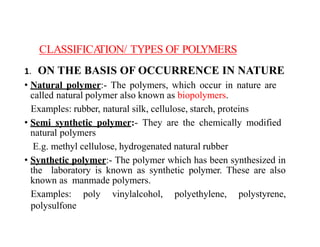
• Natural polymer:- The polymers, which occur in nature are
called natural polymer also known as biopolymers.
Examples: rubber, natural silk, cellulose, starch, proteins
• Semi synthetic polymer:- They are the chemically modified
natural polymers
E.g. methyl cellulose, hydrogenated natural rubber
• Synthetic polymer:- The polymer which has been synthesized in
the laboratory is known as synthetic polymer. These are also
known as manmade polymers.
Examples: poly vinylalcohol, polyethylene, polystyrene,
polysulfone
2. ON THE BASIS OF THERMAL RESPONSE
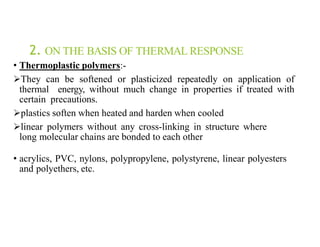
• Thermoplastic polymers:-
They can be softened or plasticized repeatedly on application of
thermal energy, without much change in properties if treated with
certain precautions.
plastics soften when heated and harden when cooled
linear polymers without any cross-linking in structure where
long molecular chains are bonded to each other
• acrylics, PVC, nylons, polypropylene, polystyrene, linear polyesters
and polyethers, etc.
• Thermosetting polymers:
These plastics require heat and pressure to mold them into shape.
They are formed into a permanent shape and cured or ‘set’
by chemical reactions such as extensive cross-linking.
They cannot be re-melted or reformed into another shape but
decompose upon being heated to too high a temperature.
• Epoxy resins, vulcanized rubbers, Phenolics, unsaturated
polyester resins, etc.
3. ON THE BASIS OF MODE OF FORMA
TION
• Addition polymers :They are formed of olefinic, diolefenic, vinyl
and related monomers. They are formed of simple addition of
monomer molecules to each other in a quick succession by a
chain mechanism.
• linear or branched polymers with little or no cross-linking
• chain reaction polymerization, is a process in which multi-
functional monomer units are attached one at a time in chain like
fashion to form linear/3-D macro-molecules.
• nR-C=C-R'
• E.g. Polyethylene, polypropylene, PVC
ADDITION REACTION
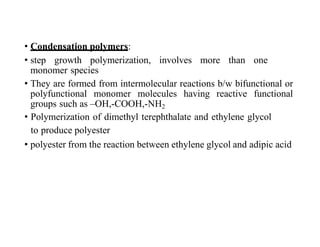
• Condensation polymers:
• step growth polymerization, involves more than one
monomer species
• They are formed from intermolecular reactions b/w bifunctional or
polyfunctional monomer molecules having reactive functional
groups such as –OH,-COOH,-NH2
• Polymerization of dimethyl terephthalate and ethylene glycol
to produce polyester
• polyester from the reaction between ethylene glycol and adipic acid
CONDENSATION REACTION
4. ON THE BASIS OF STRUCTURE
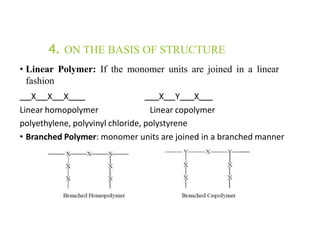
• Linear Polymer: If the monomer units are joined in a linear
fashion
X X X
Linear homopolymer
X Y X
Linear copolymer
polyethylene, polyvinyl chloride, polystyrene
• Branched Polymer: monomer units are joined in a branched manner
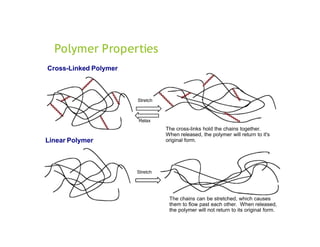
•Cross linked polymer: monomer units are joined
together in a chain fashion.
Polymer Properties
Stretch
Cross-Linked Polymer
Relax
Stretch
Linear Polymer
The chains can be stretched, which causes
them to flow past each other. When released,
the polymer will not return to its original form.
The cross-links hold the chains together.
When released, the polymer will return to it's
original form.
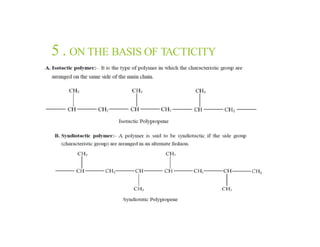
5 . ON THE BASIS OF TACTICITY
6. ON THE BASIS OF APPLICATIONAND PHYSICAL PROPERTIES
POL
YMERS
• Polymers have been used as a main tool to control the drug
release rate from the formulations.
• Polymers are macromolecules having very large chains,
contain a variety of functional groups, can be blended with
other low- and high–molecular-weight materials, and can be
tailored for any applications.
• The pharmaceutical applications of polymers range from their use
as binders in tablets to viscosity and flow controlling agents in
liquids, suspensions and emulsions.
• Polymers can be used as film coatings to disguise the unpleasant
taste of a drug, to enhance drug stability and to modify drug release
characteristics.
• Pharmaceutical polymers are widely used to achieve taste masking;
controlled release (e.g., extended, pulsatile, and targeted),
enhanced delivery devices are systems in which a drug is dispersed
within a polymer matrix and released by diffusion.
• The rate of the drug release from a matrix product depends on the
initial drug concentration and relaxation of the polymer chains,
which overall displays a sustained release characteristic
• In the biomedical area, polymers are generally used as implants
and are expected to perform long term service.
• This requires that the polymers have unique properties that are
not offered by polymers intended for general applications.
• In general, the desirable polymer properties in pharmaceutical
applications are film forming (coating), thickening (rheology
modifier), gelling (controlled release), adhesion (binding), pH-
dependent solubility (controlled release), solubility in organic
solvents (taste masking), and barrier properties (protection and
packaging).
POL
YMERS IN PHARMACEUTICALAND
BIOMEDICALAPPLICATIONS
• Water-Soluble Synthetic Polymers
• Poly (acrylic acid) Cosmetic, pharmaceuticals,
immobilization of cationic drugs, base for Carbopol
polymers
• Poly (ethylene oxide) Coagulant, flocculent, very high
molecular-weight up to a few millions, swelling agent
• Poly (ethylene glycol) Mw 1000), plasticizer, base for
suppositories
• Poly (vinyl alcohol) Water-soluble packaging, tablet binder,
tablet coating
• Cellulose-Based Polymers
• Ethyl cellulose: Insoluble but dispersible in water, aqueous coating
system for sustained release applications
• Carboxymethyl cellulose: Super disintegrant, emulsion stabilizer
• Hydroxyethyl and hydroxypropyl celluloses : Soluble in water and in
alcohol, tablet coating
• Hydroxypropyl methyl cellulose: Binder for tablet matrix and tablet
coating, gelatin alternative as capsule material
• Cellulose acetate phthalate Enteric coating
POL
YMERS IN PHARMACEUTICALAND
BIOMEDICALAPPLICATIONS
• Hydrocolloids
• Alginic acid: Oral and topical pharmaceutical products; thickening
and suspending agent in a variety of pastes, creams, and gels, as
well as a stabilizing agent for oil-in-water emulsions; binder and
disintegrant
• Carrageenan :Modified release, viscosifier
• Chitosan: Cosmetics and controlled drug delivery
applications, mucoadhesive dosage forms, rapid release
dosage forms
• Pectinic acid: Drug delivery
POL
YMERS IN PHARMACEUTICALAND
BIOMEDICALAPPLICATIONS
• Water-Insoluble Biodegradable Polymers
• Lactide-co-glycolide) polymers Microparticle–
nanoparticle for protein delivery
THANKYOU

PPT ON POLYMERS.pptx

  • 1.
    TOPIC- POLYMERS MADE BY SAURABHPUNIA M-PHARM (1ST YEAR) SCHOOL OF PHARMACEUTICAL SCIENCES, CSJMU, KANPUR (U.P) UNDER THE GUIDANCE OF DR. KALPANA ASSISTANT PROFESSOR
  • 2.
    DEFINITION • Polymers aregiant molecules of high molecular weight, called macromolecules, which are built up by linking together of a large number of small molecules, called monomers. • The reaction by which monomers combine to form polymer is known as polymerization.
  • 3.
    • Copolymer: polymersformed from 2 or more different monomers • --[A—B----A----B]--- • Homopolymer: polymers formed from bonding of identical monomers • --[A-A-A-A]--
  • 4.
    CLASSIFICA TION/ TYPES OFPOLYMERS 1. ON THE BASIS OF OCCURRENCE IN NATURE • Natural polymer:- The polymers, which occur in nature are called natural polymer also known as biopolymers. Examples: rubber, natural silk, cellulose, starch, proteins • Semi synthetic polymer:- They are the chemically modified natural polymers E.g. methyl cellulose, hydrogenated natural rubber • Synthetic polymer:- The polymer which has been synthesized in the laboratory is known as synthetic polymer. These are also known as manmade polymers. Examples: poly vinylalcohol, polyethylene, polystyrene, polysulfone
  • 5.
    2. ON THEBASIS OF THERMAL RESPONSE • Thermoplastic polymers:- They can be softened or plasticized repeatedly on application of thermal energy, without much change in properties if treated with certain precautions. plastics soften when heated and harden when cooled linear polymers without any cross-linking in structure where long molecular chains are bonded to each other • acrylics, PVC, nylons, polypropylene, polystyrene, linear polyesters and polyethers, etc.
  • 6.
    • Thermosetting polymers: Theseplastics require heat and pressure to mold them into shape. They are formed into a permanent shape and cured or ‘set’ by chemical reactions such as extensive cross-linking. They cannot be re-melted or reformed into another shape but decompose upon being heated to too high a temperature. • Epoxy resins, vulcanized rubbers, Phenolics, unsaturated polyester resins, etc.
  • 7.
    3. ON THEBASIS OF MODE OF FORMA TION • Addition polymers :They are formed of olefinic, diolefenic, vinyl and related monomers. They are formed of simple addition of monomer molecules to each other in a quick succession by a chain mechanism. • linear or branched polymers with little or no cross-linking • chain reaction polymerization, is a process in which multi- functional monomer units are attached one at a time in chain like fashion to form linear/3-D macro-molecules. • nR-C=C-R' • E.g. Polyethylene, polypropylene, PVC
  • 8.
  • 9.
    • Condensation polymers: •step growth polymerization, involves more than one monomer species • They are formed from intermolecular reactions b/w bifunctional or polyfunctional monomer molecules having reactive functional groups such as –OH,-COOH,-NH2 • Polymerization of dimethyl terephthalate and ethylene glycol to produce polyester • polyester from the reaction between ethylene glycol and adipic acid
  • 10.
  • 11.
    4. ON THEBASIS OF STRUCTURE • Linear Polymer: If the monomer units are joined in a linear fashion X X X Linear homopolymer X Y X Linear copolymer polyethylene, polyvinyl chloride, polystyrene • Branched Polymer: monomer units are joined in a branched manner
  • 12.
    •Cross linked polymer:monomer units are joined together in a chain fashion.
  • 13.
    Polymer Properties Stretch Cross-Linked Polymer Relax Stretch LinearPolymer The chains can be stretched, which causes them to flow past each other. When released, the polymer will not return to its original form. The cross-links hold the chains together. When released, the polymer will return to it's original form.
  • 14.
    5 . ONTHE BASIS OF TACTICITY
  • 16.
    6. ON THEBASIS OF APPLICATIONAND PHYSICAL PROPERTIES
  • 17.
    POL YMERS • Polymers havebeen used as a main tool to control the drug release rate from the formulations. • Polymers are macromolecules having very large chains, contain a variety of functional groups, can be blended with other low- and high–molecular-weight materials, and can be tailored for any applications. • The pharmaceutical applications of polymers range from their use as binders in tablets to viscosity and flow controlling agents in liquids, suspensions and emulsions.
  • 18.
    • Polymers canbe used as film coatings to disguise the unpleasant taste of a drug, to enhance drug stability and to modify drug release characteristics. • Pharmaceutical polymers are widely used to achieve taste masking; controlled release (e.g., extended, pulsatile, and targeted), enhanced delivery devices are systems in which a drug is dispersed within a polymer matrix and released by diffusion. • The rate of the drug release from a matrix product depends on the initial drug concentration and relaxation of the polymer chains, which overall displays a sustained release characteristic
  • 19.
    • In thebiomedical area, polymers are generally used as implants and are expected to perform long term service. • This requires that the polymers have unique properties that are not offered by polymers intended for general applications. • In general, the desirable polymer properties in pharmaceutical applications are film forming (coating), thickening (rheology modifier), gelling (controlled release), adhesion (binding), pH- dependent solubility (controlled release), solubility in organic solvents (taste masking), and barrier properties (protection and packaging).
  • 20.
    POL YMERS IN PHARMACEUTICALAND BIOMEDICALAPPLICATIONS •Water-Soluble Synthetic Polymers • Poly (acrylic acid) Cosmetic, pharmaceuticals, immobilization of cationic drugs, base for Carbopol polymers • Poly (ethylene oxide) Coagulant, flocculent, very high molecular-weight up to a few millions, swelling agent • Poly (ethylene glycol) Mw 1000), plasticizer, base for suppositories • Poly (vinyl alcohol) Water-soluble packaging, tablet binder, tablet coating
  • 21.
    • Cellulose-Based Polymers •Ethyl cellulose: Insoluble but dispersible in water, aqueous coating system for sustained release applications • Carboxymethyl cellulose: Super disintegrant, emulsion stabilizer • Hydroxyethyl and hydroxypropyl celluloses : Soluble in water and in alcohol, tablet coating • Hydroxypropyl methyl cellulose: Binder for tablet matrix and tablet coating, gelatin alternative as capsule material • Cellulose acetate phthalate Enteric coating
  • 22.
    POL YMERS IN PHARMACEUTICALAND BIOMEDICALAPPLICATIONS •Hydrocolloids • Alginic acid: Oral and topical pharmaceutical products; thickening and suspending agent in a variety of pastes, creams, and gels, as well as a stabilizing agent for oil-in-water emulsions; binder and disintegrant • Carrageenan :Modified release, viscosifier • Chitosan: Cosmetics and controlled drug delivery applications, mucoadhesive dosage forms, rapid release dosage forms • Pectinic acid: Drug delivery
  • 23.
    POL YMERS IN PHARMACEUTICALAND BIOMEDICALAPPLICATIONS •Water-Insoluble Biodegradable Polymers • Lactide-co-glycolide) polymers Microparticle– nanoparticle for protein delivery
  • 24.