www.sgcollege.edu.in
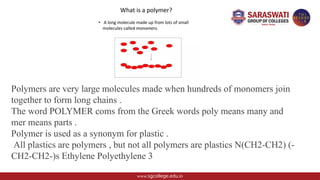
Polymers are verylarge molecules made when hundreds of monomers join
together to form long chains .
The word POLYMER coms from the Greek words poly means many and
mer means parts .
Polymer is used as a synonym for plastic .
All plastics are polymers , but not all polymers are plastics N(CH2-CH2) (-
CH2-CH2-)s Ethylene Polyethylene 3
4.
TYPES OF POLYMER
NATURALPOLYMERS Definition : Natural polymer is a polymer that results from only raw materials that
are found in nature . Some of these natural polymers include DNA and RNA Cotton , DNA , Wool , Wood
are some of the naturally occurring polymers .
HOMOPOLYMER Homopolymers are synthesized from a single type of monomer . Homopolymers are
consists of chains with identical bonding linkages to each monomer unit . This usually implies that the polymer
is made from all identical monomer molecules .
COPOLYMER When two or more different monomers together to polymerize their result is called as
copolymer . This process is called as copolymerization . Types of Copolymer : 1) Statistical copolymer 2)
Alternating copolymer 3) Block copolymer 4) Graft copolymer
THERMOPLASTIC A type of plastic that can be softened by heat , hardened by cooling , and then softened by
heat over and over again Thermoplastic are not cross – linked polymer . Examples : Polyethylene , Nylon ,
Polyvinyl chloride .
THERMOSETS Thermoset having the property of becoming permanently hard and rigid when heated .
Thermosets are hard and rigid at room temperature and do not soften on heating . Examples : Epoxy resins ,
Phenolic resins , Unsaturated polyester resins .
LONG CHAIN POLYMERS A very long strand of repeating molecules linked together by primary
bond .Polymer chains are orient themselves in lines as they enter a mold but may be annealed so they can recoil
.
Classification of PolymersBased on the Structure of the Monomer Chain
This category has the following classifications:
Linear Polymers
The structure of polymers containing long and straight chains falls into this category. PVC, i.e., polyvinyl
chloride, is largely used for making pipes, and an electric cable is an example of a linear polymer.
Branched-chain Polymers
When linear chains of a polymer form branches, then such polymers are categorised as branched chain
polymers. For example, low-density polythene.
Cross-linked Polymers
They are composed of bifunctional and trifunctional monomers. They have a stronger covalent bond in
comparison to other linear polymers. Bakelite and melamine are examples of cross-linked polymers.
Classification Based on Molecular Forces
Elastomers: These are rubber-like solids, and weak interaction forces are present in them. For example,
rubber.
Fibres: Strong, tough, high tensile strength and strong forces of interaction are present. For example, nylon -
6, 6.
Thermoplastics: These have intermediate forces of attraction. For example, polyvinyl chloride.
Thermosetting polymers: These polymers greatly improve the material’s mechanical properties. It provides
enhanced chemical and heat resistance. For example, phenolics, epoxies and silicones
7.
www.sgcollege.edu.in
Classification of PolymersBased on the Structure of the Monomer Chain
Polymers can also be classified according to their structure as linear,
branched, and cross-linked polymers. These include:
Linear Polymers: Linear polymers are straight, long chains of polymers with a
very simple structure. They have considerable strength, high density, and
viscosity. Linear polymer example: PVC (polyvinyl chloride).
Branched-chain Polymers: Branched-chain polymers consist of long chains of
polymers that have smaller, branched chains in an irregular manner. They are
not as strong as linear polymers and show low density and viscosity.
Branched-chain polymers example: LDPE (low-density polyethylene).
Cross-linked Polymers: In cross-inked polymers, the polymers are joined
together and form a network of covalent bonds. This increases the tensile
strength of the polymers. Cross-linked polymer example: Bakelite.
Application of Polymersin Ndds
The Ocusert System The delivery of therapeutic agents to the eye for the treatment of disorders of the
eye, (e.g., glaucoma), using conventional drug delivery systems, e.g., drops, ointments, is an inefficient
process.
The efficiency of ocular drug delivery is improved through the use of polymeric implants that are
implanted under the lower cul-de-sac of the eye.
In this system pilocarpine is dispersed within an alginic acid matrix which is sandwiched between two
layers each composed of poly(ethy1ene-co-vinyl acetate). It is designed to release either 20 µg/h or 40
µg/h of a therapeutic agent for a seven day period following implantation.
POLYMERS IN PHARMACEUTICALAPPLICATIONS
Plastics and Rubbers
Polyurethane,Transdermal,patch backing, blood pump, artificial heart, and vascular grafts, foam
inbiomedical and industrial products.
Polyisobutylene Pressure sensitive adhesives for transdermal delivery.
Polycyanoacrylate Biodegradable tissue adhesives in surgery,a drug carrier in nano and
‐
microparticles.
Poly (vinyl acetate) Binder for chewing gum.
Poly (vinyl chloride) Blood bag, and tubing.
Polyethylene Transdermal patch backing for drug in adhesive design, wrap, packaging, containers.
12.
Medical Products
Polymers arethe most important and largest family of materials being used in medical applications. Polymers have
various advantages such as lightweight, easy processability and reproducibility, non-toxicity, biocompatibility and good
aesthetics. Because of these advantages, polymers are used in the various medical devices such as artificial limbs, wound
dressing, artificial skin, blood bag, CAPD bag, bioprosthetic heart valve, various replacement joints, bioabsorbable suture,
contact and intraocular lenses, orthodontic devices, tissue adhesive, bandages and drug carrier & implants.
Major R&D Projects
SRI has successfully developed various polymer based products for medical applications.