TOPIC–REGULATORY AFFAIRS
UNIT 3A
SCHOOL OF PHARMACEUTICAL SCIENCES, CSJMU
LIST OF CONTENTS
 Introduction
 Historical overview of Regulatory Affairs
 Regulatory authorities
 Role of Regulatory affairs department
 Responsibility of Regulatory Affairs Professionals
2
SCHOOL OF PHARMACEUTICAL SCIENCES, CSJMU
INTRODUCTION
• Regulation and regulatory Affairs
– Regulation involves extensive evaluation of a
particular drug product to ensure protection of
public health, promotion of the product, Drug
registration, marketing authorization, import and
distribution, pharmacovigilance.
– Regulatory Affairs is a comparatively new
profession which has developed from the desire of
governments to protect public health, by
controlling the safety and efficacy of products in
areas including pharmaceuticals, veterinary
medicines, medical devices, pesticides,
agrochemicals, cosmetics and complementary
medicines.
3
SCHOOL OF PHARMACEUTICAL SCIENCES, CSJMU
INTRODUCTION
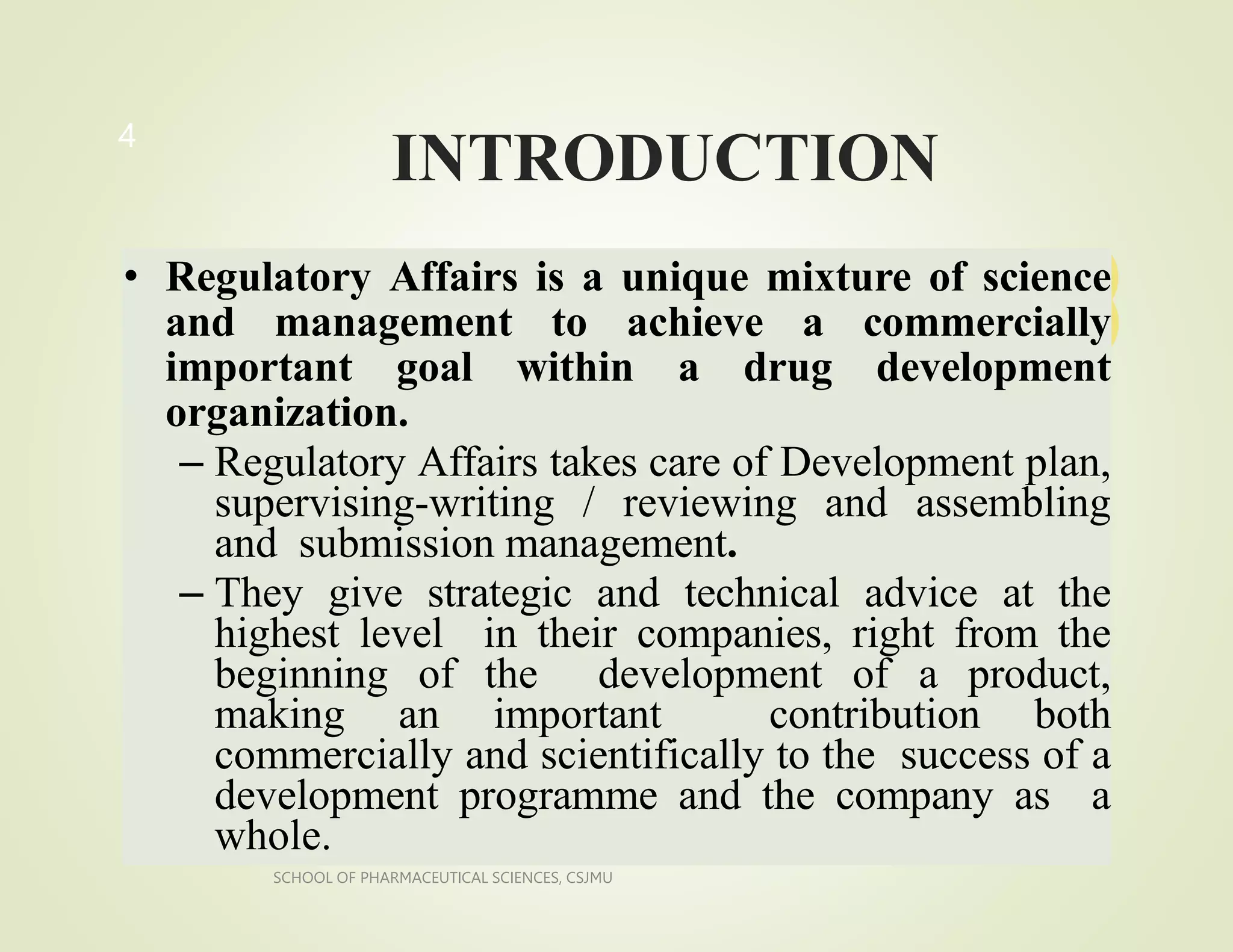
• Regulatory Affairs is a unique mixture of science
and management to achieve a commercially
important goal within a drug development
organization.
– Regulatory Affairs takes care of Development plan,
supervising-writing / reviewing and assembling
and submission management.
– They give strategic and technical advice at the
highest level in their companies, right from the
beginning of the development of a product,
making an important contribution both
commercially and scientifically to the success of a
development programme and the company as a
whole.
4
SCHOOL OF PHARMACEUTICAL SCIENCES, CSJMU
BRIEF HISTORY OF FEDRAL FOOD
DRUG AND COSMETIC ACT
• 30th August 1880: Law prohibiting transportation of adulterated or
unwholesome food, drugs or liquor.
• 1906: Congress passed Wiley Act(Pure Food and Drug act) to prevent the
manufacture, sale or transportation of adulterated or misbranded or poisonous or
deleterious food, drug, medicine or liquors and their traffic therein.
• 1912: amendment to prohibit any false claim/statement regarding of curative and
any therapeutics effect on labelling of drugs.
• June 27, 1938: Present act-
– required pretesting of new drugs before marketing.
– Dropped the concerns related to liquor.
– For any new drug: NDA should be filed.
– Label
• Should state name and quantity of every ingredient whether active or inactive
• False or misleading therapeutic claims were actionable until fraudulent intent
• Manufacture and sale of medical devices was included.
• Factory inspections by government to ensure compliance.
• Cosmetics were included.
5
SCHOOL OF PHARMACEUTICAL SCIENCES, CSJMU
GENERATION OF VARIOUS
REGULATIONS
• Major incidences made us to understand that rules
and regulations are required to prove safety along
with efficacy of drug. Such incidences are as follows:
-
YEAR ACT REASON
1902 Biologics Control Act Diphtheria Epidemic
1938 Food Drug and Cosmetic
Act
Elixir of Sulfanilamide
1962 Kefauver-Harris
Amendments
Thalidomide: Drug
Efficacy alongwith safety.
1976 Medical Device
Amendments
Dalkon Shield
(contraceptive :IUD)
1990 Safe Medical Devices Act Bjork-Shiley Heart Valves
6
SCHOOL OF PHARMACEUTICAL SCIENCES, CSJMU
CHRONOLOGICAL EVALUATION OF R.A
S.No YEAR CONTENT
1 1540
England: Manufacture of medicines were subjected to supervision under
“Apothecaries Wares Drugs and Stuffs Act”
2 1581 First Pharmacopoeia: Spanish Pharmacopoeia
3 1618 The London Pharmacopoeia
4 1938 Introduction to Fedral Food, Drugs and Cosmetics Act
5
1940
& Drugs and cosmetics Act 1940 & Rules 1945
1945
6 1962 Drug amendment act of 1962(Drug efficacy and cGMP Compliance)
7 1963 Committee on safety of Drugs was established
8 1964 Yellow Card scheme (UK after Thalidomide disaster w.r.t. adverse effects)
9 1975
European community(laws regarding medicinal pdts.: analytical,
pharmaotoxicological, testing protocols and action related to med. Pdts.)
10 1989 ICDRA organized by WHO
11 1990 ICH
12 1993 EMEA
7
SCHOOL OF PHARMACEUTICAL SCIENCES, CSJMU
GOALS OF REGULATORYAFFAIRS AS
PROFESSION
• Protection of human health
• Ensuring safety, efficacy and quality of drugs
• Ensuring appropriateness and accuracy of
product information
8
SCHOOL OF PHARMACEUTICAL SCIENCES, CSJMU
ROLES OF REGULATORYAFFAIRS
PROFESSIONALS
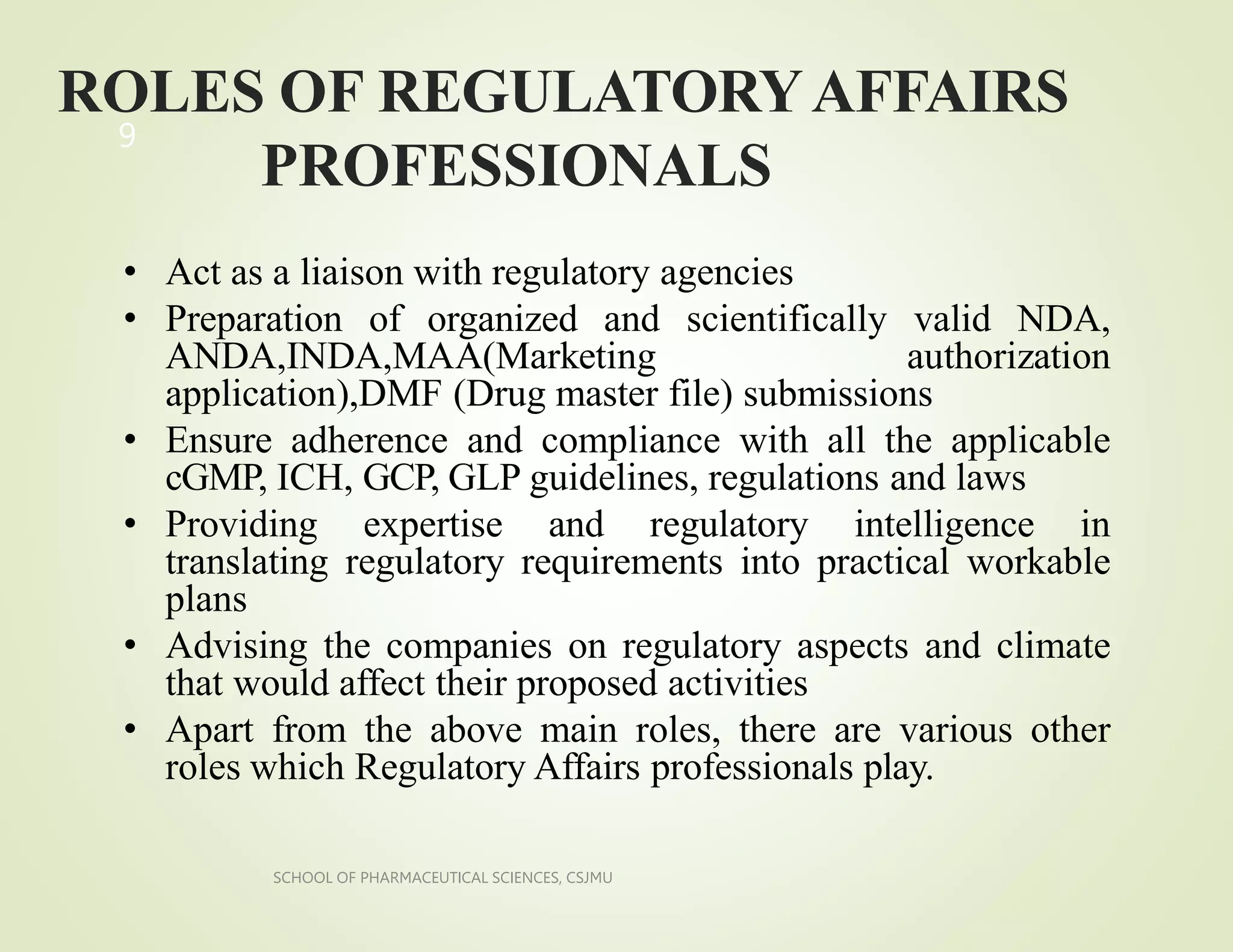
• Act as a liaison with regulatory agencies
• Preparation of organized and scientifically valid NDA,
ANDA,INDA,MAA(Marketing authorization
application),DMF (Drug master file) submissions
• Ensure adherence and compliance with all the applicable
cGMP, ICH, GCP, GLP guidelines, regulations and laws
• Providing expertise and regulatory intelligence in
translating regulatory requirements into practical workable
plans
• Advising the companies on regulatory aspects and climate
that would affect their proposed activities
• Apart from the above main roles, there are various other
roles which Regulatory Affairs professionals play.
9
SCHOOL OF PHARMACEUTICAL SCIENCES, CSJMU
WHAT WORK IS DONE IN
REGULATORYAFFAIRS DEPARTMENT?
• A new drug/generic drug manufactured by a pharmaceutical
company just cannot be released into the market for human
use.
• Here the Regulatory Affairs Department comes into play.
• Regulatory Affairs Department of a pharmaceutical company
files all the information related to the development,
manufacture, control, stability studies, packing, labeling ,
safety and efficacy studies of drugs with the Regulatory
agencies in a prescribed format as ANDA/NDA/MAA/DMF
etc.
• The Regulatory agency reviews the information provided in
accordance with regulations, guidelines and if they are
satisfied with information provided, approval will be
granted for marketing of the drug by pharmaceutical
companies for human use.
10
SCHOOL OF PHARMACEUTICAL SCIENCES, CSJMU
QUALITIES OF A GOOD RA
PROFESSIONAL
•
 Authoritative
 Team Player
 Decisive
 Resourceful
 Good Communication Skill
 Analytical Skill- Ability to evaluate the strengths and
weakness of the technical and legal options open to a
company.
 Good Informational Technology skills
 Negotiating Skills
 Able to reapply scientific and regulatory principles
 Ability to work with other disciplines
 Flexible- Always willing to learn.
11
SCHOOL OF PHARMACEUTICAL SCIENCES, CSJMU
RESPONSIBILITIES OF REGULATORY
AFFAIRS DEPARTMENT
• Keep in touch with international legislation, guidelines and customer
practices
• Keep up to the date with a company’s product range
• Ensure that a company’s products comply with the current regulations.
• The Regulatory Affairs professional’s job is to keep track of the ever-
changing legislation in all the regions in which the company wishes to
distribute its products.
• They also advise on the legal and scientific restraints and requirements,
and collect, collate, and evaluate the scientific data that their research and
development colleagues are generating.
• Formulate regulatory strategy for all appropriate regulatory submissions
for domestic, international and/or contract projects.
12
RESPONSIBILITIES OF REGULATORY
AFFAIRS DEPARTMENT
• Coordinate, prepare and review all appropriate documents for example dossier and
submit them to regulatory authorities within a specified time frame in conjugation with
the organization.
• Prepare and review of SOPs related to RA. Review of BMR, MFR, change control and
other relevant documents.
• Monitor the progress of all registration submission.
• Maintain approved applications and the record of registration fees paid against
submission of DMF’s and other documents.
• Respond to queries as they arise, and ensure that registration/ approval are granted
without delay.
• Impart training to R&D, Pilot plant and RA Team members on current regulatory
requirements.
13
RESPONSIBILITIES OF REGULATORY
AFFAIRS DEPARTMENT
• Advising their companies on the regulatory aspects and climate that would affect
proposed activities.
• Manage review audit reports and compliance, regulatory and customer inspections.
• Regulatory Affairs professionals help the company avoid problems caused by badly
kept records, inappropriate scientific thinking or poor presentation of data. In most
product areas where regulatory requirements are imposed, restrictions are also
placed upon the claims which can be made for the product on labeling or in
advertising.
• Have a duty to provide physicians and other healthcare professionals with accurate
and complete information about the quality, safety and effectiveness of the product.
14
SCHOOL OF PHARMACEUTICAL SCIENCES, CSJMU
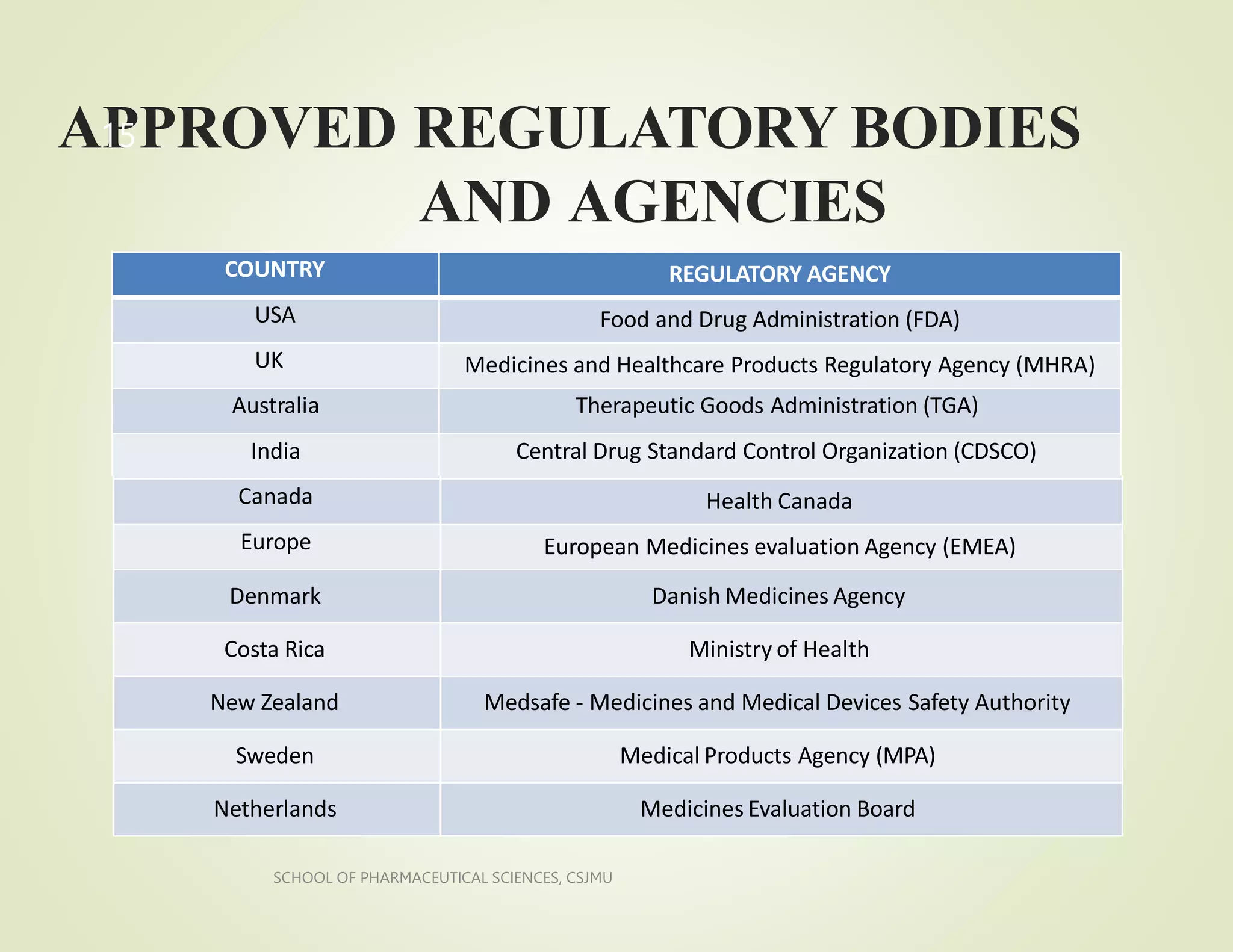
APPROVED REGULATORY BODIES
AND AGENCIES
COUNTRY
USA
UK
REGULATORY AGENCY
Food and Drug Administration (FDA)
Medicines and Healthcare Products Regulatory Agency (MHRA)
Australia
India
Canada
Europe
Therapeutic Goods Administration (TGA)
Central Drug Standard Control Organization (CDSCO)
Health Canada
European Medicines evaluation Agency (EMEA)
Denmark Danish Medicines Agency
Costa Rica Ministry of Health
New Zealand Medsafe - Medicines and Medical Devices Safety Authority
Sweden Medical Products Agency (MPA)
Netherlands Medicines Evaluation Board
15
SCHOOL OF PHARMACEUTICAL SCIENCES, CSJMU
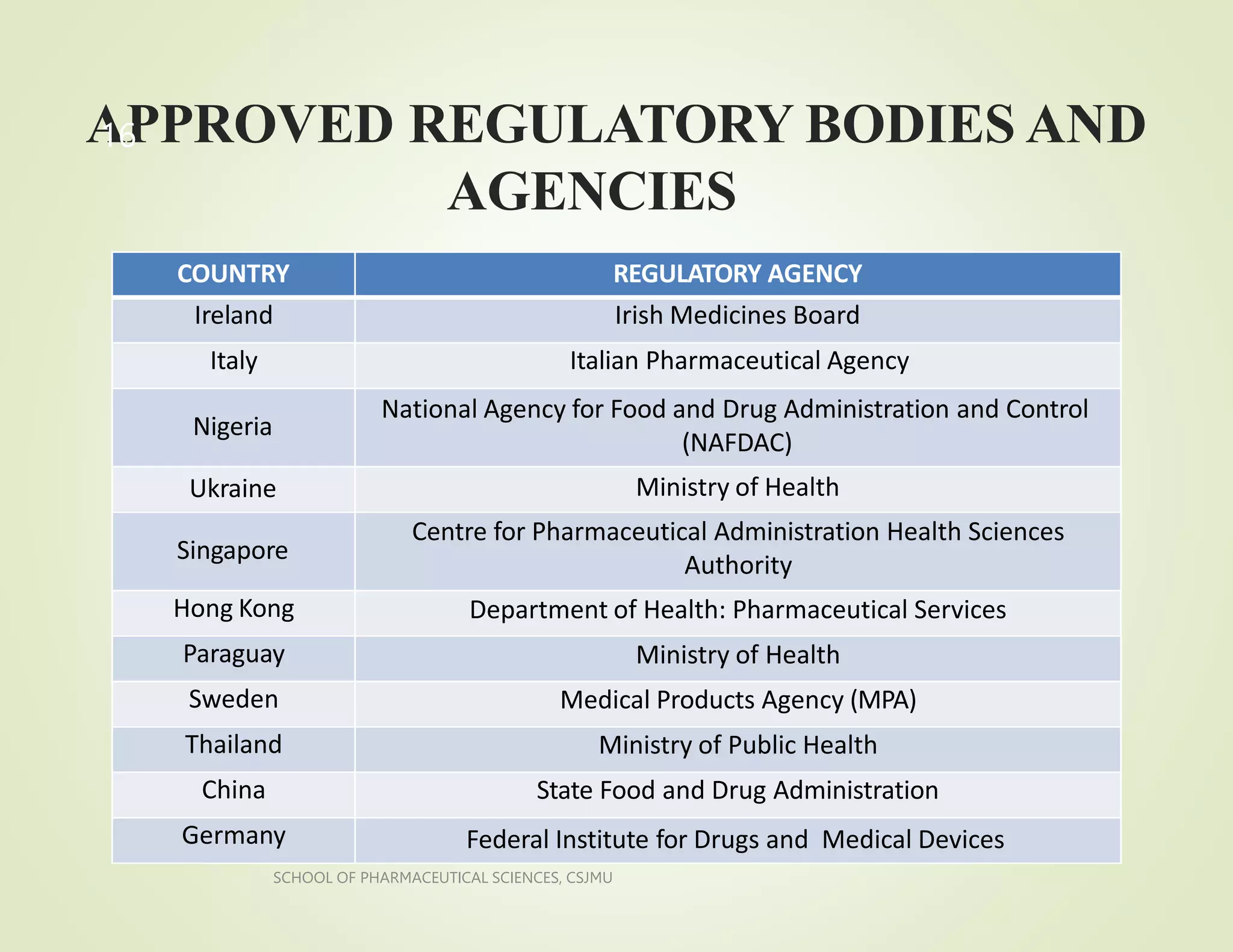
APPROVED REGULATORY BODIES AND
AGENCIES
COUNTRY
Ireland
Italy
Nigeria
Ukraine
Singapore
REGULATORY AGENCY
Irish Medicines Board
Italian Pharmaceutical Agency
National Agency for Food and Drug Administration and Control
(NAFDAC)
Ministry of Health
Centre for Pharmaceutical Administration Health Sciences
Authority
Department of Health: Pharmaceutical Services
Ministry of Health
Medical Products Agency (MPA)
Ministry of Public Health
State Food and Drug Administration
Hong Kong
Paraguay
Sweden
Thailand
China
Germany Federal Institute for Drugs and Medical Devices
16
SCHOOL OF PHARMACEUTICAL SCIENCES, CSJMU
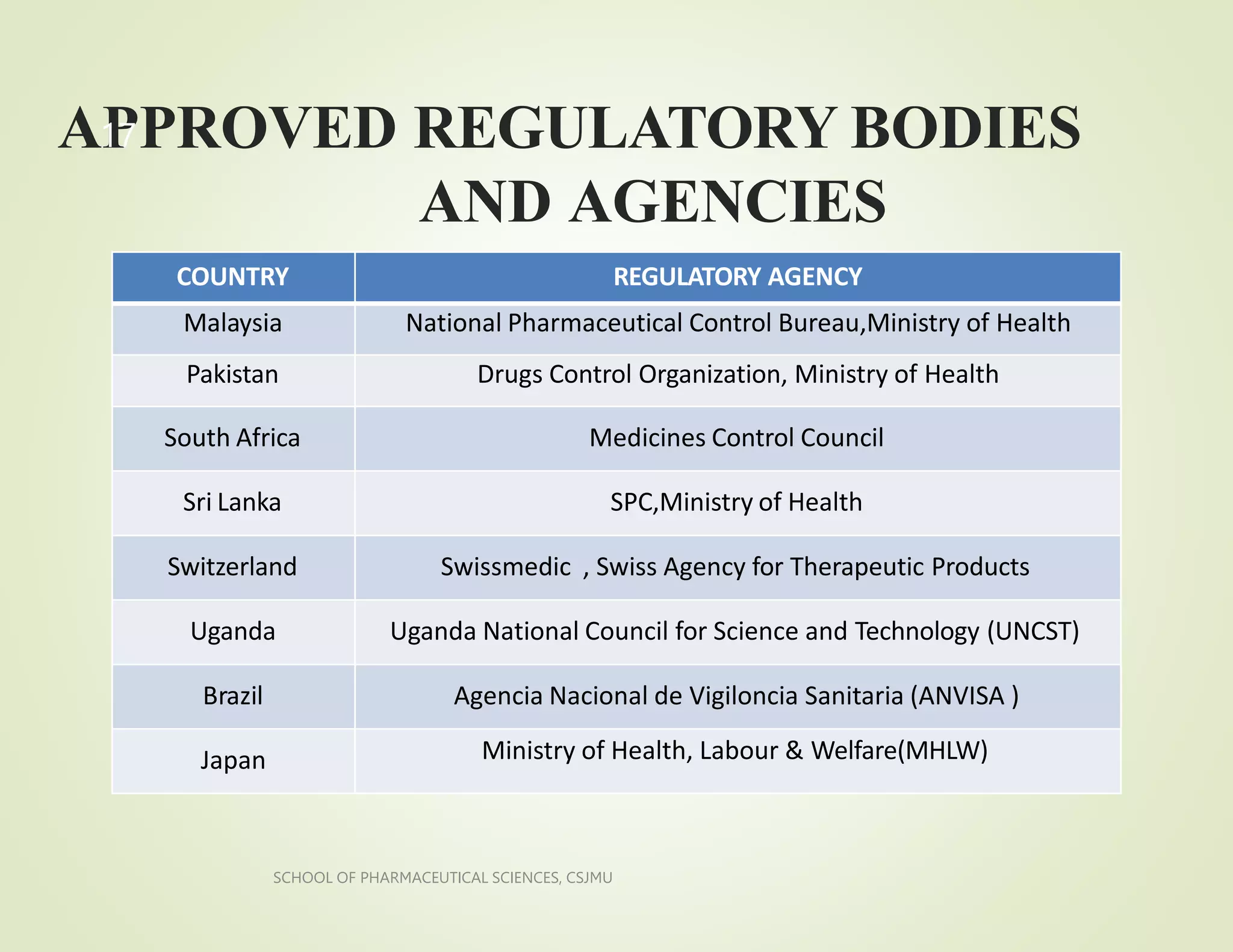
APPROVED REGULATORY BODIES
AND AGENCIES
COUNTRY
Malaysia
Pakistan
REGULATORY AGENCY
National Pharmaceutical Control Bureau,Ministry of Health
Drugs Control Organization, Ministry of Health
South Africa Medicines Control Council
Sri Lanka SPC,Ministry of Health
Switzerland Swissmedic , Swiss Agency for Therapeutic Products
Uganda Uganda National Council for Science and Technology (UNCST)
Brazil Agencia Nacional de Vigiloncia Sanitaria (ANVISA )
Japan Ministry of Health, Labour & Welfare(MHLW)
17
SCHOOL OF PHARMACEUTICAL SCIENCES, CSJMU
MAJOR REGULATORY AUTHORITIES
S.NO COUNTRY REGULATORY AUTHORITY
01. INDIA Central drug standard control organization
(CDSCO)
Drug controller general of India (DCGI)
02. U.S US FDA
03. U.K Medicines and health care products
regulatory agency (MHRA)
04. AUSTRALIA Therapeutic Goods Administration ( TGA)
05. CANADA Health Canada
06. SOUTH AFRICA Medicines control council(MCC)
18
THANKYOU
19
SCHOOL OF PHARMACEUTICAL SCIENCES, CSJMU

UNIT 3A REGULATORY AFFAIRS.pptx

  • 1.
    TOPIC–REGULATORY AFFAIRS UNIT 3A SCHOOLOF PHARMACEUTICAL SCIENCES, CSJMU
  • 2.
    LIST OF CONTENTS Introduction  Historical overview of Regulatory Affairs  Regulatory authorities  Role of Regulatory affairs department  Responsibility of Regulatory Affairs Professionals 2 SCHOOL OF PHARMACEUTICAL SCIENCES, CSJMU
  • 3.
    INTRODUCTION • Regulation andregulatory Affairs – Regulation involves extensive evaluation of a particular drug product to ensure protection of public health, promotion of the product, Drug registration, marketing authorization, import and distribution, pharmacovigilance. – Regulatory Affairs is a comparatively new profession which has developed from the desire of governments to protect public health, by controlling the safety and efficacy of products in areas including pharmaceuticals, veterinary medicines, medical devices, pesticides, agrochemicals, cosmetics and complementary medicines. 3 SCHOOL OF PHARMACEUTICAL SCIENCES, CSJMU
  • 4.
    INTRODUCTION • Regulatory Affairsis a unique mixture of science and management to achieve a commercially important goal within a drug development organization. – Regulatory Affairs takes care of Development plan, supervising-writing / reviewing and assembling and submission management. – They give strategic and technical advice at the highest level in their companies, right from the beginning of the development of a product, making an important contribution both commercially and scientifically to the success of a development programme and the company as a whole. 4 SCHOOL OF PHARMACEUTICAL SCIENCES, CSJMU
  • 5.
    BRIEF HISTORY OFFEDRAL FOOD DRUG AND COSMETIC ACT • 30th August 1880: Law prohibiting transportation of adulterated or unwholesome food, drugs or liquor. • 1906: Congress passed Wiley Act(Pure Food and Drug act) to prevent the manufacture, sale or transportation of adulterated or misbranded or poisonous or deleterious food, drug, medicine or liquors and their traffic therein. • 1912: amendment to prohibit any false claim/statement regarding of curative and any therapeutics effect on labelling of drugs. • June 27, 1938: Present act- – required pretesting of new drugs before marketing. – Dropped the concerns related to liquor. – For any new drug: NDA should be filed. – Label • Should state name and quantity of every ingredient whether active or inactive • False or misleading therapeutic claims were actionable until fraudulent intent • Manufacture and sale of medical devices was included. • Factory inspections by government to ensure compliance. • Cosmetics were included. 5 SCHOOL OF PHARMACEUTICAL SCIENCES, CSJMU
  • 6.
    GENERATION OF VARIOUS REGULATIONS •Major incidences made us to understand that rules and regulations are required to prove safety along with efficacy of drug. Such incidences are as follows: - YEAR ACT REASON 1902 Biologics Control Act Diphtheria Epidemic 1938 Food Drug and Cosmetic Act Elixir of Sulfanilamide 1962 Kefauver-Harris Amendments Thalidomide: Drug Efficacy alongwith safety. 1976 Medical Device Amendments Dalkon Shield (contraceptive :IUD) 1990 Safe Medical Devices Act Bjork-Shiley Heart Valves 6 SCHOOL OF PHARMACEUTICAL SCIENCES, CSJMU
  • 7.
    CHRONOLOGICAL EVALUATION OFR.A S.No YEAR CONTENT 1 1540 England: Manufacture of medicines were subjected to supervision under “Apothecaries Wares Drugs and Stuffs Act” 2 1581 First Pharmacopoeia: Spanish Pharmacopoeia 3 1618 The London Pharmacopoeia 4 1938 Introduction to Fedral Food, Drugs and Cosmetics Act 5 1940 & Drugs and cosmetics Act 1940 & Rules 1945 1945 6 1962 Drug amendment act of 1962(Drug efficacy and cGMP Compliance) 7 1963 Committee on safety of Drugs was established 8 1964 Yellow Card scheme (UK after Thalidomide disaster w.r.t. adverse effects) 9 1975 European community(laws regarding medicinal pdts.: analytical, pharmaotoxicological, testing protocols and action related to med. Pdts.) 10 1989 ICDRA organized by WHO 11 1990 ICH 12 1993 EMEA 7 SCHOOL OF PHARMACEUTICAL SCIENCES, CSJMU
  • 8.
    GOALS OF REGULATORYAFFAIRSAS PROFESSION • Protection of human health • Ensuring safety, efficacy and quality of drugs • Ensuring appropriateness and accuracy of product information 8 SCHOOL OF PHARMACEUTICAL SCIENCES, CSJMU
  • 9.
    ROLES OF REGULATORYAFFAIRS PROFESSIONALS •Act as a liaison with regulatory agencies • Preparation of organized and scientifically valid NDA, ANDA,INDA,MAA(Marketing authorization application),DMF (Drug master file) submissions • Ensure adherence and compliance with all the applicable cGMP, ICH, GCP, GLP guidelines, regulations and laws • Providing expertise and regulatory intelligence in translating regulatory requirements into practical workable plans • Advising the companies on regulatory aspects and climate that would affect their proposed activities • Apart from the above main roles, there are various other roles which Regulatory Affairs professionals play. 9 SCHOOL OF PHARMACEUTICAL SCIENCES, CSJMU
  • 10.
    WHAT WORK ISDONE IN REGULATORYAFFAIRS DEPARTMENT? • A new drug/generic drug manufactured by a pharmaceutical company just cannot be released into the market for human use. • Here the Regulatory Affairs Department comes into play. • Regulatory Affairs Department of a pharmaceutical company files all the information related to the development, manufacture, control, stability studies, packing, labeling , safety and efficacy studies of drugs with the Regulatory agencies in a prescribed format as ANDA/NDA/MAA/DMF etc. • The Regulatory agency reviews the information provided in accordance with regulations, guidelines and if they are satisfied with information provided, approval will be granted for marketing of the drug by pharmaceutical companies for human use. 10 SCHOOL OF PHARMACEUTICAL SCIENCES, CSJMU
  • 11.
    QUALITIES OF AGOOD RA PROFESSIONAL •  Authoritative  Team Player  Decisive  Resourceful  Good Communication Skill  Analytical Skill- Ability to evaluate the strengths and weakness of the technical and legal options open to a company.  Good Informational Technology skills  Negotiating Skills  Able to reapply scientific and regulatory principles  Ability to work with other disciplines  Flexible- Always willing to learn. 11 SCHOOL OF PHARMACEUTICAL SCIENCES, CSJMU
  • 12.
    RESPONSIBILITIES OF REGULATORY AFFAIRSDEPARTMENT • Keep in touch with international legislation, guidelines and customer practices • Keep up to the date with a company’s product range • Ensure that a company’s products comply with the current regulations. • The Regulatory Affairs professional’s job is to keep track of the ever- changing legislation in all the regions in which the company wishes to distribute its products. • They also advise on the legal and scientific restraints and requirements, and collect, collate, and evaluate the scientific data that their research and development colleagues are generating. • Formulate regulatory strategy for all appropriate regulatory submissions for domestic, international and/or contract projects. 12
  • 13.
    RESPONSIBILITIES OF REGULATORY AFFAIRSDEPARTMENT • Coordinate, prepare and review all appropriate documents for example dossier and submit them to regulatory authorities within a specified time frame in conjugation with the organization. • Prepare and review of SOPs related to RA. Review of BMR, MFR, change control and other relevant documents. • Monitor the progress of all registration submission. • Maintain approved applications and the record of registration fees paid against submission of DMF’s and other documents. • Respond to queries as they arise, and ensure that registration/ approval are granted without delay. • Impart training to R&D, Pilot plant and RA Team members on current regulatory requirements. 13
  • 14.
    RESPONSIBILITIES OF REGULATORY AFFAIRSDEPARTMENT • Advising their companies on the regulatory aspects and climate that would affect proposed activities. • Manage review audit reports and compliance, regulatory and customer inspections. • Regulatory Affairs professionals help the company avoid problems caused by badly kept records, inappropriate scientific thinking or poor presentation of data. In most product areas where regulatory requirements are imposed, restrictions are also placed upon the claims which can be made for the product on labeling or in advertising. • Have a duty to provide physicians and other healthcare professionals with accurate and complete information about the quality, safety and effectiveness of the product. 14 SCHOOL OF PHARMACEUTICAL SCIENCES, CSJMU
  • 15.
    APPROVED REGULATORY BODIES ANDAGENCIES COUNTRY USA UK REGULATORY AGENCY Food and Drug Administration (FDA) Medicines and Healthcare Products Regulatory Agency (MHRA) Australia India Canada Europe Therapeutic Goods Administration (TGA) Central Drug Standard Control Organization (CDSCO) Health Canada European Medicines evaluation Agency (EMEA) Denmark Danish Medicines Agency Costa Rica Ministry of Health New Zealand Medsafe - Medicines and Medical Devices Safety Authority Sweden Medical Products Agency (MPA) Netherlands Medicines Evaluation Board 15 SCHOOL OF PHARMACEUTICAL SCIENCES, CSJMU
  • 16.
    APPROVED REGULATORY BODIESAND AGENCIES COUNTRY Ireland Italy Nigeria Ukraine Singapore REGULATORY AGENCY Irish Medicines Board Italian Pharmaceutical Agency National Agency for Food and Drug Administration and Control (NAFDAC) Ministry of Health Centre for Pharmaceutical Administration Health Sciences Authority Department of Health: Pharmaceutical Services Ministry of Health Medical Products Agency (MPA) Ministry of Public Health State Food and Drug Administration Hong Kong Paraguay Sweden Thailand China Germany Federal Institute for Drugs and Medical Devices 16 SCHOOL OF PHARMACEUTICAL SCIENCES, CSJMU
  • 17.
    APPROVED REGULATORY BODIES ANDAGENCIES COUNTRY Malaysia Pakistan REGULATORY AGENCY National Pharmaceutical Control Bureau,Ministry of Health Drugs Control Organization, Ministry of Health South Africa Medicines Control Council Sri Lanka SPC,Ministry of Health Switzerland Swissmedic , Swiss Agency for Therapeutic Products Uganda Uganda National Council for Science and Technology (UNCST) Brazil Agencia Nacional de Vigiloncia Sanitaria (ANVISA ) Japan Ministry of Health, Labour & Welfare(MHLW) 17 SCHOOL OF PHARMACEUTICAL SCIENCES, CSJMU
  • 18.
    MAJOR REGULATORY AUTHORITIES S.NOCOUNTRY REGULATORY AUTHORITY 01. INDIA Central drug standard control organization (CDSCO) Drug controller general of India (DCGI) 02. U.S US FDA 03. U.K Medicines and health care products regulatory agency (MHRA) 04. AUSTRALIA Therapeutic Goods Administration ( TGA) 05. CANADA Health Canada 06. SOUTH AFRICA Medicines control council(MCC) 18
  • 19.