BY :SATISH KUMAR
SINGH
10 - B
Please
Give
Your
CONTENTWHO IS A CONSUMER
DUTIES OF CONSUMERS
HOW CONSUMERS ARE EXPLOITED
FACTORS CAUSING EXPLOITATION OF CONSUMERS
CONSUMER MOVEMENT
NEED OF CONSUMER MOVEMENT
CONSUMER MOVEMENT IN INDIA
CONSUMER PROTECTION ACT, 1986
IMPORTANT DAYS
RIGHT TO BE HEARD
RIGHT TO INFORMATION
RIGHT TO CHOOSE
RIGHT TO SAFETY
RIGHT TO SEEK REDRESSAL
RIGHT TO CONSUMER EDUCATION
MORE TO KNOW
WHERE SHOULD CONSUMER GO TO GET JUSTICE
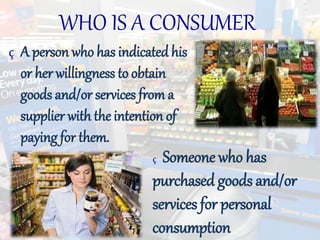
WHO IS A CONSUMER
ç A person who has indicated his
or her willingness to obtain
goods and/or services from a
supplier with the intention of
paying for them.
ç Someone who has
purchased goods and/or
services for personal
consumption
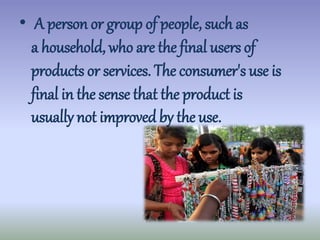
• A person or group of people, such as
a household, who are the final users of
products or services. The consumer's use is
final in the sense that the product is
usually not improved by the use.
Consumers’
organisationsThe first organisation was established in
1960 as the International Organisation
of Consumers Unions (IOCU).
Consumers’ organizations may operate
by protests and campaigning.
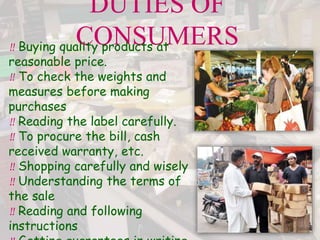
DUTIES OF
CONSUMERS‼ Buying quality products at
reasonable price.
‼ To check the weights and
measures before making
purchases
‼ Reading the label carefully.
‼ To procure the bill, cash
received warranty, etc.
‼ Shopping carefully and wisely
‼ Understanding the terms of
the sale
‼ Reading and following
instructions
HOW CONSUMERS ARE EXPLOITED
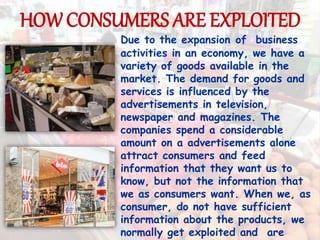
Due to the expansion of business
activities in an economy, we have a
variety of goods available in the
market. The demand for goods and
services is influenced by the
advertisements in television,
newspaper and magazines. The
companies spend a considerable
amount on a advertisements alone
attract consumers and feed
information that they want us to
know, but not the information that
we as consumers want. When we, as
consumer, do not have sufficient
information about the products, we
normally get exploited and are
FACTORS CAUSING EXPLOITATION OF CONSUMERS
¡ Limited Information : In a capitalist economy, producers and
sellers are free to produce any goods or services in any quantity
and there is no regulation on the prices. In the absence of
information about different aspects of the products, namely,
price, quality, condition of use, etc., the consumers are liable to
make a wrong choice and lose money.
¡ Limited Supplies : The consumers are exploited when the goods
and services are not available in the required quantity or numbers.
This gives us rise to hoarding and price-escalation.
¡ Limited Competition : When only one producer or group of
producer or a group of persons controls the production and supply
of a product, and is in a position to restrict the availability of
supplies, there is a possibility of manipulation in prices and
availability.
¡ Illiteracy : Illiteracy is one of the major drawbacks that lead to
the exploitation of consumers. The level of literacy directly
CONSUMER MOVEMENT
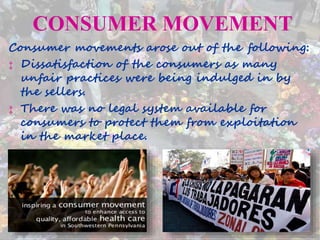
Consumer movements arose out of the following:
‡ Dissatisfaction of the consumers as many
unfair practices were being indulged in by
the sellers.
‡ There was no legal system available for
consumers to protect them from exploitation
in the market place.
NEED OF CONSUMER MOVEMENT
† Providing consumer
education.
† Providing consumer
protection.
† Building pressure on
government .
† Arranging consumer
protection programmes.
† Organizing public
opinion.
† Providing guidance to
consumer.
† Fight against marketing
system
† Consumer awareness
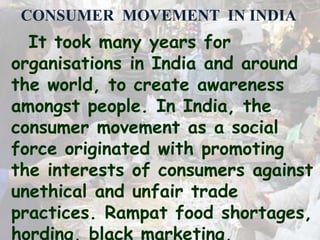
CONSUMER MOVEMENT IN INDIA
It took many years for
organisations in India and around
the world, to create awareness
amongst people. In India, the
consumer movement as a social
force originated with promoting
the interests of consumers against
unethical and unfair trade
practices. Rampat food shortages,
hording, black marketing,
CONSUMER PROTECTION ACT, 1986
Consumer Protection Act, 1986, popularly
known as COPRA, is an Act of the Parliament
of India enacted in 1986 to protect interests of
consumers in India. Effective safeguards are
provided to the consumer, against various types of
exploitations and unfair dealings,relying mainly
on compensatory rather than a disciplinary or
preventive approach under the Act.
• It applies to all goods and
services unless specifically
exempted, which covers the
private, public and
cooperative sectors. It also
provides speedy and
inexpensive.. The Right to
Information Act (RTI),
IMPORTANT DAYS
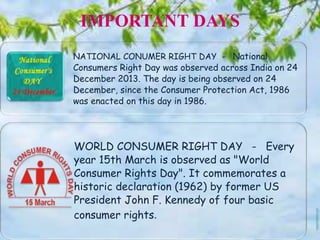
NATIONAL CONUMER RIGHT DAY - National
Consumers Right Day was observed across India on 24
December 2013. The day is being observed on 24
December, since the Consumer Protection Act, 1986
was enacted on this day in 1986.
WORLD CONSUMER RIGHT DAY - Every
year 15th March is observed as "World
Consumer Rights Day". It commemorates a
historic declaration (1962) by former US
President John F. Kennedy of four basic
consumer rights.
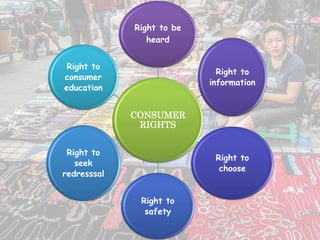
CONSUMER
RIGHTS
Right to be
heard
Right to
information
Right to
choose
Right to
safety
Right to
seek
redresssal
Right to
consumer
education
RIGHT TO BE HEARD
Right to be heardmeans that
consumer's interests will receive due
consideration at appropriate forums. It
also includes right to be represented in
various forums formed to consider the
consumer's welfare. The consumers should
form non-political andnon-commercial
consumer organizations which can be
given representation in various committees
formed by the Government and other
bodies in matters relating to consumers.
RIGHT TO
INFORMATION
The conumer has the right to be informed about
the quality, quantity, potency, purity, standard
and price of goods so as to protect the consumer
against unfair trade practices. Consumer should
insist on getting all the information about the
product or service before making a decision.
Consumer can then complain and ask for
compensation or replacement if the product
proves to be defective in any manner. This
enables the consumer to act wisely and
responsibly and also enable him to desist from
falling prey to high pressure selling techniques.
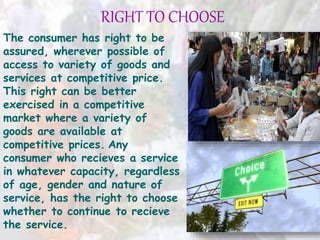
RIGHT TO CHOOSE
The consumer has right to be
assured, wherever possible of
access to variety of goods and
services at competitive price.
This right can be better
exercised in a competitive
market where a variety of
goods are available at
competitive prices. Any
consumer who recieves a service
in whatever capacity, regardless
of age, gender and nature of
service, has the right to choose
whether to continue to recieve
the service.
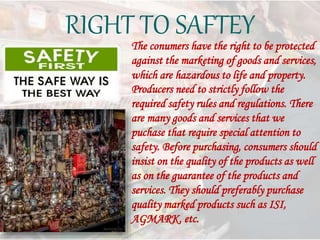
RIGHT TO SAFTEYThe conumers have the right to be protected
against the marketing of goods and services,
which are hazardous to life and property.
Producers need to strictly follow the
required safety rules and regulations. There
are many goods and services that we
puchase that require special attention to
safety. Before purchasing, consumers should
insist on the quality of the products as well
as on the guarantee of the products and
services. They should preferably purchase
quality marked products such as ISI,
AGMARK, etc.
RIGHT TO SEEK REDRESSAL
Consumers have the
right to seek
redressal against
unfair trade practices
or unscrupulous
exploitation. It also
includes right to fair
settlement of the
genuine grievances of
the consumer.
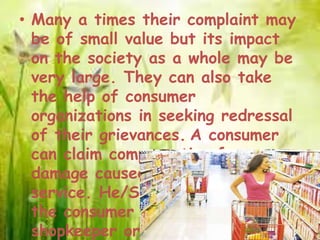
• Many a times their complaint may
be of small value but its impact
on the society as a whole may be
very large. They can also take
the help of consumer
organizations in seeking redressal
of their grievances. A consumer
can claim compensation for
damage caused by any product or
service. He/She can file a case in
the consumer court against the
shopkeeper or manufacturer.
RIGHT TO CONSUMER EDUCATION
The right to acquire
the knowledge and
skill to be an
informed consumer
throughout life.
Ignorance of
consumers,particularly
of rural consumers, is
mainly responsible for
their exploitation.
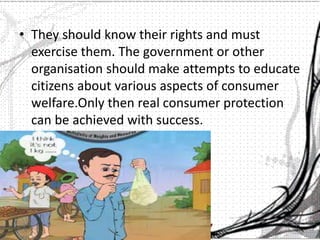
• They should know their rights and must
exercise them. The government or other
organisation should make attempts to educate
citizens about various aspects of consumer
welfare.Only then real consumer protection
can be achieved with success.
WHY CONSUMER EDUCATION IS IMPORTANT
† It provides the person with the basic
knowledge to handle consumer problem,
he/she becomes a discriminating buyer by
taking rational decisions, and thus not fall
prey to advertisements or persuasions.
† Technological developments have flooded
the market with a variety of products,
goods and services, it is therefore
important that a person possesses basic
knowledge and skills to judge the product.
† School children are mostly dependent
on their parents, it is therefore
important that they make the best
use of their pocket money.
† Consumers education can alert the
pupils to the corporate dumping of
dangerous pharmaceuticals and similar
products.
MORE TO KNOW
While buying many commodities, on the
cover you might have seen a logo with
the letters ISI, Agmark, Hallmark.
These logos and certifications help
consumers get assured of quality while
purchasing the goods and services. The
organisations that monitor and issue
these certificates allow produces to use
their logos provided they follow certain
quality standards.
WHERE SHOULD CONSUMER GO TO GET
JUSTICE
Consumers have the right to seek
redressal against unfair trade
practices and exploitation in the
consumer court. If any damage is
done to a consumer, he or she
has the right to get compensation
depending on the degree of
damage. The consumer movement
in India has led to the formation
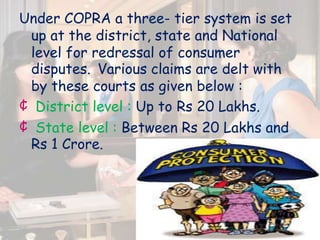
Under COPRA a three- tier system is set
up at the district, state and National
level for redressal of consumer
disputes. Various claims are delt with
by these courts as given below :
¢ District level : Up to Rs 20 Lakhs.
¢ State level : Between Rs 20 Lakhs and
Rs 1 Crore.
¢National level : Exceeding Rs 1 Crore
If a case is dismissed in district level
court, the consumer can appeal in the
state and then in the National level court.
I Hope You
Understood
Some Think
From
Made By
1 . Satish Kumar
Singh
2. Mohit Sharma
THANK
YOU FOR
YOUR
ATTENTION

Ppt on consumers rights

  • 1.
  • 2.
  • 3.
    CONTENTWHO IS ACONSUMER DUTIES OF CONSUMERS HOW CONSUMERS ARE EXPLOITED FACTORS CAUSING EXPLOITATION OF CONSUMERS CONSUMER MOVEMENT NEED OF CONSUMER MOVEMENT CONSUMER MOVEMENT IN INDIA CONSUMER PROTECTION ACT, 1986 IMPORTANT DAYS RIGHT TO BE HEARD RIGHT TO INFORMATION RIGHT TO CHOOSE RIGHT TO SAFETY RIGHT TO SEEK REDRESSAL RIGHT TO CONSUMER EDUCATION MORE TO KNOW WHERE SHOULD CONSUMER GO TO GET JUSTICE
  • 4.
    WHO IS ACONSUMER ç A person who has indicated his or her willingness to obtain goods and/or services from a supplier with the intention of paying for them. ç Someone who has purchased goods and/or services for personal consumption
  • 5.
    • A personor group of people, such as a household, who are the final users of products or services. The consumer's use is final in the sense that the product is usually not improved by the use.
  • 6.
    Consumers’ organisationsThe first organisationwas established in 1960 as the International Organisation of Consumers Unions (IOCU). Consumers’ organizations may operate by protests and campaigning.
  • 7.
    DUTIES OF CONSUMERS‼ Buyingquality products at reasonable price. ‼ To check the weights and measures before making purchases ‼ Reading the label carefully. ‼ To procure the bill, cash received warranty, etc. ‼ Shopping carefully and wisely ‼ Understanding the terms of the sale ‼ Reading and following instructions
  • 8.
    HOW CONSUMERS AREEXPLOITED Due to the expansion of business activities in an economy, we have a variety of goods available in the market. The demand for goods and services is influenced by the advertisements in television, newspaper and magazines. The companies spend a considerable amount on a advertisements alone attract consumers and feed information that they want us to know, but not the information that we as consumers want. When we, as consumer, do not have sufficient information about the products, we normally get exploited and are
  • 9.
    FACTORS CAUSING EXPLOITATIONOF CONSUMERS ¡ Limited Information : In a capitalist economy, producers and sellers are free to produce any goods or services in any quantity and there is no regulation on the prices. In the absence of information about different aspects of the products, namely, price, quality, condition of use, etc., the consumers are liable to make a wrong choice and lose money. ¡ Limited Supplies : The consumers are exploited when the goods and services are not available in the required quantity or numbers. This gives us rise to hoarding and price-escalation. ¡ Limited Competition : When only one producer or group of producer or a group of persons controls the production and supply of a product, and is in a position to restrict the availability of supplies, there is a possibility of manipulation in prices and availability. ¡ Illiteracy : Illiteracy is one of the major drawbacks that lead to the exploitation of consumers. The level of literacy directly
  • 10.
    CONSUMER MOVEMENT Consumer movementsarose out of the following: ‡ Dissatisfaction of the consumers as many unfair practices were being indulged in by the sellers. ‡ There was no legal system available for consumers to protect them from exploitation in the market place.
  • 11.
    NEED OF CONSUMERMOVEMENT † Providing consumer education. † Providing consumer protection. † Building pressure on government . † Arranging consumer protection programmes. † Organizing public opinion. † Providing guidance to consumer. † Fight against marketing system † Consumer awareness
  • 12.
    CONSUMER MOVEMENT ININDIA It took many years for organisations in India and around the world, to create awareness amongst people. In India, the consumer movement as a social force originated with promoting the interests of consumers against unethical and unfair trade practices. Rampat food shortages, hording, black marketing,
  • 13.
    CONSUMER PROTECTION ACT,1986 Consumer Protection Act, 1986, popularly known as COPRA, is an Act of the Parliament of India enacted in 1986 to protect interests of consumers in India. Effective safeguards are provided to the consumer, against various types of exploitations and unfair dealings,relying mainly on compensatory rather than a disciplinary or preventive approach under the Act.
  • 14.
    • It appliesto all goods and services unless specifically exempted, which covers the private, public and cooperative sectors. It also provides speedy and inexpensive.. The Right to Information Act (RTI),
  • 15.
    IMPORTANT DAYS NATIONAL CONUMERRIGHT DAY - National Consumers Right Day was observed across India on 24 December 2013. The day is being observed on 24 December, since the Consumer Protection Act, 1986 was enacted on this day in 1986. WORLD CONSUMER RIGHT DAY - Every year 15th March is observed as "World Consumer Rights Day". It commemorates a historic declaration (1962) by former US President John F. Kennedy of four basic consumer rights.
  • 16.
    CONSUMER RIGHTS Right to be heard Rightto information Right to choose Right to safety Right to seek redresssal Right to consumer education
  • 17.
    RIGHT TO BEHEARD Right to be heardmeans that consumer's interests will receive due consideration at appropriate forums. It also includes right to be represented in various forums formed to consider the consumer's welfare. The consumers should form non-political andnon-commercial consumer organizations which can be given representation in various committees formed by the Government and other bodies in matters relating to consumers.
  • 18.
    RIGHT TO INFORMATION The conumerhas the right to be informed about the quality, quantity, potency, purity, standard and price of goods so as to protect the consumer against unfair trade practices. Consumer should insist on getting all the information about the product or service before making a decision. Consumer can then complain and ask for compensation or replacement if the product proves to be defective in any manner. This enables the consumer to act wisely and responsibly and also enable him to desist from falling prey to high pressure selling techniques.
  • 19.
    RIGHT TO CHOOSE Theconsumer has right to be assured, wherever possible of access to variety of goods and services at competitive price. This right can be better exercised in a competitive market where a variety of goods are available at competitive prices. Any consumer who recieves a service in whatever capacity, regardless of age, gender and nature of service, has the right to choose whether to continue to recieve the service.
  • 20.
    RIGHT TO SAFTEYTheconumers have the right to be protected against the marketing of goods and services, which are hazardous to life and property. Producers need to strictly follow the required safety rules and regulations. There are many goods and services that we puchase that require special attention to safety. Before purchasing, consumers should insist on the quality of the products as well as on the guarantee of the products and services. They should preferably purchase quality marked products such as ISI, AGMARK, etc.
  • 21.
    RIGHT TO SEEKREDRESSAL Consumers have the right to seek redressal against unfair trade practices or unscrupulous exploitation. It also includes right to fair settlement of the genuine grievances of the consumer.
  • 22.
    • Many atimes their complaint may be of small value but its impact on the society as a whole may be very large. They can also take the help of consumer organizations in seeking redressal of their grievances. A consumer can claim compensation for damage caused by any product or service. He/She can file a case in the consumer court against the shopkeeper or manufacturer.
  • 23.
    RIGHT TO CONSUMEREDUCATION The right to acquire the knowledge and skill to be an informed consumer throughout life. Ignorance of consumers,particularly of rural consumers, is mainly responsible for their exploitation.
  • 24.
    • They shouldknow their rights and must exercise them. The government or other organisation should make attempts to educate citizens about various aspects of consumer welfare.Only then real consumer protection can be achieved with success.
  • 25.
    WHY CONSUMER EDUCATIONIS IMPORTANT † It provides the person with the basic knowledge to handle consumer problem, he/she becomes a discriminating buyer by taking rational decisions, and thus not fall prey to advertisements or persuasions. † Technological developments have flooded the market with a variety of products, goods and services, it is therefore important that a person possesses basic knowledge and skills to judge the product.
  • 26.
    † School childrenare mostly dependent on their parents, it is therefore important that they make the best use of their pocket money. † Consumers education can alert the pupils to the corporate dumping of dangerous pharmaceuticals and similar products.
  • 27.
    MORE TO KNOW Whilebuying many commodities, on the cover you might have seen a logo with the letters ISI, Agmark, Hallmark. These logos and certifications help consumers get assured of quality while purchasing the goods and services. The organisations that monitor and issue these certificates allow produces to use their logos provided they follow certain quality standards.
  • 28.
    WHERE SHOULD CONSUMERGO TO GET JUSTICE Consumers have the right to seek redressal against unfair trade practices and exploitation in the consumer court. If any damage is done to a consumer, he or she has the right to get compensation depending on the degree of damage. The consumer movement in India has led to the formation
  • 29.
    Under COPRA athree- tier system is set up at the district, state and National level for redressal of consumer disputes. Various claims are delt with by these courts as given below : ¢ District level : Up to Rs 20 Lakhs. ¢ State level : Between Rs 20 Lakhs and Rs 1 Crore.
  • 30.
    ¢National level :Exceeding Rs 1 Crore If a case is dismissed in district level court, the consumer can appeal in the state and then in the National level court.
  • 31.
  • 32.
    Made By 1 .Satish Kumar Singh 2. Mohit Sharma
  • 33.