Any person who buys a commodity or service for use, is known as
consumer.
Consumer in the marketplace
The status of consumer is more or less pathetic as far as consumer rights
are concerned. You can take examples of shopkeepers weighing less
than he should, company’ making false claims on packs. Then there are
local sweetmeat sellers adulterating raw materials to produce the
laddoos or barfis. You can recall the case of dropsy because of
adulterated mustard oil. No matter how bad quality you get, chances
are you will get a rude response from the shopkeeper if you dare to
complain.
Consumer Exploitation
Consumer exploitation is a situation in which a producer or a trader,
delivers much less than what they had initially promised to the
consumer.
Consumer Right
They are the rights that protect the interests of the buyers and
consumers of a commodity.
Consumer Movement /Consumer International
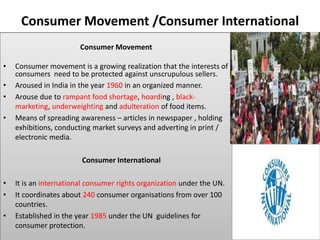
Consumer Movement
• Consumer movement is a growing realization that the interests of
consumers need to be protected against unscrupulous sellers.
• Aroused in India in the year 1960 in an organized manner.
• Arouse due to rampant food shortage, hoarding , black-
marketing, underweighting and adulteration of food items.
• Means of spreading awareness – articles in newspaper , holding
exhibitions, conducting market surveys and adverting in print /
electronic media.
Consumer International
• It is an international consumer rights organization under the UN.
• It coordinates about 240 consumer organisations from over 100
countries.
• Established in the year 1985 under the UN guidelines for
consumer protection.
Consumer Rights Protection
Consumer protection are all those measures
that protect the rights of the consumers.
• The level of dissatisfaction with the sellers and
service providers was such an extent that the
consumers had no choice but to raise their voice.
After many years of organized struggle, the
government was forced to take notice and finally
the Consumer Protection Act (COPRA) was
enacted.
• COPRA – Established in the year 1986 by the GOI.
• A three tier consumer court was established for
redressal of consumer disputes at the district, state
and national level.
The need for consumer rights
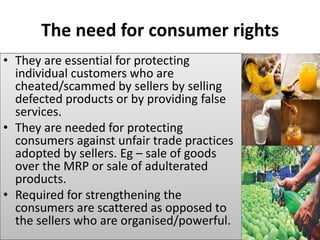
• They are essential for protecting
individual customers who are
cheated/scammed by sellers by selling
defected products or by providing false
services.
• They are needed for protecting
consumers against unfair trade practices
adopted by sellers. Eg – sale of goods
over the MRP or sale of adulterated
products.
• Required for strengthening the
consumers are scattered as opposed to
the sellers who are organised/powerful.
• Right to
Right to safety
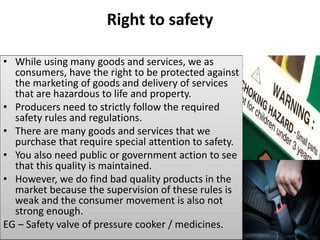
• While using many goods and services, we as
consumers, have the right to be protected against
the marketing of goods and delivery of services
that are hazardous to life and property.
• Producers need to strictly follow the required
safety rules and regulations.
• There are many goods and services that we
purchase that require special attention to safety.
• You also need public or government action to see
that this quality is maintained.
• However, we do find bad quality products in the
market because the supervision of these rules is
weak and the consumer movement is also not
strong enough.
EG – Safety valve of pressure cooker / medicines.
Right to information (RTI)
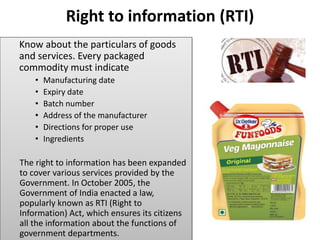
Know about the particulars of goods
and services. Every packaged
commodity must indicate
• Manufacturing date
• Expiry date
• Batch number
• Address of the manufacturer
• Directions for proper use
• Ingredients
The right to information has been expanded
to cover various services provided by the
Government. In October 2005, the
Government of India enacted a law,
popularly known as RTI (Right to
Information) Act, which ensures its citizens
all the information about the functions of
government departments.
Right to choose
Every consumer must have a right
to choose whether he/she wants
to continue to receive a particular
service or not. No seller can force
a consumer to buy anything which
he/she does not want.
eg- toothbrush & paste / Stove &
gas connection.
Right to Redress
• Consumers have the right to
seek redressal at appropriate
forums in case of unfair trade
practices.
• They can claim compensation
for the damages suffered by
them owing to the defective
goods and services provided to
them.
• The consumer can file a
complaint before the
appropriate consumer forum
on his/her own with or without
the services of lawyers.
Right to consumer education
• Becoming a conscious customer – able to
discriminate and make informed choices.
• Check out for any warnings published by the
GOI via print and electronic media( cigarettes
– injurious to health video, call ‘956xxxx55’ if
there’s water/noise/air pollution.)
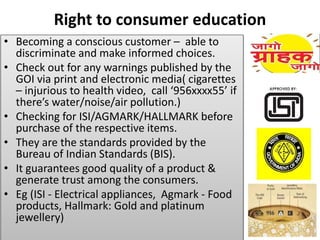
• Checking for ISI/AGMARK/HALLMARK before
purchase of the respective items.
• They are the standards provided by the
Bureau of Indian Standards (BIS).
• It guarantees good quality of a product &
generate trust among the consumers.
• Eg (ISI - Electrical appliances, Agmark - Food
products, Hallmark: Gold and platinum
jewellery)
Right to represent / heard
• Consumers have the right to present
their own case in the consumer courts or
to engage an advocate.
• consumer forums or consumer protection
councils guide consumers on how to file
cases in the consumer court.
• On many occasions, they also represent
individual consumers in the consumer
courts.
• These voluntary organisations also receive
financial support from the government
for creating awareness among the
people.
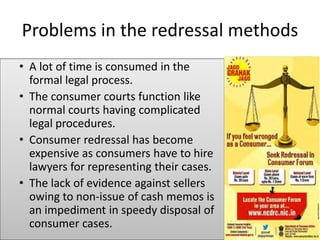
Problems in the redressal methods
• A lot of time is consumed in the
formal legal process.
• The consumer courts function like
normal courts having complicated
legal procedures.
• Consumer redressal has become
expensive as consumers have to hire
lawyers for representing their cases.
• The lack of evidence against sellers
owing to non-issue of cash memos is
an impediment in speedy disposal of
consumer cases.
THE NEW CONSUMER ACT 2019
CASE STUDY 1 & 2
FALSE
VALID
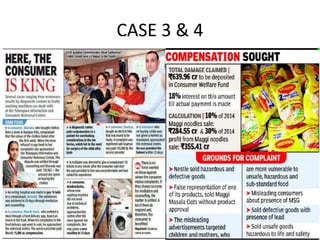
CASE 3 & 4
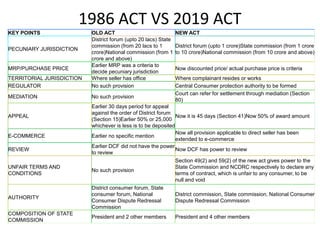
1986 ACT VS 2019 ACT
KEY POINTS OLD ACT NEW ACT
PECUNIARY JURISDICTION
District forum (upto 20 lacs) State
commission (from 20 lacs to 1
crore)National commission (from 1
crore and above)
District forum (upto 1 crore)State commission (from 1 crore
to 10 crore)National commission (from 10 crore and above)
MRP/PURCHASE PRICE
Earlier MRP was a criteria to
decide pecuniary jurisdiction
Now discounted price/ actual purchase price is criteria
TERRITORIAL JURISDICTION Where seller has office Where complainant resides or works
REGULATOR No such provision Central Consumer protection authority to be formed
MEDIATION No such provision
Court can refer for settlement through mediation (Section
80)
APPEAL
Earlier 30 days period for appeal
against the order of District forum
(Section 15)Earlier 50% or 25,000
whichever is less is to be deposited
Now it is 45 days (Section 41)Now 50% of award amount
E-COMMERCE Earlier no specific mention
Now all provision applicable to direct seller has been
extended to e-commerce
REVIEW
Earlier DCF did not have the power
to review
Now DCF has power to review
UNFAIR TERMS AND
CONDITIONS
No such provision
Section 49(2) and 59(2) of the new act gives power to the
State Commission and NCDRC respectively to declare any
terms of contract, which is unfair to any consumer, to be
null and void
AUTHORITY
District consumer forum, State
consumer forum, National
Consumer Dispute Redressal
Commission
District commission, State commission, National Consumer
Dispute Redressal Commission
COMPOSITION OF STATE
COMMISSION
President and 2 other members President and 4 other members
• When is national consumer day
is celebrated in India?
• https://consumeraffairs.nic.in/a
cts-and-rules/consumer-
protection (OFFICIAL LINK) from
the website -surf and jot down
any 3 information to share with
your class.
• Find out the no. of cases files,
cases in pending and cases
disposed.
• Pick a case study and prepare a
detail analysis of the complaint
filed, damages incurred, was
the case disposed and the
compentation given.

PPT RIGHTS.pptx

  • 2.
    Any person whobuys a commodity or service for use, is known as consumer. Consumer in the marketplace The status of consumer is more or less pathetic as far as consumer rights are concerned. You can take examples of shopkeepers weighing less than he should, company’ making false claims on packs. Then there are local sweetmeat sellers adulterating raw materials to produce the laddoos or barfis. You can recall the case of dropsy because of adulterated mustard oil. No matter how bad quality you get, chances are you will get a rude response from the shopkeeper if you dare to complain. Consumer Exploitation Consumer exploitation is a situation in which a producer or a trader, delivers much less than what they had initially promised to the consumer. Consumer Right They are the rights that protect the interests of the buyers and consumers of a commodity.
  • 3.
    Consumer Movement /ConsumerInternational Consumer Movement • Consumer movement is a growing realization that the interests of consumers need to be protected against unscrupulous sellers. • Aroused in India in the year 1960 in an organized manner. • Arouse due to rampant food shortage, hoarding , black- marketing, underweighting and adulteration of food items. • Means of spreading awareness – articles in newspaper , holding exhibitions, conducting market surveys and adverting in print / electronic media. Consumer International • It is an international consumer rights organization under the UN. • It coordinates about 240 consumer organisations from over 100 countries. • Established in the year 1985 under the UN guidelines for consumer protection.
  • 4.
    Consumer Rights Protection Consumerprotection are all those measures that protect the rights of the consumers. • The level of dissatisfaction with the sellers and service providers was such an extent that the consumers had no choice but to raise their voice. After many years of organized struggle, the government was forced to take notice and finally the Consumer Protection Act (COPRA) was enacted. • COPRA – Established in the year 1986 by the GOI. • A three tier consumer court was established for redressal of consumer disputes at the district, state and national level.
  • 5.
    The need forconsumer rights • They are essential for protecting individual customers who are cheated/scammed by sellers by selling defected products or by providing false services. • They are needed for protecting consumers against unfair trade practices adopted by sellers. Eg – sale of goods over the MRP or sale of adulterated products. • Required for strengthening the consumers are scattered as opposed to the sellers who are organised/powerful.
  • 6.
  • 7.
    Right to safety •While using many goods and services, we as consumers, have the right to be protected against the marketing of goods and delivery of services that are hazardous to life and property. • Producers need to strictly follow the required safety rules and regulations. • There are many goods and services that we purchase that require special attention to safety. • You also need public or government action to see that this quality is maintained. • However, we do find bad quality products in the market because the supervision of these rules is weak and the consumer movement is also not strong enough. EG – Safety valve of pressure cooker / medicines.
  • 8.
    Right to information(RTI) Know about the particulars of goods and services. Every packaged commodity must indicate • Manufacturing date • Expiry date • Batch number • Address of the manufacturer • Directions for proper use • Ingredients The right to information has been expanded to cover various services provided by the Government. In October 2005, the Government of India enacted a law, popularly known as RTI (Right to Information) Act, which ensures its citizens all the information about the functions of government departments.
  • 9.
    Right to choose Everyconsumer must have a right to choose whether he/she wants to continue to receive a particular service or not. No seller can force a consumer to buy anything which he/she does not want. eg- toothbrush & paste / Stove & gas connection.
  • 10.
    Right to Redress •Consumers have the right to seek redressal at appropriate forums in case of unfair trade practices. • They can claim compensation for the damages suffered by them owing to the defective goods and services provided to them. • The consumer can file a complaint before the appropriate consumer forum on his/her own with or without the services of lawyers.
  • 11.
    Right to consumereducation • Becoming a conscious customer – able to discriminate and make informed choices. • Check out for any warnings published by the GOI via print and electronic media( cigarettes – injurious to health video, call ‘956xxxx55’ if there’s water/noise/air pollution.) • Checking for ISI/AGMARK/HALLMARK before purchase of the respective items. • They are the standards provided by the Bureau of Indian Standards (BIS). • It guarantees good quality of a product & generate trust among the consumers. • Eg (ISI - Electrical appliances, Agmark - Food products, Hallmark: Gold and platinum jewellery)
  • 12.
    Right to represent/ heard • Consumers have the right to present their own case in the consumer courts or to engage an advocate. • consumer forums or consumer protection councils guide consumers on how to file cases in the consumer court. • On many occasions, they also represent individual consumers in the consumer courts. • These voluntary organisations also receive financial support from the government for creating awareness among the people.
  • 13.
    Problems in theredressal methods • A lot of time is consumed in the formal legal process. • The consumer courts function like normal courts having complicated legal procedures. • Consumer redressal has become expensive as consumers have to hire lawyers for representing their cases. • The lack of evidence against sellers owing to non-issue of cash memos is an impediment in speedy disposal of consumer cases.
  • 14.
  • 15.
    CASE STUDY 1& 2 FALSE VALID
  • 16.
  • 17.
    1986 ACT VS2019 ACT KEY POINTS OLD ACT NEW ACT PECUNIARY JURISDICTION District forum (upto 20 lacs) State commission (from 20 lacs to 1 crore)National commission (from 1 crore and above) District forum (upto 1 crore)State commission (from 1 crore to 10 crore)National commission (from 10 crore and above) MRP/PURCHASE PRICE Earlier MRP was a criteria to decide pecuniary jurisdiction Now discounted price/ actual purchase price is criteria TERRITORIAL JURISDICTION Where seller has office Where complainant resides or works REGULATOR No such provision Central Consumer protection authority to be formed MEDIATION No such provision Court can refer for settlement through mediation (Section 80) APPEAL Earlier 30 days period for appeal against the order of District forum (Section 15)Earlier 50% or 25,000 whichever is less is to be deposited Now it is 45 days (Section 41)Now 50% of award amount E-COMMERCE Earlier no specific mention Now all provision applicable to direct seller has been extended to e-commerce REVIEW Earlier DCF did not have the power to review Now DCF has power to review UNFAIR TERMS AND CONDITIONS No such provision Section 49(2) and 59(2) of the new act gives power to the State Commission and NCDRC respectively to declare any terms of contract, which is unfair to any consumer, to be null and void AUTHORITY District consumer forum, State consumer forum, National Consumer Dispute Redressal Commission District commission, State commission, National Consumer Dispute Redressal Commission COMPOSITION OF STATE COMMISSION President and 2 other members President and 4 other members
  • 18.
    • When isnational consumer day is celebrated in India? • https://consumeraffairs.nic.in/a cts-and-rules/consumer- protection (OFFICIAL LINK) from the website -surf and jot down any 3 information to share with your class. • Find out the no. of cases files, cases in pending and cases disposed. • Pick a case study and prepare a detail analysis of the complaint filed, damages incurred, was the case disposed and the compentation given.