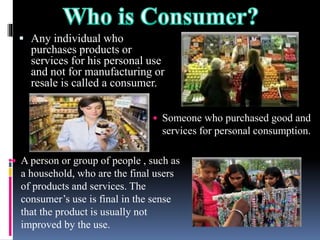
 Any individual who
purchases products or
services for his personal use
and not for manufacturing or
resale is called a consumer.
 Someone who purchased good and
services for personal consumption.
 A person or group of people , such as
a household, who are the final users
of products and services. The
consumer’s use is final in the sense
that the product is usually not
improved by the use.
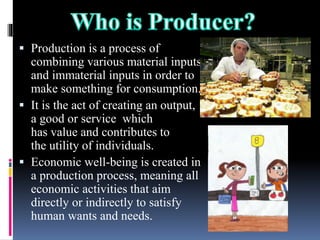
 Production is a process of
combining various material inputs
and immaterial inputs in order to
make something for consumption.
 It is the act of creating an output,
a good or service which
has value and contributes to
the utility of individuals.
 Economic well-being is created in
a production process, meaning all
economic activities that aim
directly or indirectly to satisfy
human wants and needs.
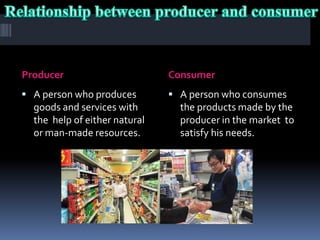
Producer Consumer
 A person who produces
goods and services with
the help of either natural
or man-made resources.
 A person who consumes
the products made by the
producer in the market to
satisfy his needs.
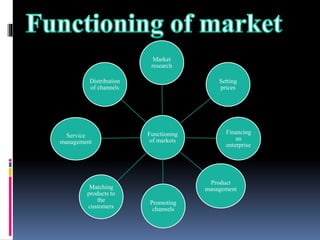
Functioning
of markets
Distribution
of channels
Market
research
Financing
an
enterprise
Setting
prices
Promoting
channels
Product
managementMatching
products to
the
customers
Service
management
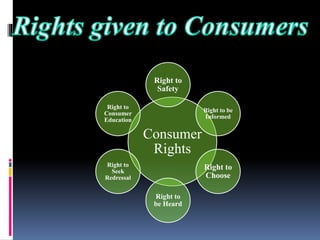
Consumer
Rights
Right to
Safety
Right to be
Informed
Right to
Choose
Right to
be Heard
Right to
Seek
Redressal
Right to
Consumer
Education
The consumer have the right to be protected
against the marketing of goods and services,
which are hazardous to life and property.
Producers need to strictly follow the required
safety rules and regulations. There are many
goods and services that we purchase that require
special attention to safety. For example,
pressure cooker have a safety valve which, if it
is defective, can cause a serious accident. The
manufacturers of the safety valve have to ensure
high quality. The purchased goods and services
availed of should not only meet their immediate
needs, but also fulfill long term interest. Before
purchasing, consumers should insist on the
quality of the product as well as on the
guarantee of the product and services. They
should preferably purchase quality marked
products such as ISI, AGMARK, etc.
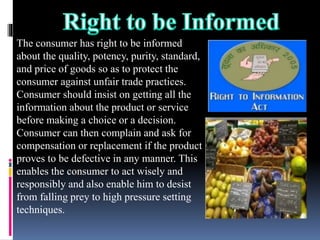
The consumer has right to be informed
about the quality, potency, purity, standard,
and price of goods so as to protect the
consumer against unfair trade practices.
Consumer should insist on getting all the
information about the product or service
before making a choice or a decision.
Consumer can then complain and ask for
compensation or replacement if the product
proves to be defective in any manner. This
enables the consumer to act wisely and
responsibly and also enable him to desist
from falling prey to high pressure setting
techniques.
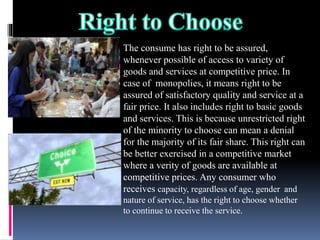
The consume has right to be assured,
whenever possible of access to variety of
goods and services at competitive price. In
case of monopolies, it means right to be
assured of satisfactory quality and service at a
fair price. It also includes right to basic goods
and services. This is because unrestricted right
of the minority to choose can mean a denial
for the majority of its fair share. This right can
be better exercised in a competitive market
where a verity of goods are available at
competitive prices. Any consumer who
receives capacity, regardless of age, gender and
nature of service, has the right to choose whether
to continue to receive the service.
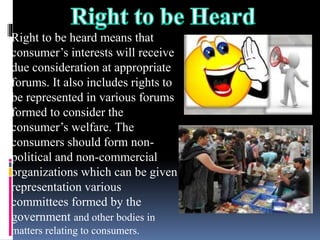
Right to be heard means that
consumer’s interests will receive
due consideration at appropriate
forums. It also includes rights to
be represented in various forums
formed to consider the
consumer’s welfare. The
consumers should form non-
political and non-commercial
organizations which can be given
representation various
committees formed by the
government and other bodies in
matters relating to consumers.
Consumers have the right to seek redressel
against unfair trade practices or
unscrupulous exploitation. It also includes
right to fair settlement of the genuine
grievances of the consumer. Consumers
must make complaint for their genuine
grievances . Many a times their complaint
may be a small value but its impact on the
society as whole may be very large. They
can also take a help of a consumer
organizations in seeking redressel of their
grievances. A consumer can claim a
compensations for damage caused by any
product or service. He/ she can file a case
in a consumer court against a shopkeeper
or manufacturer.
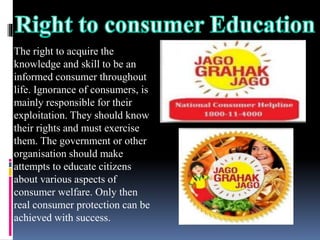
The right to acquire the
knowledge and skill to be an
informed consumer throughout
life. Ignorance of consumers, is
mainly responsible for their
exploitation. They should know
their rights and must exercise
them. The government or other
organisation should make
attempts to educate citizens
about various aspects of
consumer welfare. Only then
real consumer protection can be
achieved with success.
It took many years for organisation in India and around the world, to
create awareness amongst the people. In India, the consumer movement
as a social force originated with the necessity of protecting and
promoting he interests of consumers against unethical and unfair trade
practices. Rampat food shortages, hoarding, black marketing,
adulteration of food and edible oil gave birth to the consumer movement
in an organized form in the 1960’s. Till 1970’s consumer organizations
were largely engaged in writing articles and holding exhibitions. They
formed consumer groups to look into malpractices in ration shops and
overcrowding in the road passenger transport. More recently, India
witnessed an upsurge in the number of consumer groups. Because of all
these efforts, the movements succeeded in bringing pressure on business
firms as well as government to correct business conduct which may be
unfair and against the interests of consumers at large. A major step taken in
1986 by the Indian government was the enactment of the Consumer Protection
Act 1986 popularly known as COPRA.
Consumer Protection Act,1986, popularly known as COPRA, is an Act of the
Parliament of India enacted in 1986 to protest interests of the consumers in
India. It makes provision for the establishment of the councils and other
authorities for the settlement of consumer’s disputes and for matters connected
there with. This Act enacted in 1986 with the objective of promoting better
protection of consumer’s interest. Effective safeguards are provided to the
consumer, against various types of exploitations and unfair dealings, relying
mainly on compensatory rather than a disciplinary or preventive approach under
the Act. It applies to all goods and services unless specifically exempted each
covers the private , public and cooperative sectors. It also provides speedy and
inexpensive. The rights under the Act follow from the rights in which the articles
14-19 of the constitution of India. The right to information Act, which has
opened up governance process of our country to the common public, also has far
reaching implications for consumer protection. The Consumer Protection Act,
1986 is the most important legislation enacted to provide for effective safeguard
to consumers against various types of exploitations and unfair dealings and
relying on mainly compensatory rather than a punitive or preventive approach .
The Act has set up a three-tier quaasi-judicial consumer disputes redressal
machinery national, state and district levels for expeditions and inexpensive
settlements of consumer disputes.
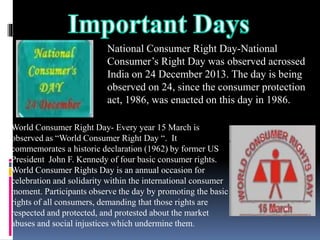
National Consumer Right Day-National
Consumer’s Right Day was observed acrossed
India on 24 December 2013. The day is being
observed on 24, since the consumer protection
act, 1986, was enacted on this day in 1986.
World Consumer Right Day- Every year 15 March is
observed as “World Consumer Right Day “. It
commemorates a historic declaration (1962) by former US
President John F. Kennedy of four basic consumer rights.
World Consumer Rights Day is an annual occasion for
celebration and solidarity within the international consumer
moment. Participants observe the day by promoting the basic
rights of all consumers, demanding that those rights are
respected and protected, and protested about the market
abuses and social injustices which undermine them.
Done By,
P. Venkata Srivathsa
X ‘A’

Consumer rights

  • 2.
     Any individualwho purchases products or services for his personal use and not for manufacturing or resale is called a consumer.  Someone who purchased good and services for personal consumption.  A person or group of people , such as a household, who are the final users of products and services. The consumer’s use is final in the sense that the product is usually not improved by the use.
  • 3.
     Production isa process of combining various material inputs and immaterial inputs in order to make something for consumption.  It is the act of creating an output, a good or service which has value and contributes to the utility of individuals.  Economic well-being is created in a production process, meaning all economic activities that aim directly or indirectly to satisfy human wants and needs.
  • 4.
    Producer Consumer  Aperson who produces goods and services with the help of either natural or man-made resources.  A person who consumes the products made by the producer in the market to satisfy his needs.
  • 5.
  • 6.
    Consumer Rights Right to Safety Right tobe Informed Right to Choose Right to be Heard Right to Seek Redressal Right to Consumer Education
  • 7.
    The consumer havethe right to be protected against the marketing of goods and services, which are hazardous to life and property. Producers need to strictly follow the required safety rules and regulations. There are many goods and services that we purchase that require special attention to safety. For example, pressure cooker have a safety valve which, if it is defective, can cause a serious accident. The manufacturers of the safety valve have to ensure high quality. The purchased goods and services availed of should not only meet their immediate needs, but also fulfill long term interest. Before purchasing, consumers should insist on the quality of the product as well as on the guarantee of the product and services. They should preferably purchase quality marked products such as ISI, AGMARK, etc.
  • 8.
    The consumer hasright to be informed about the quality, potency, purity, standard, and price of goods so as to protect the consumer against unfair trade practices. Consumer should insist on getting all the information about the product or service before making a choice or a decision. Consumer can then complain and ask for compensation or replacement if the product proves to be defective in any manner. This enables the consumer to act wisely and responsibly and also enable him to desist from falling prey to high pressure setting techniques.
  • 9.
    The consume hasright to be assured, whenever possible of access to variety of goods and services at competitive price. In case of monopolies, it means right to be assured of satisfactory quality and service at a fair price. It also includes right to basic goods and services. This is because unrestricted right of the minority to choose can mean a denial for the majority of its fair share. This right can be better exercised in a competitive market where a verity of goods are available at competitive prices. Any consumer who receives capacity, regardless of age, gender and nature of service, has the right to choose whether to continue to receive the service.
  • 10.
    Right to beheard means that consumer’s interests will receive due consideration at appropriate forums. It also includes rights to be represented in various forums formed to consider the consumer’s welfare. The consumers should form non- political and non-commercial organizations which can be given representation various committees formed by the government and other bodies in matters relating to consumers.
  • 11.
    Consumers have theright to seek redressel against unfair trade practices or unscrupulous exploitation. It also includes right to fair settlement of the genuine grievances of the consumer. Consumers must make complaint for their genuine grievances . Many a times their complaint may be a small value but its impact on the society as whole may be very large. They can also take a help of a consumer organizations in seeking redressel of their grievances. A consumer can claim a compensations for damage caused by any product or service. He/ she can file a case in a consumer court against a shopkeeper or manufacturer.
  • 12.
    The right toacquire the knowledge and skill to be an informed consumer throughout life. Ignorance of consumers, is mainly responsible for their exploitation. They should know their rights and must exercise them. The government or other organisation should make attempts to educate citizens about various aspects of consumer welfare. Only then real consumer protection can be achieved with success.
  • 13.
    It took manyyears for organisation in India and around the world, to create awareness amongst the people. In India, the consumer movement as a social force originated with the necessity of protecting and promoting he interests of consumers against unethical and unfair trade practices. Rampat food shortages, hoarding, black marketing, adulteration of food and edible oil gave birth to the consumer movement in an organized form in the 1960’s. Till 1970’s consumer organizations were largely engaged in writing articles and holding exhibitions. They formed consumer groups to look into malpractices in ration shops and overcrowding in the road passenger transport. More recently, India witnessed an upsurge in the number of consumer groups. Because of all these efforts, the movements succeeded in bringing pressure on business firms as well as government to correct business conduct which may be unfair and against the interests of consumers at large. A major step taken in 1986 by the Indian government was the enactment of the Consumer Protection Act 1986 popularly known as COPRA.
  • 14.
    Consumer Protection Act,1986,popularly known as COPRA, is an Act of the Parliament of India enacted in 1986 to protest interests of the consumers in India. It makes provision for the establishment of the councils and other authorities for the settlement of consumer’s disputes and for matters connected there with. This Act enacted in 1986 with the objective of promoting better protection of consumer’s interest. Effective safeguards are provided to the consumer, against various types of exploitations and unfair dealings, relying mainly on compensatory rather than a disciplinary or preventive approach under the Act. It applies to all goods and services unless specifically exempted each covers the private , public and cooperative sectors. It also provides speedy and inexpensive. The rights under the Act follow from the rights in which the articles 14-19 of the constitution of India. The right to information Act, which has opened up governance process of our country to the common public, also has far reaching implications for consumer protection. The Consumer Protection Act, 1986 is the most important legislation enacted to provide for effective safeguard to consumers against various types of exploitations and unfair dealings and relying on mainly compensatory rather than a punitive or preventive approach . The Act has set up a three-tier quaasi-judicial consumer disputes redressal machinery national, state and district levels for expeditions and inexpensive settlements of consumer disputes.
  • 15.
    National Consumer RightDay-National Consumer’s Right Day was observed acrossed India on 24 December 2013. The day is being observed on 24, since the consumer protection act, 1986, was enacted on this day in 1986. World Consumer Right Day- Every year 15 March is observed as “World Consumer Right Day “. It commemorates a historic declaration (1962) by former US President John F. Kennedy of four basic consumer rights. World Consumer Rights Day is an annual occasion for celebration and solidarity within the international consumer moment. Participants observe the day by promoting the basic rights of all consumers, demanding that those rights are respected and protected, and protested about the market abuses and social injustices which undermine them.
  • 16.
    Done By, P. VenkataSrivathsa X ‘A’