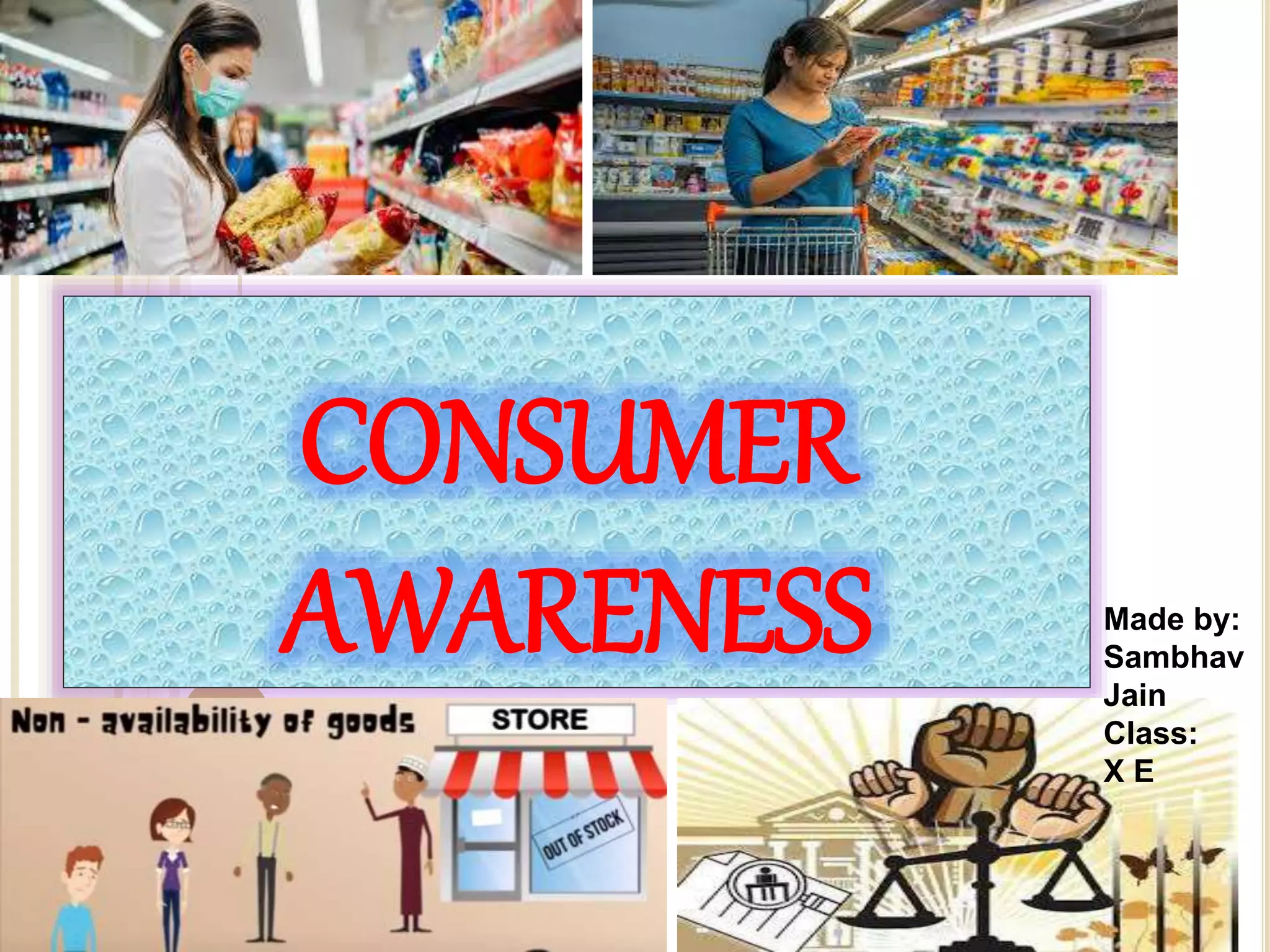
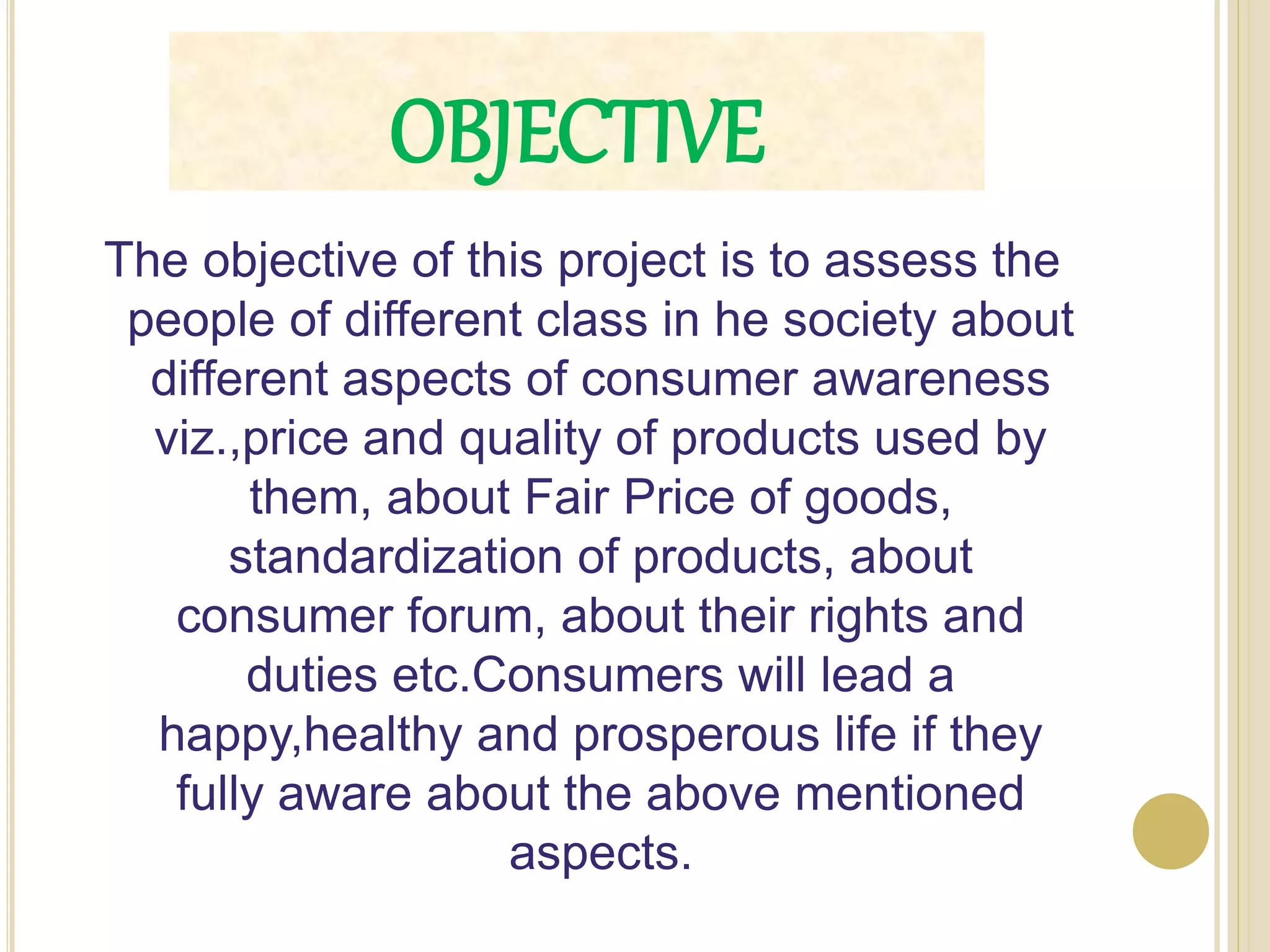
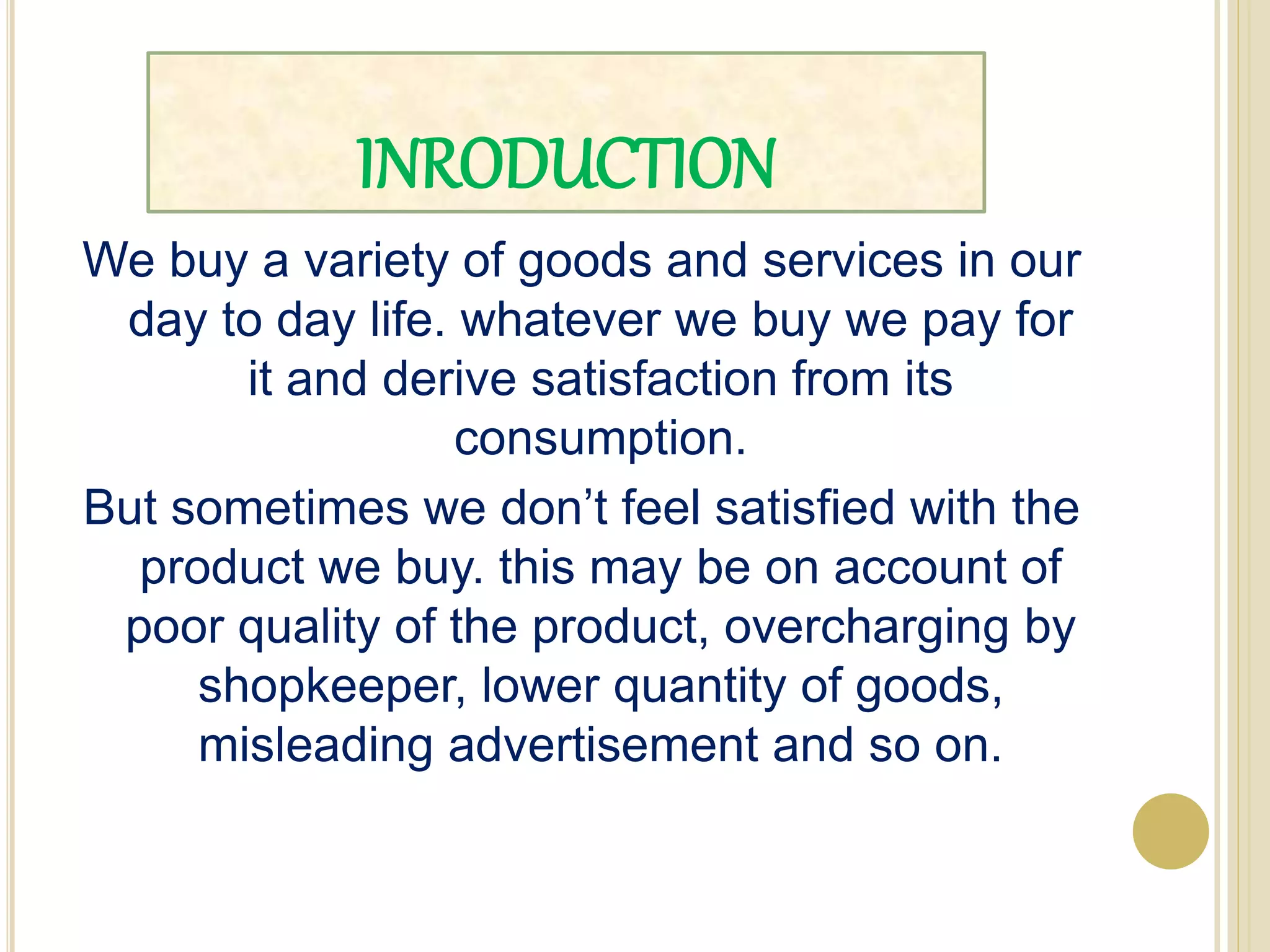
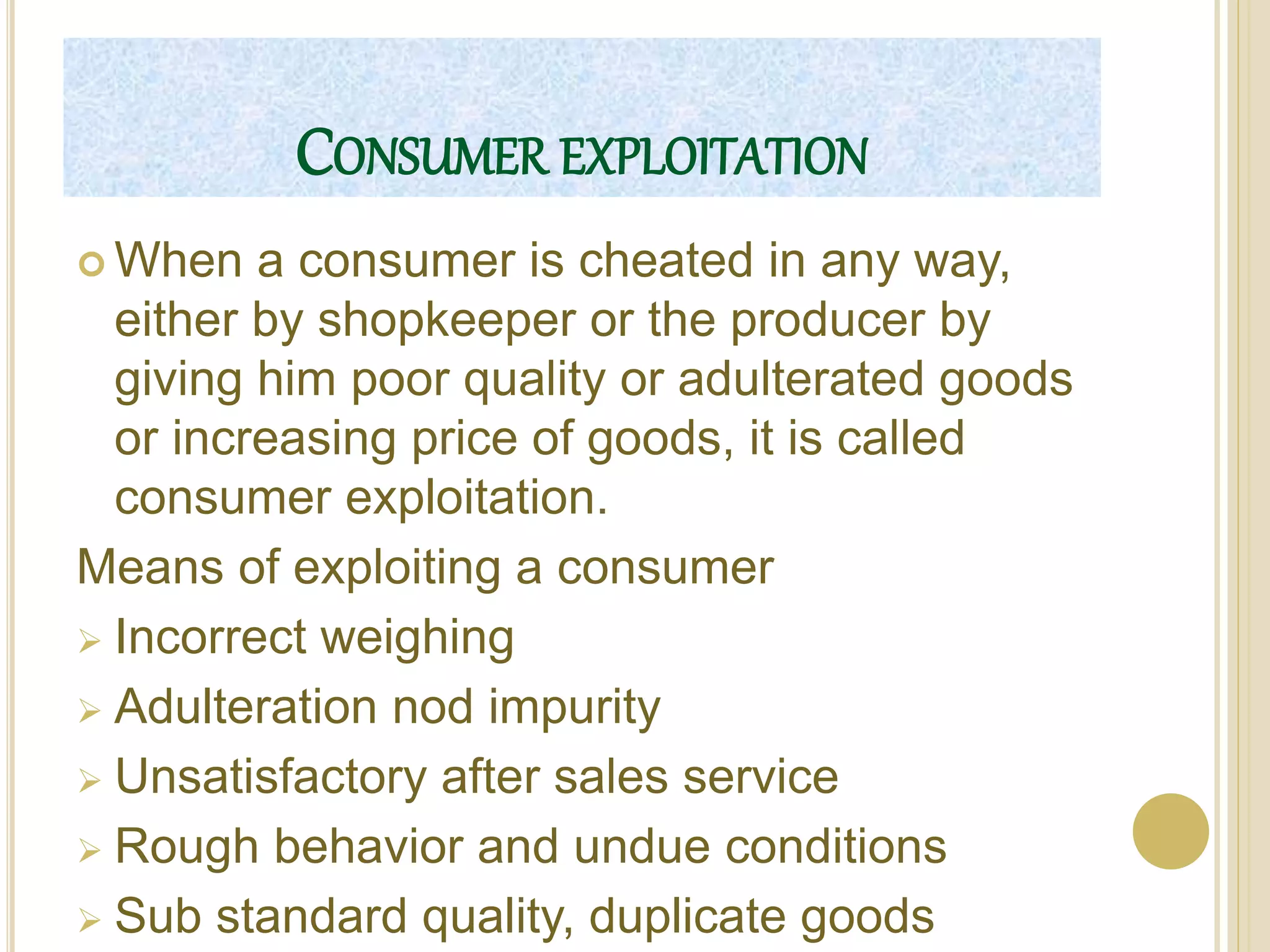
CONSUMER
AWARENESS Made by:
Sambhav
Jain
Class:
X E
ACKNOWLEDGEMENT
I would like to express my special thanks of
gratitude to my teacher Ms. Prateeksha
Sinha who gave me the golden opportunity
to do this wonderful project on the topic
“Consumer Awareness” which also helped
me in doing a lot of research and I came to
know about so many new things which
were very interesting. I would also like to
thank my parents who helped me a lot in
finalizing this project within limited time
frame.
S.NO
.
CONTENT SLIDE NO.
1. Who is a consumer 6
2. Consumer exploitation 7 to 8
3. consumer movements. 9 to 10
4. Consumer Rights 11 to 12
5. Case study on violation of consumer rights 13 to 14
6. Legislative measures 15 to 17
7. . Consumer Protection Act, 1986 18 to 19
8. Consumer forum 20
9. Critical analysis of consumer movements 21 to 22
INDDEX
OBJECTIVE
The objective of this project is to assess the
people of different class in he society about
different aspects of consumer awareness
viz.,price and quality of products used by
them, about Fair Price of goods,
standardization of products, about
consumer forum, about their rights and
duties etc.Consumers will lead a
happy,healthy and prosperous life if they
fully aware about the above mentioned
aspects.
INRODUCTION
We buy a variety of goods and services in our
day to day life. whatever we buy we pay for
it and derive satisfaction from its
consumption.
But sometimes we don’t feel satisfied with the
product we buy. this may be on account of
poor quality of the product, overcharging by
shopkeeper, lower quantity of goods,
misleading advertisement and so on.
WHO IS A CONSUMER?
oAn individual who purchases products
or services for his personal use and not
for manufacturing and resale it is called
consumer.
oA consumer is one who is the decision
maker whether or not to buy an item at
the store, or someone who is
influenced by advertisement.
CONSUMER EXPLOITATION
 When a consumer is cheated in any way,
either by shopkeeper or the producer by
giving him poor quality or adulterated goods
or increasing price of goods, it is called
consumer exploitation.
Means of exploiting a consumer
 Incorrect weighing
 Adulteration nod impurity
 Unsatisfactory after sales service
 Rough behavior and undue conditions
 Sub standard quality, duplicate goods
CONSUMER MOVEMENTS
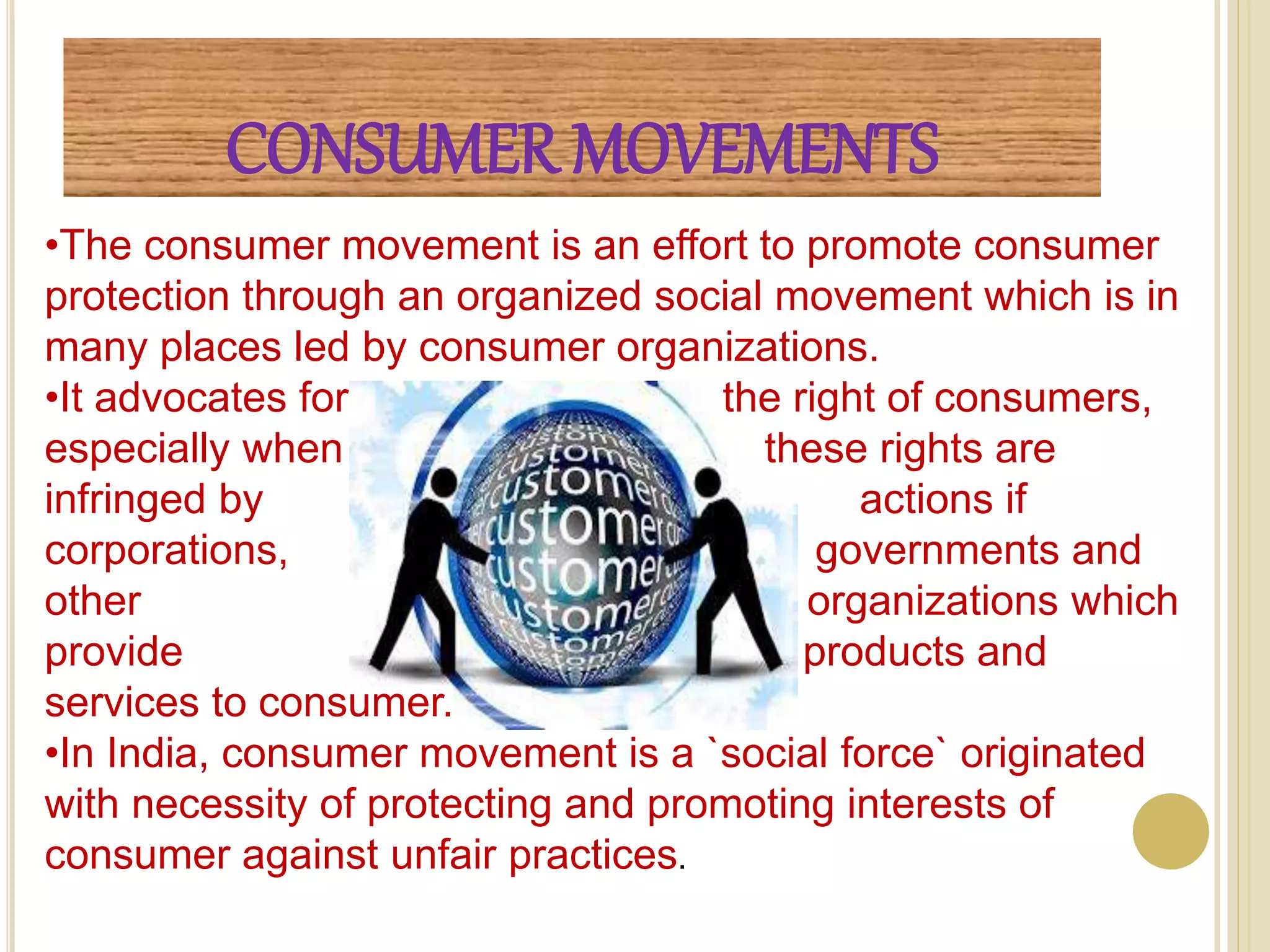
•The consumer movement is an effort to promote consumer
protection through an organized social movement which is in
many places led by consumer organizations.
•It advocates for the right of consumers,
especially when these rights are
infringed by actions if
corporations, governments and
other organizations which
provide products and
services to consumer.
•In India, consumer movement is a `social force` originated
with necessity of protecting and promoting interests of
consumer against unfair practices.
Need of consumer
movement
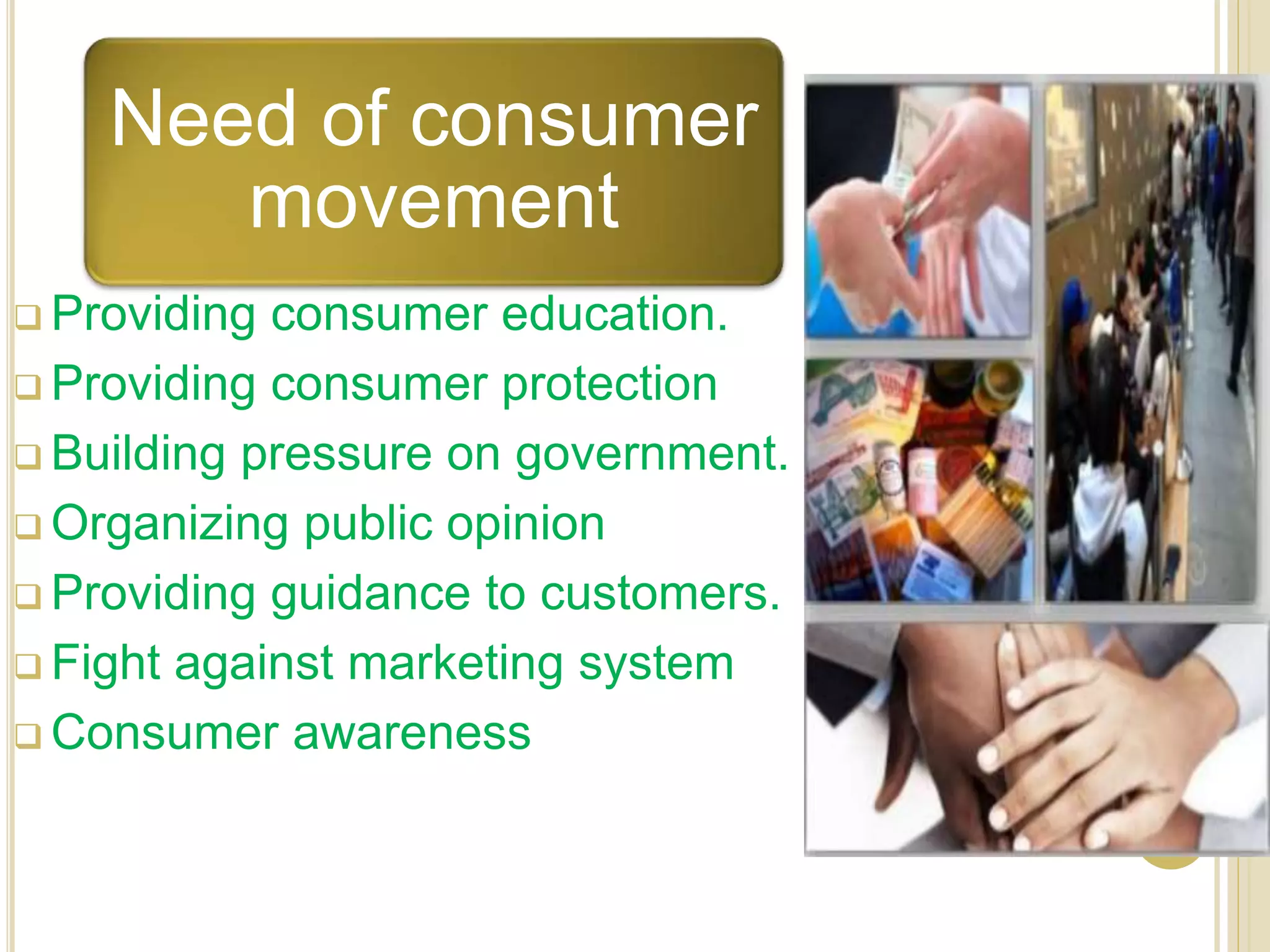
 Providing consumer education.
 Providing consumer protection
 Building pressure on government.
 Organizing public opinion
 Providing guidance to customers.
 Fight against marketing system
 Consumer awareness
Consumer rights
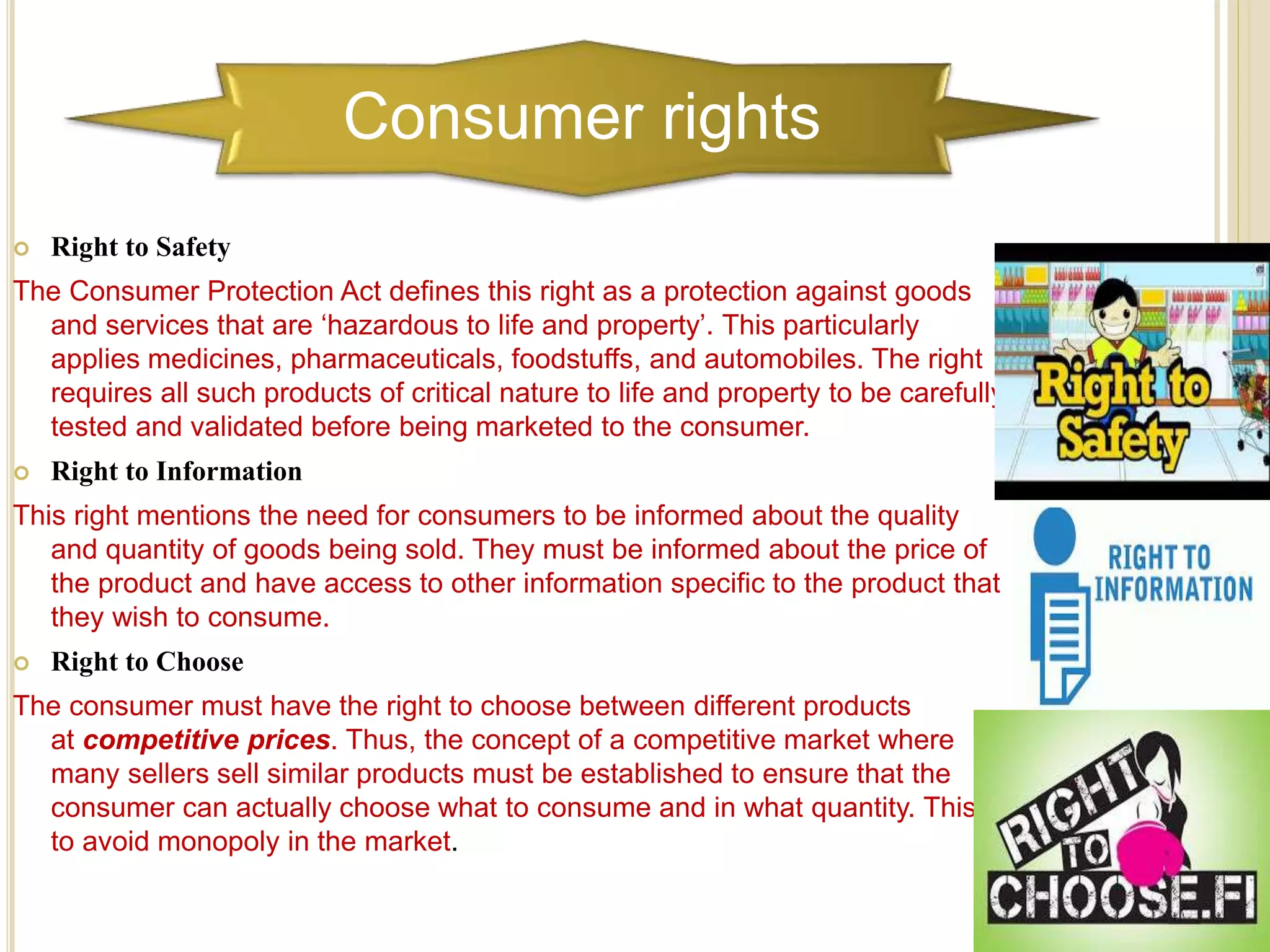
 Right to Safety
The Consumer Protection Act defines this right as a protection against goods
and services that are ‘hazardous to life and property’. This particularly
applies medicines, pharmaceuticals, foodstuffs, and automobiles. The right
requires all such products of critical nature to life and property to be carefully
tested and validated before being marketed to the consumer.
 Right to Information
This right mentions the need for consumers to be informed about the quality
and quantity of goods being sold. They must be informed about the price of
the product and have access to other information specific to the product that
they wish to consume.
 Right to Choose
The consumer must have the right to choose between different products
at competitive prices. Thus, the concept of a competitive market where
many sellers sell similar products must be established to ensure that the
consumer can actually choose what to consume and in what quantity. This is
to avoid monopoly in the market.
•RIGHT TO SEEK REDRESSED
WHEN A CONSUMER FEELS EXPLOITED, HE/SHE HAS THE RIGHT TO
APPROACH A CONSUMER COURT TO FILE A COMPLAINT. A CONSUMER
COURT IS A FORUM THAT HEARS THE COMPLAINT AND PROVIDES JUSTICE TO
THE PARTY THAT HAS BEEN HURT. THUS, IF THE CONSUMER FEELS HE/SHE
HAS BEEN EXPLOITED, THEY CAN APPROACH THE COURT USING THIS RIGHT.
RIGHT TO BE HEARD
THE PURPOSE OF THIS RIGHT IS TO ENSURE THAT THE CONSUMER GETS
DUE RECOGNITION IN CONSUMER COURTS OR REDRESSED FORUMS.
BASICALLY, WHEN A CONSUMER FEELS EXPLOITED, HE HAS THE RIGHT TO
APPROACH A CONSUMER COURT TO VOICE HIS COMPLAINT. THIS RIGHT
GIVES HIM/HER DUE RESPECT THAT HIS/HER COMPLAINT WILL BE DULY
HEARD. THE RIGHT EMPOWERS CONSUMERS TO FEARLESSLY VOICE THEIR
CONCERNS AND SEEK JUSTICE IN CASE THEY ARE EXPLOITED.
RIGHT TO CONSUMER EDUCATION
CONSUMERS MUST BE AWARE OF THEIR RIGHTS AND MUST HAVE ACCESS
TO ENOUGH INFORMATION WHILE MAKING CONSUMPTION DECISIONS. SUCH
INFORMATION CAN HELP THEM TO CHOOSE WHAT TO PURCHASE, HOW
MUCH TO PURCHASE AND AT WHAT PRICE.
CASESTUDYONVIOLATIONOF
CONSUMERRIGHTS
Factors causing violation of consumer rights
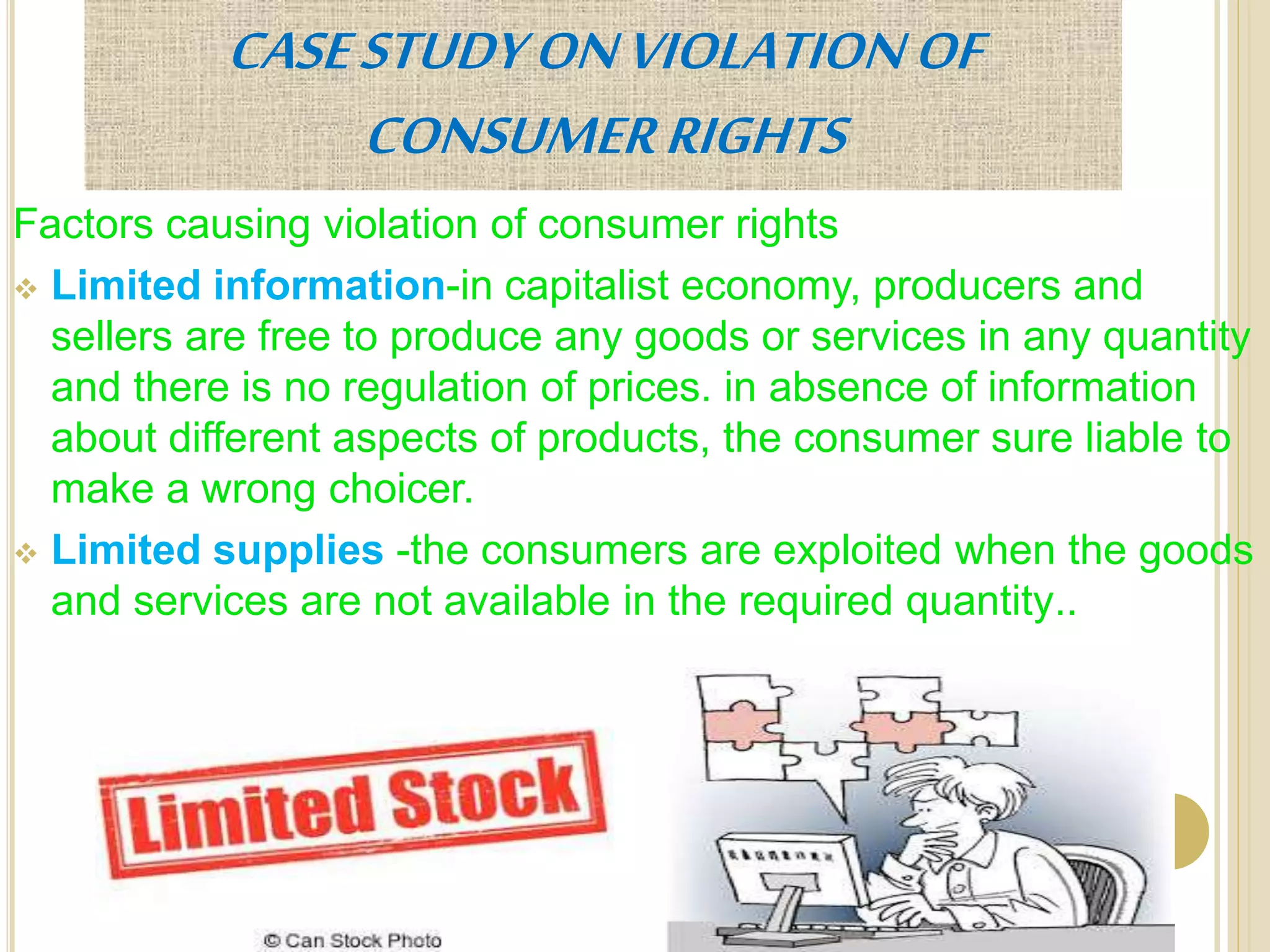
 Limited information-in capitalist economy, producers and
sellers are free to produce any goods or services in any quantity
and there is no regulation of prices. in absence of information
about different aspects of products, the consumer sure liable to
make a wrong choicer.
 Limited supplies -the consumers are exploited when the goods
and services are not available in the required quantity..
Limited competition-when only one
producer or group of producer or a group
of people controls the
production and supply of a
product, and in a position
to restrict availability of
supplies, there is a possibility of
manipulation in prices andavailablity.
 Illiteracy-illiteracy is one of major
backwards that lead to the exploitation of
consumers.
LEGISLATIVE
MEASURES
Steps taken by government are:
 Department of Consumer Affairs is periodically
taking up with the State Goats. and UT
Administrations, at the level of Chief Ministers,
Minister in-charge of Consumer Affairs/Chief
Secretaries/Secretaries dealing with Consumer
Affairs, the question of strengthening the
functioning of the consumer courts by providing
adequate infrastructure and to fill up the vacancies
of Presidents/Members on time
 Department of Consumer Affairs has been
arranging training for non-judicial Members of the
consumer courts at the Indian Institute of Public
Administration, New Delhi
Five meetings were held with the President /
Members of the National Commission and the
Presidents of the State Commissions along with the
Secretaries, State Goats. to discuss their problems,
review the working of the consumer forums and the
utilization of the one time financial assistance
released for strengthening the infrastructure of
consumer courts in their respective States/UTs. The
last meeting took place in Delhi on15-16 March,
2003.
The senior officers also reviewed working of the
consumer courts during their visits to States/UTs.
Similarly, the President, National Commission also
visits a number of State/UTs to monitor and discuss
functioning of consumer forums in States/UTs..
CONSUMER PROTECTION ACT 1986
The Consumer Protection Act, 1986 (COPRA) was
an Act of the Parliament of India enacted in 1986 to
protect the interests of consumers in India It was made
for the establishment of consumer councils and other
authorities for the settlement of consumer's grievances
and matters connected there with it. The act was passed
in Assembly in October 1986 and came into force on
December 24, 1986. The Consumer Protection Act,
1986 is a unique piece of legislation as it provides a
separate three-tier quati-judicial consumer dispute
redressed machinery at the national, state and district
level. The Act is intended to provide simple, speedy and
inexpensive redressed of the consumers' grievances.
CONSUMER FORUM
 The consumer movement in India has led to the formation
of various organizations locally known as consumer forums
or consumer protection councils. They guide consumers on
how to file cases in the consumer court. On many
occasions, they also represent individual consumers in the
consumer courts. These voluntary organizations also
receive financial support from the government for creating
awareness among the people.
 Consumer Courts: This is a three-tier quasi-judicial
system. The district level court deals with cases
involving claims upto Rs. 20 lakh. The state level
court deals with cases between Rs. 20 lakh and
Rs. 1 crore. The national level court dealt with
cases which involve claims exceeding Rs. 1 crore.
 If a case is dismissed in district level court, the consumer
can also appeal in state and then in National level courts.
CRITICAL ANALYSIS OF CONSUMERMOVEMENTS
 (i)In India, the consumer movement as a `social force’ originated with
the necessity of protecting and promoting the interests of consumers
against unethical and unfair trade practices.
(ii)Rampant food shortages, hoarding, black marketing, adulteration
of food and edible oil gave birth to the consumer movement in an
organized form In the 1960s,
(iii)Till the 1 970s, consumer organizations were largely engaged in
writing articles and holding exhibitions. They formed consumer
groups to look into the malpractices in ration shops and
overcrowding in the road passenger transport.
(iv)Because of all these efforts, the movement succeeded in bringing
pressure on business firms as well as government to correct
business conduct which may be unfair and against the interests of
consumers at large.
(v)A major step taken in 1986 by the Indian government was the
enactment of the Consumer Protection Act 1986, popularly known as
COPRA.
CONCLUSION
Conclusion of this project is that every
student as well as elders should be
aware about different aspects of different
comodities they consume on day to day
life.they should have knowledge about
certified products.we should check
MRP,date of manufacturing,expiry date at
time of purchase.they must have
awareness about their rights and duties.
Consumer Awareness

Consumer Awareness

  • 1.
  • 2.
    ACKNOWLEDGEMENT I would liketo express my special thanks of gratitude to my teacher Ms. Prateeksha Sinha who gave me the golden opportunity to do this wonderful project on the topic “Consumer Awareness” which also helped me in doing a lot of research and I came to know about so many new things which were very interesting. I would also like to thank my parents who helped me a lot in finalizing this project within limited time frame.
  • 3.
    S.NO . CONTENT SLIDE NO. 1.Who is a consumer 6 2. Consumer exploitation 7 to 8 3. consumer movements. 9 to 10 4. Consumer Rights 11 to 12 5. Case study on violation of consumer rights 13 to 14 6. Legislative measures 15 to 17 7. . Consumer Protection Act, 1986 18 to 19 8. Consumer forum 20 9. Critical analysis of consumer movements 21 to 22 INDDEX
  • 4.
    OBJECTIVE The objective ofthis project is to assess the people of different class in he society about different aspects of consumer awareness viz.,price and quality of products used by them, about Fair Price of goods, standardization of products, about consumer forum, about their rights and duties etc.Consumers will lead a happy,healthy and prosperous life if they fully aware about the above mentioned aspects.
  • 5.
    INRODUCTION We buy avariety of goods and services in our day to day life. whatever we buy we pay for it and derive satisfaction from its consumption. But sometimes we don’t feel satisfied with the product we buy. this may be on account of poor quality of the product, overcharging by shopkeeper, lower quantity of goods, misleading advertisement and so on.
  • 6.
    WHO IS ACONSUMER? oAn individual who purchases products or services for his personal use and not for manufacturing and resale it is called consumer. oA consumer is one who is the decision maker whether or not to buy an item at the store, or someone who is influenced by advertisement.
  • 7.
    CONSUMER EXPLOITATION  Whena consumer is cheated in any way, either by shopkeeper or the producer by giving him poor quality or adulterated goods or increasing price of goods, it is called consumer exploitation. Means of exploiting a consumer  Incorrect weighing  Adulteration nod impurity  Unsatisfactory after sales service  Rough behavior and undue conditions  Sub standard quality, duplicate goods
  • 9.
    CONSUMER MOVEMENTS •The consumermovement is an effort to promote consumer protection through an organized social movement which is in many places led by consumer organizations. •It advocates for the right of consumers, especially when these rights are infringed by actions if corporations, governments and other organizations which provide products and services to consumer. •In India, consumer movement is a `social force` originated with necessity of protecting and promoting interests of consumer against unfair practices.
  • 10.
    Need of consumer movement Providing consumer education.  Providing consumer protection  Building pressure on government.  Organizing public opinion  Providing guidance to customers.  Fight against marketing system  Consumer awareness
  • 11.
    Consumer rights  Rightto Safety The Consumer Protection Act defines this right as a protection against goods and services that are ‘hazardous to life and property’. This particularly applies medicines, pharmaceuticals, foodstuffs, and automobiles. The right requires all such products of critical nature to life and property to be carefully tested and validated before being marketed to the consumer.  Right to Information This right mentions the need for consumers to be informed about the quality and quantity of goods being sold. They must be informed about the price of the product and have access to other information specific to the product that they wish to consume.  Right to Choose The consumer must have the right to choose between different products at competitive prices. Thus, the concept of a competitive market where many sellers sell similar products must be established to ensure that the consumer can actually choose what to consume and in what quantity. This is to avoid monopoly in the market.
  • 12.
    •RIGHT TO SEEKREDRESSED WHEN A CONSUMER FEELS EXPLOITED, HE/SHE HAS THE RIGHT TO APPROACH A CONSUMER COURT TO FILE A COMPLAINT. A CONSUMER COURT IS A FORUM THAT HEARS THE COMPLAINT AND PROVIDES JUSTICE TO THE PARTY THAT HAS BEEN HURT. THUS, IF THE CONSUMER FEELS HE/SHE HAS BEEN EXPLOITED, THEY CAN APPROACH THE COURT USING THIS RIGHT. RIGHT TO BE HEARD THE PURPOSE OF THIS RIGHT IS TO ENSURE THAT THE CONSUMER GETS DUE RECOGNITION IN CONSUMER COURTS OR REDRESSED FORUMS. BASICALLY, WHEN A CONSUMER FEELS EXPLOITED, HE HAS THE RIGHT TO APPROACH A CONSUMER COURT TO VOICE HIS COMPLAINT. THIS RIGHT GIVES HIM/HER DUE RESPECT THAT HIS/HER COMPLAINT WILL BE DULY HEARD. THE RIGHT EMPOWERS CONSUMERS TO FEARLESSLY VOICE THEIR CONCERNS AND SEEK JUSTICE IN CASE THEY ARE EXPLOITED. RIGHT TO CONSUMER EDUCATION CONSUMERS MUST BE AWARE OF THEIR RIGHTS AND MUST HAVE ACCESS TO ENOUGH INFORMATION WHILE MAKING CONSUMPTION DECISIONS. SUCH INFORMATION CAN HELP THEM TO CHOOSE WHAT TO PURCHASE, HOW MUCH TO PURCHASE AND AT WHAT PRICE.
  • 13.
    CASESTUDYONVIOLATIONOF CONSUMERRIGHTS Factors causing violationof consumer rights  Limited information-in capitalist economy, producers and sellers are free to produce any goods or services in any quantity and there is no regulation of prices. in absence of information about different aspects of products, the consumer sure liable to make a wrong choicer.  Limited supplies -the consumers are exploited when the goods and services are not available in the required quantity..
  • 14.
    Limited competition-when onlyone producer or group of producer or a group of people controls the production and supply of a product, and in a position to restrict availability of supplies, there is a possibility of manipulation in prices andavailablity.  Illiteracy-illiteracy is one of major backwards that lead to the exploitation of consumers.
  • 15.
    LEGISLATIVE MEASURES Steps taken bygovernment are:  Department of Consumer Affairs is periodically taking up with the State Goats. and UT Administrations, at the level of Chief Ministers, Minister in-charge of Consumer Affairs/Chief Secretaries/Secretaries dealing with Consumer Affairs, the question of strengthening the functioning of the consumer courts by providing adequate infrastructure and to fill up the vacancies of Presidents/Members on time  Department of Consumer Affairs has been arranging training for non-judicial Members of the consumer courts at the Indian Institute of Public Administration, New Delhi
  • 16.
    Five meetings wereheld with the President / Members of the National Commission and the Presidents of the State Commissions along with the Secretaries, State Goats. to discuss their problems, review the working of the consumer forums and the utilization of the one time financial assistance released for strengthening the infrastructure of consumer courts in their respective States/UTs. The last meeting took place in Delhi on15-16 March, 2003. The senior officers also reviewed working of the consumer courts during their visits to States/UTs. Similarly, the President, National Commission also visits a number of State/UTs to monitor and discuss functioning of consumer forums in States/UTs..
  • 18.
    CONSUMER PROTECTION ACT1986 The Consumer Protection Act, 1986 (COPRA) was an Act of the Parliament of India enacted in 1986 to protect the interests of consumers in India It was made for the establishment of consumer councils and other authorities for the settlement of consumer's grievances and matters connected there with it. The act was passed in Assembly in October 1986 and came into force on December 24, 1986. The Consumer Protection Act, 1986 is a unique piece of legislation as it provides a separate three-tier quati-judicial consumer dispute redressed machinery at the national, state and district level. The Act is intended to provide simple, speedy and inexpensive redressed of the consumers' grievances.
  • 20.
    CONSUMER FORUM  Theconsumer movement in India has led to the formation of various organizations locally known as consumer forums or consumer protection councils. They guide consumers on how to file cases in the consumer court. On many occasions, they also represent individual consumers in the consumer courts. These voluntary organizations also receive financial support from the government for creating awareness among the people.  Consumer Courts: This is a three-tier quasi-judicial system. The district level court deals with cases involving claims upto Rs. 20 lakh. The state level court deals with cases between Rs. 20 lakh and Rs. 1 crore. The national level court dealt with cases which involve claims exceeding Rs. 1 crore.  If a case is dismissed in district level court, the consumer can also appeal in state and then in National level courts.
  • 21.
    CRITICAL ANALYSIS OFCONSUMERMOVEMENTS  (i)In India, the consumer movement as a `social force’ originated with the necessity of protecting and promoting the interests of consumers against unethical and unfair trade practices. (ii)Rampant food shortages, hoarding, black marketing, adulteration of food and edible oil gave birth to the consumer movement in an organized form In the 1960s, (iii)Till the 1 970s, consumer organizations were largely engaged in writing articles and holding exhibitions. They formed consumer groups to look into the malpractices in ration shops and overcrowding in the road passenger transport. (iv)Because of all these efforts, the movement succeeded in bringing pressure on business firms as well as government to correct business conduct which may be unfair and against the interests of consumers at large. (v)A major step taken in 1986 by the Indian government was the enactment of the Consumer Protection Act 1986, popularly known as COPRA.
  • 23.
    CONCLUSION Conclusion of thisproject is that every student as well as elders should be aware about different aspects of different comodities they consume on day to day life.they should have knowledge about certified products.we should check MRP,date of manufacturing,expiry date at time of purchase.they must have awareness about their rights and duties.