B Y : -
S H U B H A M B A J A J
CONSUMER RIGHTS
IN INDIA
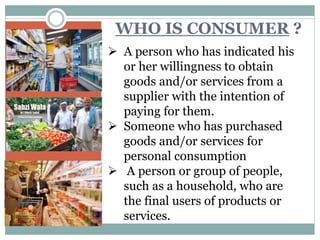
WHO IS CONSUMER ?
 A person who has indicated his
or her willingness to obtain
goods and/or services from a
supplier with the intention of
paying for them.
 Someone who has purchased
goods and/or services for
personal consumption
 A person or group of people,
such as a household, who are
the final users of products or
services.
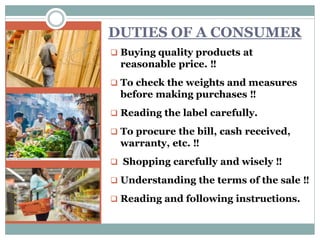
DUTIES OF A CONSUMER
A Buying quality products at
reasonable price. ‼
 To check the weights and measures
before making purchases ‼
 Reading the label carefully.
 To procure the bill, cash received,
warranty, etc. ‼
 Shopping carefully and wisely ‼
 Understanding the terms of the sale ‼
 Reading and following instructions.
IMPORTANT DAYS
 NATIONAL CONUMER RIGHT DAY -
National Consumers Right Day was
observed across India on 24 December
2013. The day is being observed on 24
December.
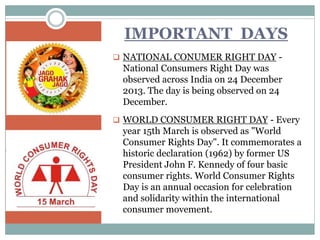
 WORLD CONSUMER RIGHT DAY - Every
year 15th March is observed as "World
Consumer Rights Day". It commemorates a
historic declaration (1962) by former US
President John F. Kennedy of four basic
consumer rights. World Consumer Rights
Day is an annual occasion for celebration
and solidarity within the international
consumer movement.
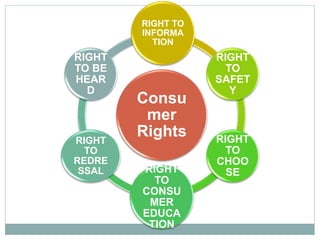
Consu
mer
Rights
RIGHT TO
INFORMA
TION
RIGHT
TO
SAFET
Y
RIGHT
TO
CHOO
SERIGHT
TO
CONSU
MER
EDUCA
TION
RIGHT
TO
REDRE
SSAL
RIGHT
TO BE
HEAR
D
RIGHT TO INFORMATION
It is defined as ‘the right to be informed about the quality,
quantity, potency, purity, standard and price of goods or
services, as to protect the consumer against unfair trade
practices’ in the Consumer Protection Act of 1986. In the
market place of India, consumers get information by two
ways namely advertising and word of mouth however these
sources are considered to be unreliable but still this word of
mouth is quite common here. Because of this, the Indian
consumers hardly have precise and complete information for
assessing the true value, safety, suitability, reliability of any
product. Usually the hidden costs can be found, lack of
suitability, quality problems and safety hazards only after the
purchase of the product.
RIGHT TO SAFETY
According to the Consumer Protection Act 1986, the
consumer right is referred to as ‘right to be protected
against marketing of goods and services which are
hazardous to life and property’. It is applicable to
specific areas like healthcare, pharmaceuticals and
food processing, this right is spread across the
domain having a serious effect on the health of the
consumers or their well being viz. Automobiles,
Housing, Domestic Appliances, Travel etc.
The developed countries like the United States have
stalwart agencies which oversee the protection of
consumer products, the Food and Drug Administration
(FDA) for food and drugs, the National Highway Traffic
Safety Administration (NHTSA) for automobiles and
the Consumer Product Safety Commission (CPSC) for
various other consumer products etc. This right needs
each product which can potentially be a danger to our
lives to be marketed after adequate and complete
verification as well as validation. India is 50 years away,
for empowering this right adequately and completely.
RIGHT TO SAFETY
RIGHT TO CHOOSE
The definition of Right to Choose as per the Consumer
Protection Act 1986 is ‘the right to be assured, wherever
possible, to have access to a variety of goods and services
at competitive prices’. For regulating the market place,
there is just one factor required and that is competition.
It is interesting to know that even micro markets like fish
vendors in some cities are known to collude and
discourage the consumers’ bargaining power. No matter
what size or form, or span, but collusion of various
companies which sell a similar kind of product is
unethical or say less legal. It can be estimated that India
has to stride for about 20 more years for empowering its
citizens fully in this regard.
RIGHT TO BE HEARD
As stated in the Consumer Protection Act 1986, ‘the
right to be heard and to be assured that consumer’s
interests will receive due consideration at appropriate
forums’ is the definition of the right to be heard. This
right helps to empower the consumers of India for
putting forward their complaints and concerns
fearlessly and raising their voice against products or
even companies and ensure that their issues are taken
into consideration as well as handled expeditiously.
However, till date the Indian Government has not
formed even one outlet for hearing the consumers or
their issues to be sorted out.
RIGHT TO REDRESSAL
The right to seek redressal against unfair trade practices or
restrictive trade practices or unscrupulous exploitation of
consumers’ is referred to as the right to redressal according
to the Consumer Protection Act 1986.The government of
India has been bit more successful with regard to this right.
The Consumer courts like District Consumer Disputes
Redressal Forums at district level, State Consumer
Disputes Redressal Commissions and National Consumer
Disputes Redressal Commissions have been incorporated
with the help of the consumer protection act. These
consumer grievance redressal agencies have fiduciary as
well as geographical jurisdictions which address consumer
cases between businesses and consumers.
RIGHT TO CONSUMER EDUCATION
The right of every Indian citizen to have education on matters
regarding consumer protection as well as about her/his right is
regarded as the last right provided by the Consumer Protection
Act 1986. The right makes sure that the consumers in the
country have informational programs and materials which are
easily accessible and would enable them to make purchasing
decisions which are better than before. Consumer education
might refer to formal education through college and school
curriculums as well as consumer awareness campaigns being
run by non-governmental and governmental agencies both.
Consumer NGOs, having little endorsement from the
government of India, basically undertake the task of ensuring
the consumer right throughout the country. India is found to be
20 years away from giving this right that gives power to the
common consumer.
THE CONSUMER ONLINE FOUNDATION
At Consumer Online Foundation (COF) they help to connect
you to your being, your self empowerment. Our team at COF
strives constantly towards a healthy, educated and an aware
nation! Be it in the field of health, education or online
support, through our various organizations like Consumer
Conexion, Partnership for Safe Medicines India, Healthy You
Foundation, Hamara Consumer Dost, New Era Patient
Friendly Hospital and Cell for Consumer Education and
Advocacy , we network to uplift Consumer's welfare and
protect their rights. An Aware Consumer is a Protected
Consumer! JAGO GRAHAK JAGO! Jago Grahak Jago, जागो
ग्राहक जागो, Consumer Complaint, Consumer Awareness,
Consumer Grievances, Consumer Rights in India
BIBLIOGRAPHY
http://www.jagograhakjago.com/
https://www.google.co.in/imghp?hl=en&tab=wi&auth
user=0
Consumer Rights

Consumer Rights

  • 1.
    B Y :- S H U B H A M B A J A J CONSUMER RIGHTS IN INDIA
  • 2.
    WHO IS CONSUMER?  A person who has indicated his or her willingness to obtain goods and/or services from a supplier with the intention of paying for them.  Someone who has purchased goods and/or services for personal consumption  A person or group of people, such as a household, who are the final users of products or services.
  • 3.
    DUTIES OF ACONSUMER A Buying quality products at reasonable price. ‼  To check the weights and measures before making purchases ‼  Reading the label carefully.  To procure the bill, cash received, warranty, etc. ‼  Shopping carefully and wisely ‼  Understanding the terms of the sale ‼  Reading and following instructions.
  • 4.
    IMPORTANT DAYS  NATIONALCONUMER RIGHT DAY - National Consumers Right Day was observed across India on 24 December 2013. The day is being observed on 24 December.  WORLD CONSUMER RIGHT DAY - Every year 15th March is observed as "World Consumer Rights Day". It commemorates a historic declaration (1962) by former US President John F. Kennedy of four basic consumer rights. World Consumer Rights Day is an annual occasion for celebration and solidarity within the international consumer movement.
  • 5.
  • 6.
    RIGHT TO INFORMATION Itis defined as ‘the right to be informed about the quality, quantity, potency, purity, standard and price of goods or services, as to protect the consumer against unfair trade practices’ in the Consumer Protection Act of 1986. In the market place of India, consumers get information by two ways namely advertising and word of mouth however these sources are considered to be unreliable but still this word of mouth is quite common here. Because of this, the Indian consumers hardly have precise and complete information for assessing the true value, safety, suitability, reliability of any product. Usually the hidden costs can be found, lack of suitability, quality problems and safety hazards only after the purchase of the product.
  • 7.
    RIGHT TO SAFETY Accordingto the Consumer Protection Act 1986, the consumer right is referred to as ‘right to be protected against marketing of goods and services which are hazardous to life and property’. It is applicable to specific areas like healthcare, pharmaceuticals and food processing, this right is spread across the domain having a serious effect on the health of the consumers or their well being viz. Automobiles, Housing, Domestic Appliances, Travel etc.
  • 8.
    The developed countrieslike the United States have stalwart agencies which oversee the protection of consumer products, the Food and Drug Administration (FDA) for food and drugs, the National Highway Traffic Safety Administration (NHTSA) for automobiles and the Consumer Product Safety Commission (CPSC) for various other consumer products etc. This right needs each product which can potentially be a danger to our lives to be marketed after adequate and complete verification as well as validation. India is 50 years away, for empowering this right adequately and completely. RIGHT TO SAFETY
  • 9.
    RIGHT TO CHOOSE Thedefinition of Right to Choose as per the Consumer Protection Act 1986 is ‘the right to be assured, wherever possible, to have access to a variety of goods and services at competitive prices’. For regulating the market place, there is just one factor required and that is competition. It is interesting to know that even micro markets like fish vendors in some cities are known to collude and discourage the consumers’ bargaining power. No matter what size or form, or span, but collusion of various companies which sell a similar kind of product is unethical or say less legal. It can be estimated that India has to stride for about 20 more years for empowering its citizens fully in this regard.
  • 10.
    RIGHT TO BEHEARD As stated in the Consumer Protection Act 1986, ‘the right to be heard and to be assured that consumer’s interests will receive due consideration at appropriate forums’ is the definition of the right to be heard. This right helps to empower the consumers of India for putting forward their complaints and concerns fearlessly and raising their voice against products or even companies and ensure that their issues are taken into consideration as well as handled expeditiously. However, till date the Indian Government has not formed even one outlet for hearing the consumers or their issues to be sorted out.
  • 11.
    RIGHT TO REDRESSAL Theright to seek redressal against unfair trade practices or restrictive trade practices or unscrupulous exploitation of consumers’ is referred to as the right to redressal according to the Consumer Protection Act 1986.The government of India has been bit more successful with regard to this right. The Consumer courts like District Consumer Disputes Redressal Forums at district level, State Consumer Disputes Redressal Commissions and National Consumer Disputes Redressal Commissions have been incorporated with the help of the consumer protection act. These consumer grievance redressal agencies have fiduciary as well as geographical jurisdictions which address consumer cases between businesses and consumers.
  • 12.
    RIGHT TO CONSUMEREDUCATION The right of every Indian citizen to have education on matters regarding consumer protection as well as about her/his right is regarded as the last right provided by the Consumer Protection Act 1986. The right makes sure that the consumers in the country have informational programs and materials which are easily accessible and would enable them to make purchasing decisions which are better than before. Consumer education might refer to formal education through college and school curriculums as well as consumer awareness campaigns being run by non-governmental and governmental agencies both. Consumer NGOs, having little endorsement from the government of India, basically undertake the task of ensuring the consumer right throughout the country. India is found to be 20 years away from giving this right that gives power to the common consumer.
  • 13.
    THE CONSUMER ONLINEFOUNDATION At Consumer Online Foundation (COF) they help to connect you to your being, your self empowerment. Our team at COF strives constantly towards a healthy, educated and an aware nation! Be it in the field of health, education or online support, through our various organizations like Consumer Conexion, Partnership for Safe Medicines India, Healthy You Foundation, Hamara Consumer Dost, New Era Patient Friendly Hospital and Cell for Consumer Education and Advocacy , we network to uplift Consumer's welfare and protect their rights. An Aware Consumer is a Protected Consumer! JAGO GRAHAK JAGO! Jago Grahak Jago, जागो ग्राहक जागो, Consumer Complaint, Consumer Awareness, Consumer Grievances, Consumer Rights in India
  • 14.