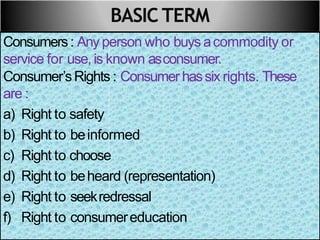
BASIC TERM
Consumers: Any person who buys acommodity or
service for use, is known asconsumer.
Consumer’sRights : Consumer hassix rights. These
are :
a) Right to safety
b) Right to beinformed
c) Right to choose
d) Right to beheard (representation)
e) Right to seekredressal
f) Right to consumereducation
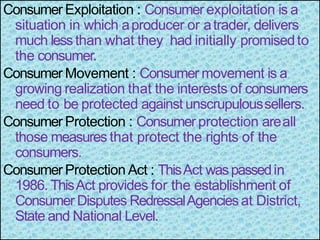
Consumer Exploitation : Consumer exploitation is a
situation in which aproducer or atrader, delivers
much lessthan what they had initially promisedto
the consumer.
Consumer Movement : Consumer movement is a
growing realization that the interests of consumers
need to be protected against unscrupuloussellers.
Consumer Protection : Consumer protection areall
those measures that protect the rights of the
consumers.
Consumer Protection Act : ThisAct waspassedin
1986. ThisAct provides for the establishment of
Consumer Disputes RedressalAgenciesat District,
State and National Level.
AGMARK: AGMARKis asealof government
that guarantees the quality of few selected
agricultural products. It is implementedunder
Agriculture ProductAct, 1937, which was
amended in 1986. Its products like honey,
masalas,spices, etc.
BIS: BISstands for Bureau of Indian Standard. This
protects the consumers from lack of quality and
varying standard of industrial and consumergoods.
Onthe other hand,AGMARKis meant only for
agricultural products.
CodexAlimentarius Commission : It develops food
standards, guidelines and codesof practices for
production and international trade in foodproducts.
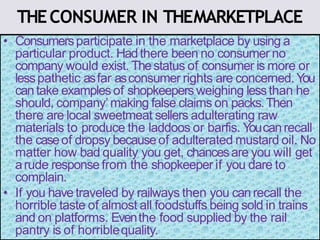
THECONSUMER IN THEMARKETPLACE
• Consumersparticipate in the marketplace by using a
particular product. Hadthere been no consumer no
company would exist. Thestatus of consumer is more or
lesspathetic asfar asconsumer rights are concerned. You
cantake examplesof shopkeepers weighing lessthan he
should, company’ making false claims on packs.Then
there are local sweetmeat sellers adulterating raw
materials to produce the laddoos or barfis. Youcanrecall
the caseof dropsy becauseof adulterated mustard oil. No
matter how bad quality you get, chancesare you will get
arude response from the shopkeeper if you dare to
complain.
• If you havetraveled by railways then you canrecall the
horrible taste of almost all foodstuffs being sold in trains
and on platforms. Eventhe food supplied by the rail
pantry is of horriblequality.
Exploitation in the marketplace
Exploitation in the marketplace happens in various
ways. For example, sometimes traders indulge in
unfair trade practices such as when shopkeepers
weigh less than what they should or when traders add
charges that were not mentioned before, or when
adulterated/defective goods are sold.
Exploitation in the marketplace
Media
Markets do not work in a fair manner when
producers are few and powerful whereas
consumers purchase in small amounts and are
scattered.
This happens especially when large companies are
producing these goods.
These companies with huge wealth, power and
reach can manipulate the market in various ways.
At times false information is passed on through the
media, and other sources to attract consumers.
CONSUMER MOVEMENT
In India, the consumer movement as a ‘social force’
originated with the necessity of protecting and
promoting the interests of consumers against
unethical and unfair trade practices.
India haslong tradition of food adulteration, black
marketing, hoarding, underweighing, etc.
It wasfrom the 1960sthat theconsumer movement
beganin India. Till the 1970s, consumer movement was
mainly restricted to writing articles and holding
exhibitions. But there hasbeen an upsurge in the
number of consumer groups in recenttimes.
• Thelevel of dissatisfaction with the sellers and service
SAFETYIS EVERYONE’S
RIGHT
Reji’s suffering shows
how ahospital, dueto
negligence by the
doctors and staff in
giving anesthesia,
crippled astudent for
life.
• Right to Be Informed :Aconsumer hasthe right to have
correct information about aproduct. There are rules which
make it mandatory to mention ingredients and safety features
on the pack of aproduct. Proper information helps a
consumer to makeinformed buying decision.Apack of a
product also needsto mention the MRP(Maximum Retail
Price) and aconsumer cancomplain if the seller asksformore
than the MRP.
• In recent times, the right to information hasbeen expanded
to cover various services provided by the Government. In
October 2005, the Government of India enacted alaw,
popularly known asRTI(Right to Information) Act, which
ensures its citizens all the information about the functions of
government departments. Theeffect of the RTIAct canbe
understood from the followingcase.
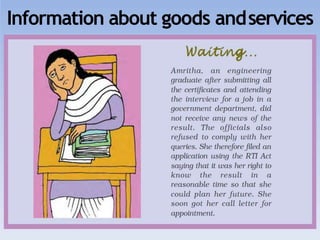
Information about goods andservices
Right to Choose:
Aconsumerhasthe right tochoosefrom
different options.
A seller cannot just offer to sellonly one
brand to the consumer.
Theseller hasto offer variousoptions to the
consumer.
Thisright is usually enforcedthrough laws
against monopoly trade.
When choice isdenied
Where should consumersgo to get
justice?
Right to Seek Redressal:
Consumers have the right to seek redressal against
unfair trade practices and exploitation.
Eg: false promises, manufacturing defect made by the
producer.
consumer, she has the right to get compensation
depending on the degree of damage.
Supposeyou took amobile connection and the bill
shows many hidden charges which were not explained to
you earlier. Or the mobile company activated aringtone
without your permission. Thenyou cango to the
Let ustake the caseof Prakash.Hehad sent a
money- order to his village for his daughter’s
marriage. The money did not reach his daughter
at the time when she needed it nor did it reach
months later. Prakashfiled a casein adistrict
level consumer court in New Delhi. All the steps
he undertook are illustratedbelow.
CONSUMER FORUM
• Theconsumer movement in India hasled to the
formation of various organisations locally known as
consumer forums or consumer protection councils.
• Theyguide consumers on how to file casesin the
consumer court.
• Onmany occasions, they also represent individual
consumers in the consumercourts.
• Thesevoluntary organisations also receive financial
support from the government for creating awareness
among the people.
• If you are living in aresidential colony, you might have
noticed name boards of Resident WelfareAssociations.
If there is any unfair trade practice meted out to their
members they take up the caseon theirbehalf.
• Consumer Courts: Thisis athree-tier quasi-judicial system.
• District Consumer Disputes RedressalForum (DCDRF)
• State Consumer Disputes Redressal Commission (SCDRC)
• National Consumer Disputes Redressal Commission
(NCDRC)
• Thedistrict level court deals with casesinvolving claims
upto Rs.20 lakh. Thestate level court deals with cases
between Rs.20 lakh and Rs.1 crore. Thenational level
court dealt with caseswhich involve claims exceeding Rs.1
crore.
If acaseis dismissed in district level court, the consumer can
also appeal in state and then in National levelcourts.
Thechoice of court will depend on the amount of
transaction and relief you seekand the location wherethe
causeof action arises.
The Act has enabled us as consumers to have the right to
The enactment of COPRA has led to the setting up of
separate departments of Consumer Affairs in central and
state governments.
The posters that you have seen are one example through
which government spread information about legal process
which people can use.
You might also be seeing such advertisements on television
channels.
This calls for acquiring the knowledge and skill to become a
well-informed consumer.
Right to be informed
National Consumers’Day
24th December is celebrated asthe National
Consumers’Day.It wason this day that the Indian
Parliament enacted the Consumer Protection Act in
1986. India is one of the few countries that have
exclusive courts for consumer redressal. The
consumer movement in India hasmade significant
progress in recent times. At present, thereare more
than 700 consumer groups. Out of them, about 20
25 are well organized and are recognized for their
work.
CONSUMER DUTIES:
-Make sure that your consumer rights arerespected.
-Complain if you are not satisfied with products and
services even if you are not personallyaffected.
-Demandarefund or replacement for inferior
products and services even if the money involvedis
small.
-Readall documents carefully before signingand
make sure that you understand the contents.
-Beinformed in the language youunderstand.
Consumer rights
Consumer rights
Consumer rights
Consumer rights

Consumer rights

  • 2.
    BASIC TERM Consumers: Anyperson who buys acommodity or service for use, is known asconsumer. Consumer’sRights : Consumer hassix rights. These are : a) Right to safety b) Right to beinformed c) Right to choose d) Right to beheard (representation) e) Right to seekredressal f) Right to consumereducation
  • 3.
    Consumer Exploitation :Consumer exploitation is a situation in which aproducer or atrader, delivers much lessthan what they had initially promisedto the consumer. Consumer Movement : Consumer movement is a growing realization that the interests of consumers need to be protected against unscrupuloussellers. Consumer Protection : Consumer protection areall those measures that protect the rights of the consumers. Consumer Protection Act : ThisAct waspassedin 1986. ThisAct provides for the establishment of Consumer Disputes RedressalAgenciesat District, State and National Level.
  • 4.
    AGMARK: AGMARKis asealofgovernment that guarantees the quality of few selected agricultural products. It is implementedunder Agriculture ProductAct, 1937, which was amended in 1986. Its products like honey, masalas,spices, etc.
  • 5.
    BIS: BISstands forBureau of Indian Standard. This protects the consumers from lack of quality and varying standard of industrial and consumergoods. Onthe other hand,AGMARKis meant only for agricultural products. CodexAlimentarius Commission : It develops food standards, guidelines and codesof practices for production and international trade in foodproducts.
  • 7.
    THECONSUMER IN THEMARKETPLACE •Consumersparticipate in the marketplace by using a particular product. Hadthere been no consumer no company would exist. Thestatus of consumer is more or lesspathetic asfar asconsumer rights are concerned. You cantake examplesof shopkeepers weighing lessthan he should, company’ making false claims on packs.Then there are local sweetmeat sellers adulterating raw materials to produce the laddoos or barfis. Youcanrecall the caseof dropsy becauseof adulterated mustard oil. No matter how bad quality you get, chancesare you will get arude response from the shopkeeper if you dare to complain. • If you havetraveled by railways then you canrecall the horrible taste of almost all foodstuffs being sold in trains and on platforms. Eventhe food supplied by the rail pantry is of horriblequality.
  • 8.
    Exploitation in themarketplace Exploitation in the marketplace happens in various ways. For example, sometimes traders indulge in unfair trade practices such as when shopkeepers weigh less than what they should or when traders add charges that were not mentioned before, or when adulterated/defective goods are sold.
  • 9.
  • 10.
  • 11.
  • 13.
    Media Markets do notwork in a fair manner when producers are few and powerful whereas consumers purchase in small amounts and are scattered. This happens especially when large companies are producing these goods. These companies with huge wealth, power and reach can manipulate the market in various ways. At times false information is passed on through the media, and other sources to attract consumers.
  • 14.
    CONSUMER MOVEMENT In India,the consumer movement as a ‘social force’ originated with the necessity of protecting and promoting the interests of consumers against unethical and unfair trade practices. India haslong tradition of food adulteration, black marketing, hoarding, underweighing, etc. It wasfrom the 1960sthat theconsumer movement beganin India. Till the 1970s, consumer movement was mainly restricted to writing articles and holding exhibitions. But there hasbeen an upsurge in the number of consumer groups in recenttimes. • Thelevel of dissatisfaction with the sellers and service
  • 18.
    SAFETYIS EVERYONE’S RIGHT Reji’s sufferingshows how ahospital, dueto negligence by the doctors and staff in giving anesthesia, crippled astudent for life.
  • 19.
    • Right toBe Informed :Aconsumer hasthe right to have correct information about aproduct. There are rules which make it mandatory to mention ingredients and safety features on the pack of aproduct. Proper information helps a consumer to makeinformed buying decision.Apack of a product also needsto mention the MRP(Maximum Retail Price) and aconsumer cancomplain if the seller asksformore than the MRP. • In recent times, the right to information hasbeen expanded to cover various services provided by the Government. In October 2005, the Government of India enacted alaw, popularly known asRTI(Right to Information) Act, which ensures its citizens all the information about the functions of government departments. Theeffect of the RTIAct canbe understood from the followingcase.
  • 20.
  • 24.
    Right to Choose: Aconsumerhastheright tochoosefrom different options. A seller cannot just offer to sellonly one brand to the consumer. Theseller hasto offer variousoptions to the consumer. Thisright is usually enforcedthrough laws against monopoly trade.
  • 25.
  • 26.
    Where should consumersgoto get justice? Right to Seek Redressal: Consumers have the right to seek redressal against unfair trade practices and exploitation. Eg: false promises, manufacturing defect made by the producer. consumer, she has the right to get compensation depending on the degree of damage. Supposeyou took amobile connection and the bill shows many hidden charges which were not explained to you earlier. Or the mobile company activated aringtone without your permission. Thenyou cango to the
  • 27.
    Let ustake thecaseof Prakash.Hehad sent a money- order to his village for his daughter’s marriage. The money did not reach his daughter at the time when she needed it nor did it reach months later. Prakashfiled a casein adistrict level consumer court in New Delhi. All the steps he undertook are illustratedbelow.
  • 36.
    CONSUMER FORUM • Theconsumermovement in India hasled to the formation of various organisations locally known as consumer forums or consumer protection councils. • Theyguide consumers on how to file casesin the consumer court. • Onmany occasions, they also represent individual consumers in the consumercourts. • Thesevoluntary organisations also receive financial support from the government for creating awareness among the people. • If you are living in aresidential colony, you might have noticed name boards of Resident WelfareAssociations. If there is any unfair trade practice meted out to their members they take up the caseon theirbehalf.
  • 38.
    • Consumer Courts:Thisis athree-tier quasi-judicial system. • District Consumer Disputes RedressalForum (DCDRF) • State Consumer Disputes Redressal Commission (SCDRC) • National Consumer Disputes Redressal Commission (NCDRC) • Thedistrict level court deals with casesinvolving claims upto Rs.20 lakh. Thestate level court deals with cases between Rs.20 lakh and Rs.1 crore. Thenational level court dealt with caseswhich involve claims exceeding Rs.1 crore. If acaseis dismissed in district level court, the consumer can also appeal in state and then in National levelcourts. Thechoice of court will depend on the amount of transaction and relief you seekand the location wherethe causeof action arises. The Act has enabled us as consumers to have the right to
  • 39.
    The enactment ofCOPRA has led to the setting up of separate departments of Consumer Affairs in central and state governments. The posters that you have seen are one example through which government spread information about legal process which people can use. You might also be seeing such advertisements on television channels. This calls for acquiring the knowledge and skill to become a well-informed consumer. Right to be informed
  • 43.
    National Consumers’Day 24th Decemberis celebrated asthe National Consumers’Day.It wason this day that the Indian Parliament enacted the Consumer Protection Act in 1986. India is one of the few countries that have exclusive courts for consumer redressal. The consumer movement in India hasmade significant progress in recent times. At present, thereare more than 700 consumer groups. Out of them, about 20 25 are well organized and are recognized for their work.
  • 44.
    CONSUMER DUTIES: -Make surethat your consumer rights arerespected. -Complain if you are not satisfied with products and services even if you are not personallyaffected. -Demandarefund or replacement for inferior products and services even if the money involvedis small. -Readall documents carefully before signingand make sure that you understand the contents. -Beinformed in the language youunderstand.