By
Divya Rajput
CONTENTWHO IS A CONSUMER
DUTIES OF CONSUMERS
HOW CONSUMERS ARE EXPLOITED
FACTORS CAUSING EXPLOITATION OF CONSUMERS
CONSUMER MOVEMENT
NEED OF CONSUMER MOVEMENT
CONSUMER MOVEMENT IN INDIA
CONSUMER PROTECTION ACT, 1986
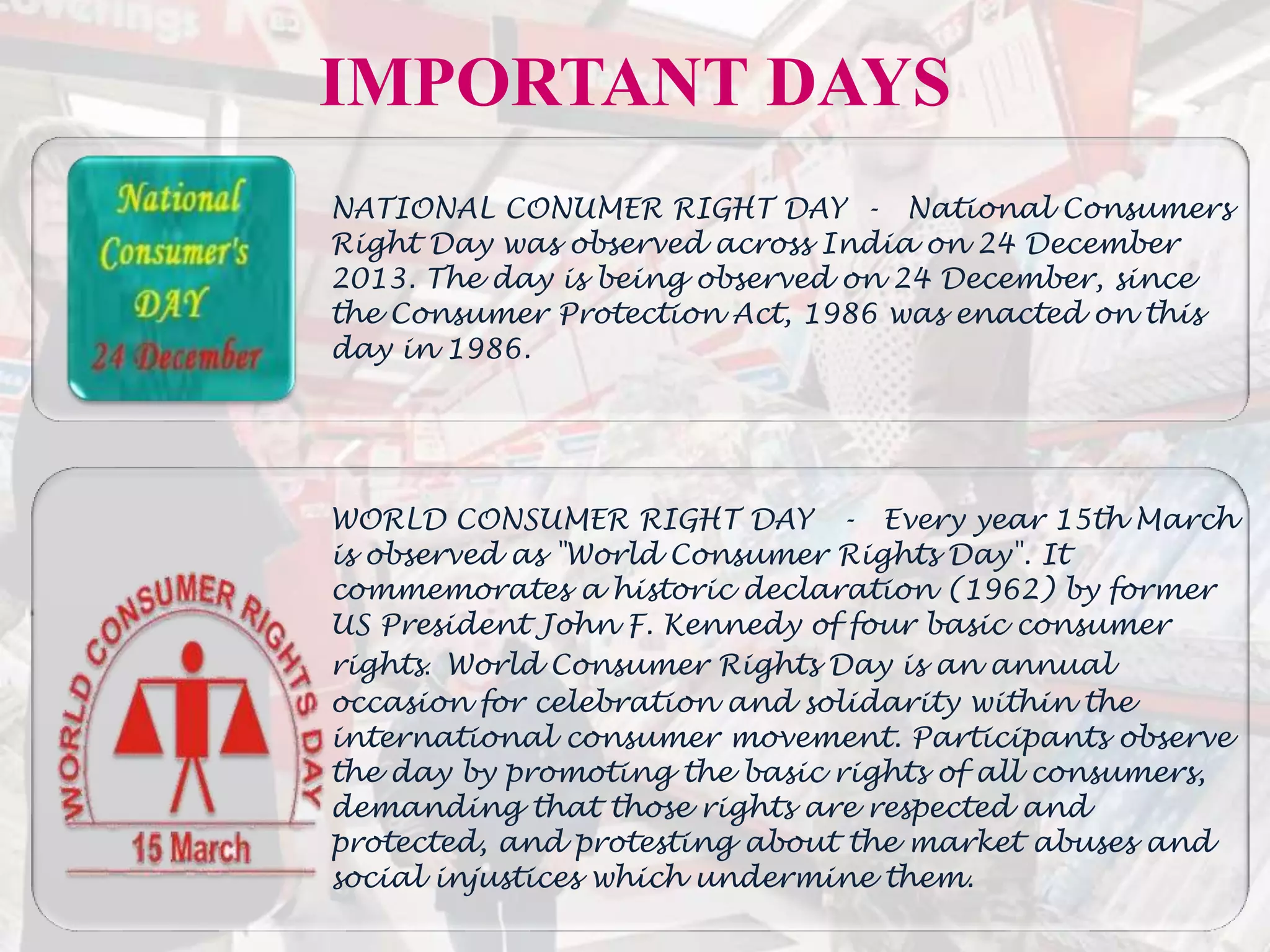
IMPORTANT DAYS
RIGHT TO BE HEARD
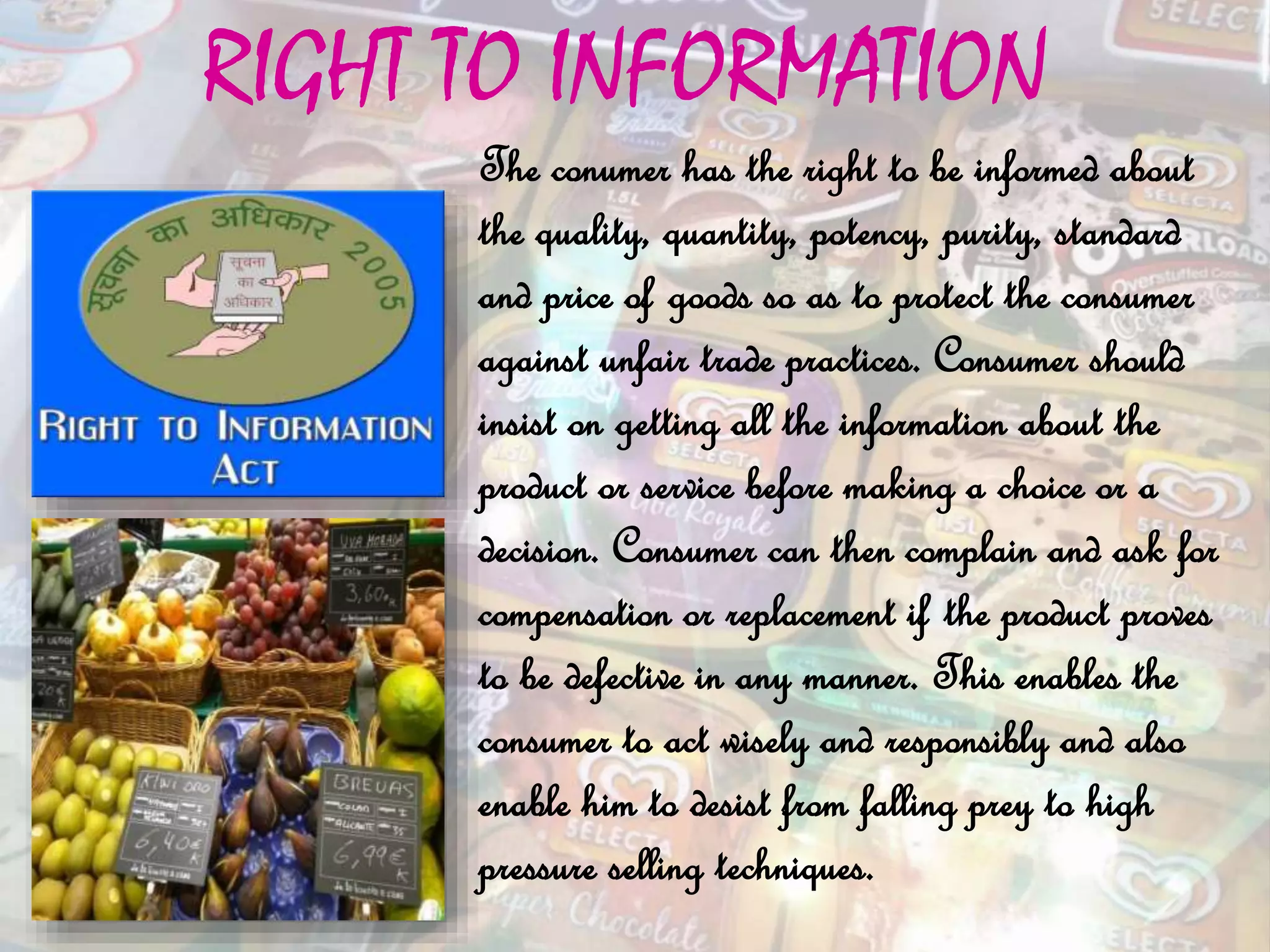
RIGHT TO INFORMATION
RIGHT TO CHOOSE
RIGHT TO SAFETY
RIGHT TO SEEK REDRESSAL
RIGHT TO CONSUMER EDUCATION
MORE TO KNOW
WHERE SHOULD CONSUMER GO TO GET JUSTICE
WHO IS A CONSUMER
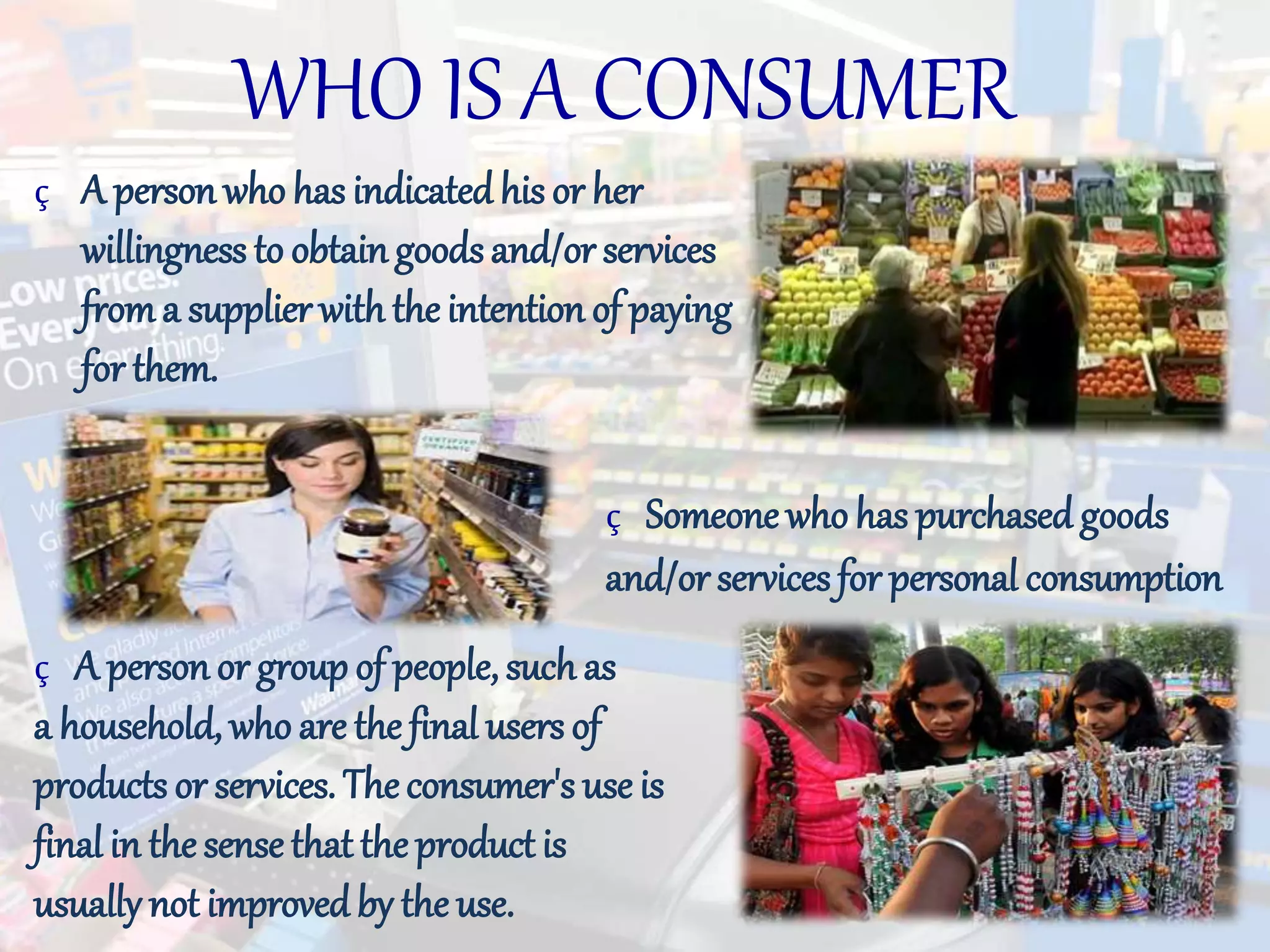
ç A person who has indicatedhis or her
willingness to obtaingoodsand/or services
froma supplier with the intention of paying
for them.
ç Someone who has purchased goods
and/or services for personal consumption
ç A person or group of people, such as
a household, who are the final users of
products or services. Theconsumer's use is
final in thesense that the product is
usually not improvedby the use.
DUTIES OF
CONSUMERS‼ Buying quality products at
reasonable price.
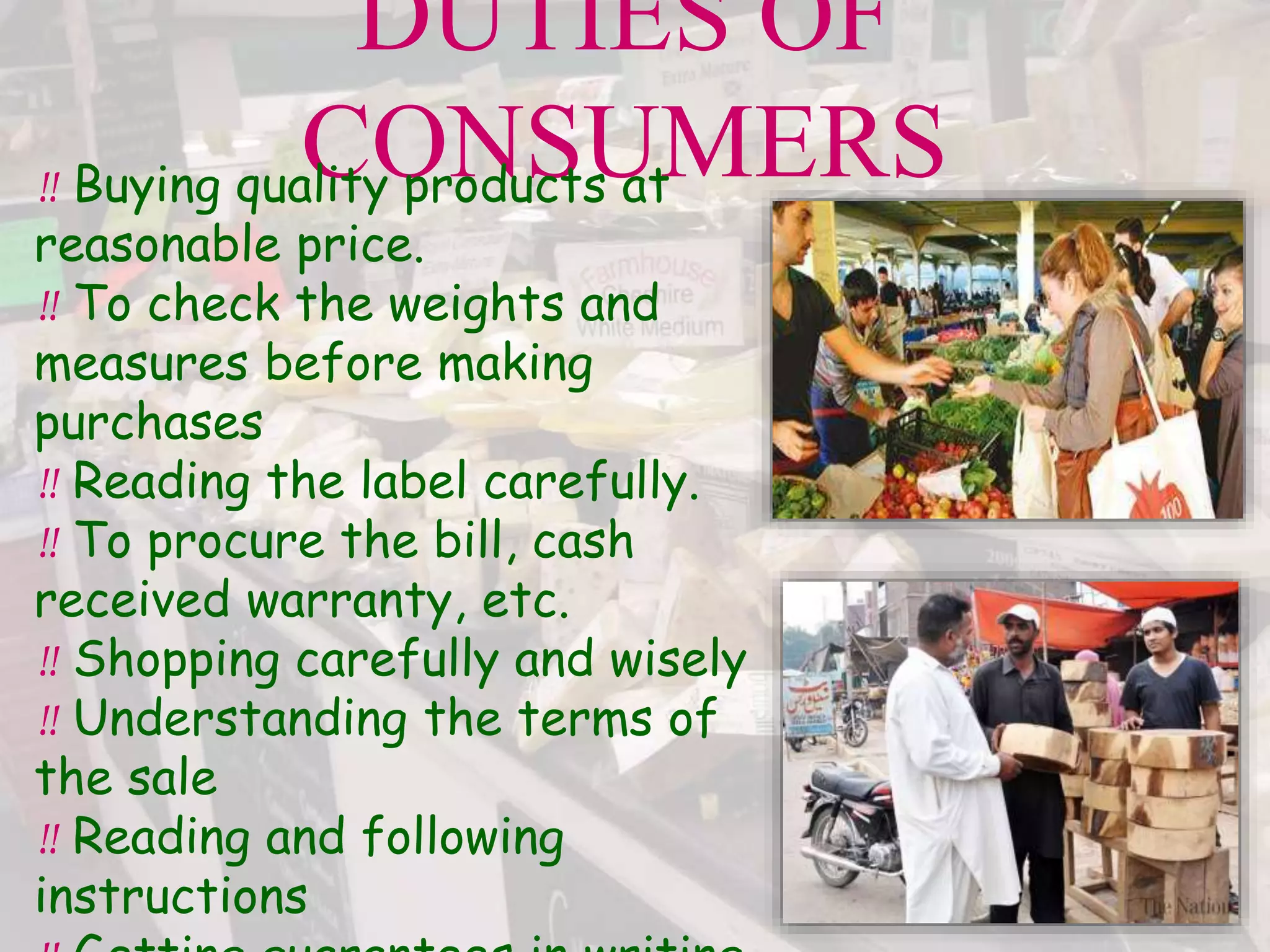
‼ To check the weights and
measures before making
purchases
‼ Reading the label carefully.
‼ To procure the bill, cash
received warranty, etc.
‼ Shopping carefully and wisely
‼ Understanding the terms of
the sale
‼ Reading and following
instructions
HOW CONSUMERS ARE EXPLOITED
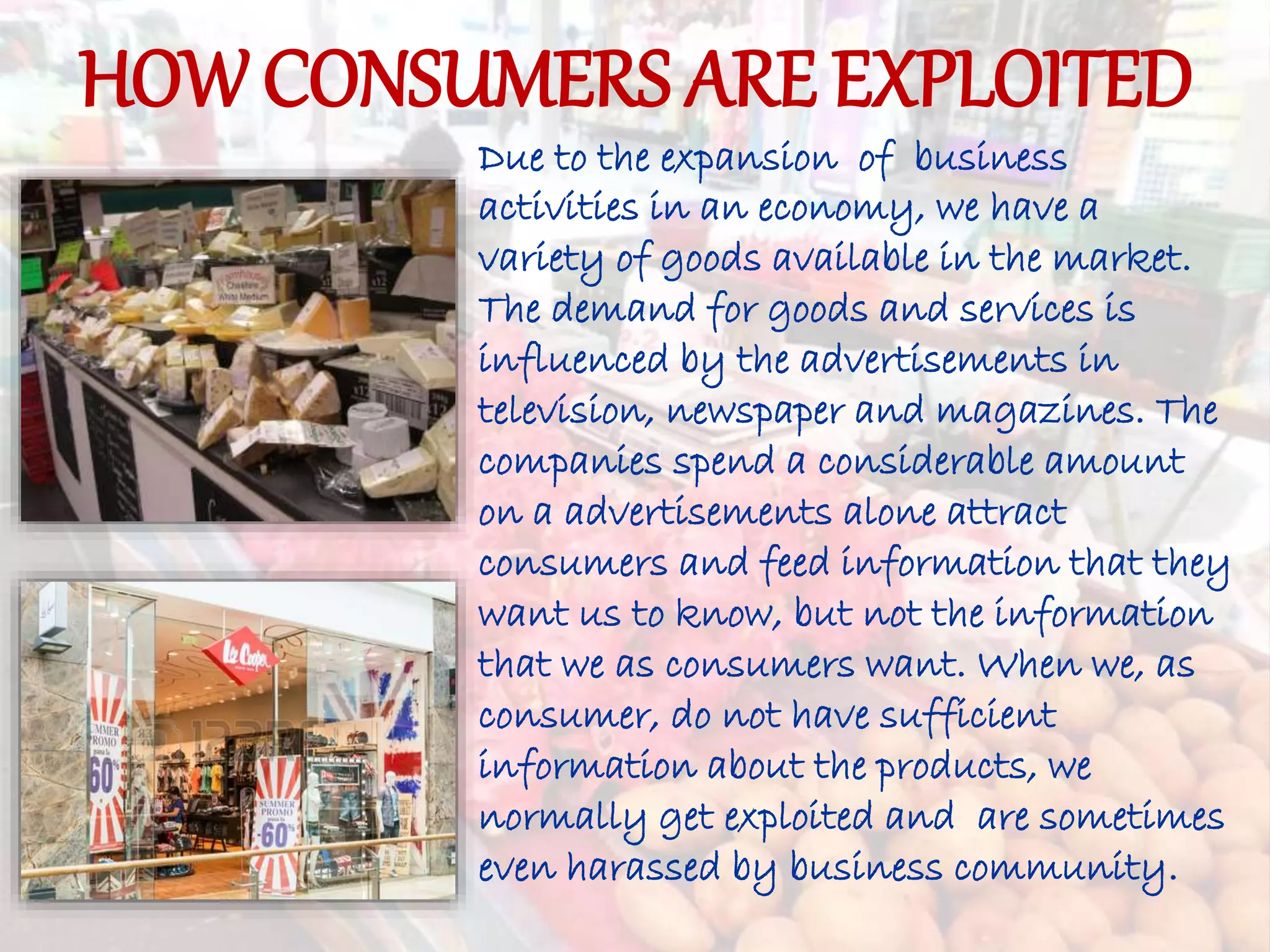
Due to the expansion of business
activities in an economy, we have a
variety of goods available in the market.
The demand for goods and services is
influenced by the advertisements in
television, newspaper and magazines. The
companies spend a considerable amount
on a advertisements alone attract
consumers and feed information that they
want us to know, but not the information
that we as consumers want. When we, as
consumer, do not have sufficient
information about the products, we
normally get exploited and are sometimes
even harassed by business community.
§Underweight and Under-measurements : The goods
being sold in the market are sometimes not measured
or weighed correctly
§Sub-standard Quality : The goods sold are sometimes
of sub-standard quality. Selling of medicine beyond
their expiry dates is generally the grievances of
consumers.
§High Prices : Very often the traders charge a higher
price than the prescribed retail price
§Duplicate Articles : In the name of genuine parts or
goods, fake or duplicate items are being sold to the
consumers.
§Artificial Scarcity : In order to amass illegitimate
profit, businessman create artificial scarcity by
hoarding. They sell it later at a higher price.
§False or Incomplete Information : Sellers easily
mislead consumers by giving wrong information about
the product, its price, quality, reliability, life cycle,
FACTORS CAUSING EXPLOITATION OF CONSUMERS
¡ Limited Information : In a capitalist economy, producers and
sellers are free to produce any goods or services in any quantity
and there is no regulation on the prices. In the absence of
information about different aspects of the products, namely,
price, quality, condition of use, etc., the consumers are liable to
make a wrong choice and lose money.
¡ Limited Supplies : The consumers are exploited when the goods
and services are not available in the required quantity or numbers.
This gives us rise to hoarding and price-escalation.
¡ Limited Competition : When only one producer or group of
producer or a group of persons controls the production and supply
of a product, and is in a position to restrict the availability of
supplies, there is a possibility of manipulation in prices and
availability.
¡ Illiteracy : Illiteracy is one of the major drawbacks that lead to
the exploitation of consumers. The level of literacy directly
CONSUMER MOVEMENT
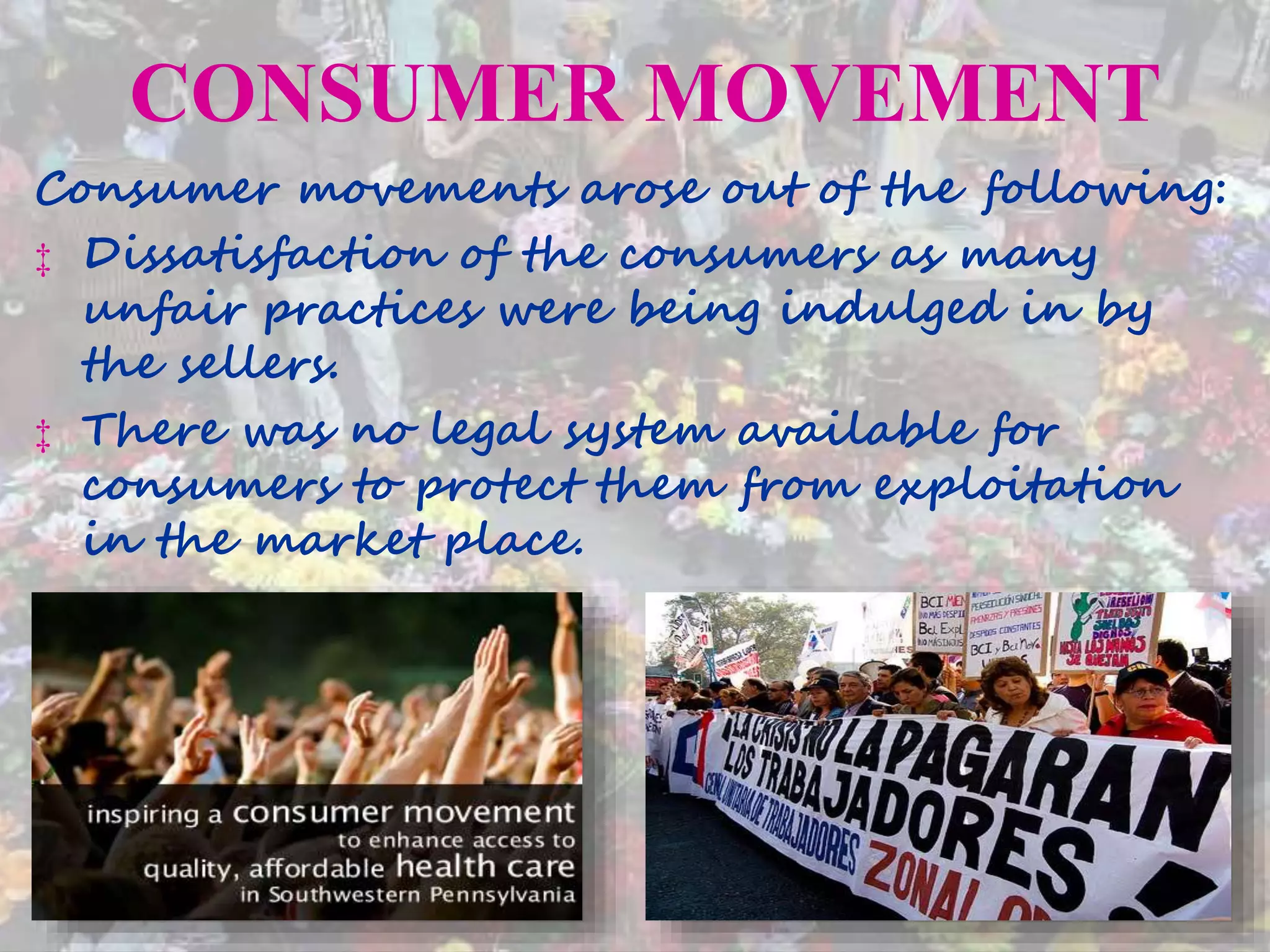
Consumer movements arose out of the following:
‡ Dissatisfaction of the consumers as many
unfair practices were being indulged in by
the sellers.
‡ There was no legal system available for
consumers to protect them from exploitation
in the market place.
NEED OF CONSUMER MOVEMENT
† Providing consumer
education.
† Providing consumer
protection.
† Building pressure on
government .
† Arranging consumer
protection programmes.
† Organizing public
opinion.
† Providing guidance to
consumer.
† Fight against marketing
system
† Consumer awareness
CONSUMER MOVEMENT IN INDIA
It took many years for organisations in India and around the world, to create
awareness amongst people. In India, the consumer movement as a social force
originated with the necessity of protecting and promoting the interests of consumers
against unethical and unfair trade practices. Rampat food shortages, hording, black
marketing, adulteration of food and edible oil gave birth to the consumer movement
in an organised form in the 1960s. Till the 1970s, consumer organisations were
largely engaged in writing articles and holding exhibitions. They formed consumer
groups to look into malpractices in ration shops and overcrowding in the road
passeneger transport. More recently. India witnessed an upsurge in the number of
consumer groups. Because of all these efforts, the movement succeeded in bringing
pressure on business firms as well as government to correct business conduct which
may be unfair and against the interest s of consumers at large. A major step taken in
1986 by the Indian government was the enactment of the Consumer Protection
Act 1986, popularly known as COPRA.
CONSUMER PROTECTION ACT, 1986
Consumer Protection Act, 1986, popularly known as COPRA, is an Act of the Parliament of
India enacted in 1986 to protect interests of consumers in India. It makes provision for the establishment
of consumer councils and other authorities for the settlement of consumers' disputes and for matters
connected therewith. This Act was enacted in 1986 with the objective of providing better protection of
consumer’s interest. Effective safeguards are provided to the consumer, against various types of
exploitations and unfair dealings, relying mainly on compensatory rather than a disciplinary or preventive
approach under the Act. It applies to all goods and services unless specifically exempted, which covers
the private, public and cooperative sectors. It also provides speedy and inexpensive. The rights under the
Act flow from the rights enshrined in Articles 14 to 19 of the Constitution of India. The Right to
Information Act (RTI), which has opened up governance processes of our country to the common public,
also has far-reaching implications for consumer protection. The Consumer Protection Act, 1986 is the
most important legislation enacted to provide for effective safeguards to consumers against various types of
exploitations and unfair dealings, relying on mainly compensatory rather than a punitive or preventive
approach. The Act has set up a three-tier quasi-judicial consumer disputes redressal machinery at the
National, State and District levels, for expeditious and inexpensive settlement of consumer disputes.
IMPORTANT DAYS
NATIONAL CONUMER RIGHT DAY - National Consumers
Right Day was observed across India on 24 December
2013. The day is being observed on 24 December, since
the Consumer Protection Act, 1986 was enacted on this
day in 1986.
WORLD CONSUMER RIGHT DAY - Every year 15th March
is observed as "World Consumer Rights Day". It
commemorates a historic declaration (1962) by former
US President John F. Kennedy of four basic consumer
rights. World Consumer Rights Day is an annual
occasion for celebration and solidarity within the
international consumer movement. Participants observe
the day by promoting the basic rights of all consumers,
demanding that those rights are respected and
protected, and protesting about the market abuses and
social injustices which undermine them.
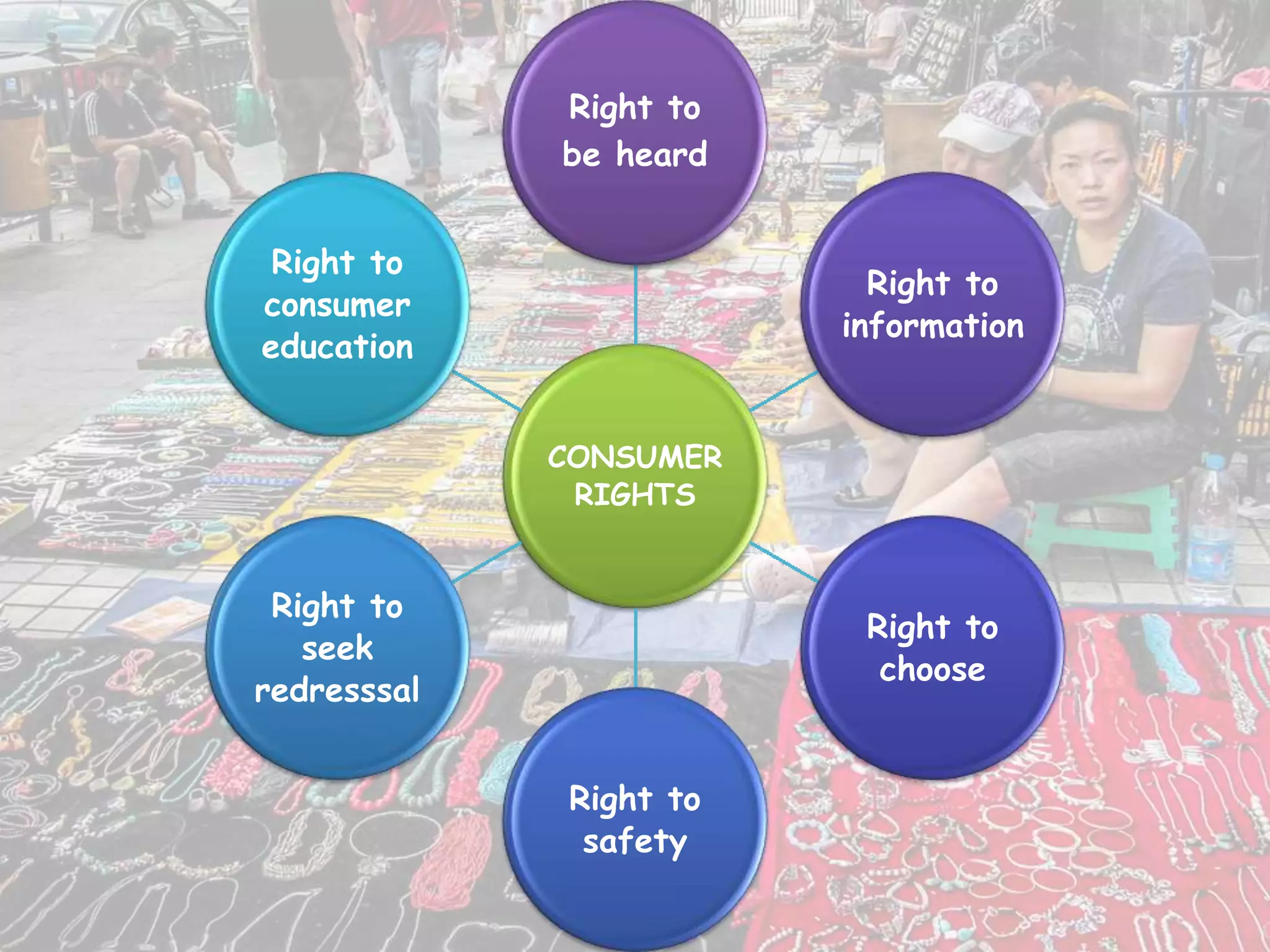
CONSUMER
RIGHTS
Right to
be heard
Right to
information
Right to
choose
Right to
safety
Right to
seek
redresssal
Right to
consumer
education
RIGHT TO BE HEARD
Right to be heard means that
consumer's interests will receive due
consideration at appropriate forums. It also
includes right to be represented in various
forums formed to consider the consumer's
welfare. The consumers should form non-
political and non-commercial consumer
organizations which can be given
representation in various committees formed
by the Government and other bodies in
matters relating to consumers.
RIGHT TO INFORMATION
The conumer has the right to be informed about
the quality, quantity, potency, purity, standard
and price of goods so as to protect the consumer
against unfair trade practices. Consumer should
insist on getting all the information about the
product or service before making a choice or a
decision. Consumer can then complain and ask for
compensation or replacement if the product proves
to be defective in any manner. This enables the
consumer to act wisely and responsibly and also
enable him to desist from falling prey to high
pressure selling techniques.
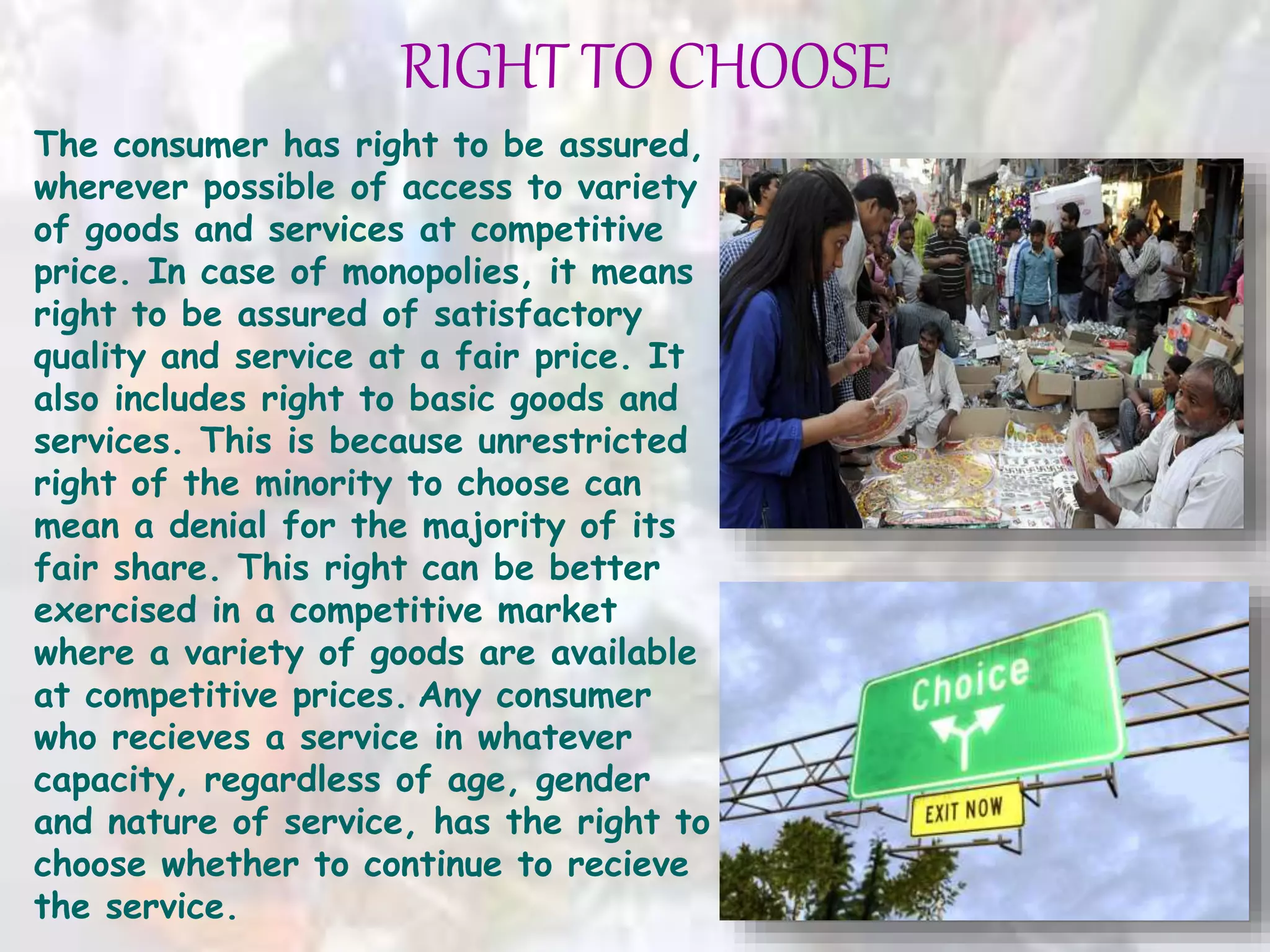
RIGHT TO CHOOSE
The consumer has right to be assured,
wherever possible of access to variety
of goods and services at competitive
price. In case of monopolies, it means
right to be assured of satisfactory
quality and service at a fair price. It
also includes right to basic goods and
services. This is because unrestricted
right of the minority to choose can
mean a denial for the majority of its
fair share. This right can be better
exercised in a competitive market
where a variety of goods are available
at competitive prices. Any consumer
who recieves a service in whatever
capacity, regardless of age, gender
and nature of service, has the right to
choose whether to continue to recieve
the service.
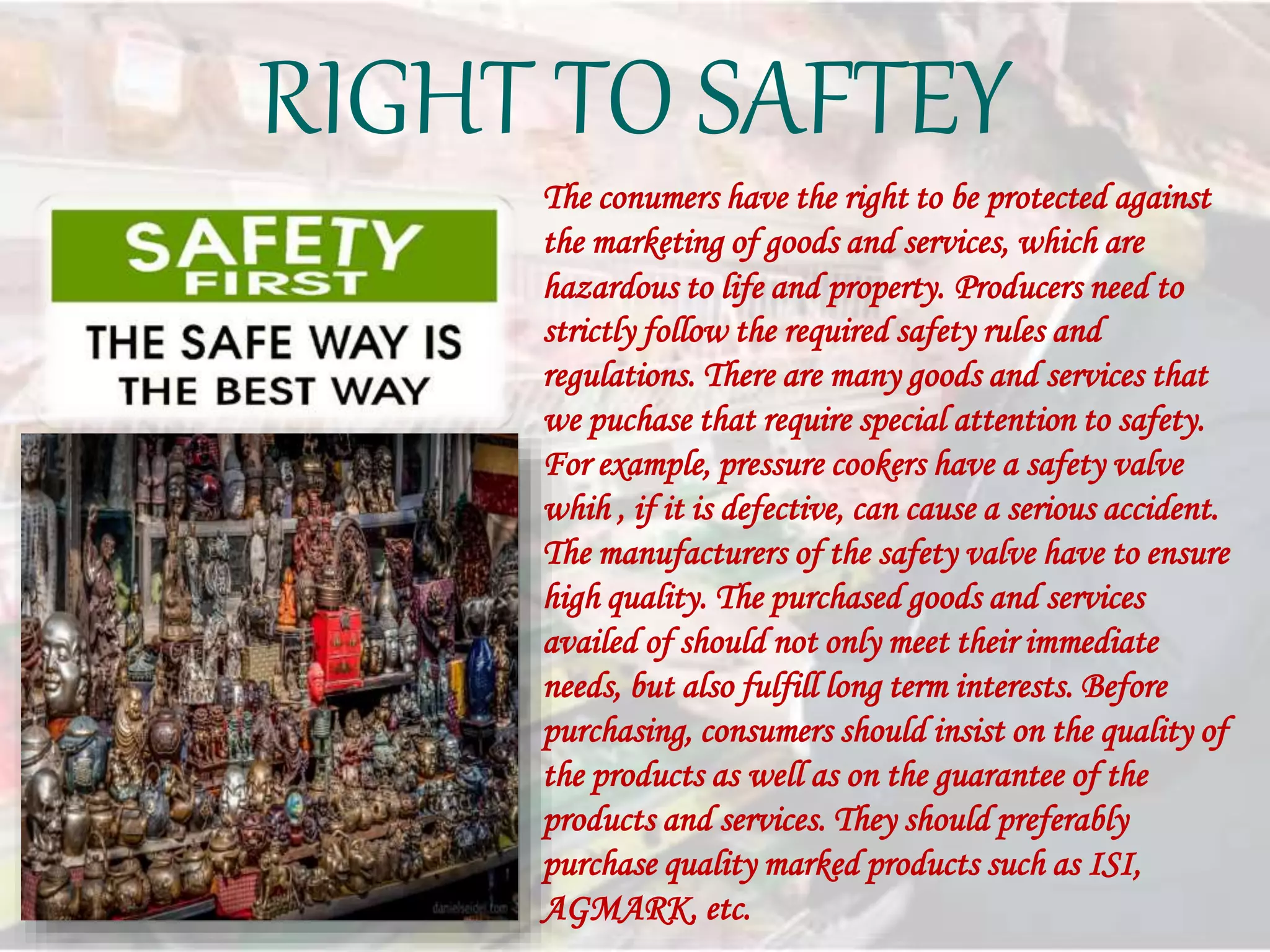
RIGHT TO SAFTEY
The conumers have the right to be protected against
the marketing of goods and services, which are
hazardous to life and property. Producers need to
strictly follow the required safety rules and
regulations. There are many goods and services that
we puchase that require special attention to safety.
For example, pressure cookers have a safety valve
whih , if it is defective, can cause a serious accident.
The manufacturers of the safety valve have to ensure
high quality. The purchased goods and services
availed of should not only meet their immediate
needs, but also fulfill long term interests. Before
purchasing, consumers should insist on the quality of
the products as well as on the guarantee of the
products and services. They should preferably
purchase quality marked products such as ISI,
AGMARK, etc.
RIGHT TO SEEK REDRESSAL
Consumers have the right to seek redressal
against unfair trade practices or unscrupulous
exploitation. It also includes right to fair
settlement of the genuine grievances of the
consumer. Consumers must make complaint for
their genuine grievances. Many a times their
complaint may be of small value but its impact
on the society as a whole may be very large.
They can also take the help of consumer
organizations in seeking redressal of their
grievances. A consumer can claim compensation
for damage caused by any product or service.
He/She can file a case in the consumer court
against the shopkeeper or manufacturer.
RIGHT TO CONSUMER EDUCATION
The right to acquire the
knowledge and skill to be an
informed consumer throughout
life. Ignorance of consumers,
particularly of rural consumers,
is mainly responsible for their
exploitation. They should know
their rights and must exercise
them. The government or other
organisation should make
attempts to educate citizens
about various aspects of
consumer welfare.Only then real
consumer protection can be
achieved with success.
WHY CONSUMER EDUCATION IS IMPORTANT
† It provides the person with the basic knowledge to handle consumer
problem, he/she becomes a discriminating buyer by taking rational
decisions, and thus not fall prey to advertisements or persuasions.
† Technological developments have flooded the market with a variety
of products, goods and services, it is therefore important that a
person possesses basic knowledge and skills to judge the product.
† School children are mostly dependent on their parents, it is
therefore important that they make the best use of their pocket
money.
† Consumers education can alert the pupils to the corporate dumping
of dangerous pharmaceuticals and similar products.
MORE TO KNOW
While buying many commodities, on the
cover you might have seen a logo with the
letters ISI, Agmark, Hallmark. These
logos and certifications help consumers
get assured of quality while purchasing
the goods and services. The organisations
that monitor and issue these certificates
allow produces to use their logos provided
they follow certain quality standards.
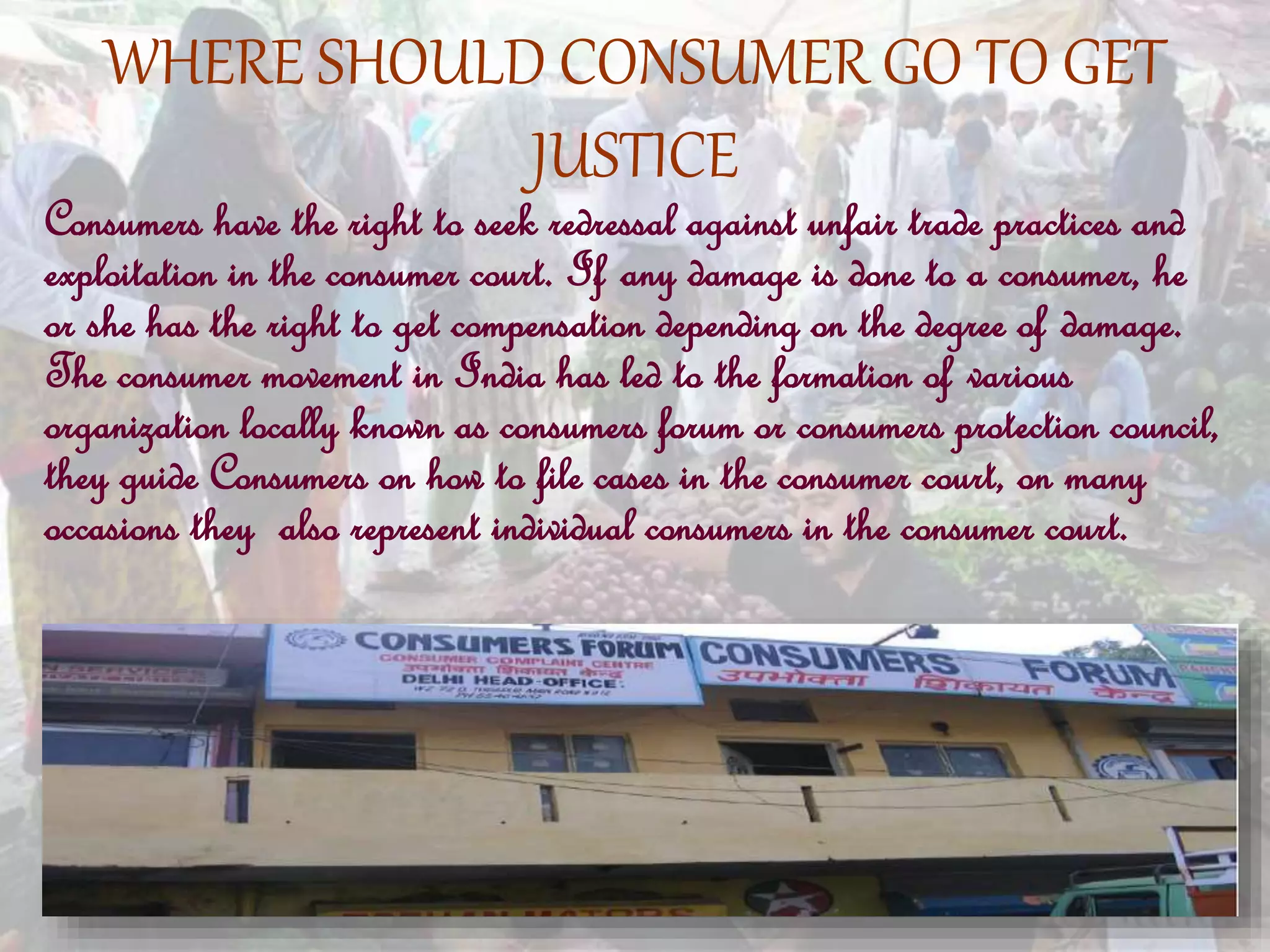
WHERE SHOULD CONSUMER GO TO GET
JUSTICE
Consumers have the right to seek redressal against unfair trade practices and
exploitation in the consumer court. If any damage is done to a consumer, he
or she has the right to get compensation depending on the degree of damage.
The consumer movement in India has led to the formation of various
organization locally known as consumers forum or consumers protection council,
they guide Consumers on how to file cases in the consumer court, on many
occasions they also represent individual consumers in the consumer court.
Under COPRA a three- tier system is set
up at the district, state and National
level for redressal of consumer
disputes. Various claims are delt with
by these courts as given below :
¢ District level : Up to Rs 20 Lakhs.
¢ State level : Between Rs 20 Lakhs and
Rs 1 Crore.
¢ National level : Exceeding Rs 1 Crore
If a case is dismissed in district level
court, the consumer can appeal in the
state and then in the National level
court.
THANK
YOU

Consumerrights 150117232222-conversion-gate02

  • 1.
  • 2.
    CONTENTWHO IS ACONSUMER DUTIES OF CONSUMERS HOW CONSUMERS ARE EXPLOITED FACTORS CAUSING EXPLOITATION OF CONSUMERS CONSUMER MOVEMENT NEED OF CONSUMER MOVEMENT CONSUMER MOVEMENT IN INDIA CONSUMER PROTECTION ACT, 1986 IMPORTANT DAYS RIGHT TO BE HEARD RIGHT TO INFORMATION RIGHT TO CHOOSE RIGHT TO SAFETY RIGHT TO SEEK REDRESSAL RIGHT TO CONSUMER EDUCATION MORE TO KNOW WHERE SHOULD CONSUMER GO TO GET JUSTICE
  • 3.
    WHO IS ACONSUMER ç A person who has indicatedhis or her willingness to obtaingoodsand/or services froma supplier with the intention of paying for them. ç Someone who has purchased goods and/or services for personal consumption ç A person or group of people, such as a household, who are the final users of products or services. Theconsumer's use is final in thesense that the product is usually not improvedby the use.
  • 4.
    DUTIES OF CONSUMERS‼ Buyingquality products at reasonable price. ‼ To check the weights and measures before making purchases ‼ Reading the label carefully. ‼ To procure the bill, cash received warranty, etc. ‼ Shopping carefully and wisely ‼ Understanding the terms of the sale ‼ Reading and following instructions
  • 5.
    HOW CONSUMERS AREEXPLOITED Due to the expansion of business activities in an economy, we have a variety of goods available in the market. The demand for goods and services is influenced by the advertisements in television, newspaper and magazines. The companies spend a considerable amount on a advertisements alone attract consumers and feed information that they want us to know, but not the information that we as consumers want. When we, as consumer, do not have sufficient information about the products, we normally get exploited and are sometimes even harassed by business community.
  • 6.
    §Underweight and Under-measurements: The goods being sold in the market are sometimes not measured or weighed correctly §Sub-standard Quality : The goods sold are sometimes of sub-standard quality. Selling of medicine beyond their expiry dates is generally the grievances of consumers. §High Prices : Very often the traders charge a higher price than the prescribed retail price §Duplicate Articles : In the name of genuine parts or goods, fake or duplicate items are being sold to the consumers. §Artificial Scarcity : In order to amass illegitimate profit, businessman create artificial scarcity by hoarding. They sell it later at a higher price. §False or Incomplete Information : Sellers easily mislead consumers by giving wrong information about the product, its price, quality, reliability, life cycle,
  • 7.
    FACTORS CAUSING EXPLOITATIONOF CONSUMERS ¡ Limited Information : In a capitalist economy, producers and sellers are free to produce any goods or services in any quantity and there is no regulation on the prices. In the absence of information about different aspects of the products, namely, price, quality, condition of use, etc., the consumers are liable to make a wrong choice and lose money. ¡ Limited Supplies : The consumers are exploited when the goods and services are not available in the required quantity or numbers. This gives us rise to hoarding and price-escalation. ¡ Limited Competition : When only one producer or group of producer or a group of persons controls the production and supply of a product, and is in a position to restrict the availability of supplies, there is a possibility of manipulation in prices and availability. ¡ Illiteracy : Illiteracy is one of the major drawbacks that lead to the exploitation of consumers. The level of literacy directly
  • 8.
    CONSUMER MOVEMENT Consumer movementsarose out of the following: ‡ Dissatisfaction of the consumers as many unfair practices were being indulged in by the sellers. ‡ There was no legal system available for consumers to protect them from exploitation in the market place.
  • 9.
    NEED OF CONSUMERMOVEMENT † Providing consumer education. † Providing consumer protection. † Building pressure on government . † Arranging consumer protection programmes. † Organizing public opinion. † Providing guidance to consumer. † Fight against marketing system † Consumer awareness
  • 10.
    CONSUMER MOVEMENT ININDIA It took many years for organisations in India and around the world, to create awareness amongst people. In India, the consumer movement as a social force originated with the necessity of protecting and promoting the interests of consumers against unethical and unfair trade practices. Rampat food shortages, hording, black marketing, adulteration of food and edible oil gave birth to the consumer movement in an organised form in the 1960s. Till the 1970s, consumer organisations were largely engaged in writing articles and holding exhibitions. They formed consumer groups to look into malpractices in ration shops and overcrowding in the road passeneger transport. More recently. India witnessed an upsurge in the number of consumer groups. Because of all these efforts, the movement succeeded in bringing pressure on business firms as well as government to correct business conduct which may be unfair and against the interest s of consumers at large. A major step taken in 1986 by the Indian government was the enactment of the Consumer Protection Act 1986, popularly known as COPRA.
  • 11.
    CONSUMER PROTECTION ACT,1986 Consumer Protection Act, 1986, popularly known as COPRA, is an Act of the Parliament of India enacted in 1986 to protect interests of consumers in India. It makes provision for the establishment of consumer councils and other authorities for the settlement of consumers' disputes and for matters connected therewith. This Act was enacted in 1986 with the objective of providing better protection of consumer’s interest. Effective safeguards are provided to the consumer, against various types of exploitations and unfair dealings, relying mainly on compensatory rather than a disciplinary or preventive approach under the Act. It applies to all goods and services unless specifically exempted, which covers the private, public and cooperative sectors. It also provides speedy and inexpensive. The rights under the Act flow from the rights enshrined in Articles 14 to 19 of the Constitution of India. The Right to Information Act (RTI), which has opened up governance processes of our country to the common public, also has far-reaching implications for consumer protection. The Consumer Protection Act, 1986 is the most important legislation enacted to provide for effective safeguards to consumers against various types of exploitations and unfair dealings, relying on mainly compensatory rather than a punitive or preventive approach. The Act has set up a three-tier quasi-judicial consumer disputes redressal machinery at the National, State and District levels, for expeditious and inexpensive settlement of consumer disputes.
  • 12.
    IMPORTANT DAYS NATIONAL CONUMERRIGHT DAY - National Consumers Right Day was observed across India on 24 December 2013. The day is being observed on 24 December, since the Consumer Protection Act, 1986 was enacted on this day in 1986. WORLD CONSUMER RIGHT DAY - Every year 15th March is observed as "World Consumer Rights Day". It commemorates a historic declaration (1962) by former US President John F. Kennedy of four basic consumer rights. World Consumer Rights Day is an annual occasion for celebration and solidarity within the international consumer movement. Participants observe the day by promoting the basic rights of all consumers, demanding that those rights are respected and protected, and protesting about the market abuses and social injustices which undermine them.
  • 13.
    CONSUMER RIGHTS Right to be heard Rightto information Right to choose Right to safety Right to seek redresssal Right to consumer education
  • 14.
    RIGHT TO BEHEARD Right to be heard means that consumer's interests will receive due consideration at appropriate forums. It also includes right to be represented in various forums formed to consider the consumer's welfare. The consumers should form non- political and non-commercial consumer organizations which can be given representation in various committees formed by the Government and other bodies in matters relating to consumers.
  • 15.
    RIGHT TO INFORMATION Theconumer has the right to be informed about the quality, quantity, potency, purity, standard and price of goods so as to protect the consumer against unfair trade practices. Consumer should insist on getting all the information about the product or service before making a choice or a decision. Consumer can then complain and ask for compensation or replacement if the product proves to be defective in any manner. This enables the consumer to act wisely and responsibly and also enable him to desist from falling prey to high pressure selling techniques.
  • 16.
    RIGHT TO CHOOSE Theconsumer has right to be assured, wherever possible of access to variety of goods and services at competitive price. In case of monopolies, it means right to be assured of satisfactory quality and service at a fair price. It also includes right to basic goods and services. This is because unrestricted right of the minority to choose can mean a denial for the majority of its fair share. This right can be better exercised in a competitive market where a variety of goods are available at competitive prices. Any consumer who recieves a service in whatever capacity, regardless of age, gender and nature of service, has the right to choose whether to continue to recieve the service.
  • 17.
    RIGHT TO SAFTEY Theconumers have the right to be protected against the marketing of goods and services, which are hazardous to life and property. Producers need to strictly follow the required safety rules and regulations. There are many goods and services that we puchase that require special attention to safety. For example, pressure cookers have a safety valve whih , if it is defective, can cause a serious accident. The manufacturers of the safety valve have to ensure high quality. The purchased goods and services availed of should not only meet their immediate needs, but also fulfill long term interests. Before purchasing, consumers should insist on the quality of the products as well as on the guarantee of the products and services. They should preferably purchase quality marked products such as ISI, AGMARK, etc.
  • 18.
    RIGHT TO SEEKREDRESSAL Consumers have the right to seek redressal against unfair trade practices or unscrupulous exploitation. It also includes right to fair settlement of the genuine grievances of the consumer. Consumers must make complaint for their genuine grievances. Many a times their complaint may be of small value but its impact on the society as a whole may be very large. They can also take the help of consumer organizations in seeking redressal of their grievances. A consumer can claim compensation for damage caused by any product or service. He/She can file a case in the consumer court against the shopkeeper or manufacturer.
  • 19.
    RIGHT TO CONSUMEREDUCATION The right to acquire the knowledge and skill to be an informed consumer throughout life. Ignorance of consumers, particularly of rural consumers, is mainly responsible for their exploitation. They should know their rights and must exercise them. The government or other organisation should make attempts to educate citizens about various aspects of consumer welfare.Only then real consumer protection can be achieved with success.
  • 20.
    WHY CONSUMER EDUCATIONIS IMPORTANT † It provides the person with the basic knowledge to handle consumer problem, he/she becomes a discriminating buyer by taking rational decisions, and thus not fall prey to advertisements or persuasions. † Technological developments have flooded the market with a variety of products, goods and services, it is therefore important that a person possesses basic knowledge and skills to judge the product. † School children are mostly dependent on their parents, it is therefore important that they make the best use of their pocket money. † Consumers education can alert the pupils to the corporate dumping of dangerous pharmaceuticals and similar products.
  • 21.
    MORE TO KNOW Whilebuying many commodities, on the cover you might have seen a logo with the letters ISI, Agmark, Hallmark. These logos and certifications help consumers get assured of quality while purchasing the goods and services. The organisations that monitor and issue these certificates allow produces to use their logos provided they follow certain quality standards.
  • 22.
    WHERE SHOULD CONSUMERGO TO GET JUSTICE Consumers have the right to seek redressal against unfair trade practices and exploitation in the consumer court. If any damage is done to a consumer, he or she has the right to get compensation depending on the degree of damage. The consumer movement in India has led to the formation of various organization locally known as consumers forum or consumers protection council, they guide Consumers on how to file cases in the consumer court, on many occasions they also represent individual consumers in the consumer court.
  • 23.
    Under COPRA athree- tier system is set up at the district, state and National level for redressal of consumer disputes. Various claims are delt with by these courts as given below : ¢ District level : Up to Rs 20 Lakhs. ¢ State level : Between Rs 20 Lakhs and Rs 1 Crore. ¢ National level : Exceeding Rs 1 Crore If a case is dismissed in district level court, the consumer can appeal in the state and then in the National level court.
  • 24.