Thromboembolism
Dr.Nafeeya
Department of Forensic Medicine &Toxicology
Overview
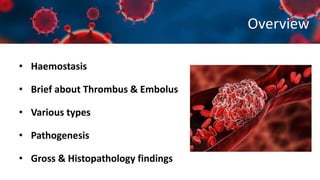
• Haemostasis
• Brief about Thrombus & Embolus
• Various types
• Pathogenesis
• Gross & Histopathology findings
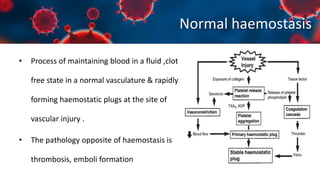
Normal haemostasis
• Process of maintaining blood in a fluid ,clot
free state in a normal vasculature & rapidly
forming haemostatic plugs at the site of
vascular injury .
• The pathology opposite of haemostasis is
thrombosis, emboli formation
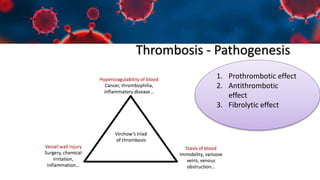
Thrombosis - Pathogenesis
1. Prothrombotic effect
2. Antithrombotic
effect
3. Fibrolytic effect
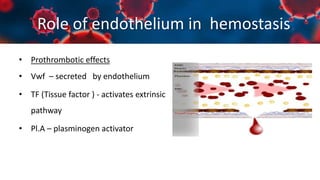
Role of endothelium in hemostasis
• Prothrombotic effects
• Vwf – secreted by endothelium
• TF (Tissue factor ) - activates extrinsic
pathway
• Pl.A – plasminogen activator
Fibrinolytic effect
• Plasminogen activators
convert plasminogen to
plasmin
• Plasmin lyses Fibrin (&
Fibrinogen) to degradation
products which are soluble
and are removed.
Anti thrombotic effects
PGI2 & Nitric oxide
Heparin like molecule
Thrombomodulin
TFPI –tissue factor pathway
inhibitor
Thrombosis - Definition
• Thrombosis refers to the formation of thrombus within a vascular lumen,
defined as an aggregate of coagulated blood containing platelets, fibrin,
and entrapped cellular elements..
Thrombosis - arterial
• Arterial thrombosis eg , myocardial infarction (1- cause of death).
• stroke (2- cause of death),
• or peripheral infarcts.
Thrombosis - High risk patients
• Tissue damage (surgery, burns)
• Prolonged immobilization
• Myocardial infarction
• Neoplasms ,Prosthetic heart valves
• DIC (also increased risk of hemorrhage)
Smokers
Pregnancy/postpartum
Oral contraceptives
Hyperlipidemia
Sickle cell disease
Atrial fibrillation
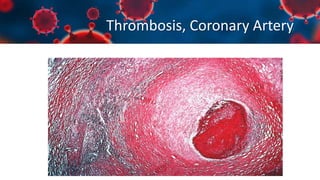
Thrombosis, Coronary Artery
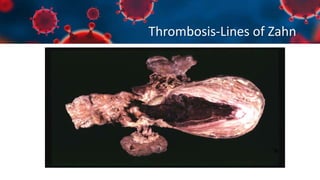
Thrombosis-Lines of Zahn
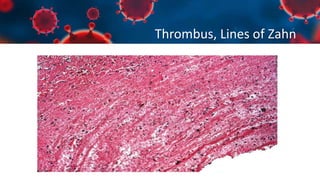
Thrombus, Lines of Zahn
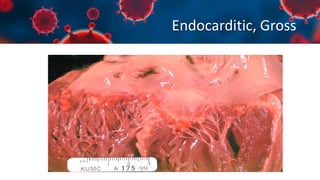
Endocarditic, Gross
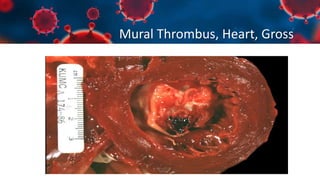
Mural Thrombus, Heart, Gross
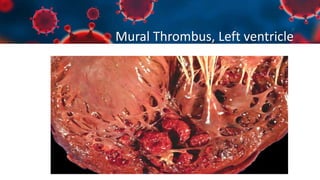
Mural Thrombus, Left ventricle
• Complications of cardiac thrombosis
– The major complication of thrombi in any location in the heart is the
– detachment of fragments and their transport to distant sites
(embolization),
– where they lodge and occlude arterial vessels.
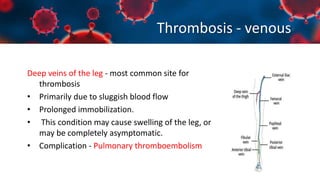
Thrombosis - venous
Deep veins of the leg - most common site for
thrombosis
• Primarily due to sluggish blood flow
• Prolonged immobilization.
• This condition may cause swelling of the leg, or
may be completely asymptomatic.
• Complication - Pulmonary thromboembolism
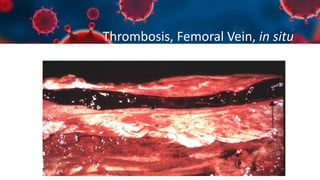
Thrombosis, Femoral Vein, in situ
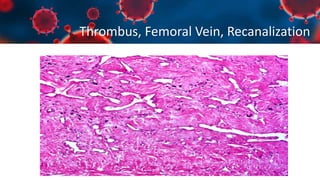
Thrombus, Femoral Vein, Recanalization
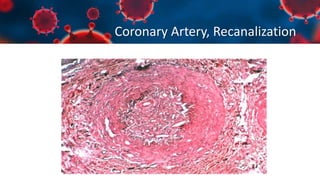
Coronary Artery, Recanalization
Thrombosis - fate of thrombi
• Propagation
• Embolization
• Dissolution (lysis by the thrombolytic system)
• Organization and re-canalization
Embolism - Definition
• Embolism is the passage through the venous or arterial circulations of any
material capable of lodging in a blood vessel and thereby obstructing the
lumen
Embolism-Types
• Thromboembolism (most common)
• Fat embolism
• Amniotic fluid embolism
• Gas embolism
• Cholesterol embolism
• Septic embolism
• Foreign body embolism
• Bone marrow embolism
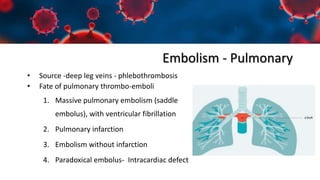
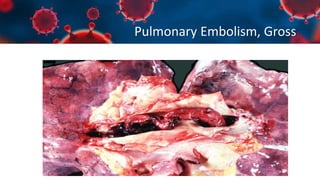
Embolism - Pulmonary
• Source -deep leg veins - phlebothrombosis
• Fate of pulmonary thrombo-emboli
1. Massive pulmonary embolism (saddle
embolus), with ventricular fibrillation
2. Pulmonary infarction
3. Embolism without infarction
4. Paradoxical embolus- Intracardiac defect
Pulmonary Embolism, Gross
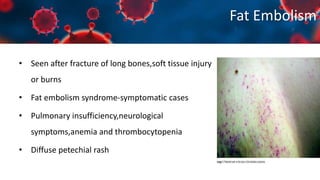
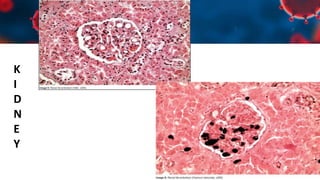
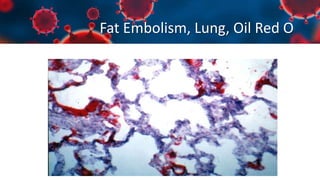
Fat Embolism
• Seen after fracture of long bones,soft tissue injury
or burns
• Fat embolism syndrome-symptomatic cases
• Pulmonary insufficiency,neurological
symptoms,anemia and thrombocytopenia
• Diffuse petechial rash
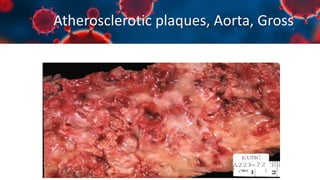
Atherosclerotic plaques, Aorta, Gross
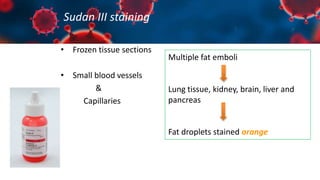
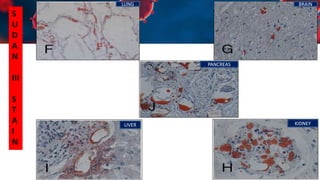
Sudan III staining
• Frozen tissue sections
• Small blood vessels
&
Capillaries
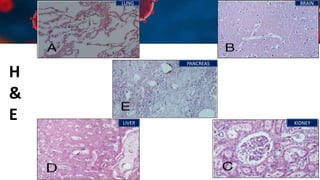
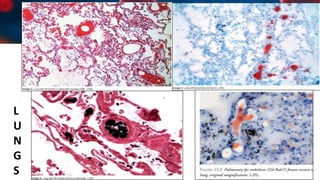
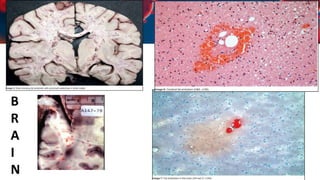
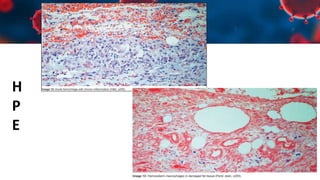
Multiple fat emboli
Lung tissue, kidney, brain, liver and
pancreas
Fat droplets stained orange
H
&
E
LUNG
PANCREAS
KIDNEY
BRAIN
LIVER
LUNG BRAIN
KIDNEY
LIVER
PANCREAS
S
U
D
A
N
III
S
T
A
I
N
L
U
N
G
S
B
R
A
I
N
K
I
D
N
E
Y
Fat Embolism, Lung, Oil Red O
H
P
E
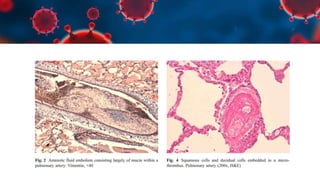
Amniotic fluid embolism
• Post partum complication-Condition in which amniotic fluid, fetal cells,
hair or other debris enters the maternal circulation due to tear in amnion
via placental bed.
• C/f-sudden severe dyspnoea,cyanosis and shock,neurologic impairment
• Cause-infusion of amniotic fluid into maternal circulation
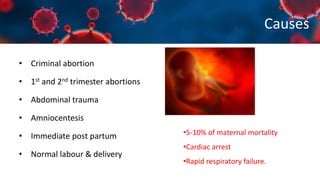
Causes
• Criminal abortion
• 1st and 2nd trimester abortions
• Abdominal trauma
• Amniocentesis
• Immediate post partum
• Normal labour & delivery
•5-10% of maternal mortality
•Cardiac arrest
•Rapid respiratory failure.
Stains used
• Alcian blue – detects mucin
• H & E – routine staining
• Attwood’s stain – stains keratin red and mucus turquoise blue
• Lendrum stain ( contains Phloxine & Tartrazine ) – stains squames red
• Sudan black or oil red – detects vernix caseosa
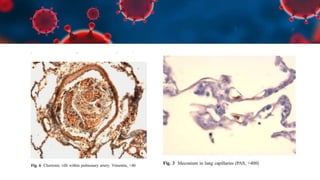
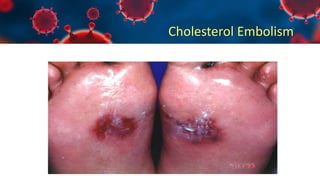
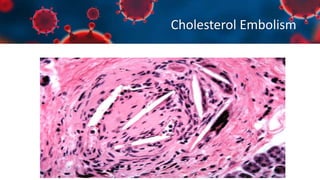
Cholesterol Embolism
References
• K S N Reddy 34th edition - Essentials of Forensic Medicine and Toxicology
• Anil aggrawal - Text book of Forensic Medicine and Toxicology
 Knights forensic pathology
• Robbins & cotran basis of disease pathology.
• Atlas of histology –Lippincotts williams &wikins
 Amniotic fluid embolism: Manjusha Viswanathan, International Journal of Reproduction,
Contraception, Obstetrics and Gynaecology Viswanathan M et al. Int J Reprod Contracept Obstet
Gynecol
 Forensic aspects of post-mortem histological detection of amniotic fluid embolism ,I. Sinicina , Springer-
Verlag 2009
• Fat embolism, fat embolism syndrome and the autopsy, academic forensic pathology, 2019
• Pathogenesis of non-traumatic fat embolism, Geoffrey Hulman, the lancet, 1988
• Autopsy diagnosis of fat embolism syndrome, am J forensic med pathol & volume 32, number 3,
september 2011

Thromboembolism

  • 1.
  • 2.
    Overview • Haemostasis • Briefabout Thrombus & Embolus • Various types • Pathogenesis • Gross & Histopathology findings
  • 3.
    Normal haemostasis • Processof maintaining blood in a fluid ,clot free state in a normal vasculature & rapidly forming haemostatic plugs at the site of vascular injury . • The pathology opposite of haemostasis is thrombosis, emboli formation
  • 4.
    Thrombosis - Pathogenesis 1.Prothrombotic effect 2. Antithrombotic effect 3. Fibrolytic effect
  • 5.
    Role of endotheliumin hemostasis • Prothrombotic effects • Vwf – secreted by endothelium • TF (Tissue factor ) - activates extrinsic pathway • Pl.A – plasminogen activator
  • 6.
    Fibrinolytic effect • Plasminogenactivators convert plasminogen to plasmin • Plasmin lyses Fibrin (& Fibrinogen) to degradation products which are soluble and are removed. Anti thrombotic effects PGI2 & Nitric oxide Heparin like molecule Thrombomodulin TFPI –tissue factor pathway inhibitor
  • 7.
    Thrombosis - Definition •Thrombosis refers to the formation of thrombus within a vascular lumen, defined as an aggregate of coagulated blood containing platelets, fibrin, and entrapped cellular elements..
  • 8.
    Thrombosis - arterial •Arterial thrombosis eg , myocardial infarction (1- cause of death). • stroke (2- cause of death), • or peripheral infarcts.
  • 9.
    Thrombosis - Highrisk patients • Tissue damage (surgery, burns) • Prolonged immobilization • Myocardial infarction • Neoplasms ,Prosthetic heart valves • DIC (also increased risk of hemorrhage) Smokers Pregnancy/postpartum Oral contraceptives Hyperlipidemia Sickle cell disease Atrial fibrillation
  • 10.
  • 11.
  • 12.
  • 13.
  • 14.
  • 15.
  • 16.
    • Complications ofcardiac thrombosis – The major complication of thrombi in any location in the heart is the – detachment of fragments and their transport to distant sites (embolization), – where they lodge and occlude arterial vessels.
  • 17.
    Thrombosis - venous Deepveins of the leg - most common site for thrombosis • Primarily due to sluggish blood flow • Prolonged immobilization. • This condition may cause swelling of the leg, or may be completely asymptomatic. • Complication - Pulmonary thromboembolism
  • 18.
  • 19.
  • 20.
  • 21.
    Thrombosis - fateof thrombi • Propagation • Embolization • Dissolution (lysis by the thrombolytic system) • Organization and re-canalization
  • 22.
    Embolism - Definition •Embolism is the passage through the venous or arterial circulations of any material capable of lodging in a blood vessel and thereby obstructing the lumen
  • 23.
    Embolism-Types • Thromboembolism (mostcommon) • Fat embolism • Amniotic fluid embolism • Gas embolism • Cholesterol embolism • Septic embolism • Foreign body embolism • Bone marrow embolism
  • 24.
    Embolism - Pulmonary •Source -deep leg veins - phlebothrombosis • Fate of pulmonary thrombo-emboli 1. Massive pulmonary embolism (saddle embolus), with ventricular fibrillation 2. Pulmonary infarction 3. Embolism without infarction 4. Paradoxical embolus- Intracardiac defect
  • 25.
  • 26.
    Fat Embolism • Seenafter fracture of long bones,soft tissue injury or burns • Fat embolism syndrome-symptomatic cases • Pulmonary insufficiency,neurological symptoms,anemia and thrombocytopenia • Diffuse petechial rash
  • 27.
  • 28.
    Sudan III staining •Frozen tissue sections • Small blood vessels & Capillaries Multiple fat emboli Lung tissue, kidney, brain, liver and pancreas Fat droplets stained orange
  • 29.
  • 30.
  • 31.
  • 32.
  • 33.
  • 34.
  • 35.
  • 36.
    Amniotic fluid embolism •Post partum complication-Condition in which amniotic fluid, fetal cells, hair or other debris enters the maternal circulation due to tear in amnion via placental bed. • C/f-sudden severe dyspnoea,cyanosis and shock,neurologic impairment • Cause-infusion of amniotic fluid into maternal circulation
  • 37.
    Causes • Criminal abortion •1st and 2nd trimester abortions • Abdominal trauma • Amniocentesis • Immediate post partum • Normal labour & delivery •5-10% of maternal mortality •Cardiac arrest •Rapid respiratory failure.
  • 38.
    Stains used • Alcianblue – detects mucin • H & E – routine staining • Attwood’s stain – stains keratin red and mucus turquoise blue • Lendrum stain ( contains Phloxine & Tartrazine ) – stains squames red • Sudan black or oil red – detects vernix caseosa
  • 41.
  • 42.
  • 43.
    References • K SN Reddy 34th edition - Essentials of Forensic Medicine and Toxicology • Anil aggrawal - Text book of Forensic Medicine and Toxicology  Knights forensic pathology • Robbins & cotran basis of disease pathology. • Atlas of histology –Lippincotts williams &wikins  Amniotic fluid embolism: Manjusha Viswanathan, International Journal of Reproduction, Contraception, Obstetrics and Gynaecology Viswanathan M et al. Int J Reprod Contracept Obstet Gynecol  Forensic aspects of post-mortem histological detection of amniotic fluid embolism ,I. Sinicina , Springer- Verlag 2009 • Fat embolism, fat embolism syndrome and the autopsy, academic forensic pathology, 2019 • Pathogenesis of non-traumatic fat embolism, Geoffrey Hulman, the lancet, 1988 • Autopsy diagnosis of fat embolism syndrome, am J forensic med pathol & volume 32, number 3, september 2011