GUN POWDER
Overview
• Evolution of gun powder
• Function of gun powder
• Uses of gun powder
• Detection of gun powder
• Unburnt gun powder
Evolution of gun powder
• Gunpowder is the first explosive to have
been developed
• "Four great inventions“
• It was invented in china during late 9th
century
• The chinese first used gunpowder in warfare
in 904, as "flying fires.“
• Gunpowder was invented by chinese
alchemists in the 9th century.
• The use of gunpowder in warfare during the course of the 19th century
diminished due to the invention of smokeless powder.
• Black powder was first produced by Roger Bacon in 1250
• Immortality
• By the 1700’s the invention had spread around
the world.
Gunpowder is often referred to today as "black powder"
to distinguish it from the propellant used in firearms.
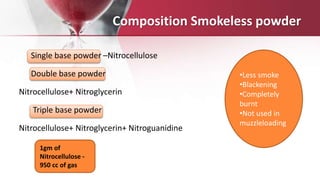
Propellant
• Propellants –material that is burnt to propel ammunition
• Black powder
• Smokeless powder
• Semi smokeless powder
1gm of black
powder
280 cc of gas
What is gunpowder?
• An explosive material-black powder
• Potassium Nitrate(75%)
• Charcoal(15%)
• Sulfur (10%)
Functions
• Charcoal – Fuel
• Sulfur – Binding
Fuel
The temperature of ignition
Speed of combustion
Improves shelf life by-
reducing water absorption
• Potassium nitrate-Oxidizer
Modern Smokeless powder
Lead, barium ,antimony ,copper
,iron ,carbon monoxide ,
Nitrates,nitrites,zinc,nickel
,carbon particles
Composition Smokeless powder
Single base powder –Nitrocellulose
Double base powder
Nitrocellulose+ Nitroglycerin
Triple base powder
Nitrocellulose+ Nitroglycerin+ Nitroguanidine
1gm of
Nitrocellulose -
950 cc of gas
•Less smoke
•Blackening
•Completely
burnt
•Not used in
muzzleloading
Uses for gunpowder
Other features
• Gunpowder takes less than half a
second to ignite.
• Gunpowder is still being used today.
• Gunpowder can reach heats of up to
800 degrees Celsius.
Gun powder residues
• Fire arm discharge residues or cartridge discharge residues
• A mixture of material that originate from
firing a gun and its residues that is deposited
on the hands and clothes of someone who
discharges a firearm .
Distribution of GSR
•Skin of hand-thumb &
index finger
•Lateral 1/3 rd of palm
•Anatomical snuff box
region
Collection techniques
• By adhesives –Tape lifts, glue lifts ,stainless steel studs
• Swabs –Isopropanol as solvent
• Vacuum lifts –clothings
• Nasal collection – 48 hrs
• Hair –fine toothed comb
Dead
•Protect from
action of friction
•Paper bag
Maintenance of the
chain of custody
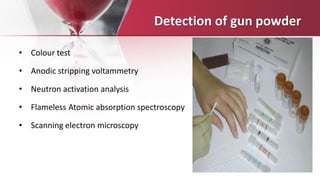
Detection of gun powder
• Colour test
• Anodic stripping voltammetry
• Neutron activation analysis
• Flameless Atomic absorption spectroscopy
• Scanning electron microscopy
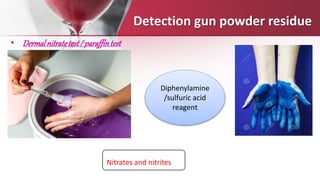
Detection gun powder residue
• Dermalnitratetest/ paraffintest
Nitrates and nitrites
Diphenylamine
/sulfuric acid
reagent
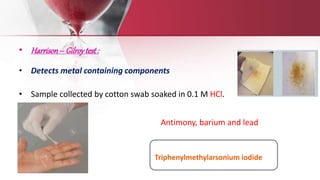
• Harrison– Gilroytest:
• Detects metal containing components
• Sample collected by cotton swab soaked in 0.1 M HCl.
Triphenylmethylarsonium iodide
Antimony, barium and lead
Griess test
• Samples – dissolve in ether
• Add marshall reagent
0.2 %Naphthylenediamine
dihydrochloride
2% sulphanilamide in
5% phosphoric acid
Cloth
Hand
Hair
Face
Anodic strippling volumetery
• First step –cleaning step
• Second step-electroplating step
• Third step- equilibrium step
• Fourth step-stripping step
Hcl –sensitive method
Neutron Activation Analysis
• Subjected to gamma ray spectrometry.
• Detects antimony, barium and copper.
Advantages –highly sensitive & accurate
Multi element analysis
Disadvantages – Nuclear reactor is required
Trained staff,costly
Atomic Absorption Spectroscopy And Flameless
Atomic Absorption Spectroscopy
Electron of atoms can absorb energy and be promoted to a
wavelength
Elements in the samples can be identified by missing wavelength
Atomic absorption spectroscopy
Detects antimony, barium and copper
Advantages & disadvantages
• Easy sample preparation
• Easy to use
• Low detection limits
• Low investment & cost
• Well documented technique
• Detects one element at a time
• Lack of specificity
Elements are not
unique contains
some environmental
Contaminants
SEM-EDX
Detection of these
particles is an indicator
that the suspect fired
the gun .
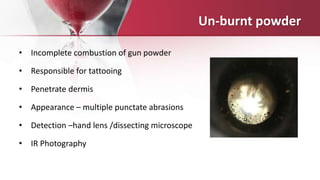
Un-burnt powder
• Incomplete combustion of gun powder
• Responsible for tattooing
• Penetrate dermis
• Appearance – multiple punctate abrasions
• Detection –hand lens /dissecting microscope
• IR Photography
Reference
• Principles of Forensic Medicine & Toxicology Rajesh Bardalae
• Knights Forensic Pathology
• Dr.B.R SHARMA Forensic science in other criminal investigation -5th edition
• Anil Aggrawal textbook of forensic medicine and toxicology.
• Narayan reddy essential of forensic medicine

GUN POWDER

  • 1.
  • 2.
    Overview • Evolution ofgun powder • Function of gun powder • Uses of gun powder • Detection of gun powder • Unburnt gun powder
  • 3.
    Evolution of gunpowder • Gunpowder is the first explosive to have been developed • "Four great inventions“ • It was invented in china during late 9th century • The chinese first used gunpowder in warfare in 904, as "flying fires.“ • Gunpowder was invented by chinese alchemists in the 9th century.
  • 4.
    • The useof gunpowder in warfare during the course of the 19th century diminished due to the invention of smokeless powder. • Black powder was first produced by Roger Bacon in 1250 • Immortality • By the 1700’s the invention had spread around the world. Gunpowder is often referred to today as "black powder" to distinguish it from the propellant used in firearms.
  • 5.
    Propellant • Propellants –materialthat is burnt to propel ammunition • Black powder • Smokeless powder • Semi smokeless powder 1gm of black powder 280 cc of gas
  • 7.
    What is gunpowder? •An explosive material-black powder • Potassium Nitrate(75%) • Charcoal(15%) • Sulfur (10%)
  • 8.
    Functions • Charcoal –Fuel • Sulfur – Binding Fuel The temperature of ignition Speed of combustion Improves shelf life by- reducing water absorption • Potassium nitrate-Oxidizer Modern Smokeless powder Lead, barium ,antimony ,copper ,iron ,carbon monoxide , Nitrates,nitrites,zinc,nickel ,carbon particles
  • 9.
    Composition Smokeless powder Singlebase powder –Nitrocellulose Double base powder Nitrocellulose+ Nitroglycerin Triple base powder Nitrocellulose+ Nitroglycerin+ Nitroguanidine 1gm of Nitrocellulose - 950 cc of gas •Less smoke •Blackening •Completely burnt •Not used in muzzleloading
  • 10.
  • 11.
    Other features • Gunpowdertakes less than half a second to ignite. • Gunpowder is still being used today. • Gunpowder can reach heats of up to 800 degrees Celsius.
  • 12.
    Gun powder residues •Fire arm discharge residues or cartridge discharge residues • A mixture of material that originate from firing a gun and its residues that is deposited on the hands and clothes of someone who discharges a firearm .
  • 14.
    Distribution of GSR •Skinof hand-thumb & index finger •Lateral 1/3 rd of palm •Anatomical snuff box region
  • 17.
    Collection techniques • Byadhesives –Tape lifts, glue lifts ,stainless steel studs • Swabs –Isopropanol as solvent • Vacuum lifts –clothings • Nasal collection – 48 hrs • Hair –fine toothed comb Dead •Protect from action of friction •Paper bag Maintenance of the chain of custody
  • 18.
    Detection of gunpowder • Colour test • Anodic stripping voltammetry • Neutron activation analysis • Flameless Atomic absorption spectroscopy • Scanning electron microscopy
  • 19.
    Detection gun powderresidue • Dermalnitratetest/ paraffintest Nitrates and nitrites Diphenylamine /sulfuric acid reagent
  • 20.
    • Harrison– Gilroytest: •Detects metal containing components • Sample collected by cotton swab soaked in 0.1 M HCl. Triphenylmethylarsonium iodide Antimony, barium and lead
  • 21.
    Griess test • Samples– dissolve in ether • Add marshall reagent 0.2 %Naphthylenediamine dihydrochloride 2% sulphanilamide in 5% phosphoric acid Cloth Hand Hair Face
  • 22.
    Anodic strippling volumetery •First step –cleaning step • Second step-electroplating step • Third step- equilibrium step • Fourth step-stripping step Hcl –sensitive method
  • 23.
    Neutron Activation Analysis •Subjected to gamma ray spectrometry. • Detects antimony, barium and copper. Advantages –highly sensitive & accurate Multi element analysis Disadvantages – Nuclear reactor is required Trained staff,costly
  • 24.
    Atomic Absorption SpectroscopyAnd Flameless Atomic Absorption Spectroscopy Electron of atoms can absorb energy and be promoted to a wavelength Elements in the samples can be identified by missing wavelength Atomic absorption spectroscopy Detects antimony, barium and copper
  • 25.
    Advantages & disadvantages •Easy sample preparation • Easy to use • Low detection limits • Low investment & cost • Well documented technique • Detects one element at a time • Lack of specificity Elements are not unique contains some environmental Contaminants
  • 26.
    SEM-EDX Detection of these particlesis an indicator that the suspect fired the gun .
  • 27.
    Un-burnt powder • Incompletecombustion of gun powder • Responsible for tattooing • Penetrate dermis • Appearance – multiple punctate abrasions • Detection –hand lens /dissecting microscope • IR Photography
  • 28.
    Reference • Principles ofForensic Medicine & Toxicology Rajesh Bardalae • Knights Forensic Pathology • Dr.B.R SHARMA Forensic science in other criminal investigation -5th edition • Anil Aggrawal textbook of forensic medicine and toxicology. • Narayan reddy essential of forensic medicine

Editor's Notes

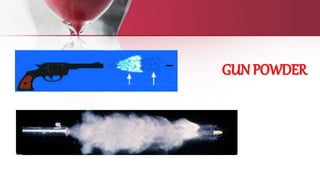
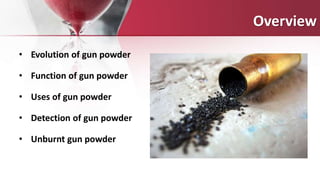
  • #2 Whenever a gun is fired the following emerges from the muzzle of the barrel in a conical shape
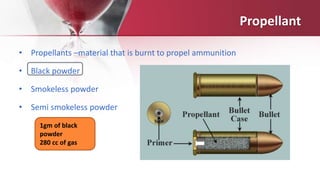
  • #4 Originally, it was made by mixing elemental sulfur, charcoal, and potassium nitrate . compass, gunpowder, papermaking, and printing.
  • #5 Used for immortality.
  • #6 Propellant type vary depending on the type of weapon or bullet.used in the ammunition to acelerate the bullet send it out of the barrel .when discharged the powder burns however some of the powder send it to air and sent around the area.This can help to determine the criminal if traces are left on the culprint .
  • #9 Detectable Inorganic material in modern smokeless powder -produce mostly gases co,co2,n2,o2 .
  • #10 Smokeless powders can cause serious injury if used in muzzleloaders.
  • #11 Used for fireworks.Was used as a propellant in firearms.Used as an explosive for mining.Used as bombs for military purposes.Also used to ignite matches.
  • #13 Escapes from weapon opening in vaporized form & solidified when coming in contact with environment like suspects hand ,cloths,hair etc.
  • #14 Escapes from weapon opening in vaporized form & solidified when coming in contact with environment like suspects hand ,cloths,hair etc.
  • #22 Walker test –clothing .detects No2
  • #23 Electrodes are raised to high potetial .Electrons measured in current
  • #24 Pour the sample in neclear reactor.the elements in the sample absorb neutrons and become radionucleotide so radiocounter is needed.
  • #27 Scanning Electron Microscopy – Energy Dispersion X-ray Analysis.lead ,antimony & barium