ACEEE International Journal on Signal and Image Processing Vol 1, No. 1, Jan 2010


Novel DCT based watermarking scheme for digital
                   images
                                      Neminath Hubballi, Kanyakumari D P,
                         Dept of Computer Science,Indian Institute of Technology Guwahati
                                             neminath@iitg.ernet.in
                            Dept of Information Science,GMIT, Davanagere,karnataka
                                           kanya.dpoojar@gmail.com

                         Abstract                                  •      Key requirement - Different keys should
                                                                         produce different watermarks.
        There is an ever growing interest in copyright              • Reliable detection - It should be possible to
  protection of multimedia content, thus digital                         detect the watermark with high degree of
  watermarking techniques are widely practiced. Due to                   reliability given the key.
  the internet connectivity and digital libraries the               •     Robustness - It should tolerate some of the
  research interest of protecting digital content                        common image processing attacks.
  watermarking is extensively researched. In this paper             In literature watermarking algorithms are classified
  we present a novel watermark generation scheme                 into two categories. a) Fragile: These algorithms are
  based on the histogram of the image and apply it to the        sensitive to changes that are made to the digital signal
  original image in the transform(DCT) domain. Further           and identify where the change has occurred.
  we study the performance of the watermark against              b) Robust: These algorithms ensure that the image
  some common attacks that can take place with images.           processing operations do not erase the embedded
  Experimental results show that the embedded                    watermark signal. Several watermarking approaches
  watermark is imperceptible and image quality is not            appear in literature. Most of these techniques work in
  degraded.                                                      transform domain such as DFT, DWT and DCT
                                                                 although there are many methods which work in
                     I. Introduction                             spatial domain. Many of the algorithms proposed meet
                                                                 the imperceptibility requirement quite easily but
         Internet has given great help to mankind at the         robustness to different image processing attacks is the
  same time brought up serious security issues to the            key challenge and the algorithms in literature
  forefront. This widespread connectivity of computers           addressed only a subset of attacks. Recently a
  across the globe makes it feasible to access the               clustering based technique is applied in[7]. In [5] a
  information from any place. As connectivity increases          method to watermark only face region is proposed. In a
  the risk associated with the security of data or               more similar technique [3] proposes identifying robust
  information also scales up. This development of web            regions in the image segments and watermarking the
  technology makes the transfer of digital content more          most robust segments. There are some visible
  pervasive. To protect the ownership of such digital            watermarking techniques also present in the literature
  content watermarking[8], [1] techniques are used.              which have different requirements as compared to the
  Watermark is an invisible mark(another piece of digital        conventional techniques [6] is such a technique. A
  data) inserted into original digital content and is not        more detailed study on different watermarking
  easy to erase. The security of watermark depends on            techniques can be found in[2].
  the secrete key used for generation and embedding of                  In this paper we propose a novel a DCT
  watermark. In general there is a trade off between the         transform based watermarking scheme which is robust
  embedding strength(the watermark robustness) and               against many common image attacks and experimental
  quality (the watermark invisibility). Increased                results verify this. The paper is organized as follows.
  robustness requires a stronger embedding, which in             Section II discuses the proposed method. The section
  turn increases the visual degradation of the images.           III provides the experimental results and discussion.
  Some of the desired characteristics of watermarking            Finally the last section provides the concluding
  techniques are                                                 remarks.
     • Imperceptibility - It should not be possible to
          find the presence of watermark from bare eyes.

                                                            13
© 2010 ACEEE
DOI: 01.ijsip.01.01.03
ACEEE International Journal on Signal and Image Processing Vol 1, No. 1, Jan 2010


               II. PROPOSED METHOD                                image blocks and the procedure for embedding the
                                                                  watermark is described in the next section.
         The proposed algorithm is a transform domain
  (frequency domain) watermarking scheme and works                B. Watermark embedding
  by modifying the DCT( Discrete Cosine Transform)                         The watermark generated from the original
  coefficients. The watermark is content based i.e                image is embedded in the Discrete Cosine
  generated from the image itself and no external signal          Transform(DCT) domain to the image itself. We
  source is used as watermark. Hence we need a way to             divide the image into blocks of size 8X8 and apply the
  generate the watermark sequence from the image                  DCT on each block which is given by the equation 3,
  which in our case is a binary digit. The step by step           thus transforming a block of time domain coefficients
  procedure for generating the watermark data(signal) is          into of the same size frequency domain coefficients.
  given bellow. It is to be noticed that the binary               The mid frequency coefficients are as identified by the
  sequence generation is done with spatial domain                 bellow matrix are altered according to the equation 4.
  information but the embedding of watermark done in              In literature the mid frequency coefficients are
  transform domain.                                               normally chosen for adding watermark, this is because
                                                                  these coefficients are not altered significantly when the
  A. Watermark generation                                         image is compressed and filtered. Hence we used the
                                                                  same method here.
      The watermark to be embedded into image is                                         N-1 N-1
  generated as follows.                                               C(u,v)= a(u)a(v) ∑ ∑ f (x,y)
                                                                                          X=0 y=0
     • Histogram of the image to be watermarked is
                                                                      cos [ ∏ (2x + 1 )u/ 2N] cos[∏(2y + 1 )u/ 2N] (3)
          generated and the mean of the histogram is
          calculated. Let Hm be the mean of histogram.
     • The gray scale threshold of the image is                          0   0   0   1   1   1      1   0
          calculated using Otsu’s method[4]. Let Gt be                   0   0   1   1   1   1      0   0
          the gray level threshold of the image which is                 0   1   1   1   1   0      0   0
          a number between 0 and 1.                                      1   1   1   1   0   0      0   0
     • Downscale the mean histogram Hm by
                                                                         1   1   1   0   0   0      0   0
          multiplying it with Gt. Let this value be Th.
     • Divide the original image into blocks                             1   1   0   0   0   0      0   0
                                                                         1   0   0   0   0   0      0   0
          Xb = Xb(k, I), 0 ≤ k ≤ N 1 / 8,0 ≤ l < N2 /8 (1)               0   0   0   0   0   0      0   0

       where N1 and N2 are the number of rows and                     Yw (k,l) = X (k,l) +   aX(k,l) W (k,l)           (4)
       columns of image.
      • Calculate the mean of the blocks as                       B. Watermark extraction
                         7 7
          Mb (k,1) = 1/64 ∑ ∑ X(K*8+I,l*8+j)           (2)              To verify the presence of watermark, original
                         i=1 j=1
                                                                  image is required. In the first step the effect of
                                                                  watermarking is undone on the suspicious image. After
      •    Compare Th with Mb(k; l) and generate the              that the watermark pattern is calculated from this
           binary sequence as                                     image using the steps described to generate the
           if Mb(k; l) > Th then                                  watermark pattern. The undoing is defined using the
                  W(k; l) = 0                                     equations 5 and 6.
           else
                   W(k; l) = 1                                        Yc (k,l) = Yw(k,l)if W (k,l)                 (5)
  Thus computed matrix W is a binary pattern of 0’s and
  1’s which is the watermark. It is to be noted that this
  watermark is generated from some operations applied             Else
  on image blocks itself rather than taking from external            Yc (k,l) = 1/(1+a)Yw(k,l)                        (6)
  source, hence the name content based watermark. This
  watermark is embedded into the DCT coefficients of

                                                             14
© 2010 ACEEE
DOI: 01.ijsip.01.01.03
ACEEE International Journal on Signal and Image Processing Vol 1, No. 1, Jan 2010


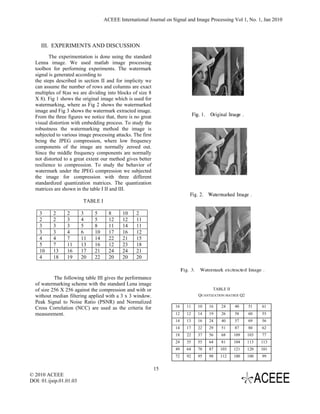
     III. EXPERIMENTS AND DISCUSSION
         The experimentation is done using the standard
  Lenna image. We used matlab image processing
  toolbox for performing experiments. The watermark
  signal is generated according to
  the steps described in section II and for implicity we
  can assume the number of rows and columns are exact
  multiples of 8(as we are dividing into blocks of size 8
  X 8). Fig 1 shows the original image which is used for
  watermarking, where as Fig 2 shows the watermarked
  image and Fig 3 shows the watermark extracted image.
  From the three figures we notice that, there is no great
  visual distortion with embedding process. To study the
  robustness the watermarking method the image is
  subjected to various image processing attacks. The first
  being the JPEG compression, where low frequency
  components of the image are normally zeroed out.
  Since the middle frequency components are normally
  not distorted to a great extent our method gives better
  resilience to compression. To study the behavior of
  watermark under the JPEG compression we subjected
  the image for compression with three different
  standardized quantization matrices. The quantization
  matrices are shown in the table I II and III.

                         TABLE I

    3     2      2       3    5      8      10    2
    2     2      3       4    5      12     12    11
    3     3      3       5    8      11     14    11
    3     3      4       6    10     17     16    12
    4     4      7       11   14     22     21    15
    5     7      11      13   16     12     23    18
    10    13     16      17   21     24     24    21
    4     18     19      20   22     20     20    20


           The following table III gives the performance
  of watermarking scheme with the standard Lena image
  of size 256 X 256 against the compression and with or                             TABLE II
  without median filtering applied with a 3 x 3 window.                      QUANTIZATION MATRIX Q2
  Peak Signal to Noise Ratio (PSNR) and Normalized
  Cross Correlation (NCC) are used as the criteria for             16   11   10   16    24    40      51    61
  measurement.                                                     12   12   14   19    26    58      60    55
                                                                   14   13   16   24    40    57      69    56
                                                                   14   17   22   29    51    87      80    62
                                                                   18   22   37   56    68   109      103   77
                                                                   24   35   55   64    81   104      113   113
                                                                   49   64   78   87   103   121      120   101
                                                                   72   92   95   98   112   100      100   99


                                                             15
© 2010 ACEEE
DOI: 01.ijsip.01.01.03
ACEEE International Journal on Signal and Image Processing Vol 1, No. 1, Jan 2010


                                                                                               REFERENCES
  The following table III shows the effects of blurring
  the image using a Gaussian low pass filter and                           [1] H. Berghel and L. O’Gorman, Protecting ownership
  sharpening with UnSharp Mask filter. An NCC of                           rights through digital watermarking, IEEE Computer
  0.9999 was observed when there is no attack on the                       Magazine (July-1996), 101–103.
                                                                           [2] Edin Muharemagic, Survey of watermarking techniques
  image.                                                                   and applications., Department of computer science and
                                                                           engineering , Florida Atlantic University.
                             TABLE III
                                                                           [3] Athanasios Nikolaids and ioannis Pitas, Region-based
                      QUANTIZATION MATRIX Q3                               image watermarking, IEEE Transactions on Image
                                                                           Processing 10 (November , 2001), 1726–1740.
         52   55      61   66      70      61        64     73
                                                                           [4] N. Otsu, A threshold selection method for gray-level
                                                                           histograms, IEEE Transactions on Systems man and
         63   59      66   90      109     85        69     72             Cybernetics 9 (1979), 62–66.
         62   59      59   113     113    113        66     73             [5] N. Tsapatsoulis P.Tzouveli, K. Ntalianis and S.Kollias,
         63   58      71   122     154    106        70     69             Automatic face region watermarking using qualified
                                                                           significant wavelet trees, Proceedings of 9th International
         67   61      68   104     126     88        68     70
                                                                           Workshop on Systems, Signal and Image Processing,
         79   65      60   70      77      68        58     58             Control Systems Centre Manchester, United Kingdom
         85   71      64   59      55      61        61     83             (November , 2002), 101–103.
                                                                           [6] K. R. Ramakrishnan Saraju P. Mohanty and Mohan S
         87   79      69   68      68      76        76     94
                                                                           Kankanahalli, An adaptive dct domain visible watermarking
                                                                           technique for protection of publicly avalaible images, ICMPS
                                                                           (2000).
                                                                           [7] Wen Xing, A digital watermarking method based on
                            TABLE IV                                       classified labeled bisecting-k-means clustering, Proceedings
                    PERFORMANCE AGAINST QUANTIZATION                       of Second International Conference on Machine Learning
                                                                           and Cybernetics. (November-2003).
   Q Matrix   PSNR         PSNR          NCC              NCC              [8] Wenjun Zeng, Digital watermarking and datahiding:
              without      with          without          with             Technologies and applications, Proceedings of International
              filtering    filtering     filtering        filtering
                                                                           Conference on Information System, Analysis and Synthesis.
                                                                           3 (1999).
  Ql          45.03        32.76         0.7814           0.9654
  Q2          30.79        28.05         0.9788           0.9883
  Q3          46.23        32.56         0.7300           0.9883


                         TABLE V
        PERFORMANCE AGAINST BLURRING AND SHARPENING


       Operation           PSNR                   NCC
       Blurring            31.13                  0.9977
       Sharpening          24.82                  0.9826


                      IV. CONCLUSION

         In this paper we presented a novel DCT based
  approach for watermarking digital still images and
  evaluated the performance of the scheme with some
  possible image processing attacks. Experiments
  revealed a good resilience against such attacks.
  Moreover the authorization procedure is simple and
  fast also allows easy extraction.


                                                                      16
© 2010 ACEEE
DOI: 01.ijsip.01.01.03

Novel DCT based watermarking scheme for digital images

  • 1.
    ACEEE International Journalon Signal and Image Processing Vol 1, No. 1, Jan 2010 Novel DCT based watermarking scheme for digital images Neminath Hubballi, Kanyakumari D P, Dept of Computer Science,Indian Institute of Technology Guwahati neminath@iitg.ernet.in Dept of Information Science,GMIT, Davanagere,karnataka kanya.dpoojar@gmail.com Abstract • Key requirement - Different keys should produce different watermarks. There is an ever growing interest in copyright • Reliable detection - It should be possible to protection of multimedia content, thus digital detect the watermark with high degree of watermarking techniques are widely practiced. Due to reliability given the key. the internet connectivity and digital libraries the • Robustness - It should tolerate some of the research interest of protecting digital content common image processing attacks. watermarking is extensively researched. In this paper In literature watermarking algorithms are classified we present a novel watermark generation scheme into two categories. a) Fragile: These algorithms are based on the histogram of the image and apply it to the sensitive to changes that are made to the digital signal original image in the transform(DCT) domain. Further and identify where the change has occurred. we study the performance of the watermark against b) Robust: These algorithms ensure that the image some common attacks that can take place with images. processing operations do not erase the embedded Experimental results show that the embedded watermark signal. Several watermarking approaches watermark is imperceptible and image quality is not appear in literature. Most of these techniques work in degraded. transform domain such as DFT, DWT and DCT although there are many methods which work in I. Introduction spatial domain. Many of the algorithms proposed meet the imperceptibility requirement quite easily but Internet has given great help to mankind at the robustness to different image processing attacks is the same time brought up serious security issues to the key challenge and the algorithms in literature forefront. This widespread connectivity of computers addressed only a subset of attacks. Recently a across the globe makes it feasible to access the clustering based technique is applied in[7]. In [5] a information from any place. As connectivity increases method to watermark only face region is proposed. In a the risk associated with the security of data or more similar technique [3] proposes identifying robust information also scales up. This development of web regions in the image segments and watermarking the technology makes the transfer of digital content more most robust segments. There are some visible pervasive. To protect the ownership of such digital watermarking techniques also present in the literature content watermarking[8], [1] techniques are used. which have different requirements as compared to the Watermark is an invisible mark(another piece of digital conventional techniques [6] is such a technique. A data) inserted into original digital content and is not more detailed study on different watermarking easy to erase. The security of watermark depends on techniques can be found in[2]. the secrete key used for generation and embedding of In this paper we propose a novel a DCT watermark. In general there is a trade off between the transform based watermarking scheme which is robust embedding strength(the watermark robustness) and against many common image attacks and experimental quality (the watermark invisibility). Increased results verify this. The paper is organized as follows. robustness requires a stronger embedding, which in Section II discuses the proposed method. The section turn increases the visual degradation of the images. III provides the experimental results and discussion. Some of the desired characteristics of watermarking Finally the last section provides the concluding techniques are remarks. • Imperceptibility - It should not be possible to find the presence of watermark from bare eyes. 13 © 2010 ACEEE DOI: 01.ijsip.01.01.03
  • 2.
    ACEEE International Journalon Signal and Image Processing Vol 1, No. 1, Jan 2010 II. PROPOSED METHOD image blocks and the procedure for embedding the watermark is described in the next section. The proposed algorithm is a transform domain (frequency domain) watermarking scheme and works B. Watermark embedding by modifying the DCT( Discrete Cosine Transform) The watermark generated from the original coefficients. The watermark is content based i.e image is embedded in the Discrete Cosine generated from the image itself and no external signal Transform(DCT) domain to the image itself. We source is used as watermark. Hence we need a way to divide the image into blocks of size 8X8 and apply the generate the watermark sequence from the image DCT on each block which is given by the equation 3, which in our case is a binary digit. The step by step thus transforming a block of time domain coefficients procedure for generating the watermark data(signal) is into of the same size frequency domain coefficients. given bellow. It is to be noticed that the binary The mid frequency coefficients are as identified by the sequence generation is done with spatial domain bellow matrix are altered according to the equation 4. information but the embedding of watermark done in In literature the mid frequency coefficients are transform domain. normally chosen for adding watermark, this is because these coefficients are not altered significantly when the A. Watermark generation image is compressed and filtered. Hence we used the same method here. The watermark to be embedded into image is N-1 N-1 generated as follows. C(u,v)= a(u)a(v) ∑ ∑ f (x,y) X=0 y=0 • Histogram of the image to be watermarked is cos [ ∏ (2x + 1 )u/ 2N] cos[∏(2y + 1 )u/ 2N] (3) generated and the mean of the histogram is calculated. Let Hm be the mean of histogram. • The gray scale threshold of the image is 0 0 0 1 1 1 1 0 calculated using Otsu’s method[4]. Let Gt be 0 0 1 1 1 1 0 0 the gray level threshold of the image which is 0 1 1 1 1 0 0 0 a number between 0 and 1. 1 1 1 1 0 0 0 0 • Downscale the mean histogram Hm by 1 1 1 0 0 0 0 0 multiplying it with Gt. Let this value be Th. • Divide the original image into blocks 1 1 0 0 0 0 0 0 1 0 0 0 0 0 0 0 Xb = Xb(k, I), 0 ≤ k ≤ N 1 / 8,0 ≤ l < N2 /8 (1) 0 0 0 0 0 0 0 0 where N1 and N2 are the number of rows and Yw (k,l) = X (k,l) + aX(k,l) W (k,l) (4) columns of image. • Calculate the mean of the blocks as B. Watermark extraction 7 7 Mb (k,1) = 1/64 ∑ ∑ X(K*8+I,l*8+j) (2) To verify the presence of watermark, original i=1 j=1 image is required. In the first step the effect of watermarking is undone on the suspicious image. After • Compare Th with Mb(k; l) and generate the that the watermark pattern is calculated from this binary sequence as image using the steps described to generate the if Mb(k; l) > Th then watermark pattern. The undoing is defined using the W(k; l) = 0 equations 5 and 6. else W(k; l) = 1 Yc (k,l) = Yw(k,l)if W (k,l) (5) Thus computed matrix W is a binary pattern of 0’s and 1’s which is the watermark. It is to be noted that this watermark is generated from some operations applied Else on image blocks itself rather than taking from external Yc (k,l) = 1/(1+a)Yw(k,l) (6) source, hence the name content based watermark. This watermark is embedded into the DCT coefficients of 14 © 2010 ACEEE DOI: 01.ijsip.01.01.03
  • 3.
    ACEEE International Journalon Signal and Image Processing Vol 1, No. 1, Jan 2010 III. EXPERIMENTS AND DISCUSSION The experimentation is done using the standard Lenna image. We used matlab image processing toolbox for performing experiments. The watermark signal is generated according to the steps described in section II and for implicity we can assume the number of rows and columns are exact multiples of 8(as we are dividing into blocks of size 8 X 8). Fig 1 shows the original image which is used for watermarking, where as Fig 2 shows the watermarked image and Fig 3 shows the watermark extracted image. From the three figures we notice that, there is no great visual distortion with embedding process. To study the robustness the watermarking method the image is subjected to various image processing attacks. The first being the JPEG compression, where low frequency components of the image are normally zeroed out. Since the middle frequency components are normally not distorted to a great extent our method gives better resilience to compression. To study the behavior of watermark under the JPEG compression we subjected the image for compression with three different standardized quantization matrices. The quantization matrices are shown in the table I II and III. TABLE I 3 2 2 3 5 8 10 2 2 2 3 4 5 12 12 11 3 3 3 5 8 11 14 11 3 3 4 6 10 17 16 12 4 4 7 11 14 22 21 15 5 7 11 13 16 12 23 18 10 13 16 17 21 24 24 21 4 18 19 20 22 20 20 20 The following table III gives the performance of watermarking scheme with the standard Lena image of size 256 X 256 against the compression and with or TABLE II without median filtering applied with a 3 x 3 window. QUANTIZATION MATRIX Q2 Peak Signal to Noise Ratio (PSNR) and Normalized Cross Correlation (NCC) are used as the criteria for 16 11 10 16 24 40 51 61 measurement. 12 12 14 19 26 58 60 55 14 13 16 24 40 57 69 56 14 17 22 29 51 87 80 62 18 22 37 56 68 109 103 77 24 35 55 64 81 104 113 113 49 64 78 87 103 121 120 101 72 92 95 98 112 100 100 99 15 © 2010 ACEEE DOI: 01.ijsip.01.01.03
  • 4.
    ACEEE International Journalon Signal and Image Processing Vol 1, No. 1, Jan 2010 REFERENCES The following table III shows the effects of blurring the image using a Gaussian low pass filter and [1] H. Berghel and L. O’Gorman, Protecting ownership sharpening with UnSharp Mask filter. An NCC of rights through digital watermarking, IEEE Computer 0.9999 was observed when there is no attack on the Magazine (July-1996), 101–103. [2] Edin Muharemagic, Survey of watermarking techniques image. and applications., Department of computer science and engineering , Florida Atlantic University. TABLE III [3] Athanasios Nikolaids and ioannis Pitas, Region-based QUANTIZATION MATRIX Q3 image watermarking, IEEE Transactions on Image Processing 10 (November , 2001), 1726–1740. 52 55 61 66 70 61 64 73 [4] N. Otsu, A threshold selection method for gray-level histograms, IEEE Transactions on Systems man and 63 59 66 90 109 85 69 72 Cybernetics 9 (1979), 62–66. 62 59 59 113 113 113 66 73 [5] N. Tsapatsoulis P.Tzouveli, K. Ntalianis and S.Kollias, 63 58 71 122 154 106 70 69 Automatic face region watermarking using qualified significant wavelet trees, Proceedings of 9th International 67 61 68 104 126 88 68 70 Workshop on Systems, Signal and Image Processing, 79 65 60 70 77 68 58 58 Control Systems Centre Manchester, United Kingdom 85 71 64 59 55 61 61 83 (November , 2002), 101–103. [6] K. R. Ramakrishnan Saraju P. Mohanty and Mohan S 87 79 69 68 68 76 76 94 Kankanahalli, An adaptive dct domain visible watermarking technique for protection of publicly avalaible images, ICMPS (2000). [7] Wen Xing, A digital watermarking method based on TABLE IV classified labeled bisecting-k-means clustering, Proceedings PERFORMANCE AGAINST QUANTIZATION of Second International Conference on Machine Learning and Cybernetics. (November-2003). Q Matrix PSNR PSNR NCC NCC [8] Wenjun Zeng, Digital watermarking and datahiding: without with without with Technologies and applications, Proceedings of International filtering filtering filtering filtering Conference on Information System, Analysis and Synthesis. 3 (1999). Ql 45.03 32.76 0.7814 0.9654 Q2 30.79 28.05 0.9788 0.9883 Q3 46.23 32.56 0.7300 0.9883 TABLE V PERFORMANCE AGAINST BLURRING AND SHARPENING Operation PSNR NCC Blurring 31.13 0.9977 Sharpening 24.82 0.9826 IV. CONCLUSION In this paper we presented a novel DCT based approach for watermarking digital still images and evaluated the performance of the scheme with some possible image processing attacks. Experiments revealed a good resilience against such attacks. Moreover the authorization procedure is simple and fast also allows easy extraction. 16 © 2010 ACEEE DOI: 01.ijsip.01.01.03