Intro
Chapter 3:
Sensation and
Perception
The Major Senses
• There are 6 major senses.
– vision
– hearing
– touch
– taste
– pain
– smell
• The list can be extended with balance, joint
senses, and others.
• Vision has been studied most extensively.
Principles of Sensation
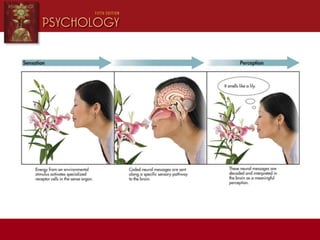
• Transduction—physical energy to neural signal
• Absolute threshold—smallest strength of a stimulus
that can be detected
• Difference threshold—(just noticeable difference)
smallest difference that can be detected
• Weber’s law—for each sense the size of a just
noticeable difference is a constant proportion of the
size of the initial stimulus
• Sensory adaptation—the decline in sensitivity to
constant stimulus
Vision
Purpose of the Visual System
–transform light energy into an
electrochemical neural response
–represent characteristics of objects
in our environment such as size,
color, shape, and location
Vision Key Terms
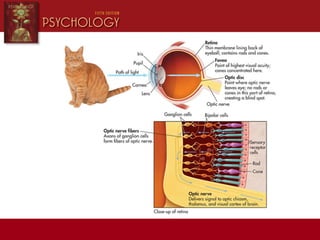
• Cornea—clear membrane that covers the
front of the eye, helps gather and direct
incoming light
• Pupil—the opening in the middle of the iris
that changes size to let in different
amounts of light
• Iris—the colored part of the eye; the
muscle that controls the size of the pupil
Vision Key Terms
• Lens—a transparent structure behind the
pupil; bends light as it enters the eye
• Retina—a thin, light-sensitive membrane
located at the back of the eye that contains
sensory receptors for vision
• Accommodation—the process by which the
lens changes shape to focus incoming light
so that it falls on the retina
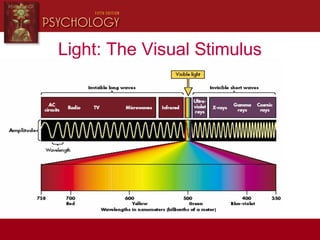
Light: The Visual Stimulus
• Light can be described as both a particle
and a wave
• The wavelength of a light is the distance of
one complete cycle of the wave
• Visible light has wavelengths from ~400nm
to 700nm
• The wavelength of light is related to its
perceived color
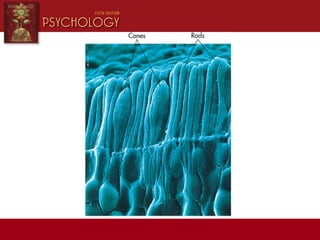
Distribution of Rods and Cones
• Cones—concentrated in center
of eye (fovea)
–~6 million
• Rods—concentrated in periphery
–~120 million
• Blind spot—region with no rods
or cones
Differences Between
Rods and Cones
• Cones
– allow us to see in bright light
– allow us to see fine spatial detail
– allow us to see different colors
• Rods
– allow us to see in dim light
– can not see fine spatial detail
– can not see different colors
Rod Vs Cone Visual Acuity
• Cones—one cone often synapses onto
only a single ganglion cell
• Rods—the axons of many rods synapse
onto one ganglion cell
• This allows rods to be more sensitive
in dim light, but it also reduces visual
acuity
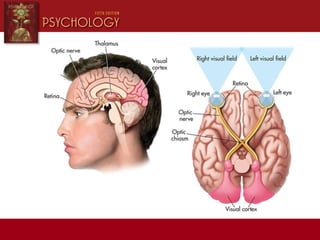
Processing Visual Information
• Ganglion cells—neurons that connect to the
bipolar cells; their axons form the optic nerve
• Bipolar cells—neurons that connect rods and
cones to the ganglion cells
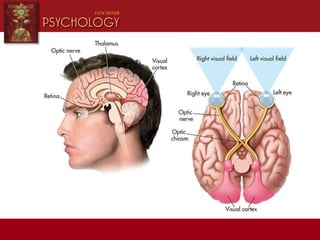
• Optic chiasm—point in the brain where the
optic nerves from each eye meet and partly
crossover to opposite sides of the brain
Color Vision
• Our visual system interprets differences
in the wavelength of light as color
• Rods are color blind, but the cones
allow us to see different colors
• This difference occurs because we
have only one type of rod but three
types of cones
Properties of Color
• Hue—property of wavelengths of light
known as color; different wavelengths
correspond to our subjective experience of
color (hue)
• Saturation—property of color that
corresponds to the purity of the light wave
• Brightness—perceived intensity of a color,
corresponds to amplitude of the light wave
Color Mixing
• Two basic types of color mixing
–subtractive color mixture
• example: combining different color
paints
–additive color mixture
• example: combining different color
lights
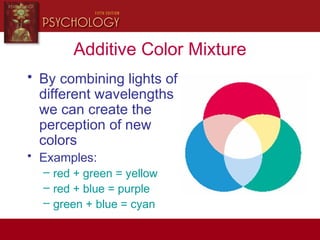
Additive Color Mixture
• By combining lights of
different wavelengths
we can create the
perception of new
colors
• Examples:
– red + green = yellow
– red + blue = purple
– green + blue = cyan
Trichromatic Theory of
Color Vision
• Researchers found that by mixing only
three primary lights (usually red, green,
and blue), they could create the perceptual
experience of all possible colors
• This lead Young and Helmholtz to propose
that we have three different types of
photoreceptors, each most sensitive to a
different range of wavelengths
Trichromacy and TV
• All color televisions are based on the fact that
normal human color vision is trichromatic
• Although we perceive the whole range of colors
from a TV screen, it only has three colored
phosphors (red, green, and blue)
• By varying the relative intensity of the three
phosphors, we can fool the visual system into
thinking it is seeing many different colors
Opponent Process Theory
of Color Vision
• Some aspects of our color
perception are difficult to explain
by the trichromatic theory alone
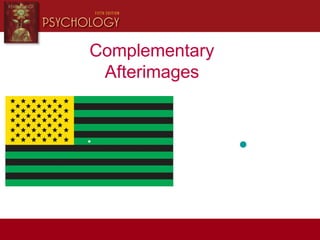
• Example: afterimages
– if we view colored stimuli for an extended
period, we will see an afterimage in a
complementary color
Complementary
Afterimages
Opponent-Process Theory
• To account for phenomena like
complementary afterimages, Herring
proposed that we have two types of
color opponent cells
– red-green opponent cells
– blue-yellow opponent cells
• Our current view of color vision is that
it is based on both the trichromatic and
opponent-process theory
Overview of Visual System
• The eye is like a camera, but instead of using
film to catch the light we have rods and cones
• Cones allow us to see fine spatial detail and
color, but cannot function well in dim light
• Rods enable us to see in dim light, but at the
loss of color and fine spatial detail
• Our color vision is based on the presence of
3 types of cones, each maximally sensitive
to a different range of wavelengths
Hearing: Sound Waves
• Auditory perception occurs when sound
waves interact with the structures of the ear
• Sound wave—changes over time in the
pressure of an elastic medium (for example,
air or water)
• Without air (or another elastic medium) there
can be no sound waves, and thus no sound
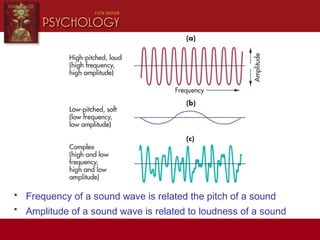
• Frequency of a sound wave is related the pitch of a sound
• Amplitude of a sound wave is related to loudness of a sound
Frequency of Sound Waves
• The frequency of a sound wave is
measured as the number of cycles
per second (Hertz)
– 20,000 Hz Highest frequency we can hear
– 4,186 Hz Highest note on a piano
– 1,000 Hz Highest pitch of human voice
– 100 Hz Lowest pitch of human voice
– 27 Hz Lowest note on a piano
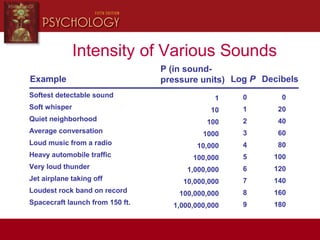
Intensity of Various Sounds
Example
P (in sound-
pressure units) Log P Decibels
Softest detectable sound
Soft whisper
Quiet neighborhood
Average conversation
Loud music from a radio
Heavy automobile traffic
Very loud thunder
Jet airplane taking off
Loudest rock band on record
Spacecraft launch from 150 ft.
1
10
100
1000
10,000
100,000
1,000,000
10,000,000
100,000,000
1,000,000,000
0
1
2
3
4
5
6
7
8
9
0
20
40
60
80
100
120
140
160
180
Anatomy of Ear
Purpose of the structures in the ear:
–Measure the frequency (pitch) of
sound waves
–Measure the amplitude (loudness)
of sound waves
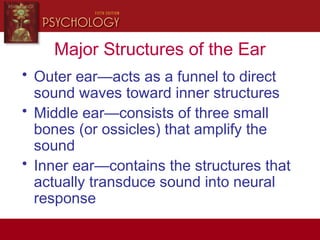
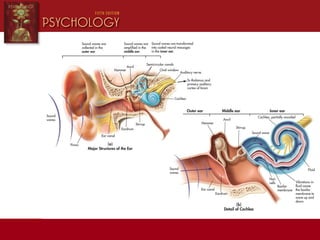
Major Structures of the Ear
• Outer ear—acts as a funnel to direct
sound waves toward inner structures
• Middle ear—consists of three small
bones (or ossicles) that amplify the
sound
• Inner ear—contains the structures that
actually transduce sound into neural
response
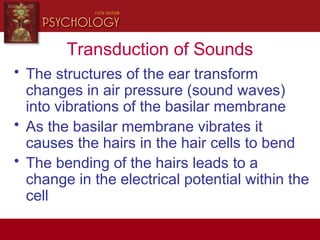
Transduction of Sounds
• The structures of the ear transform
changes in air pressure (sound waves)
into vibrations of the basilar membrane
• As the basilar membrane vibrates it
causes the hairs in the hair cells to bend
• The bending of the hairs leads to a
change in the electrical potential within the
cell
Distinguishing Pitch
• Frequency theory—basilar membrane
vibrates at the same frequency as the
sound wave
• Place theory—different frequencies
cause larger vibrations at different
locations along the basilar membrane
Coding and Auditory Masking
• The way in which waves travel
down the basilar membrane
causes some sounds to interfere
with (or mask) our ability to hear
other sounds
• Low-frequency sounds provide
better masking than high-
frequency sounds
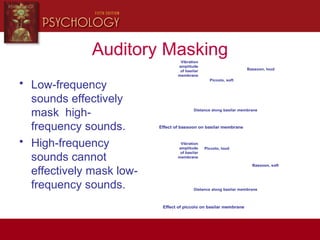
Auditory Masking
• Low-frequency
sounds effectively
mask high-
frequency sounds.
• High-frequency
sounds cannot
effectively mask low-
frequency sounds.
Piccolo, soft
Bassoon, loud
Piccolo, loud
Bassoon, soft
Distance along basilar membrane
Effect of bassoon on basilar membrane
Vibration
amplitude
of basilar
membrane
Vibration
amplitude
of basilar
membrane
Effect of piccolo on basilar membrane
Piccolo, soft
Bassoon, loud
Piccolo, loud
Bassoon, soft
Piccolo, loud
Bassoon, soft
Distance along basilar membrane
Effect of bassoon on basilar membrane
Vibration
amplitude
of basilar
membrane
Vibration
amplitude
of basilar
membrane
Effect of piccolo on basilar membrane
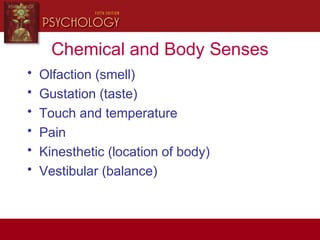
Chemical and Body Senses
• Olfaction (smell)
• Gustation (taste)
• Touch and temperature
• Pain
• Kinesthetic (location of body)
• Vestibular (balance)
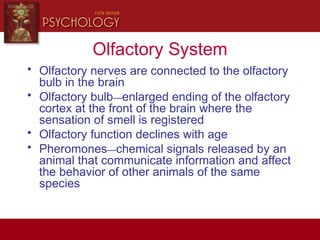
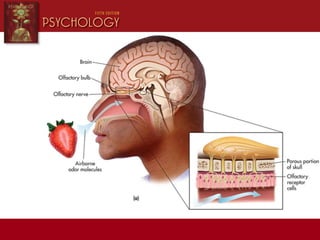
Olfactory System
• Olfactory nerves are connected to the olfactory
bulb in the brain
• Olfactory bulb—enlarged ending of the olfactory
cortex at the front of the brain where the
sensation of smell is registered
• Olfactory function declines with age
• Pheromones—chemical signals released by an
animal that communicate information and affect
the behavior of other animals of the same
species
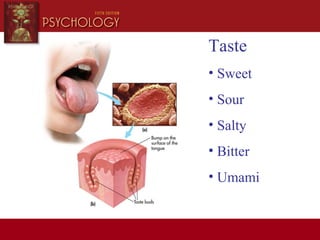
Taste
• Sweet
• Sour
• Salty
• Bitter
• Umami
Skin and Body Senses
• Pressure—Pacinian corpuscles
• Itch—response to histamine
• Temperature—receptors reactive to
cold or warm, simultaneous
stimulation produces sensation of hot
• Pain—free nerve endings are
receptors
Elements of Pain
• Gate-control theory of pain—pain is a
product of both physiological and
psychological factors that cause spinal
gates to open and relay patterns of intense
stimulation to the brain; the brain
perceives them as pain
• Phantom limb pain—when a person
continues to experience intense painful
sensations in a limb that has been
amputated
Movement, Position, and Balance
• Kinesthetic—sense of location of
body parts in relation to one another
• Vestibular—sense of balance,
receptors located in the inner ear
• Proprioceptors—receptors in muscles
and joints that provide information
about body position and movement
Perception
The process of integrating,
organizing, and interpreting
sensory information
Perceptual Processing
• Bottom-up processing—emphasizes the
importance of sensory receptors in
detecting the basic features of a stimulus;
moves from part to whole; also called data-
driven processing
• Top-down processing—emphasizes
importance of observer’s cognitive
processes in arriving at meaningful
perceptions; moves from whole to part;
also called conceptually driven processing
Perceptual Organization
• Some of the best examples of
perceptual organization were provided
by the Gestalt psychologists
• Gestalt psychologists hypothesized that
“the whole is greater than the sum of
the parts”
• They were interested in showing the
global nature of our perceptions
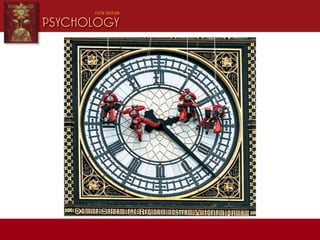
Gestalt Grouping Principles
Gestalt theorists argued that our perceptual
systems automatically organized sensory
input based on certain rules
• Proximity
• Similarity
• Closure
• Good continuation
• Common movement
• Good form
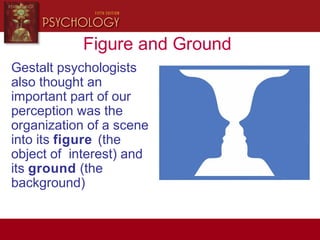
Figure and Ground
Gestalt psychologists
also thought an
important part of our
perception was the
organization of a scene
into its figure (the
object of interest) and
its ground (the
background)
Depth Perception
• One of our more important perceptual
abilities involves seeing in three
dimensions
• Depth perception is difficult because we
only have access to two-dimensional
images
• How do we see a 3-D world using only
the 2-D retinal images?
Depth Perception Cues
• Cue—stimulus characteristics
that influence our perceptions
• We are able to see in 3-D
because the visual system can
use depth cues that appear in
the retinal images
Types of Depth Cues
Depth cues are usually divided into
categories; we will consider two types
of depth cues
•Monocular—depth cues that appear in
the image in either the left or right eye
•Binocular—depth cues that involve
comparing the left and right eye images
Monocular Depth Cues
• Relative image size
• Overlap
• Aerial perspective
• Texture gradient
• Linear perspective
• Motion parallax
Binocular Depth Cues
• Monocular depth cues allow us to see in
3-D with the view of only one eye, but our
best depth perception occurs if we look
through both eyes
• This is because our right and left eyes see
a slightly different view of the world
• The difference between the image in the
two eyes is know as binocular disparity
Stereogram
• Another way to create the illusion of
depth through binocular stereopsis
is with an stereogram
• An stereogram is formed by
repeating columns of patterns
Stereogram
Perceptual Constancy
• When viewing conditions change, the
retinal image changes even if the objects
being viewed remain constant
Example: As a person walks away from you
their retinal image decreases in size
• Important function of the perceptual
system is to represent constancy in our
environment even when the retinal image
varies
Size Constancy
• The cylinders at
positions A and B are
the same size even
though their image
sizes differ
• The depth cues such
as linear perspective
and texture help the
visual system judge the
size accurately Point A
Point B
Point A
Point B
Shape Constancy
• It is hard to tell if the
figure on the upper
right is a trapezoid or
a square slanted
backward.
• If we add texture, the
texture gradient helps
us see that it is
actually a square
Perceptual Set
The influence of prior assumptions and
expectations on perceptual interpretations
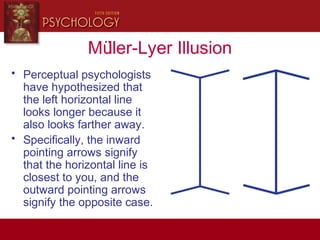
Müller-Lyer Illusion
• Perceptual psychologists
have hypothesized that
the left horizontal line
looks longer because it
also looks farther away.
• Specifically, the inward
pointing arrows signify
that the horizontal line is
closest to you, and the
outward pointing arrows
signify the opposite case.
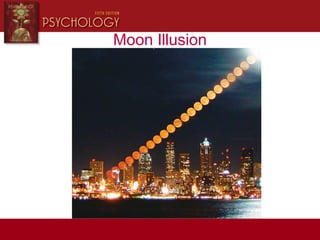
Moon Illusion

PSYC 1113 Chapter 3

  • 1.
  • 2.
    The Major Senses •There are 6 major senses. – vision – hearing – touch – taste – pain – smell • The list can be extended with balance, joint senses, and others. • Vision has been studied most extensively.
  • 4.
    Principles of Sensation •Transduction—physical energy to neural signal • Absolute threshold—smallest strength of a stimulus that can be detected • Difference threshold—(just noticeable difference) smallest difference that can be detected • Weber’s law—for each sense the size of a just noticeable difference is a constant proportion of the size of the initial stimulus • Sensory adaptation—the decline in sensitivity to constant stimulus
  • 5.
    Vision Purpose of theVisual System –transform light energy into an electrochemical neural response –represent characteristics of objects in our environment such as size, color, shape, and location
  • 6.
    Vision Key Terms •Cornea—clear membrane that covers the front of the eye, helps gather and direct incoming light • Pupil—the opening in the middle of the iris that changes size to let in different amounts of light • Iris—the colored part of the eye; the muscle that controls the size of the pupil
  • 7.
    Vision Key Terms •Lens—a transparent structure behind the pupil; bends light as it enters the eye • Retina—a thin, light-sensitive membrane located at the back of the eye that contains sensory receptors for vision • Accommodation—the process by which the lens changes shape to focus incoming light so that it falls on the retina
  • 8.
  • 9.
    Light: The VisualStimulus • Light can be described as both a particle and a wave • The wavelength of a light is the distance of one complete cycle of the wave • Visible light has wavelengths from ~400nm to 700nm • The wavelength of light is related to its perceived color
  • 12.
    Distribution of Rodsand Cones • Cones—concentrated in center of eye (fovea) –~6 million • Rods—concentrated in periphery –~120 million • Blind spot—region with no rods or cones
  • 13.
    Differences Between Rods andCones • Cones – allow us to see in bright light – allow us to see fine spatial detail – allow us to see different colors • Rods – allow us to see in dim light – can not see fine spatial detail – can not see different colors
  • 14.
    Rod Vs ConeVisual Acuity • Cones—one cone often synapses onto only a single ganglion cell • Rods—the axons of many rods synapse onto one ganglion cell • This allows rods to be more sensitive in dim light, but it also reduces visual acuity
  • 16.
    Processing Visual Information •Ganglion cells—neurons that connect to the bipolar cells; their axons form the optic nerve • Bipolar cells—neurons that connect rods and cones to the ganglion cells • Optic chiasm—point in the brain where the optic nerves from each eye meet and partly crossover to opposite sides of the brain
  • 18.
    Color Vision • Ourvisual system interprets differences in the wavelength of light as color • Rods are color blind, but the cones allow us to see different colors • This difference occurs because we have only one type of rod but three types of cones
  • 19.
    Properties of Color •Hue—property of wavelengths of light known as color; different wavelengths correspond to our subjective experience of color (hue) • Saturation—property of color that corresponds to the purity of the light wave • Brightness—perceived intensity of a color, corresponds to amplitude of the light wave
  • 20.
    Color Mixing • Twobasic types of color mixing –subtractive color mixture • example: combining different color paints –additive color mixture • example: combining different color lights
  • 21.
    Additive Color Mixture •By combining lights of different wavelengths we can create the perception of new colors • Examples: – red + green = yellow – red + blue = purple – green + blue = cyan
  • 22.
    Trichromatic Theory of ColorVision • Researchers found that by mixing only three primary lights (usually red, green, and blue), they could create the perceptual experience of all possible colors • This lead Young and Helmholtz to propose that we have three different types of photoreceptors, each most sensitive to a different range of wavelengths
  • 23.
    Trichromacy and TV •All color televisions are based on the fact that normal human color vision is trichromatic • Although we perceive the whole range of colors from a TV screen, it only has three colored phosphors (red, green, and blue) • By varying the relative intensity of the three phosphors, we can fool the visual system into thinking it is seeing many different colors
  • 24.
    Opponent Process Theory ofColor Vision • Some aspects of our color perception are difficult to explain by the trichromatic theory alone • Example: afterimages – if we view colored stimuli for an extended period, we will see an afterimage in a complementary color
  • 25.
  • 26.
    Opponent-Process Theory • Toaccount for phenomena like complementary afterimages, Herring proposed that we have two types of color opponent cells – red-green opponent cells – blue-yellow opponent cells • Our current view of color vision is that it is based on both the trichromatic and opponent-process theory
  • 27.
    Overview of VisualSystem • The eye is like a camera, but instead of using film to catch the light we have rods and cones • Cones allow us to see fine spatial detail and color, but cannot function well in dim light • Rods enable us to see in dim light, but at the loss of color and fine spatial detail • Our color vision is based on the presence of 3 types of cones, each maximally sensitive to a different range of wavelengths
  • 30.
    Hearing: Sound Waves •Auditory perception occurs when sound waves interact with the structures of the ear • Sound wave—changes over time in the pressure of an elastic medium (for example, air or water) • Without air (or another elastic medium) there can be no sound waves, and thus no sound
  • 31.
    • Frequency ofa sound wave is related the pitch of a sound • Amplitude of a sound wave is related to loudness of a sound
  • 32.
    Frequency of SoundWaves • The frequency of a sound wave is measured as the number of cycles per second (Hertz) – 20,000 Hz Highest frequency we can hear – 4,186 Hz Highest note on a piano – 1,000 Hz Highest pitch of human voice – 100 Hz Lowest pitch of human voice – 27 Hz Lowest note on a piano
  • 33.
    Intensity of VariousSounds Example P (in sound- pressure units) Log P Decibels Softest detectable sound Soft whisper Quiet neighborhood Average conversation Loud music from a radio Heavy automobile traffic Very loud thunder Jet airplane taking off Loudest rock band on record Spacecraft launch from 150 ft. 1 10 100 1000 10,000 100,000 1,000,000 10,000,000 100,000,000 1,000,000,000 0 1 2 3 4 5 6 7 8 9 0 20 40 60 80 100 120 140 160 180
  • 34.
    Anatomy of Ear Purposeof the structures in the ear: –Measure the frequency (pitch) of sound waves –Measure the amplitude (loudness) of sound waves
  • 35.
    Major Structures ofthe Ear • Outer ear—acts as a funnel to direct sound waves toward inner structures • Middle ear—consists of three small bones (or ossicles) that amplify the sound • Inner ear—contains the structures that actually transduce sound into neural response
  • 37.
    Transduction of Sounds •The structures of the ear transform changes in air pressure (sound waves) into vibrations of the basilar membrane • As the basilar membrane vibrates it causes the hairs in the hair cells to bend • The bending of the hairs leads to a change in the electrical potential within the cell
  • 38.
    Distinguishing Pitch • Frequencytheory—basilar membrane vibrates at the same frequency as the sound wave • Place theory—different frequencies cause larger vibrations at different locations along the basilar membrane
  • 39.
    Coding and AuditoryMasking • The way in which waves travel down the basilar membrane causes some sounds to interfere with (or mask) our ability to hear other sounds • Low-frequency sounds provide better masking than high- frequency sounds
  • 40.
    Auditory Masking • Low-frequency soundseffectively mask high- frequency sounds. • High-frequency sounds cannot effectively mask low- frequency sounds. Piccolo, soft Bassoon, loud Piccolo, loud Bassoon, soft Distance along basilar membrane Distance along basilar membrane Effect of bassoon on basilar membrane Vibration amplitude of basilar membrane Vibration amplitude of basilar membrane Effect of piccolo on basilar membrane Piccolo, soft Bassoon, loud Piccolo, loud Bassoon, soft Piccolo, loud Bassoon, soft Distance along basilar membrane Distance along basilar membrane Effect of bassoon on basilar membrane Vibration amplitude of basilar membrane Vibration amplitude of basilar membrane Effect of piccolo on basilar membrane
  • 41.
    Chemical and BodySenses • Olfaction (smell) • Gustation (taste) • Touch and temperature • Pain • Kinesthetic (location of body) • Vestibular (balance)
  • 42.
    Olfactory System • Olfactorynerves are connected to the olfactory bulb in the brain • Olfactory bulb—enlarged ending of the olfactory cortex at the front of the brain where the sensation of smell is registered • Olfactory function declines with age • Pheromones—chemical signals released by an animal that communicate information and affect the behavior of other animals of the same species
  • 44.
    Taste • Sweet • Sour •Salty • Bitter • Umami
  • 45.
    Skin and BodySenses • Pressure—Pacinian corpuscles • Itch—response to histamine • Temperature—receptors reactive to cold or warm, simultaneous stimulation produces sensation of hot • Pain—free nerve endings are receptors
  • 46.
    Elements of Pain •Gate-control theory of pain—pain is a product of both physiological and psychological factors that cause spinal gates to open and relay patterns of intense stimulation to the brain; the brain perceives them as pain • Phantom limb pain—when a person continues to experience intense painful sensations in a limb that has been amputated
  • 47.
    Movement, Position, andBalance • Kinesthetic—sense of location of body parts in relation to one another • Vestibular—sense of balance, receptors located in the inner ear • Proprioceptors—receptors in muscles and joints that provide information about body position and movement
  • 48.
    Perception The process ofintegrating, organizing, and interpreting sensory information
  • 49.
    Perceptual Processing • Bottom-upprocessing—emphasizes the importance of sensory receptors in detecting the basic features of a stimulus; moves from part to whole; also called data- driven processing • Top-down processing—emphasizes importance of observer’s cognitive processes in arriving at meaningful perceptions; moves from whole to part; also called conceptually driven processing
  • 50.
    Perceptual Organization • Someof the best examples of perceptual organization were provided by the Gestalt psychologists • Gestalt psychologists hypothesized that “the whole is greater than the sum of the parts” • They were interested in showing the global nature of our perceptions
  • 51.
    Gestalt Grouping Principles Gestalttheorists argued that our perceptual systems automatically organized sensory input based on certain rules • Proximity • Similarity • Closure • Good continuation • Common movement • Good form
  • 56.
    Figure and Ground Gestaltpsychologists also thought an important part of our perception was the organization of a scene into its figure (the object of interest) and its ground (the background)
  • 57.
    Depth Perception • Oneof our more important perceptual abilities involves seeing in three dimensions • Depth perception is difficult because we only have access to two-dimensional images • How do we see a 3-D world using only the 2-D retinal images?
  • 58.
    Depth Perception Cues •Cue—stimulus characteristics that influence our perceptions • We are able to see in 3-D because the visual system can use depth cues that appear in the retinal images
  • 59.
    Types of DepthCues Depth cues are usually divided into categories; we will consider two types of depth cues •Monocular—depth cues that appear in the image in either the left or right eye •Binocular—depth cues that involve comparing the left and right eye images
  • 60.
    Monocular Depth Cues •Relative image size • Overlap • Aerial perspective • Texture gradient • Linear perspective • Motion parallax
  • 62.
    Binocular Depth Cues •Monocular depth cues allow us to see in 3-D with the view of only one eye, but our best depth perception occurs if we look through both eyes • This is because our right and left eyes see a slightly different view of the world • The difference between the image in the two eyes is know as binocular disparity
  • 63.
    Stereogram • Another wayto create the illusion of depth through binocular stereopsis is with an stereogram • An stereogram is formed by repeating columns of patterns
  • 64.
  • 65.
    Perceptual Constancy • Whenviewing conditions change, the retinal image changes even if the objects being viewed remain constant Example: As a person walks away from you their retinal image decreases in size • Important function of the perceptual system is to represent constancy in our environment even when the retinal image varies
  • 66.
    Size Constancy • Thecylinders at positions A and B are the same size even though their image sizes differ • The depth cues such as linear perspective and texture help the visual system judge the size accurately Point A Point B Point A Point B
  • 67.
    Shape Constancy • Itis hard to tell if the figure on the upper right is a trapezoid or a square slanted backward. • If we add texture, the texture gradient helps us see that it is actually a square
  • 68.
    Perceptual Set The influenceof prior assumptions and expectations on perceptual interpretations
  • 69.
    Müller-Lyer Illusion • Perceptualpsychologists have hypothesized that the left horizontal line looks longer because it also looks farther away. • Specifically, the inward pointing arrows signify that the horizontal line is closest to you, and the outward pointing arrows signify the opposite case.
  • 70.