
AUDIO BASICS:
PROPAGATION,
AMPLITUDE,
FREQUENCY, AND
TIMBRE
Luth Oliveira, Salvador, BA, Brazil
Introduction
Hi, I'm Luth Oliveira from Salvador, Bahia,
Brazil, and this lesson is for week 1 of
Introduction To Music Production at
Coursera.org. I will be teaching the audio
basics: Propagation, Amplitude, Frequency,
and Timbre.
Basic properties of Sound
As important as start producing, learning some
basic properties of sound let us aware of what
we are really matipulating. These properties are
known as: Propagation, Amplitude, Frequency
and Timbre.
Propagation
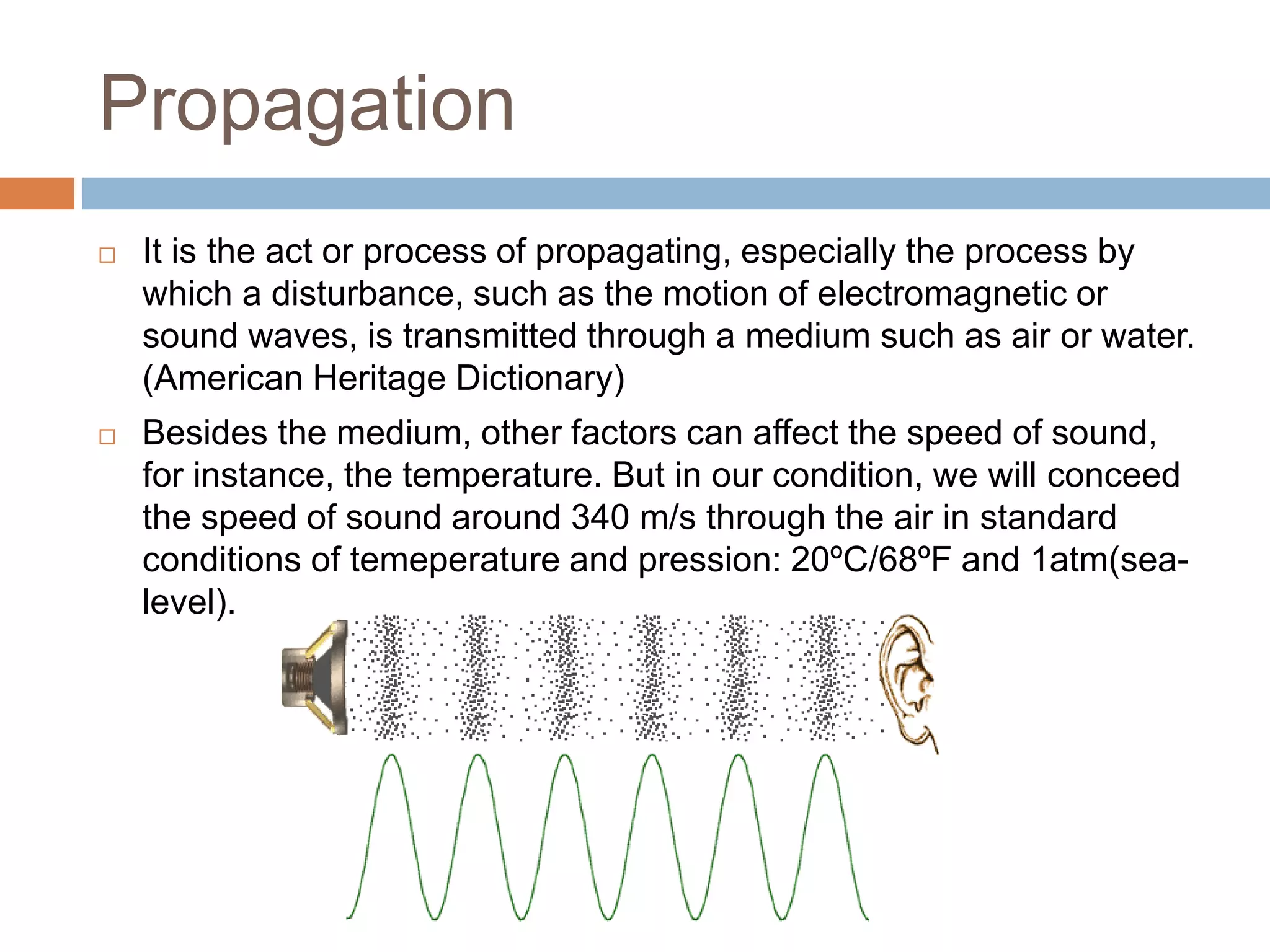
 It is the act or process of propagating, especially the process by
which a disturbance, such as the motion of electromagnetic or
sound waves, is transmitted through a medium such as air or water.
(American Heritage Dictionary)
 Besides the medium, other factors can affect the speed of sound,
for instance, the temperature. But in our condition, we will conceed
the speed of sound around 340 m/s through the air in standard
conditions of temeperature and pression: 20ºC/68ºF and 1atm(sea-
level).
Amplitude
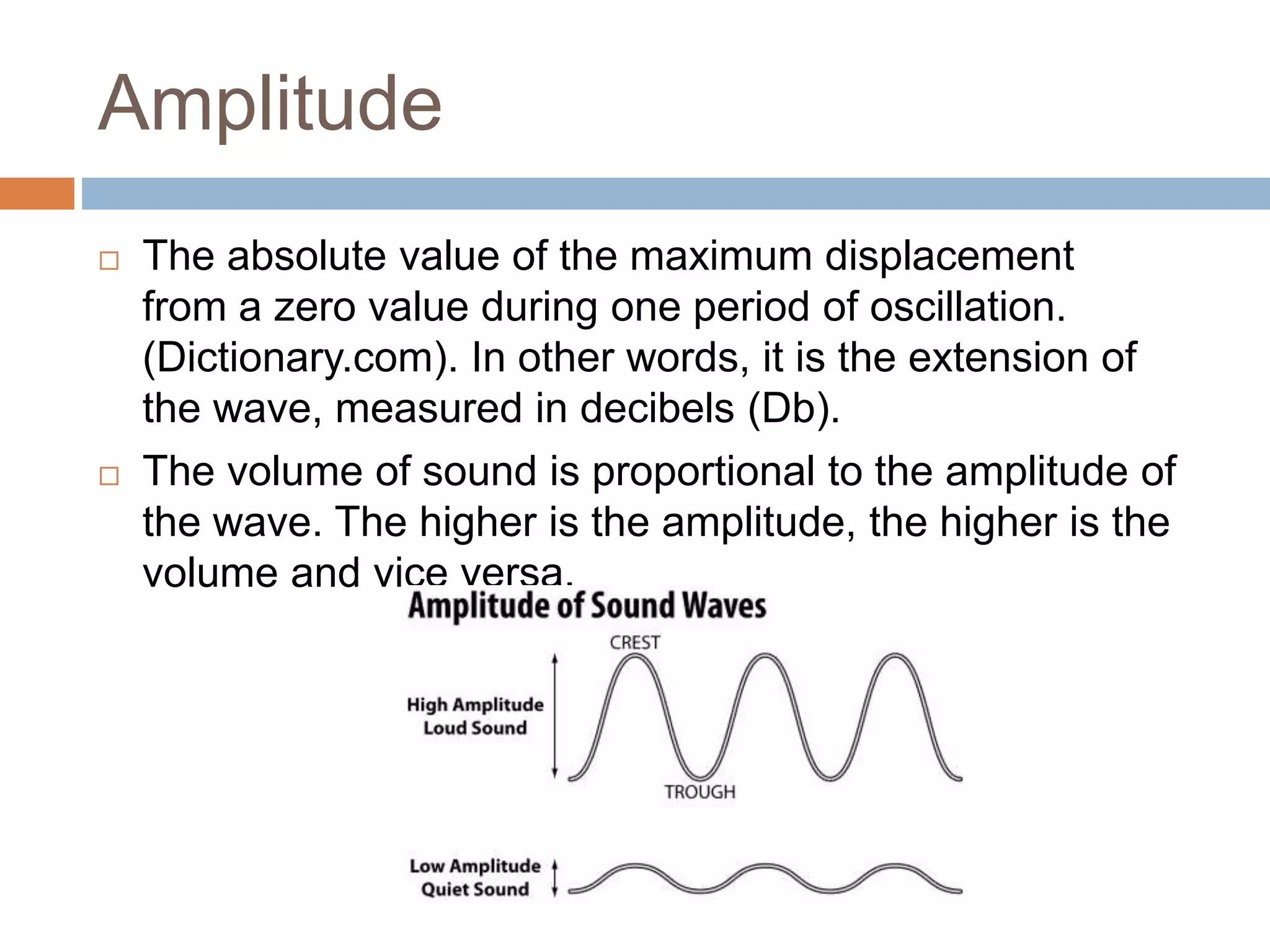
 The absolute value of the maximum displacement
from a zero value during one period of oscillation.
(Dictionary.com). In other words, it is the extension of
the wave, measured in decibels (Db).
 The volume of sound is proportional to the amplitude of
the wave. The higher is the amplitude, the higher is the
volume and vice versa.
Amplitude x Loudness
 Although the relation between the two terms,
they are differen in their applications.
Amplitude is something measurable by a
computer, and loudness is our perception of
that.
Frequency
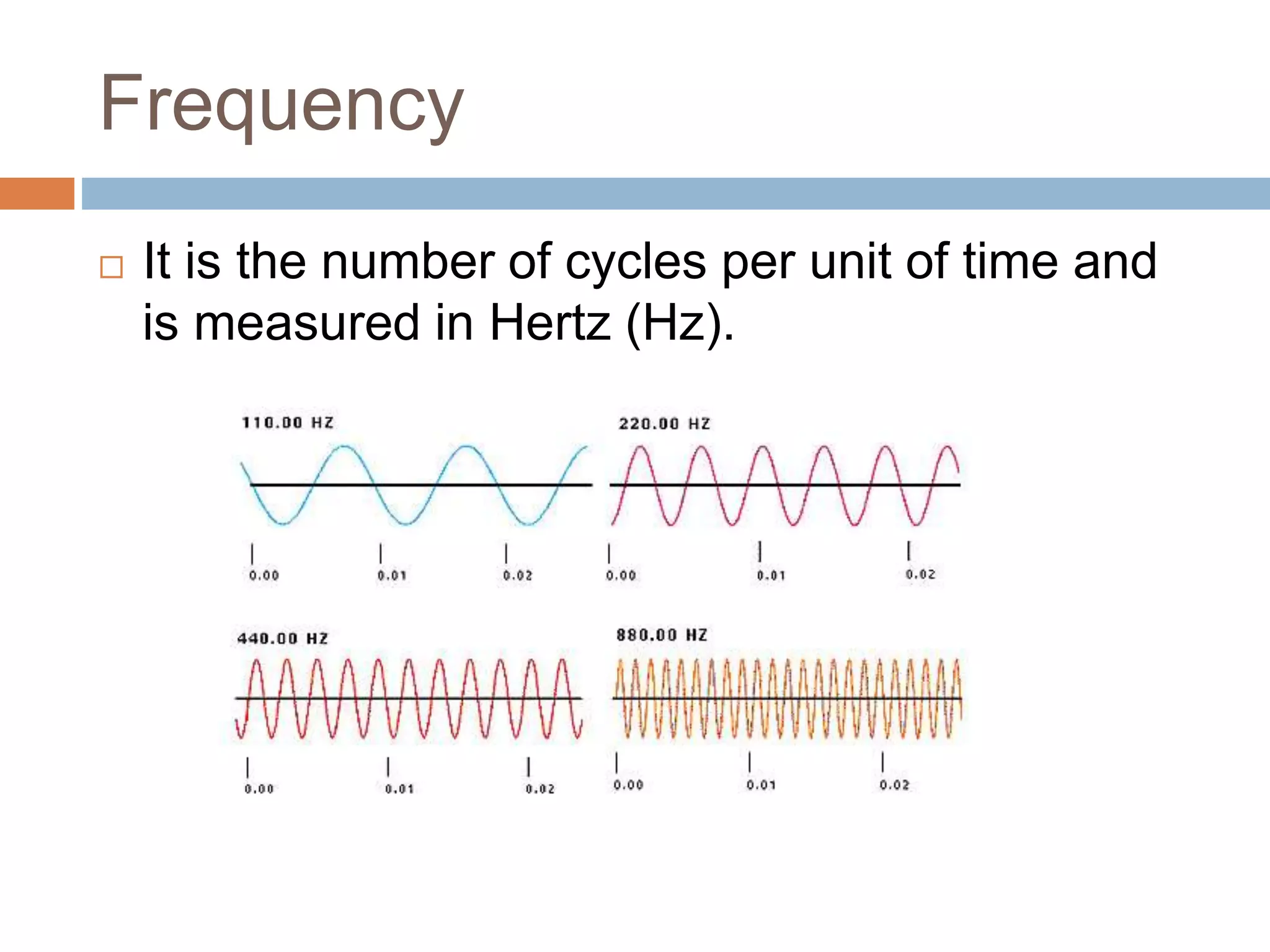
 It is the number of cycles per unit of time and
is measured in Hertz (Hz).
Frequency x Pitch
 Like Amplitude, Frequency is related to
another term but can not be interchanged.
Frequency is what the computer measure and
pitch is something that we percieve.
Timbre
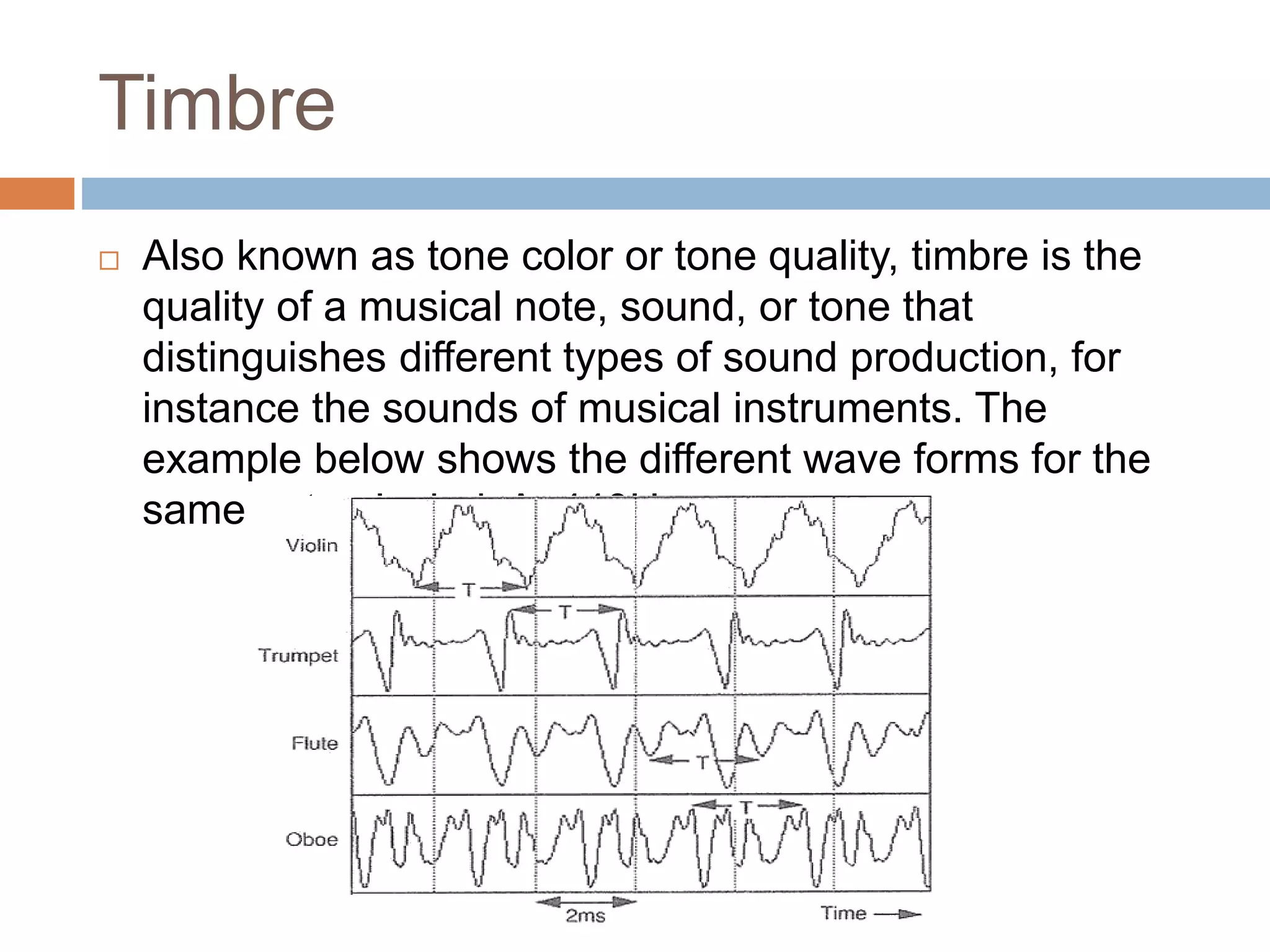
 Also known as tone color or tone quality, timbre is the
quality of a musical note, sound, or tone that
distinguishes different types of sound production, for
instance the sounds of musical instruments. The
example below shows the different wave forms for the
same note playied: A, 440Hz.
Thanks for reading. Have a nice course!!!

Audio Basics: Propagation, Amplitude, Frequency and Timbre

  • 1.
  • 2.
    Introduction Hi, I'm LuthOliveira from Salvador, Bahia, Brazil, and this lesson is for week 1 of Introduction To Music Production at Coursera.org. I will be teaching the audio basics: Propagation, Amplitude, Frequency, and Timbre.
  • 3.
    Basic properties ofSound As important as start producing, learning some basic properties of sound let us aware of what we are really matipulating. These properties are known as: Propagation, Amplitude, Frequency and Timbre.
  • 4.
    Propagation  It isthe act or process of propagating, especially the process by which a disturbance, such as the motion of electromagnetic or sound waves, is transmitted through a medium such as air or water. (American Heritage Dictionary)  Besides the medium, other factors can affect the speed of sound, for instance, the temperature. But in our condition, we will conceed the speed of sound around 340 m/s through the air in standard conditions of temeperature and pression: 20ºC/68ºF and 1atm(sea- level).
  • 5.
    Amplitude  The absolutevalue of the maximum displacement from a zero value during one period of oscillation. (Dictionary.com). In other words, it is the extension of the wave, measured in decibels (Db).  The volume of sound is proportional to the amplitude of the wave. The higher is the amplitude, the higher is the volume and vice versa.
  • 6.
    Amplitude x Loudness Although the relation between the two terms, they are differen in their applications. Amplitude is something measurable by a computer, and loudness is our perception of that.
  • 7.
    Frequency  It isthe number of cycles per unit of time and is measured in Hertz (Hz).
  • 8.
    Frequency x Pitch Like Amplitude, Frequency is related to another term but can not be interchanged. Frequency is what the computer measure and pitch is something that we percieve.
  • 9.
    Timbre  Also knownas tone color or tone quality, timbre is the quality of a musical note, sound, or tone that distinguishes different types of sound production, for instance the sounds of musical instruments. The example below shows the different wave forms for the same note playied: A, 440Hz.
  • 10.
    Thanks for reading.Have a nice course!!!