PRINCIPLES
OF
GUIDANCE AND
COUNSELING
r.a.s.Borja
What is GUIDANCE?
• “to direct” or “to point out”
• giving assistance or helping a person to
solve certain concerns
• helping an individual in understanding
one‘s strengths and limitations as well as
directing self in solving problems and
making decisions.
Guidance is also defined as:
• an activity in which many persons and
organizations take part
• given individuals by their parents, relatives,
and friends and by the community at large
through various educational, industrial,
social, religious, and political agencies and,
particularly, through the press and
broadcasting services
Guidance is also defined as:
• giving of information that enables others to
increase the scope of their exploratory
behavior
• providing information about a person’s own
abilities and interests as determined by
psychological tests or about educational
opportunities and the requirements of
various occupations
WHAT IS COUNSELING?
• Shertzer and Stone “a helping relationship”
• Gazda- “facilitating personal growth and
problem solving through effective
interpersonal communication”
Counseling
• Patterson:
• 1- influencing voluntary behavior change on the
part of the client.
• 2- providing conditions that facilitate voluntary
change
• 3- a relationship with limits
• 4- conditions facilitating behavior change are
provided through interviews
• 5. Is private and confidential
Counseling is NOT
• Persuasion
• Discipline
• Giving Advice
• Giving information
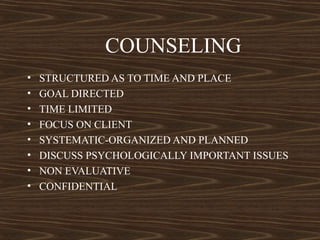
COUNSELING
• STRUCTURED AS TO TIME AND PLACE
• GOAL DIRECTED
• TIME LIMITED
• FOCUS ON CLIENT
• SYSTEMATIC-ORGANIZED AND PLANNED
• DISCUSS PSYCHOLOGICALLY IMPORTANT ISSUES
• NON EVALUATIVE
• CONFIDENTIAL
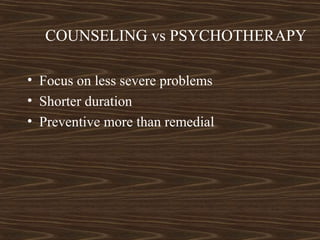
COUNSELING vs PSYCHOTHERAPY
• Focus on less severe problems
• Shorter duration
• Preventive more than remedial
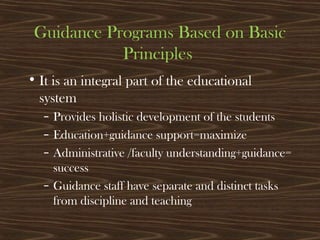
Guidance Programs Based on Basic
Principles
• It is an integral part of the educational
system
– Provides holistic development of the students
– Education+guidance support=maximize
– Administrative /faculty understanding+guidance=
success
– Guidance staff have separate and distinct tasks
from discipline and teaching
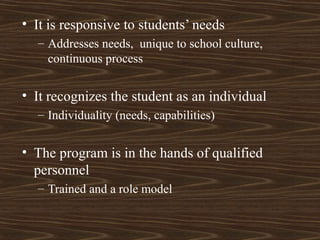
• It is responsive to students’ needs
– Addresses needs, unique to school culture,
continuous process
• It recognizes the student as an individual
– Individuality (needs, capabilities)
• The program is in the hands of qualified
personnel
– Trained and a role model
Basic Principles for Community Agencies
• Understand the characteristics of the population
and environment where agency is serving
• Data must be factual, not theoretical
• Communicate to the staff and the community any
findings about the community/ activities
• Specify goals, established priorities and identify
procedures to achieve goals
• Evaluate the program for improvements and
public support
The Need for Guidance Services
• The Family Situation
– The Disappearing Family
– The Unready Family
– The Pathological Family
• Increased Mobility of Filipinos
– Increasing Course Options and Educational Attainment
– New Job Titles
– Lack of Job Possibilities
– New Trends in Permanency and Tenure
– Increasing Financial Difficulty
• Increasing Possibilities of Experiencing
Crisis
– Calamities
– Crimes
– Learning and Other Disorders

ppt 1 module 5 Guidance and counseling

  • 1.
  • 2.
    What is GUIDANCE? •“to direct” or “to point out” • giving assistance or helping a person to solve certain concerns • helping an individual in understanding one‘s strengths and limitations as well as directing self in solving problems and making decisions.
  • 3.
    Guidance is alsodefined as: • an activity in which many persons and organizations take part • given individuals by their parents, relatives, and friends and by the community at large through various educational, industrial, social, religious, and political agencies and, particularly, through the press and broadcasting services
  • 4.
    Guidance is alsodefined as: • giving of information that enables others to increase the scope of their exploratory behavior • providing information about a person’s own abilities and interests as determined by psychological tests or about educational opportunities and the requirements of various occupations
  • 5.
    WHAT IS COUNSELING? •Shertzer and Stone “a helping relationship” • Gazda- “facilitating personal growth and problem solving through effective interpersonal communication”
  • 6.
    Counseling • Patterson: • 1-influencing voluntary behavior change on the part of the client. • 2- providing conditions that facilitate voluntary change • 3- a relationship with limits • 4- conditions facilitating behavior change are provided through interviews • 5. Is private and confidential
  • 7.
    Counseling is NOT •Persuasion • Discipline • Giving Advice • Giving information
  • 8.
    COUNSELING • STRUCTURED ASTO TIME AND PLACE • GOAL DIRECTED • TIME LIMITED • FOCUS ON CLIENT • SYSTEMATIC-ORGANIZED AND PLANNED • DISCUSS PSYCHOLOGICALLY IMPORTANT ISSUES • NON EVALUATIVE • CONFIDENTIAL
  • 9.
    COUNSELING vs PSYCHOTHERAPY •Focus on less severe problems • Shorter duration • Preventive more than remedial
  • 10.
    Guidance Programs Basedon Basic Principles • It is an integral part of the educational system – Provides holistic development of the students – Education+guidance support=maximize – Administrative /faculty understanding+guidance= success – Guidance staff have separate and distinct tasks from discipline and teaching
  • 11.
    • It isresponsive to students’ needs – Addresses needs, unique to school culture, continuous process • It recognizes the student as an individual – Individuality (needs, capabilities) • The program is in the hands of qualified personnel – Trained and a role model
  • 12.
    Basic Principles forCommunity Agencies • Understand the characteristics of the population and environment where agency is serving • Data must be factual, not theoretical • Communicate to the staff and the community any findings about the community/ activities • Specify goals, established priorities and identify procedures to achieve goals • Evaluate the program for improvements and public support
  • 13.
    The Need forGuidance Services • The Family Situation – The Disappearing Family – The Unready Family – The Pathological Family • Increased Mobility of Filipinos – Increasing Course Options and Educational Attainment – New Job Titles – Lack of Job Possibilities – New Trends in Permanency and Tenure – Increasing Financial Difficulty
  • 14.
    • Increasing Possibilitiesof Experiencing Crisis – Calamities – Crimes – Learning and Other Disorders