DEFINITIONS
SCIENCE - originates from a Latin word
‘Scientia’ which means knowledge. Thus, it
is defined as a systematized body of
knowledge composed of hypotheses,
theories, principles, models, and laws that
have been drawn conclusively from
observations, verifiable facts, and
experimental findings obtained primarily
through the application of the scientific
method.
DEFINITIONS
PHILOSOPHY - is derived from the Greek
words "Philosophia," which means "love"
and "wisdom," respectively. Thus, it was
defined as the study of the nature and
meaning of the universe and human life, as
it requires rational exploration and inquiry
into human existence, phenomena,
knowledge, ethics, and so on.
COMPARE AND CONTRAST
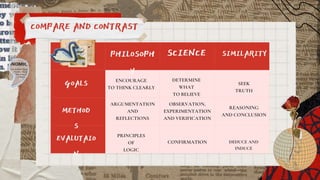
SCIENCE
PHILOSOPH
Y
SIMILARITY
METHOD
S
GOALS
EVALUTAIO
N
ENCOURAGE
TO THINK CLEARLY
DETERMINE
WHAT
TO BELIEVE
SEEK
TRUTH
ARGUMENTATION
AND
REFLECTIONS
OBSERVATION,
EXPERIMENTATION
AND VERIFICATION
REASONING
AND CONCLUSION
PRINCIPLES
OF
LOGIC
CONFIRMATION DEDUCE AND
INDUCE
RATIONALISM VS NATURALISM
According to rationalism, philosophical beliefs are formed
and justified independently of sensory observation,
whereas they are present in science. Whereas, Naturalism,
states that science should be used to investigate
traditionally philosophical questions
CORRELATIONS
Science and philosophy have always learned
from each other. Philosophy provides fresh
strength and generalizations, while the
sciences impact the world-view and
methodological pulses of its universal
principles.
Complementary to its role in conceptual clarification,
philosophy can contribute to the critique of scientific
assumptions—and can even be proactive in formulating
novel, testable, and predictive theories that help set new
paths for empirical research.
CORRELATIONS
CORRELATIONS
Philosophy and science share the tools of
logic, conceptual analysis, and rigorous
argumentation. Yet philosophers can
operate these tools with degrees of
thoroughness, freedom, and theoretical
abstraction that practicing researchers
often cannot afford in their daily activities.
Philosophy helps us to achieve a deeper understanding of
the social significance and general prospects of scientific
discoveries and their technical applications. The
impressive achievements of the scientific and
technological revolution, the contradictions and social
consequences it has evoked, raise profound philosophical
problems.
CORRELATIONS

SCIENCE VS PHILOSOPHY

  • 2.
    DEFINITIONS SCIENCE - originatesfrom a Latin word ‘Scientia’ which means knowledge. Thus, it is defined as a systematized body of knowledge composed of hypotheses, theories, principles, models, and laws that have been drawn conclusively from observations, verifiable facts, and experimental findings obtained primarily through the application of the scientific method.
  • 3.
    DEFINITIONS PHILOSOPHY - isderived from the Greek words "Philosophia," which means "love" and "wisdom," respectively. Thus, it was defined as the study of the nature and meaning of the universe and human life, as it requires rational exploration and inquiry into human existence, phenomena, knowledge, ethics, and so on.
  • 4.
    COMPARE AND CONTRAST SCIENCE PHILOSOPH Y SIMILARITY METHOD S GOALS EVALUTAIO N ENCOURAGE TOTHINK CLEARLY DETERMINE WHAT TO BELIEVE SEEK TRUTH ARGUMENTATION AND REFLECTIONS OBSERVATION, EXPERIMENTATION AND VERIFICATION REASONING AND CONCLUSION PRINCIPLES OF LOGIC CONFIRMATION DEDUCE AND INDUCE
  • 5.
    RATIONALISM VS NATURALISM Accordingto rationalism, philosophical beliefs are formed and justified independently of sensory observation, whereas they are present in science. Whereas, Naturalism, states that science should be used to investigate traditionally philosophical questions
  • 6.
    CORRELATIONS Science and philosophyhave always learned from each other. Philosophy provides fresh strength and generalizations, while the sciences impact the world-view and methodological pulses of its universal principles.
  • 7.
    Complementary to itsrole in conceptual clarification, philosophy can contribute to the critique of scientific assumptions—and can even be proactive in formulating novel, testable, and predictive theories that help set new paths for empirical research. CORRELATIONS
  • 8.
    CORRELATIONS Philosophy and scienceshare the tools of logic, conceptual analysis, and rigorous argumentation. Yet philosophers can operate these tools with degrees of thoroughness, freedom, and theoretical abstraction that practicing researchers often cannot afford in their daily activities.
  • 9.
    Philosophy helps usto achieve a deeper understanding of the social significance and general prospects of scientific discoveries and their technical applications. The impressive achievements of the scientific and technological revolution, the contradictions and social consequences it has evoked, raise profound philosophical problems. CORRELATIONS