Gerontology
(Late Adulthood)
Arroj Imtiaz
”
Gerontology
◉ The scientific study of
old age, the process of
ageing, and the
particular problems of
old people.
2
3
•Age sixty-five is considered a milestone and
the beginning of late adulthood.
•Reaching this age generally brings about
retirement from work, eligibility for Social
Security and Medicare benefits, income tax
advantages, reduced fares and admission
prices to leisure events, and special purchase.
Period of decline
◉ Period of decline comes partly from physical and
partly psychological factors.
◉ The physical cause of decline is a change in the body
cells due to the effects of the aging process.
◉ The psychological cause of decline has something to
do with unfavorable attitudes towards oneself, other
people, work and life.
4
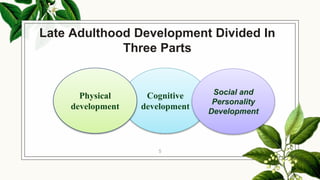
Late Adulthood Development Divided In
Three Parts
Cognitive
development
Physical
development
Social and
Personality
Development
5
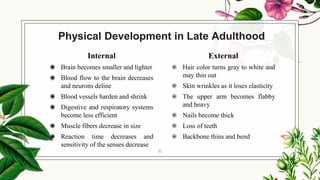
Physical Development in Late Adulthood
Internal
◉ Brain becomes smaller and lighter
◉ Blood flow to the brain decreases
and neurons deline
◉ Blood vessels harden and shrink
◉ Digestive and respiratory systems
become less efficient
◉ Muscle fibers decrease in size
◉ Reaction time decreases and
sensitivity of the senses decrease
External
◉ Hair color turns gray to white and
may thin out
◉ Skin wrinkles as it loses elasticity
◉ The upper arm becomes flabby
and heavy
◉ Nails become thick
◉ Loss of teeth
◉ Backbone thins and bend
6
Health Issues
◉ The majority of elderly people are in relatively good
health although they usually have one or more chronic
conditions that require medical attention.
◉ The most common complaints are cardiovascular disease,
hypertension, hearing impairment, and lower back
problems.
◉ Heart disease, cancer, and stroke become the leading cause
of death. People become more susceptible to disease as the
immune system weakens. 7
8
•The relationship between diet,
exercise, and health continues to be
strong in late adulthood.
•To decrease a person’s risk for
developing cancer or heart disease, a
diet should emphasize fruit and
vegetable consumption.
Cognitive Development
Memory
◉ Episodic memories, relating specific life experiences, seem to be
the most vulnerable to loss.
◉ Semantic memories (general knowledge and facts) tend to be
largely unaffected by age.
◉ Short term memory declines gradually until age 70.
◉ Autobiographical memory retention, pleasant memories are more
likely to be recalled than unpleasant memories.
Intelligence
◉ The aged person is often pictured as forgetful, intellectually slow, and
indecisive. Dual-process model of intellectual changes has been
proposed to describes two aspects of intelligence,
◉ Mechanics Dimension (which resembles fluid intelligence).
◉ Pragmatics Dimension (practical thinking applying knowledge and
skills gained from experience, and wisdom in solving problems).
◉ Decline in the mechanics dimension
◉ Pragmatic Intelligence is extremely useful at this time of the life span. It
can be likened to the wisdom gained from experience.
10
Social and Personality Development
◉ Adjusting to changes is a central challenge.
◉ Many people find old age a time of contradictions.
◉ On the one hand, they experience deterioration in physical skills and
functioning.
◉ On the other hand, personal and social growth continues through the
years of late adulthood.
◉ Successful adjustment and adaptation can lead to healthy development in
late adulthood
11
Emotional Adjustment to Aging
◎ In comparison with younger adults, older adults appear to be more
complex in their emotional experiences. This is referred to as
affective complexity.
Erikson’s Theory Ego Integrity vs. Despair is the final stage of life.
◎ Sense of integrity, people feel whole, complete, and satisfied with
their life choices and achievements.
◎ Despair, on the other hand occurs when seniors feel they have made
wrong decisions, but life is too short to remedy any life directions.
12
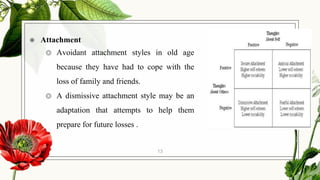
◉ Attachment
◎ Avoidant attachment styles in old age
because they have had to cope with the
loss of family and friends.
◎ A dismissive attachment style may be an
adaptation that attempts to help them
prepare for future losses .
13
◉ Leisure Time, Like younger adults, older adults enjoy leisure activities
such as entertainment, shopping, and gardening. Older adults do differ in
terms of leisure interests for more active forms of leisure.
◉ Moral Development, religion important in their lives, for more than
70% of adults it is an important part of their identity and daily living.
Religiosity typically increases with aging.
◉ Relationships in Late Adulthood
◎ Marriage, friendship and siblings
14
Retirement
◉ Several factors influence when someone will retire like receiving
social securit, economic and social conditions, ability to do work
related activities .
◉ Individuals that are financially secure, welleducated, healthy,
married, and active in volunteerism or other hobbies adjust best to
retirement and experience the greatest satisfaction.
15
Challenges
◉ Health Care Costs
◉ Disease
◉ Physical Aging
◉ Physical Assistance
◉ Financial Security
◉ Loneliness
◉ Abuse or Neglect
◉ Transportation
◉ Changing social climate 16
Death and Dying
◉ Thanatology the study of death and dying. There is two main
types of death first is functional death where the absence of a
heartbeat and breathing. Second is brain death where a diagnosis
of death based on the cessation of all signs of brain activity.
◉ In first Pathway death occurs suddenly.
◉ In second pathway death occurs after steady decline.
◉ In third pathway dying is a long and erratic process.
17
18
Charles Corr- theory of death
◉ Charles Corr have suggested that dying is a uniquely individual
experience that does not fit into neat stages.
◉ This theory says people who are dying face a set of
psychological tasks which include: minimizing physical stress,
maintaining the richness of life, continuing or deepening their
relationships with other people, and fostering hope, often through
spiritual searching 19
Edwin Shneidman- theory of death
◉ Theory draws on his unique combination of front-line experiences and
extensive grasp of many diverse but relevant conceptual frameworks such as
sociology, psychoanalysis, philosophy, and literature.
◉ His themes include such feelings and thoughts as incredulity, a sense of
unfairness, fear of pain or even general terror, and fantasies of being
rescued.
◉ His theory suggests that there are "themes" in people's reactions to dying
that can occur and recur in any order throughout the dying process.
21

Late adulthood ppt

  • 1.
  • 2.
    ” Gerontology ◉ The scientificstudy of old age, the process of ageing, and the particular problems of old people. 2
  • 3.
    3 •Age sixty-five isconsidered a milestone and the beginning of late adulthood. •Reaching this age generally brings about retirement from work, eligibility for Social Security and Medicare benefits, income tax advantages, reduced fares and admission prices to leisure events, and special purchase.
  • 4.
    Period of decline ◉Period of decline comes partly from physical and partly psychological factors. ◉ The physical cause of decline is a change in the body cells due to the effects of the aging process. ◉ The psychological cause of decline has something to do with unfavorable attitudes towards oneself, other people, work and life. 4
  • 5.
    Late Adulthood DevelopmentDivided In Three Parts Cognitive development Physical development Social and Personality Development 5
  • 6.
    Physical Development inLate Adulthood Internal ◉ Brain becomes smaller and lighter ◉ Blood flow to the brain decreases and neurons deline ◉ Blood vessels harden and shrink ◉ Digestive and respiratory systems become less efficient ◉ Muscle fibers decrease in size ◉ Reaction time decreases and sensitivity of the senses decrease External ◉ Hair color turns gray to white and may thin out ◉ Skin wrinkles as it loses elasticity ◉ The upper arm becomes flabby and heavy ◉ Nails become thick ◉ Loss of teeth ◉ Backbone thins and bend 6
  • 7.
    Health Issues ◉ Themajority of elderly people are in relatively good health although they usually have one or more chronic conditions that require medical attention. ◉ The most common complaints are cardiovascular disease, hypertension, hearing impairment, and lower back problems. ◉ Heart disease, cancer, and stroke become the leading cause of death. People become more susceptible to disease as the immune system weakens. 7
  • 8.
    8 •The relationship betweendiet, exercise, and health continues to be strong in late adulthood. •To decrease a person’s risk for developing cancer or heart disease, a diet should emphasize fruit and vegetable consumption.
  • 9.
    Cognitive Development Memory ◉ Episodicmemories, relating specific life experiences, seem to be the most vulnerable to loss. ◉ Semantic memories (general knowledge and facts) tend to be largely unaffected by age. ◉ Short term memory declines gradually until age 70. ◉ Autobiographical memory retention, pleasant memories are more likely to be recalled than unpleasant memories.
  • 10.
    Intelligence ◉ The agedperson is often pictured as forgetful, intellectually slow, and indecisive. Dual-process model of intellectual changes has been proposed to describes two aspects of intelligence, ◉ Mechanics Dimension (which resembles fluid intelligence). ◉ Pragmatics Dimension (practical thinking applying knowledge and skills gained from experience, and wisdom in solving problems). ◉ Decline in the mechanics dimension ◉ Pragmatic Intelligence is extremely useful at this time of the life span. It can be likened to the wisdom gained from experience. 10
  • 11.
    Social and PersonalityDevelopment ◉ Adjusting to changes is a central challenge. ◉ Many people find old age a time of contradictions. ◉ On the one hand, they experience deterioration in physical skills and functioning. ◉ On the other hand, personal and social growth continues through the years of late adulthood. ◉ Successful adjustment and adaptation can lead to healthy development in late adulthood 11
  • 12.
    Emotional Adjustment toAging ◎ In comparison with younger adults, older adults appear to be more complex in their emotional experiences. This is referred to as affective complexity. Erikson’s Theory Ego Integrity vs. Despair is the final stage of life. ◎ Sense of integrity, people feel whole, complete, and satisfied with their life choices and achievements. ◎ Despair, on the other hand occurs when seniors feel they have made wrong decisions, but life is too short to remedy any life directions. 12
  • 13.
    ◉ Attachment ◎ Avoidantattachment styles in old age because they have had to cope with the loss of family and friends. ◎ A dismissive attachment style may be an adaptation that attempts to help them prepare for future losses . 13
  • 14.
    ◉ Leisure Time,Like younger adults, older adults enjoy leisure activities such as entertainment, shopping, and gardening. Older adults do differ in terms of leisure interests for more active forms of leisure. ◉ Moral Development, religion important in their lives, for more than 70% of adults it is an important part of their identity and daily living. Religiosity typically increases with aging. ◉ Relationships in Late Adulthood ◎ Marriage, friendship and siblings 14
  • 15.
    Retirement ◉ Several factorsinfluence when someone will retire like receiving social securit, economic and social conditions, ability to do work related activities . ◉ Individuals that are financially secure, welleducated, healthy, married, and active in volunteerism or other hobbies adjust best to retirement and experience the greatest satisfaction. 15
  • 16.
    Challenges ◉ Health CareCosts ◉ Disease ◉ Physical Aging ◉ Physical Assistance ◉ Financial Security ◉ Loneliness ◉ Abuse or Neglect ◉ Transportation ◉ Changing social climate 16
  • 17.
    Death and Dying ◉Thanatology the study of death and dying. There is two main types of death first is functional death where the absence of a heartbeat and breathing. Second is brain death where a diagnosis of death based on the cessation of all signs of brain activity. ◉ In first Pathway death occurs suddenly. ◉ In second pathway death occurs after steady decline. ◉ In third pathway dying is a long and erratic process. 17
  • 18.
  • 19.
    Charles Corr- theoryof death ◉ Charles Corr have suggested that dying is a uniquely individual experience that does not fit into neat stages. ◉ This theory says people who are dying face a set of psychological tasks which include: minimizing physical stress, maintaining the richness of life, continuing or deepening their relationships with other people, and fostering hope, often through spiritual searching 19
  • 20.
    Edwin Shneidman- theoryof death ◉ Theory draws on his unique combination of front-line experiences and extensive grasp of many diverse but relevant conceptual frameworks such as sociology, psychoanalysis, philosophy, and literature. ◉ His themes include such feelings and thoughts as incredulity, a sense of unfairness, fear of pain or even general terror, and fantasies of being rescued. ◉ His theory suggests that there are "themes" in people's reactions to dying that can occur and recur in any order throughout the dying process.
  • 21.