Roe’s Theory of
Occupational Choice
“there is a relationship
between personality theory
and occupational
classification”
05/27/15 copyright 2006 www.brainybetty.com 2
• Early childhood experiences
are related to career choices.
05/27/15 copyright 2006 www.brainybetty.com 3
Parent-child relationships:
– Emotional concentration
• Overprotective
• Overdemanding
– Avoidance
• Neglect
• Rejection--Emotional or physical
– Acceptance
• Loving
• Casual
05/27/15 copyright 2006 www.brainybetty.com 4
• Students will likely to choose
a work situation that reflects
the psychological climate of
home grew up in
05/27/15 copyright 2006 www.brainybetty.com 5
Roe and Maslow
• Roe found Maslow’s hierarchy
of needs as a suitable
framework to discuss the
relationship of occupations to
the satisfaction of basic
needs
05/27/15 copyright 2006
www.brainybetty.com
6
Roe and Maslow
• Motivation in career
accomplishments can root
from the satisfaction of the
needs of the person
05/27/15 copyright 2006
www.brainybetty.com
7
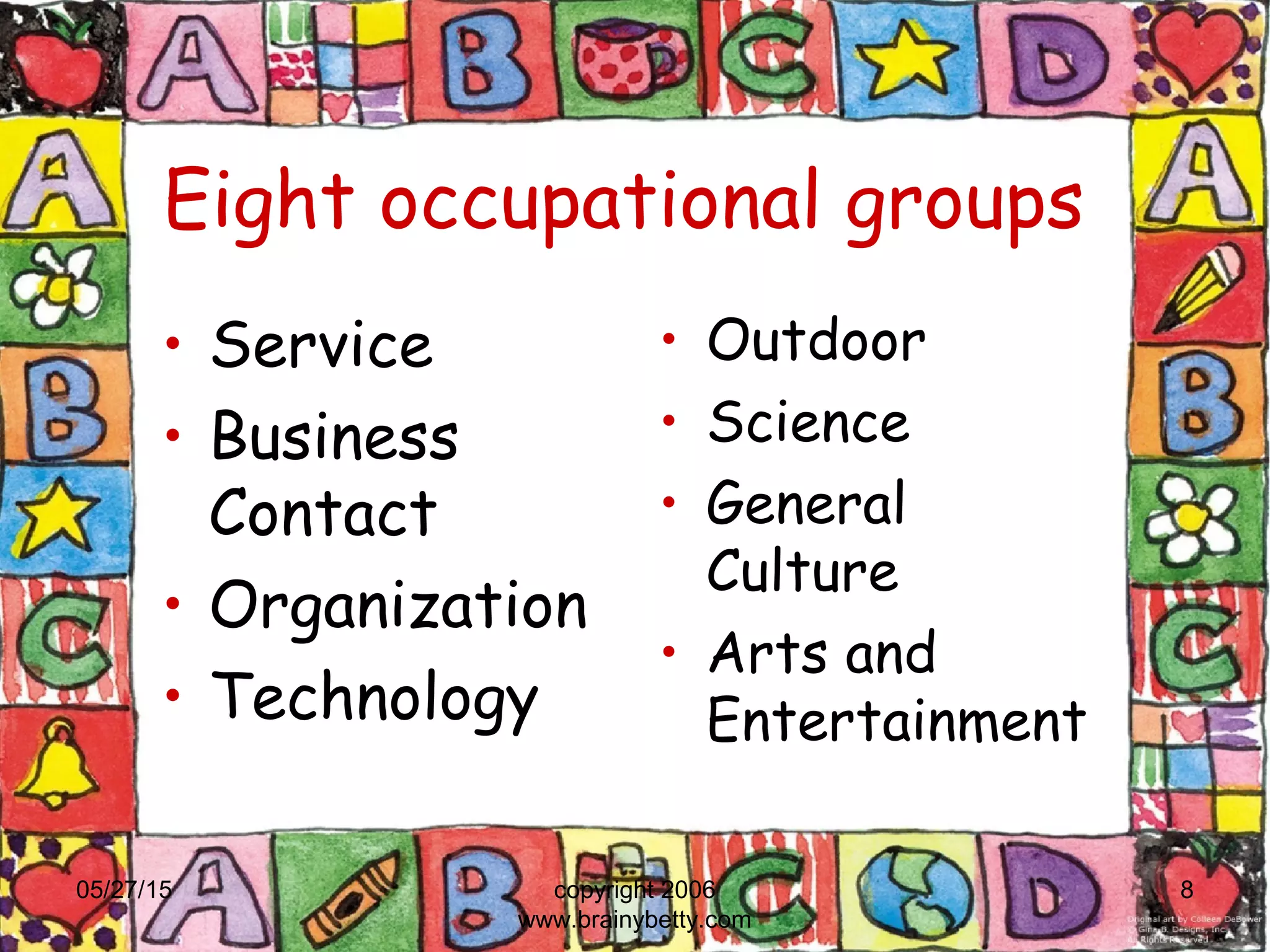
Eight occupational groups
• Service
• Business
Contact
• Organization
• Technology
• Outdoor
• Science
• General
Culture
• Arts and
Entertainment
05/27/15 copyright 2006
www.brainybetty.com
8
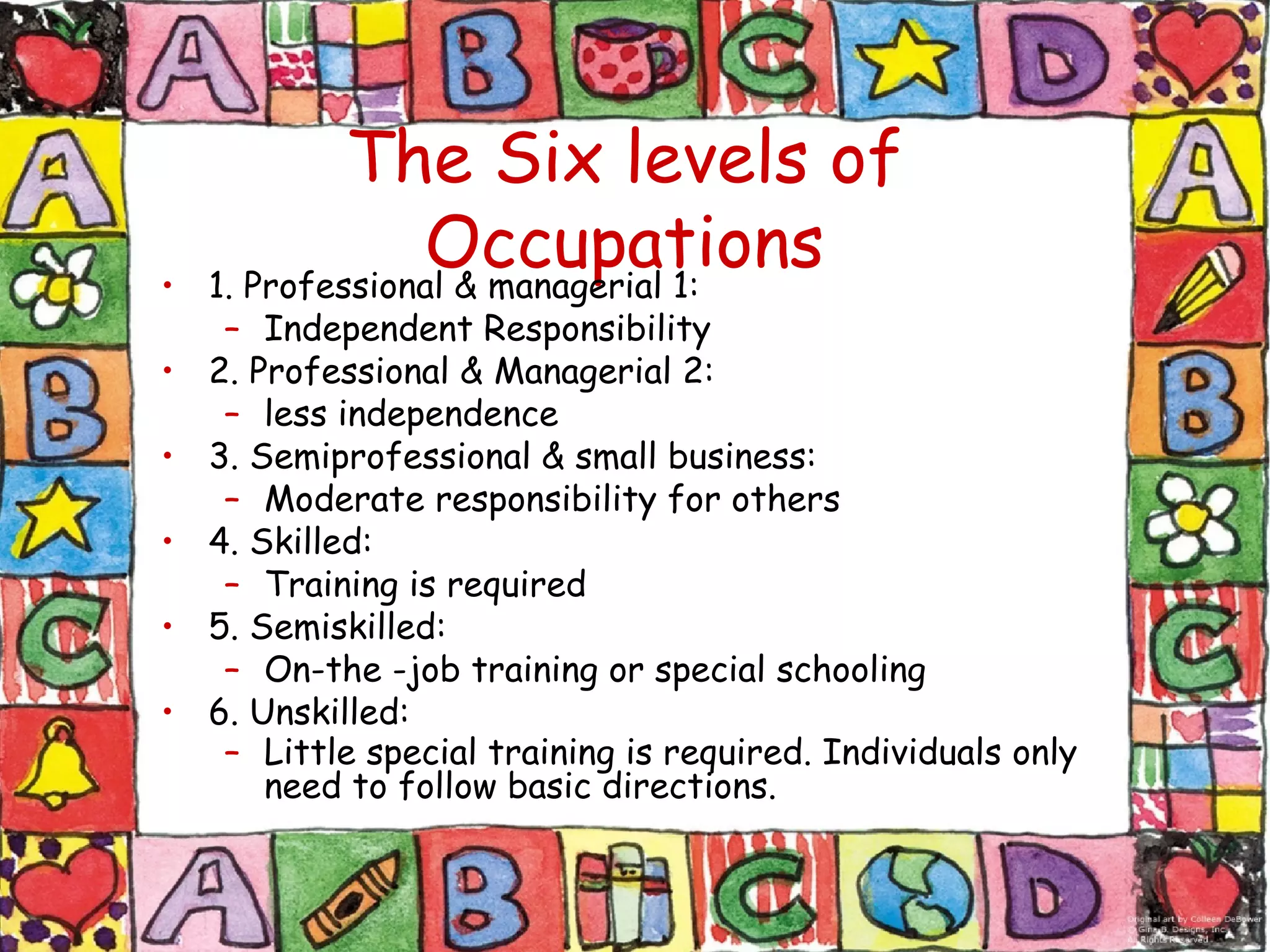
The Six levels of
Occupations• 1. Professional & managerial 1:
– Independent Responsibility
• 2. Professional & Managerial 2:
– less independence
• 3. Semiprofessional & small business:
– Moderate responsibility for others
• 4. Skilled:
– Training is required
• 5. Semiskilled:
– On-the -job training or special schooling
• 6. Unskilled:
– Little special training is required. Individuals only
need to follow basic directions.
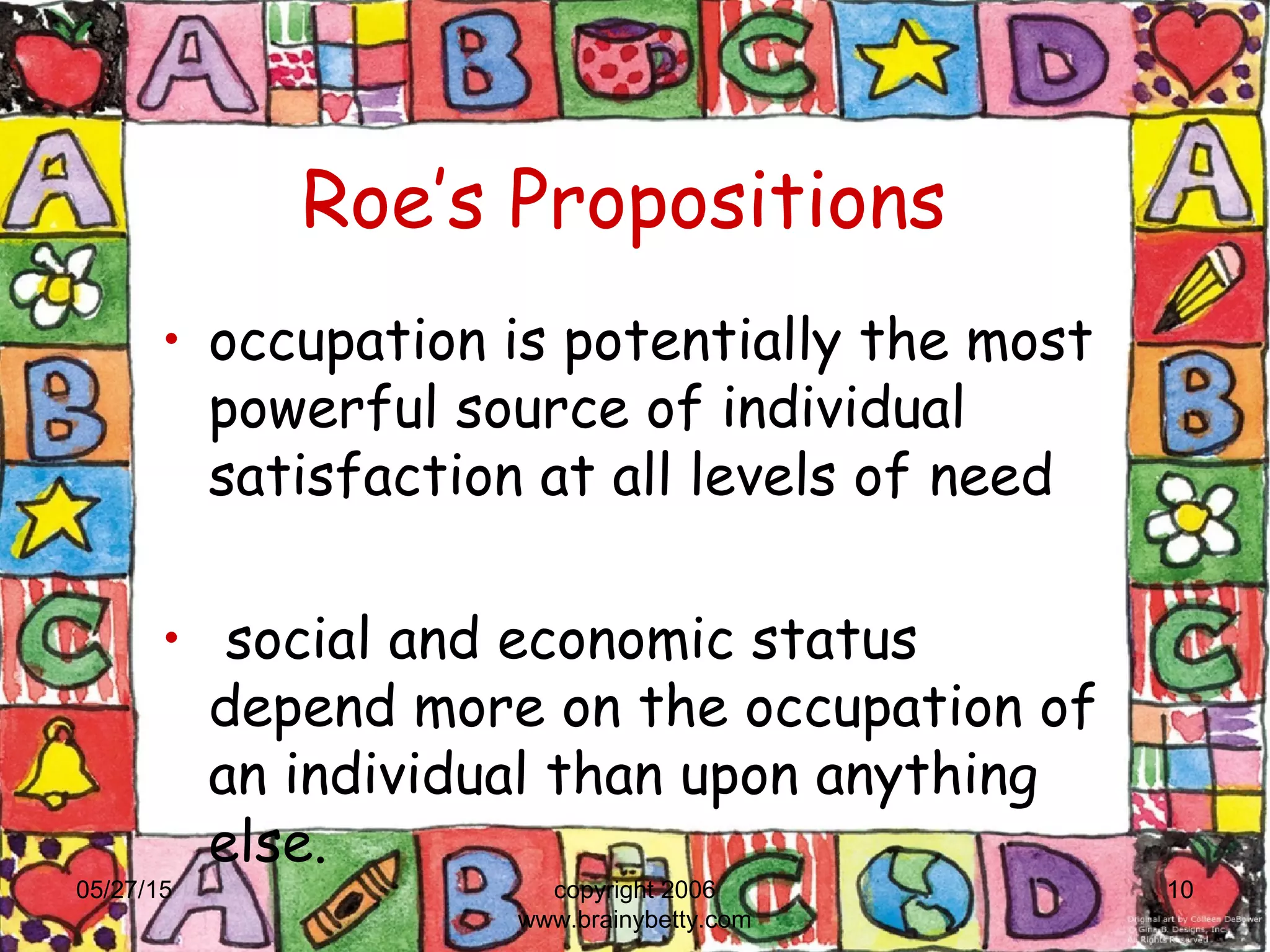
Roe’s Propositions
• occupation is potentially the most
powerful source of individual
satisfaction at all levels of need
• social and economic status
depend more on the occupation of
an individual than upon anything
else.
05/27/15 copyright 2006
www.brainybetty.com
10
Theory into practice
• Conduct activities that explore
the student’s needs and pair them
with the student’s abilities,
interests
• It is important that the students
are guided in addressing their
needs through proper decision-
making.05/27/15 copyright 2006
www.brainybetty.com
11

ppt 4 module 5 Roe

  • 1.
  • 2.
    “there is arelationship between personality theory and occupational classification” 05/27/15 copyright 2006 www.brainybetty.com 2
  • 3.
    • Early childhoodexperiences are related to career choices. 05/27/15 copyright 2006 www.brainybetty.com 3
  • 4.
    Parent-child relationships: – Emotionalconcentration • Overprotective • Overdemanding – Avoidance • Neglect • Rejection--Emotional or physical – Acceptance • Loving • Casual 05/27/15 copyright 2006 www.brainybetty.com 4
  • 5.
    • Students willlikely to choose a work situation that reflects the psychological climate of home grew up in 05/27/15 copyright 2006 www.brainybetty.com 5
  • 6.
    Roe and Maslow •Roe found Maslow’s hierarchy of needs as a suitable framework to discuss the relationship of occupations to the satisfaction of basic needs 05/27/15 copyright 2006 www.brainybetty.com 6
  • 7.
    Roe and Maslow •Motivation in career accomplishments can root from the satisfaction of the needs of the person 05/27/15 copyright 2006 www.brainybetty.com 7
  • 8.
    Eight occupational groups •Service • Business Contact • Organization • Technology • Outdoor • Science • General Culture • Arts and Entertainment 05/27/15 copyright 2006 www.brainybetty.com 8
  • 9.
    The Six levelsof Occupations• 1. Professional & managerial 1: – Independent Responsibility • 2. Professional & Managerial 2: – less independence • 3. Semiprofessional & small business: – Moderate responsibility for others • 4. Skilled: – Training is required • 5. Semiskilled: – On-the -job training or special schooling • 6. Unskilled: – Little special training is required. Individuals only need to follow basic directions.
  • 10.
    Roe’s Propositions • occupationis potentially the most powerful source of individual satisfaction at all levels of need • social and economic status depend more on the occupation of an individual than upon anything else. 05/27/15 copyright 2006 www.brainybetty.com 10
  • 11.
    Theory into practice •Conduct activities that explore the student’s needs and pair them with the student’s abilities, interests • It is important that the students are guided in addressing their needs through proper decision- making.05/27/15 copyright 2006 www.brainybetty.com 11