Environmental Impact of DisposalGreenPharmEdu.org
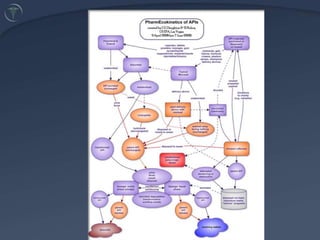
Environmental Impact of DisposalAPIs enter the environment by three primary routes:Excretion (primarily via urine and secondarily via feces) comprises continual low-level contributions from multitudes of peopleBathing releases APIs from medications applied directly to the skin and excreted via sweat *Disposalof leftover, unwanted medications represents acute but transient and episodic contributions from fewer peopleDisposalis the best route for pollution prevention / source control measuresIndirect entry can occur via disposal of unwanted drugs and used delivery devices to trash (e.g., in leachates from landfills)
Proper disposal is greatly complicated by the conflict between the need to protect public safety (e.g., from drug diversion) and the need to minimize environmental exposure* DaughtonCG and Ruhoy IS. "Environmental Footprint of Pharmaceuticals: The Significance of Factors Beyond Direct Excretion to Sewers," Environmental Toxicology & Chemistry 2009, 28(12):2495-2521; doi:10.1897/08-382.1; available: http://www3.interscience.wiley.com/cgi-bin/fulltext/123234136/PDFSTART
Environmental ConcernsTreatment and prevention of disease, together with improved quality of life, are highly visible aspects of a global pharmaceutical industry with sales in 2007 exceeding $700 Billion.Medicines are designed to have biological effects in small dosesNon-target organisms can be exposedPossible subtle effects in aquatic organisms at very low concentrations (as low as ng/L or parts per trillion [ppt])There are thousands of chemically distinct APIs in medicinesPotential for synergistic effects with other medicines and/or other contaminants
Environmental ConcernsPharmaceutical Facility Waste StreamsIn IndiaThe levels of the most abundant API (ciprofloxacin) reached 31 mg/L (31 ppm)  at a waste treatment facility, orders of magnitude higher than had ever been reportedLarsson et al. 2007“Health facilities flush estimated 250 Million pounds of drugs a year” USA Today, Sept. 2008
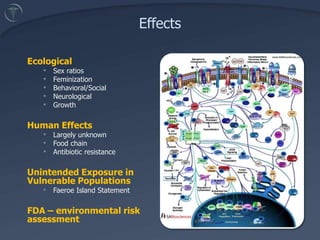
EffectsEcologicalSex ratiosFeminizationBehavioral/SocialNeurologicalGrowthHuman EffectsLargely unknownFood chainAntibiotic resistanceUnintended Exposure in Vulnerable PopulationsFaeroe Island StatementFDA – environmental risk assessment
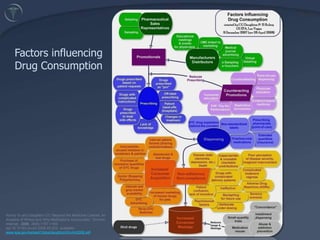
Factors influencing Drug ConsumptionRuhoy IS and Daughton CG "Beyond the Medicine Cabinet: An Analysis of Where and Why Medications Accumulate," Environ. Internat., 2008, 34(8):1157-1169; doi:10.1016/j.envint.2008.05.002; available: www.epa.gov/nerlesd1/bios/daughton/EnvInt2008.pdf
8Pharmaceutical AccumulationConsumer HomesBoth human and animal medicinePhysician Offices and ClinicsSamples and in-office procedure useVeterinarian OfficesAnimal SheltersDental OfficesHospitalsLong-Term and Chronic Care FacilitiesDecedent HomesDonationsSchools (confiscation and health care offices)Military BasesSheltersDialysis CentersTransfusion CentersFirst Responder ServicesFirst-Aid KitsBorder Check PointsCustoms (airline and freight)Confined Animal Feeding Operations (CAFOs)AgricultureAquacultureZoosClan LabsCemeteriesCruise ShipsPrisons and JailsHumanitarian Organizations
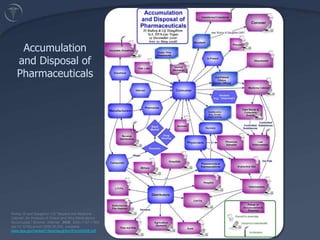
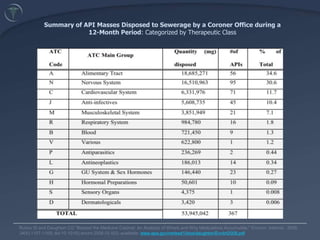
Accumulation and Disposal of PharmaceuticalsRuhoy IS and Daughton CG "Beyond the Medicine Cabinet: An Analysis of Where and Why Medications Accumulate," Environ. Internat., 2008, 34(8):1157-1169; doi:10.1016/j.envint.2008.05.002; available: www.epa.gov/nerlesd1/bios/daughton/EnvInt2008.pdf
10Major UnknownWhat fractions of drug residues occurring in the ambient environment result from discarding leftover drugs?No studies provided objective data from well-defined populations to support any type of conclusionData are needed on the types, quantities, and frequencies with which drugs accumulate as household waste

2.4. Environmental Impact of Disposal (Ruhoy)

  • 1.
    Environmental Impact ofDisposalGreenPharmEdu.org
  • 2.
    Environmental Impact ofDisposalAPIs enter the environment by three primary routes:Excretion (primarily via urine and secondarily via feces) comprises continual low-level contributions from multitudes of peopleBathing releases APIs from medications applied directly to the skin and excreted via sweat *Disposalof leftover, unwanted medications represents acute but transient and episodic contributions from fewer peopleDisposalis the best route for pollution prevention / source control measuresIndirect entry can occur via disposal of unwanted drugs and used delivery devices to trash (e.g., in leachates from landfills)
  • 3.
    Proper disposal isgreatly complicated by the conflict between the need to protect public safety (e.g., from drug diversion) and the need to minimize environmental exposure* DaughtonCG and Ruhoy IS. "Environmental Footprint of Pharmaceuticals: The Significance of Factors Beyond Direct Excretion to Sewers," Environmental Toxicology & Chemistry 2009, 28(12):2495-2521; doi:10.1897/08-382.1; available: http://www3.interscience.wiley.com/cgi-bin/fulltext/123234136/PDFSTART
  • 5.
    Environmental ConcernsTreatment andprevention of disease, together with improved quality of life, are highly visible aspects of a global pharmaceutical industry with sales in 2007 exceeding $700 Billion.Medicines are designed to have biological effects in small dosesNon-target organisms can be exposedPossible subtle effects in aquatic organisms at very low concentrations (as low as ng/L or parts per trillion [ppt])There are thousands of chemically distinct APIs in medicinesPotential for synergistic effects with other medicines and/or other contaminants
  • 6.
    Environmental ConcernsPharmaceutical FacilityWaste StreamsIn IndiaThe levels of the most abundant API (ciprofloxacin) reached 31 mg/L (31 ppm) at a waste treatment facility, orders of magnitude higher than had ever been reportedLarsson et al. 2007“Health facilities flush estimated 250 Million pounds of drugs a year” USA Today, Sept. 2008
  • 7.
    EffectsEcologicalSex ratiosFeminizationBehavioral/SocialNeurologicalGrowthHuman EffectsLargelyunknownFood chainAntibiotic resistanceUnintended Exposure in Vulnerable PopulationsFaeroe Island StatementFDA – environmental risk assessment
  • 8.
    Factors influencing DrugConsumptionRuhoy IS and Daughton CG "Beyond the Medicine Cabinet: An Analysis of Where and Why Medications Accumulate," Environ. Internat., 2008, 34(8):1157-1169; doi:10.1016/j.envint.2008.05.002; available: www.epa.gov/nerlesd1/bios/daughton/EnvInt2008.pdf
  • 9.
    8Pharmaceutical AccumulationConsumer HomesBothhuman and animal medicinePhysician Offices and ClinicsSamples and in-office procedure useVeterinarian OfficesAnimal SheltersDental OfficesHospitalsLong-Term and Chronic Care FacilitiesDecedent HomesDonationsSchools (confiscation and health care offices)Military BasesSheltersDialysis CentersTransfusion CentersFirst Responder ServicesFirst-Aid KitsBorder Check PointsCustoms (airline and freight)Confined Animal Feeding Operations (CAFOs)AgricultureAquacultureZoosClan LabsCemeteriesCruise ShipsPrisons and JailsHumanitarian Organizations
  • 10.
    Accumulation and Disposalof PharmaceuticalsRuhoy IS and Daughton CG "Beyond the Medicine Cabinet: An Analysis of Where and Why Medications Accumulate," Environ. Internat., 2008, 34(8):1157-1169; doi:10.1016/j.envint.2008.05.002; available: www.epa.gov/nerlesd1/bios/daughton/EnvInt2008.pdf
  • 11.
    10Major UnknownWhat fractionsof drug residues occurring in the ambient environment result from discarding leftover drugs?No studies provided objective data from well-defined populations to support any type of conclusionData are needed on the types, quantities, and frequencies with which drugs accumulate as household waste