Pang Khai Shuen 0318423
Lee Ren Jet 0319058
Ng Seng He 0323037
Yap Jia En 0319550
Yeo Dor Een 0316224
 The construction industry has been playing a significant role
in aggregate economy of the country in term of its
contribution to revenue generation, capital formation and
employment creation which ultimately support the gross
domestic product (GDP) and the socio-economic
development of Malaysia.
 Research has been done that Malaysian construction
industry has suffered high proportion of business failure
during economic downturn compared to other industries.
 Construction industry in general respond slowly to
environmental changes that cause the economy downturn.
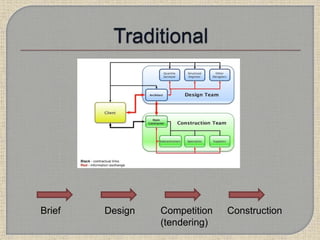
Brief Design Competition
(tendering)
Construction
 Accountability of contractor due to a competitive
selection
 Competitive fairness
 Reduce low quality or design risk
 Easy to manage and arrange changes to the
contract
Disputes
Time consuming
People who deliver the project lack of
opportunity to give suggestion
do not give any advantages for contractor
 In management contracts, the client usually starts by
appointing a consultant team to prepare project
drawings.
 A management contractor is appointed to participate in
the planning and construction of the project.
 Management contractor plans the programme, makes
decisions on the contents of each package to be sub-
contracted, organizes and manages the construction of
all the works which are undertaken by sub-contractors.
 Able to achieve early commencement of construction for multi-
phase projects due to overlapping of design and construction.
 Consultants are able to gain more buildability advice or input
from contractors and subcontractors.
 The overall development time will be shorter and lead to early
completion.
 It allows the client to change the design during construction
because drawings and detail matters can be adjusted as the
construction work proceeds.
 Poor certainty of final cost until the last works of contract
has been signed.
 The number of variations and amount of remeasurement
may be greater than traditional method due to insufficient
design development.
 Returned tender price may be high since time is rush and
members of tenderer are limited.
agreements that employ
standardized, non-negotiated
provisions, usually in preprinted
forms.
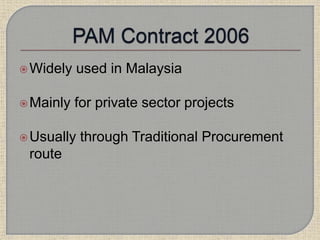
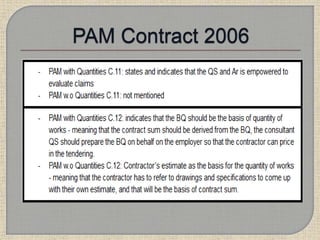
PAM Contract 2006 (With/Without
Quantities)
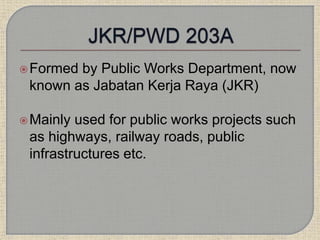
JKR/PWD 203A
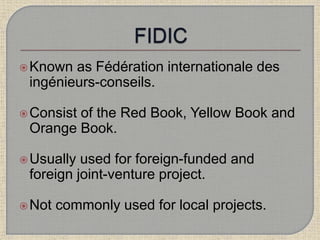
FIDIC
Widely used in Malaysia
Mainly for private sector projects
Usually through Traditional Procurement
route
Formed by Public Works Department, now
known as Jabatan Kerja Raya (JKR)
Mainly used for public works projects such
as highways, railway roads, public
infrastructures etc.
Known as Fédération internationale des
ingénieurs-conseils.
Consist of the Red Book, Yellow Book and
Orange Book.
Usually used for foreign-funded and
foreign joint-venture project.
Not commonly used for local projects.
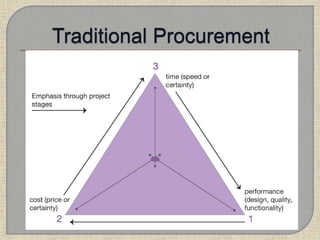
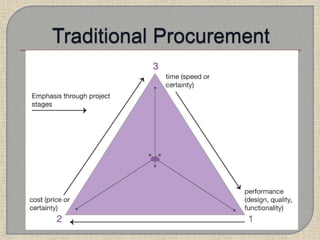
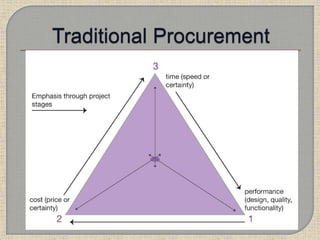
Traditional Procurement
• Fixed Price Contract
• Remeasurement Contract
• Drawing and Specifications
• Cost Reimbursement Contract
Management Contracting
• Management Fee
Fixed Price Contract
• Firm Price
• Based on Complete BoQ
• Complete design required
Remeasurement Contract
• Based on Approx BoQ
• Quantities are subjected to remeasurement
• Works may proceed before design has been
finalized
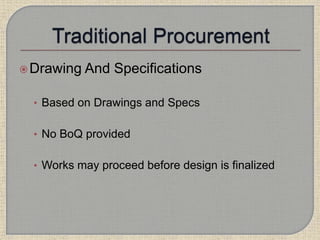
Drawing And Specifications
• Based on Drawings and Specs
• No BoQ provided
• Works may proceed before design is finalized
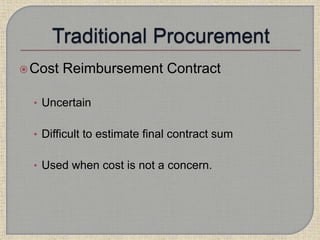
Cost Reimbursement Contract
• Uncertain
• Difficult to estimate final contract sum
• Used when cost is not a concern.
1) Analysis of client’s needs and objectives
2) Selection of possible procurement
methods
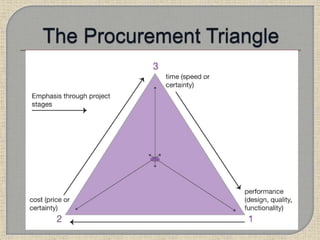
1) The client’s primary concerns can be
made known
2) “Highest Quality, Lowest Cost, Shortest
Time”
Cost price can not fluctuate too much
Affects profit obtained from each units sold
Building quality should meet customers’
expectations
Project size, location, and expected quality
Outlining special requirements:
• Specially built plants and equipment
• Key challenges (site accessibility)
• Elements that might impact the project time scale
Example:
20-storey condominium:
• Heavy machineries such as tower cranes and
temporary lifts
• Transportation and erection
• Ingress & Egress
• Resources needed for proper planning
• (permits, road carriage weight limits etc)
4 Categories of risks that should be
identified:
• 1. Strategic risks
• 2. External risks
• 3. Project risks
• 4. Discovery risks
4 ways to handle risks:
• Terminate
• Treat
• Transfer
• Tolerate
Carrying out of a project requires:
• Expertise
• Experience
• Knowledge
• Skill
Capability of human resources to commit
Our client is an experienced firm
Ample Resources
Traditional Method
Traditional Procurement Method
Why?
• Priority on cost and quality
• Ability to monitor and involve
• Lower risks portion
• Adequate financial resources
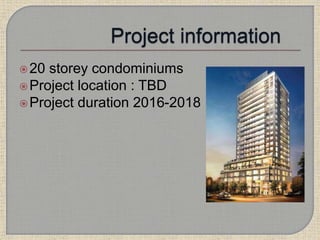
20 storey condominiums
Project location : TBD
Project duration 2016-2018
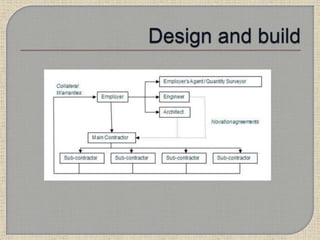
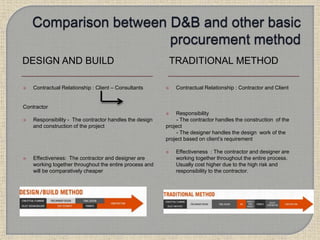
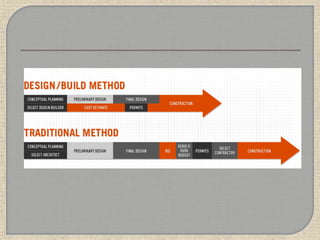
DESIGN AND BUILD TRADITIONAL METHOD
 Contractual Relationship : Contractor and Client
 Responsibility
- The contractor handles the construction of the
project
- The designer handles the design work of the
project based on client’s requirement
 Effectiveness : The contractor and designer are
working together throughout the entire process.
Usually cost higher due to the high risk and
responsibility to the contractor.
 Contractual Relationship : Client – Consultants
Contractor
 Responsibility - The contractor handles the design
and construction of the project
 Effectiveness: The contractor and designer are
working together throughout the entire process and
will be comparatively cheaper
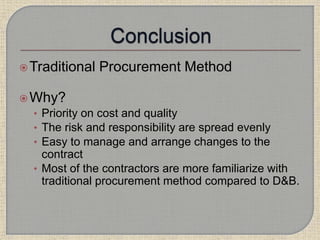
Traditional Procurement Method
Why?
• Priority on cost and quality
• The risk and responsibility are spread evenly
• Easy to manage and arrange changes to the
contract
• Most of the contractors are more familiarize with
traditional procurement method compared to D&B.
THANK YOU

PP1 - Presentation Slides

  • 1.
    Pang Khai Shuen0318423 Lee Ren Jet 0319058 Ng Seng He 0323037 Yap Jia En 0319550 Yeo Dor Een 0316224
  • 2.
     The constructionindustry has been playing a significant role in aggregate economy of the country in term of its contribution to revenue generation, capital formation and employment creation which ultimately support the gross domestic product (GDP) and the socio-economic development of Malaysia.  Research has been done that Malaysian construction industry has suffered high proportion of business failure during economic downturn compared to other industries.  Construction industry in general respond slowly to environmental changes that cause the economy downturn.
  • 4.
  • 5.
     Accountability ofcontractor due to a competitive selection  Competitive fairness  Reduce low quality or design risk  Easy to manage and arrange changes to the contract
  • 6.
    Disputes Time consuming People whodeliver the project lack of opportunity to give suggestion do not give any advantages for contractor
  • 8.
     In managementcontracts, the client usually starts by appointing a consultant team to prepare project drawings.  A management contractor is appointed to participate in the planning and construction of the project.  Management contractor plans the programme, makes decisions on the contents of each package to be sub- contracted, organizes and manages the construction of all the works which are undertaken by sub-contractors.
  • 9.
     Able toachieve early commencement of construction for multi- phase projects due to overlapping of design and construction.  Consultants are able to gain more buildability advice or input from contractors and subcontractors.  The overall development time will be shorter and lead to early completion.  It allows the client to change the design during construction because drawings and detail matters can be adjusted as the construction work proceeds.
  • 10.
     Poor certaintyof final cost until the last works of contract has been signed.  The number of variations and amount of remeasurement may be greater than traditional method due to insufficient design development.  Returned tender price may be high since time is rush and members of tenderer are limited.
  • 11.
    agreements that employ standardized,non-negotiated provisions, usually in preprinted forms.
  • 12.
    PAM Contract 2006(With/Without Quantities) JKR/PWD 203A FIDIC
  • 13.
    Widely used inMalaysia Mainly for private sector projects Usually through Traditional Procurement route
  • 15.
    Formed by PublicWorks Department, now known as Jabatan Kerja Raya (JKR) Mainly used for public works projects such as highways, railway roads, public infrastructures etc.
  • 16.
    Known as Fédérationinternationale des ingénieurs-conseils. Consist of the Red Book, Yellow Book and Orange Book. Usually used for foreign-funded and foreign joint-venture project. Not commonly used for local projects.
  • 17.
    Traditional Procurement • FixedPrice Contract • Remeasurement Contract • Drawing and Specifications • Cost Reimbursement Contract Management Contracting • Management Fee
  • 18.
    Fixed Price Contract •Firm Price • Based on Complete BoQ • Complete design required
  • 20.
    Remeasurement Contract • Basedon Approx BoQ • Quantities are subjected to remeasurement • Works may proceed before design has been finalized
  • 22.
    Drawing And Specifications •Based on Drawings and Specs • No BoQ provided • Works may proceed before design is finalized
  • 24.
    Cost Reimbursement Contract •Uncertain • Difficult to estimate final contract sum • Used when cost is not a concern.
  • 27.
    1) Analysis ofclient’s needs and objectives 2) Selection of possible procurement methods
  • 29.
    1) The client’sprimary concerns can be made known 2) “Highest Quality, Lowest Cost, Shortest Time”
  • 30.
    Cost price cannot fluctuate too much Affects profit obtained from each units sold Building quality should meet customers’ expectations
  • 31.
    Project size, location,and expected quality Outlining special requirements: • Specially built plants and equipment • Key challenges (site accessibility) • Elements that might impact the project time scale
  • 32.
    Example: 20-storey condominium: • Heavymachineries such as tower cranes and temporary lifts • Transportation and erection • Ingress & Egress • Resources needed for proper planning • (permits, road carriage weight limits etc)
  • 33.
    4 Categories ofrisks that should be identified: • 1. Strategic risks • 2. External risks • 3. Project risks • 4. Discovery risks
  • 34.
    4 ways tohandle risks: • Terminate • Treat • Transfer • Tolerate
  • 35.
    Carrying out ofa project requires: • Expertise • Experience • Knowledge • Skill Capability of human resources to commit
  • 36.
    Our client isan experienced firm Ample Resources Traditional Method
  • 37.
    Traditional Procurement Method Why? •Priority on cost and quality • Ability to monitor and involve • Lower risks portion • Adequate financial resources
  • 39.
    20 storey condominiums Projectlocation : TBD Project duration 2016-2018
  • 43.
    DESIGN AND BUILDTRADITIONAL METHOD  Contractual Relationship : Contractor and Client  Responsibility - The contractor handles the construction of the project - The designer handles the design work of the project based on client’s requirement  Effectiveness : The contractor and designer are working together throughout the entire process. Usually cost higher due to the high risk and responsibility to the contractor.  Contractual Relationship : Client – Consultants Contractor  Responsibility - The contractor handles the design and construction of the project  Effectiveness: The contractor and designer are working together throughout the entire process and will be comparatively cheaper
  • 45.
    Traditional Procurement Method Why? •Priority on cost and quality • The risk and responsibility are spread evenly • Easy to manage and arrange changes to the contract • Most of the contractors are more familiarize with traditional procurement method compared to D&B.
  • 46.